Executive summary
1. Introduction
2. More time please
3. Britain in 2010
4. Opportunity for organisations
5. Conclusions
Endnotes
Contents
3
4
5
12
14
18
19
©
© The Work Foundation Registered as a charity no: 290003 First published June 2003
All rights reserved. No part of this publication may be reproduced, stored in a retrieval system or transmitted, in any form or by any means, electronic, mechanical, photocopying, recording and/or otherwise without the prior written permission of the publishers. This publication may not be lent, resold, hired out or otherwise disposed of by way of trade in any form, binding or cover other than that in which is is published, without the prior consent of the publishers.
The Work Foundation, in association with Employers for Work-Life Balance, has commissioned some research into whether working people are feeling a ‘time squeeze’ and how they are managing their work-life balance. The results of the survey (to which 500 people responded) were clear: despite the increased profile of work-life balance, despite the government legislation and despite all the campaigns, people are still feeling a time squeeze. Specifically:
z Many people want more flexibility to manage their dif-ferent responsibilities. Although full-timers are feeling the time squeeze the most, they are not the only ones who are exhausted by their lifestyles, and it is not only parents of young children who want more control over how they spend their time.
z Women continue to bear the brunt of domestic labour: many working women are still doing a 'double shift' of paid work and unpaid housework/childcare. There are, however, signs that the unpaid tasks are more likely to be shared in households where two working partners earn similar amounts and have similarly 'important' careers.
z Many people are employing domestic support and this is creating a new labour market.
z Work-life balance is achieving an ever-higher profile in the workplace, but there are still, nonetheless, significant numbers of people who think it is an issue exclusively for parents.
z People place great value on being able to control their own time and many feel that autonomy in this regard not only makes them happier, but more productive.
z Several demographic factors indicate that the importance of work-life balance is not going to go away: more and more young people are insisting on achieving work-life balance, more women are entering the workplace and organisations are going to need to find ways of retaining older workers with valuable experience.
z Well-implemented work-life balance policies can deliver a variety of business benefits.
z Well-implemented work-life balance policies can provide important opportunities for organisations as well as for their staff.
z The focus of debates about work-life balance needs to shift away from the business case; there is a social need for organisations to consider sustainability.
Conclusion
z Work-life balance is a much bigger, and further-reaching issue than many organisations and individuals may yet have realised. The smartest and most forward-looking organisations will see that by putting work-life balance at the heart of their cultures and their strategic plans they will not only be satisfying employees and creating more equitable workplaces, but increasing their productivity and responding competitively to significant changes, such as our growing 24/7 lifestyle.
In Cambridge people can pop into the supermarket for a pint of milk at 3.00 am if they want to. In Bradford a campaign is running to set up a local 24-hour chemist, so people don’t have to travel to Leeds for 24/7
pharmaceutical services. And in Newbury they’re starting to talk about whether locals will be allowed to take advantage of new laws that make ‘a swift half’ a possibility at any time of the day or night. The 24/7 society is moving steadily from rhetoric to reality as more and more people expect services when and where they want them.
But the trade-off is people feeling that there is never enough time to do everything they could do or should do, that they’re a bit out of control, that as much as possible needs to done in as short a time as possible.’Speed-dating’
–based on the assumption that after three minutes conversation you know whether or not someone is a potential partner –is the latest articulation of this desire, or need, to cram as much of life as possible into a finite amount of time.
Workplaces, never slow to jump on the ‘more for less’ bandwagon, have been particularly enthusiastic
proponents of cramming as much as possible into each hour of the day. A European-wide survey carried out in 20001found that the intensification of work has risen
sharply in the last ten years. People are working faster, with over half of the workers in Europe exposed to working at high speed and to tight deadlines during at least one quarter of their working time. And it is taking its toll. A recent London School of Economics/ Policy Studies Institute survey found that over a quarter of men and women (29%) said their job left them feeling exhausted much, most or all of the time2.
But work intensification is not the only reason for this exhaustion. Although unrealistic deadlines and constant time pressures are a source of stress, a Work Foundation survey in 20013found that, for 70% of respondents, juggling
home and work demands was a major source of stress. The
influx of women into the labour market over the last thirty years has meant that it can no longer be taken for granted that unpaid domestic work will be done by the person at home –they’re often out doing paid work instead. Childcare and housework have thus become issues of importance to organisations, and have catalysed debates about ensuring individuals have time outside work to pursue other activities and aspirations. In the last thirty years the phrase ‘work-life balance’ was not only born but has become common currency.
‘Work-life balance’ is meant to articulate the desire of all individuals –not just those with families or caring
responsibilities –to achieve and maintain a ‘balance’ between their paid work and their life outside work, whatever their ‘life’ involves, from childcare and housework to leisure or self-development. There are problems with the phrase. For example, work is a part of ‘life’, do people who love working long hours really want a ‘balance’, are ‘work’ and ‘life’ separate anyway4? However, its impact has been
real. Many large organisations have implemented policies designed to increase employee flexibility around when, where and how they work. Many more are starting to see the potential benefits.
But how much difference has the higher profile of work-life balance made? What is the ‘work-life balance’ that people want? And do they want it at all? Is it a passing phase or here to stay? Should organisations respond and, if so, how? If employees want a different way of working, and organisations need to change to adapt to the 24/7 society, how can work-life balance be put at the heart of
organisational change and employee satisfaction?
In the first half of 2003, The Work Foundation, in association with the Employers for Work-Life Balance Forum,
conducted a survey5of 500 men and women in different
sectors and at different job levels. The purpose was to investigate whether people really were feeling pushed for time and what they wanted to change about the way they spent their time.
The results were stark: despite the campaigns, the legislation and the good practice in various organisations, people are still feeling a time squeeze.
2.1 Time with friends and family
Over two-thirds of respondents (69%) want to spend more time with their families. But it is full-time workers who are feeling the time squeeze the most: nearly three-quarters (73%) want to spend more time with their families and they are only half as likely as part-time workers to say they
are very happy with their work-life balance. Those who are under 25 and those with children under six are also the most likely to be discontent with their current work-life balance.
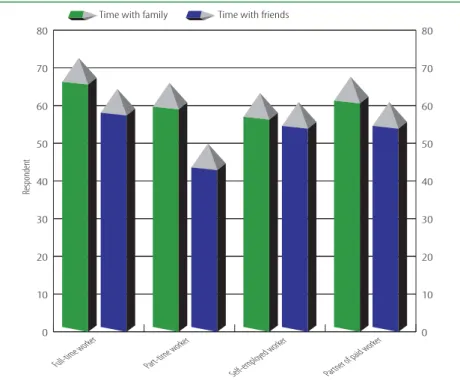
The survey results also give an insight into what ‘work-life balance’ means to people: it is principally about spending time with family and friends, but also about having the opportunity to pursue other activities and aspirations (see Figure 1). Findings also showed that people want to spend more time with families and friends regardless of the hours they work and whether or not they have young children. Nearly two-thirds (64%) of those without young children wanted to spend more time with their family.
The survey found evidence too to suggest that partners are becoming ‘increasingly demanding’. This confirmed the view expressed by Richard Reeves in The Work Foundation’s
0 10 20 30 40 50 60 70 80
0 10 20 30 40 50 60 70 80 Time with friends
Time with family
Partner of paid w orker Self-emplo
yed work er Part-time w
orker Full-time w
orker
Responden
t
report Dad's Army, that men are under increasing pressure from their working partners to participate more in
housework and childcare6. But what the current survey also
highlights is the demands made, by non-working partners, on paid workers. Over two-thirds of partners of paid workers (68%) agreed that they wanted their partner to spend more time with their family. And although both those in paid work and their unpaid partners agreed that friends were important, they had different priorities. Whilst over 20% of employed respondents strongly agreed that they wanted to spend more time with their friends, only 3% of partners of employed people felt strongly that this was important –suggesting that they have views on how that extra time should be spent: with the family.
2.2 Leisure activities
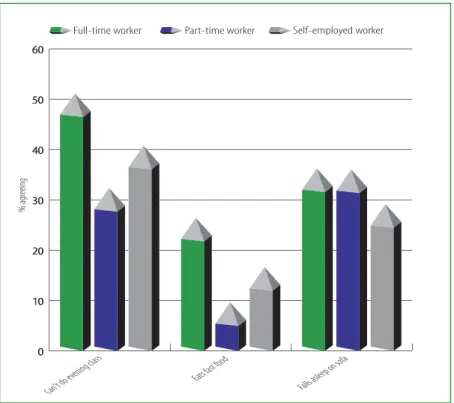
Paid work –particularly full-time paid work –is also having an impact upon people’s leisure activities and eating habits (see Figure 2). Over a third (36%) of full-time and part-time workers in our sample agree that ‘In the evenings I am so tired I just fall asleep on the sofa’. The fact that both full-time and part-full-time workers say this demonstrates that unpaid activities, such as housework and childcare, can be at least as exhausting as paid employment.
Those with children, particularly children under six, and those in high-level professional work are most likely to feel they lack time for evening classes or similar activities. Those with children are far more likely to eat healthily, however, and the group most likely to neglect their nutrition (and strongly agree that ‘in the evening I just eat fast food, pre-prepared meals and snacks because I don’t have time to
0 0 10 10 20 20 30 30 40 40 50 50 60 60
0 10 20 30 40 50 60
Self-employed worker
Falls asleep on sofa Eats fast food
Can't do ev ening class
% agr
eeing
Part-time worker Full-time worker
cook’) are young, single, high-level professionals without children –the ‘Marks & Spencer demographic’.
2.3 Household tasks
What Burggraf7(1998) calls the ‘two for one’ offer to
employers (the offer of a stay-at-home partner to do all the domestic work for every man employed in the workplace) is rapidly becoming a thing of the past. Women now make up almost 45% of the labour force8and in 1999 two-thirds
of UK couples with dependent children were both earning9.
But our survey findings simply provide the latest evidence that the household work has not been redistributed and that women tend to do a ‘double shift’–they have a double time squeeze.
Our survey found that women were over three and a half times more likely than men to strongly agree that they do most of the household tasks themselves, and over
twelve times more likely to strongly agree that they do most of the childcare. This tallies with other research suggesting that women spend nearly three hours a day doing unpaid work, including childcare and household chores, compared to men, who spend one hour and forty minutes a day doing these unpaid tasks10.
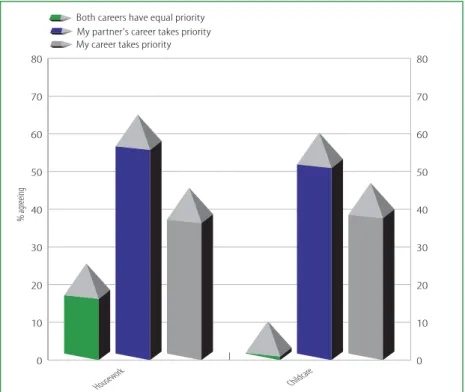
These figures tie in with the way in which earnings and career prioritisation influence which of two partners does the childcare and housework: see Figures 3 and 4.
Those earning the least in a household are the most likely to do the majority of the housework and childcare. Similarly, those whose career takes a lower priority are five times more likely than those whose career is the higher priority to say that they do most of the housework. Women continue to, on average, earn 81p for every average male £1, and this can also mean that their career is seen as a lower priority for the household. This means that the
0 10 20 30 40 50 60 70 80
0 10 20 30 40 50 60 70 80 Highest earner
Lowest earner Highest earner
Childcar e Housew
ork
% agr
eeing
Lowest earner Equal earners
existing tendency of women to take on the brunt of domestic responsibilities is reinforced by their increased likelihood to earn less and place less priority upon their career.
We should not be too dismayed; even after 40 years of social investment in Scandinavia, this unequal distribution of domestic labour is still a problem. But what’s really interesting is that the findings also suggest that those who have careers of equal priority and have similar earnings are more likely to share the childcare and housework than other households, and that this was more likely to happen in non-manual households. It is not just about gender; economic status makes a difference.
2.4 Another labour market: increasing
demand for domestic help
With so many people working long hours and struggling to
find time to spend with family and friends many people have ‘outsourced’ some domestic labour, enabling them to go out and earn money or give them that bit more time. One in ten respondents said that they employed someone to do the housework and nearly one in five (17%)
employed someone to look after their children.
People employing domestic help are overwhelmingly likely to be full-time or self-employed workers: three-fifths of those who employed someone to do the housework or look after their children were full-time workers and over a quarter were self-employed (see Figure 5). Those with partners who are not in paid employment are highly unlikely to employ someone else to do the domestic labour.
There is also another factor in whether people outsource domestic labour –and this is the support provided by family and community –an issue that may
0 10 20 30 40 50 60 70 80
0 10 20 30 40 50 60 70 80 Both careers have equal priority
My partner s career takes priority
Childcar e Housew
ork
% agr
eeing
My partner's career takes priority My career takes priority
vary according to region. A case study (see Appendix C, in separate PDF file) of a business owner who relocated from Kingston-upon-Thames to Buxton in Derbyshire
demonstrates that employees in London are far more likely to lack community and family support around them, and that this has an impact –both on their need for flexible working and on their need for employed help with domestic chores.
Our findings show that job type also influences whether people employ someone to help with domestic labour. Interestingly, although those in high-level professional work are three times as likely as those in manual work to employ someone to help with housework, there is much less difference when it comes to employing someone to help with childcare. 22% of high-level professional workers in our sample employ someone to help with childcare, compared to 13% of those in manual work. This may demonstrate the increasing importance of childcare to households where both partners are in work. This makes it even more concerning that although this ‘personal and protective’ service sector of childcare and housework has been growing steadily over the last thirty years, it is not nearly enough to meet the needs of the influx of women into the labour market. Across the UK, there is only one childcare place for every seven children under the age of eight and only one in ten employers helps their staff with childcare11. Research conducted by the
Women’s Unit has shown that a lack of available, accessible and affordable childcare, and a lack of work with suitable hours, to be influential factors in women’s decision to stay home12.
The reliance on domestic help throws up an interesting issue: many high-flying, well-paid people, particularly women, depend upon a mainly female workforce, often low paid, in order to be able to participate in their own well paid jobs. Indeed the wages of one group of women are being depressed to allow another group to advance theirs. What does this do to the childcarers’ work-life balance? The National Childcare Strategy is starting to work to raise the qualifications of childcarers and to widen recruitment, particularly to men. It is also starting to improve, and increase, childcare provision in different areas of the country. But further progress in high quality, affordable childcare remains crucial.
2.5 Employer support for work-life balance?
So with work-life balance rising up the agenda and a well-recognised term (Edwards & Burkitt, 2001)13, what do
employees now expect from their employers and what do they think of what they have been doing so far?
Flexibility has gradually improved over the last ten years, with the LSE/PSI survey showing that, for example, employers taking part in a flexible hours scheme have increased from 17% to 22%. And employers come out well in The Work Foundation’s survey, with three-fifths of full-time respondents agreeing that their employer would support parents and others being able to work flexibly. Part-time workers were even more enthusiastic, with three-quarters agreeing their employer supports parents and slightly fewer, 65%, agreeing their employer supports anyone working flexibly.
Interestingly it is those who are single and without dependents or who have a partner who stays at home to do the domestic labour who are most likely to be positive
Work status % employing % employing
someone for someone for
housework childcare
Full-time 59.6 64.5
Part-time 9.6 6.5
Self-employed 26.9 29.0
Partner of
paid worker 3.9 0.0
about their employers and agree that their employer supports parents being able to work flexibly. Those in families where both partners have paid work –i.e. those who may particularly need a great deal of flexibility from their employer –are less likely to comment as favourably on their employer’s work-life balance practices.
Perceptions about who work-life balance is for, and whether it is ‘just for parents’, are interesting. Over half of all respondents (54%) disagree that work-life balance should be, primarily, an issue for parents; and the proportion is greater among those under 55. Over a third (37%) of all respondents do, however, take the view that it’s just for parents, showing that this perception is still widespread. This is an important barrier to overcome in order for work-life balance to benefit organisations and individuals.
Perhaps because of a concern that work-life balance is for a particular group, employees still worry about the impact of flexible working upon their careers. Those in our sample whose career takes the highest priority in their household are the most likely to agree that reducing their hours would be the kiss of death for their careers (56%), particularly if they work in agriculture, retail and business. Career-minded individuals are also more likely to say they have too much work to do in their contracted hours (61%), particularly if they are full-time workers and work in the public sector.
2.6 Time sovereignty
An issue that runs through the survey responses, and illuminates further what ‘work-life balance’ means to people, is control over time. The survey suggests that people really value being able to determine their own hours –with the self-employed being the strongest example. As is traditional for those running their own business, over half (54%) agree that they work very long hours and a quarter agree that they have too much work to do in their ‘contracted’ hours. This is despite the fact that
nearly nine out of ten (88%) agree that ‘their employer’ allows anyone flexibility in the way that they work –more than those in part-time work (65%) and over one and a half times as many as those who are in full-time work. And, what is most striking, is that the self-employed are amongst the happiest with their work-life balance, with over one in five (22%) very content.
This strongly suggests that it is having control over their time, i.e. having flexibility to make choices about how they spend their time, that contributes to their contentment. This interpretation is supported by the fact that the only people happier than the self-employed are those who have chosen to restrict their hours, i.e. the part-time workers.
But what is so striking is that over two-fifths (41%) of the full-time workers agree that if they were given more control over their time they would be more productive –
compared to one in five part-time workers, who may be working shorter hours but clearly don’t feel this necessarily means that they’re in control. And, surprisingly, those who prioritise their career are far more likely to say that they would be more productive given more control over their hours. This may hint at frustration with long hours cultures that can require individuals to stay even if there is no need for them to do so. Which has implications that go to the heart of what ‘work-life balance’ means to all workers –not just parents or those with caring responsibilities –and how organisations should respond.
2.7 So what does ‘work-life balance’ mean?
Worker satisfaction has taken a pummelling over the last ten years. The LSE/PSI survey showed that on a number of measures, satisfaction had fallen dramatically. The biggest fall, however, has been in satisfaction with working hours –
followed by workload (which is often related)14.
But there is a possible contradiction in the survey. Many of those working the longest hours are the ones who love their work the most: these are, perhaps, the stalwarts of
long hours cultures and ‘presenteeism’, the very people who decry the relevance of ‘work-life balance’. And this contradiction can only be resolved by looking for the common theme that distinguishes the satisfied workers from the dissatisfied. And that theme is geniune autonomy over hours worked. Only a tenth of the UK workforce decide their own working time15, and even for those who
‘theoretically’ have autonomy, issues such as lack of childcare, low pay, workload and workplace culture may make it impossible for them to be able to determine how they manage their work. Lack of control is a huge contributor to stress.
This idea of autonomous working, called ‘time sovereignty’ by The Work Foundation16, may be key to
tackling the deep-seated problem of people wanting to change the way they work and live their lives. And it may bring a completely different meaning to the term ‘work-life balance’. Our findings suggest that achieving ‘work-life balance’ is about people having the opportunity to have some control over when, where and how they work so that they can pursue activities and aspirations as they wish.
It’s interesting that many organisations that praise the success of their work-life balance policies have gone down the route of autonomous working17. BT’s vision, for example,
is about ‘getting rid of as much bureaucracy and
unnecessary control as possible’. Caroline Waters, Director of People Networks at BT, defines work-life balance as follows:
‘Work-life balance is achieved when an individual’s right to a fulfilled life inside and outside work is accepted and respected as the norm to the mutual benefit of the individual, business and society.’
IXL Laundry Services Group enables people to work out their rota between them to ensure production is
completed on time and they can manage their other activities. And the case study presented in Appendix D demonstrates how another big organisation, Lloyds TSB, implements its work-life balance policy, with a detailed
examination of the approach to the needs of a Bristol-based business systems manager.
It is important to note that the other word used in the context of organisations’ approaches to work-life balance is ‘flexibility’, and equally important to note that working flexibly doesn’t necessarily mean you improve your work-life balance, as many people working flexibly may find themselves working at weekends and during evenings.
It is clear that our current lifestyles mean that many in the workplace, particularly women, are struggling to manage all their different responsibilities, and that this is starting to lead to the development of a dual female labour market. But are the pressures of a 24/7 society and this desire for better ‘work-life balance’ here to stay?
Demands for work-life balance have been steadily increasing: the Institute of Management’s annual Quality of Working Lifereport showed that in 2000, 32% of managers polled said home life was more important than work, compared with only a quarter who said this in 1997. Older workers also find they have shifting priorities, and as they progress towards their 60s they are far more likely to want to continue working for an organisation if they are offered greater flexibility and perhaps reduced hours18.
Younger workers coming into the labour market have also often been found to have different attitudes towards work from previous generations –an observation that may be often muttered under an older worker’s breath! Surveys do, however, back up the idea that different generations have different work ethics, with findings suggesting that members of the so-called ‘Generation X’ (born between 1965 and 1980) are far more likely to challenge
presenteeism and be reluctant to work as many long hours as their parents did19. Findings of a Work Foundation survey
conducted in 2001 concurred with this, showing that 80% of ‘Generation X’ would be more likely to stay in their jobs if
the employer allowed a good work-life balance20. And this is
not just because they’re ‘slackers’: a global survey of final year high-flying MBA students reported that 45% said a balanced lifestyle was a priority when they were choosing a future career, while 90% cited work-life balance as a key factor in determining commitment to their employer21.
Not only does this trend look set to continue as younger workers climb higher up the organisational hierarchies, but demographic trends look set to intensify the desire for a better ‘work-life balance’. Over the next ten years the recruitment pool will continue to change dramatically. Figure 6 lists some changes that look set to occur over the next 20 years.
There will be more working mothers: women will make up over half the employed workforce by 2006. And this doesn’t just mean that organisations need to get a lot smarter about recruiting and retaining the best female talent (although, of course, this is important from the point of view of both productivity and social justice). Men, too, are going to start needing to work different hours at different points in their career –if the US experience is
3. Britain in 2010
Ageing population z 12 million over 65s by 2021
z 2.7 workers to every 1 non-worker by 2020 (compared with 4:1 in 1990)·
z 3 million more workers aged over 35·
z 1.3 million fewer workers aged 25-35
Changing recruitment pool z Only 20% of workforce made up of white, able-bodied men under 45 years in full- ime
work in 2010·
z 80% of workforce growth to 2010 will be women·
z 8% of the workforce will be from an ethnic minority by 2030
Changing families: 2010 z 1 in 5 UK workers will be mothers·
z 1 in 10 children will be stepchildren·
z Single parent families will be 25% of all families·
z Average age of mother at birth of first child will be 28·
z 1.8 children per family
Eldercare z Up to 10 million people will be caring for elderly relatives
Figure 6: Britain over the next 20 years
anything to go by, as househusbands are on the increase22.
Are organisations going to exclude all those who wish to spend more time with family and friends –at least a third of people, just according to this survey?
There will also be fewer young people entering the labour market, and more and more people with eldercare responsibilities which are starting to bite. In our survey, those with eldercare responsibilities were four times more likely to say that they found it difficult to cope with their job because of their domestic responsibilities. And eldercare is on the increase.
The ‘goldfish syndrome’ that seems to afflict
organisations when recessions start to bite also needs to stop. Time after time, organisations find that if they get rid of experienced –more expensive –team members during difficult times, they are left with a more inexperienced team that is not necessarily well-equipped to deliver the high standard of service they need24. And the cost of re-hiring
people when the recession is over –or a job can’t be done without them –doesn’t bear thinking about. Organisations need to start thinking much more cleverly about how to retain older workers, perhaps at lower cost. When research suggests that they would be happy to stay on if provided with a flexible working package, business sense suggests that work-life balance policies will continue to increase in importance as the decade advances.
People, perhaps particularly working women, are feeling a time-squeeze, despite the advances that work-life balance campaigns and policies have made so far. They want more control over their time and to have a better ‘work-life balance’. Despite isolated good practice and perceptions that employers would support people working flexibly, somehow people are not taking up the policies. The demographics show that this is not going to go away; organisations cannot sustain this way of working to 2010. So something has to change.
4.1 The existing business case
The current focus is on organisations being persuaded to change by the long-standing business case for work-life balance. Many organisations, such as Pricewaterhouse-Coopers (PwC), have found that work-life balance policies are beneficial, and can lead to cost savings, improved motivation and higher productivity. In PwC’s words:
‘At PricewaterhouseCoopers we firmly believe that promoting work-life balance is a “business critical” issue and not simply the “right thing to do”.’
The key benefits perceived by organisations are set out in the box opposite (and in more detail in the appendices):
These benefits make a compelling case for the importance of work-life balance –both to the bottom line and to the way that organisations work. But having a business case and some initiatives is not enough: to realise these advantages, organisations need to move beyond simply creating beautifully crafted policies and initiatives –
generally a route map for change –to tackling some of the barriers stacked up against achieving the change needed to reap the benefits of work-life balance.
4.2 Ringing the changes
Change is not easy: the regularity with which general organisational change programmes, touted as ‘changing the way we work’, fizzle into history, becoming just more
failed initiatives, demonstrates the difficulty of changing workplace cultures. The barriers that are hardest to overcome, and yet the most important, are cultural and attitudinal: research on change programmes shows that the main obstacle to successful change is employee resistance at all levels (frontline, middle and senior
management25). There are good reasons for such resistance:
employees tend to resist because of a lack of
understanding of the change, comfort with the way things are and fear of the unknown, while middle managers fear they will lose control and be overloaded with work26.
Work-life balance, a strong challenge to many
workplace cultures, is no exception to this resistance –also for good reasons. Research done by the Institute of Employment Studies27has looked at bridging the gap
between policies offered and take-up, and found that there were a number of reasons why workers felt unable to take advantage of organisational work-life policies, including:
z Wages –many, particularly low-paid workers, cannot afford the reduction in wages required by many flexible working practices.
z Workload –a large volume of work can make it difficult to work reduced hours or adopt alternative work patterns.
z Reliance on individuals –employers may want individuals to work out what would work best, when they may be unaware of available options or feel unable to suggest the changes.
z Career progression –many may worry that flexible working will be seen as a sign of lack of commitment.
z Long hours –workplace cultures may belie the policies, with workers feeling that they would not be supported if they did take advantage of them.
As, in practice, work-life balance policies are also principally taken up by mothers, there is also a problem of them being perceived as a ‘mommy track’, just for women. Clearly, cultural and attitudinal problems with work-life balance are enormous –and many of the cultures are
based in ideas at the heart of what organisations are for. For example, PwC is an organisation committed to good customer service, and has sought to tackle the long hours culture that often goes with that:
‘Essential ingredients of our sustained success are our organisational culture of commitment to high quality client service, and the fact that our people are highly self-motivated and tend to set themselves very high standards.28’
Many organisations with strong work-life balance policies recognise this and have attempted to tackle the underlying barriers to take-up. Lloyds TSB sees their work-life balance policies as not just being about ‘helping the
bank to meet its core strategic aims’ but also:‘about moving from a “long hours culture”, where attendance matters more than achievement, to an environment where people are valued for the results they deliver and the competencies they
demonstrate….culture change is a gradual process because attitudes just don’t alter overnight. But as more people use the scheme and as managers see the real benefits, flexible working is increasingly seen as an effective tool for everyone.29’
And BT is very clear that the benefits outweigh the difficulty of overcoming these barriers to change:
‘As with any change, there have been barriers, but these are mostly attitudinal and, compared to the benefits, are
The business case
Recruitment and retention
z Wider talent pool: PwC argues that work-life balance policies are an essential ingredient of successful recruitment and retention strategies.
z Employer of choice:Lloyds TSB believes that flexible working is a 'powerful tool to support the motivation and
commitment of its people that really contributes to its goal of becoming 'employer of choice'. This is particularly because the scheme is open to all employees who can make a business case, regardless of their reason for wanting to work flexibly.
z Retention:98% of women who leave BT for maternity leave now come back, saving over £3 million in recruitment and induction costs alone. And at IXL Laundry, office staff turnover, which has previously been considerable, has been reduced to 0% this year so far.
Productivity and reward
z Improved performance:PwC believes long hours do not necessarily equate to commitment or productivity, and at LloydsTSB over 80% on the Work Options work-life balance scheme believed flexible working improved their
performance (almost 90% of their managers endorsed this). BT homeworker productivity is up by 31% so far.
z Output focus:the association of reward with output rather
than with attendance at BT has resulted in the average participant in their 'Self Motivated Team' project working fewer hours whilst being more productive and earning more money.
Product development and marketing
z Product development:BT's way of working has allowed new flexible working products to be developed, such as
technology facilitating working from home. It also means that it is demonstrating the capability of its own products, showing the 'business and societal benefits of harnessing technology to deliver greater flexibility'.
Reduced overheads
z Lower accommodation and travel costs:technology has facilitated over 7,000 BT people working at home and not needing to travel into the office.
Flexible workforce
z Reduced absenteeism:in BT absenteeism is down to 3.1%, compared to a UK average of 8.5%.
z Flexibility:it's easier to deploy people to cover absence when shifts are flexible.
Customer benefits
z Continuity: better retention means greater continuity of service and, often, better customer retention.
insignificant. Attitudinal barriers were overcome by making our policies available to everyone, stressing the business and bottom line impacts of productivity and retention gains and by asking converted managers to convince their peers.30’
If work-life balance policies are in demand and look set to continue to become more important, then they need to work and to offer everyone a valid alternative way of working. And for them to be really effective, they need to change workplace cultures, address issues about wages, and change expectations about the way that men and women should work31–requiring far more than a few
policies added on to a culture that rejects the idea that commitment and leaving the office on time can go hand in hand. Work-life balance is thus about changing far more than recruitment and retention practices –it goes to the heart of having a different way of working.
4.3 Linking change with work-life balance
Work pioneered in the United States by Rhona Rapoport and Lotte Bailyn suggests that work-life balance could be an organisational lever to sell change to employees and managers. Their studies argue that work-life balance and organisational change can be linked through the oldest incentive in the book –‘something in it for me’.
Organisations need to change in response to external imperatives, such as changing consumer demand and the 24/7 society, and they need to respond to demands for better work-life balance from employees. So Rhona Rapoport and Lotte Bailyn suggest they do both32. As they
argue, people want to be effective anyway, and if there is a personal pay-off in achieving organisational goals then there is an even more powerful incentive to make those changes. They conducted pilots in Xerox, Corning and Tandem Computers which encouraged teams to focus on how they can simultaneously improve both their
performance and their work-life balance –and found a great deal of innovative thinking. Different ways of working
that improved the customer experience as well as work-life balance were set up. In many cases they identified key strategic issues and worked well: Xerox has stated that it was ‘proud to have been on the ground floor of this seminal research’. Interestingly, many problems that arose in the pilots were because organisations did not support the changes effectively or support middle managers in dealing with them –both problems in change programmes.
Successful examples of ‘doing both’, of improving both effectiveness and work-life balance, have also been pioneered in the UK. PwC have been among the first organisations to try to use the lessons learned from Rhona Rapoport’s work to institute change in the UK. Their project aims to:‘achieve a more equitable workplace, improve effectiveness in the way people work and ensure that people have a happier, more conducive working environment to encourage them to work more productively.’
Most of the work is being carried out by Flametree, a specialist work-life balance consultancy business, and, as at May 2003, recommendations have just been made. These range from strategic and high-level –restructuring, for example –to more tactical solutions looking at specific issues. PwC are clear, however, that because everyone involved in changing has been consulted and has helped create what will happen, people will engage in the change
–because they know what to expect and what they will gain. This is a hot-off-the-press study: recommendations do not go into action until July 2003, so updates on success will need to follow.
4.4 About time for change
One study which operates on similar principles has been completed and has been a great success. Recognising that society is becoming more ‘24/7’, and that people can’t necessarily access public services between 9.00am and 5.00pm (because they’re working too), the government has committed itself to widening access to public services. This
means changing working hours and working practices across public services –and the Inland Revenue in Sussex have been at the forefront of this initiative.
Working with their main unions (PCS and USRO), together with the TUC, the Inland Revenue in Sussex used time as a reward for people changing their working hours and practices. Although this was at a time of industrial dispute, consulting staff and making sure that the final way of working was good for the business and the employees meant that positive results were achieved for both customer service and individuals’ work-life balance. The Inland Revenue are now opening later and are open six days a week, due to higher customer numbers from those needing help with tax issues, and individuals feel more in control of their own working patterns –a success that may well be replicated beyond Sussex.
4.5 Beyond the business case?
There are some powerful arguments for bottom line benefits of work-life balance policies. But it is interesting to contrast the continued government and organisational insistence on the validity of business case for work-life balance, with government and organisational approaches to other human resource policies. A topical example of this contrast is executive pay. Most FTSE 100 firms cannot prove that high pay improves profit (indeed the opposite may be more likely), and yet it is a strategy pursued by many organisations. Why is it that there is no insistence upon a business case for high executive pay but that work-life balance, which is about individuals being able to manage all their different responsibilities and aspirations, is continually required to prove its economic worth?
Research done by Roper, Cunningham and James (2002)33, looking at HR specialists’ views on the regulatory
provisions introduced by the government, suggests that they do not always rate the business case argument. Many thought that, for example, the new flexible working
provisions enabling those with children under six to have the right to work flexibly, would have a negative impact on their organisations. Where support was expressed, it was generally on the grounds of improved social justice rather than on the grounds that regulations would be good for business. This research concludes that employment is more likely to be made family-friendly through an emphasis on a ‘social justice and rights-based approach to the issue’.
This is an approach counter to that of the government
– but the government could be missing the point. In Scandinavia, nobody demands proof about the tangible benefits of work-life policies –they are seen as being about social investment. Shouldn’t the government be aiming to progress the debates beyond the business case to the social case? Some organisations, such as ICI, argue that work-life balance only needs to be cost-neutral. They also argue that work-life balance practices are favoured by some investors and analysts.
Research being conducted by Rhona Rapoport, Sue Lewis and Richenda Gambles34is trying to take a historical
perspective and look at why work-life debates have stalled in the past. They are finding that a major barrier to success is the failure to look at the context for work-life debates –
the way men’s and women’s roles are changing, for example. Their work suggests that, by linking the social context and the social case for change with the business case, work-life policies would become more successful and more beneficial to individuals, organisations and society.
Work-life balance has a strong business case but, beyond that, it is the right thing to do for society and equity. It’s time that the government started to
acknowledge and celebrate that. After all, corporate social responsibility is rising up the corporate agenda primarily because customers feel it is ‘the right thing for
organisations to do’; organisations should be socially responsible. Why can’t it be the same for work-life balance?
‘I think what we all need to wake up to is that we’ve got the best educated, most aspirational workforce that we’ve ever had as a generation of workers in Britain and they don’t want jobs at any price.They want jobs that are satisfying, that give them the opportunity to progress at work and to fulfil their ambitions, and I think both business and unions need to start taking account of that in the way that we organise work, in the way that we think about what it is we make, what it is we do.’
Frances O’Grady, TUC
Work-life balance debates have progressed rapidly and are changing people’s lives gradually. But they need to keep progressing: over a third of people think they are policies just for parents, undermining the wider relevance of work-life balance and misunderstanding what it is for. Work-work-life balance is about living a fulfilled life inside and outside paid work, having control over your time so you can achieve that. Despite the increased profile of work-life balance, most workers still face a time squeeze, women are still bearing the brunt of domestic labour and a new low-paid female labour market is being created to prop up the way we’re working. It’s not sustainable.
Work-life balance policies currently benefit many organisations –but many have policies that are not helping their workforce or their organisation. Policies tagged onto organisations will sit at the edges, not adding the value they could, not improving employee work-life balance, not touching equity issues. However, by putting work-life at the heart of an organisational strategy, and reflecting wider social shifts towards a 24/7 society and employee needs, organisations can use work-life balance as a powerful lever for change on a range of levels. Organisations that can catch up with the 21st century, with women being in paid work, and with the fact that a 24/7 life doesn’t have to mean 24/7 working, can gain competitive advantage. But these policies are also about social equity, and future work-life balance debates in organisations need to shift the focus
away from proving the business case towards recognising importance of the social benefits.
Work-life balance has always been about changing and challenging the way we work. Its future is in making work better for organisations and for employees.
1. Paoli, P and Merllie, D (2001) Third European Survey on Working Conditions 2000, European Foundation for the Improvement of Living and Working Conditions. 2. LSE/PSI (2002) Working in Britain Survey.
3. Managing Best Practice No 83 (2001) Occupational Stress, The Work Foundation.
4. See www.employersforwork-lifebalance.org.uk and Taylor, R, (2002) The Future of Work-Life Balance, ESRC.
5. A telephone poll of 500 men and women conducted between April and May 2003 by IFF.
6. Reeves, R (2002) Dads’ Army: the Case for Father-Friendly Workplaces, The Work Foundation.
7. Burggraf, S (1998) The Feminine Economic and Economic Man, Perseus Books.
8. Labour Force Survey, 2002.
9. General Household Survey, Office for National Statistics. 10. UK 2000 Time Use Survey, Office for National Statistics. 11. See Daycare Trust at www.daycaretrust.org.uk
12. Although the National Childcare Strategy continues to create new childcare places, with an investment of £200 million, 70% of working women with dependent children have informal arrangements for all or part of their childcare (Parents’ Demand for Childcare, DfEE, 2000). Also see Women’s Attitudes to Combining Paid Work and Family Life, The Women’s Unit, 1998
13. Edwards, L and Burkitt, N (2001) Wanting More from Work? Expectations and Aspirations of People in Low and Middle Paid Employment DfEE/IPPR.
14. LSE/PSI (2002) Working In Britain Survey. 15. LSE/PSI (2002) Working In Britain Survey.
16. Doyle, J and Reeves, R (2001) Time Out: the Case for Time Sovereignty, The Work Foundation.
17. See Appendix D.
18. See, for example, Lloyds TSB Private Banking Survey 2003, or www.efa.org.uk
19. Tulgan, B (1995) Managing Generation X, Merritt Publishing.
20. Stop watching the clock - it's time to get flexible, Industrial Society press release, 14 September 2001. 21. International Student Survey Report, Coopers and Lybrand, 1997.
22.‘America’s alpha career women leave men at the kitchen sink’, The Observer, 18 May 2003.
23. Department for Work and Pensions, 2001. 24. Innovating for the Upturn, Accenture, 2002.
25. Best Practices in Change Management Report, 2003 see www.prosci.com
26. Ibid
27. Harper, H, Kodz, J and Dench, S (2002) Work-Life Balance: Beyond the Rhetoric, IES Report 384.
28. Appendix E 29. Appendix D 30. Appendix A
31. Rapoport, R et al (2002) Beyond Work-Family Balance: Advancing Gender Equity and Workplace Performance, Jossey-Bass.
32. Ibid
33. Roper, I, Cunningham, I and James, P (2002) Assessing the Government's Approach to Family-Friendly Policies. Presented to Society for the Advancement of Socio-Economics Annual Conference, Minneapolis, 27-30 June, 2002.
34. Lewis, S, Rapoport, R, and Gambles, R (May 2003) ‘Reflections on the Integration of Paid Work with the Rest of Life’, presented to the ESRC Seminar series on Work, life and time in the new economy.
Appendix A: BT
Appendix B: Inland Revenue
Appendix C: IXL Laundry Services
Appendix D: Lloyds TSB
Appendix E: PricewaterhouseCoopers
Appendices
ii
v
viii
x
xiv
Published by The Work Foundation in association with Employers for Work-life Balance Registered as a charity no: 290003
First published June 2003
All rights reserved. No part of this publication may be reproduced, stored in a retrieval system or transmitted, in any form or by any means, electronic, mechanical, photocopying, recording and/or otherwise without the prior written permission of the publishers. This publication may not be lent, resold, hired out or otherwise disposed of by way of trade in any form, binding or cover other than that in which is is published, without the prior consent of the publishers.
Improving work-life balance
through technology
* All figures are based on the financial year ending 31 March 2003.
The company
Turnover: £18,727 million
Pre-tax profit: £1,829 million
Workforce
No. of employees: 93,755
% female 23.6
% ethnic minorities: 8.6
% turnover: 3.0
% women returning
after maternity leave 98.0
The problems
The global challenge:Using technological advances to ensure that BT’s extensive workforce best delivers its range of telecommunications, internet and IT services locally, nationally and internationally to 21 million customers.
The cultural challenge:Evolving work-life balance from an individual’s desire to reduce their working hours, to empowering all employees to make choices about where, how and when they work.
Breaking down barriers within the company between departments, functions and colleagues; thus reducing bureaucracy and hierarchical systems.
Response
Creating an ‘e-BT’:BT has harnessed communications tech-nology to transform the way the company runs, moving from a more static, office-based workforce to an ‘e-BT’ of employees who work flexibly and/or from home.
Equipping people with access to the information necessary to do their jobs seems obvious, but prior to eBT much of the information was not available to people where they were working. Often engineers had to leave customer premises to find the information they needed, wasting time and decreasing customer satisfaction. Providing employees with online, real-time access to information not only increased productivity, it also increased sales, customer sat-isfaction and enabled flexible working. BT now has:
z 7,000 home workers of whom 24% are female
z 650 job sharers
z 6,600 part-time workers
BT has used its own technological products and servic-es to effect this change: BT broadband, for instance, is used by employees at home, in the office, at a customer compa-ny or while travelling.
Business benefits
More talented workforce:
z Surveys show that people want to work for companies with a sound work-life balance ethos, so BT can draw from a wide talent pool.
z Flexible work options, welfare-to-work initiatives and new technologies (such as ‘typetalk’) attract people traditionally under-represented in the UK workforce, such as disabled people and carers.
More flexible and responsive workforce:
z Improved retention: natural attrition is now only 3% of the workforce.
Reduced recruitment and training costs:
z 98% of women return to BT after maternity leave, saving £3 million in recruitment and induction costs.
Reduced absenteeism:
average of 8.5%.
Increased productivity:
z BT’s ‘Self-Motivated Team’ project, involving around 6,000 employees, associates reward with output rather than attendance –participants now work fewer hours and are more productive.
z 7,000 BT employees now work from home with productivity gains of 31%.
Happier customers:
z Flexible working arrangements mean that BT can respond to customer demand 24/7.
z Customer and employee feedback shows increases in customer satisfaction (8%), and employee ‘happiness’ (14%).
Reduced overheads:
z It costs £2,000 to set up a homeworker, while each desk not used saves £6,000 per annum. This equates to a £52 million saving per year.
z More home workers mean an annual £10 million saving in fuel costs along with associated benefits of reduced congestion and pollution.
Other cost savings:
z Sold newly rationalised property portfolio on lease-back, releasing £2.38 billion into the business.
In practice
Case 1
Carole Stenson, Customer Service Engineer,has worked for BT for 15 years. After having two children now aged three and one, she went from full-time to part-time working.
z While on maternity leave with her first child, he became ill with meningitis. Carole was able to get extended unpaid leave to look after him.
z Carole’s partner encouraged her to leave BT and look after their children full-time. She approached her line manager about the possibility of working part-time and this was agreed.
z She started working for BT on Thursdays and Fridays. Carole then changed her working days to Fridays and Saturdays, enabling her partner to take care of the children on Saturdays and reduced childminder costs.
z Carole plans to return to full-time working when both her children start school.
Carole says:‘If I’d carried on working full-time I wouldn’t have experienced those special moments with my children.’
Benefit to BT:Carole's skills and extensive corporate knowledge have been retained.
Case 2
Paul Blacker, Head of BT Strategy, BTOpenworld, has worked for BT for 22 years. Married with three children aged five, three and three months, he works variable hours.
Paul began a role abroad but found it too stressful with his family in the UK. He was able to apply for and return to a job in the UK.
with his family was being eroded. He wanted more flexi-bility. Paul now varies the hours he works: he often starts work very early but takes time off later in the day.
Paul says:‘My work-life balance is much more harmo-nious since my return to the UK. Flexible working enables us to have regular “special days” for our children.’ Benefit to BT:BT has retained a high-profile employee by demonstrating its commitment to flexible working prac-tices for men as well as women.
Case 3
Ian Fowlerhas worked for BT for 30 years and is married with an 18-year-old son. Ian started his career with BT as an Apprentice Engineer.
After doing jury service, Ian became very interested in the law and became a magistrate. Ian talked to his line manager and HR and has worked full-time from home for the past three years.
Ian says:‘I love the flexibility that home working gives me to pursue my duties as a magistrate, as I have to be in court for 35 sittings a year. I can’t see myself going back to an office.’
Benefit to BT:BT has retained a long-serving employee by accommodating his interests and needs, and saved overhead costs.
Challenges
The way people work is changing and for many employees is now completely different to how they worked only a few years ago. Management practices now have to change. The UK workforce is one of the most flexible and is adapting to the new environment. The UK’s management population now needs to do likewise.
The future
In the UK more and more families are dependent on more than one wage earner in the household. This means that families need employment that enables them to both earn and undertake their other responsibilities. Employers need to create employment models which enable everyone to contribute to their success while also succeeding in their personal lives –which means focusing more on contribu-tion and less on geography, hierarchy and time.
© © BT
Appendix B: Inland Revenue and Public and
Commercial Services Union
OurTime –
a work-life balance project
The company
The Inland Revenue is responsible for the administration of direct taxes plus tax credits, child benefit, national insurance contributions and stamp duties together with the collec-tion of student loans and Nacollec-tional Minimum Wage enforce-ment. It has around 37 million customers and handles a yearly tax income of around £220 billion.
The Public and Commercial Services union (PCS) is the largest civil services union, with 280,000 members. PCS rep-resents 93% of Inland Revenue employees.
Workforce
The Inland Revenue has offices throughout the UK..
z No. of employees: 70,000
z % female: 64%
The problem
The Inland Revenue needed to extend its opening hours to the public, while helping staff to retain a good balance between work and personal life.
Response
The OurTime project was a partnership between PCS and the Inland Revenue, with support from the TUC. Working together, union and management explored ways to give people more options for their working hours, at the same time as allowing the business to open beyond core hours.
z Surveys and focus groups were run to establish what staff wanted before matching staff and business needs.
z Three pilot studies were then established. An enquiry centre and telephone team pilot tested scope for
extending opening to volunteers. The third pilot, in the Risk, Intelligence and Analysis team, tested the mutual benefit of increased flexibility for staff where there were no external customer interfaces. They tested a variety of flexible
working arrangements including variable core time, personal core time, no core time, compressed working week/fortnight and banking time.
z Three training packages were commissioned from specialists and tested in the trial offices. The three packages helped managers managing a flexible workforce, team members work together more effectively, and the Inland Revenue organise work for flexibility and security.
Take-up and outcomes
Take-up was very good, especially once staff saw the practi-cal benefits of flexible working enjoyed by their colleagues. The project was successful both locally and nationally. Locally
The project helped to develop trust between employee and employer, and to strengthen links with the community. Staff were given the flexibility to better manage their work-life balance. Customers received an extended service. Nationally
The wider impact of the project was to create a model process which could act as a template for the rest of the Inland Revenue, and indeed a wider audience. A resource information package,‘OurTime’ was produced based on the process used, including:
z three specially commissioned training packages which can be used by any public sector organisation
z a new handbook on flexible options for staff
z a booklet on how to set up a learning access point as part of a work-life balance initiative
z a CD ROM containing a staff survey on working time preferences, information on how to run staff focus groups, and ground rules for running a pilot.
While by no means definitive, it will provide insights to organisations addressing work-life balance, and may help those using the Investors in People work-life balance model.
Business benefits
Helping staff to juggle their commitments:
z Possible to reduce absences
z Improve staff morale
z Better able to cover peak times (ie, staffing profile matches customer demand).
Recognising diversity:
z Wider pool for recruitment
z Better reflection of customer base
z Staff with broader experience.
Extending or improving customer access:
z Customers have choice of access
z Better informed customers lead to less reworking
z Smoothing of business peaks
Becoming an employer of choice:
z Recruitment of quality staff
z Retention of staff
z Reduced recruitment and training costs due to less wastage
z Improvement of profile in community.
Making better use of IT or accommodation:
z Lower unit costs
z More money for existing services
Challenges: what to watch for
Partnership working
z Tensions (regional and local; unions and management)
z Right people on the project board
z People resorting to set piece management/union confrontation
z Setting realistic timeframes
Top tips:
z Take time at the start to talk to partners
z Ensure each person can contribute
z Examine issues that might give each side a problem
z Start with quick wins
Planning and control
z Role conflict on project board
z Different views on project management
z Being too inflexible with your plan
z Misjudging resources. When? How long? Who? What?
Top tips:
z Ensure project members appreciate holistic nature of work-life balance
z Appoint a project manager
z Be open to creative thinking and new ideas. Test these.
z Review milestones and timescales at each meeting.
Funding
z Getting this right at the start or you will lose valuable time!
z Getting promises of funds in writing
z Financial propriety rules
z Problems in tracking progress
Top tips:
z Appoint someone to be accountable and set clear guidelines
z Be clear about any conditions
z Explore flexibility of each partner’s funding and use the more flexible for innovative expenditure.
z Set in place clear audit trails and monitor budget
The future
The Inland Revenue is considering extending the OurTime project to branches across the country. The OurTime pack has been adopted by a number of companies as template for introducing flexible working in their organisation.
©
In practice
Julie Barnes is an employee in the Inland Revenue Corporate Services in South East England. She is married with twin girls aged six. She collected ‘flexi-credits’ toward time off for childcare by working Saturday mornings.
Case 1
Julie wanted to find a way to spend more time with her children over the summer holidays. By working one Saturday per month as a receptionist in the Inland Revenue's enquiry centre, she is able to bank flexi-credits towards time off in August. Time banking means she was able to collect flexi credits greater than the current 18 hour maximum.
Julie says:‘I haven’t got any childcare problems this summer, and I won’t have to pay a childminder.’
Benefit to Inland Revenue:The Inland Revenue can extend its opening hours and provide a face-to-face customer service on Saturday. Julie is a happier employee and as such her productivity and quality of work have improved.
Case 2
Des Dugmore is an employee in the Inland Revenue’s Risk and Intelligence Analysis Service in Brighton. He commutes to work from Burgess Hill every-day by bus. He compressed his working fortnight to reduce travel time.
Des looked at the flexible working options on offer and decided to try a compressed working fortnight. This involved working 74 hours in 9 days leaving the 10th day free. Or to put it another way, an additional 24 days off on top of his annual leave.
Des says:‘I save about an hour and a half in travelling time. I have more time to be at home, go shopping, watch films, potter in the garden or go away for long weekends.’
Benefit to Inland Revenue:Des has proved that he can still deliver results for the Inland Revenue while increasing work-life balance: everyone is a winner.
Improving work-life balance
in a small business
The company
IXL, based in Buxton, Derbyshire and with a depot in Chester, provides laundry and dry cleaning services to domestic and contract clients in the Midlands and North Wales. The owners previously sold another business, Classic Cleaners, in March 2002, having bought IXL in October 2001. Annual turnover is £750,000.
Workforce
The company has few young employees. Three employees have been with IXL for over 25 years; the longest serving member of staff for 38 years. The turnover of factory staff and drivers has always been low. The company usually has no more than one member of staff on maternity leave at any one time.
z No. of employees: 20
z % female: 75
z Average length of service: 10 years (for 50% of staff ) (All figures are based on the year ending March 2002.)
The problems
z High turnover of office staff:Staff and systems were inherited when the owners bought IXL. The owners recognised that that some systems were outdated and bureaucratic.
z Traditional culture:Flexible working options are still rare in many SMEs outside London. Apart from women with children, most employees are unused to weighing up work-life benefits when applying for jobs.
Response
Simple, informal work-life approach:
z IXL has an ‘open door’ policy
z Any employee can make a request to work flexible
hours
z The business case is paramount; not the personal reason for the request
z Managers need to take into account the production schedule in the factory and overall employee cover and attendance
z Part-time jobs were introduced: when some office vacancies arise, they are re-advertised as two part-time roles at 20 hours per week
Business benefits
z Staff retention and loyalty:
z Low cost of implementation:
o Work-life policies cost only management time to implement
z Reduced recruitment and training costs:
o The turnover of office staff has been reduced
z More efficient office systems:
o New part-time office roles enabled IXL to introduce more efficient systems over time
Challenges
Factory production requirements:
z Work-life initiatives have to revolve around an understanding of weekly and monthly production requirements.
z Employees are encouraged to work out rotas among themselves that ensure production is completed on time, while accommodating individuals' personal commitments.
z Drivers and factory workers start at 7.30am and finish at 4.00pm or 3.00pm on Fridays: this timetable leaves sufficient time for personal commitments.
z Office staff can work more flexible hours: they can start early and/or work late.
Employees motivated more by salary:
factory jobs.
z Family support is traditionally strong: grandparents expect to look after grandchildren whilst their sons and daughters are at work.
z IXL’s workforce tends to be older, therefore fewer staff than the national average have childcare responsibilities.
z Potential recruits are therefore motivated more by salary than work-life balance policies.
Entrenched attitudes as a barrier to change:
z Some office staff were not prepared to learn the new systems and chose to leave
©
© IXL Laundry Services
In practice
Case 1
Kathleen Ash, 48, has recently started a job with IXL as a part-time bookkeeper.
z Kathleen keeps horses and needs to feed them in the morning before work.
z Office hours are 9.00am to 5.00pm, but Kathleen negotiated to start work at 9.45am before she joined.
Kathleen says:‘I appreciate the flexibility I have in starting later. IXL is changing computer systems and accounting packages. I’ve often worked longer hours to ensure a smooth transition of the system.’
Benefit to IXL:Agreeing to Kathleen’s request has helped engender a spirit of co-operation, which benefits the business and the bottom line.
Case 2
Anna Travis, 36, has recently started a job with IXL as a secretary working two and a half days per week.
z Anna has three children and needs to get to two different schools and a nursery, which are several miles apart, before work.
z Anna negotiated to start work at 9.15am, to allow for the extra time needed to cover the distances.
Anna says:‘The flexibility in starting times and a shorter lunch, if required, is a huge benefit as it means travelling through lighter traffic and being able to deliver all three children to their destinations calmly and safely. I don’t have the worry of being five minutes late as I know I can make the time up at lunch or after work.’
Benefit to IXL:IXL has gained Anna’s skills and ensured she has the flexibility to manage her work and her other commitments.