Streaming Submodular Maximization:
Massive Data Summarization on the Fly
Ashwinkumar Badanidiyuru
Cornell Unversity
[email protected]
Baharan Mirzasoleiman
ETH Zurich[email protected]
Amin Karbasi
ETH Zurich Yale University[email protected]
Andreas Krause
ETH Zurich
[email protected]
ABSTRACT
How can one summarize a massive data set “on the fly”, i.e., without even having seen it in its entirety? In this paper, we address the problem of extracting representative elements from a large stream of data. I.e., we would like to select a subset of sayk data points from the stream that are most representative according to some objective function. Many natural notions of “representativeness” satisfy submodular-ity, an intuitive notion of diminishing returns. Thus, such problems can be reduced to maximizing a submodular set function subject to a cardinality constraint. Classical ap-proaches to submodular maximization require full access to the data set. We develop the first efficient streaming algo-rithm with constant factor 1/2−ε approximation guaran-tee to the optimum solution, requiring only a single pass through the data, and memory independent of data size. In our experiments, we extensively evaluate the effectiveness of our approach on several applications, including training large-scale kernel methods and exemplar-based clustering, on millions of data points. We observe that our streaming method, while achieving practically the same utility value, runs about 100 times faster than previous work.
Categories and Subject Descriptors
H.2.8 [Database Management]: Database applications—
Data mining
Keywords
Submodular functions; Streaming algorithms
1.
INTRODUCTION
The unprecedented growth in modern datasets – coming from different sources and modalities such as images, videos, sensor data, social networks, etc. – demands novel tech-niques that extract useful information from massive data, while still remaining computationally tractable. One
com-Permission to make digital or hard copies of all or part of this work for personal or classroom use is granted without fee provided that copies are not made or distributed for profit or commercial advantage and that copies bear this notice and the full citation on the first page. Copyrights for components of this work owned by others than the author(s) must be honored. Abstracting with credit is permitted. To copy otherwise, or republish, to post on servers or to redistribute to lists, requires prior specific permission and/or a fee. Request permissions from [email protected].
KDD’14,August 24–27, 2014, New York, NY, USA.
Copyright is held by the owner/author(s). Publication rights licensed to ACM. ACM 978-1-4503-2956-9/14/08 ...$15.00.
http://dx.doi.org/10.1145/2623330.2623637.
pelling approach that has gained a lot of interest in recent years isdata summarization: selecting representative subsets of manageable size out of large data sets. Applications range from exemplar-based clustering [8], to document [23, 7] and corpus summarization [33], to recommender systems [10, 9], just to name a few. A systematic way for data summariza-tion, used in all the aforementioned applications, is to turn the problem into selecting a subset of data elements opti-mizing a utility function that quantifies “representativeness” of the selected set. Often-times, these objective functions satisfysubmodularity, an intuitive notion of diminishing re-turns (c.f., [27]), stating that selecting any given element earlier helps more than selecting it later. Thus, many prob-lems in data summarization require maximizing submodular set functions subject to cardinality constraints [14, 18], and big data means we have to solve this problem at scale.
Submodularity is a property of set functions with deep theoretical and practical consequences. The seminal result of Nemhauser et al. [27], that has been of great importance in data mining, is that a simple greedy algorithm produces so-lutions competitive with the optimal (intractable) solution. This greedy algorithm starts with the empty set, and iter-atively locates the element with maximal marginal benefit (increasing the utility the most over the elements picked so far). This greedy algorithm (and other standard algorithms for submodular optimization), however, unfortunately re-quiresrandom accessto the data. Hence, while it can easily be applied if the data fits in main memory, it is impractical for data residing on disk, or arriving over time at a fast pace. In many domains, data volumes are increasing faster than the ability of individual computers to store them in main memory. In some cases, data may be produced so rapidly that it cannot even be stored. Thus, it becomes of crucial importance to process the data in astreamingfashion where at any point of time the algorithm has access only to a small fraction of data stored in primary memory. This approach not only avoids the need for vast amounts of random-access memory but also provides predictions in a timely manner based on the data seen so far, facilitating real-time analytics. In this paper, we provide a simple streaming protocol,
called Sieve-Streaming, for monotone submodular
func-tion maximizafunc-tion, subject to the constraint that at most
k points are selected. It requires only a single pass over the data, in arbitrary order, and provides a constant fac-tor1/2−εapproximation to the optimum solution, for any
memory (i.e., independent of the data set size), and pro-cesses data points with O((logk)/ε) update time. To the best of our knowledge, it is the first streaming protocol that provides such strong theoretical guarantees if nothing but monotone submodularity is assumed. Our experimen-tal results demonstrate the effectiveness of our approach on several submodular maximization problems. We show that for problems such as exemplar-based clustering and ac-tive set selection in nonparametric learning, our approach leads to streaming solutions that provide competitive utility when compared with those obtained via classical methods, at a dramatically reduced fraction of the computational cost (about 1% in both the exemplar based clustering and active set selection applications).
2.
BACKGROUND AND RELATED WORK
Over the recent years, submodular optimization has been identified as a powerful tool for numerous data mining and machine learning applications including viral marketing [17], network monitoring [22], news article recommendation [10], nonparametric learning [14, 29], document and corpus sum-marization [23, 7, 33], network inference [30], and Determi-nantal Point Processes [13]. A problem of key importance in all these applications is to maximize a monotone submodu-lar function subject to a cardinality constraint (i.e., a bound on the numberkof elements that can be selected). See [18] for a survey on submodular maximization.
Classical approaches for cardinality-constrained submod-ular optimization, such as the celebrated greedy algorithm of Nemhauser et al. [27], or its accelerated variants [24, 22, 3] require random access to the data. Once the size of the dataset increases beyond the memory capacity (typical in many modern datasets) or the data is arriving incrementally over time, neither the greedy algorithm, nor its accelerated versions can be used.
Scaling up: distributed algorithms.
One possible approach to scale up submodular optimiza-tion is to distribute data to several machines, and seek par-allel computation methods. In particular, Mirzasoleiman et al. [25] in parallel to Kumar et al. [20] devised distributed al-gorithms for maximizing submodular functions, under some additional assumptions on the objective function: Lipschitz continuity [25] or bounded spread of the non-zero marginal gains [20]. Prior to [25] and [20], specific instances of dis-tributed submodular maximization, that often arise in large-scale graph mining problems, have been studied. In par-ticular, Chierichetti et al. [6] and later Blelloch et al. [5] addressed the MAX-COVER problem and provided a con-stant approximation to the centralized algorithm. Lattanzi et al. [21] addressed more general graph problems by intro-ducing the idea offiltering: reduce the size of the input in a distributed fashion so that the resulting, much smaller, problem instance can be solved on a single machine. Our streaming methodSieve-Streamingemploys a similar fil-tering idea.
Streaming algorithms for submodular maximization.
Another natural approach to scale up submodular opti-mization, explored in this paper, is to use streaming algo-rithms. In fact, in applications where data arrives at a pace that does not allow even storing it, this is the only viable op-tion. The first approach,Stream-Greedy, for submodular
maximization on data streams is presented by [14]. How-ever, their approach makes strong assumptions about the way the data stream is generated, and unless their assump-tions are met, it is fairly easy to construct examples (and we demonstrate one in this paper) where the performance of their algorithm degrades quickly when compared to the optimum solution. Furthermore, the update time (compu-tational cost to process one data point) of their approach is Ω(k), which is prohibitive for largek. We compare against their approach in this paper.
The work of [20] claims a multi-pass and a single-pass streaming algorithm. The claimed guarantees for the sin-gle pass algorithm depend on the maximum increase in the objective any element can offer (Thm. 27, [20]), while the multi-pass algorithm has a memory requirement depending on the data sizen (Thm. 28, [20]). Our algorithm Sieve-Streaminglazily tracks the maximum valued element, en-abling a single pass streaming algorithm whichdoes not de-pendon the maximum increase in the objective any element can offer. We cannot empirically compare against [20] as the details of both algorithms are omitted.
There is further related work on thesubmodular secretary problem[15, 4]. While also processing elements in a stream, these approaches are different in two important ways: (i) they work in the stronger model where they must either commit to or permanently discard newly arriving elements; (ii) they requirerandomarrival of elements, and have a worse approximation ratio (≤0.1 vs. 1/2−). If elements arrive in arbitrary order, performance can degrade arbitrarily. Some approaches also require large (i.e.,O(n)) memory [15].
In this paper, we provide the first streaming algorithm for cardinality-constrained submodular maximization with 1) constant factor approximation guarantees, that 2) makes no assumptions on the data stream, 3) requires only a single pass, 4) onlyO(klogk) memory and 5) onlyO(logk) update time, assuming 6) nothing but monotone submodularity.
3.
STREAMING SUBMODULAR MAX
We consider the problem of selecting subsets out of a large data set of size n, indexed by V (called ground set). Our goal is to maximize a non-negative set functionf: 2V →R+,
where, forS ⊆V,f(S) quantifies the utility of setS, cap-turing, e.g., how wellS representsV according to some ob-jective. We will discuss concrete instances of functionsfin Section 4. A set functionf is naturally associated with a
discrete derivative, also called themarginal gain,
4f (e|S)=. f(S∪ {e})−f(S), (1)
where S ⊆ V and e ∈ V, which quantifies the increase in utility obtained when adding eto set S. f is called mono-tone iff for alleandS it holds that4f(e|S)≥0. Further, f is submodular iff for all A ⊆B ⊆V ande ∈ V \B the following diminishing returns condition holds:
4f (e|A)≥ 4f(e|B). (2)
That means, adding an elementein context of a setAhelps at least as much as addingein context of a supersetBofA. Throughout this paper, we focus on such monotone submod-ular functions. For now, we adopt the common assumption thatf is given in terms of a value oracle (a black box) that computesf(S) for anyS⊆V. In Section 6, we will discuss the setting wheref(S) itself depends on the entire data set
contain a large class of functions that naturally arise in data mining and machine learning applications (c.f., [17, 22, 10, 14, 9, 23, 7, 33, 30, 18]).
Cardinality-constrained submodular maximization.
The focus of this paper is on maximizing a monotone sub-modular function subject to a cardinality constraint, i.e.,
max
S⊆Vf(S) s.t. |S| ≤k. (3)
We will denote by S∗ the subset of size at most k that achieves the above maximization, i.e., the optimal solution, with valueOPT=f(S∗). Unfortunately, problem (3) is NP-hard, for many classes of submodular functions [11]. How-ever, a seminal result by Nemhauser et al. [27] shows that a simple greedy algorithm is highly effective. It starts with the empty setS0=∅, and at each iterationiover the whole
dataset, it chooses an elemente∈V maximizing (1), i.e.,
Si=Si−1∪ {arg max
e∈V 4f(e|Si−1)}. (4)
LetSgdenote this greedy solution of size at mostk. Nemhauser
et al. prove thatf(Sg)≥(1−1/e)OPT, i.e., the greedy
algo-rithm obtains a (1−1/e)≈0.63 approximation. For several classes of monotone submodular functions, it is known that (1−1/e) is the best approximation guarantee that one can hope for [26, 11, 19]. Moreover, the greedy algorithm can be accelerated using lazy evaluations [24, 22].
Submodular optimization over data streams.
In many today’s data mining and machine learning appli-cations, running the standard greedy algorithm or its vari-ants [24, 22] is computationally prohibitive: either the data set does not fit in main memory on a single computer, pre-cluding random access, or the data itself arrives in a stream (e.g., activity logs, video streams), possibly in a pace that precludes storage. Hence, in such applications, we seek methods that can process quickly arriving data in a timely manner. Streaming algorithmswith a limited memory avail-able to them (much less than the ground set) and limited processing time per item [12] are practical solutions in such scenarios. They access only a small fraction of data at any point in time and provide approximate solutions.
More formally, in context of streaming submodular max-imization, we assume that the ground setV ={e1, . . . , en}
is ordered (in some arbitrary manner, w.l.o.g., the natural order 1,2, . . . , n), and any streaming algorithm must process
V in the given order. At each iterationt, the algorithm may maintain a memoryMt⊂V of points, and must be ready to output a candidate feasible solutionSt⊂Mtof size at most
|St| ≤ k. Whenever a new point arrives from the stream, the algorithm may elect to remember it (i.e., insert it into its memory). However, if the memory exceeds a specified ca-pacity bound, it must discard elements before accepting new ones. The performance of a streaming algorithm is measured by four basic parameters:
• thenumber of passesthe algorithm needs to make over the data stream,
• thememoryrequired by the algorithm (i.e., maxt|Mt|),
• the running time of the algorithm, in particular the number of oracle queries (evaluations off) made,
• the approximation ratio, i.e., f(ST)/OPT where ST is the final solution produced by the algorithm1.
1Note thatT can be bigger thann, if the algorithm makes
multiple passes over the data.
Towards Streaming Submodular Maximization.
The standard greedy algorithm (4) requires access to all elements of the ground set and hence cannot be directly ap-plied in the streaming setting. A naive way to implement it in a streaming fashion, when the data is static and does not increase over time, is to pass k times over the ground set and at each iteration select an element with the max-imum marginal gain. This naive approach will provide a (1−1/e) approximation at the price of passing many (i.e,
k) times over the data, using O(k) memory, O(nk) func-tion evaluafunc-tions. Note that, if the data size increases over time (e.g., new elements are added to a log, video is be-ing recorded, etc.) we can no longer implement this naive approach. Moreover, the accelerated versions of the greedy algorithm do not provide any benefit in the streaming set-ting as the full ground set is not available for random access. An alternative approach is to keep a memory of the best elements seen so far. For instance, we can start from the
empty set S0 = ∅. As long as no more than k elements
e1, e2, . . . , et have arrived (or no more thank elements are
read from the ground set), we keep all of them, i.e., St =
St−1∪ {et}, for t ≤k. Then for each new data point et,
wheret > k, we check whether switching it with an element inSt−1 will increase the value of the utility functionf. If
so, we switch it with the one that maximizes the utility. Formally, if there exists ane∈St−1such thatf(St−1∪{et}\
{e})> f(St−1), then we swapeandet, settingSt=St−1∪
{et} \ {e}. This greedy approach is the essence of Stream-Greedyof [14]. However, unless strong conditions are met,
the performance of Stream-Greedy degrades arbitrarily
withk(see Appendix).
Very recently, the existence of another streaming
algo-rithm – Greedy-Scaling – was claimed in [20]. As
nei-ther the algorithm nor its proof were described in the pa-per, we were unable to identify its running time in theory and its performance in practice. Based on their claim, if
nothing but monotone submodularity is assumed,
Greedy-Scaling has to pass over the dataset O(1/δ) times in or-der to provide a solution withδ/2 approximation guarantee. Moreover, the required memory also increases with data as
O(knδlogn). With a stronger assumption, namely that all (non-zero) marginals are bounded between 1 and ∆, the exis-tence of a one-pass streaming algorithm with approximation guarantee 1/2−, and memoryk/log(n∆) is claimed. Note that the above requirement on the bounded spread of the nonzero marginal gains is rather strong and does not hold in certain applications, such as the objective in (6) (here, ∆ may increase exponentially ink).
In this paper, we devise an algorithm–Sieve-Streaming– that, for any ε > 0, within only one pass over the data stream, using only O(klog(k)/ε) memory, running time of at mostO(nlog(k)/ε) produces a 1/2−εapproximate solu-tion to (3). So, while the approximasolu-tion guarantee is slightly worse compared to the classical greedy algorithm, a single pass suffices, and the running time is dramatically improved. Moreover,ε serves as a tuning parameter for trading accu-racy and cost.
4.
APPLICATIONS
We now discuss two concrete applications, with their sub-modular objective functionsf, where the size of the datasets or the nature of the problem often requires a streaming solu-tion. We report experimental results in Section 7. Note that
# passes approx. guarantee memory update time
Standard Greedy [27] O(k) (1−1/e) O(k) O(k)
Greedy-Scaling[20] O(1/δ) δ/2 knδlogn ?
Stream-Greedy[14] multiple (1/2−ε) O(k) O(k)
Sieve-Streaming 1 (1/2−ε) O(klog(k)/ε) O(log(k)/ε)
Table 1: Comparisons between the existing streaming methods in terms of number of passes over the data, required memory, update time per new element and approximation guarantee. ForGreedy-Scalingwe report here the performance guarantees claimed in [20]. However, as the details of the streaming algorithm are not presented in [20] we were unable to identify the
update time and compare with them in our experiments. ForStream-Greedyno upper bound on the number of rounds is
provided in [14]. The memory and update times are not explicitly tied toε.
many more data mining applications have been identified to rely on submodular optimization (e.g., [17, 22, 10, 9, 23, 33, 30]), which can potentially benefit from our work. Providing a comprehensive survey is beyond the scope of this article.
4.1
Exemplar Based Clustering
We start with a classical data mining application. Sup-pose we wish to select a set of exemplars, that best represent a massive data set. One approach for finding such exemplars is solving thek-medoid problem [16], which aims to mini-mize the sum of pairwise dissimilarities between exemplars and elements of the dataset. More precisely, let us assume that for the data set V we are given a distance function
d:V×V →Rsuch thatd(·,·) encodes dissimilarity between
elements of the underlying setV. Then, thek-medoid loss function can be defined as follows:
L(S) = 1
|V|
X
e∈V
min
υ∈Sd(e, υ).
By introducing an auxiliary elemente0 (e.g., = 0, the all
zero vector) we can turn L into a monotone submodular
function [14]:
f(S) =L({e0})−L(S∪ {e0}). (5)
In words,fmeasures the decrease in the loss associated with the setS versus the loss associated with just the auxiliary element. It is easy to see that for suitable choice ofe0,
max-imizingf is equivalent to minimizing L. Hence, the stan-dard greedy algorithm provides a very good solution. But the problem becomes computationally challenging when we have a large data set and we wish to extract a small subset
S of exemplars. Our streaming solutionSieve-Streaming
addresses this challenge.
Note that in contrast to classical clustering algorithms (such ask-means), the submodularity-based approach is very general: It does not requireanyproperties of the distance function d, except nonnegativity (i.e., d(·,·) ≥0). In par-ticular, dis not necessarily assumed to be symmetric, nor obey the triangle inequality.
4.2
Large-scale Nonparametric Learning
Besides extracting representative elements for sake of ex-plorative data analysis, data summarization is a powerful technique for speeding up learning algorithms.
As a concrete example, consider kernel machines [31] (such as kernelized SVMs/logistic regression, Gaussian processes, etc.), which are powerful non-parametric learning techniques. The key idea in these approaches is to reduce non-linear problems such as classification, regression, clustering etc. to linear problems – for which good algorithms are available
– in a, typically high-dimensional, transformed space. Cru-cially, the data setV ={e1, . . . , en}is represented in this
transformed space only implicitly via a kernel matrix
KV,V =
Ke1,e1 . . . Ke1,en .
.
. ...
Ken,e1 . . . Ken,en
.
HerebyKei,ej is the similarity of itemiandjmeasured via a symmetric positive definite kernel function. For example, a commonly used kernel function in practice where elements of the ground setV are embedded in a Euclidean space is the squared exponential kernel
Kei,ej = exp(−|ei−ej|
2 2/h
2
).
Many different kernel functions are available for modeling various types of data beyond Euclidean vectors, such as se-quences, sets, graphs etc. Unfortunately, when scaling to large data sets, even representing the kernel matrix KV,V
requires space quadratic in n. Moreover, solving the learn-ing problems (such as kernelized SVMs, Gaussian processes, etc.) typically has cost Ω(n2) (e.g.,O(n3) for Gaussian
pro-cess regression).
Thus, a common approach to scale kernel methods to large data sets is to performactive set selection(c.f., [28, 32]), i.e., select a small, representative subset S⊆V, and only work with the kernel matrixKS,S restricted to this subset. The key challenge is to select such a representative setS.
One prominent procedure that is often used in practice is the Informative Vector Machine (IVM) [32], which aims to select a setS maximizing the following objective function
f(S) =1
2log det(I+σ −2
ΣS,S), (6)
whereσis a regularization parameter. Thus, sets maximiz-ing f(S) maximize the log-determinant I+σ−2Σ
S,S, and
therefore capture diversity of the selected elements S. It
can be shown that f is monotone submodular [32]. Note
that similar objective functions arise when performing MAP inference in Determinantal Point Processes, powerful prob-abilistic models for data summarization [13].
When the size of the ground set is small, standard greedy algorithms (akin to (4)) provide good solutions. Note that the objective function f only depends on the selected ele-ments (i.e., the cost of evaluatingf does not depend on the size ofV). For massive data sets, however, classical greedy algorithms do not scale, and we must resort to streaming.
In Section 7, we will show how Sieve-Streaming can
choose near-optimal subsets out of a data set of 45 million vectors (user visits from Yahoo! Front Page) by only ac-cessing a small portion of the dataset. Note that in many
nonparametric learning applications, data naturally arrives over time. For instance, the Yahoo! Front Page is visited by thousands of people every hour. It is then advantageous, or sometimes the only way, to make predictions with kernel methods by choosing the active set on the fly.
5.
THE SIEVE-STREAMING ALGORITHM
We now present our main contribution, theSieve-Streaming algorithm for streaming submodular maximization. Our ap-proach builds on three key ideas: 1) a way of simulating the (intractable) optimum algorithm via thresholding, 2) guess-ing the threshold based on the maximum sguess-ingleton element, and 3) lazily running the algorithm for different thresholds when the maximum singleton element is updated. As our final algorithm is a careful mixture of these ideas, we show-case each of them by making certain assumptions and then removing each assumption to get the final algorithm.
5.1
Knowing
OPThelps
The key reason why the classical greedy algorithm for sub-modular maximization works, is that at every iteration, an element is identified that reduces the “gap” to the optimal solution by a significant amount. More formally, it can be seen that, ifSiis the set of the firstielements picked by the greedy algorithm (4), then the marginal value4f(ei+1|Si)
of the next elementei+1 added is at least (OPT−f(Si))/k.
Thus, our main strategy for developing our streaming al-gorithm is identify elements with similarly high marginal value. The challenge in the streaming setting is that, when we receive the next element from the stream, we must im-mediately decide whether it has “sufficient” marginal value. This will require us to compare it toOPTin some way which gives the intuition that knowingOPTshould help.
With the above intuition, we could try to pick the first element with marginal value OPT/k. This specific attempt does not work for instances that contain a single element with marginal value just above OPT/k towards the end of the stream, and where the rest of elements with marginal value just belowOPT/kappear towards the beginning of the stream. Our algorithm would have then rejected these ele-ments with marginal value just belowOPT/kand can never get their value. But we can immediately observe that if we had instead lowered our threshold fromOPT/k to some
βOPT/k, we could have still gotten these lower valued ele-ments while still making sure that we get the high valued elements whenβis reasonably large. Below, we useβ= 1/2. Our algorithm will be based on the above intuition. Sup-pose we knowOPTup to a constant factorα, i.e., we have a valuevsuch thatOPT≥v≥α·OPTfor some 0≤α≤1. The algorithm starts with settingS=∅and then, after observ-ing each element, it adds it toS if the marginal value is at least (v/2−f(S))/(k− |S|) and we are still below the cardi-nality constraint. Thus, it “sieves” out elements with large marginal value. The pseudocode is given in algorithm 1
Proposition 5.1. Assuming inputvto algorithm 1 sat-isfiesOPT≥v≥αOPT, the algorithm satisfies the following properties
• It outputs a setS such that|S| ≤k andf(S)≥α
2OPT
• It does1 pass over the data set, stores at mostk ele-ments and hasO(1)update time per element.
Algorithm 1SIEVE-STREAMING-KNOW-OPT-VAL Input: vsuch thatOPT≥v≥αOPT
1: S=∅
2: fori= 1 tondo 3: if 4f(ei|S)≥v/2
−f(S)
k−|S| and|Sv|< kthen
4: S:=S∪ {ei}
5: return S
5.2
Knowing
maxe∈Vf({e})is enough
Algorithm 1 requires that we know (a good approxima-tion) to the value of the optimal solution OPT. However, obtaining this value is a kind of chicken and egg problem where we have to estimate OPTto get the solution and use the solution to estimate OPT. The crucial insight is that, in order to get a very crude estimate onOPT, it is enough
to know the maximum value of any singleton elementm=
maxe∈Vf({e}). From submodularity, we have that m≤OPT≤k·m.
This estimate is not too useful yet; if we apply Proposi-tion 5.1 directly withv=kmandα= 1/k, we only obtain the guarantee that the solution will obtain a value ofOPT/2k. Fortunately, once we get this crude upper bound k·m
onOPT, we can immediately refine it. In fact, consider the following set
O={(1 +)i|i∈Z, m≤(1 +)i≤k·m}.
At least one of the thresholdsv∈Oshould be a pretty good estimate of OPT, i.e there should exist at least somev∈O
such that (1−)OPT ≤ v ≤ OPT. That means, we could
run Algorithm 1 once for each valuev∈O, requiring mul-tiple passes over the data. In fact, instead of using mulmul-tiple passes, a single pass is enough: We simply run several copies of Algorithm 1 in parallel, producing one candidate solution for each threshold v ∈ O. As final output, we return the best solution obtained.
More formally, the algorithm proceeds as follows. It as-sumes that the value m = maxe∈Vf({e}) is given at the
beginning of the algorithm. The algorithm discretizes the range [m, k·m] to get the setO. Since the algorithm does not know which value amongOis a good estimate forOPT, it simulates Algorithm 1 for each of these valuesv: Formally it starts with a set Sv for each v∈ Oand after observing each element, it adds to everySvfor which it has a marginal value of at least (v/2−f(Sv))/(k− |Sv|) and Sv is below the cardinality constraint. Note that |O| = O((logk)/), i.e., we only need to keep track of O((logk)/) many sets
Sv of size at most k each, bounding the size of the mem-oryM =∪v∈OSv byO((klogk)/). Moreover, the update time isO((logk)/) per element. The pseudocode is given in Algorithm 2.
Proposition 5.2. Assuming inputmto Algorithm 2
sat-isfiesm= maxe∈Vf({e}), the algorithm satisfies the
follow-ing properties
• It outputs a set S such that |S| ≤ k and f(S) ≥
1
2−
OPT
• It does1pass over the data set, stores at mostO klog k
elements and hasO logk
Algorithm 2SIEVE-STREAMING-KNOW-MAX-VAL Input: m= maxe∈Vf({e})
1: O={(1 +)i|i∈Z, m≤(1 +)i≤k·m}
2: For eachv∈O, Sv:=∅
3: fori= 1 tondo
4: forv∈Odo
5: if 4f(ei|Sv)≥v/2
−f(Sv)
k−|Sv| and|Sv|< kthen
6: Sv:=Sv∪ {ei}
7: return argmaxv∈Onf(Sv)
5.3
Lazy updates: The final algorithm
While Algorithm 2 successfully removed the unrealistic requirement of knowingOPT, obtaining the maximum value
mof all singletons still requires one pass over the full data set, resulting in a two-pass algorithm.
It turns out that it is in fact possible to estimate m on the fly, within asinglepass over the data. We will need two ideas to achieve this. The first natural idea is to maintain an auxiliary variable mwhich holds the current maximum singleton element after observing each elementeiand lazily instantiate the thresholdsv= (1 +)i, m≤(1 +)i≤k·m.
Unfortunately, this idea alone does not yet work: This is be-cause when we instantiate a thresholdvwe could potentially have already seen elements with marginal valuev/(2k) that we should have taken for the solution corresponding toSv.
The second idea is to instead instantiate thresholds for an
increased rangev= (1 +)i, m≤(1 +)i≤2·k·m. It can
be seen that when a thresholdv is instantiated from this expanded setO, every element with marginal valuev/(2k) toSvwill appear on or aftervis instantiated.
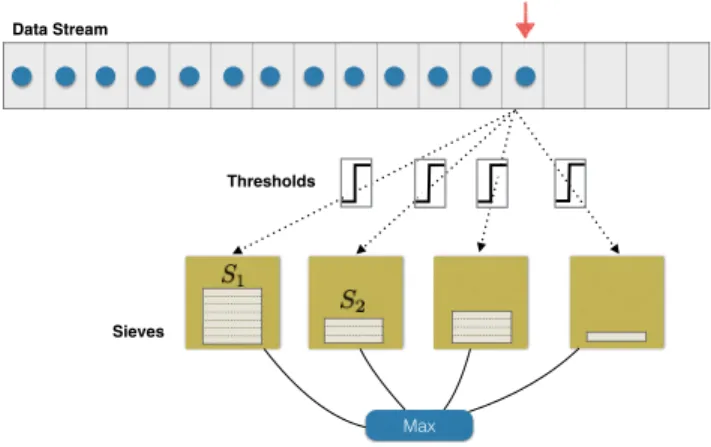
We now state the algorithm formally. It maintains an aux-iliary variablemthat holds the current maximum singleton element after observing each elementei. Whenevermgets updated, the algorithm lazily instantiates the set Oi and deletes all thresholds outsideOi. Then it includes the ele-menteiinto everySvforv∈Oiifeihas the marginal value (v/2−f(Sv))/(k− |Sv|) toSv. Finally, it outputs the best solution amongSv. We call the resulting algorithm Sieve-Streaming, and present its pseudocode in Algorithm 3, as well as an illustration in Figure 1.
Algorithm 3Sieve-Streaming 1: O={(1 +)i|i∈
Z}
2: For eachv∈O, Sv:=∅(maintain the sets only for the necessaryv’s lazily)
3: m:= 0
4: fori= 1 tondo 5: m:= max(m, f({ei}))
6: Oi={(1 +)i|m≤(1 +)i≤2·k·m}
7: Delete allSv such thatv /∈Oi.
8: forv∈Oido
9: if 4f(ei|Sv)≥v/k2−|−fS(Sv)
v| and|Sv|< kthen
10: Sv:=Sv∪ {ei}
11: return argmaxv∈Onf(Sv)
Theorem 5.3. Sieve-Streaming(Algorithm 3) satisfies the following properties
• It outputs a set S such that |S| ≤ k and f(S) ≥
1
2 −
OPT
Data Stream
Sieves
Thresholds
Max
Figure 1: Illustration of Sieve-Streaming. Data arrives in any order. The marginal gain of any new data point is computed with respect to all of the sieves. If it exceeds the specific threshold of any sieve that does not yet meet the cardinality constraint, the point will be added. Otherwise it will be discarded. Sieve-Streamingensures that the num-ber of sieves is bounded. Moreover, it can provide statistics about the data accumulated at any time by returning the elements of the sieve with maximum utility.
• It does1pass over the data set, stores at mostO klog k
elements and hasO logk
update time per element.
Note that the total computation cost ofSieve-Streaming is O nlog k
. This is in contrast to the cost of O(nk) for the classical greedy algorithm. Thus, not only does Sieve-Streamingrequire only a single pass through the data, it also offers an accuracy–performance tradeoff by providing the tuning parameter. We empirically evaluate this trade-off in our experiments in Section 7. Further note that when executing Sieve-Streaming, some sets Sv do not “fill up” (i.e., meet the cardinality constraint). The empirical per-formance can be improved – without sacrificing any guaran-tees – by maintaining a reservoir (cf., Sec. 6) of O(klogk)
random elements, and augment the non-full sets Sv upon
termination by greedily adding elements from this reservoir.
6.
BEYOND THE BLACK-BOX
In the previous sections, we have effectively assumed a so called black-box model for the function evaluations: given
any set S, our algorithm Sieve-Streaming can evaluate
f(S) independently of the ground setV. I.e., the black-box implementingfonly needs access to the selected elementsS, but not the full data streamV. In several practical settings, however, this assumption is violated, meaning that the util-ity functionf depends on the entire dataset. For instance, in order to evaluate (5) we need to know the loss function over the entire data set. Fortunately, many such functions (including (5)) share an important characteristic; they are
additively decomposable [25] over the ground set V. That means, they can be written as
f(S) = 1
|V|
X
e∈V
fe(S), (7) wherefe(S) is a non-negative submodular function. Decom-posability requires that there is a separate monotone sub-modular function associated with every data point e ∈ V
and the value off(S) is nothing but the average offe(S). For the remaining of this section, we assume that the func-tions fe(·) can all be evaluated without accessing the full ground set. We define the evaluation of the utility function
frestricted to a subsetW ⊆V as follows:
fW(S) = 1
|W|
X
e∈W fe(S).
HencefW(S) is the empirical average off w.r.t. to set W. Note that as long asW is large enough and its elements are randomly chosen, the value of the empirical mean fW(S) will be a very good approximation of the true meanf(S).
Proposition 6.1. Assume that all offe(S) are bounded and w.l.o.g. |fe(S)| ≤ 1. Moreover, let W be uniformly sampled fromV. Then by Hoeffding’s inequality we have
Pr(|fW(S)−f(S)|> ξ)≤2 exp
−|W|ξ2
2
.
There are at most|V|k sets of size at most k. Hence, in
order to have the RHS≤δ forany setS of size at most k
we simply (using the union bound) need to ensure
|W| ≥ 2 log(2/δ) + 2klog(|V|)
ξ2 . (8)
As long as we know how to sample uniformly at random from a data stream, we can ensure that for decomposable functions defined earlier, our estimate is close (within the error margin ofξ) to the correct value. To sample randomly, we can use areservoir sampling technique [35]. It creates a reservoir array of size|W|and populates it with the first|W|
items ofV. It then iterates through the remaining elements of the ground set until it is exhausted. At thei-th element wherei >|W|, the algorithm generates a random numberj
between 1 andi. Ifjis at most|W|, thej-th element of the reservoir array is replaced with theith element ofV. It can be shown that upon finishing the data stream, each item in
V has equal probability of being chosen for the reservoir. Now we can devise a two round streaming algorithm, which in the first round applies reservoir sampling to sample an evaluation setW uniformly at random. In the second round, it simply runsSieve-Streamingand evaluates the utility functionf only with respect to the reservoirW.
Algorithm 4Sieve-Streaming+ Reservoir Sampling 1: Go through the data and find a reservoirW of size (8) 2: RunSieve-Streamingby only evaluatingfW(·)
Theorem 6.2. SupposeSieve-Streaminguses a valida-tion setW of size |W| ≥ 2 log(2/δ)k2ε+22k3log(|V|). Then with probability1−δ, the output of Alg 4 will be a setS of size at mostksuch that
f(S)≥(1
2−ε)(OPT−ε).
This result shows howSieve-Streamingcan be applied to decomposable submodular functions if we can afford enough memory to store a sufficiently large evaluation set. Note that the above approach naturally suggests a heuristic one-pass algorithm for decomposable functions: Take the first
2 log(2/δ)k2+2k3log(|V|)
ε2 samples as validation set and run the
greedy algorithm on it to produce a candidate solution. Then process the remaining stream, updating the validation set via reservoir sampling, and applyingSieve-Streaming, us-ing the current validation set in order to approximately eval-uatef. We report our experimental results for the exemplar-based clustering application using an evaluation setW.
7.
EXPERIMENTS
In this section, we address the following questions:
• How good is the solution provided bySieve-Streaming compared to the existing streaming algorithms?
• What computational benefits do we gain when using
Sieve-Streamingon large datasets?
• How good is the performance ofSieve-Streamingon
decomposable utility functions?
To this end, we runSieve-Streamingon the two data min-ing applications we described in Section 4: exemplar-based clustering and active set selection for nonparametric learn-ing. For both applications we report experiments on large datasets with millions of data points. Throughout this sec-tion we consider the following benchmarks:
• random selection: the output is k randomly selected data points fromV.
• standard greedy: the output is the k data points se-lected by algorithm (4). This algorithm is not appli-cable in the streaming setting.
• lazy greedy: the output produced by the accelerated greedy method [24]. This algorithm is not applicable in the streaming setting.
• Stream-Greedy: The output is the k data points provided byStream-Greedyas described in Section 3 In all of our experiments, we stop the streaming algorithms if the utility function does not improve significantly (rela-tive improvement of at leastγ for some small valueγ >0). In all of our experiment, we chose γ = 10−5. This way, we can compare the performance of different algorithms in terms of computational efforts in a fair way. Throughout this section, we measure the computational cost in terms of the number of function evaluations used (more precisely, number of oracle queries). The advantage of this measure is that it is independent of the concrete implementation and platform. However, to demonstrate that the results remain almost identical, we also report the actual wall clock time for the exemplar-based clustering application. The random selection policy has the lowest computational cost among the streaming algorithms we consider in this paper. In fact, in terms of function evaluations its cost is one; at the end of the sampling process the selected set is evaluated once. To implement the random selection policy we can employ the reservoir sampling technique discussed earlier. On the other end of the spectrum, we have the standard greedy al-gorithm which makeskpasses over the ground set, providing typically the best solution in terms of utility. Since it is com-putationally prohibitive we cannot run it for the large-scale datasets. However, we also report results on a smaller data set, where we compare against this algorithm.
7.1
Active Set Selection
For the active set selection objective described in Sec-tion 4.2, we chose a Gaussian kernel with h = 0.75 and
Stream−GreedySieve−Streaming Greedy Lazy Greedy Random 0
0.2 0.4 0.6 0.8 1
Utility Cost
~45% ~100%
~97% ~90%
~56%
~27%
~1% ~100% ~100%~100%
(a) Parkinsons
Stream−Greedy Sieve−Streaming Random 0
0.2 0.4 0.6 0.8 1
Utility Cost
~1% ~1%
~100% ~100%
~59% ~99%
(b) Census
Stream−Greedy Sieve−Streaming Random 0
0.2 0.4 0.6 0.8 1
Utility Cost
~60%
~1% ~1%
~90% ~100% ~100%
(c) Y! front page
10 20 30 40 50 60 70 80 90 100 0
2 4 6 8 10 12 14 16
K
Utility
Random Greedy
Sieve−Streaming
Stream−Greedy
(d) Parkinsons
5 10 15 20 25 30 35 40 45 50 0
2 4 6 8 10 12 14 16 18x 10
8
K
Utility
Random
Sieve−Streaming
Stream−Greedy
(e) Census
10 20 30 40 50 60 70 80 90 100 0
5 10 15 20 25 30 35
K
Utility
Random Stream−Greedy
Sieve−Streaming
(f) Y! front page
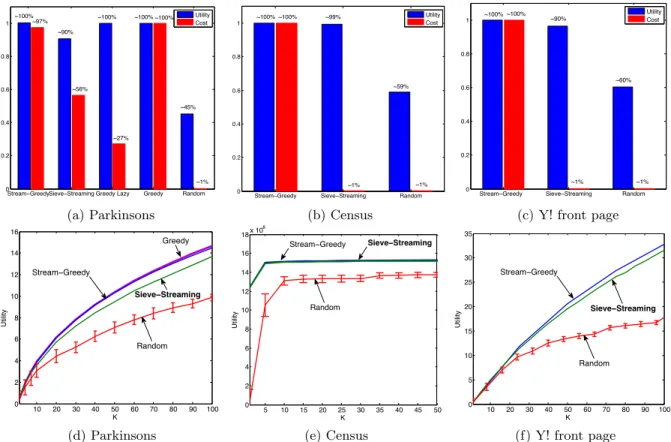
Figure 2: Performance comparison. a), b) and c) show the utility obtained, along with the computational cost, by the algorithms on 3 different datasets. Sieve-Streamingachieves the major fraction of the utility with orders of magnitude less computation time. d), e) f) demonstrate the performance of all the algorithms for different values ofkon the same datasets.
In all of themSieve-Streamingperforms close to the (much more computationally expensive)Stream-Greedybenchmark.
σ= 1. For the small-scale experiments, we used the Parkin-sons Telemonitoring dataset [34] consisting of 5,875 bio-medical voice measurements with 22 attributes from peo-ple with early-stage Parkinson’s disease. We normalized the vectors to zero mean and unit variance. Fig. 2a compares
the performance of Sieve-Streamingto the benchmarks
for a fixed active set sizek= 20. The computational costs of all algorithms, as well as their acquired utilities, are nor-malized to those of the standard greedy. As we can see, Sieve-Streamingprovides a solution close to that of the standard greedy algorithm with a much reduced computa-tional cost. For different values ofk, Fig. 2d shows the
per-formance of all the benchmarks. Again,Sieve-Streaming
operates close toStream-Greedyand (lazy) greedy. For our large-scale scale experiment, we used theYahoo! Webscopedata set consisting of 45,811,883 user visits from the Featured Tab of the Today Module on the Yahoo! Front Page [2]. For each visit, the user is associated with a feature vector of dimension six. Fig. 2c compares the performance of Sieve-Streamingto the benchmarks for a fixed active set sizek = 100. Since the size of the data set is large, we cannot run the standard (or lazy) greedy algorithm. As a consequence, computational costs and utilities are normal-ized to those of theStream-Greedybenchmark. For such a large dataset, the benefit of usingSieve-Streamingis much
more pronounced. As we see, Sieve-Streamingprovides
a solution close to that of Stream-Greedy while having
several orders of magnitude lower computational cost. The performance of all algorithms (expect the standard and lazy greedy) for different values ofkis shown in Fig. 2f.
7.2
Exemplar-Based Clustering
Our exemplar-based clustering experiment involves Sieve-Streaming applied to the clustering utility function (de-scribed in Section 4.1) with the squared Euclidean distance, namely, d(x, x0) =kx−x0k2
. We run the streaming algo-rithms on theCensus1990dataset [1]. It consists of 2,458,285 data points with 68 attributes. We compare the performance of Sieve-Streamingto the benchmarks as well as the clas-sical online k-means algorithm (where we snap each mean to the nearest exemplar in a second pass to obtain a subset
S⊆V). Again, the size of the dataset is too large to run the standard greedy algorithm. As discussed in Section 6, the clustering utility function depends on the whole data set. However, it is decomposable, thus an evaluation setW can be employed to estimate the utility of any set S based on the data seen so far. For our experiments, we used reservoir sampling with|W|= 1/10|V|.
Fig 2b shows the performance ofSieve-Streaming
com-pared to the benchmarks for a fixed active set size k = 5. The computational costs of all algorithms, as well as their acquired utilities, are normalized to those of Stream-Greedy. We did not add the performance of onlinek-means to this figure as onlinek-means is not based on submodular function maximization. Hence, it does not query the cluster-ing utility function. As we observe again,Sieve-Streaming provides a solution close to that of Stream-Greedy with substantially lower computational cost. For different values ofk, Fig. 2e shows the performance of all the benchmarks. To compare the computational cost of onlinek-means with the benchmarks that utilize the clustering utility function, we measure the wall clock times of all the methods. This is
reported in Table 2. We see again that the utility of Sieve-Streamingis comparable to Stream-Greedy and online
k-means with much lower wall clock time.
8.
CONCLUSIONS
We have developed the first efficient streaming algorithm– Sieve-Streaming–for cardinality-constrained submodular
maximization. Sieve-Streaming provides a constant
fac-tor 1/2−εapproximation guarantee to the optimum solu-tion and requires only a single pass through the data and memory independent of the data size. In contrast to pre-vious work, which makes strong assumptions on the data streamV or on the utility function (e.g., bounded spread of marginal gains, or Lipschitz continuity), we assumed nothing but monotonicity and submodularity. We have also demon-strated the effectiveness of our approach through extensive
large scale experiments. As shown in Section 7,
Sieve-Streamingreaches the major fraction of the utility function with much (often several orders of magnitude) less computa-tional cost. This property ofSieve-Streamingmakes it an appealing and sometimes the only viable method for solv-ing very large scale or streamsolv-ing applications. Given the importance of submodular optimization to numerous data mining and machine learning applications, we believe our results provide an important step towards addressing such problems at scale.
Acknowledgments. This research was supported in part by NSF AF-0910940, SNF 200021-137971, DARPA MSEE FA8650-11-1-7156, ERC StG 307036, a Microsoft Faculty Fellowship and an ETH Fellowship.
9.
REFERENCES
[1] Census1990, UCI machine learning repository, 2010. [2] Yahoo! academic relations. r6a, yahoo! front page
today module user click log dataset, version 1.0, 2012. [3] A. Badanidiyuru and J. Vondr´ak. Fast algorithms for
maximizing submodular functions. InSODA, 2014. [4] M. Bateni, M. Hajiaghayi, and M. Zadimoghaddam.
Submodular secretary problem and extensions. In
APPROX-RANDOM, pages 39–52, 2010. [5] G. E. Blelloch, R. Peng, and K. Tangwongsan.
Linear-work greedy parallel approximate set cover and variants. InSPAA, 2011.
[6] F. Chierichetti, R. Kumar, and A. Tomkins.
Max-cover in map-reduce. InWWW, 2010.
[7] A. Dasgupta, R. Kumar, and S. Ravi. Summarization through submodularity and dispersion. InACL, 2013. [8] D. Dueck and B. J. Frey. Non-metric affinity
propagation for unsupervised image categorization. In
ICCV, 2007.
[9] K. El-Arini and C. Guestrin. Beyond keyword search: Discovering relevant scientific literature. InKDD, 2011.
[10] K. El-Arini, G. Veda, D. Shahaf, and C. Guestrin. Turning down the noise in the blogosphere. InKDD, 2009.
[11] U. Feige. A threshold of ln n for approximating set cover.Journal of the ACM, 1998.
[12] M. M. Gaber, A. Zaslavsky, and S. Krishnaswamy. Mining data streams: a review.SIGMOD Record, 34(2):18–26, 2005.
[13] J. Gillenwater, A. Kulesza, and B. Taskar.
Near-optimal map inference for determinantal point processes. InNIPS, pages 2744–2752, 2012.
[14] R. Gomes and A. Krause. Budgeted nonparametric learning from data streams. InICML, 2010.
[15] A. Gupta, A. Roth, G. Schoenebeck, and K. Talwar. Constrained non-monotone submodular maximization: Offline and secretary algorithms. InWINE, 2010. [16] L. Kaufman and P. J. Rousseeuw.Finding groups in
data: an introduction to cluster analysis, volume 344. Wiley-Interscience, 2009.
[17] D. Kempe, J. Kleinberg, and E. Tardos. Maximizing the spread of influence through a social network. In
Proceedings of the ninth ACM SIGKDD, 2003. [18] A. Krause and D. Golovin. Submodular function
maximization. InTractability: Practical Approaches to Hard Problems. Cambridge University Press, 2013. [19] A. Krause and C. Guestrin. Near-optimal nonmyopic
value of information in graphical models. InUAI, 2005.
[20] R. Kumar, B. Moseley, S. Vassilvitskii, and
A. Vattani. Fast greedy algorithms in mapreduce and streaming. InSPAA, 2013.
[21] S. Lattanzi, B. Moseley, S. Suri, and S. Vassilvitskii. Filtering: a method for solving graph problems in mapreduce. InSPAA, 2011.
[22] J. Leskovec, A. Krause, C. Guestrin, C. Faloutsos, J. VanBriesen, and N. Glance. Cost-effective outbreak detection in networks. InKDD, 2007.
[23] H. Lin and J. Bilmes. A class of submodular functions
for document summarization. InNAACL/HLT, 2011.
[24] M. Minoux. Accelerated greedy algorithms for maximizing submodular set functions.Optimization Techniques, LNCS, pages 234–243, 1978.
[25] B. Mirzasoleiman, A. Karbasi, R. Sarkar, and A. Krause. Distributed submodular maximization: Identifying representative elements in massive data. In
Neural Information Processing Systems (NIPS), 2013. [26] G. L. Nemhauser and L. A. Wolsey. Best algorithms
for approximating the maximum of a submodular set function.Math. Oper. Research, 1978.
[27] G. L. Nemhauser, L. A. Wolsey, and M. L. Fisher. An analysis of approximations for maximizing submodular set functions - I.Mathematical Programming, 1978. [28] C. E. Rasmussen and C. K. I. Williams.Gaussian
Processes for Machine Learning (Adaptive Computation and Machine Learning). 2006.
[29] C. Reed and Z. Ghahramini. Scaling the indian buffet process via submodular maximization. InICML, 2013. [30] M. G. Rodriguez, J. Leskovec, and A. Krause.
Inferring networks of diffusion and influence.ACM Transactions on Knowledge Discovery from Data, 5(4):21:1–21:37, 2012.
[31] B. Sch¨olkopf and A. Smola.Learning with Kernels: Support Vector Machines, Regularization,
Optimization, and Beyond. MIT Press, Cambridge, MA, USA, 2001.
[32] M. Seeger. Greedy forward selection in the informative vector machine. Technical report, University of California, Berkeley, 2004.
Sieve-Streaming onlinek-means Stream-Greedy
wall clock time 4376 s 11905 s 77160 s
utility 152·106 152·106 153·106
Table 2: Performance ofSieve-Streamingwith respect toStream-Greedyand onlinek-means. To compare the
computa-tional cost, we report the wall clock time in second. In this experiment we usedk= 100.
[33] R. Sipos, A. Swaminathan, P. Shivaswamy, and T. Joachims. Temporal corpus summarization using submodular word coverage. InCIKM, 2012. [34] A. Tsanas, M. A. Little, P. E. McSharry, and L. O.
Ramig. Enhanced classical dysphonia measures and sparse regression for telemonitoring of parkinson’s disease progression. InICASSP, 2010.
[35] J. Vitter. Random sampling with a reservoir.ACM Trans. Mathematical Software, 11(1):37–57, 1985.
APPENDIX
Proof of Proposition 5.1. We will first prove by in-duction that after adding|S|elements toSthe solution will satisfy the following inequality
f(S)≥v|S|
2k (9)
The proof is by induction. The base casef(∅)≥0 is easy to see. Assume by induction that equation 9 holds for setS
and we add elemente. Then we know by the condition of the algorithm thatf(S∪ {e})−f(S)≥ v/k2−|−fS(|S). Simplifying we getf(S∪ {e})≥f(S)(1− 1
k−|S|) +
v
2(k−|S|). Substituting
equation 9 into this equation and simplifying we get the desired resultf(S∪ {e})≥v(|S2|k+1).
The rest of the proof is quite simple. There are two cases.
• Case 1: At the end of the algorithmS hask elements. Then from equation 9 we get f(S) ≥ v
2k ·k =
v
2 ≥
α
2 OPT.
• Case 2: At the end of the algorithm|S|< k. Then let
A∗be the optimal solution withA∗−S={a1, a2, . . . , al}
and A∗∩S = {al+1, al+2, . . . , ak}. Let for each
ele-mentaj∈A∗−S, it be rejected from including intoS
when the current solution wasSj⊆S. Then we have the two inequalities thatfSj(aj)≤v/2−f(Sj)
k−|Sj| and that
f(Sj) ≥ v|Sj|
2k . Combining the two we get fSj(aj) ≤
v
2k which implies that fS(aj) ≤ v
2k. Let Aj denote
{a1, a2, . . . , aj}.
f(S∪A∗)−f(S) =
l
X
j=1
f(S∪Aj)−f(S∪Aj−1)
≤
l
X
j=1
f(Sj∪ {aj})−f(Sj)
≤
l
X
j=1
v
2k ≤ v
2 ≤
OPT
2
⇒OPT−f(S)≤OPT
2 ⇒f(S)≥ 1 2OPT
Here the first inequality is due to submodularity, second is by definition ofA∗−S.
Proof of Proposition 5.2. The proof directly follows from Theorem 5.1 and the fact that there exists a v ∈ O
such that (1−)OPT≤v≤OPT.
Proof of Theorem 5.3. First observe that when a thresh-oldvis instantiated any element with marginal value at least
v/(2k) to Sv appears on or afterv is instantiated. This is because if such an elementeiappeared beforevwas instanti-ated thenv∈Oiand would have been instantiated whenei
appeared. Then the proof directly follows from Theorem 5.2 and the fact that Algorithm 3 is the same as Algorithm 2 with a lazy implementation.
Proof of Theorem 6.2. The proof closely follows the proof of the algorithm when we evaluate the submodular function exactly from Proposition 5.1, 5.2 and Theorem 5.3. From Proposition 6.1 we get that for any set S,|fW(S)−
f(S)| ≤
k. Hence, as we are takingkelements, the error for
the solution after taking each element adds up and we get
f(S)≥(1/2−)OPT−
k·k which is the desired result.
Bad example for
Stream-GreedyWe show that there exists a family of problem instances of streaming submodular maximization under ak cardinal-ity constraint, where it holds for the solution S produced byStream-Greedyafter one pass through the data, that
f(S)/OPT≤1/k. For this claim, take the weighted coverage of a collection of sets: Fix a setX and a collectionV of sub-sets of X. Then for a subcollectionS ⊆V, the monotone submodular functionf is defined as
fcov(S) =
X
x∈∪v∈Sv
w(x).
Here,w(·) is the weight function that assigns positive weights to any element fromX. Now, let us assume thatX is the set of natural numbers and elements arrive as follows:
{1},{2}, . . . ,{k},{1,2, . . . , k}
{k+ 1},{k+ 2}, . . . ,{2k},{k+ 1, k+ 2, . . . ,2k}. . .
{k2+1},{k2+2}, . . . ,{k2+k},{k2+1, k2+2, . . . , k2+k}
Let <<1. We define the weights as
w(1) =w(2) =· · ·=w(k) = 1
w(k+ 1) =w(k+ 2) =· · ·=w(2k) = 1 +
. . .
w(k2+ 1) =w(k2+ 2) =· · ·=w(k2+k) = 1 +k
Then it is clear thatStream-Greedyskips the non-singleton sets as they do not provide any benefit. In contrast, the opti-mum solution only consists of those sets. Now, after observ-ing O(k2) elements from the above data stream, the ratio
between the solution provided byStream-Greedyand the