
Robust Tracking-by-Detection using a Detector Confidence Particle Filter
Michael D. Breitenstein
1Fabian Reichlin
1Bastian Leibe
1,2Esther Koller-Meier
1Luc Van Gool
1,3 1Computer Vision Laboratory
2UMIC Research Centre
3ESAT-PSI / IBBT
ETH Zurich
RWTH Aachen
KU Leuven
Abstract
We propose a novel approach for multi-person tracking-by-detection in a particle filtering framework. In addition to final high-confidence detections, our algorithm uses the continuous confidence of pedestrian detectors and online trained, instance-specific classifiers as a graded observa-tion model. Thus, generic object category knowledge is complemented by instance-specific information. A main contribution of this paper is the exploration of how these unreliable information sources can be used for multi-person tracking. The resulting algorithm robustly tracks a large number of dynamically moving persons in complex scenes with occlusions, does not rely on background modeling, and operates entirely in 2D (requiring no camera or ground plane calibration). Our Markovian approach relies only on information from the past and is suitable for online applica-tions. We evaluate the performance on a variety of datasets and show that it improves upon state-of-the-art methods.
1. Introduction
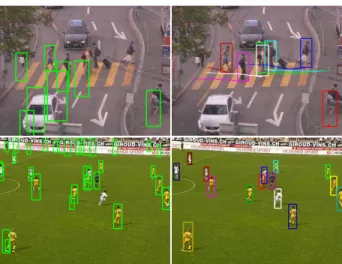
The goal of the work presented in this paper is to au-tomatically detect and track a variable number of targets in complex scenes using a monocular, potentially moving, uncalibrated camera. This is a very challenging problem, since there are many sources of uncertainty for the object locations,e.g., measurement noise, clutter, changing back-ground, and significant occlusions. In order to cope with those difficulties, tracking-by-detection approaches have become increasingly popular [2, 11, 16, 20, 26]. Such ap-proaches involve the continuous application of a detection algorithm in individual frames and the association of detec-tions across frames. The main challenges when using an object detector for tracking are that the resulting output is unreliable and sparse,i.e., detectors only deliver a discrete set of responses and usually yield false positives and miss-ing detections (see Fig. 1, left). Several recent multi-object tracking-by-detection algorithms address the resulting data association problem by optimizing detection assignments over a larger temporal window [1, 3, 12, 16, 21]. They use information from future frames and locate the targets in the current frame with a temporal delay.
Figure 1:Using the output of a person detector (left), which typi-cally contains many false positives and missing detections, our al-gorithm robustly tracks multiple targets in complex scenes (right).
Sequential Monte Carlo methods (or Particle Filters) [8] offer a framework for representing the tracking uncertainty in a Markovian manner by only considering information from past frames. Therefore, such an approach is more suit-able for time-critical, online applications. Okumaet al. [20] and Caiet al. [5] combine tracking-by-detection with parti-cle filtering by using final detections to initialize color based tracker samples. We also adopt a particle filtering frame-work, but we extend previous methods by several new ideas. Most importantly, the above approaches only rely on the final, sparse output from the object detector. In contrast, our approach integrates the object detector itself into the track-ing process by monitortrack-ing its continuous detection confi-dence and using it as a graded observation model. This idea follows the intuition that by forgoing the hard detec-tion decision, we can impart tracking approaches with more flexibility to handle difficult situations. Although such a combination appears desirable, it raises a number of ques-tions. As available object detectors have only been opti-mized for accurate results at those locations passing the final non-maximum suppression stage, it is not guaranteed that the shape of the underlying confidence volume in-between those locations will always support tracking. In addition, a 1515
majority of the densities’ local maxima correspond to false positives that may deteriorate the tracking results.
A main contribution of this paper is the exploration of how this unreliable information source can be used for bust multi-person tracking. Our algorithm achieves this ro-bustness through a careful interplay between object detec-tion, classificadetec-tion, and target tracking components: In addi-tion to a general, class-specificpedestrian detectorto local-ize people, we trainperson-specific classifiers. As our expe-riments show, the resulting approach yields a good tracking performance in a large variety of highly dynamic scenarios. Our approach automatically initializes a separate particle filter for each person detected with high confidence. In or-der to resolve the data association of final high-confidence detections and trackers in each frame, our approach evalu-ates a scoring function integrating the online-trained clas-sifier, the distance to the tracked target, and a probabilistic gating function accounting for the target size, motion direc-tion, and velocity. If a final detection is classified as reliable based on this function, it is mainly used to guide the par-ticles of the associated tracker. Otherwise, the continuous confidence of the class-specific detector and the instance-specific classifiers is mainly used. To evaluate the reliability of the detector confidence, we perform explicit inter-object occlusion reasoning. Finally, the algorithm computes the observation likelihood function of each particle filter using the associated detection, the intermediate output of the de-tector, and the classifier evaluated at each particle location. For computational efficiency, we limit ourselves to a first-orderMarkovmodel,i.e., all data associations for timetare made attand never reconsidered afterwards.
This paper makes the following contributions: (1) We present a novel approach for probabilistic tracking-by-detection in a Particle Filtering framework. (2) Our ap-proach exploits the continuous detector confidence for ro-bust multi-target tracking and integrates it into the observa-tion model. (3) In order to deal with unreliable detecobserva-tions, we combine this input with online-trained classifiers to re-solve the data association. The resulting combination effec-tively integrates generic category knowledge with person-specific information, thereby greatly improving tracker ro-bustness and reducing classifier drift. (4) We present exten-sive experiments demonstrating that the proposed approach is applicable to a wide variety of tracking scenarios ranging from surveillance settings to highly dynamic sports scenes.
2. Related Work
A vast amount of work has been published on multi-target tracking, and a review is beyond the scope of this paper. While many approaches rely on background sub-traction from one or several static cameras [3, 14, 23, 27], recent progress in object detection has increased interest in combining tracking and detection [2, 16, 20, 26]. However,
many methods rely on global optimization to construct con-sistent trajectories from detections [1, 3, 12, 16, 21], which precludes their use in an online scenario.
To better represent the state space uncertainty of a target, Particle Filters were introduced to the vision community by [13]. Later extensions include a representation of the joint state space for multiple targets [24] and the combination with an object detector for Markovian tracking-by-detection [10, 20]. As runtime directly scales with the number of par-ticle evaluations, those approaches face a dilemma when additional targets appear. They can either spend an expo-nentially growing number of particles on representing the joint state space sufficiently well, or they can guarantee a constant runtime by keeping the number of particles fixed, at the price of lowering approximation accuracy. This can be solved by using independent particle sets for each target [5, 23], at the cost of potential problems with occlusions.
Using independent trackers requires solving a data asso-ciation problem to assign measurements to targets. Classi-cal approaches include JPDAF [9] and MHT [22]. However, the computational complexity grows exponentially with the number of targets and time steps, respectively. We stick to a greedy scheme for making the detection-tracker assign-ments and focus on obtaining a good scoring function in-stead. Such an approach is also used by [5, 26], but there the assignments are made only based on spatial distance, without considering target appearance. This can be prob-lematic for complex scenes with many targets and diffi-cult background where many false positive detections oc-cur. [26] additionally learn color histograms for each part, which however do not always distinguish very well. In contrast, our method additionally evaluates the output of online-trained classifiers and a probabilistic gating func-tion for reliable detecfunc-tion-tracker assignments. Recently, a background subtraction based tracker has been presented that also learns target-specific classifiers online [23], but employs them only when targets split and merge.
Previous approaches exist that exploit the detection con-fidence, but they are developed primarily for single-target tracking and do not show a thorough evaluation for multi-target tracking. E.g., [2, 11] exploit the confidence map of a classifier, [17] apply classifiers with different confidence thresholds, and [6] accumulate detection probabilities tem-porally. In contrast, our algorithm is designed for robust multi-target tracking, addressing its specific problems.
3. Approach
For many tracking applications, approaches should rely only on past observations. Within this context, a Particle Filter (PF) estimates the time-evolving posterior distribu-tion of the target locadistribu-tions with a weighted set of particles. PFs consist of a dynamic model for prediction and an obser-vation model to evaluate the likelihood of a predicted state.
(a) Sliding window
x y scale
(b) Detector conf. density (c) Feature voting
Figure 2: Thedetector confidence density, which we use for the observation model of the particle filter, is common for sliding-window based and voting based detectors.
In this paper, we explore the idea of using the output of an object detector for the observation model. A general problem with this is the reliability of the resulting detec-tions;i.e., not all persons are detected in each frame ( miss-ing detections) and some detections are not caused by a per-son (false positive detections). These problems are demon-strated in Fig. 1. To address them, many recent methods rely on expensive global optimization techniques instead of making successive, irreversible decisions at each time step, which is a major limitation for time-critical applications.
In contrast, our algorithm for tracking-by-detection im-plements a first-order Markov model (i.e., it only relies on information from the current and the last time step). It achieves the necessary robustness by integrating the infor-mation from object detection in two ways: First, our algo-rithm carefully assesses the detections in each frame and maximally selects one to guide the tracker for a particular target. For this purpose, we train a classifier for each target during runtime (see Sec. 3.2). Second, our algorithm ad-ditionally exploits the intermediate, continuous confidence density of an object detector (see next paragraph). To assess its reliability, our algorithm performs inter-object occlusion reasoning (see Sec. 3.3). Finally, the tracker integrates both types of detector output into the observation likelihood.
Detection Confidence Density. At the core of our ap-proach lies the realization that current state-of-the-art per-son detectors all build up some form ofconfidence density as one stage of their pipeline. This is true for both sliding-window based detectors such as HOG [7] and for feature-based detectors such as ISM [15]. In the sliding-window case, this density is implicitly sampled in a discrete 3D grid (location and scale) by evaluating the different detection windows with a classifier. In the ISM case, it is explicitly created in a bottom-up fashion through probabilistic votes cast by matching, local features (see Fig. 2). In order to ar-rive at individual detections, both types of approaches try to find local maxima in the density volume and then apply some form of non-maximum suppression. This reduces the result set to a manageable number of high-quality hypothe-ses, but it also throws away potentially useful information.
Fig. 3 illustrates both types of output for ISM (left) and HOG (right). As can be seen, there are situations where a detector did not yield a final detection but a tracking
algo-Figure 3: Detector output of ISM (left) and HOG (right). We show final detections as green bounding boxes and the detector confidence density in blue (low) to red (high). The density often contains useful information at the location of missing detections.
rithm could still be guided using the intermediate output. On the other hand, both detectors also show a high confi-dence density on certain background structures.
3.1. Particle Filtering
Bootstrap Filter. Our tracking algorithm is based on es-timating the distribution of each target state by a particle filter. The statex ={x, y, u, v} consists of the 2D image position(x, y)and the velocity components(u, v). There-fore, we employ thebootstrap filter, where the state transi-tion density (or “prior kernel”) is used as importance distri-bution to approximate the probability density function. For sequences with abrupt, fast camera motion, we apply iter-ative likelihood weighting [19]. For details about particle filtering, we refer to [8]. The importance weight wt(i)for each particleiat time steptis then described by:
wt(i) ∝ w(t−1i) ·p(yt|x(ti)). (1)
Since re-sampling is carried out in each time step using a fixed number ofNparticles,w(t−1i) =N1 is a constant and can be ignored. Thus, (1) reduces to the conditional likelihood of a new observationytgiven the propagated particlesx(ti), which we estimate as described in Sec. 3.3.
Motion Model. To propagate the particles, we use a constant velocity motion model:
(x, y)t = (x, y)t−1+ (u, v)t−1·Δt+ε(x,y) (2)
(u, v)t = (u, v)t−1+ε(u,v). (3) The process noiseε(x,y), ε(u,v)for each state variable is in-dependently drawn from zero-mean Normal distributions. The varianceσ2(x,y)for the position noise changes with the size of the tracking target, whereas the varianceσ(2u,v)for the velocity noise is inversely proportional to the number of successfully tracked frames. Hence, the longer a target is tracked successfully, the less the particles are spread.Δtis dependent on the frame-rate of the sequence. The size of the target is estimated as described below.
Tracker Initialization and Termination. Object de-tection yields fully automatic initialization. The algorithm initializes a new tracker for an object that has subsequent
Figure 4: The result of the probabilistic gating function (Eq. 5) depends on the velocity of the target, resulting in radial isolines (left) or different 2D cone angles (left, right).
detections with overlapping bounding boxes, which are nei-ther occluded nor associated to an already existing tracker (see Sec. 3.2). In order to avoid persistent false positives from similar-looking background structures (such as win-dows, doors, or trees), we only initialize trackers from de-tections that appear in a zone along the image borders for sequences where this is reasonable (see Sec. 4). The initial sample positions are drawn from a Normal distribution cen-tered at the detection center. The initial size corresponds to the detection size, and the motion direction is set to be orthogonal to the closest image border. A tracker only sur-vives a limited number of frames without associated detec-tion and is then automatically terminated.
Tracker Position and Size. Although represented by a (possibly multi-modal) distribution, a single position of the tracking target is sometimes required (e.g., for visualiza-tion). We estimate the position by the strongest mode of the distribution, found using mean-shift. Instead of including the size of the target in the state space of the particles, the target size is set to the average of the last four associated detections. In our experiments, this yields better results, possibly because of the exponentially growing number of particles necessary for estimating a larger state space.
3.2. Data Association
In order to decide which detection should guide which tracker, we solve a data association problem, assigning at most one detection to at most one target. The optimal single-frame assignment can be obtained by the Hungarian algorithm. In our experiments, we however found that the following greedy algorithm achieves equivalent results at lower computational cost (also reported by [26]).
The matching algorithm works as follows: First, a matching score matrixS for each pair(tr, d)of trackertr and detectiondis computed as described below. Then, the pair (tr∗, d∗) with maximum score is iteratively selected, and the rows and columns belonging to trackertrand de-tectiondinSare deleted. This is repeated until no further valid pair is available. Finally, only the associated detec-tions with a matching score above a threshold are used, en-suring that a selected detection actually is a good match to a target. Consequently, the chances are high that often no detection is associated with a target, but if one is, it can be used to strongly influence the tracker.
Figure 5: The detector confidence reliability function (Eq. 7) evaluated for trackerareturns a high value if another trackerb
with associated detection is nearby (right).
Matching Score. Our data association method evaluates a matching function for each tracker-detection pair(tr, d) (the higher the score, the better the match between detection and tracking target). The matching functions(tr, d) evalu-ates the distance between the detectiondand each particle pof trackertr. It employs a classifierctr(d)trained fortr and evaluated ford(see the following paragraphs):
s(tr, d) =g(tr, d)·(ctr(d) +α· N p∈tr
pN(d−p)), (4) wherepN(d−p)∼ N(d−p; 0, σ2det)denotes the Normal distribution evaluated for the distance betweendandp, and g(tr, d)is a gating function described next.
Gating Function. Not only the distance of a detection to the tracker is important, but also its location with respect to velocity and motion direction of the target. Therefore, a probabilistic gating function g(tr, d)additionally assesses each detection. It consists of the product of two probabili-ties, both drawn from Normal distributions.
g(tr, d) =p(sized|tr)p(posd|tr) (5) =
pN(sizetr−sized
sizetr )·pN(|d−tr|) if|vtr|< τv pN(sizetr−sized
sizetr )·pN(dist(d,vtr)) otherwise. The first factor measures the agreement between the sizes of target and detection. The second term implements the in-tuition that fast moving objects cannot change their course so abruptly because of their inertia. Therefore, it depends on the velocity of the target; if it is below a thresholdτv, the velocity is ignored and the term is proportional to the distance from the tracker positiontrto the detectiond. In this case of an (almost) motionless target, the isolines of the function are radial (see Fig. 4, left). Otherwise, the second term depends ondist(d,vtr), which is the shortest distance between the detectiondand the line given by the motion directionvtr = (u, v)of the tracker. The variance for the
second term is chosen such that it is proportional to the dis-tance from the tracker to the detection projected tovtr. In
this case, the isolines of Eq. 5 form a 2D cone (see Fig. 4). The variance is made inversely proportional to the velocity, such that the angle of the 2D cone is smaller the higher the speed of a target is (see Fig. 4).1
1The second term of Eq. (5) is equivalent to an angular error that is
correctly measured by the von Mises distribution, but can be closely ap-proximated by a Gaussian distribution in the 1D case [18].
Boosted Classifiers. To assess the similarity of a tracker-detection pair, we train a boosted classifier of weak learners for each tracking target. The classifier is similar to [11] and is trained online on one target against all oth-ers. Patches used as positive training examples are sam-pled from the bounding box of the associated detection. The negative training set is sampled from nearby targets, augmented by background patches. The classifier is only updated on non-overlapping detections. After each update step, we keep a constant number of the most discriminative weak learners. The output of the classifier is linearly scaled to the range[−1,1]. The weak learners (feature types) are selected by evaluating the classifier for different combina-tions of color and appearance features (see Sec. 4).
3.3. Observation Model
To compute the weightwtr,pfor a particlepof the tracker tr, our algorithm estimates the conditional likelihood of the new observation given the propagated particle. For this pur-pose, we combine different sources of information, namely the associated detectiond∗, the intermediate output of the detection algorithm, and the output of the classifierctr: wtr,p=p(yt|x(ti)) = (6)
β· I(tr)·pN(p−d∗)
detection
+γ·dc(p)·po(tr)
det. confidence density
+η·ctr(p)
classifier
where the parametersβ, γ, ηare set experimentally. Each term is described below in detail.
Detection Term. The first term computes the distance between the particlepand the associated detectiond∗, eval-uated under a Normal distributionpN. I(tr)is an indica-tor function that returns1 if a detection was associated to the tracker and0otherwise. When a matching detection is found, this term robustly guides the particles.
Detector Confidence Density Term. The second term evaluates the intermediate output of the object detector by computing the detector confidence densitydc(p)at the par-ticle position. To estimatedc(p)for the ISM detector [15], we compute the local densityρin the Hough voting space using a cubical kernel adapted to the target object size and scale it withf = 1−exp(−ρ)to[0,1]. For the HOG de-tector [7], dc(p)corresponds to the raw SVM confidence output before applying non-maximum suppression.
Unfortunately, the detector confidence density is not al-ways reliable; often, an erroneously high value is caused by background structures (see Fig. 3). To assess its reliabil-ity, our algorithm therefore performsinter-object occlusion reasoningusing the following rationale: if another tracker tr is nearby that is associated with a detection, the detec-tor confidence density around this image location is most probably caused by the foreground and not by background structure. Consequently, the detector probably did not find
both targets because of the occlusion. In this case, we as-sume that the detection confidence density is meaningful in this image area and can be used to guide the tracker.
To assess thereliability of the detector confidence den-sity, our tracking algorithm evaluates a function,
po(tr) = ⎧ ⎪ ⎪ ⎨ ⎪ ⎪ ⎩
1 ifI(tr) = 1
max
tr:I(tr)=1pN(tr−tr
) elif∃I(tr) = 1
0 else
(7)
which is used in (6) to weight the influence of the detector confidence density. The closertris, the more reliable is the detector output at the position of trackertr. In Fig. 5, the function values are illustrated for the tracker of the person entering the scene from the right.
Classifier Term. For the third term of Eq. (6), the classi-fier trained for the targettris evaluated for the image patch at the particle location with the corresponding size. This term uses color and texture information (see Sec. 3.2 and 4) to assess the new particle position and complements the terms from the detector output. While other tracking meth-ods are purely based on such classifier output (c.f. [11]), this adds additional robustness to our particle filter approach. In addition, the combination of generic category knowledge with person-specific information makes our approach more robust to classifier drift thane.g. [11].
Influence of Observation Likelihood Terms. The in-fluence of the different observation likelihood terms in (6) is demonstrated on a simple sequence in Fig. 6. As can be seen, certain background structures (tram tracks and road markings) cause false positive detections. In Fig. 6(a), both targets are correctly associated with a detection (dashed bounding boxes), based on which the trackers are mainly guided. In contrast, Fig. 6(b) shows a state where no de-tection is assigned to them; as a result, the particles are weighted (almost) uniformly. In Fig. 6(c), the particles of the blue tracker are weighted mainly based on the detector confidence density term, because no detection is available. As the red tracker is nearby and is associated with a detec-tion, the detector confidence for the blue tracker is assumed to be high. Between the images in Figs. 6(d) and 6(e), a bus causes a long occlusion (for 50 frames) during which false positive detections are rejected by the classifier. This is essential for the success of the tracker.
Fig. 7 shows erroneous tracking results if the density or classifier term in Eq. (6) have too much influence (con-trolled by the parametersβ, γ, η). In Fig. 7 (left), the tracker is misguided by the detection confidence density term. In Fig. 7 (right), the tracker is misguided because a part of the roof of the bus was visible in detections used for updating the classifier. In our experiments, we keptβandηfixed and only adaptedγfor some sequences (as described below).
(a) (b) (c) (d) (e)
Figure 6: Example tracking results demonstrating the influence of the different observation likelihood terms in Eq. (6) (see text;green: ISM detection bounding boxes;redandblue: tracker particle sets, weights are proportional to color intensity).
Figure 7:Erroneous tracking results if (a) the detector confidence density or (b) the classifier have too much influence (c.f. Fig. 6(e)).
4. Experimental Results
Experimental Setup. We evaluate the tracking algorithm on five challenging sequences: ETHZ Central [16], TUD Crossing [1], i-Lids AB [12], UBC Hockey [20], and our own Soccer dataset2. They are taken from both static and
moving cameras and vary with respect to viewpoint, type of movement, and amount of occlusion, which demonstrates the robustness of our approach (see Fig. 9 and the videos). Unfortunately, there is no generally accepted benchmark available for multi-person tracking. Therefore, most related publications have carried out experiments on their own se-quences, which we have tried to combine.
In all sequences, we only use 2D information and do not assume any scene knowledge (e.g., ground plane calibration or entry/exit zones,c.f., [12, 16]). Sticking to the detectors originally used with these sequences, we employ the ISM detector [15] for ETH Central, TUD crossing, and UBC Hockey, and the HOG detector [7] for i-Lids and Soccer. We use the publicly available, pre-trained versions (i.e., not specifically trained for any test sequence,c.f., [20]). Given the detector output, the runtime of our unoptimized code is 2–0.4 fps (Intel Core2Duo 2.13GHz), depending on the number of detections and targets in a sequence.3
All parameters have been set experimentally, but most remained identical for all sequences. This was the case for the variancesσ2in Eqs. (4)-(7), as well as forβ, ηin Eq. (6). γwas increased for TUD Crossing to overcome long-lasting overlaps between detections. Overall,β, γ, ηwere chosen such that the ratio between the respective terms are about 20:2:1 for a tracker with associated detection. On average, a detection is selected and associated to a tracker every 2– 10 frames, depending on the sequence. To handle abrupt motion changes in the sports sequences, we increasedσ2in Eqs. (2), (3) to make the motion model more flexible.
2The references indicate publications with state-of-the-art results. 3Note that the HOG detector can be implemented in real-time [25].
Dataset Prec. Accur. F. Neg. F. Pos. ID Sw. ETH Centr. 70.0% 72.9% 26.8% 0.3% 0 ETH Centr. [16] 66.0% 33.8% 51.3% 14.7% 5 UBC Hockey 57.0% 76.5% 22.3% 1.2% 0 UBC Hockey [20] 51.0% 67.8% 31.3% 0.0% 11 i-LIDS easy 67.0% 78.1% 16.4% 5.3% 18 i-LIDS med* 66.0% 76.0% 22.0% 2.0% 2 i-LIDS [12] - 68.4% 29.0% 13.7% -i-LIDS [26] - 55.3% 37.0% 22.8% -TUD Cross. 71.0% 84.3% 14.1% 1.4% 2 Soccer 67.0% 85.7% 7.9% 6.2% 4
Table 1:CLEAR MOT results on5datasets demonstrate the per-formance of our algorithm compared to state-of-the-art methods.
Classifier Comparison. To select features for the boosted classifier (i.e., number, type, combination of fea-tures), we evaluate the ability of the classifiers to distin-guish between the correct target and all other targets. For this purpose, we compare the classifiers on different se-quences using annotated ground truth. Ideally, a classifier returns a score of+1for the bounding box of the target it is trained for and−1for all other input. Fig. 8 shows the difference between the classifier score on the annotated tar-get and the highest score on all other tartar-gets for different features and combinations (RGI/RGB/HS/Lab=red-green-intensity/RGB/hue-saturation/Lab histograms; LBP=local binary patterns; Haar=Haar wavelets). The higher the score difference, the better is the ability of the classifier to dis-tinguish between targets. In Figs. 8(a) and 8(b), we show a detailed evaluation for TUD Crossing. As can be seen, the number of features is not critical. However, the choice of color feature type and number of histogram bins heavily affects the result and the average computation time (which includes training and testing). Fig. 8(c) compares differ-ent feature combinations on three test sequences. Based on these evaluations, we use50RGI and LPB features with3 bins per color channel for all sequences.
Tracking Evaluation. We use the CLEAR MOT met-rics for evaluation. It returns a precision score (intersection over union of bounding boxes) and an accuracy score (com-posed of false negative rate, false positive rate, and number of ID switches). As can be seen in table 1, the sequences are tracked with high precision and accuracy. The false
nega-0.4 0.6 0.8 1 1.2 1.4
2 3 4 5 0
250 500 750 1000 1250 Curv es: A vg. Score Dif f. Bars: A vg. Comput. T ime [ms]
Number of Bins per Color Channel RGI
RGB HS Lab
(a) Color feature type for TUD Crossing.
0.7 0.9 1.1 1.3
10 30 50 70 90
A v erage Score Dif ference
Number of Features per Classifier RGI LBP RGI+Haar RGI+LBP RGI+Haar+LBP
(b) Number of features for TUD Crossing.
0.7 0.9 1.1 1.3
i-Lids
AB med. CrossingTUD CentralETH
A v erage Score Dif ference RGI RGI+Haar RGI+LBP RGI+Haar+LBP
(c) Feature combinations.
Figure 8:Evaluation for classifier feature selection. The plots show the difference between the classifier score on the annotated target and the highest score on all other targets for different features, averaged over all frames and targets.
tives occur if persons are annotated but not detected. This happens if a person is very close to another one (ETH Cen-tral, TUD Crossing), is sitting (ETH Central), or is partially outside of the image (i-Lids). The ID switches in i-Lids happen mainly if a person is occluded (e.g., by the pillar) and a new tracker is initialized for a reappearing target. For sports sequences, the ability of the classifier to differenti-ate between players is decreased because of their similar appearance.
We compare our method with the state-of-the-art results reported for these sequences4 (see Tab. 1): On ETH
Cen-tral with [16] (using provided trajectories), on UBC Hockey with [20] (obtained using their publicly available Matlab code on their data), and on i-Lids as reported by [12]5. In all cases, our precision and accuracy results outperform the previously published results, even though our algorithm does not use global optimization [12, 16], a detector specif-ically trained for the appearance in the sequence [20], cam-era calibration [16], or a scene model [12].
5. Conclusion
We have presented a novel approach for tracking-by-detection in a particle filtering framework. As our expe-riments show, the proposed approach achieves robust track-ing performance in a large variety of application scenarios and outperforms previous methods. The key factors for this performance are: (1) a careful selection of the detections that influence a tracker; (2) use of an online trained classi-fier for data association; and (3) a combination of final de-tections, continuous detector confidence and classifier out-put to guide particles. While our approach only uses 2D information, additional knowledge about the scene (e.g., a ground plane to improve detections), about the appearance of persons, or about the camera motion would be beneficial. Acknowledgments: We acknowledge support by the EU project HERMES (IST-027110). We thank H. Grabner, K.
4Videos: www.vision.ee.ethz.ch/˜bremicha/tracking.
See additionally [4] for an evaluation on the PETS’09 dataset.
5We tested on i-Lids AB easy and the first half of i-Lids medium, for
which we added annotations for fully visible, sitting persons (i-Lids med*).
Schindler, A. Ess, M. Andriluka and K. Okuma for their code or data. Soccer dataset is courtesy of LiberoVision and Teleclub.
References
[1] M. Andriluka, S. Roth, and B. Schiele. People-tracking-by-detection and people-People-tracking-by-detection-by-tracking. InCVPR, 2008. [2] S. Avidan. Ensemble tracking.PAMI, 29(2):261–271, 2007. [3] J. Berclaz, F. Fleuret, and P. Fua. Robust people tracking
with global trajectory optimization. InCVPR, 2006. [4] M. D. Breitenstein, F. Reichlin, B. Leibe, E. Koller-Meier,
and L. V. Gool. Markovian tracking-by-detection from a sin-gle, uncalibrated camera. InCVPR PETS, 2009.
[5] Y. Cai, N. de Freitas, and J. J. Little. Robust visual tracking for multiple targets. InECCV, 2006.
[6] R. Choudhury, C. Schmid, and K. Mikolajczyk. Face detec-tion and tracking in a video by propagating detecdetec-tion proba-bilities.PAMI, 25(10):1215–1228, 2003.
[7] N. Dalal and B. Triggs. Histograms of oriented gradients for human detection. InCVPR, 2005.
[8] A. Doucet, N. De Freitas, and N. Gordon.Sequential Monte Carlo methods in practice. Springer-Verlag, 2001.
[9] T. Fortmann, Y. Bar Shalom, and M. Scheffe. Sonar tracking of multiple targets using joint probabilistic data association.
IEEE J. Oceanic Engineering, 8(3):173–184, 1983. [10] J. Giebel, D. Gavrila, and C. Schn¨orr. A bayesian framework
for multi-cue 3d object tracking. InECCV, 2004.
[11] H. Grabner and H. Bischof. On-line boosting and vision. In
CVPR, 2006.
[12] C. Huang, B. Wu, and R. Nevatia. Robust object tracking by hierarchical association of detection responses. InECCV, 2008.
[13] M. Isard and A. Blake. Condensation—conditional density propagation for visual tracking.IJCV, 29(1):5–28, 1998. [14] O. Lanz. Approximate Bayesian multibody tracking.PAMI,
28(9):1436–1449, 2006.
[15] B. Leibe, A. Leonardis, and B. Schiele. Robust object detec-tion with interleaved categorizadetec-tion and segmentadetec-tion.IJCV, 77(1-3):259–289, 2008.
[16] B. Leibe, K. Schindler, and L. Van Gool. Coupled detection and trajectory estimation for multi-object tracking. InICCV, 2007.
Figure 9:Tracking results on the ETHZ Central [16], TUD Crossing [1], i-Lids AB medium [12], UBC Hockey [20] and Soccer dataset. [17] Y. Li, H. Ai, T. Yamashita, S. Lao, and M. Kawade.
Track-ing in low frame rate video: A cascade particle filter with discriminative observers of different life spans. PAMI, 30(10):1728–1740, 2008.
[18] K. Mardia.Statistics of directional data. Acad. Press, 1972. [19] S. J. McKenna and H. Nait-Charif. Tracking human motion using auxiliary particle filters and iterated likelihood weight-ing.Image Vision Comput., 25(6):852–862, 2007.
[20] K. Okuma, A. Taleghani, N. De Freitas, J. Little, and D. Lowe. A boosted particle filter: Multitarget detection and tracking. InECCV, 2004.
[21] A. G. A. Perera, C. Srinivas, A. Hoogs, G. Brooksby, and W. Hu. Multi-object tracking through simultaneous long oc-clusions and split-merge conditions. InCVPR, 2006.
[22] D. Reid. An algorithm for tracking multiple targets. IEEE Trans. Automatic Control, 24(6):843–854, 1979.
[23] X. Song, J. Cui, H. Zha, and H. Zhao. Vision-based multiple interacting targets tracking via on-line supervised learning. InECCV, 2008.
[24] J. Vermaak, A. Doucet, and P. Perez. Maintaining multi-modality through mixture tracking. InICCV, 2003. [25] C. Wojek, G. Dork´o, A. Schulz, and B. Schiele.
Sliding-windows for rapid object class localization: A parallel tech-nique. InDAGM, 2008.
[26] B. Wu and R. Nevatia. Detection and tracking of multi-ple, partially occluded humans by bayesian combination of edgelet based part detectors.IJCV, 75(2):247–266, 2007. [27] T. Zhao and R. Nevatia. Tracking multiple humans in


![Figure 9: Tracking results on the ETHZ Central [16], TUD Crossing [1], i-Lids AB medium [12], UBC Hockey [20] and Soccer dataset.](https://thumb-us.123doks.com/thumbv2/123dok_us/8427715.2241783/8.918.100.796.105.772/figure-tracking-results-central-crossing-hockey-soccer-dataset.webp)
