Proposal for Biomedical Engineering Degree Program
in the Benjamin M. Statler College of Engineering and
Table of Contents
1. Executive Summary ... 1
2. Alignment with University Mission ... 1
3. Rationale ... 2 4. Program Content ... 3 4.1 Admission Requirements... 3 4.2 Advising Plan ... 3 4.3 Curriculum ... 3 4.3.1 Freshman Year ... 4 4.3.2 Sophomore Year ... 5 4.3.3 Junior Year ... 6 4.3.4 Senior Year ... 7 4.4 Qualified Faculty ... 8
5. Administration and Governance ... 9
6. Plans for Roll-Out ... 10
7. Assessment Plan ... 10 A. Appendix A - Letters of Support - Internal to WVU ... A-1
A-1 From Dr. Brian Woerner – Chair of the Lane Department of Electrical and
Computer Engineering A-2
A-2 From Dr. Jacki Prucz – Chair of the Department of Mechanical and
Aerospace Engineering A-4
A-3 From Dr. Joan Gorham – Associate Dean, Eberly College of Arts and
Science A-5
A-4 From Dr. Eugene V. Cilento – Dean, Statler College of Engineering and
Mineral Resources A-6
A-5 Permission to plan Documents from Provost Elizabeth Dooley to Robin
Hissam A-7
A-6 Approval from the Department of Mechanical and Aerospace Engineering’s
curriculum committee A-7
A-7 Letter of support for increased enrollment in STAT 215 from Dr. James
Harner, Chair of the Department of Statistics A-8
A-8 Letter of support from Dr. Robin Hensel, Assistant Dean for Freshman
Experience, Statler College of Engineering and Mineral Resources A-9
B-1 School of Pharmacy, Robert C. Byrd Health Sciences Center - Signed by Rae Matsumoto, Associate Dean for Research and Graduate Programs B-2 B-2 Bioscience Association of West Virginia (BioWV) - Signed by Bryan
Brown, Executive Director B-4
B-3 Mylan, Inc., - Signed by Kenneth Miller, Sr. Director, Film and
Transdermal Product Development...B-6
C. Appendix C
-
Syllabi for established courses that will be included in the BiomedicalEngineering Curriculum C-1
EE 221 - Introduction to Electrical Engineering C-2
EE 222 - Introduction to Electrical Engineering Laboratory ... C-5 CHE 381 - Introduction to Biomedical Engineering...C-3 BIOL 236 - Human Physiology: Quantitative Laboratory...C-15 CHE 320 - Chemical Engineering Thermodynamics ... C-18 CHE 366 - Materials Science and Engineering...C-26 CHE 382- Biomaterials...C-29 MAE 473 - Bioengineering/Biomechanics...C-33
STAT 215 - Introduction to Probability and Statistics C-35
D. Appendix D - Syllabi for courses being developed for the Biomedical Engineering
Curriculum...D-1 BMEG 3XX - Biomedical Imaging...D-2 BMEG 3XX - Transport Phenomena in Biological Systems I...D-5 BMEG 3XX - Transport Phenomena in Biological Systems II...D-8 BMEG 4XX – Biomedical Engineering Design I/II...D-11 BMEG 4XX - Biomedical Engineering Seminar and Journal Club D-13
BMEG 4XX - Biomedical Instrumentation D-14
E. Appendix E - Electives for Biomedical Engineering ... E-1
F. Appendix F - A Complete List of Technical Electives F-1
G. Appendix G - Complete Biomedical Engineering Curriculum G-1
1. Executive Summary
This proposal focuses on the establishment of a degree in Biomedical Engineering (BMEG). This degree will be administered by the Chemical Engineering department; however, other departments within the Benjamin M. Statler College of Engineering and Mineral Resources (Statler College) and in other colleges will be heavily involved in the execution of this program. The BMEG program will focus on developing engineering skills and applying them to materials, processes, and procedures used in medicine and biology. Biomedical engineering is a rapidly growing field, and West Virginia University has an opportunity to create a unique program that will highlight the technical strengths of the University and garner interest in the development of biomedical industry in the state.
2. Alignment with University Mission
This program will enable our university to seek out, challenge, educate and graduate, and provide new opportunities to the citizens of West Virginia. The best high school students have shown interest in taking on the challenges that cross the fields of engineering, the physical sciences, and health sciences. This convergence is being promoted more actively nationally and will be a major contributor to new technology that will increase US global competitiveness in the field of health care in the coming decades.
This program will attract and retain high quality faculty and students. We already have a core faculty that participate in the Biomedical Engineering certificate program (developed and administered by the Chemical Engineering department since 2008) and are developing active, collaborative research programs that cross disciplines. These faculty members bring industrial experience, as well as graduate degrees and postdoctoral fellowships from top institutions. The research areas and faculty interests will attract the interest of top students in the state of West Virginia.
A Biomedical Engineering degree program will create exciting and productive new paths for investigation and development, and will increase graduate education opportunities and research collaborations with Health Sciences and several other departments across the campus. This program will give undergraduate and graduate students the opportunity to learn and implement advanced technologies and to perform leading edge research in biomedical engineering. The Biomedical certificate introduced in 2008 has given new options for students and by expanding it to a degree program will provide students excellent opportunities through undergraduate research experiences.
Currently, the Statler College is below the national average in female student enrollment (~16%) at 13%. This Biomedical Engineering degree program will increase diversity at the University, and certainly in the Statler College since this field is attractive to female students and boasts the highest percentage of female graduates among all of the engineering disciplines (40% nationally, ASEE 2007).
3. Rationale
The biomedical engineering discipline is among the fastest growing engineering disciplines due to the rapid advancement of medical technologies and treatment and diagnosis strategies; in fact, many are touting this century as the one that will revolutionize the biological sciences. These advancements will likely provide immense benefits for society globally. The Bureau of Labor Statistics predicts (May 2010) an employment growth potential of 72% between 2008 and 2018 in this area.
In West Virginia, statistics indicate that over 50% of the deaths in 2006 were a result of heart disease, cancer, or respiratory diseases. Development of a Biomedical Engineering program will produce in-state graduates well-poised to address these ailments and others, making progress to cure or to stabilize these diseases a reality. Additionally, West Virginia has a rapidly aging population with 23% of the population predicted to be over the age of 65 by 2030. This increase will be a major driving force in the expansion of the biomedical engineering discipline, and an increased workforce in this discipline will be needed to solve and predict the complex problems associated with medical care.
There is no comprehensive BMEG program in West Virginia, although the College of Health Professions at Marshall University offers programs that focus on specific medical professions. By contrast, the proposed program will be more general, teaching the basics of life and engineering sciences and including design and innovation to advance biomedical technologies and applications. Fifteen of the 73 ABET accredited Biomedical Engineering programs are in the neighboring states of Ohio, Pennsylvania, Maryland and Virginia. This degree ranks among the most frequently desired undergraduate majors by health sciences students that are not offered in the Statler College; therefore, it is an important program to establish in West Virginia to help retain talented West Virginia residents with an interest in biomedical engineering. Establishing this program at West Virginia University will also develop new opportunities for West Virginia students to remain in their home state and will promote the image of the University nationally.
In West Virginia, there are a number of companies that manufacture biomedical and pharmaceutical products, as well as a few analytical start-up companies. West Virginia is committed to increasing the bioscience industry, as demonstrated by the incorporation of the Bioscience Association of West Virginia (BioWV). Statistics show bioscience employment and companies in West Virginia comprise less than 0.4% of the national industry; however, the potential for growth in this area is great, not only in West Virginia, but also on a global level. West Virginia University needs to become more active in this developing field and has an opportunity to lead economic development in biomedical engineering and biotechnology in the state. Thus, establishment of a Biomedical Engineering degree program will enable the Statler College to promote student recruitment opportunities with health care companies that currently do not recruit at West Virginia University or that are located out of the State and thus will provide more national visibility for the College and the University.
In addition to a strong biomedical engineering presence in the Statler College, this program will lead to a much stronger educational and research relationship with the Robert C. Byrd Health Sciences Center, the Eberly and Davis Colleges, and the National Institute for Occupational Safety and Health. It will lead to additional strengths and new resources for specialized courses and/or modules in science and engineering.
4. Program Content
4.1 Admission Requirements
As the Biomedical Engineering program begins, there will be an enrollment cap placed on the first three years to ensure that the current faculty, who will establish the program, can cover the proposed courses and advising of enrolled students. The maximum number of students entering the BMEG program will not exceed 40 per year. These students will be chosen based on their grades in key courses required for success in the Biomedical Engineering program. These courses will include MATH 155, MATH 156, CHEM 115, CHEM 116, BIOL 115, PHYS 111, ENGR 101, and ENGR 102. As courses from the second semester of the freshman year are required for admission determination, students will not be able to enroll in the Introduction to Biomedical Engineering course in the sophomore year until after grades are released in May. Additionally, there will be no avenue for students to declare their major early if they chose to go into the Biomedical Engineering program.
4.2 Advising Plan
Currently, the Chemical Engineering department strives to maintain an average of 30 advisees per faculty advisor. This number has allowed the department to maintain strong interactions with our students and to obtain consistently high ratings for advising from internal student evaluations. To duplicate the success of the Chemical Engineering program, the advising plan for the Biomedical Engineering program will utilize 3 faculty advisors for the first 5 years of the program, resulting in a maximum number of 40 advisees after 3 years. However, after 3 years, the advising plan will be revisited to ensure that the students are getting quality advising and to address the possible need for additional advisors.
4.3 Curriculum
The proposed curriculum has been developed by the members of the Biomedical Engineering Program Development Committee and has been approved by the Chair of the Chemical Engineering department, the Freshman Engineering department, and the Dean of the Statler College. Support letters from these constituents along with other
letters of support from major biomedical companies in the state as well as graduate programs are included in Appendices A and B.
A suggested sequence of courses that includes courses required for the major and courses meeting the West Virginia University General Education Curriculum (GEC) follows. Please note that there are no required GEC classes; however, some of the courses required for the Biomedical degree may also satisfy GEC objectives. The actual program of study for each student will be determined by the student in consultation with the academic advisor.
4.3.1 Freshman Year
Students entering the Statler College take a common set of courses in engineering, to aid in their transition from high school to an engineering college. The proposed courses are included in Table 4.1. Only one change in the first year courses has been made for those students interested in pursuing a BMEG degree; namely, the addition of Biology 115 in the fall semester. This course schedule allows students to stay on track with other incoming freshmen and also to be able to change their major before the sophomore year with no disruption in their course plan.
4.3.2 Sophomore Year
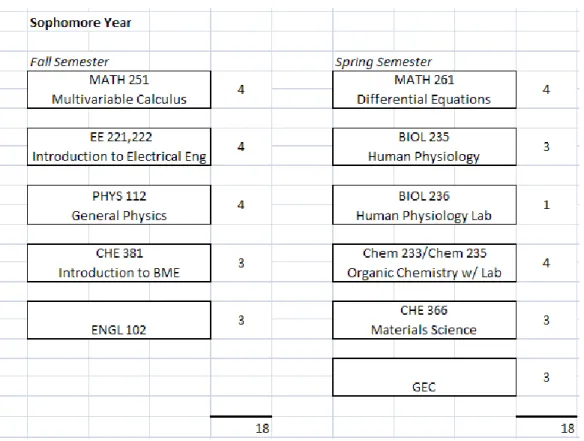
In the Statler College, students enter their program of choice in their second year. The curriculum for the sophomore year (shown in Table 4.2) will include multiple classes in the BMEG program as well as required core courses. Syllabi for Introduction to Biomedical Engineering (CHE 381), Human Physiology Lab (BIOL 236) and Materials Science (CHE 366) can be found in Appendix C. Because CHE 381 is currently offered during the junior year for the Biomedical Engineering certificate program, the course content and prerequisites will be modified slightly to accommodate sophomore level students in the degree program as well as changing the number to a 200-level course. Similarly, CHE 366 will be modified slightly to accommodate sophomore level students in the degree program and the course will also be changed to a 200-level course. The EE 221 and 222 courses will provide an introduction to electrical circuits that will be helpful for the Human Physiology Lab (BIOL 236); all syllabi for existing courses for the BMEG program can be found in Appendix C.
4.3.3 Junior Year
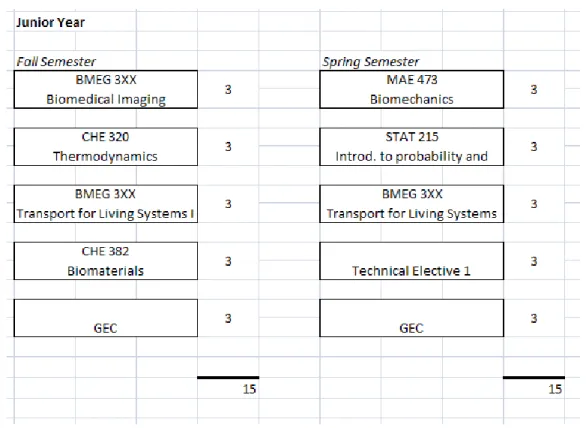
The curriculum for junior year (shown in Table 4.3) utilizes a combination of courses offered by the Department of Chemical Engineering as well as other departments in the Statler College and Eberly College. Specifically, students will take Thermodynamics and Biomaterials from the Chemical Engineering department and Biomechanics from the Mechanical and Aerospace Engineering department. The Thermodynamics course in Chemical Engineering focuses on phase equilibria and non-ideal systems, which directly apply to biological systems, and will enhance the BMEG program. It is pertinent for a student to have a strong understanding of theory and applicability of statistical methods in evaluating biomedical data and this is the reason for including STAT 215, Introduction to Probability and Statistics. Likewise, the 2-course sequence in Transport for Living Systems will provide the theoretical basis for much of the mathematical description and modeling of biomedical systems developed throughout the junior and senior years. The new Biomedical Imaging course will provide students with a comprehensive overview of the different techniques used to diagnose and evaluate data from medical imaging. The Biomechanics course (MAE 473) will provide an overview of the cardiovascular, musculoskeletal, pulmonary and cellular mechanics. The 300-level BMEG Biomedical Imaging course will be taught by a qualified faculty member of the Lane Department of Electrical and Computer Engineering, a letter of support on this matter is included in Appendix A. Syllabi for the four new courses in Biomedical Engineering can be found in Appendix D. Because MAE 473 is currently offered during the senior year in the Mechanical and Aerospace Engineering department, the course content and prerequisites will need to be modified slightly to accommodate junior level students in the degree program and
thus the course will be changed to a 300 level number; a syllabus can be found in Appendix C and letters of support from the Mechanical and Aerospace
department may be found in Appendix A. The first of four technical electives is also required in the spring of the third year. A compilation of the syllabi for the currently offered technical electives is given in Appendix E for courses closely allied to the Biomedical Engineering area. However, this does not preclude students taking other science-based or technology-based electives; a full list of suggested electives is given in Appendix F.
Table 4.3: Third year schedule of courses
4.3.4 Senior Year
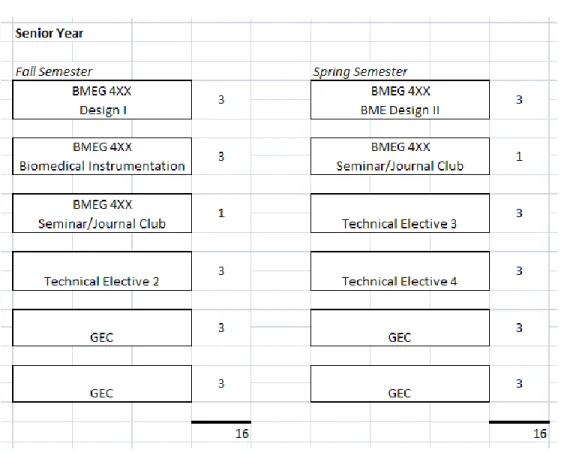
The final year schedule of courses is shown in Table 4.4. The course load will include three newly developed Biomedical Engineering courses (plus a 2-semester seminar sequence); syllabi are included in Appendix D. The Biomedical Instrumentation course will be a new course developed by faculty in the Department of Mechanical and Aerospace Engineering. Two new courses in Biomedical Engineering Design will be also added, to satisfy the University’s capstone requirement and the requirement for a writing course. The BMEG 4xx Design sequence will be team taught with faculty members in Chemical Engineering guiding groups of students through capstone projects. A 2-semester seminar course, in which students and outside speakers will discuss current topics in the biomedical engineering field, will also be scheduled. Likewise, this 400- level BMEG seminar series will be taught by the BMEG faculty, probably on a rotation basis. The syllabi for these courses are included in Appendix D. Three technical electives are required in the final year (chosen from courses listed in Appendices E and F), giving students an area of focus for their studies. These technical electives can be also fulfilled by Honors Senior Thesis.
Table 4.4: Fourth year schedule of courses
A complete curriculum chart is given in Appendix G. The total number of credits that will be required for students to complete the BMEG program is 131 hours. The curriculum allows students to include the requisite courses for pre-medical qualification. The proposed curriculum will require eight new courses, three of which will be offered for two semesters: Transport for Living Systems, BMEG Design and Seminar/Journal Club.
4.4 Qualified Faculty
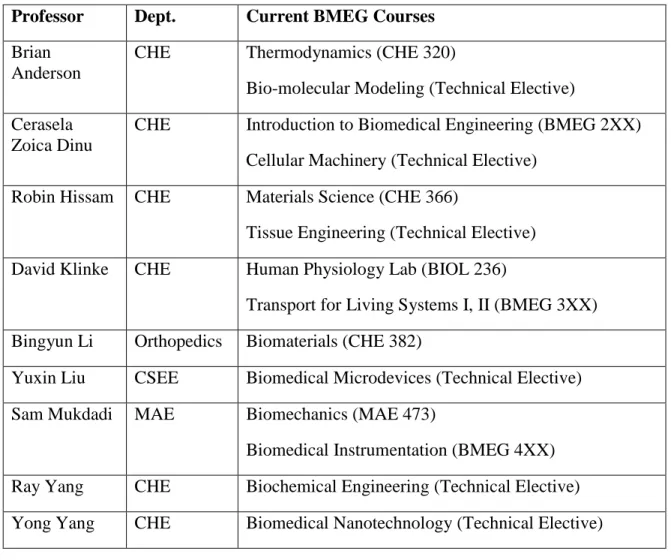
There are faculty members directly involved with the Biomedical Engineering program, as listed in Table 4.5. These professors are not only willing to give their time to the proposed program, but have also been instrumental in the organization and planning of the curriculum.
Table 4.5: Faculty involved in teaching courses in the Biomedical Engineering program Professor Dept. Current BMEG Courses
Brian Anderson
CHE Thermodynamics (CHE 320)
Bio-molecular Modeling (Technical Elective) Cerasela
Zoica Dinu
CHE Introduction to Biomedical Engineering (BMEG 2XX) Cellular Machinery (Technical Elective)
Robin Hissam CHE Materials Science (CHE 366)
Tissue Engineering (Technical Elective) David Klinke CHE Human Physiology Lab (BIOL 236)
Transport for Living Systems I, II (BMEG 3XX) Bingyun Li Orthopedics Biomaterials (CHE 382)
Yuxin Liu CSEE Biomedical Microdevices (Technical Elective) Sam Mukdadi MAE Biomechanics (MAE 473)
Biomedical Instrumentation (BMEG 4XX) Ray Yang CHE Biochemical Engineering (Technical Elective) Yong Yang CHE Biomedical Nanotechnology (Technical Elective)
Although the faculty members come from a variety of departments, the goal of the program is to introduce all aspects of biomedical engineering, which can only be achieved through a University-wide, collaborative and interdisciplinary effort.
5. Administration and Governance
The Biomedical Engineering program will be housed in the Chemical Engineering department, and the administration of the new degree program will rely heavily on the current faculty and staff. However, because this program is highly interdisciplinary, the administrations of multiple departments must work together for this program to succeed.
The availability of faculty members to teach courses within the program must be balanced with the courses they need to cover in their home department, a task that must be
taken on by the Chairs of the respective contributing departments. Based on the letters of commitment from the other participating departments in the Statler College (Appendix A) it is believed that the proposed curriculum is both feasible and realistic. The proposed fees and the enrollment procedures will be similar to the ones currently implemented in
the Statler College. The BMEG fee will be separated from the ChE fee and will be used to support the implementation and the development of the proposed BMEG program.
6. Plans for Roll-Out
The plan is to introduce this program to the freshman Cohort in Fall semester 2013. 7. Assessment Plan
The effectiveness of the program will be assessed using the following four methods. These methods have been developed by the Chemical Engineering department, and, since BMEG will be housed in this department, a common assessment plan will be utilized to ensure high quality standards as well as program improvement.
1) Starting in the sophomore year, oral and written presentations will be evaluated using established rubrics to assess the development of skills pertaining to the discipline and the outlined objectives.
2) Interviews of students by members of the Department Academy and Visiting Committee will give students the opportunity to voice suggestions, concerns and
opinions; contents will be summarized for a report to the Chair. Additional annual interviews of the students by the Department Chair will be reported to the faculty. This is typically done at a faculty retreat held before the beginning of each academic year.
3) Surveys will be given to students at the end of each year. Surveys will also be mailed to alumni to evaluate fulfillment of the program’s educational objectives.
4) Employers will be surveyed and information regarding job placement or post- graduate training will be requested to assess the attractiveness of our graduates to companies and other institutions.