© 2019 by the Serbian Biological Society How to cite this article: Božić D, Sarić-Krsmanović M, Matković A, Vranješ F, 305 Jarić S, Vrbničanin S. The response of weedy sunflower (Helianthus annuus L.) to
nicosulfuron: An examination of vegetative parameters and acetolactate synthase activity. Arch Biol Sci. 2019;71(2):305-13.
The response of weedy sunflower (
Helianthus annuus
L.) to nicosulfuron: an
examination of vegetative parameters and acetolactate synthase activity
Dragana Božić1, Marija Sarić-Krsmanović2, Ana Matković3, Filip Vranješ1 Snežana Jarić4 and Sava Vrbničanin1,*
1University of Belgrade, Faculty of Agriculture, Nemanjina 6, Belgrade, Serbia 2Institute of Pesticides and Environmental Protection, Banatska bb, Belgrade, Serbia 3Institute of Medicinal Plant Research “Josif Pančić”, Belgrade, Serbia
4Institute for Biological Research “Siniša Stanković” University of Belgrade, Bul. Despota Stefana 142, 11060 Belgrade, Serbia
*Corresponding author: [email protected]
Received: November 6, 2018; Revised: January 18, 2019; Accepted: February 14, 2019; Published online: March 5, 2019
Abstract: Genetic and morphological interpopulation variability of weed species is often responsible for variable responses to herbicides. As weedy sunflower, an invasive form of Helianthus annuus L., possesses high morphological and genetic variability, very different responses of its populations to herbicides can be expected. This species is one of the dominant weed species in row crops, including maize, in many European countries in which nicosulfuron is intensively used for weed control. There are little available data about the response of this sunflower form to nicosulfuron or of the interpopulation variability of its response to other herbicides. The responses of three weedy sunflower populations to nicosulfuron were studied in field dose-response experiments, and acetolactate synthase (ALS) enzyme activity at different herbicide concentra-tions was determined in vitro. Interpopulation variability in the response to nicosulfuron was confirmed. Populations WS2 and WS3 were more that 20-fold and 30-fold less susceptible to nicosulfuron, respectively, than population WS1, based on fresh weight, whereas the differences were not so prominent based on other parameters, including plant height, leaf area and ALS activity, and ranged from 2 to 12-fold.
Keywords: acetolactate synthase activity; dose-response; nicosulfuron; vegetative parameters; weedy sunflower
INTRODUCTION
Helianthus annuus L.(family Asteraceae) is a
spe-cies that occurs in many different forms: as “normal” crop plants, atypical plants known as “off-type” crops (which are the result of crossing sunflower hybrids with wild plants during seed production), wild sun-flower (present in the area of origin of sunsun-flower in America), volunteer plants (present in those areas where the cultivated sunflower was grown over the last one or two years), and weedy plants. The origin of weedy populations can be different: (i) the seeds of wild forms could be introduced unintentionally; (ii) during sunflower seed production, wild sunflow-ers could hybridize with crops, making crop-wild hybrids; (iii) weedy sunflower could result from the spontaneous evolution of its volunteer populations; and (iv) volunteer populations could hybridize with ornamental sunflowers grown in gardens [1]. Wild,
weedy and volunteer sunflower populations are of concern in several regions of the world because of their invasive capacity and crop interference [2-6]. In America, where common sunflower is native, weedy forms of sunflower strongly affect the yield of crops such as soybean and maize [7], while volunteer plants have never been reported to constitute self-perpetuating populations, nor to cause serious agronomic prob-lems [8]. In Europe, where sunflower is not native, volunteers are commonly present in the fields [8]. Furthermore, weedy populations are also present in some countries, including France [9], Spain [9,10], Hungary [11], Serbia [6,12], Croatia, Romania, etc. Muller et al. [1] have documented that the infestation of sunflower fields with weedy sunflower was between 13 and 27% in Spain, while the density of this weed in
France reached 15 plants m-2. The largest populations
Serbia prominent larger populations were recorded in the southern Srem (around 1000 ha of crop and non-crop fields) and southern Banat (around 7-8000 ha of crop and non-crop fields) areas in Vojvodina Province (northern Serbia) [6,12]. These populations show typi-cal wild traits in combination with domesticated traits, and they are morphologically clearly different from the volunteers from which they originate [9]. Owing to their highly competitive ability, these populations can cause considerable yield losses. Studying the impacts of weedy populations on sunflower cultivation, Muller et al. [9] found that weedy sunflowers greatly decrease crop yield, causing losses of more than 50%. Also, they have been documented to decrease the yield of soybean by up to 97% [13] and of maize up to 64% [14]. An additional problem with these populations can be the potential flow of the genes responsible for the tolerance to ALS- inhibiting herbicides from herbicide-tolerant sunflower hybrids to the weedy populations [15,16], leading to the development of resistant populations.
Nicosulfuron is a selective sulfonylurea herbicide for post-emergence control of sensitive perennial and annual grasses and some broadleaf weeds in corn [17,18]. The mode of action of this herbicide is the inhibition of the enzyme acetolactate synthase (ALS), also known as acetohydroxyacid synthase (AHAS), which controls the synthesis of amino acids (leucine, isoleucine and valine) needed for protein biosyn-thesis. The amino acid substitution in ALS enzyme, represented by 28 possible substitutions identified in different weed species, is the main mechanism of target-site-based resistance to this group of herbicides [19,20, 21]. Also, a non-target-site-based mechanism of resistance is possible [22]. Herbicides kill sensitive plants while resistant plants survive, leading to the development of resistant populations due to continuous and intensive herbicide use. Currently, weed resistance to nicosulfuron has been reported in 52 unique cases, with 23 species (12 dicots and 11 monocots) [19].
In America, many cases of common sunflower resistance to herbicides have been confirmed [23-25], but the response of European weedy sunflower populations to herbicides has rarely been studied [26,27]. Although weedy sunflower is present in some European countries, including France, Spain, Hungary, Croatia, Romania and Serbia, there are little data about its populations and their response to herbicides.
Since weedy sunflower is one of the dominant weeds in many maize fields in Serbia, as well as in many other European countries with intensive sunflower production where the application of nicosulfuron for weed control is very common, it is useful to know its response to this herbicide. Božić et al. [27] have con-firmed a reduction in the vegetative and generative production of this weed by the recommended rate of nicosulfuron application (40 g active ingredient (a.i.)
ha-1). Also, Zollinger [28] has documented a 50-70%
sunflower crop injury by nicosulfuron. Contrary to this, Brighenti et al. [29] found that nicosulfuron had no phytotoxic effect on sunflower crops. It may not be possible to extrapolate the results of these studies to the populations of weedy sunflower due to the high morphological and genetic variability of different sunflower forms [30-33]. Owing to the distinct mor-phological and genetic variations of weedy sunflower, which include different proportions of cultivated and wild traits, a very different response of its populations to herbicides can be expected. Also, the popularity of herbicide-tolerant sunflower hybrids included in the
Clearfield®, Clearfield Plus® and ExpresSun® systems
[34,35] further increases the potential for obtaining very variable responses of populations due to the gene flow between hybrids and weedy populations [16,36].
Therefore, the objective of this study was to study the response of weedy sunflower to nicosulfuron, with special emphasis on the interpopulation variability of that response.
MATERIALS AND METHODS
Seed collection
Dose response
A field dose-response experiment was performed in Padinska Skela in two consecutive years. The experi-mental layout was a completely randomized design, with four replicates. Young seedlings of three weedy sunflower populations were transplanted to the field from containers at the end of April. The plot size
was 5×4.2 m, with a plant density of 5.7 m-2
(inter-row spacing of 24 cm and the distance between (inter-rows being 70 cm). All the relevant information about the experiments is summarized in Table S1 and the me-teorological conditions during the experiment are shown in Table S2.
Four-leaf-stage plants were treated with different
rates of nicosulfuron (Motivell, 40 g ai L-1, SC, BASF,
Germany). Five herbicide rates (plus the untreated control) were used as follows: 10, 20, 40, 60 and 80 g
a.i. ha-1, with the recommended rate 40 g a.i. ha-1. The
herbicides were applied using a Neptune 15, Kwazar®
knapsack sprayer, delivering 300 L ha-1,equipped with
RS-MM 110°/04 nozzles. Plant height, fresh weight and leaf area were measured 30 and 33 days after treatment
(DAT) in the 1st and 2nd years, respectively. Plant height
and fresh weight of the aboveground part of plants were measured in the field immediately after sampling, while leaf area was measured using a Delta-T leaf area meter (Delta-T Devices, Burwell, Cambridge, UK) in the laboratory about 4-6 h after sampling.
ALS assay
For the ALS assay, seeds were sown in pots (38 cm2
surface area) containing a commercial potting mix (Flora Gard TKS1, Germany). The plants were grown in a controlled environment chamber with a 16/8 h
(day/night) photoperiod of light 300 μEm-2s-1 and
temperature of 28°C, and were irrigated manually
when needed. The in vitro ALS activity study was
conducted according to a procedure described by Ray [38], with some modifications described by Božić et al. [39]. This assay detects the production of acetoin from acetolactate, which is the ALS enzyme product. All procedures were performed at 4°C.
Young leaves from two-pair-leaf-stage seedlings were harvested for ALS enzyme extraction. Two g of the plant tissue was pulverized using a cold mortar and
pestle in 6 mL of extraction buffer (0.1 M potassium phosphate (pH 7.5) containing 1 mM sodium pyruvate,
0.5 mM thiamine pyrophosphate, 0.5 mM MgCl2, 10
μM flavin adenine dinucleotide (FAD) and 100 mL L-1
glycerol). The homogenates were filtered through a layer
of cheese cloth and centrifuged at 14000 x g for 25 min.
ALS contained in the supernatant was precipitated with ammonium sulfate and the solution was centrifuged at
14000 x g for 25 min. The supernatant was discarded
and the pellets were resuspended in the resuspension buffer (0.12 M potassium phosphate (pH 7.0)
contain-ing 20 mM sodium pyruvate, and 0.5 mM MgCl2).
Protein concentrations of the crude enzyme extracts were determined by the method of Bradford [40], using bovine serum albumin for the standard curve.
ALS activity was assayed by adding 0.1 mL of en-zyme preparation to 0.5 mL of the reaction mixture (20 mM potassium phosphate (pH 7.0) containing 20 mM sodium pyruvate, 0.5 mM thiamine pyrophosphate,
0.5 mM MgCl2, 10 μM FAD), containing increasing
concentrations of the tested herbicide. Nicosulfuron was added at rates of 0, 0.01, 0.1, 1, 10, 100 μM to all populations. The reaction mixture was incubated at 30°C for 1 h and the reaction was terminated by the
addition of 0.05 mL H2SO4 (6 N). Then, 0.5 mL of
creatine (5 g L-1 in water) was added and the solution
was incubated for 15 min at 60°C. The added sulfuric acid terminated the ALS reaction and decarboxylated the enzyme product acetolactate to acetoin. Acetoin
was detected as a colored complex (A525nm) formed
after the addition of 0.5 mL α-naphthol (50 g L-1 freshly
prepared in 2.5 N NaOH) and incubation at 60°C for 15 min. A standard curve was constructed using com-mercial acetoin. The experiment was conducted as a completely randomized design. Experiments for each combination of hybrid and herbicide were performed twice, with three replicates.
Data analysis
Dose response was used to analyze the following re-sponse parameters: plant height, fresh weight and leaf area from the field trials, as well as acetoin levels from the ALS assay. More specifically, dose-response analysis was based on the three-parameter log-logistic model:
y=d/(1+exp(b(log(x) – e))), where x and y denote
respectively. Parameter d denotes the average response for rate 0, whereas
pa-rameter e corresponds to the rate which
reduces the response by 50%;
param-eter b is proportional to the slope of the
dose-response curve at a rate equal to e,
i.e. the larger the value of b, the steeper
the dose-response curve [41,42]. For each response parameter, simultaneous models for all three populations were considered. Field trials repeated in two consecutive years were analyzed using separate models for the two years due to differences in meteorological condi-tions (Table S2). Parameter estimates with corresponding estimated standard errors are summarized in tables and the fitted dose-response curves are shown with average response values in graphs. The delta method was used to calculate
the standard errors of the ratios of GR50
(the dose required to reduce growth by 50%, i.e. I50,
which is the concentration required to inhibit activity by 50%) [41]. The statistical analyses and visualization of the fitted curves were carried out using the statistical
environment R and the extension package drc [41].
RESULTS
Response of weedy sunflower to nicosulfuron in the field
Dose-response experiments showed that the WS1, WS2 and WS3 weedy sunflower populations displayed very different responses to nicosulfuron (Fig. 1).
Approxi-mately 0.77-65.02 g nicosulfuron ha-1 was required to
reduce the vegetative parameters (plant height, fresh weight, leaf area) by 50%, depending on the parameter,
population and year. Generally, the GR50 values were
less than the recommended rate, with the exception of plant height in populations WS2 and WS3 in both years. The differences between the populations were
more pronounced for fresh weight. Namely, in the 1st
year it was observed that for a 50% reduction in fresh weight in the WS1 population, a rate of 0.77 g a.i.
ha-1 of nicosulfuron was required. This rate is about
25- and 37-fold less than the required rates for the
Fig. 1. Response of weedy sunflower populations (WS1, WS2, WS3) to nicosulfuron in the field based on: plant height (1st year – a; 2nd year – d), fresh weight (1st year – b; 2nd year – e) and leaf area (1st year – c; 2nd year – f).
Table 1. Parameters (±SE) of the log-logistic equation† used to calculate the rate of nicosulfuron application required for 50% reduction of plant height, fresh weight and leaf area (GR50; g a.i. ha-1) and ALS activity (I
50) of weedy sunflower populations.
Ye
ar
Par
am
et
er
Po
pu
la
tio
n
d b GR50 (g a.i. ha-1)
/I50 (µM)
1
st
Pl
ant
heig
ht WS1 80.80±2.30 0.33±0.07 30.73±7.34
WS2 80.12±2.22 1.20±0.14 60.46±4.46 WS3 94.11±2.15 1.38±0.14 62.59±3.42
Fr
es
h
w
eig
ht WS1 689.16±21.14 0.45±0.13 0.77±0.77
WS2 733.92±20.82 1.26±0.10 19.58±1.48 WS3 864.49±19.66 1.51±0.09 28.98±1.53
Le
af
ar
ea WS1 6601.50±89.89.39 0.54±0.06 1.52±0.45
WS2 6624.90±89.36 0.89±0.04 9.39±0.59 WS3 7289.60±88.73 0.92±0.04 17.99±0.77
2
nd
Pl
ant
heig
ht WS1 78.52±1.81 0.34±0.06 34.88±6.51
WS2 78.25±1.69 1.33±0.13 65.02±3.53 WS3 92.82±1.65 1.38±0.12 63.69±2.78
Fr
es
h
w
eig
ht WS1 669.07±14.21 0.47±0.09 0.91±0.57
WS2 713.36±13.93 1.30±0.07 21.18±1.07 WS3 843.89±13.05 1.56±0.07 29.89±1.06
Le
af
ar
ea WS1 6409.20±87.51 0.56±0.06 1.68±0.47
WS2 6431.90±87.46 0.91±0.04 10.30±0.61 WS3 7151.40±86.74 0.93±0.04 18.68±0.77
ALS a
ss
ay
(
in
v
itro
) WS1 3.93±0.08 0.36±0.02 0.03±0.01
WS2 3.56±0.08 0.41±0.02 0.11±0.02 WS3 3.53±0.07 0.48±0.02 0.17±0.03
populations WS2 (19.58 g a.i. ha-1)and WS3 (28.98 g
a.i. ha-1), respectively (Table 1). In the 2nd year, rates
for all three populations were slightly higher: 0.91 g
a.i. ha-1 for WS1, 21.18 g a.i. ha-1 for WS2 and 29.89
g a.i. ha-1 for WS3. The least sensitive parameter was
plant height and the rates of nicosulfuron needed to reduce this parameter by half varied from 30.73 g a.i.
ha-1 (WS1) to 62.59 g a.i. ha-1 (WS3), and from 34.88
(WS1) to 63.69 (WS3) in the 1st and 2nd years,
respec-tively (Table 1). The rates that caused a 50% reduction
in leaf area were from 1.52 g a.i. ha-1 (WS1) to17.99 g
a.i. ha-1 (WS3), and from 1.68 g a.i. ha-1 (WS1) to 18.68
g a.i. ha-1 (WS3) in the1st and 2nd years, respectively. The
ratio calculated from the GR50 values (Table 2) revealed
that the WS1 population was more sensitive than the other two populations, which was most noticeable in the fresh weight parameter.
In addition to the GR50 values, the slopes of the
dose-response curves (parameter b) varied
consid-erably between parameters and populations (Table
1), but were significantly (P=0.0001) lower for WS1
when compared with WS2 and WS3 for all vegetative parameters in both experimental years. The differences between WS2 and WS3 were mainly insignificant
(P>0.05), with the exception of fresh weight in the
2nd year (P=0.0093). The average response for rate 0
depended on the parameter, as indicated by parameter
d (Table 1). Thus, the untreated control did not differ
(P>0.05) between WS1 and WS2, while significant
differences (P=0.0001) were confirmed between WS1
and WS3 and between WS2 and WS3.
Response of weedy sunflower to nicosulfuron based on ALS activity
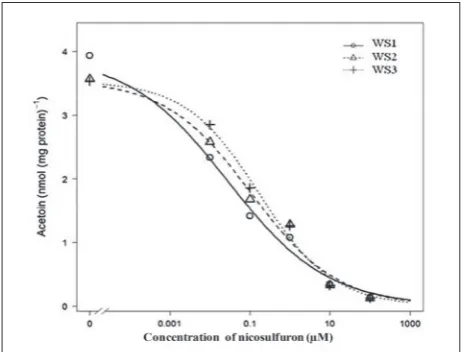
In vitro incubation of the ALS enzyme (Fig. 2) extracted
from the leaves of three weedy sunflower populations, with nicosulfuron concentrations ranging from 0.01 to 100 µM, caused 40-97%, 28-96% and 19-97% inhi-bition of enzyme activity in the WS1, WS2 and WS3 populations, respectively. Nicosulfuron required for
ALS I50 (herbicide concentration required to inhibit
the enzyme activity by 50%) was 0.03 µM, 0.11 µM and 0.17 µM for WS1, WS2 and WS3, respectively (Table 1). The level of ALS activity in the control was similar
in all three populations (parameter d in Table 1). Also,
the slopes of the dose-response curves (parameter b)
were similar for WS2 and WS3, while for WS1 the slope was slightly lower (Fig. 2). Based on the ratio
between I50 values, ALS from WS1 was about 4- and
6-fold more sensitive to nicosulfuron than ALS from WS2 and WS3, respectively. Meanwhile, the sensitiv-ity of ALS from WS1 and WS2 was similar (Table 2).
DISCUSSION
The results presented herein reflect a large range in the growth responses of weedy sunflower populations to nicosulfuron depending on population and growth
parameter. Generally, nicosulfuron GR50 values were
greater for WS2 and WS3 than for WS1, and mostly greater for WS3 than for WS2. The most pronounced
differences were obtained for fresh weight (1st year:
Table 2. GR50 (growth reduction by 50%) ratio of vegetative pa-rameters and ALS activity of three weedy sunflower populations in response to nicosulfuron.
Ye
ar Parameter Ratioa
WS2/WS1 WS3/WS1 WS3/WS2
1
st
Plant height(cm) 1.97 2.04 1.04
Fresh weight (g) 25.41 37.62 1.48
Leaf area (cm2) 6.16 11.80 1.92
2
nd
Plant height(cm) 1.86 1.82 0.98
Fresh weight (g) 23.37 32.98 1.41
Leaf area (cm2) 6.11 11.08 1.81
ALS assay 3.80 6.13 1.55
aRatio: GR
50 (WS1)/GR50 (WS2); GR50 (WS1)/GR50 (WS3);
GR50 (WS2)/GR50 (WS3).
25-fold (WS2/WS1) and 38-fold (WS3/WS1); 2nd year:
23-fold (WS2/WS1) and 33-fold (WS3/WS1)), indicat-ing that the WS1 population was much more susceptible to nicosulfuron than the other populations. Only 0.77
and 0.91 g a.i. ha-1 GR
50 values were estimated for this
population based on fresh weight in two consecutive year experiments. The susceptibility of this population to nicosulfuron was a little lower than the susceptibility
of Setaria faberi, whose GR50 value based on plant dry
weight was <0.5 g nicosulfuron ha-1 [43]. However,
this population was more susceptible to
nicosulfu-ron than the population of Amaranthus retroflexus
(GR50 = 4.11 g a.i. ha-1) [44] and Xanthium strumarium
(8 g a.i. ha-1) [45]. Unlike WS1, the populations WS2
(GR50: 25 g a.i. ha-1 and 23 g a.i. ha-1 in 1st and 2nd year,
respectively) and WS3 (GR50: 38 g a.i. ha-1 and 33 g a.i.
ha-1 in 1st and 2nd year, respectively) were considerably
less susceptible to nicosulfuron than the populations of
the abovementioned S. faberi and A. retroflexus, while
their susceptibility was similar to the one recorded
for X. strumarium populations, studied by Božić et
al. [45]. Similarly, significant differences in herbicide (thifensulfuron, also an ALS inhibitor) responses were
identified among the populations of Amaranthus rudis
and A. tuberculatus [46]. Explanations for such
herbi-cide response variability were the genetic variability of the studied species due to their dioecious nature and the development of herbicide resistance. In addi-tion to the reported differences between populaaddi-tions, differences in herbicide response were also visible between years, which was probably due to differences in environmental conditions, especially precipitation, during the period between sowing and sampling (the
1st year was characterized by slightly higher
precipita-tion than the 2nd year). This concurs with previous
studies demonstrating that environmental conditions significantly affect the activity and effects of foliage-applied herbicides [39, 45, 47].
The obtained results regarding in vitro ALS enzyme
activity with I50 values of WS2 (0.11 µM) and WS3 (0.17
µM) were similar to those for sensitive populations of
Ambrosia artemisiifolia (I50=0.137 µM), Avena fatua
(I50=0.104 µM), Panicum miliaceum (I50=0.135 µM),
A. retroflexus (I50=0.104 µM) [48] and X. strumarium
(I50=0.11 µM and I50=0.16, depending on the population)
[41] incubated with nicosulfuron, while this value for the WS1 population (0.03 µM) was significantly lower. These results prove that the differences in susceptibility
of weedy sunflower populations to nicosulfuron are the result of an altered susceptibility of the ALS enzyme, which is a confirmed mechanism of weed resistance [49-51] or crop tolerance to ALS-inhibiting herbicides in many cases [39,52]. Differences in response to nico-sulfuron between populations WS1, WS2 and WS3 were most evident when plant fresh weight was compared. Plant weight is the most suitable parameter for studies of plant responses to herbicides and resistance confirma-tion [22, 39,53], although in some cases resistance was confirmed based on plant height or leaf area [39,54]. However, vegetative parameters cannot provide an explanation for the mechanism of resistance, and ALS enzyme activity studies are necessary. Given that the investigation of ALS activity is a more sensitive method
than vegetative parameters, the ratio between the GR50/
I50 values for a resistant and sensitive population is
usu-ally higher for ALS activity [39,50]. Contrary to this, the
ratios between I50 values of WS2 and WS1 and WS3 and
WS1 were lower than the ratios between GR50 values for
the same populations based on fresh weight. Similarly, Hanson [49] obtained a much higher ratio between
the population of Camelina macrocarpa resistant to
chlorsulfuron and a sensitive population. A lower ratio for ALS activity points to a possible combination of two mechanisms of resistance – altered ALS enzyme and a metabolic mechanism; to confirm this, studies of nicosulfuron metabolism and molecular studies of ALS gene are necessary [22].
Previous research has shown that weed populations can vary greatly in their susceptibility to herbicides [46,55,56]. A possible reason for variability in the herbicide response can be the geographical origin of populations, which might be related to the differences in herbicide use or genetic variation [55]. On the other hand, populations from geographically close locations can show variability in their herbicide responses [56,57], which is in accordance with our results. Namely, deter-mination of the origin of weedy sunflower is specific in comparison to many other weed species because the population genesis can be very different [1]. Claerhout et al. [58] found a weak correlation between the mor-phological/genetic variations and herbicide sensitivity
of Echinochloa crus-galli and E. muricata accessions,
WS3, based on GR50 values for fresh weight, suggest the possibility of herbicide-resistance development. In order to clarify the reasons for variability in herbicide responses of weedy sunflower populations, studies of morphological and genetic variability, population origin and herbicide use history are necessary.
Funding: This research was supported by the Ministry of Educa-tion, Science and Technological Development of the Republic of Serbia, Grants III46008, 173018.
Author contributions: Sava Vrbničanin and Dragana Božić par-ticipated in the design of this study, the collection of samples, all analyses, measurements and calculations. Dragana Božić drafted
and wrote the manuscript.Marija Sarić-Krsmanović, Ana Matković
and Filip Vranješ participated in the work related to field and laboratory experiments. Snezana Jarić helped in drafting and writ-ing the manuscript, includwrit-ing critical revision of the manuscript.
Conflict of interest disclosure: The authors declare that they have no conflict of interest.
REFERENCES
1. Muller M-H, Latreille M, Tollon C. The origin and evolution of a recent agricultural weed: population genetic diversity of weedy populations of sunflower (Helianthus annuus L.) in Spain and France. Evol Appl. 2011;4:499-514.
2. Bervillé A, Müller MH, Poinso B, Serieys H. Ferality: Risks of gene flow between sunflower and other Helianthus spe-cies. In: Gressel J, editor. Crop ferality and volunteerism: a threat to food security in the transgenic era? Boca Raton, USA: CRC Press,; 2005. p. 209-30.
3. Müller MH, Arlie G, Bervillé A, David J, Delieux F, Fer-nandez- Martinez JM, Jouffret P, Lecomte V, Reboud X, Rousselle Y, Serieys H, Teissere N, Tsitrone A. Le comparti-ment spontané du tournesol Helianthus annuus en Europe: prospections et premières caracterisations génétiques. Actes BRG 2006;6:335-53.
4. Vischi M, Cagiotti ME, Cenci CA, Seiler GJ, Olivieri AM. Dispersal of wild sunflower by seed and persistent basal stalks in some areas of central Italy. Helia. 2006;29:89-94. 5. Stanković-Kalezić R, Kojić M, Vrbničanin S, Radivojević Lj.
Helianthus annuus- a new important element of the non-arable and non-arable flora in Serbia’s region of Southern Banat. Helia. 2007;30:37-42.
6. Saulić M, Stojićević D, Matković A, Božić D, Vrbničanin S. Population variability of weedy sunflower as invasive spe-cies. In: Uludag A, Trichkova T, Rat M, Tomov R, editors. Proceedings of the 4th ESENIAS Workshop: International Workshop on IAS in Agricultural and Non-Agricultural Areas in ESENIAS Region; 2013 Dec 16-17; Çanakkale, Turkey. 2013. p. 79-85.
7. Kane NC, Rieseberg LH. Genetics and evolution of weedy Helianthus annuus populations: adaptation of an agricultural weed. Mol Ecol. 2008;17:384-94.
8. Ostrowski MF, Rousselle Y, Tsitrone A, Santoni S, David J, Reboud X, Muller M-H. Using linked markers to estimate the genetic age of volunteer population: a theoretical and empirical approach. Heredity. 2010;105:384-93.
9. Muller M E, Delieux F, Fernandez Martinez J M, Garric B, Lecomte V, Anglade G, Leflon M, Motard C, Segura R. Occurrence, distribution and distinctive morphological traits of weedy Helianthus annuus L. populations in Spain and France. Genet Resour Crop Ev. 2009;56:869-77. 10. Poverene M, Cantamutto M. A comparative study of invasive
Helianthus annuus populations in their natural habitats of Argentina and Spain. Helia. 2010;33:63-74.
11. Benécsné Bárdi G, Hartman F, Radvány B, Szentey L. Veszé-lyes 48. VeszéVeszé-lyes, nehezen irtható gyomnövények és az ellenük való védekezés. Szekszárd: Mezőföldi Agrofórum Kft; 2005.
12. Vrbničanin S, Stojićević D, Božić D, Saulić S. Hibridna forma divljeg suncokreta Helianthus annuus L. Biljni lekar. 2014;42:257-72.
13. Geier PW, Maddux LD, Moshier LJ, Stahlman PW. Com-mon sunflower (Helianthus annuus) interference in soybean (Glycine max). Weed Technol. 1996;10:317-21.
14. Deines SR, Blinka EL, Regehr DL, Staggenborg SA. Common sunflower (Helianthus annuus) and shattercane (Sorghum bicolor) interference in corn. Weed Sci. 2004;52:976-83. 15. Massinga RA, Al-Khatib K, Amand PS, Miller JF. Gene flow
from imidazolinone-resistant domesticated sunflower to wild relatives. Weed Sci. 2003;51:854-62.
16. Božić D, Pavlović D, Bregola V, Di Loreto A, Bosi S, Vrbničanin S. Gene Flow from Herbicide-Resistant Sun-flower Hybrids to Weedy SunSun-flower. J Plant Dis Protect. 2015a;122:183-8.
17. Baghestani MA, Zand E, Soufizadeh S, Eskandari A, Poura-zar R, Veysi M, Nassirzadeh N. Efficacy evaluation of some dual purpose herbicides to control weeds in maize (Zea mays L.). Crop Prot. 2004;26:936-42.
18. Nosratti I, Hassan MA, Saeed R. Control of johnsongrass (Sorghum halepense) with nicosulfuron in maize at different planting patterns. J Agron. 2007;6:444-8.
19. Heap, I. The International Survey of Herbicide Resistant Weeds. 2019 [cited 2019 Jan 14]. Available from: http:// www.weedscience.org.
20. Powles SB, Yu Q. Evolution in Action: Plants Resistant to Herbicides. Annu Rev Plant Biol. 2010;61:317-47.
21. Brosnan JT, Vargas JJ, Breeden GK, Grier L, Aponte R A, Tresch S, Laforest M. A new amino acid substitution (Ala-205-Phe) in acetolactate synthase (ALS) confers broad spectrum resistance to ALS-inhibiting herbicides. Planta. 2016;243:149.
22. Mei Y, Si C, Liu M, Qiu L, Zheng M. Investigation of resis-tance levels and mechanisms to nicosulfuron conferred by non-target-site mechanisms in large crabgrass (Digi-taria sanguinalis L.) from China. Pestic Biochem Physiol. 2017;141:84-9.
24. White AD, Owen MDK, Hartzler RG, Cardina J. Common sunflower resistance to acetolactate synthase- inhibiting her-bicides. Weed Sci. 2002;50:432-7.
25. Zelaya IA, Owen MDK. Evolved resistance to acetolactate synthase–inhibiting herbicides in common sunflower (Heli-anthus annuus), giant ragweed (Ambrosia trifida), and shat-tercane (Sorghum bicolor) in Iowa. Weed Sci. 2004;52:538-48. 26. Vrbničanin S, Božić D, Sarić-Krsmanović M, Stojićević
D, Onc-Jovanović E. Ocena fitnesa populacija korovskog suncokreta (Helianthus annuus L.). Acta herbologica. 2013;22:89-99.
27. Božić D, Vrbničanin S, Stojićević D, Pavlović D. Effect of nic-osulfuron on the populations of invasive weedy sunflower.
In: Nordmeyer H, Ulber L, editors. Proceedings of 27th
Ger-man Conference on Weed Biology and Weed Control; 2016 Feb 23-25; Braunschweig, Germany. 2016. p. 225-31. 28. Zollinger RK. Advances in sunflower weed control in the
USA. In: Seiler GJ, editor. Proceedings of the 16th Interna-tional Sunflower Conference; 2004 Aug - Sept 29; Fargo, North Dacota, USA. Fargo, ND; 2004. p. 435-39.
29. Brighenti AM, Souza Sobrinho F, Rocha WSD, Castro C, Martins CE, Muller MD. Reduced rates of herbicides applied to imidazolinone- resistant sunflower crossbred with Brachi-aria ruziziensis. Helia. 2011;34:49-58.
30. Poverene M, Cantamutto MA, Carrera A, Ureta S, Alva-rez D, Alonso Roldan V, Presotto A, GutierAlva-rez A, Luis S, Hernandez A. Wild sunflower research in Argentina. Helia. 2006;29:65-76.
31. Reagon M, Snow AA. Cultivated Helianthus annuus (Astera-ceae) volunteers as a genetic „Bridge“ to weedy sunflower populations in North America. Am J Bot. 2006;93:127-33. 32. Dimitrijević A, Cantamutto M, Poverene M, Stojićević D,
Božić D, Vrbničanin S, Imerovski I, Miladinović D. Agro-ecological characterization of the wild sunflower from three sunflower crop regions of South America and Europe. In: Proceedings of International Conference „Capturing wild relative and landrace diversity for crop improvement“; 2014 Jun 16-20; Cambridge, England. 2014. p. 86.
33. Stojićević D, Saulić M, Božić D, Dimitrijević A, Miladinovic D, Vrbničanin S. Population Variability of Weedy Sunflower Based on Seed Morphological Traits. In: Fried G, Bon MC, Brundu G, Brunel S, Chauvel B, Cheptou PO, Hatcher PE, Haury J, Jourdan M, Kazakou E, Le Bourgeois T, Mandon-Dalger I, Marchante H, Mekki M, Müller-Schärer H, Novak S, Recasens J, Sforza R, Sheppard A, Vitou J, editors.
Pro-ceedings of 4th International Symposium “Environmental
Weeds and Invasive Plants”; 2014 May 19-23; Montpellier, France. 2014. p. 105.
34. Tan S, Evans RR, Dahmer ML, Singh BK, Shaner DL. Imid-azolinone-tolerant crops: history, current status and future. Pest Manag Sci. 2005;61:246-57.
35. DD2008-69: Determination of the Safety of Pioneer Hi-Bred Production Ltd.’s Sulfonylurea - Tolerant ExpressSun™ Sun-flower (Helianthus annuus) L. SU7 [Internet]. Plant Health and Biosecurity Directorate and the Animal Health Direc-torate of the Canadian Food Inspection Agency; 2008 Feb [updated 2017 Sep 15; cited 2018 Oct 18]. Available from: http://www.inspection.gc.ca/english/plaveg/bio/dd/dd0869e. shtml
36. Faure N, Serieys H, Bervillé A. Potential gene flow from cul-tivated sunflower to volunteer, wild Helianthus species in Europe. Agric Ecosyst Environ. 2002;89:183-90.
37. Gilmore EC, Rogers RS. Heat units as a method of measur-ing maturity in corn. Agron J. 1958;50:611-5.
38. Ray TB. Site of Action of Chlorsulfuron. Plant Physiol. 1984;75:827-31.
39. Božić D, Sarić M, Malidža G, Ritz C, Vrbničanin S. Resis-tance of sunflower hybrids to imazamox and tribenuron-methyl. Crop Prot. 2012;39:1-10.
40. Bradford MM. A Rapid and Sensitive Method for the Quantitation of Microgram Quantities of Protein Utiliz-ing the Principle of Protein–Dye BindUtiliz-ing. Analyt Biochem. 1976;72:255-60.
41. Ritz C, Streibig JC. Bioassay analysis using R. J Stat Softwa. 2005;12:1-22.
42. Ritz C. Towards a unified approach to dose-response model-ling in ecotoxicology. Environ Toxicol Chem. 2010;29:220-9. 43. Volenberg DS, Stoltenberg DE, Boerboom CM. Biochemi-cal mechanism and inheritance of cross-resistance to acetolactate synthase inhibitors in giant foxtail. Weed Sci. 2001;49:635-41.
44. Scarabel L, Varotto S, Sattin M. European biotype of Ama-ranthus retroflexus cross-resistant to ALS inhibitors and response to alternative herbicides. Weed Res. 2007;47:527-33.
45. Božić D, Barac M, Sarić-Krsmanović M, Pavlović D, Ritz C, Vrbničanin S. Common Cocklebur (Xanthium stru-marium) Response to Nicosulfuron. Not Bot Horti Agrobo. 2015;43:186-91.
46. Patzoldt WL, Tranel PJ, Hager AG. Variable herbicide responses among Illinois waterhemp (Amaranthus rudis and A. tuberculatus) populations. Crop Prot. 2002;21:707-12. 47. Kudsk P, Kristensen JL. Effect of environmental factors on
herbicide performance. In: Proceedings of the First Inter-national Weed Control Congress; 1992 Feb 17-21; Monash University, Melbourne, Australia. 1992. p 173-86.
48. Mekki M, Leroux GD. Inhibition of plant acetolactate syn-thase by nicosulfuron, rimsulfuron, and their mixture DPX-79406. Weed Sci. 1994;42:327-32.
49. Hanson BD, Park KW, Mallory-Smith CA, Till DC. Resis-tance of Camelina microcarpa to acetolactate synthase inhib-iting herbicides. Weed Res. 2004;44:187-94.
50. Maertens KD, Sprague CL, Tranel PJ, Hines RA. Amaranthus hybridus populations resistant to triazine and acetolactate synthase-inhibiting herbicides. Weed Res. 2004;44:21-6. 51. Merotto A Jr, Jasieniuk M, Osuna MD, Vidotto F, Ferrero
A, Fischer AJ. Cross-Resistance to Herbicides of Five ALS-Inhibiting Groups and Sequencing of the ALS Gene in Cype-rus difformis L. J Agricult Food Chem. 2009;57:1389-98. 52. Abayo GO, English T, Eplee RE, Kanampiu JK, Ransom JK,
Gressel J. Control of parasitic witchweeds (Striga spp.) on corn (Zea mays) resistant to acetolactate synthase inhibitors. Weed Sci. 1998;46:459-66.
54. Park KW, Mallory-Smith CA. Multiple herbicide resistance in downy brome (Bromus tectorum) biotypes. Weed Sci. 2005;53:780-6.
55. Escorial C, Loureiro I, Rodríguez-García E, Chueca C. Popu-lation variability in the response of ripgut brome (Bromus diandrus) to sulfosulfuron and glyphosate herbicides. Weed Sci. 2011;59:107-12.
56. Espeby LA, Fogelfors H, Milberg P. Susceptibility variation to new and established herbicides: examples of inter- popu-lation sensitivity of grass weeds. Crop Prot. 2011;30:429-35.
57. Schulz A, Mathiassen SK, de Mol F. Approaches to early detection of herbicide resistance in Apera spica-venti regard-ing intra- and inter- field situations. J Plant Dis Protect. 2014;121:138-48.
Supplementary Data