ISSN-L: 2501 - 1235 Available on-line at: www.oapub.org/edu
doi: 10.5281/zenodo.1310040 Volume 4 │ Issue 8 │ 2018
EFFECTS OF YOGIC PRACTICE ON
SELECTED BODY COMPOSITION VARIABLES
AMONG MILD INTELLECTUALLY CHALLENGED PERSONS
A. Yuvaraji
Dr., Post-Doctoral Fellow (UGC-DSRPDFHS), Department of Physical Education and Sports,
Pondicherry University, Pondicherry, 605014, India
Abstract:
Purpose of the study was to facilitate the Effects of yogic practices on selected body composition variables among intellectually challenged persons for this study twenty (N=20) male mild intellectually challenged persons were randomly selected as a subject from Paradise special school, Muttukadu in Chennai, India. Their Age ranged between 14-18 years. They were randomly divided in to two equal groups of ten (n=10) subjects each namely experimental group and Control group. Experimental group underwent to yogic practice for the period of twelve weeks and no training are given to the control group. Body composition variables such as Body Mass Index (BMI) and percentage body fat (%) were selected as dependent variables and independent variables were only yoga. The data was collected before and after the experimental treatment period. Analysis of Covariance (ANCOVA) statistical technique was used in this study. It was concluded that Body Mass Index (BMI) and percent body fat (%) level of experimental group were significantly altered due to the influence of twelve weeks practices of yoga when compare with control group of mild intellectually challenged persons.
Keywords: mild intellectually challenged persons, body composition variables, BMI, and percentage body fat
1. Introduction
Physical activity is very importance for the entire human being not only normal population and also the special population especially intellectually challenged persons, to make them fit and to prevent them from disease like heart problem, kidney, lung disorder and liver problems, I have carryout this topic, through my training we can
prevent them in all kind of disease and we can be extent life span of the Intellectually challenged persons.
2. Intellectually Challenged Persons
Mental retardation (MR), learning disability or intellectually challenged is a common disorder among the children, characterized by significantly impaired cognitive functioning and deficits in two or more adaptive behaviours. It has been historically defined as an intelligence quotient score under 70. Once focused almost entirely on cognition, the definition now includes both a component relating to mental functioning and one relating to individual’s functional skills in their environment. As a result, a person with a below average an intelligence quotient may not be considered mentally retarded. Syndrome mental retardation is intellectual deficits associated with other medical and behavioural signs. Non syndrome mental retardation refers to intellectual deficits that appear without other abnormalities.
Persons diagnosed as having significantly lower than average intelligence and considerable problem in adapting to everyday life or lacking independence in regard to activities of daily living (Medical Dictionary, 12 December 1998).
Based on their IQ score, they were divided in to five categories namely; Mild, Moderate, Sever and Profound.
3. Yogic Practice
Yoga poses for meditation helps the yogi to sit in a steady posture for extended periods of time. Also, we have to select a yoga posture that allows the spinal column to be upright and straight. There are only few yoga poses for meditation that satisfy these two conditions.
Yoga Poses or Asanas are postures aimed at developing a healthy body and mind. The Patanjali Yoga Sutras define Asana as – ‘Sthiram Sukham Asanam’, which means Asana is a pose that is steady and comfortable. Asana is the third step in Maharishi Patanjali’s Ashtanga yoga. Asanas or yogic poses are aimed towards attaining strength, flexibility, balance and steadiness. Apart from the spiritual benefits, each Yoga pose also has its specific health benefits.
4. Statement of the Problem
5. Hypothesis
1. It was hypothesis that there would be significant changes in body composition
variable such as Body Mass Index (BMI) among Mild intellectually challenged persons due to the influence of twelve weeks of yogic practice.
2. It was hypothesis that there would be significant changes in body composition
variables such as percentage of body fat (%) among Mild intellectually challenged persons due to the of twelve weeks influence of yogic practice.
6. Methodology
Purpose of the study was to facilitate the effects of yogic practices on selected body composition variables among intellectually challenged persons for this study twenty (N=20) male mild intellectually challenged persons were randomly selected as a subject from Paradise special school, Muttukadu in Chennai, India. Their age ranged between 14-18 years. They were randomly divided in to two equal groups of ten (n=10) subjects each namely experimental group and Control group. Experimental group underwent to yogic practice for the period of twelve weeks and no training are given to the control group for the period of twelve weeks. Body composition variables such as BMI and percentage body fat were selected as dependent variables and independent variables were only sand training. The data was collected before and after the experimental treatment period. Analysis of covariance (ANCOVA) statistical technique was used in this study.
7. Result and Discussions of Body Mass Index (BMI)
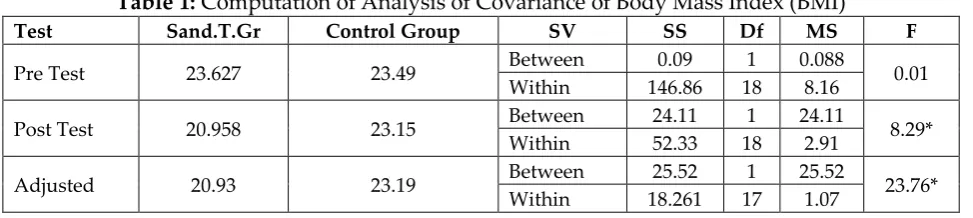
The statistical analysis of comparing the initial and final means of Body Mass Index (BMI) due to Effects of yogic practices on selected body composition variables among mild intellectually challenged persons is presented in Table 1.
Table 1: Computation of Analysis of Covariance of Body Mass Index (BMI)
Test Sand.T.Gr Control Group SV SS Df MS F
Pre Test 23.627 23.49 Between 0.09 1 0.088 0.01
Within 146.86 18 8.16
Post Test 20.958 23.15 Between 24.11 1 24.11 8.29* Within 52.33 18 2.91
Adjusted 20.93 23.19 Between 25.52 1 25.52 23.76*
Within 18.261 17 1.07 *significant at0.05 of, for 1 and 18 (df) =3.1, 1 and 17 (df) =3.1
proud that the obtained F value 8.29 was greater than the required value of 3.1 be significant at 0.05 level. Taking in to consideration of the pre-test means adjusted post-test means were done and the obtained F value 23.76 was greater than the required value of 3.1and hence it was accepted that the yoga significantly lesser the Body Mass Index (BMI).
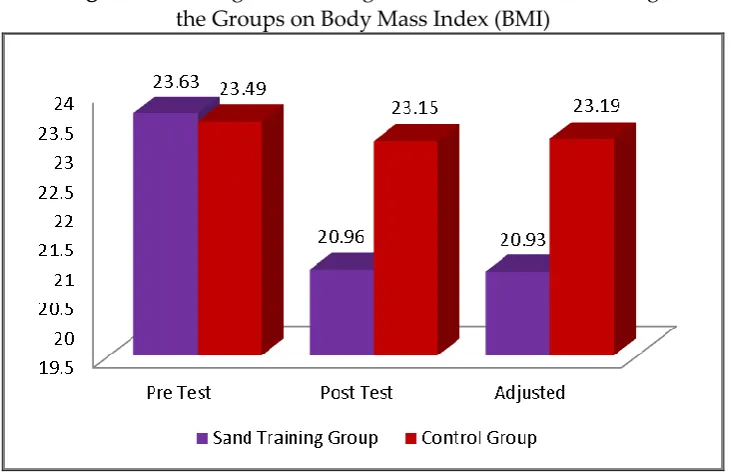
BMI was measured by using BMI formula which is weight/height in meters (2), the result presented in Table 1 showed significant differences in the adjusted means, as the obtained F value was greater than the required F value. It was also proved that there was a significance difference between experimental and control group. The pre, post and adjusted posttest mean values of yoga and control group of intellectually challenged person’s Body mass index (BMI) are graphically represented in the Figure 1.
Figure 1: Bar Diagram Showing the Mean Differences among the Groups on Body Mass Index (BMI)
7.1 Results on Percentage of Body Fat (%)
The statistical analysis of comparing the initial and final means of Percentage of Body Fat. Due to effects of yogic practices on selected body composition variables among mild intellectually challenged persons is presented in Table 2.
Table 2: Computation of Analysis of Covariance of Percentage of Body Fat
Test Sand.T.Gr Control Group SV SS df MS F
Pre Test 30 30.20 Between 0.20 1 0.200 0.02
Within 191.60 18 10.64
Post Test 27.4 30.90 Between 61.25 1 61.25 6.67*
Within 165.30 18 9.18
Adjusted 27.48 30.82 Between 55.48 1 55.48 30.08*
As shown in Table 2 the obtained F value on the scores of the pre-test means 0.02 was lesser then the required table value of 3.1, which proved that the random assignment of the subject was successful and their scores in percentage of body fat before the training were equal and there were no significant differences. The analysis of post-test means proud that the obtained F value 6.67 was greater than the required value of 3.1 is significant at 0.05 level. Taking in to consideration of the pre-test means adjusted post-test means were done and the obtained F value 30.08 was greater than the required value of 3.1 and hence it was accepted that the yoga significantly lesser the percentage of body fat.
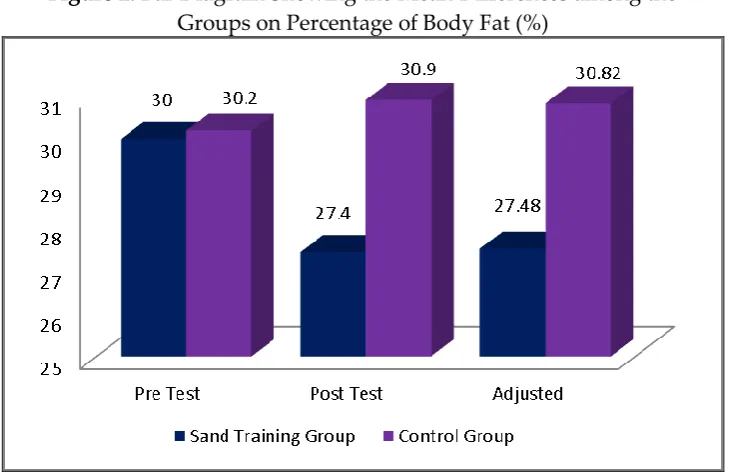
Percentage of body fat was measured by using skin fold caliper and measuring tape of around 7 points of subject body, the result presented in Table 2 showed significant differences in the adjusted means, as the obtained F value was greater than the required F value. It was also proved that there was a Significance difference between experimental and control group. The pre, post and adjusted posttest mean values of yoga and control group of intellectually challenged person’s percentage of body fat (%) are graphically represented in the Figure 2.
Figure 2: Bar Diagram Showing the Mean Differences among the Groups on Percentage of Body Fat (%)
7.2 Discussion on Hypotheses
1. For the purpose of the study, the investigator formulated two hypotheses
number first hypotheses stating that it was hypothesis that there would be a significant changes in body composition variable such as BMI among Mild
intellectually challenged persons due to the influence of yogic practice. The
2. It was hypothesis that there would be a significant changes in body composition variable such as percentage of body fat among mild intellectually challenged persons due to the influence of yogic practice The result presented in Table 2 proved that there were significant differences among the yoga and control group on the selected criterion variables such as percentage of body fat (%) the results proved that yogic practice has significantly altered than the control group.
8. Conclusion
The following conclusions were drawn within the limitations and delimitations of this study:
1. The obtained result shows that there was a significant change in Body Mass
Index (BMI) among mild intellectually challenged persons; this was due to six weeks of yogic practice.
2. The obtained result shows that there was a significant change in percentage of
body fat (%) among mild intellectually challenged persons; this was due to six weeks of yogic practice.
References
1. Blaak, El. E. and Saris, Wim, H. M. 2002. Substrate oxidation, obesity and exercise
training. Best practice & research. Clinical Endocrinology & Metabolism, 16(4): 667-678.
2. Jince Kappan (2012) Effect of Sand Running and Weight Training on Selected
Body composition variables of College Men, IJSR - International Journal Of Scientific Research, Volume: I, Issue: VII, December - 2012
3. Pavel Kumar (2015) Impact of Yoga for Endurance Development among
Athletes, International Journal of Applied Research 2015; 1(7): 503-506
4. Siff, M., Super training (4th Edition) Super training Institute; 6th edition, 2003.
5. Sivamani and D. Sultana (2014) Effect of Yoga with and without Plyometric Exercises on Selected Physical Fitness Variables Among Pondicherry University Athletes, Indian Journal of Science and Technology, Vol. 7(S7), 24-27, November 2014.
Creative Commons licensing terms