CHEMICAL INTERACTIONS BETWEEN IRON AND ARSENIC IN WATER
Richard Johnston
A dissertation submitted to the faculty of the University of North Carolina at Chapel Hill in partial fulfillment of the requirements for the degree of Doctor of Philosophy in the Department of Environmental Sciences and Engineering, School of Public Health
Chapel Hill 2008
Approved by:
ABSTRACT
Richard Johnston: Chemical interactions between iron and arsenic in water (Under the direction of Philip C. Singer)
This dissertation presents results from a series of experiments involving precipitation of ferrous arsenate, redox reactions between various Fe/As couples, and competitive adsorption. Batch and column experiments were made and interpreted quantitatively using geochemical modeling.
A new solubility constant was calculated for symplesite, a ferrous arsenate mineral, and geochemical modeling suggests that some arsenic-impacted groundwaters in Bangladesh are super-saturated with respect to this mineral. Oxidation experiments demonstrated that oxygenation of Fe(II) is much faster in the presence of inorganic buffers than when non-complexing organic buffers are used. Fe(II) oxidation was largely unaffected by the presence of the hydroxyl radical scavenger propanol. These findings call into question the classic formulation of Fe(II) oxygenation, and long-accepted kinetic rate constants.
During the oxygenation of Fe(II), As(III) competes with Fe(II) for reactive oxidizing species. As(III) oxidation is reduced in the presence of inorganic ligands, most likely because these ligands increase the reactivity of dissolved Fe(II).
iii
after contacting the goethite surface. This could be explained by the existence of sites which can adsorb Fe(II) but not As. However, surface complexation modeling with this approach could not capture some of the aspects of multi-component adsorption. An alternate explanation could be that upon adsorption Fe(II) transfers an electron into the bulk surface of the goethite, regenerating Fe(III) at the surface and allowing more adsorption to take place.
ACKNOWLEDGEMENTS
I would first of all like to thank my dissertation advisor, Professor Phil Singer, for allowing me to explore my interests in arsenic, even though it was not an area of active research for him, and for all the mentoring and guidance he has provided me over the years. I could never have set up the UNC laboratory experiments, especially that beautiful old AAS and all the column plumbing, without the assistance of Glenn Walters and Randy Goodman, and I thank Professor Dharni Vasudevan for the use of her glovebox and laboratory at Duke. I also thank the other members of my dissertation committee, Professors Casey Miller, Larry Benninger and Bill Glaze (Emeritus) at UNC, and Urs von Gunten at EAWAG, for their advice and patience. I greatly appreciate the fellowships provided by the UNC Graduate School and the National Science Foundation which made this work possible.
I am grateful to UNICEF for giving me the opportunity to work on arsenic mitigation in Bangladesh both before and after my time at UNC. It has been a privilege and a great learning experience, in spite of all the challenges. Thanks to my colleagues there for their friendship and support, and to my supervisor Paul Edwards for endorsing my request to take time off (during the monsoon flood season, even) to complete and defend this dissertation.
v
TABLE OF CONTENTS
Page
ABSTRACT ... ii
ACKNOWLEDGEMENTS ... iv
TABLE OF CONTENTS ...v
LIST OF TABLES ... viii
LIST OF FIGURES ... ix
CHAPTER 1: INTRODUCTION ...1
1.1 Background ...1
1.1.1 Geochemistry of arsenic and iron ...3
1.1.2 Adsorption onto iron oxides ...8
1.1.3 Oxidation ...16
1.1.4 In situ water treatment ...21
1.2 Research objectives ...25
1.3 Organization of thesis ...26
CHAPTER 2: SOLUBILITY OF SYMPLESITE (FERROUS ARSENATE): IMPLICATIONS FOR REDUCED GROUNDWATERS AND OTHER GEOCHEMICAL ENVIRONMENTS ...29
2.1 INTRODUCTION ...29
2.2 MATERIALS AND METHODS ...32
2.2.1 Chemicals ...32
2.2.2 Experimental and analytical methods ...33
2.3 RESULTS ...34
2.4 DISCUSSION ...40
2.4.1 Bangladesh ...40
2.4.2 Other environments ...46
CHAPTER 3: REDOX REACTIONS IN THE FE–AS–O2 SYSTEM ...48
3.1 Introduction ...48
3.1.1 Iron ...49
3.1.2 Arsenic and iron ...51
3.2 Materials and methods ...53
3.2.1 Chemicals ...53
3.2.2 Goethite ...53
3.2.3 Reduction of As(V) by Fe(II) ...54
3.2.4 Co-oxidation of As(III) and Fe(II) by O2 ...55
3.2.5 Speciation and measurement of dissolved arsenic and iron ...56
3.3 Results and discussion ...57
3.3.1 Reduction of As(V) by Fe(II) ...57
3.3.2 Co-oxidation of As(III) and Fe(II) by O2 ...62
3.4 Summary and conclusions ...69
CHAPTER 4: COMPETITIVE ADSORPTION OF AS(III), AS(V), AND FE(II) ONTO GOETHITE ...71
4.1 Introduction ...71
4.2 Experimental section ...75
4.2.1 Chemicals ...75
4.2.2 Goethite synthesis ...76
4.2.3 Adsorption kinetics ...76
4.2.4 Adsorption isotherms ...77
4.2.5 Adsorption edges and envelopes ...78
4.2.6 Speciation and measurement of dissolved arsenic and iron ...79
4.2.7 Geochemical modeling ...80
4.3 Results and discussion ...81
4.3.1 Adsorption kinetics ...81
4.3.2 Adsorption isotherms ...83
4.3.3 Competitive adsorption of As(III) and As(V) ...87
vii
CHAPTER 5: IN SITU REMOVAL OF FE(II) AND AS(III): COLUMN STUDIES 95
5.1 Introduction ...95
5.2 Materials and methods ...100
5.2.1 Chemicals ...100
5.2.2 Goethite-coated sand ...100
5.2.3 Column packing and characterization ...101
5.2.4 Experimental design ...101
5.2.5 Measurement of As and Fe ...105
5.2.6 Measurement of dissolved oxygen ...105
5.2.7 Geochemical modeling ...105
5.3 Results ...106
5.3.1 Iron ...108
5.3.2 Oxygen ...110
5.3.3 Arsenic ...111
5.3.4 Geochemical modeling ...113
5.4 Discussion ...116
5.4.1 Implications for in situ treatment ...116
5.4.2 Geochemical modeling and interpretation ...118
CHAPTER 6: CONCLUSIONS AND RECOMMENDATIONS ...120
6.1 Conclusions ...120
6.2 Recommendations ...123
APPENDIX A: X-Ray Diffraction Patterns ...128
APPENDIX B: SUPPLEMENTARY INFORMATION ...129
LIST OF TABLES
Page
Table 1-1: Acidity constants for arsenate and arsenite ...4
Table 1-2: Solubility of Fe(II) and Fe(III) minerals ...7
Table 1-3: Points of zero charge for common iron oxides ...8
Table 1-4: Log rate (k in M-1s-1) and equilibrium (K) constants for oxidation reactions ...21
Table 2-1: PHREEQC model parameters for dissolved species ...37
Table 2-2: Thermodynamic solubility products (pKso) for Me(II)3(YO4)2•8(H2O) ...40
Table 2-3: Solubility products used for geochemical modeling ...43
Table 2-4: Geochemistry of Bangladesh groundwater samples oversaturated with respect to symplesite. ...45
Table 4-1: PHREEQC model parameters ...81
ix
LIST OF FIGURES
Page
Figure 1-1: pe-pH diagram for arsenic at 25°C ...4
Figure 1-2: pe-pH stability diagram for 10-5 M iron, 25°C ...7
Figure 1-3: Adsorption of arsenate (a) and arsenite (b) onto ferrihydrite ...13
Figure 2-1: Precipitation of ferrous arsenate. ...35
Figure 2-2: Ferrous arsenate stoichiometry ...36
Figure 2-3: Log ion activity products for ferrous arsenate and ferrous hydroxide ...38
Figure 2-4: Stability field for symplesite. ...41
Figure 2-5: Cumulative frequency distributions of saturation indices for various minerals ...44
Figure 3-1: As(III) production in goethite suspension. ...59
Figure 3-2: Comparison of extent of Fe(II) adsorption and observed rate constant for As(III) production. ...60
Figure 3-3: Impact of sorbed Fe(II) on observed rate constant for As(III) production. ...61
Figure 3-4: Effect of buffering agents on iron oxidation kinetics ...63
Figure 3-5: As(V) production resulting from co-oxidation of As(III) with Fe(II) in the presence of various buffering agents. ...65
Figure 3-6: Effect of As(III) on the kinetics of Fe(II) oxidation. ...66
Figure 3-7: Comparison of As(V) yield per mole Fe(II) oxidized...67
Figure 4-1: Adsorption kinetics for 30 µM As(III) and As(V) onto goethite. ...82
Figure 4-2: Adsorption isotherms for As(III), As(V), and Fe(II) ...84
Figure 4-3: Adsorption of As(III), As(V), and As(total) in single-sorbate and binary-sorbate systems. ...89
Figure 4-4: Adsorption of Fe(II) and As(III) in single-ion and binary systems. ...93
Figure 5-1: Breakthrough curves for dissolved oxygen, ferrous iron, and arsenic ...107
CHAPTER 1: INTRODUCTION
1.1 Background
Arsenic is a drinking water contaminant of great public health concern, as low levels of exposure can lead to a variety of cancer (skin, lung, bladder) and non-cancer (diabetes mellitus, vascular hypertension, dermal lesions) endpoints (WHO 2001). In 2001, the USEPA lowered its maximum contaminant level (MCL) for arsenic in drinking water from 50 to 10 µg/L (USEPA 2001b).
Widespread arsenic contamination of groundwater affects tens of millions of people in Asia and Latin America, with arsenic levels of over 1000 µg/L frequently reported. In the United States such gross contamination has been reported in only a few instances, but a large number of municipalities face low-level arsenic contamination, chiefly in their groundwater sources. It is estimated that 5% of U.S. municipalities will need to provide some kind of treatment to comply with the new MCL (USEPA 2001b). The vast majority of affected systems are small utilities servicing fewer than 10,000 people. Estimates of annualized compliance costs in the U.S. range widely, from 180 million dollars (USEPA 2000) to 955 million dollars (Frey, Owen et al. 1998), but the arsenic rule will be expensive by any standard.
fixed-bed adsorption onto granular ferric hydroxide is gaining in popularity. Ion exchange and reverse osmosis are also potential treatment technologies, but have not found as wide application. Most of these treatment trains require pre-oxidation, since arsenate [As(V)] is much easier to remove than arsenite [As(III)]. Small systems often have no treatment apart from chlorination and corrosion control, so adding an arsenic removal train will require considerable infrastructure modifications and training.
Subsurface immobilization of arsenic might be an effective alternative to above-ground treatment (Rott and Friedle 2000). In situ immobilization of ferrous iron has been practiced effectively for decades, chiefly in Europe (e.g. Braester and Martinell 1988b; Mettler, Abdelmoula et al. 2001; Mettler 2002). In this technology, a volume of oxygenated water (usually groundwater that has been extracted and saturated with dissolved oxygen or air) is injected into the subsurface where it oxidizes native ferrous iron to form an insoluble ferric hydroxide coating on mineral surfaces. Iron-free water can then be withdrawn from the aquifer for extended periods before dissolved iron breaks through. The efficiency of the process, defined as the volume ratio of groundwater abstracted to oxidized water injected, ranges from about 3 to 12 (Appelo, Drijver et al. 1999) and typically increases with time. Since ferric hydroxide is a strong scavenger of arsenic, and arsenic-impacted groundwater often has high levels of ferrous iron (Nickson, McArthur et al. 2000), it might be possible to take advantage of the freshly precipitated ferric oxide to adsorb arsenic from solution. The concept has only been examined in a handful of pilot plants, but results seem encouraging (Welch, Stollenwerk et al. 2000; Sarkar and Rahman 2001; Rott, Meyer et al. 2002).
3
used, and since operation is simple and requires no special scientific or technical background, recurring costs are low. Water quality would be improved by removing iron and possibly manganese along with arsenic. Another advantage in the case of arsenic removal is that no arsenic-rich wastes are produced at the surface – management of such residuals in traditional treatment plants can add a significant burden to utilities.
Although in situ arsenic removal has been demonstrated in several pilot studies, the mechanisms controlling removal are not well understood. It is not clear why arsenic removal varies widely, from 50% (Sarkar and Rahman 2001) to over 90% (Rott, Meyer et al. 2002). Key mechanisms at work include competitive adsorption of both iron and arsenic onto ferric oxide surfaces, and heterogeneous oxidation of iron and possible arsenic. Authigenic precipitation of minerals containing ferrous iron and/or arsenic could also play a controlling role in subsurface transport.
1.1.1 Geochemistry of arsenic and iron
1.1.1.1 Arsenic
Figure 1-1: pe-pH diagram for arsenic at 25 °C (Smedley and Kinniburgh 2002)
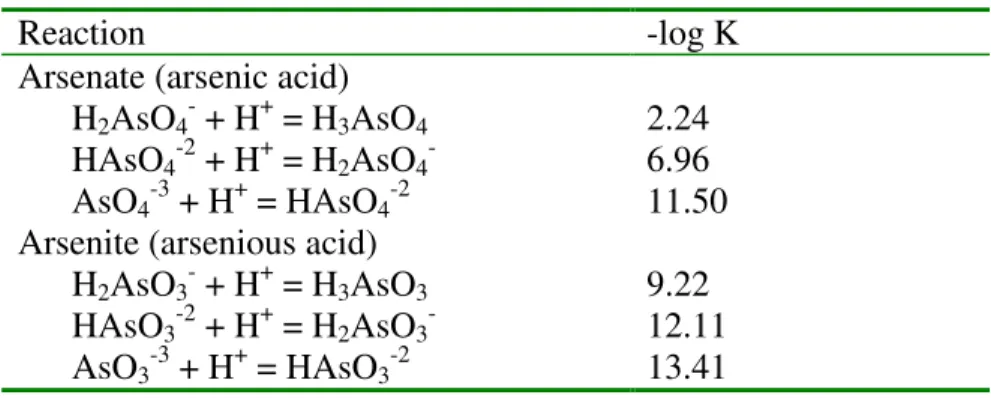
Table 1-1: Acidity constants for arsenate and arsenite (Smith and Martell 2001)
Reaction -log K
Arsenate (arsenic acid)
H2AsO4- + H+ = H3AsO4 2.24 HAsO4-2 + H+ = H2AsO4- 6.96 AsO4-3 + H+ = HAsO4-2 11.50 Arsenite (arsenious acid)
5
Arsenic levels in groundwaters vary widely, depending on the mineral or sediment type and geochemical conditions. Minerals, especially iron oxides, are thought to control arsenic mobility. Arsenic concentrations are typically below 10 µg/L, but widespread areas have been found (e.g. in China, India, Bangladesh, Taiwan, Argentina, Mexico and Hungary) where concentrations can reach up to 5000 µg/L (Smedley and Kinniburgh 2002). Arsenic levels are lower in the USA, with only a handful of municipalities reported concentrations greater than 50 µg/L. However, individual US wells can contain extreme concentrations of arsenic (up to 12 mg/L) in rare cases (Schreiber, Simo et al. 2000), and levels of 10-50 µg/L are not uncommon (Chen, Frey et al. 1999; Welch, Westjohn et al. 2000).
In groundwaters not impacted by acid mine drainage or geothermal waters, there are two main geochemical environments that can lead to arsenic mobilization: anoxic conditions, and arid oxidizing environments (Smedley and Kinniburgh 2002; Ravenscroft 2008). In both cases, a significant portion of the mobilization is due to the failure of iron oxide minerals to retain arsenic. Under anoxic conditions, iron oxides undergo reductive dissolution, liberating any adsorbed trace elements. In arid oxidizing environments, groundwater is often alkaline, which decreases the positive charge on oxide surfaces, making adsorption of anions such as arsenate less favorable. Since iron oxides typically have points of zero charge near pH 7 or 8 (Schwertmann and Cornell 2000), they may actually bear a negative charge in these environments.
In sediments, the element which correlates best with arsenic levels is frequently iron, and arsenic-rich groundwater often has high levels of dissolved iron, especially under reducing conditions (Smedley and Kinniburgh 2002).
1.1.1.2 Iron
Dissolved iron in groundwater is a much more pervasive problem than dissolved arsenic. There are no negative health impacts of dissolved iron in drinking water, but because of the aesthetic problems caused by iron, including taste, color and staining, the USEPA has set a secondary maximum contaminant level (SMCL) of 0.3 mg/L. SMCLs are not enforced by EPA, but iron removal is common in order to satisfy consumer expectations.
Fe(III) (ferric iron) is practically insoluble above pH 3 (see Figure 1-2), though ferric colloids can contribute to iron in drinking water. Iron speciation in groundwater is dominated by dissolved Fe(II) (ferrous iron). Due to microbial reduction of FeOOH, where FeOOH is the terminal electron acceptor, dissolved Fe(II) frequently exceeds 10-4 M (5.5 mg/L) or even 10-3 M (55 mg/L) in groundwater (Tyrrel and Howsam 1997).
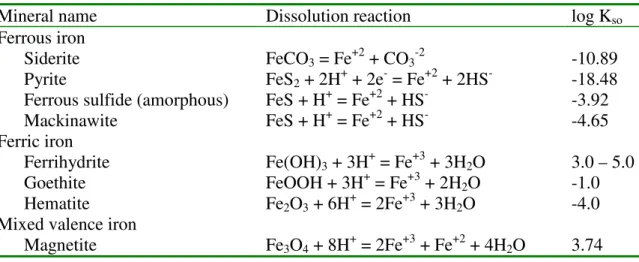
The solubility of both ferrous and ferric iron is limited by a number of minerals, most of which are more soluble under acidic conditions (Table 1-2). The more crystalline ferric minerals (goethite, hematite) are much less soluble than the amorphous ferrihydrite.
7 -15 -10 -5 0 5 10 15 20
0 2 4 6 8 10 12 14
pH P e Fe+2 Fe(OH)2(s) Fe(OH)3(s ) Fe+3 FeOH+2 Fe(OH)4-H2(g) O2(g)
Figure 1-2: pe-pH stability diagram for 10-5 M iron, 25°C (after Stumm and Morgan 1996)
Table 1-2: Solubility of Fe(II) and Fe(III) minerals (Stumm and Morgan 1996; Parkhurst and Appelo 1999)
Mineral name Dissolution reaction log Kso
Ferrous iron
Siderite FeCO3 = Fe+2 + CO3-2 -10.89
Pyrite FeS2 + 2H+ + 2e- = Fe+2 + 2HS- -18.48
Ferrous sulfide (amorphous) FeS + H+ = Fe+2 + HS- -3.92
Mackinawite FeS + H+ = Fe+2 + HS- -4.65
Ferric iron
Ferrihydrite Fe(OH)3 + 3H+ = Fe+3 + 3H2O 3.0 – 5.0
Goethite FeOOH + 3H+ = Fe+3 + 2H2O -1.0
Hematite Fe2O3 + 6H+ = 2Fe+3 + 3H2O -4.0
Mixed valence iron
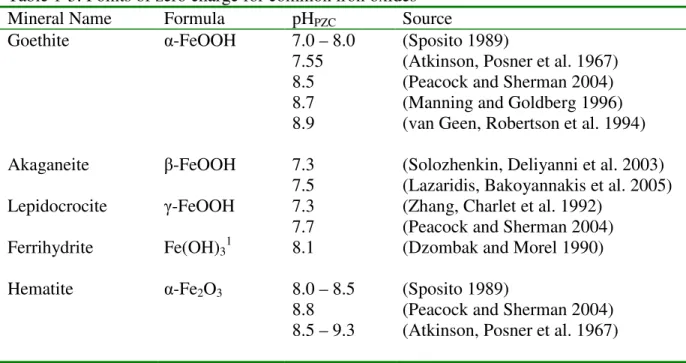
Table 1-3: Points of zero charge for common iron oxides
Mineral Name Formula pHPZC Source
Goethite -FeOOH 7.0 – 8.0 (Sposito 1989)
7.55 (Atkinson, Posner et al. 1967) 8.5 (Peacock and Sherman 2004) 8.7 (Manning and Goldberg 1996) 8.9 (van Geen, Robertson et al. 1994) Akaganeite -FeOOH 7.3 (Solozhenkin, Deliyanni et al. 2003)
7.5 (Lazaridis, Bakoyannakis et al. 2005) Lepidocrocite -FeOOH 7.3 (Zhang, Charlet et al. 1992)
7.7 (Peacock and Sherman 2004)
Ferrihydrite Fe(OH)31 8.1 (Dzombak and Morel 1990)
Hematite -Fe2O3 8.0 – 8.5
8.8 (Sposito 1989) (Peacock and Sherman 2004) 8.5 – 9.3 (Atkinson, Posner et al. 1967)
1.1.2 Adsorption onto iron oxides
1.1.2.1 Surface complexation theory
The concentration of many trace elements, including arsenic, in natural waters is limited by the availability of surface sites for adsorption. In natural sediments, natural organic matter (NOM), clays, and metal oxides can all complex trace constituents, but the oxides, particularly of iron, are thought to play the most important role (Dzombak and Morel 1990).
The binding of dissolved ions with functional groups at a surface can be considered as analogous to reactions that occur in solution, such as the formation of metal-ligand or
1 The term “ferrihydrite” is often used to describe an amorphous ferric solid with approximate formula Fe(OH)
9
base complexes. The adsorption of metals results in the displacement of protons from the surface:
>Fe(III)OH + M+2 = >Fe(III)OM+ + H+ (Equation 1-1)
where > represents the oxide surface. Anion adsorption results in ligand exchange with surface hydroxyl groups:
>Fe(III)OH + A-2 = >Fe(III)A- + OH- (Equation 1-2)
Surface complexation modeling (SCM), as developed by Stumm and co-workers (Singer and Stumm 1970; Schindler and Stumm 1987; Stumm 1992), involves the quantification of these adsorption reactions with equilibrium constants. For example, for the anion A-2, the equilibrium relationship is:
(Equation 1-3)
where Kapp is the apparent equilibrium constant, and { } represents activity. Activities of surface species are commonly assumed to be proportional to their concentration (Stumm and Morgan 1996) for low ionic strength conditions.
>Fe(III)OH + H+ = >Fe(III)OH2+ (Equation 1-4)
>Fe(III)OH = >Fe(III)O- + H+ (Equation 1-5)
Surface complexation modeling recognizes that the surface can be charged, and that ions will need to diffuse across an electrostatic gradient before binding at the surface. The apparent adsorption constant can be broken up into an intrinsic term, describing the formation of a chemical bond with a hypothetical uncharged surface, and a Coulombic term, describing the electrostatic effect of the charged surface.
Kapp = Kint exp( ZF /RT) (Equation 1-6)
where Kint is the intrinsic equilibrium constant, Z is the net change in surface charge, F is Faraday’s constant, is the surface potential, R is the gas constant, and T is the absolute temperature.
11
A number of proprietary or free surface complexation codes are available; the most commonly used are USEPA’s MINTEQA2 (Allison, Brown et al. 1991) and USGS’s PHREEQC (Parkhurst and Appelo 1999). In this work, PHREEQC is used, since it has the ability for simple one-dimensional transport with advection and diffusion, unlike MINTEQA2, which is purely an equilibrium speciation model. A related program, PHAST (Parkhurst, Kipp et al. 2008), extends PHREEQC’s transport abilities into three dimensions by using the transport code HST3D. PHREEQC was revised in 1999, and contains kinetic modeling options not available in MINTEQA2.
All of the surface complexation codes make use of the Dzombak and Morel compilation (1990) of adsorption constants onto ferrihydrite. Constants are available for 12 cations (Ag+, Ba+2, Ca+2, Cd+2, Co+2, Cr+3, Cu+2, Hg+2, Ni+2, Pb+2, Sr+2, Zn+2), 8 anions (AsO4-3, CrO4-2, PO4-3, SO4-2, S2O3-2, SeO3-2, SeO4-2, VO4-3) and 2 uncharged species (H3AsO3, H3BO3). The compilation lacks constants for ferrous iron and carbonate, both of which are required for this dissertation. Other researchers have published binding constants for ferrous iron (Coughlin and Stone 1995; Liger, Charlet et al. 1999; Appelo, Van der Weiden et al. 2002) and carbonate (Zachara, Girvin et al. 1987; van Geen, Robertson et al. 1994; Villalobos and Leckie 2000; Wijnja and Schulthess 2001; Appelo, Van der Weiden et al. 2002), using new experimental evidence or linear free energy relationships.
lacking for ferrous iron and carbonate. Unfortunately, constants are also lacking for arsenite and arsenate.
1.1.2.2 Adsorption of arsenic
Arsenate is relatively easy to remove from water using coagulation methods, since it bears a negative charge in natural waters above pH 2.2 (see Figure 1.1), and is electrostatically attracted to the positive charge on metal hydroxide surfaces. Fresh, preformed ferrihydrite has a reported arsenate adsorption capacity in the range of 0.1 M As/M Fe. Preformed hydroxides only remove arsenic through adsorption, while in situ coagulation leads to coprecipitation as well, and yields much higher capacities, in the vicinity of 0.5 to 0.6 M As/M Fe. (Edwards 1994).
13
Figure 1-3: Adsorption of arsenate (a) and arsenite (b) onto ferrihydrite (DPHE/BGS/MML 2000)
Arsenic adsorption will be affected by the presence of other anions and cations. Some anions will impede adsorption by competing with arsenic for surface sites and lowering the surface charge. Cations, in contrast, can increase the positive surface charge, and enhance arsenic adsorption (Dzombak and Morel 1990).
hydroxyls; these can be mononuclear or binucleaer, depending on whether the hydroxyls are coordinated to the same or different iron atom in the oxide. O’Reilly et al. (2001) found further EXAFS evidence of a bidentate binuclear structure at the As(V)-goethite surface, and showed that adsorption was rapid, with 93% of adsorption occurring within the first 24 hours. Arsenate desorption in a phosphate solution was initially rapid, but reached a plateau after ~35% of arsenic had been desorbed. Even after 5 months of phosphate extraction, a significant amount of arsenate remained adsorbed.
EXAFS (Manning, Fendorf et al. 1998) and FTIR (Sun and Doner 1998) studies of arsenite at the goethite surface suggest an inner-sphere bidentate binuclear bridging complex, similar to that of arsenate.
Information on the structure of arsenic surface complexes gleaned from spectroscopic studies can be used to inform surface complexation modeling; the above studies suggest that in most cases arsenic surface complexes should be modeled as bidentate binuclear species.
1.1.2.3 Adsorption of ferrous iron
Adsorption of trace metals onto iron oxides has been extensively studied, but relatively little research has been done on ferrous iron adsorption, because of the difficulties in prevention of Fe(II) oxidation, especially at higher pH. Recently more attention has been paid to ferrous iron adsorption, since the adsorbed ferrous ion is a strong reductant and can chemically reduce a number of compounds that are otherwise nonlabile.
15
1986; Coughlin and Stone 1995). The density of sites accessible to Fe(II) has been estimated at 1.6 to 2.9 sites/nm2 from isotherms made at near pH 7.0 (Coughlin and Stone 1995; Amonette, Workman et al. 2000; Mettler 2002), similar to the generic density of 2.3 sites/nm2 recommended for all minerals (Davis and Kent 1990). However, maximum adsorption capacity is pH-dependent: Mettler (2002) found a maximum capacity of 10.2 sites/nm2 at pH 8, compared to 2.9 sites/nm2 for the same goethite at pH 7. Vikesland and Valentine (2002) could model adsorption of Fe(II) below pH 7 and in the absence of carbonate using standard site densities, but needed to invoke a site density of 13 sites/nm2, citing the precedent of Davies and Morgan (1989), in order to match Fe(II) adsorption at higher pH and in the presence of carbonate.
Several studies have shown incomplete recovery of adsorbed Fe(II) upon acidification (Coughlin and Stone 1995; Jeon, Dempsey et al. 2001). Recent work has shown that adsorbed Fe(II) is re-worked into the interior of the goethite matrix through an electron transfer process (Coughlin and Stone 1995; Jeon, Dempsey et al. 2001; Jeon, Dempsey et al. 2003):
>Fe(III)OH + Fe(II) >Fe(III)OFe(II)OH >Fe(II)OFe(III)OH (Equation 1-7)
1.1.3 Oxidation
Both arsenic and iron have two stable oxidation states in natural systems, with the reduced species being favored under the reducing conditions typical of groundwater, and the oxidized species dominating (at equilibrium) in the presence of oxygen.
When oxidants are introduced into the subsurface, they may be consumed by a number of reduced species. The chief desired target for the proposed in situ arsenic removal process is ferrous iron, in order to create fresh sorption sites, but arsenite oxidation may be an additional goal. Reduced manganese could also consume oxidants, but the main unintended sink for oxidants will most likely be organic material coating sediment grains.
1.1.3.1 Arsenite
Arsenite is a moderately strong reductant in acid solution (Cotton and Wilkinson 1988):
H3AsO4 + 2H+ + 2e- = H3AsO3 + H2O EH° = 0.56 V, (Equation 1-8)
17
In natural systems most mineral surfaces tend to be negatively charged, due either to low points of zero charge or sorption of NOM, and therefore anions tend to be much more mobile than cations.
Oxygen is a readily available oxidant in natural waters, and is thermodynamically favored to oxidize arsenite. However the oxygenation of arsenite is very slow, taking days to weeks (Pierce and Moore 1982). Cherry and others (1979) showed that even when distilled water spiked with arsenite (pH 7) is saturated with oxygen, arsenic speciation stays relatively unchanged for days. Eary et al. (1990) reported that arsenite oxygenation was slowest around pH 5, and developed an empirical rate equation to describe the reaction kinetics between pH 8 and 12.
Arsenite can also be directly oxidized by a number of strong oxidants, including chlorine, hypochlorite, ozone, permanganate, hydrogen peroxide, and Fenton’s reagent (H2O2/Fe2+). Some solids, such as manganese dioxide, can also oxidize arsenite. Ultraviolet radiation can catalyze the oxidization of arsenite in the presence of other oxidants, such as oxygen. Direct UV oxidation of arsenite is slow, but may be catalyzed by the presence of sulfite (USEPA 2001a), ferric iron (Emett and Khoe 2001), citrate and iron (Hug, Canonica et al. 2001) or TiO2 (Bissen, Vieillard-Baron et al. 2001).
Ferric iron solids are thermodynamically capable of oxidizing arsenite, but EXAFS studies have shown that arsenite is not oxidized upon adsorption to goethite (Manning, Fendorf et al. 1998) or lepidocrocite (Farquhar, Charnock et al. 2002).
Biologically mediated oxidation may be faster than chemical oxidation in natural systems. Wilkie and Hering (1998) showed that microbes catalyzed arsenite oxidation in a geothermally-impacted river, and packed beds inoculated with iron-oxidizing bacteria can achieve better arsenite removal than control packed beds (Katsoyiannis, Zouboulis et al. 2002).
1.1.3.2 Ferrous iron
Homogeneous oxidation of ferrous iron is very slow under acidic conditions, but increases rapidly with pH, showing a first-order dependence on iron and oxygen, and a second-order dependence on [OH-] concentration in the pH range 5-9 (Stumm and Lee 1961; Singer and Stumm 1970).
II app O
II II
Fe k OH P Fe k dt Fe
d 2
2
(Equation 1-9)
where pO2 is the partial pressure of oxygen, and k is the rate constant in units of min-1atm-1M-2.
19
The most commonly invoked mechanism, originally proposed by Weiss (1935) for homogeneous oxidation, involves dissolved oxygen being reduced to water through four single-electron transfers, passing respectively through the intermediary stages of superoxide, hydrogen peroxide, and hydroxyl radical, which can oxidize an additional three Fe(II) atoms (Stumm and Morgan 1996):
2 2 2
,
2 ( )
)
(OH O Fe OH O
Fe slow III
aq II (Equation 1-10) 2 2 2 2 ,
2 2 ( )
)
(OH O H Fe OH H O
Fe III aq II (Equation 1-11) OH O H OH Fe H O H OH Fe III aq II 2 2 2 2 ,
2 ( )
)
( (Equation 1-12)
O H OH Fe H OH OH Fe III aq II 2 2 ,
2 ( )
)
( (Equation 1-13)
giving the net reaction
O H OH Fe H O OH Fe III aq II 2 2 2 ,
2 4 4 ( ) 2
) (
4 (Equation 1-14)
Mineral surfaces are known to catalyze many reactions, including the oxygenation of
ferrous iron. When ferrous iron is adsorbed inner-spherically at an oxide surface, the surface
species is electronically similar to the labile hydrolyzed ferrous species in solution, so it is
not surprising that the adsorbed species is a stronger reductant than free ferrous iron (Luther
III 1990; Wehrli 1990).
Kinetics of heterogeneous oxidation have been studied for over thirty years (Tamura,
research continues today. Modern research focuses on how the presence of ferrous iron in
heterogeneous systems can reduce species which are otherwise stable in oxidized settings,
such as chromate (Fendorf and Li 1996; Pettine, D'Ottone et al. 1998), uranyl (Lenhart and
Honeyman 1999), nitrobenzenes (Klausen, Trober et al. 1995), carbamate pesticides
(Strathmann and Stone 2001; Strathmann and Stone 2002), and halogenated organic
compounds (Amonette, Workman et al. 2000; Pecher, Haderlein et al. 2002). There is also
interest in how ferrous iron scavenges disinfectant residuals in drinking water distribution
systems (Vikesland and Valentine 2000; Vikesland and Valentine 2002).
In the presence of surfaces, ferrous iron can be oxidized in solution or at the surface,
leading to the following mixed rate expression (Tamura, Goto et al. 1976; Tamura,
Kawamura et al. 1980):
OFe Fe k
Fe k
dt Fe
d III
hetero o
T 2
hom 2
(Equation 1-15)
where Fe 2 T FeIIIOFe Fe 2 .
The work of Tamura et al. predates Millero’s contributions (Millero 1985; Millero,
Sotolongo et al. 1987) to the understanding of the importance of speciation in the
second-order rate dependence on pH, and the rate constants are conditional with respect to pH. In a
more recent examination of heterogeneous Fe(II) oxidation, Wehrli (1990) demonstrated a
linear free energy relationship (LFER) between the oxidation reaction rate constant k and the
21
one is consistent with the Marcus theory of electron transfer in outer-sphere reactions
(Stumm and Morgan 1996, p. 689), and the LFER was used to estimate an equilibrium
constant and oxidation potential for the adsorbed Fe(II) species, based on the experimentally
observed rate constant. The adsorbed Fe(II) species was found to have a similar kinetic rate
to that of FeOH+.
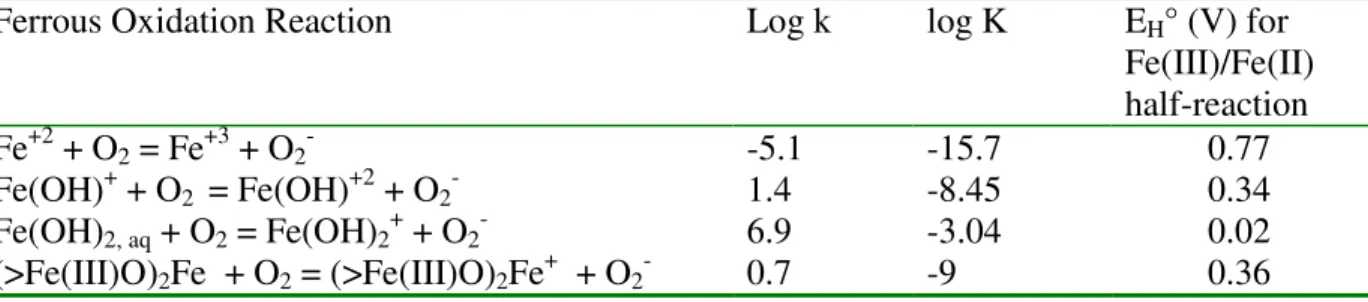
Table 1-4: Log rate (k in M-1s-1) and equilibrium (K) constants for oxidation reactions (Wehrli 1990; Stumm and Sulzberger 1992)
Ferrous Oxidation Reaction Log k log K EH° (V) for Fe(III)/Fe(II) half-reaction
Fe+2 + O2 = Fe+3 + O2- -5.1 -15.7 0.77
Fe(OH)+ + O2 = Fe(OH)+2 + O2- 1.4 -8.45 0.34
Fe(OH)2, aq + O2 = Fe(OH)2+ + O2- 6.9 -3.04 0.02 (>Fe(III)O)2Fe + O2 = (>Fe(III)O)2Fe+ + O2- 0.7 -9 0.36
Biological oxidation of ferrous iron can be an important or even dominant process in
engineered iron removal plants (Mouchet 1992; Sharma, Petrusevski et al. 2005). In the
presence of oxygen, abiotic oxygenation of Fe(II) is probably more important than biotic
oxidation above pH 7, due to the rapid kinetics. Likewise, if ferrous iron, arsenite and natural
organic matter are all competing for oxygen which is artificially introduced into an aquifer,
it is likely that ferrous iron will be the kinetically dominant reductant. In slightly acidic
waters, ferrous oxygenation is much slower, so there should be more competition for oxygen
among the inorganic reductants, and biotic oxidation of iron could become an important
process.
1.1.4 In situ water treatment
In situ treatment of drinking water is still relatively uncommon in the US, though it
of not producing any wastes that must be disposed of, and often requires little or no chemical
addition. It is operationally simple, requires minimal construction, and can be more
economical than conventional above-ground treatment, both in capital and recurring costs.
The most commonly applied in situ removal technologies are for removal of nitrate (Braester
and Martinell 1988b; Braester and Martinell 1988a) and iron and manganese removal,
reviewed below.
1.1.4.1 Iron and manganese
Although in situ iron removal has been practiced for decades, mostly in Europe
(Grombach 1985; Jechlinger, Kasper et al. 1985; Braester and Martinell 1988b; Braester and
Martinell 1988a; Maogong 1988) the mechanisms of iron removal are not well understood,
and have only recently been examined rigorously.
In in situ iron treatment, a volume of water is saturated with oxygen and introduced
into an aquifer through an injection well. The injectate is usually allowed to react for some
time (a few hours to a day), before extracting groundwater from the aquifer. Iron-free water
can then be withdrawn from the aquifer for extended periods before dissolved iron breaks
through. Upon iron breakthrough, the process is repeated. The injection well can also be used
for extraction (the “push-pull” configuration), or a series of satellite injection wells can
surround a central extraction well [e.g. the Vyredox™ system (Braester and Martinell 1988b;
Braester and Martinell 1988a; Maogong 1988)]. The efficiency of the process, defined as the
volume ratio of groundwater abstracted to oxidized water injected, ranges from about 3 to 12
(Appelo, Drijver et al. 1999), and typically increases with time.
23
of Fe(II) oxidation during injection phases is somewhat controversial. Some attribute the
oxidation to biological processes (Grombach 1985; Rott and Friedle 2000), while others
consider heterogeneous oxidation at the ferric oxide surface (Mettler 2002) or homogeneous
oxidation following displacement by divalent ions in the injectate (Appelo, Drijver et al.
1999) to be the key mechanisms. Recent work by Mettler and others (Mettler, Abdelmoula et
al. 2001; Mettler 2002) suggests that at slightly elevated pH (characteristic of a calcareous
aquifer), abiotic oxidation rates are so fast that biotic oxidation of Fe(II) is insignificant.
The rapid kinetics of ferrous oxygenation above pH 7 allow Fe(II) to be oxidized
even in the presence of competing reductants such as Mn(II) or NOM (Mettler 2002).
However, the oxidant-rich injectate can only occupy a certain volume of aquifer, so the
limiting factor in iron removal may well be the amount of ferrous iron adsorbed to mineral
surfaces (Appelo, Drijver et al. 1999). In this case, injection of stronger oxidants or the use of
pure oxygen to saturate injectate, as recommended by some (Jechlinger, Kasper et al. 1985;
Rott and Friedle 2000; Rott, Meyer et al. 2002), will likely lead to only marginal
improvements in iron removal. Developing this idea, Appelo (1999) has made numerical
experiments with the geochemical reactive transport code PHREEQC, and successfully
modeled the observed behavior of in situ iron removal plants.
1.1.4.2 Arsenic
Since arsenic is often present in groundwater under reducing conditions, along with
elevated levels of ferrous iron, it should be possible to apply an in situ iron removal process
as described above, and adsorb much of the arsenic onto the resulting ferric solid. Very little
In Germany, in order to remediate an acidic aquifer containing high levels of arsenite
and ferrous iron, Matthess (1981) injected 29 tons of potassium permanganate
directly into 17 contaminated wells, and reduced mean arsenic concentrations from
13,600 to 60 µg/L.
Welch et al. (2000) showed that in an alkaline (pH >9) basaltic aquifer As(V) levels
could be lowered by about 30% by injecting an acidic ferric chloride solution, which
both increased the number of ferric sorption sites and lowered the pH to below 8.
Martin and Kempton (2000) sequentially injected ferrous sulfate and oxygen
solutions into a column packed with unconsolidated sand. The resulting ferric
precipitate retarded As(V) breakthrough by 30 pore volumes (and Cr(VI)
breakthrough by 8).
In Bangladesh, Sarkar and Rahman (2001) pumped anoxic groundwater containing
ca. 150 µg/L arsenic (speciation unknown) into a storage tank, aerating the water with
cascading filters. The tank was allowed to drain back into the well overnight, and
when water was pumped out the following day, arsenic levels were initially below 20
µg/L, but rose rapidly to ~100 µg/L.
Rott et al. (2002) made a similar experimental setup to that of Sarkar and Rahman,
and were able to reduce arsenic concentrations (mostly as arsenite) in situ from
approximately 35 to 5 µg/L, while iron and manganese levels were also lowered.
This handful of pilot studies shows that in situ treatment of arsenic can succeed, but
that understanding of the removal process is lacking. Neither Matthess nor Sarkar and
25
concentration, indicate how long low arsenic levels were maintained, or try to explain the
mechanisms responsible for the observed arsenic reduction.
1.2 Research objectives
The goal of this dissertation research is to examine the factors affecting in situ arsenic
removal, especially the interactions between iron and arsenic which are key factors for in situ
treatment. This dissertation explores three different geochemical phenomena: precipitation,
oxidation, and adsorption. Extensive research has been conducted on the importance of these
chemical factors for conventional (above-ground) arsenic removal, but these findings have
not been extended to subsurface treatment.
After batch studies on each of these three topics (precipitation, oxidation, and
adsorption), a series of packed column experiments were performed to mimic an in situ
arsenic removal scheme, using goethite-coated sand as a surrogate for aquifer sediments. In
both batch and column experiments, the geochemical transport code, PHREEQC (Parkhurst
and Appelo 1999), was used to model and interpret the chemical processes.
Findings from this research are expected to improve understanding of geochemical
processes affecting arsenic mobility in the subsurface, and arsenic removal in engineered
systems. In particular, the results have direct implications for the successful application of in
situ removal of arsenic from groundwater. By better understanding the chemical interactions
between arsenic and iron which take place in an in situ treatment scheme, it will be possible
to predict under what circumstances the technique could be successfully applied, and how
1.3 Organization of thesis
This thesis contains four papers, presented as Chapters 2 through 5. Chapter 2,
published in the Soil Science Society of America Journal in 2007, is entitled “Solubility of
symplesite (ferrous arsenate): implications for reduced groundwaters and other geochemical
environments.” This paper describes the precipitation of the vivianite analogue symplesite,
Fe(II)3(As(V)O4)2(s). A new solubility constant for the mineral is calculated based on
controlled laboratory precipitation experiments. Using geochemical modeling and a database
of groundwater composition in Bangladesh, it is shown that some groundwaters are
supersaturated with respect to symplesite. The manuscript concludes with a consideration of
environments in which symplesite might control arsenic solubility, such as engineered
arsenic removal systems.
Chapter 3, published in Chemosphere in 2007, is entitled “Redox reactions in the Fe–
As–O2 system.” This paper examines the direct reduction of As(V) by Fe(II), and shows that
the reaction occurs at low but measurable levels, and is enhanced at higher pH or higher
Fe(II) concentrations. The reaction was not seen in the absence of goethite. The paper also
examines the co-oxidation of As(III) and Fe(II) by dissolved oxygen. While As(III) is
kinetically stable in the presence of oxygen at circumneutral pH, As(V) is generated when
Fe(II) is also present. The paper considers conventional descriptions of Fe(II) oxygenation,
and concludes that buffer effects have compromised the quantification of oxidation kinetic
constants in classic papers on this subject. Furthermore, the classical formulation of Fe(II)
oxidation involves oxidation by hydroxyl radical and hydrogen peroxide, which is
inconsistent with oxidation rates noted, in this work and others, in the presence of radical
27
Chapter 4, entitled “Competitive adsorption of As(III), As(V), and Fe(II) onto
goethite,” describes competitive adsorption effects seen between As(III) and Fe(II), and
between As(III) and As(V) on goethite. Limited competition was observed between As(III)
and As(V), and surface complexation modeling gave a good qualitative description of this
competitive effect. However, the model under-predicted the adsorption of As(III) at all pH
levels, suggesting that some surface sites are more selective for As(III) than for As(V).
Isotherm experiments showed a much higher capacity of the goethite surface for Fe(II) than
for either arsenic species. This was simulated with a surface complexation model by
postulating the existence of two groups of surface sites, one accessible only to Fe(II). This
two-site model could successfully describe single-component adsorption of As(III), As(V),
and Fe(II), but gave poor predictions of multi-component adsorption. It is hypothesized that
the apparent high capacity of the goethite surface for Fe(II) is due to interfacial electron
transfer rather than the diversity of surface sites.
Chapter 5, entitled “In situ removal of Fe(II) and As(III): column studies,” describes a
series of packed column experiments designed to simulate an in situ arsenic removal scheme
consisting of sequential injection of oxygen-rich water followed by the abstraction of water
from an aquifer enriched in arsenic and ferrous iron. The experiments showed that removal
of both Fe(II) and As(III) was more effective at higher pH and that removal efficiency
increased over time at higher pH, as expected. At pH 8, the amount of Fe(III) in the column
increased by more than 50% due to oxidation of adsorbed Fe(II). Surface complexation
modeling simulations predicted some of the retardation effects seen, notably the major
two-site model from Chapter 4 are contrasted with the more conventional 1-two-site model, which
does not match the data as well.
Chapters 4 and 5 are planned for submission to Science of the Total Environment.
Chapter 6 gives a summary of the overall findings of the research, and makes
CHAPTER 2: SOLUBILITY OF SYMPLESITE (FERROUS ARSENATE): IMPLICATIONS FOR REDUCED GROUNDWATERS
AND OTHER GEOCHEMICAL ENVIRONMENTS2
2.1 INTRODUCTION
Over the past decade, it has become evident that naturally occurring arsenic in
groundwater is much more widespread than previously thought. Following the recognition in
the mid-1990s that much of the alluvial groundwater of Bangladesh was contaminated with
high levels of arsenic – exceeding 1 mg/L in cases – water quality surveys have revealed the
presence of geogenic arsenic in other Asian countries, including Vietnam, Cambodia, Nepal,
Myanmar, and Afghanistan. India and China have longstanding recognized zones of arsenic
contamination, but new contaminated areas within these countries are still being identified
(e.g. Bihar state in India). Tens of millions of people are exposed to unsafe levels of arsenic
in drinking water in these countries, and tens of thousands of arsenicosis patients have
already been identified.
Arsenic mobility in the subsurface is thought to be controlled by adsorption onto
aquifer materials, particularly oxide minerals and clays. High levels of dissolved arsenic can
occur in anoxic aquifers, where partial or complete reductive dissolution of iron oxides is
driven by bacterial consumption of organic matter (Aggett and Obrien 1985; Lovley 1991;
Nickson, McArthur et al. 1998; Nickson, McArthur et al. 2000). Oxic aquifers may also
contain significant levels of dissolved arsenic, especially under alkaline conditions where
desorption of anions is favored (Smedley and Kinniburgh 2002).
Under the strongly reducing conditions typical of young, organic-rich aquifers,
arsenic is typically found as As(III), while under oxidizing conditions the As(V) species are
thermodynamically favored. However, redox transformations of As(III) to As(V) and vice
versa are kinetically limited (Cherry, Shaikh et al. 1979) so that non-equilibrium distributions
of As(III) and As(V) are often encountered in natural waters. For example, in Bangladesh
the National Hydrogeochemical Survey measured arsenite and total arsenic, along with other
analytes in 271 wells; 123 of these had measurable levels of dissolved arsenic but dissolved
oxygen and nitrate were below detection limits (in most cases 0.1 and 0.3 mg/L, respectively)
(DPHE/BGS/MML 2000). In 54% of these anoxic wells the As(III):Astot ratio was less than 0.5; in 17% of the wells the ratio was below 0.1. Elsewhere, in a study of arsenic cycling in
lakes, Aurillo et al. reported that in late summer/fall oxic surface waters from Upper Mystic
Lake had an As(III):Astot ratio of approximately 0.5 (Aurillo, Mason et al. 1994). Both of these studies illustrate As(III) levels far from thermodynamic equilibrium.
If the high levels of dissolved arsenic in reducing groundwaters are caused by
reductive dissolution of iron oxides, one would expect a strong correlation between dissolved
Fe and As levels in groundwater. While most high-As waters under these conditions have
relatively high Fe, there is no clear correlation between the two elements in groundwater
(DPHE/BGS/MML 2000; Nickson, McArthur et al. 2000; Ahmed, Bhattacharya et al. 2004).
Furthermore, dissolved iron levels, while high, are not as high as would be expected from
31
missing Fe (Zheng, Stute et al. 2004) while others point to the possibility that solid ferrous
iron phases such as ferrous sulfide, pyrite, siderite, vivianite, or green rusts may sequester
significant amounts of Fe(II) in reducing groundwaters (Horneman, Van Geen et al. 2004).
Geochemical modeling has shown that shallow groundwater in Bangladesh is often saturated
with respect to calcite, siderite and vivianite (Nickson, McArthur et al. 2000; Ahmed,
Bhattacharya et al. 2004), and a number of ferrous solids including pyrite (Nickson,
McArthur et al. 2000), ferrous phosphate and ferrous silicate (Harvey, Swartz et al. 2002)
have been identified in core sediments from arsenic-affected areas in Bangladesh.
In principle, solid phases could also limit arsenate solubility. Scorodite
(Fe(III)As(V)O4•2H2O) is a well-known mineral in arsenic-bearing ore deposits, but is only
formed under strongly acidic conditions (Dove and Rimstidt 1985; Rochette, Li et al. 1998).
Arsenates of various divalent metals (Ba, Ca, Cu, Mg, Mn, Ni, Zn) exist as analogues of
vivianite (Fe(II)3(PO4)2•8H2O) but most are too soluble to limit arsenate concentrations in
natural systems (Essington 1988; Voigt, Brantley et al. 1996; Bothe and Brown 1999a; Bothe
and Brown 1999b). Isomorphic substitution of divalent metals, or of PO4 for AsO4, occurs
readily in these minerals and solid solutions among the vivianite analogues can be expected
(Frost, Martens et al. 2003). Mineral identification is complicated by the fact that X-ray
diffraction patterns are identical for many of the vivianite analogues (Frost, Martens et al.
2003).
Symplesite and parasymplesite are arsenate analogues of vivianite with the formula
(Fe(II)3(As(V)O4)2•8H2O) from triclinic and monoclinic crystal systems, respectively (Mori
and Ito 1950; Roberts, Campbell et al. 1990). Relatively few studies have examined the
various arsenate minerals including symplesite (Frost, Martens et al. 2003), and a few studies
have reported thermodynamic data for ferrous arsenate species (Hess and Blanchar 1976;
Khoe, Huang et al. 1991; Sadiq 1997; Gonzalez and Monhemius 1998). In the metallurgical
literature, Khoe et al. (1991) have reported a solubility product for ferrous arsenate of 4 ± 1
x10-41. In laboratory microcosms, bacterial reduction of Fe(III) in scorodite reportedly produces an acidic ferrous arsenate phase (Fe(II)HAs(V)O4•xH2O), (Cummings, Caccavo et
al. 1999), and traces of symplesite along with other unknown ferrous arsenate phases
(Papassiopi, Vaxevanidou et al. 2003). But to our knowledge, precipitation of authigenic
symplesite has not been documented in natural systems.
In this paper a solubility constant for symplesite is reported based on controlled
laboratory experimental data, and geochemical modeling is conducted, which suggests that
this phase might occur in natural systems, as well as under more extreme conditions.
2.2 MATERIALS AND METHODS
2.2.1 Chemicals
All chemicals were of Certified ACS grade, and were used without further
purification. Stock solutions of Fe(II) and As(V) were made by dissolving
Fe(II)(NH4)2(SO4)2 and NaH2As(V)O4 in de-ionized water. NaNO3 was used for ionic
strength control. All solutions were prepared inside an anaerobic glove box (Coy Laboratory
Products Inc., 2% hydrogen atmosphere) using de-ionized water that had been deaerated by
boiling under a nitrogen atmosphere outside the glove box for 30 minutes. Strong acid
33 2.2.2 Experimental and analytical methods
An acidic solution containing 1.00 mM Fe(II) and 0.50 mM As(V) in dilute nitric acid
(pH ~4.5) was prepared from stock solutions of ferrous ammonium sulfate and sodium
dihydrogen arsenate in a background electrolyte of 100 mM NaNO3. The solution was
continuously mixed with a magnetic stirrer in a 500 mL reactor inside the glove box. Strong
base (100 mM KOH) was added dropwise, resulting in the steady increase of pH (measured
with an Orion probe) until the onset of precipitation at approximately pH 7.0, which was
marked by a drop in pH and the appearance of a white precipitate. Precipitation was allowed
to proceed for one hour, after which 10 mL aliquots were transferred in duplicate to 15 mL
polypropylene centrifuge tubes (Falcon). Variable amounts of KOH were then added to the
precipitation reactor, and pH was recorded after each addition. After an increase of
approximately 0.2-0.3 pH units, duplicate aliquots were transferred to centrifuge tubes. The
tubes were placed on an end-over-end shaker in the glove box, and equilibrated for 6-8 hours.
Temperature in the anaerobic chamber ranged from 26.2°C to 27.0°C over the course of the
experiment.
After equilibration, samples were filtered through pre-rinsed 0.2 m nylon syringe
filters for analysis of Fe(II) and As, and the final pH was recorded. Fe(II) was measured in
the glove box using a modified Ferrozine method (Stookey 1970), while arsenic samples
were acidified and measured within two days using graphite furnace atomic absorption
spectroscopy (GFAAS, Perkin-Elmer 5100 with Zeeman correction).
In a separate experiment, a larger quantity of precipitate was prepared by mixing 5
mM Fe(II) with 3 mM As(V), and raising the pH with KOH to ~7.5, which calculations
with no inert electrolyte, to simplify precipitate identification. After stirring magnetically for
one hour, the resulting precipitate was allowed to settle overnight in the glove box. A small
amount of precipitate was dissolved in dilute nitric acid to allow measurement of the
Fe(II):As(V) ratio. Approximately 20 mL of slurry was collected, dewatered using a nylon
syringe filter (0.2 m), and dried in a dessication chamber under anoxic conditions. The
crystal structure of the precipitate was analyzed using X-ray powder diffractometry (Rigaku
Multiflex) with a Cu-K radiation source ( = 1.5418 Å, 40 mA current). The precipitate was
mounted on a glass slide and immediately covered with a drop of glycerol to prevent
oxidation. The scan range was from 5-60° (2 ) with a speed of 1° per second.
2.3 RESULTS
In all samples, a white precipitate was clearly visible, which was subsequently
identified by X-ray diffraction analysis as ferrous arsenate [symplesite, Fe(II)3(As(V)O4)2
(s)]. Fe(II) and As(V) concentrations dropped dramatically during equilibration, with the
greatest reductions occurring at higher pH (see Figure 2-1). The solid lines shown are model
predictions (discussed below). The pH also decreased, by as much as 1.4 units. As(V)
precipitated in accordance with Equation 2-1:
3Fe2+ + 2HAsO4-2 = Fe3(AsO4)2(s) + 2H+ (Equation 2-1)
The precipitation reaction shown liberates protons from the dissolved arsenic species,
causing the pH to fall. At pH 8.5, dissolved arsenic levels were reduced by more than 99.9%,
35 0.1
1.0 10.0 100.0 1,000.0
5 6 7 8 9 10
final pH
µM
F
e
II o
r A
s
V
FeII AsV
FeII AsV
Figure 2-1: Precipitation of ferrous arsenate. Initial conditions, 1000 uM Fe(II), 500 uM As(V), 0.1 M NaNO3. Solid lines represent model predictions.
Above pH 8.5, precipitation of ferrous hydroxide was observed (see Equation 2.2),
which resulted in a further drop in dissolved Fe(II) levels and production of a bluish-green
precipitate. Equilibrium As(V) levels began to rise above pH 8.5, as Fe(II) was increasingly
sequestered in ferrous hydroxide.
Figure 2-1 shows good agreement between replicate samples, though the pH in some
cases varied by as much as 0.2 units. This variation is not surprising given the lack of a pH
buffer in the system, apart from the As(V) system itself.
y = 0.666x R2 = 0.996
0 100 200 300 400 500 600
0 200 400 600 800 1000
FeII removed, µM
A
s
V re
m
ov
ed
, µ
M
Figure 2-2: Ferrous arsenate stoichiometry. Open symbols represent conditions of oversaturation with respect to Fe(OH)2(s).
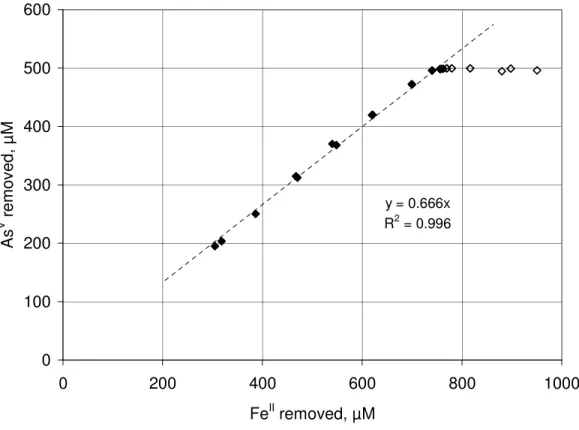
The stoichiometry of the precipitate was assessed by measuring the amounts of
dissolved Fe(II) and As(V) removed from solution. Linear regression (Figure 2-2) shows
that for every mole of Fe(II) removed, 0.666 moles of As(V) were lost, consistent with
Equation 2-1. This stoichiometry was confirmed by precipitate dissolution and elemental
37
of decreasing intensity) which matched the main peaks of the reference spectrum of
symplesite, Fe(II)3(As(V)O4)2·8(H2O). Sample and reference spectra are shown in Appendix
A.
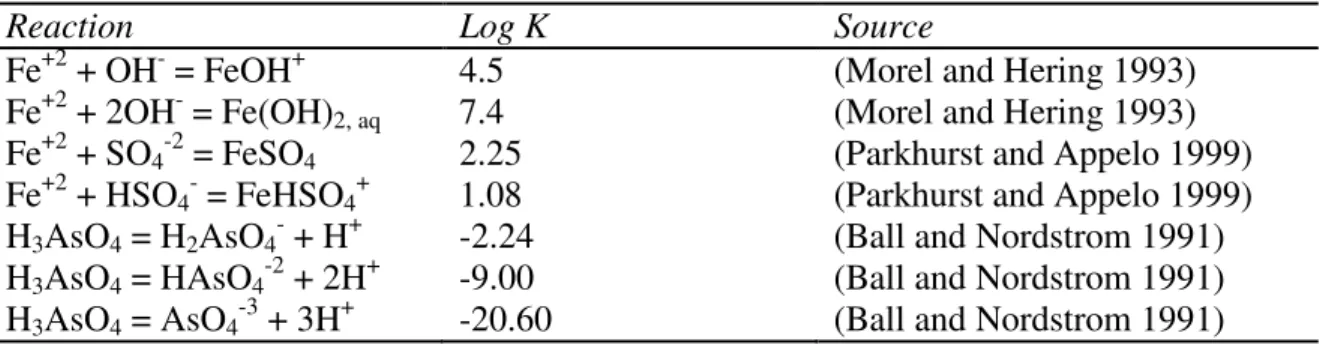
PHREEQC (Parkhurst and Appelo 1999) was used to determine the ion activity
product (IAP) for samples taken from the precipitation experiment. Activity coefficients were
calculated using the Davies equation. The relevant equilibrium constants used in the
calculations are shown in Table 2-1. Reactions involving ferrous sulfate species are included
since the Fe(II) stock was prepared from ferrous ammonium sulfate, and significant
formation of ferrous sulfate species could affect formation of ferrous arsenate complexes. For
modeling purposes, redox transformations of Fe(II) and As(V) were blocked.
Table 2-1: PHREEQC model parameters for dissolved species
Reaction Log K Source
Fe+2 + OH- = FeOH+ 4.5 (Morel and Hering 1993) Fe+2 + 2OH- = Fe(OH)2, aq 7.4 (Morel and Hering 1993) Fe+2 + SO4-2 = FeSO4 2.25 (Parkhurst and Appelo 1999) Fe+2 + HSO4- = FeHSO4+ 1.08 (Parkhurst and Appelo 1999) H3AsO4 = H2AsO4- + H+ -2.24 (Ball and Nordstrom 1991) H3AsO4 = HAsO4-2 + 2H+ -9.00 (Ball and Nordstrom 1991) H3AsO4 = AsO4-3 + 3H+ -20.60 (Ball and Nordstrom 1991)
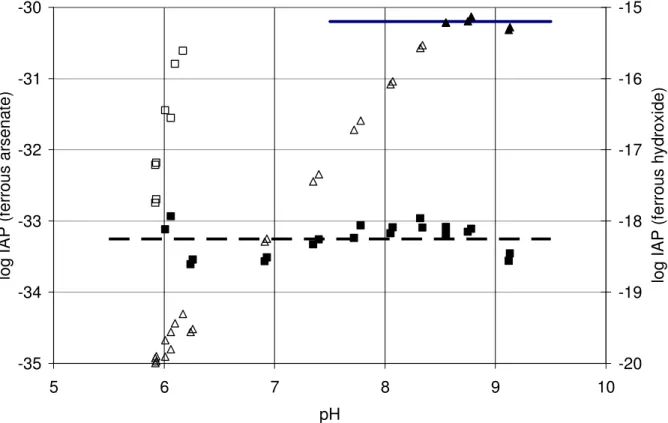
The ion activity products calculated for symplesite and ferrous hydroxide are shown
in Figure 2-3. The eight samples with the lowest initial pH values (6.40 to 7.10 at the
beginning of equilibration), have significantly higher IAPs for symplesite than other samples;
these samples most likely remained oversaturated because of relatively slow precipitation
kinetics under these conditions. At higher pH, precipitation is more rapid and an equilibrium
value seems to be reached within the equilibration period of 6-8 hours. Averaging the
symbols in Figure 2-3), a solubility product, pKso, of 33.25 (± 2 = 0.46) is calculated for
symplesite. Figure 2-3 also shows ferrous hydroxide precipitation occurring at approximately
pH 8.5. The average IAP above this point is 10-15.2, which is in excellent agreement with the reported pKso of 15.1 for ferrous hydroxide (Stumm and Morgan 1996). This serves as a
validation of the quality of the Fe(II) and pH measurements, as well as the modeling analysis.
-35 -34 -33 -32 -31 -30
5 6 7 8 9 10
pH lo g IA P (f er ro us a rs en at e) -20 -19 -18 -17 -16 -15 lo g IA P (f er ro us h yd ro xi de )
Figure 2-3: Log ion activity products for ferrous arsenate (squares, left axis) and ferrous hydroxide (triangles, right axis). Dashed and solid lines represent equilibrium solubility products for ferrous arsenate and ferrous hydroxide, respectively. Filled symbols are used for samples considered to be at equilibrium with ferrous arsenate or ferrous hydroxide phases.
In Figure 2-1, the solid lines show model predictions of dissolved Fe(II) and As(V)
39
correctly predicts the increase in As(V) and drop in Fe(II) as ferrous hydroxide precipitates
above pH 8.5.
This new solubility constant for symplesite is several orders of magnitude larger than
that reported by Khoe et al. (1991), of approximately 10-41.2. The reason(s) for this large difference are not clear. The difference could be explained by non-equilibrium conditions in
these experiments, or by the possible passage of colloidal symplesite through the 0.2 micron
nylon filters used in our system, but these potential explanations seem unlikely. It is also
possible that different ferrous arsenate solids, having the same Fe(II):As(V) ratio, are formed
under acidic and neutral conditions. The Khoe et al. experiments were based on precisely
measuring the pH at the onset of precipitation (near pH 2) while these experiments measured
soluble Fe(II) and As(V) in the presence of precipitate from pH 6-9. Further work is required
to resolve the discrepancy between these reported solubility constants; ideally the solubility
constant should be calculated from both oversaturated and undersaturated conditions.
It was hypothesized that a linear free energy relationship might exist between divalent
metal precipitates of phosphate and arsenate of the form Me(II)3(YO4)2·8(H2O), where Y
represents As(V) or P, since the two oxyanions are structurally similar. Published constants
were found for many solids, but in only four cases were both arsenate and phosphate
solubility products available (Table 2-2). No clear relationship is evident from these four sets
of data, but in the case of Cd(II) and Fe(II), the solubility products for both oxyanions are
Table 2-2: Thermodynamic solubility products (pKso) for Me(II)3(YO4)2•8(H2O)
Me(II) Y = As Source Y = P Source
Cd 32.66 (CRC 2005) 32.60 (CRC 2005)
Co 28.17 (CRC 2005) 34.69 (CRC 2005)
Cu 35.10 (CRC 2005) 36.85 (CRC 2005)
Fe 33.25 This study 33.06 (Singer 1972)
2.4 DISCUSSION
2.4.1 Bangladesh
Using the PHREEQC model and its associated database, modified to include arsenic
compounds, equilibrium speciation can be computed for complex mixtures. Figure 2-4 is a
simulated stability diagram for symplesite, indicating total dissolved As(V) concentrations in
equilibrium with symplesite for various Fe(II) concentrations. The calculations are made for
two ionic strengths representative of those in Bangladesh groundwaters. The figure shows
that drinking water meeting the World Health Organization (WHO) Guideline Value for
arsenic of 10 g/L (WHO 2004) is unlikely to be saturated with respect to symplesite unless
the Fe concentrations are unrealistically high. However, in reduced groundwaters, such as
those found in Bangladesh, it is not uncommon to find water containing 100-1000 g/L
arsenic and significant amounts of dissolved iron (10% of samples in the National
Hydrogeochemical Survey exceeded 10 mg/L), at circumneutral pH (DPHE/BGS/MML
2000). Symplesite might represent a significant sink for arsenate and ferrous iron in these
41 0 1 2 3 4 5 6 7 8 9 10
6 6.5 7 7.5 8 8.5 9
pH
Fe
II , m
g/ L 10 30 100 300 1000
1000 300 100 30 10
Figure 2-4: Stability field for symplesite. Isopleths represent total arsenate concentration in g/L. Solid lines are calculated with an ionic strength of 0.01, while dotted lines have an ionic strength of 0.05. Areas to the right of the isopleths are oversaturated with respect to symplesite.
In Bangladesh groundwaters, dissolved arsenic is predominantly present as As(III)
(Bhattacharya, Jacks et al. 2002), but As(V) is dominant in sediments near the water table,
where highly enriched bands of ferric iron are found (Breit, Lowers et al. 2005). These are
thought to be caused by repeated fluctuations of the water table: when submerged, arsenic
and Fe(II) adsorb to ferric oxide surfaces, which may also partially dissolve due to
dissimilatory reduction by bacteria. Bacterial reduction of ferric hydroxide would liberate
arsenic to solution, without necessarily reducing As(V) to As(III) (Cummings, Caccavo et al.
hydroxide adsorption sites. Adsorbed Fe(II) is more easily oxidized than the free species
(Stumm and Lee 1961), and reactive intermediary species produced during the oxygenation
of Fe(II) can oxidize As(III) to produce As(V) (Roberts, Hug et al. 2004; Johnston and
Singer 2007a).
In Bangladesh, a number of researchers have conducted geochemical surveys
measuring arsenic and other parameters in groundwater. One of the most extensive is the
National Hydrogeochemical Survey (NHS) (DPHE/BGS/MML 2000), which analyzed 271
wells in three Special Study Areas for a broad suite of parameters. Samples were filtered at
collection through 0.2 m acetate filters. Iron was not speciated, but is assumed to be
completely present as ferrous species, since the solubility of ferric iron at neutral pH is
negligible. Other researchers have reported very high Fe(II)/Fetot ratios in Bangladesh
groundwater (Horneman, Van Geen et al. 2004).
Concentrations of major ions (Ca2+, Cl-, F-, Fe2+, HCO3-, K+, Mg2+, Mn2+, Na+, NH4+, NO3-, PO4-3, H3SiO3-, SO4-2) from this dataset were used along with As(V), As(III), pH and temperature to model geochemical speciation. Arsenic and iron redox transformations were
blocked by decoupling the species in PHREEQC. Only the 256 records where pH data were
available were used in the analysis. Solubility products for solid phases used in the model are
listed in Table 2-3.
As a check on the input data, a charge balance was performed for each sample. A
consistent positive bias was noted, with a median value of +8.7%. This suggests that cations
are systematically overestimated, or that anions are missing or underestimated in the NHS