The handle
http://hdl.handle.net/1887/22849
holds various files of this Leiden University
dissertation
Author
: Haazebroek, Pascal
Title
: On the dynamic interplay between perception and action : a connectionist
perspective
between perception and action
A connectionist perspective
by
Printed by Iskamp Drukkers B.V. Enschede
Layout: Pascal Haazebroek ISBN: 978-94-6191-984-7
between perception and action
A connectionist perspective
Proefschrift
ter verkrijging van
de graad van Doctor aan de Universiteit Leiden, op gezag van de Rector Magnificus Prof. Mr. C.J.J.M. Stolker,
volgens besluit van het College voor Promoties te verdedigen op woensdag 11 december 2013
klokke 10.00 uur
Door
Pascal Haazebroek
geboren te ’s-Gravenhage
Promotor
Prof. Dr. B. Hommel (Universiteit Leiden)
Overige leden
Chapter 1 Introduction
Traditional views of human information processing Artificial Intelligence and Robotics
Information processing in the brain
Direct interaction between perception and action Representing perception and action using common codes HiTEC connectionist model
Outline of the thesis Publications 11 12 13 14 16 16 18 18 19
Chapter 2 HiTEC Connectionist Model
Cortical layering Connectionist approach HiTEC architecture Basic model behavior Ideomotor learning Task internalization
Computational implementation Simulating behavioral studies Model dynamics Discussion 23 24 25 26 28 29 29 30 33 34 36
Chaper 3 Action Control
Simulation 1: Action-effect learning Simulation 2: Action planning Discussion
41
43 46 48
Chapter 4 Automaticity
Simulation 3: Simon effect Simulation 4: Stroop effect Discussion
57
58 61 63
Chapter 5 Task Context
Chapter 6 General Discussion
Research questions revisited Key characteristics of HiTEC Extending HiTEC
99
100 103 107
References Appendix Samenvatting Acknowledgements Curriculum Vitae
How do we interact with our environment? We effortlessly turn door handles, reach for a cup of coffee, and use various kinds of tools and electronic equipment. But how do we coordinate our actions in response to these environmental demands? Intuitively, we first perceive an object, then we think for a very brief moment, and, finally, we perform actions on it. So, somehow in ‘the thinking’ our perception and action systems must ‘connect’. The nature of this connection has been a central topic within the field of Cognitive Psychology (Ward, 2002). Indeed, actions that are not guided by perception would not only be inefficient but might also be rather dangerous. Moreover, coordinating perception and action is potentially very complex as natural environments offer an overwhelming number of perceivable objects and natural bodies allow for a virtually unlimited number of different responses. As the human cognitive system usually seems to cope quite well with this complexity, understanding its perception and action connection could be beneficial for developing artificial embodied cognitive systems (i.e., robots) that need to cope with similar challenges.
In this thesis I argue that perception and action planning do not represent separable stages of a unidirectional processing sequence, but rather emerging properties of highly interactive mental processes. In other words, information processing is the result of a (context modulated) dynamic interplay between perception and action.
Traditional views of human information processing
Traditionally, very much in line with the intuitive reasoning described above, responding to
stimuli in our environment has theoretically been conceived as a sequence of separable stages of
processing (e.g., Donders, 1868; Neisser, 1967; Sternberg, 1969; see Figure 1). The separation of information processing into a sequence of steps has a strong history in various theories of human information processing. Moreover, in many models and cognitive systems different steps are often realized by different modules.
For example, in their seminal work, Card, Moran and Newell (1983) describe the
Model Human Processor being composed of three main modules: perception, cognition
and action modules. Information processing is defined as a cyclic, sequential process from stimulus perception to cognitive problem solving to response execution. The perceptual system is considered to contain sensors and is responsible for coding the sensory input into symbolic representations. The cognitive system combines this symbolic input with long term memory and determines how to respond. Finally, the motor system is assumed to carry out the specified response.
Figure 1. The perceive-think-act sequence is the basis of various theories of human information processing
Stimulus selection
In similar vein, the Seven stages of Action model (Norman, 1988) — a conceptual model of human task performance popular in the field of Human Computer Interaction — decomposes the interaction between people and their environment into the following seven
stages: people (1) perceive the state of the world, (2) interpret their perception, (3) form evaluations based on these interpretations, (4) match these evaluations against their goals, (5) form an intention to act, (6) translate this intention into a sequence of actions and (7) execute this action sequence. Executing an action sequence subsequently results in a change in the world state which can again be perceived in the first stage.
More recently, cognitive architectures have been developed (e.g., ACT-R, Anderson, 1993; SOAR, Newell, 1990; EPIC, Kieras & Meyer, 1997) to address the challenge of computationally characterizing human information processing. Crucially, these architectures also separate processing in stages and mostly focus on the middle, cognitive steps of the perceive-think-act processing sequence. It is assumed that the first steps, perceiving and interpreting the world state, are performed relatively easily. The main focus is on comparing the world state with a goal state and deciding upon which action to take next in order to achieve the goal state. It is further assumed that once an action is chosen, its execution is easy, leading to a predictable new world state. The core mechanism used by most cognitive architectures is a production rule system (Byrne, 2003). A production rule defines the translation of a pre-condition into an action that is known to produce a desired post-condition. This can be interpreted as “IF (x) THEN (y)” rules. By specifying a set of production rules, a cognitive architecture can be given some prior knowledge resulting in response tendencies to choose those actions that eventually realize certain goals. When putting a cognitive architecture, endowed with a set of production rules, in interaction with an environment, however, conflicts between rules or unexpected conditions may present themselves. Moreover, by assuming a set of production rules, a cognitive architecture also assumes a set of action alternatives. However, when someone is interacting with a physical or virtual environment, it is often unclear which actions can be performed. Also, in certain contexts, people may not readily detect all action opportunities and action alternatives may differ in their availability, leading to variance in behavior (Kirlik, 2007). This is hard to capture in a cognitive architecture that assumes a predefined set of (re)actions.
Artificial Intelligence and Robotics
go through all alternatives of what to do next, an algorithm taking minutes to compute. Finally, during the ‘action’ stage, essentially with eyes shut, Shakey would move a couple of feet, hoping that the world would remain stable. Then, in a new cycle, Shakey opened up its eyes again, looked at the environment, built a new world model and continued its journey. As demonstrated by rather hilarious scenes where culprits would come in and alter the environment precisely when Shakey was in its ‘blind’ action stage resulting in inaccurate internal models and inappropriate actions, this perceive-think-act architecture seemed to pose a problem for real world robotics: robots constructed like Shakey are limited by the need for all information from the sensors to pass through the modeling and planning modules before having any effect on the robot’s actions (Brooks, 1991). As a result, Shakey could only cope with highly impoverished, static environments. Natural, dynamic environments would require too much time to construct a plan in response to ongoing, unexpected events.
In the decades that followed, some AI researchers took stronger notice of nature and observed that rather simple organisms such as bugs and insects are quite able to cope with environments that are too challenging for Shakey. Brooks (1986) proposed an activity-based decomposition of information processing. He reasoned that perception, cognition and action should be considered intertwined and suggested that a system might rather be
decomposed in different behavior-producing subsystems and that each of these subsystems
in itself forms a complete perception, cognition, action pathway. As these pathways may inhibit
or suppress each other, such a system is able to exhibit a wide variety of complex behaviors. This approach resulted in a decade of developing insect-like robots that demonstrated much better performance in dealing with real environments than the earlier robots based on the top down approach, like Shakey. However, linking their behavior and internal representations to higher level cognitive activities such as planning, reasoning about and communicating with other robots or humans proved to be rather hard (Shanahan, 1998).
The issue of modularity is still a central topic in modern day robotics. Robots are complex systems and functional decomposition into hardware and/or software modules makes sense from an engineering point of view. In the last decade we have witnessed the dawn of highly advanced robot vision systems that recognize complex objects instantaneously (e.g., Detry & Piater, 2011) and reconstruct entire 3D scenes in internal world models (e.g., Baseki et al., 2010) . Moreover, video clips of robots showing immensely impressive behavioral repertoires (e.g., drumming, dancing, walking stairs) appear in the media weekly. How to architect and interconnect perceptual, cognitive and action systems, however, remains a matter of debate and an issue to be explicitly addressed by roboticists (e.g., the three-level architecture described in Kraft et al., 2008).
Information processing in the brain
contain a single complex central processor that does all the computations; it rather consists of
billions of simple computing units (neurons) that are interconnected by trillions of connections
and primarily engage in local interactions (i.e., with their directly connected ‘neighbors’). Given the complexity of the brain early work on network models of cognitive performance was not aimed at modeling brain activity in complete detail. Researchers rather set out to model cognitive phenomena in systems that exhibited some of the same basic properties as networks of neurons in the brains. McCulloch and Pitts (1943) laid the foundation with networks composed of binary units and demonstrated (Pitts & McCulloch, 1947) that these networks could be used to perform pattern recognition tasks. Later approaches (e.g., Rosenblatt 1961) explored similar networks of units with connections of varying weights. In addition, following Hebb’s (1949) suggestion that when two neurons in the brain were jointly active, the strength of their connection might increase, procedures came to be that allowed these networks to learn and demonstrate associative memory abilities (e.g., Taylor, 1956). The success of these early network models was, however, rather short-lived as there were strong limitations (e.g., demonstrated by Minskey & Papert, 1969) to what this type of networks could compute and serious learning algorithms were lacking. These limitations turned the focus of AI research towards symbolic models of information processing.
In the mid-1980s, however, important limitations of rule-based symbolic systems were identified (e.g., inflexibility, difficulty in learning from experience, inadequate generalization) and network-inspired approaches came back in vogue. Rumelhart, Hinton, and McClelland
(1986) published their very influential Parallel Distributed Processing (PDP) work that
essentially defined the connectionism. In the connectionist approach there is a network of elementary units, each of which has a certain degree of activation. The network is considered
to be a dynamical system which, once provided with initial input, spreads activation among
its units for a set period of time or until a stable state is achieved. Such a connectionist system
is considered to ‘perform’ a cognitive task by interpreting the inputs as a problem and the resulting stable configuration of the system as the solution to that problem. Compared to the symbolic approach, that involves transformation of symbols according to specific rules, the connectionist approach focuses on causal processes by which the units spread activation to
each other. Hence, information processing in connectionist networks is distributed.
As connectionism became increasingly popular in the late 1980s, some researchers (e.g., Fodor, 1983; Pinker, 1997) argued that connectionism actually constituted a reversion toward behaviorism (e.g., Watson, 1913) by focusing on mere input-output associations rather than addressing mental processes in terms of explicit logical algorithms. In their view, mental activity is computational; that is, performing operations on symbols. Indeed one could argue that connectionist-like hardware (i.e., the brain) may actually only implement the symbolic-like software algorithms. Hence, the mind could still very well be decomposed in separate (e.g., perception, cognition and action) subsystems. Indeed, to what extent the
mind can be considered a modular system is still a matter of lively debate among cognitive
Direct interaction between perception and action
Now, interestingly, empirical findings in psychology have demonstrated that parts of human information processing do not seem to involve conscious cognitive decision making. Features
of perceived objects (such as location, orientation, and size) can influence actions directly
and beyond (tight) cognitive control, as illustrated by stimulus–response compatibility phenomena, such as the Simon effect (Simon & Rudell, 1967). In the typical Simon task, stimuli vary on a spatial dimension (e.g., randomly appearing on the left or right) and on a non-spatial dimension (e.g., having different colors). Participants have to respond to the non-spatial stimulus feature by performing a spatially defined response (e.g., pressing a left or right key). Although the location of the stimulus is irrelevant for the response choice, it nevertheless influences response time and accuracy: participants respond faster (and more accurately) when the stimulus location is congruent with the response location than when the stimulus location is incongruent with the response location. This finding suggests that there is a direct interaction between stimulus perception and response planning. The Simon effect is a very robust finding, has been replicated numerous times and has been used frequently as a methodological tool to investigate perception, action, and cognitive control (for general overviews, see Hommel, 2011; Proctor, 2010).
To account for both controlled and automatic processing, various dual route process accounts have been proposed (e.g., Kornblum, Hasbroucq, & Osman, 1990; Zorzi & Umilta, 1995). These accounts propose that there is a second, direct route from perception to action that can bypass cognition, as explicitly modeled in various computational models of the Simon effect (e.g., Zorzi & Umilta, 1995; see Chapter 4 for a more elaborate discussion). Essentially, dual route accounts consider the observed direct stimulus-response interaction as an exception requiring an additional route next to the ‘normal’ one that does involve
cognition. Moreover, they typically do not address the reason why some stimulus features
directly influence action and others do not.
Representing perception and action using common codes
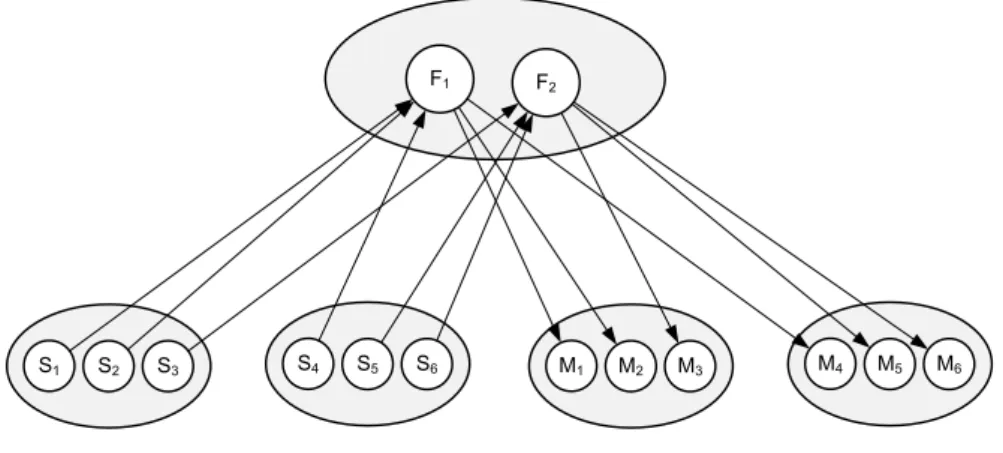
An alternative view that gives much more weight to this direct interaction between perception and action is the Theory of Event Coding (TEC, Hommel, Müsseler, Aschersleben & Prinz, 2001; illustrated in Figure 2). TEC is a general theoretical framework that addresses how perceived events (i.e., stimuli) and produced events (i.e., actions) are cognitively represented and how their representations interact to generate both perceptions and action plans. TEC holds that stimuli and actions are represented in the same way and by using the same ‘feature
codes’. These codes refer to the distal features of objects and events in the environment,
such as shape, size, distance, and location, rather than to proximal features of the sensations elicited by stimuli (e.g., retinal location or auditory intensity; see Heider, 1959; Hommel, 2009). For example, a haptic sensation on the left hand and a visual stimulus on the left both activate the same distal code representing ‘left’.
stimulus event itself. This theoretical assumption is derived from ideomotor theory (James, 1890; see Stock & Stock, 2004, for a historical overview), which presumes that actions
are cognitively represented in terms of their perceivable effects. According to the ideomotor
principle, when one executes a particular action, the motor pattern is automatically associated to the perceptual input representing the action’s effects (action–effect learning; Elsner & Hommel, 2001). Based on these action-effect associations, people can subsequently plan and control (Hommel, 2009) a motor action by anticipating its perceptual effects, that is, (re-)activate a motor pattern by intentionally (re-)activating the associated feature codes.
Thus, stimuli and actions are represented in a common representational medium (Prinz, 1990).
Consequently, stimulus perception and action planning are considered to be similar processes:
both involve activating1 feature codes that represent external events.
Neuroscientific evidence for common codes at a distal feature level can be found in the response characteristics of mirror neurons in the premotor cortex (cf., Keysers & Perrett, 2004). In the macaque monkey, these neurons are active both when the monkey performs a particular action and when it perceives the same action carried out by another monkey or human, such as picking up food. Crucially, this overlap occurs at a distal representational level, that is, at the level where planned and perceived actions can be described as having the same goal or end state such as picking up an object (Rizzolati & Craighero, 2004). Also, various behavioral studies show that, in humans, action planning can actually influence object perception (e.g., Fagioli, Hommel & Schubotz, 2007; Stoet & Hommel, 2002; Wykowska, Schubö & Hommel, 2009), suggesting that perceptual processes and action processes overlap in time (see also Hommel, 1997) and influence each other.
F1 F2
S1 S2 S3 S4 S5 S6 M1 M2 M3 M4 M5 M6
Figure 2. Sensory, feature and motor codes in TEC (adapted from Hommel et al., 2001). Multiple sensory codes can relate to the
same feature codes (and vice versa). The same holds for motor codes and feature codes.
1 TEC also addresses how more complex cognitive codes (‘event files’) are created, an aspect that refers to the
Finally, TEC stresses the role of task context in stimulus and response coding. In particular, the responsiveness of feature codes to activation sources is considered to be modulated according
to the task or goals at hand (the intentional weighting principle, Memelink & Hommel,
2013). For example, if the task is to grasp an object, feature codes representing features relevant for grasping (such as the object’s shape, size, location and orientation) are assumed
to be enhanced, while feature codes representing irrelevant features (such as the object’s color
or sound) appear to be attenuated (Hommel, 2010; Wykowska et al., 2009).
HiTEC connectionist model
In this thesis I aim to shed more light on the biological and computational plausibility of common representations underlying perception and action planning. To this end I have developed HiTEC, a connectionist model based on TEC. Our aim was to formulate a
clear alternative to sequential models of perception and action and to develop a minimal
framework for considering how perceptual and action processes may interact in the control of behavior. HiTEC extends and further specifies TEC’s principles to account for a series of key experimental findings in a unitary theoretical framework and at a level of specificity that allows for computer simulation.
Outline of the thesis
The thesis is organized as follows. Chapter 2 presents HiTEC, the connectionist model developed to study the feasibility of common representations and interactive processing; in Chapters 3 to 5, various simulations of empirical phenomena are described. Here, the focus is on research questions that particularly challenge existing models of stimulus-response translation that assume separate modules or processing stages. Finally, general conclusions are described in Chapter 6. In this endeavor the following research questions are addressed in this thesis.
How do neuron-like representations realize stimulus-response translation?
This research question is addressed in Chapter 2. In this chapter, the HiTEC connectionist
model is presented. In HiTEC, neuron-like representations are distributed over multiplelevels
and processing involves both feedforward and feedback interaction between lower and higher
level representations. In addition, one of the HiTEC levels contains common representations;
these representations are used both for stimulus perception and response planning. As a result, stimulus-response processing is fully interactive rather than in stages. The HiTEC model is used in all simulations discussed in this thesis.
How do situation-specific meanings of motor actions emerge?
to select and execute an appropriate response to a stimulus a plausible cognitive model must first learn (i.e., from experience) what the effects of its motor actions are and how to interpret these effects in the task context. How these situation-specific meanings of actions may emerge and how these meanings are used in action control is addressed in Chapter 3. Simulations in this chapter demonstrate that HiTEC allows for associating action effects with motor actions. Moreover, the strengths of these associations depend on the context allowing for the emergence of situation-specific meanings.
How and why do parts of stimulus–response translation occur automatically?
Some parts of the translation from stimulus to response are considered to occur automatically as demonstrated by stimulus–response compatibility (SRC) effects such as the Simon effect (Hommel, 2011; Simon & Rudell, 1967). How and why these effects may occur is addressed in Chapter 4. Simulations in this chapter demonstrate that HiTEC provides a parsimonious rationale for these effects, most notably in terms of the common representation level and the fact that task-relevance is considered to apply to both stimuli and responses.
How does the task context modulate stimulus-response translation?
How the task context may modulate stimulus-response translation is more explicitly addressed in Chapter 5, which includes both the simulation of an existing empirical study and a novel behavioral study and its simulation. The first simulation in this chapter demonstrates how the task context may modulate action control by means of (spatial) attention within the environment; the empirical study and the second simulation show how intentional weighting may also operate on a more abstract (distal) level.
Finally, in Chapter 6, these research questions and their interrelations are further discussed as not only perception and action are strongly interrelated, so are the different research questions addressed in this thesis.
Publications
The thesis is an integration of a number of articles I wrote in collaboration with co-authors. Note that this is reflected in the various chapters by the use of ‘we’ rather than ‘I’. The interested reader is referred to these articles.
Haazebroek, P., & Hommel, B. (2009a). Anticipative control of voluntary action: Towards
a computational model. Lecture Notes in Artificial Intelligence, 5499, 31-47.
Haazebroek, P., & Hommel, B. (2009b). Towards a computational model of perception
and action in human computer interaction. Lecture Notes in Computer Science, 5620,
247-256.
Haazebroek, P., Raffone, A., & Hommel, B. HiTEC: A Connectionist Model of the Interaction
between Perception and Action Planning. Manuscript submitted for publication.
Haazebroek, P., van Dantzig, S., & Hommel, B. (2009). Towards a computational account
of context mediated affective stimulus-response translation. Proceedings of the 31st
Annual Conference of the Cognitive Science Society (pp. 1012-1017). Austin, TX: Cognitive Science Society.
Haazebroek, P., van Dantzig, S., & Hommel, B. (2011a). A computational model of
perception and action for cognitive robotics. Cognitive Processing, 12, 355-365
Haazebroek, P., van Dantzig, S., & Hommel, B. (2011b). Interaction between Task
Oriented and Affective Information Processing in Cognitive Robotics. Lecture Notes
of the Institute for Computer Sciences, Social Informatics and Telecommunications Engineering, 59, 34-41.
Haazebroek, P., van Dantzig, S., & Hommel, B. (2013). How task goals mediate the
interplay between perception and action. Frontiers in Psychology, 4:247.
As my PhD project was embedded into an interdisciplinary robotics project I also got the chance to collaborate with scientists from other disciplines. Some of this collaborative work has not been integrated in this thesis, even though it contains some of the ideas captured therein; the interested reader is referred to following articles.
Broekens, J. & Haazebroek, P. (2007). Emotion and reinforcement: Affective facial
expressions facilitate robot learning. In Proceedings of the IJCAI Workshop on AI for
Human Computing (AI4HC’07, Hyderabad, India) (pp.47-54).
Lacroix, J. P. W., Postma, E., Hommel, B. & Haazebroek, P. (2006). NIM as a brain for a
humanoid robot. In Proceedings of the Toward Cognitive Humanoid Robots workshop
at the IEEE-RAS International Conference on Humanoid Robots 2006. Genoa, Italy. Spiekman, M.E., Haazebroek, P., & Neerincx, M.A. (2011). Requirements and Platforms
for Social Agents that Alarm and Support Elderly living Alone. Lecture Notes in
Chapter 2
HiTEC Connectionist Model
This chapter is an integration of major parts of the following articles:
Haazebroek, P., Raffone, A., & Hommel, B. HiTEC: A Connectionist Model of the
Interac-tion between PercepInterac-tion and AcInterac-tion Planning. Manuscript submitted for publication. Haazebroek, P., van Dantzig, S., & Hommel, B. (2013). How task goals mediate the
In this chapter we describe the HiTEC connectionist model in full detail. We start out with discussing the general cortical layering of the brain and our general connectionist modeling approach. Then we describe the specific HiTEC architecture, followed by its computational implementation. We proceed with discussing how HiTEC allows simulating behavioral studies and, finally, we compare our approach with related work and address how neuron-like representations may realize stimulus-response translation.
Cortical layering
Neurons in the primate cortex appear to be organized in numerous interconnected cortical layers. It is commonly assumed that this organization allows the brain to encode perceived
objects in a distributed fashion. That is, different features seem to be processed and represented
across different cortical layers (e.g., Cowey, 1985; DeYoe & Van Essen, 1988), coding for different perceptual modalities (e.g., visual, auditory, tactile, proprioceptive) and different dimensions within each modality (e.g., visual color and shape, auditory location and pitch). Each sensory cortical layer typically contains neurons that are responsive to specific sensory features (e.g., a specific color or a specific visual location). Cortical layers in the motor cortex contain neurons that code for more or less specific movements (e.g., the muscle contractions that produce the movement of the hand pressing a certain key, or more complex movement such as shifting one’s weight to the right). Higher up in the processing stream there are cortical layers containing neurons that are receptive to stimulation from different modalities. In effect, they are considered to integrate information from different senses and modalities. Finally, the prefrontal cortex contains neurons that are involved in task-generic cognitive
control (Duncan & Owen, 2000). These levels of representation are illustrated in Figure 3 and
form the basis of the HiTEC model architecture.
Figure 3. Tentative locations of various cortical layers in the primate brain with sensory layers in sensory regions,
task control layers in the frontal lobe, motor layers in motor area and intermediate feature layers mediating between lower and higher region layers.
Auditory Somato sensory Motor
Task Control
Crucially, cortical layers are not only interconnected by feedforward connections (i.e., from lower to higher level layers) but there are also dense neural pathways from centers of higher brain function back into perception centers (Braitenberg & Schüz, 1991; Young,
1995) suggesting top-down influence of higher level layers on processing within lower level
layers (e.g., Prinz, 2006). This constraint of reciprocal connectivity between various levels of representation is taken seriously in the HiTEC connectionist model.
Connectionist approach
The cortical layers in the primate brain contain a vast amount of spiking neuron cells. The local interactions between these neurons are largely random, but on a group level – a neuron population – the global population activity (i.e., mean spike frequency) can be considered deterministic (Wilson & Cowan, 1972). That is, mean activation depends on various inputs and the decay of the neuron population (see Figure 4).
To model such neuron populations HiTEC follows2 the interactive activation
connectionist modeling approach (PDP; Rumelhart et al., 1986). In these connectionist models processing occurs through the interactions of a large number of interconnected elements called units. In HiTEC, these units may stand for the neuron populations described above and are organized into higher structures representing cortical layers. Each unit has an activation value indicating local activity. Processing occurs by propagating activity through the network; that is, by propagating activation from one unit to the other, via weighted connections. When a connection between two units is positively weighted, the connection is excitatory and the units will increase each other’s activation. When the connection is negatively weighted, it is inhibitory and the units will reduce each other’s activation. Processing starts when one or more units receive some sort of external input. Gradually, unit activations rise and propagate through the network while interactions between units control the flow of processing. Some units can be designated output units. When activations of these units reach a certain threshold the network is considered to produce the corresponding output(s).
Figure 4. Cortical layer with neuron populations with various inputs
(TD: top down, Inh: lateral inhibition, Exc: excitatory input)
2 For our current work we have focused on representations and interactive processing. For this purpose, PDP
principles provided the means we needed. This modeling framework, however, is not essential for TEC/HiTEC. Other aspects are probably hard to tackle within the limitations of PDP, such as binding and integration. In the future we may change to or add other modeling principles than PDP prescribes.
I
HiTEC architecture
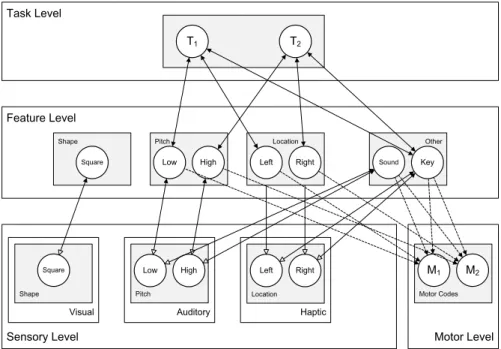
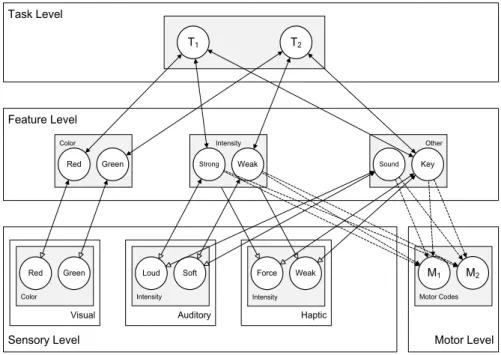
HiTEC has a multiple-layer architecture (see Figure 5) and recurrent interactions at multiple levels, including feedback to lower level units. In HiTEC feedforward and feedback interactions are cooperative and lateral interactions (i.e., within layers) are competitive (see also Murre, Phaf & Wolters, 1992; van Dantzig, Raffone & Hommel, 2011). The HiTEC neural network is composed of excitatory and inhibitory neural units in each layer. The
coding functions are implemented as excitatory units3. The inhibitory units are only involved
in lateral competitive interactions; by contrast, the excitatory units can receive inputs from and send outputs to associated units in other layers, yielding cooperative interactions. Within each layer inhibitory units are activated by an associated excitatory unit and propagate inhibition to the excitatory units that implement other codes in the same layer (see Figure 6).
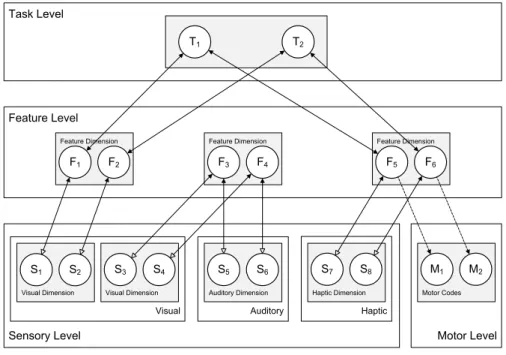
We now first describe the general model architecture, and then describe the model behavior and the computational specification of the network units. HiTECs general architecture contains sensory layers, feature layers, a task layer and a motor layer, as depicted in Figure 5. Each layer resembles a cortical circuitry and contains codes implemented as excitatory connectionist network units as described above. The different codes (and related units) are characterized as follows.
Task Level Sensory Level Haptic Feature Level Motor Level Haptic Dimension
S7 S8
Auditory Auditory Dimension
S5 S6
Visual Visual Dimension
S3 S4 Visual Dimension
S1 S2
Motor Codes
M1 M2 Feature Dimension
F1 F2
Feature Dimension
F3 F4
Feature Dimension
F5 F6
T1 T2
Figure 5. General computational structure of HiTEC. Codes are contained in layers at various levels, and are connected by
excitatory connections. Solid lines denote fixed weights, dashed lines are connections with learned weights. Sensory codes receive modulated excitatory input from feature codes, denoted by the open arrows. Note that feature code – motor code associations are
one-way connections and that feature code – task code connections are non-modulated both ways.
3 We have opted for localist representations to keep HiTECs architecture and representations as simple as possible.
Sensory codes
In HiTEC, different perceptual modalities (e.g., visual, auditory, tactile, proprioceptive) are distinguished and different dimensions within each modality (e.g., visual color and shape, auditory location and pitch) are processed and represented in different sensory layers. Each sensory layer contains a number of sensory codes that are responsive to specific sensory features (e.g., a specific color or a specific location in the visual field). Sensory codes receive external input and feedback activation from feature codes.
Crucially, the responsiveness of sensory coding units is modulated by connected feature coding units. This is realized by making the inputs from feature units to a sensory coding unit dependent on that sensory coding unit’s activation, which is primarily determined by its external stimulation. This way, a sensory coding unit cannot become highly active by mere top down input, which would be the equivalent of a hallucination.
Motor codes
The motor layer contains motor codes, referring to more or less specific movements (e.g., the movement of the hand pressing a certain key or producing a verbal utterance). Although motor codes could also be organized in multiple layers (e.g. reflecting different body parts), in the present version of HiTEC we consider only a single basic motor layer with a set of motor codes. Motor codes are activated by feature codes. When the activation level of one of the motor coding units reaches a set response threshold, the motor code is assumed to
be selected and executed. Subsequent actioneffects in the environment are presented to the
sensory coding units.
How motor actions are controlled is more explicitly addressed in Chapter 3. Note that our present account of motor information represents a dramatic simplification. Movements are unlikely to be represented by coherent, encapsulated motor programs (as considered by Keele, 1968) but, rather, in a rather complex, distributed fashion (Hommel & Elsner, 2009; Wickens, Hyland, & Anson, 1994). However, this simplification does not affect our main arguments and it helps keeping the model and its behavior reasonably transparent.
Feature codes
TEC’s notion of feature codes (Hommel et al., 2001) is captured at the feature level by codes that are connected to and thus grounded in both sensory codes and motor codes. Crucially, the same (distal) feature code (e.g., ‘left’) can be connected to multiple sensory codes (e.g., ‘left proprioceptive direction’ and ‘left visual shape’). Thus, information from different sensory modalities and dimensions is combined in one feature code representation. It is assumed that feature codes arise from regularities in sensorimotor experience, presumably by detecting co-occurrences of sensory features. The distal feature ‘left’, for example, could arise from perceptual experience of numerous objects that were visible and audible on the left. Future
encounters of objects audible on the left activate the ‘left’feature code which – by means of
in expecting to see something on the left as well, which seems to be quite useful, for example when visual sensory input is degraded. Although feature codes are considered to arise from experience, in the present HiTEC version we assume the existence of a set of feature codes (and their connections to sensory codes) to bootstrap the process of extracting sensorimotor regularities in interactions with the environment.
Since feature codes connect to both sensory codes and motor codes, they can be considered common codes in the sense of Prinz (1990), subserving both stimulus perception and response planning. When a certain feature code is used to represent a task stimulus and this same feature code is also used to represent a task response, the resulting code overlap may result in compatibility effects. Such compatibility effects are demonstrated in the simulations discussed in the next chapters, most notably in Chapter 4.
Task codes
The task layer contains generic task codes that reflect alternative stimulus-response combinations resulting from the task context. Different task codes reflect different stimulus-response choice options within the task context. Task codes connect bi-directionally to feature codes, both the feature codes that represent stimuli and the feature codes that represent responses, in correspondence with the current task context. Note that task codes themselves are task-generic (i.e., labeled ‘T1’, ‘T2’ et cetera); their meaning derives from their connections
with specific feature codes.
The multiple-layer recurrent neural network architecture with different types of codes and the connections between associated codes is illustrated in Figure 5. Note that the connection weights can be different (asymmetrical) for corresponding ‘forward’ and ‘backward’ connections (e.g. different weights for the connection from feature codes to task codes, and the reciprocal connection from task codes to feature codes).
Basic model behavior
Ideomotor learning
In HiTEC, connections between feature codes and motor codes are learned according to the ideomotor principle (Hommel, 2009; James, 1890; Lotze, 1852). This principle states that when one executes a particular action and perceives the resulting effects in the environment, the active motor pattern is automatically associated to the perceptual input representing the action’s effect. Based on these action-effect associations, people can subsequently plan and control a motor action by anticipating its perceptual effect.
In similar vein, learning in HiTEC is done by first randomly activating motor codes, not unlike the random movement behavior of newborn infants (motor babbling) or complete novices at a new task. When a motor code reaches a threshold of activation, we assume that the response is executed, resulting in perceivable changes in the environment (action effects). Perceiving these action effects constitutes stimulating the respective sensory codes; activation is subsequently propagated from these sensory codes towards feature codes (cf. Elsner & Hommel, 2001). Finally, associations are learned between these feature codes and the executed motor code. During subsequent stimulus-response translation these associations enable activation of the appropriate motor action by activating the associated feature codes. Thus, a motor action can be selected by ‘anticipating its perceptual effects’. Ideomotor learning and its role in action control is addressed more elaborately in Chapter 3.
Task internalization
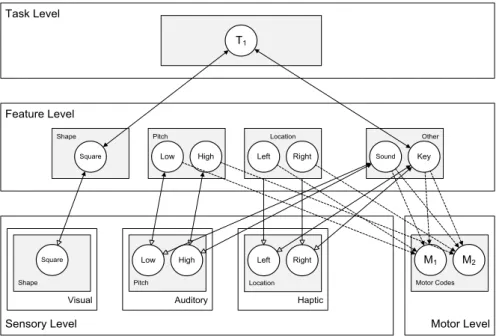
In behavioral experiments both stimuli and responses can have a variety of features. The task context dictates which of these features are relevant (i.e., the features to look for and to discriminate) and which are irrelevant. In HiTEC, a task instruction is implemented by connecting feature codes and task codes according to the actual task rules in terms of stimulus features and response (i.e., action effect) features. This procedure allows the task instruction to be readily internalized. An example task instruction “when you hear a high tone, press the left
key” would then be implemented as connections from ‘High’ to ‘T1’ and from ‘T1’ to ‘Left’
and ‘Key’. During the subsequent stimulus-response translation, these connections modulate the responsiveness of feature codes to bottom-up input from stimulated sensory codes and through these connections activation is propagated towards feature codes associated to the proper motor responses in accordance with task demands (cf., Miller & Cohen, 2001). This way, appropriate goal oriented behavior can take place within a certain task context.
to the model. That is no additional ‘task inputs’ or biases in code dynamics are required to control stimulus-response translation.
Computational implementation
HiTEC codes are implemented as (excitatory) neural network units, characterized by an activation level. These units, which may stand for neuronal groups, receive excitatory and inhibitory inputs from other units and background noise. Excitatory inputs can either be voltage independent or voltage dependent, i.e. with a modulatory role dependent on the voltage (‘activation’) of the receiving unit. Indeed, cortical feedback connections are generally voltage dependent, i.e. necessitate a sufficient level of feedforward (stimulus related) synaptic input to be effective. In addition, the activation of the units is characterized by a decay rate, so that in case of absence of any input the activation will decay exponentially towards a resting level. Units in the sensory layers can also receive an external (stimulus related) input. Thus, on every cycle unit activations are updated according to the following equation:
(1)
In this equation, da is the activation decay rate, Ai(t) is the activation level of unit i at
time t, Exci is the sum of its excitatory input, Inhi is its inhibitory input and both γexc and γinh
are scaling terms. Note that both excitatory and inhibitory inputs are scaled in a way that the unit’s activation may take on any real value between 0.0 and 1.0. The excitatory input is computed as follows:
(2)
Here, ExcVIi is a voltage independent (‘non-modulatory’) input from other units in
the network, which does not depend on the activation of the receiving unit; ExcVDi is a
voltage dependent input, which is instead dependent on the activation of the receiving units (implicitly related to the membrane potential of receiving neurons). These different excitatory inputs stand for different synaptic currents in cortical networks: feedforward signaling takes place by voltage-independent synaptic currents, and feedback signaling by modulatory voltage dependent currents (e.g., Dehaene et al., 2003; Raffone & Pantani, 2010; Tononi,
Sporns, & Edelman, 1992). Exti is input from external stimulation (only for units in the
sensory layers) and Noisei is a noise term. This noise term is determined by drawing a random
value from a Gaussian distribution4 at each update cycle and for each unit independently.
(
1
)
(
)
(
1
(
)
)
(
)
)1
(
t
d
A
t
Exc
A
t
Inh
A
t
A
i+
=
−
a×
i+
γ
exc×
i×
−
i+
γ
inh×
i×
ii i
i i
i ExcVI ExcVD Ext Noise
Exc = + + +
4 Determining the noise term by drawing from a Gaussian distribution sometimes (with our parameters, in < 5%
The voltage independent input is obtained by calculating the weighted sum of the outputs of all connected units (apart from units where voltage dependent input applies, see below):
(3)
Here, w+ are the positive weights of the connections from other units k to unit i and ϕ
is a scale factor. The output of a unit is a non-linear function of its activation value, using the following function (Grossberg & Grunewald, 1997; Grossberg & Somers, 1991), with parameters na and qa:
(4)
Crucially, the responsiveness of sensory coding units is modulated by connected feature coding units. This is realized by making the inputs from feature units to a sensory coding unit dependent on the sensory coding unit’s activation, which is primarily determined by its external stimulation. This way, a sensory coding unit cannot become highly active by mere top down input. This voltage dependent input from feature coding units to sensory coding units is computed using the following equation (see Tononi et al., 1992, for a similar computation):
(5)
Here, da is the activation decay rate and VT is the voltage threshold. When the sensory
coding unit has a (scaled) activation level higher than this threshold, top down input from connected feature coding units is taken into account, rescaled in proportion to the voltage threshold and added to the sensory coding unit’s excitatory input. If the sensory coding unit’s scaled activation level is lower than the voltage threshold, this input is discarded.
Activation of units is competitive, so that coding units within the same layer (sensory layers, feature layers, task layer, or motor layer) inhibit each other. This is computationally realized by the involvement of ‘paired units’. As shown in Figure 6, each of the inhibitory units receive activation from its excitatory paired unit, and propagates inhibition (i.e., their ‘outgoing’ connections are negatively weighted) to all other excitatory units within the same layer. Such inhibition is characterized by non-linearity, i.e. inhibitory units propagate inhibition when they approach a level of activation. This mechanism ensures that within a layer only one unit becomes highly active after a certain number of simulation cycles.
∑
+=
k k k i w F A t
ExcVI
ϕ
( ( ))na i na
na i i qaA A
A F ) ( ) ( VT VT d t A t A F w
ExcVD i a
k k k
Inhi is computed using the following equation:
(6)
Here, k denotes the inhibitory units belonging to any other unit than unit i in the layer,
and w- are the negative connection weights. The activation of inhibitory units is updated
in a similar fashion as the excitatory units, but their input can only be excitatory from the associated paired unit.
Connections
Weights between sensory coding units and feature coding units are set by hand as are the weights of the connections between feature coding units and task coding units closely following the task instruction. The weights from feature coding units to motor coding units are modified using Hebbian learning. Specifically, at the end of each learning trial (see below), the connection weights from feature coding units to motor coding units are updated during a number of cycles according to the following set of equations:
(7)
Figure 6. Inhibition between units within the same layer. In each layer, codes are implemented as excitatory units with additional
paired inhibitory units. These inhibitory units receive activation from their excitatory paired unit (arrowed connections) and send inhibition (i.e., activation through negatively weighted connections; denoted with solid discs) to all other excitatory units within
the same layer.
U1 U2
U1inh U2inh
k k k i w F A t
Inh ( ())
1
(
)
)
(
)
(
)
(
)
1
(
)
1
(
t
d
w
t
LR
Act
t
Act
t
w
t
w
jk
w
jk
j
k
jkLT t A if LT LT t A t
Act j j
j
( ) 1 ) ( ) ( LT t A if t
Actj()0 j()
LT t A if LT LT t A t
Actk k k
() 1 ) ( ) ( LT t A if t
In these equations, wjk is the weight from feature coding unit j to motor coding unit
k, the dw weight decay rate ensures that only repeated co-activations result in stable weight
learning, LR denotes the learning rate (i.e., the magnitude of the change in weights for each
learning trial), Actj (t) is a value based on the activation of feature coding unit j, Actk (t) is
a value based on the activation of motor coding unit k, LT is the learning threshold (above
which the activation levels of both units must be in order to engage in weight learning) and
Aj(t) and Ak (t) are the actual activation levels at time t of feature coding unit j and motor
coding unit k respectively. Note that we rescale the activation of both units to their respective
proportion to the learning threshold and that the computed connection weights are bound to vary between 0.0 and 1.0.
The total number of codes (coding units) and connections varies with the specific instances of HiTEC used for the different simulations. All parameters and default values as used in the simulations are listed in the Appendix. In sum, these modeling equations and parameters allow for a biologically plausible simulation of activation propagation through a network of units. Higher decay rates make units decay faster; lower decay rates keep units very active for a longer period of time. Higher input values for external input and stronger weights between units result in faster activation propagation. Higher voltage thresholds make unit activation to a lesser extent enhanced by top down input; conversely, lower voltage thresholds lead to earlier and stronger influence of top down modulation on unit activation. Stronger weights between excitatory and inhibitory units strengthen the lateral inhibition mechanism. As a result, they reduce the time required to settle the competition between the units within a shared layer, after which only one unit remains strongly activated. Lower weights, conversely, lengthen this time to convergence.
Note that our ambition for HiTEC has not been to search for specific parameter values (e.g., thresholds, weight ranges and scaling parameters) in order to optimally fit specific data distributions. We rather set out to provide a proof of principle as to how neurally plausible representations and connectivity may realize stimulus-response translation while addressing critical theoretical issues such as action control (Chapter 3), automaticity (Chapter 4) and coping with task context (Chapter 6).
Simulating behavioral studies
To model a behavioral study in HiTEC, a specific instance of the HiTEC model is constructed with layers, codes (coding units) and connections that match the stimulus, response, and task characteristics of the simulated experiment. Crucially, connections between feature codes and task codes are set to reflect the exact task instructions.
feature codes allows the model to learn the feature code – motor code associations.
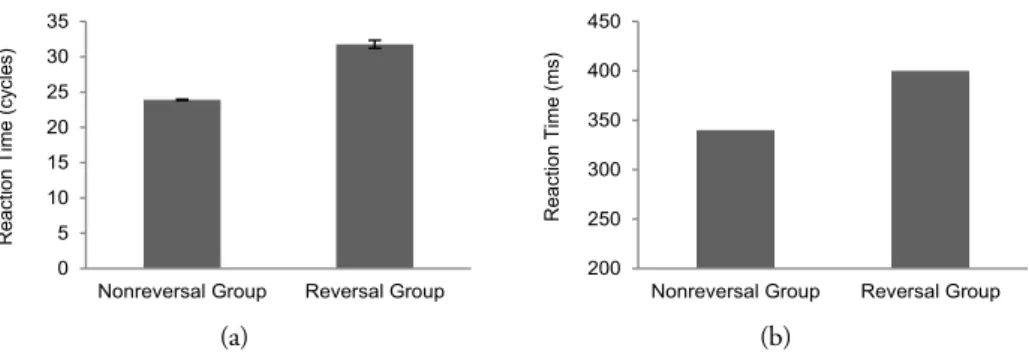
In the subsequent, experimental, phase the model is presented with various stimuli by supplying input to specific sensory coding units. Gradually, activation spreads across all the involved coding units in the various network layers. The trial is terminated at the selection of a motor response and the reaction time is determined based on the number of cycles between stimulus onset and response selection. This enables comparing simulated reaction times with reaction times of human participants in behavioral experiments.
In each simulation, multiple simulated subjects are generated based on the same HiTEC model instance. Although the layers and codes in the networks of these simulated subjects are identical, the noise in activation propagation of coding units is random, resulting in individual differences in performance, as reflected in both varying reaction times and error trials. To be able to use between-subjects designs, simulated subjects are assigned to different group conditions (and receive, for example, different task instructions or stimuli). Mean reaction times and standard deviations are computed for each simulated subject and each condition.
Model dynamics
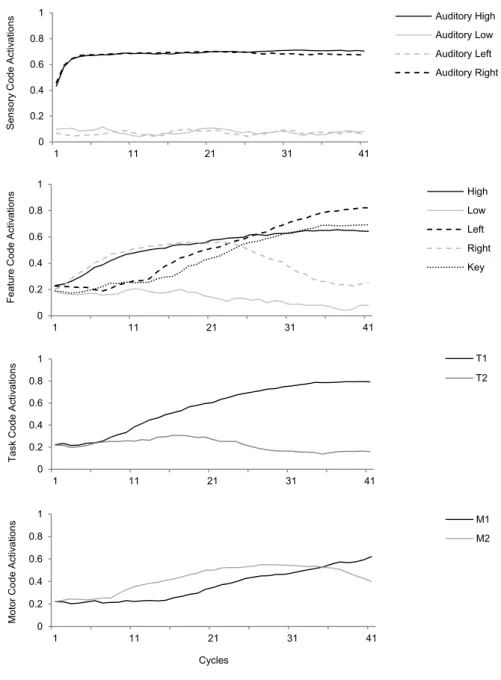
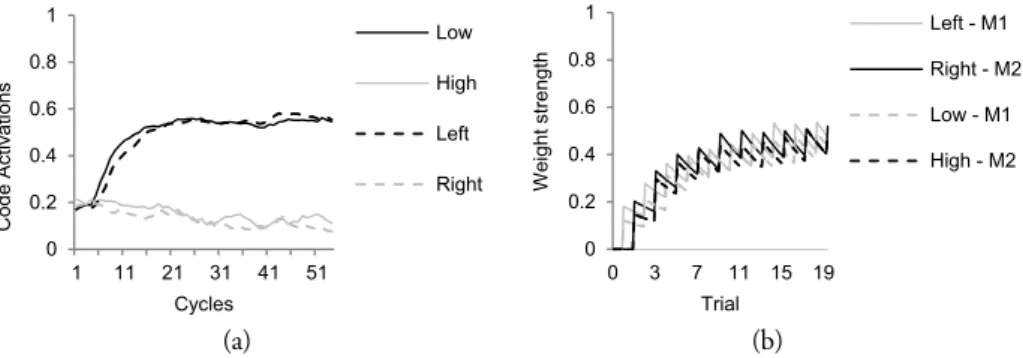
As depicted in Figure 7, when a stimulus is presented to the model, activation propagates from sensory codes to feature codes, involving task codes, other feature codes and motor codes simultaneously. In the figure, an example trial (incongruent trial in the Simon task; see Chapter 4 for the specific HiTEC model instance and actual simulation results) is shown. From the first cycle on a high, right stimulus tone is presented by feeding external input to the sensory codes ‘Auditory high’ and ‘Auditory right’. During the subsequent cycles their activation levels rise accordingly. Simultaneously, activation propagates towards feature codes. Until cycle 21, these are predominantly the feature codes (e.g., ‘Right’ and ‘High’) connected to the active sensory codes.
Due to prior action-effect learning, feature code ‘Right’ propagates activation to motor
code ‘M2’, of which the activation level is rising during cycles 6 to 29. At the same time,
activation propagates from the ‘High’ feature code towards the task codes, resulting in a
relatively more strongly activated ‘T1’ and less strongly activated ‘T2’ from cycle 7 on. ‘T1’
further propagates activation towards feature code ‘Left’. As a result, this feature code’s activation level rises from cycle 7 on and exceeds the activation level of ‘Right’ at cycle 24.
At the same time activation propagates from ‘Right’ to the associated motor code ‘M1’ which
exceeds the activation level of ‘M2’ at cycle 34 and reaches the response threshold at cycle 41.
At that point, also feature codes ‘Left’ and ‘Key’ are highly activated.
Note that these feature codes resemble the action effect of the produced response. Also
note that when ‘M2’ would have been slightly more activated, this code could have reached
Figure 7. Interactive processing during a single stimulus-response translation trial (i.e., a high right auditory tone) involving representations at all levels simultaneously (example shown from Simon effect simulation. See Chapter 4 for more details).
0 0.2 0.4 0.6 0.8 1
1 11 21 31 41
Sensory Code Activ ations Auditory High Auditory Low Auditory Left Auditory Right 0 0.2 0.4 0.6 0.8 1
1 11 21 31 41
Feature Code Activ
ations High Low Left Right Key 0 0.2 0.4 0.6 0.8 1
1 11 21 31 41
Task Code Activ ations T1 T2 0 0.2 0.4 0.6 0.8 1
1 11 21 31 41
Motor Code Activ
ations
Cycles
Discussion
In HiTEC, neuron-like representations realize stimulus-response translation. Stimuli are presented by feeding external input to sensory codes. Responses are considered to execute when a motor code reaches the activation threshold. The connection between perception and action is realized by representations on multiple levels and interconnected by feedforward and feedback connections. The result is an integrated processing network that translates stimuli in responses by gradually propagating activation trough units in the model. Rather than a sequential stepwise process from sensory codes through intermediate representations to response codes, all representations at all levels cooperate and compete and together converge to a response outcome. Crucially, representations at higher levels modulate representations at lower levels. This allows both for direct interaction between perception and action representations and modulation by the task context.
Although the rather simple HiTEC model is not intended as a detailed neuroscientific model, it might be worth noting that its components, as well as their connectivity, do map in a gross way onto specific neural systems. The network architecture follows the same general form as more neurobiologically oriented models of visual attention and object selection do (e.g., Deco & Rolls, 2004).
Our approach is in line with the integrated competition hypothesis (Duncan, Humphreys,
& Ward, 1997). This hypothesis proposes that visual attention results from competition in multiple brain systems and rests on the three following principles. First, different objects are considered to compete for activation within multiple brain systems. Second, although this competition takes place in multiple brain systems, it is integrated between these systems in such a way that units responding to the same object in different brain systems support each other’s activity, whereas units responding to different object compete. Finally, competition is considered to be directed on the basis of relevant object properties based on the current task demands. Duncan et al. (1997) suggest top-down neural priming as a possible control mechanism. HiTEC could be considered both a generalization and specification of this hypothesis. Due to the common coding nature of feature codes, not only visual attention but also action anticipation (and thus action control) are considered to compete for activation, hence generalizing the scope of the integrated competition account. HiTEC further specifies a possible method of directing this competition using task set connections rather than priming. HiTEC explicitly addresses how the task instruction could implement such a task set and how task instruction could influence both perception and action planning.
representations receive external input and activation gradually spreads among various units coding through the reciprocal connections converging to a selected object and action. Task context is encoded by priming the units that represent the object feature (e.g., the color red) to look for or the action feature (e.g., a grabbing action) to execute. This biases the global competition resulting in response time differences between different conditions. The most important difference between Ward’s (1999) model and HiTEC concerns the model architecture: Ward has explicitly taken the ventral ‘what’ and dorsal ‘where’ pathways (Milner & Goodale, 1995) into account resulting in two hardwired pathways between perceptual and action systems. HiTEC, in contrast, is based on TEC and thus contains a common coding level of feature representations that are used both for perception and action planning. Another major difference between the models is how a task is internalized. In Ward’s model, a selection of codes receives a priming bias input. In this sense, stimulus presentation and task instruction occur simultaneously and using the same mechanism of applying external input. In HiTEC, in contrast, task context is internalized by interconnecting feature codes and generic task codes. These pathways subsequently modulate the propagation of activation resulting from stimulus presentation. Crucially, this allows HiTEC to internalize multiple task rules that compete during subsequent stimulus-response translation, whereas the Ward model seems to be confined to executing one specific task rule depending on the code(s) that receive additional input bias. Finally, although Ward, in accord with our approach, aimed at addressing the interaction between perception and action, his model assumes the implications for action of a given object by fixed connections between object features (e.g., vertical object orientation) and specific actions (e.g., vertical grasp). This connection between perception and action planning is addressed more explicitly in HiTEC using the notion of common codes and ideomotor learning (see Chapter 3). Moreover, these mechanisms allow addressing the issue of automaticity (see Chapter 4), which is not a matter of interest (or readily possible to account for) in the Ward model.
More recently, Botvinick et al. (Botvinick, Buxbaum, Bylsma, & Jax, 2009) further developed the Ward model. In their simulations, they explicitly link specific object features (e.g., color, shape, location) to specific response representations (e.g., reach actions, manual actions, color naming, respectively). In accord with Ward, they find that implementing a task set (i.e., priming specific actions) results in top down input to object features and, hence, in selective attention for objects having these features. Most points of comparison between HiTEC and the Ward model also apply here: the connections between object features and specific actions are assumed, the task set is implemented as additional input to action codes and automaticity is not addressed.
between perception and action.
Well-known models of automaticity (e.g., Cohen, Dunbar, & McClelland, 1990; Kornblum et al., 1990; Kornblum, Stevens, Whipple, & Requin, 1999; Zorzi & Umilta, 1995) typically share the general (PDP) connectionist approach with units and excitatory and inhibitory connections. The model of the Simon effect by Zorzi and Umilta (1995), for example, contains stimulus feature codes and response codes. The stimulus feature codes propagate activation towards the response codes. The response codes compete for activation due to their mutual inhibitory connection. In contrast with the models described above, the connections between stimulus codes and response codes are one-directional. That is, stimulus codes activate response codes, not the other way around. In general, these models are more
focused on the process of translating stimuli to responses and aim at fitting their simulation
results to behavioral data. In this endeavor, Kornblum et al. (1999) explicitly divide processing in two distinct sequential stages: stimulus processing and response production. This division ensures that no processing takes place in the response-production stage until activation in the stimulus stage has reached threshold; this is in sharp contrast with HiTEC and the models of the interaction between perception and action discussed above. It does, however, allow them to fit their model to behavioral data on specific stimulus onset asynchrony effects in time courses in SRC effects. In contrast to these dual route process models, HiTEC and both the Ward and Botvinick et al. models take (neurally inspired) representations and reciprocal connectivity into account. The dual route models are discussed more elaborately in Chapter 4 where we discuss the topic of automation.
Finally, it must be stressed that HiTEC has a fairly simple architecture, modeling only a minimal basis of neuroscientific findings. The human brain has many more mechanisms known to mediate perception and action (e.g., subcortical structures such as the superior colliculus and the thalamus). In addition, processing in cortical areas is mediated by a variety of factors (e.g., neurotransmitters) and top down influences and lateral competition, central in HiTEC’s interactive processing, are shown to await a first, fast feedforward sweep of activation in visual processing (Lamme & Roelfsema, 2000) suggesting distinct modes of vision and that assuming immediate interaction between multiple levels is rather simplified.
Chapter 3
Action Control
This chapter is an integration of major parts of the following articles:
Haazebroek, P., & Hommel, B. (2009a). Anticipative control of voluntary action: Towards
a computational model. Lecture Notes in Artificial Intelligence, 5499, 31-47.
Haazebroek, P., Raffone, A., & Hommel, B. HiTEC: A Connectionist Model of the
Interac-tion between PercepInterac-tion and AcInterac-tion Planning. Manuscript submitted for publication. Haazebroek, P., van Dantzig, S., & Hommel, B. (2011). A computational model of
Human behavior is commonly proactive rather than reactive. That is, people do not await particular stimulus events to trigger certain responses but, rather, carry out planned actions to reach particular goals. Planning an action ahead and carrying it out in a goal-directed fashion requires prediction and anticipation: in order to select an action that is suited to reach a particular goal presupposes knowledge about relationships between actions and effects, that is, about which goals can be realized by what action. Under some circumstances this knowledge might be generated ad hoc. For instance, should your behavior ever make a flight attendant to drop you by parachute in a desert, your previously acquired knowledge may be insufficient to select among reasonable action alternatives, so you need to make ad hoc predictions to find out where to turn to. But fortunately, most of the situations we encounter are much more familiar and, thus, much easier to deal with. We often have a rough idea about what actions may be suitable under a given goal and in a particular context, simply because we have experience: we have had and reached the same or similar goals and acted in the same or similar situations before.
How experience with one’s own actions generates knowledge that guides the efficient selection of actions, and how humans carry out voluntary actions in general, was the central issue in ideomotor approaches to human action control. Authors like Lotze (1852), Harless (1861), and James (1890) were interested in the general question of how the mere thought of a particular action goal can eventually lead to the execution of movements that reach that
goal in the absence of any conscious access to the responsible motor processes (executive
ignorance). Key to the theoretical conclusion they came up with, the ideomotor principle, was the insight that actions are means to generate perceptions (of wanted outcomes) and that these perceptions can be anticipated. If there would be an associative mechanism that integrates motor processes (m) with representations of the sensory effects they produce (e), reactivating the representation of the effect by voluntarily “thinking of it” may suffice to
reactivate the associated motor processes (em). In other words, integrating movements and
their sensory consequences presumably provides a knowledge base that allows for selecting actions according to their anticipated outcomes—for anticipative action control that is.