EFFECT OF POLICY AND PRACTICE CHANGES ON ORAL ANTICOAGULATION USE IN NORTH CAROLINA
Christopher Alan Beadles
A dissertation submitted to the faculty of the University of North Carolina at Chapel Hill in partial fulfillment of the requirements for the degree of Doctor of Philosophy in the Department of Health Policy and Management in Gillings School of Global Public Health.
Chapel Hill 2013
Approved by:
ii ABSTRACT
CHRISTOPHER BEADLES: Effect of policy and practice changes on oral anticoagulation use in North Carolina
(Under the direction of Kristen Hassmiller Lich)
Despite a long history of proven effectiveness, oral anticoagulation therapy (OAT) has been underused in medical practice so the full potential for stroke risk reduction has yet to be realized in everyday clinical settings.Several policy changes intended to improve care quality and change care delivery were recently established, but the effect of these policy changes on OAT use is unknown. The overall objective of this proposal is to estimate the effect of policy and practice changes on OAT use in real world clinical settings. This work: investigates the impact of The Joint Commission’s National Patient Safety Goals
on the initiation of OAT in eligible AF patients (Aim 1); evaluates the effect of geographic, physician, facility and patient factors on OAT initiation and time to discontinuation for eligible AF patients (Aim 2); and investigates the effect of patient-centered medical homes (PCMH) on OAT initiation (Aim 3). The overall hypothesis of the work is that both National Patient Safety Goals and PCMHs are associated with increased use of OAT, but only PCMHs are associated with greater time to OAT discontinuation.
iii
using Cox proportional hazard regressions to evaluate time to OAT discontinuation before and after these policy changes. A difference in difference modeling approach is used to compare OAT initiation by PCMH exposure status.
This research is significant in several respects: 1) it examines an
understudied area of health policy governing health care delivery safety and quality in a population with documented underuse of appropriate therapy; 2) it identifies and
iv
TABLE OF CONTENTS
LIST OF TABLES……….vi
LIST OF FIGURES…………...……….………viii
Chapter I. OVERALL BACKGROUND AND SIGNIFICANCE………..1
The Burden of Atrial Fibrillation……….……….………....1
Oral Anticoagulation Therapy Efficacy, Effectiveness and Utilization………..2
Policy and Practice Changes in Oral Anticoagulation……….………...6
Policy and Practice Changes in Anticoagulation: Interactions with patient-, physician-, and facility level factors………..12
Conceptual Framework……….………13
Specific Aims……….……….………15
II. THE EFFECT OF NATIONAL PATIENT SAFETY GOALS ON ORAL ANTICOAGULATION INITIATION………..17
Overview……….……….17
Introduction ……….………...……….…...18
Methods……….……….……….20
Results……….25
Discussion……….………..28
III. THE EFFECT OF GEOGRAPHIC, PHYSICIAN, FACILITY, AND PATIENT FACTORS ON ORAL ANTICOAGULATION THERAPY INITIATION AND PERSISTENCE……….…….…………..…..36
Overview………..36
Introduction……….………….………...37
v
Results………..………..….42
Discussion………..……….44
IV. THE EFFECT OF PATIENT CENTERED MEDICAL HOMES ON ORAL ANTICOAGULATION THERAPY INITITATION AND PERSISTENCE………….53
Overview………..53
Introduction……….………….………54
Methods……….………..55
Results……….60
Discussion……….……….….62
V. CONCLUSIONS……...………..………...………....69
Summary of Findings………..…………...………...………69
Limitations………...73
Practice Implications, Policy Implications and Future Directions...……..………..76
Summary………..……….…………..77
Appendix One CHAPTER 2 SUPPLEMENTAL MATERIAL………..……….79
Appendix Two CHAPTER 3 SUPPLEMENTAL MATERIAL.……….……….…………81
Appendix Three CHAPTER 4 SUPPLEMENTAL MATERIAL..………..………82
vi
LIST OF TABLES
Table
1. Stroke Prevention Trials using Antithrombotics in Atrial Fibrillation……….….…3
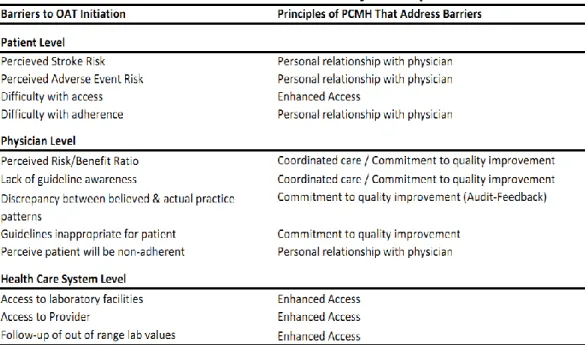
2. Barriers to OAT Initiation Addressed by Principles of the PCMH……..………...11
3. Baseline Characteristics Among Intervention Group And Control Groups.……….……..33
4. Estimated Marginal Effects of Policy Changes, Patient Characteristics and Inpatient Facility Characteristics…..……….…….………...34
5. Estimated Marginal Effects of Sensitivity Analyses in Alternate Outcome Definitions, Outpatient Only Cohort and Combined Inpatient/Outpatient Cohorts……….………...…...35
6. Factors Influencing OAT Initiation and Time to OAT Discontinuation……….…………...48
7. Patient Characteristics of OAT Initiators and Non-Initiators……….49
8. Characteristics of AF Patients by Initial Diagnosis Setting………...50
9. Average Marginal Effects for Oral Anticoagulation Therapy Initiation………51
10. Patient Characteristics and Hazard of OAT Discontinuation………...52
11. Baseline Characteristics Following Inverse Probability of Treatment Weighting for Each Cohort..……….…..66
12. Unadjusted Difference in Percent OAT Initiation and Average Marginal Effect of Explanatory Variables in Three Cohorts...……….……….67
13. Sensitivity Analysis………..68
14. Factors Influencing OAT Initiation and Time to OAT Discontinuation……….78
15. ICD-9-CM Codes Employed to Assign CHADS2 Stroke Risk Score..………79
16. ICD-9-CM Codes Utilized to Identify Relative Exclusions to OAT…...…..……….79
. 17. ICD-9-CM and CPT Codes Utilized to Identify Guideline Positive Cohort…..…...………80
18. ICD-9-CM Codes Utilized to Identify Laboratory Blood Tests and Anticoagulation Management….………….………..………….……….80
vii
20. ICD-9-CM Codes Employed to Assign CHADS2 Stroke Risk Score……..………81
21. Baseline Characteristics (Unadjusted)………...………...………..82
22. ICD-9-CM Codes Employed to Assign CHADS2 Stroke Risk Score…………..…………83
23. ICD-9-CM Codes Utilized to Identify Relative Exclusions to OAT……..………83
24. ICD-9-CM and CPT Codes Utilized to Identify Guideline
Positive Cohort…...………....84
25. ICD-9-CM and CPT Codes to Identify Laboratory Blood Tests
viii
LIST OF FIGURES
Figure
1. Growth of NCQA Accredited PCMHs and Participating Clinicians
in the United States………...9 2. External Environment Changes & Their Effects on OAT Use & Persistence…….………14
3. Selection of Incident AF, Application of Inclusion/Exclusion Criteria
ix
LIST OF ABBREVIATIONS
AF Atrial Fibrillation
ARF Area Resource File
CMS Centers for Medicaid and Medicare Services
CHADS2 Congestive Heart Failure, Hypertension, Age>75, Diabetes, TIA/Stroke
JCAHO Joint Commission on Accreditation of Healthcare Organizations
HPSA Health Professional Shortage Area
ICD-9-CM International Classification of Disease 9th Edition Clinical Modification
IPTW Inverse Probability of Treatment Weight
NCQA National Committee on Quality Assurance
NCSHP North Carolina State Health Plan
NPSGs National Patient Safety Goals
OAT Oral Anticoagulation Therapy
OSCAR Online Survey, Certification and Reporting Database
PCMH Patient-Centered Medical Home
CHAPTER 1
OVERALL BACKGROUND AND SIGNIFICANCE
The Burden of Atrial Fibrillation
Atrial fibrillation (AF) is the most common cardiac arrhythmia, affecting between 2.7 and 6.1 million Americans, and a major independent risk factor for stroke [1]. The lifetime risk for developing AF is 1 in 4 for men and women age 40 years and older [2]. In
observational cohort studies, documented AF clearly precedes stroke in patients with an initial stroke event [3]. Patients with AF have a five-fold greater risk of stroke even after adjusting for other stroke risk factors [1]. Moreover, strokes secondary to AF are nearly twice as likely to be fatal as non-AF caused stroke, more likely to recur within one year, and result in greater severity of functional deficits among survivors [4,5]. The increased severity is independent of advanced age and other stroke risk factors [6]. AF is often asymptomatic [7,8] and frequently clinically undetected [9], thus the true risk of stroke related to AF is likely underestimated [10].
Stroke is associated with substantial health care costs, long term disability and is the 4th leading cause of death in the US [1]. The annual direct cost of stroke in the United States in 2009 was an estimated $22.8 billion (total direct and indirect costs of $38.6 billion) [1] and the long-term cost of a single major ischemic event is an estimated $145,251 [11]. Following a first event stroke, one year mortality is approximately 25%, while 5-year mortality is greater than 50% [1]. While AF is directly responsible for 15-20% of strokes [12], direct annual costs
2
costs are 3 times greater than before an AF diagnosis, and for those who experience a subsequent transient ischemic attack, ischemic stroke or major bleed, post-event total direct costs increase 4-8 times pre-AF costs [14].
While the overall prevalence of AF is roughly 1-2% among adults 20 years or older, it increases dramatically from 50 years of age (0.1%) to 80 years of age (10%) [15]. Applying the current prevalence of AF to US Census Bureau projections for the year 2050, the number of individuals with AF is expected to reach 12 million secondary to the larger proportion of elderly individuals [2].
Oral Anticoagulation Therapy Efficacy, Effectiveness and Utilization
Clinically, AF allows blood to pool in the small chambers of a patient’s heart (atria).
This pooling of blood fosters a favorable environment for the coagulation of blood and formation of blood clots. In time, the blood clots dislodge or fragment blocking the arteries that supply the brain, resulting in an ischemic stroke. Warfarin decreases the blood’s ability
to form clots and has been the primary anticoagulant in oral anticoagulation therapy (OAT) for nearly six decades. Beginning in the early 1990’s multiple randomized controlled trials
confirmed the efficacy of Warfarin in reducing stroke risk secondary to AF and its superior stroke risk reduction to the anti-platelet agent acetylsalicylic acid (ASA) or aspirin (Table 1). Multiple meta-analyses have confirmed the results of individual trials [16-18]. Oral
3
Table 1. Stroke Prevention Trials using Antithrombotics in Atrial Fibrillation Study Year Participants Intervention Arms
AFASAK 1989 1007 Warfarin*, aspirin and placebo
BAATAF 1990 420 Warfarin* and control
SPAF I 1991 1330 Warfarin*, aspirin* and placebo
CAFA 1991 378 Warfarin and placebo
SPINAF 1992 571 Warfarin* and placebo
EAFT 1993 1007 Warfarin*, aspirin and placebo
SPAF II 1994 1100 Warfarin and aspirin
SPAF III 1996 1044 Warfarin* and low-dose Warfarin plus aspirin ACTIVE-W 2006 6706 Warfarin* and clopidogrel plus aspirin
* Indicates a statistically significant result reported for efficacy
ACTIVE-W: Atrial Fibrillation Clopidogrel Trial with Warfarin AFASAK: Atrial Fibrillation, Aspirin, Anticoagulation BAATAF: Boston Area Anticoagulation Trial for Atrial Fibrillation CAFA: Canadian Atrial Fibrillation Anticoagulation EAFT: European Atrial Fibrillation Trial SPAF: Stroke Prevention in Atrial Fibrillation SPINAF: Stroke Prevention in Non-rheumatic Atrial Fibrillation
Observational studies confirm stroke risk reduction but at a smaller effect size. An early prospective observational study in two practice settings in Montreal followed 221 patients with documented AF for a mean of 27 months [19]. The study reported a relative risk reduction in stroke for patients in the Warfarin treatment arm that was equivalent to the randomized trials, despite having patients that were older and sicker than those included in the trials. Go and colleagues found a 51% relative risk reduction associated with Warfarin use for an assembled cohort of 11,526 AF patients (July 1996-Jan 1997) followed for 25,341 person-years in a large integrated health care system in Northern California [20]. Darkow and associates utilized a large claims database from a managed care organization to create a cohort of 12,539 patients with incident AF in the 2000 calendar year, of which
approximately 40% received Warfarin while the remainder were Warfarin candidates [21]. After adjusting for age, gender and other stroke risk factors they observed a 22% relative risk reduction for patients receiving Warfarin during a maximum 720-day follow-up.
4
events [22]. Birman-Deych and associates studied a cohort of Medicare beneficiaries with AF who were hospitalized between March 1998 and April 1999 in all 50 states. After
adjusting for comorbid conditions, Warfarin prescription was associated with a 35% relative risk reduction in ischemic strokes, but this effect was smaller in black and Hispanic
beneficiaries [23]. A similar finding has been reported in Medicaid participants as well. Boulanger and associates created a retrospective cohort from administrative claims data in California Medicaid recipients aged 50 years and older. They identified 4,355 patients with incident AF between January 1998 and March 2002 in which 59% filled any prescription for Warfarin and Warfarin exposure occurred during only 37% of days following diagnosis. The relative risk reduction of stroke during periods of Warfarin exposure was 27% less than during periods of Warfarin non-exposure [24].
Effectiveness of OAT in reducing stroke risk in clinical practice is lower than that achieved in randomized clinical trials for several reasons. To achieve the same results as clinical trials, an equivalent level of anticoagulation is required [25,26]. However,
5
Despite heterogeneous estimates of Warfarin effectiveness in stroke risk reduction in practice, observational studies have demonstrated a significant and consistent reduction in overall medical costs associated with Warfarin exposure. A retrospective observational cohort study using claims data from a large managed care organization identified a cohort of 3,981 incident AF patients between January 2001 and June 2002 and followed them at least 6 months. The researchers found a 200% increase in total direct health care costs from pre- to post-AF diagnosis. Interestingly, regardless of stroke risk, exposure to Warfarin was associated with an 18-29% decrease in costs [14]. A similar finding was recently
demonstrated in Medicare beneficiaries. Mercaldi and colleagues analyzed claims data from the Medicare 5% sample, identifying 119,764 incident AF patients from 2004 to 2005 and compared Warfarin users to non-users for an average of 2.1 years follow-up. Individually, use of Warfarin therapy among patients with AF was independently associated with lower medical costs, averaging $9,836 per patient per year [35].
6
OAT is becoming outdated and in all cases precedes the development of two major policy changes anticipated to meaningfully affect OAT use.
Policy and Practice Changes in Oral Anticoagulation: the establishment of anticoagulation National Patient Safety Goals
The Joint Commission is the nation's oldest and largest standards-setting and accrediting body in health care. Its primary purpose is to [38]: “continuously improve health
care for the public, in collaboration with other stakeholders, by evaluating health care organizations and inspiring them to excel in providing safe and effective care of the highest quality and value.” To this end, the Joint Commission evaluates and accredits more than
19,000 health care organizations and programs in the United States. Joint Commission accreditation is required for reimbursement from Medicare and many private health
insurance companies. The Joint Commission established its National Patient Safety Goals (NPSGs) program in 2002 to help accredited organizations address particular areas of concern in regards to patient safety [38]. The first set of NPSGs became effective January 1, 2003 [38]. The NPSGs concerning anticoagulation were added in 2007 and became
effective January 1, 2008 [38]. These goals were intended to increase the rate of guideline concordant care concerning OAT among hospitals providing anticoagulation services. Presumably the goals improve OAT utilization through a direct effect on hospitals and an indirect effect on patient adherence to OAT. The direct effect is a result of a hospital implementing a policy, guidelines, or anticoagulation management services in response to establishment of the NPSGs. The indirect effect may be mediated through a greater availability of OAT management resources, once it has been initiated [29,39].
To my knowledge, the effect of The Joint Commission’s revision of the NPSGs has
7
Joint Commission process of care guidelines and improved outcomes yields mixed results. For example, VanSuch and colleagues [40] found compliance with The Joint Commission guidelines for discharge instructions in heart failure patients was associated with decreased readmission rates and Kfoury and associates [41] reported a positive incremental
relationship between degree of adherence to The Joint Commission core measures for heart failure and one-year survival. But Fonarow’s group [42] reported no association with
adherence to The Joint Commission heart failure core measures and 60-90 day mortality or readmission; and Patterson and colleagues [43] found compliance with The Joint
Commission heart failure core measures had no association with one year mortality or readmission.
The contribution of this research is expected to provide a greater understanding of the effect of The Joint Commission NPSGs concerning anticoagulation on guideline concordant use of OAT with a specific focus on initiation and time to discontinuation. This contribution is significant because it examines an understudied area of health policy, The Joint Commission NPSGs that govern health care delivery in a population with documented underutilization of appropriate therapy. The study addresses a relevant policy intervention intended to modify organization of health care systems, delivery of health care services, and utilization with the intent to improve health care outcomes and cost-effectiveness.
Understanding the effect of policy interventions such as The Joint Commission NPSGs on advancing health care safety, quality and efficiency will provide a baseline for evaluating future interventions aimed at improving America’s healthcare system.
Policy and Practice Changes in Oral Anticoagulation: the emergence of the Patient Centered Medical Home
8
that adopts many aspects of Wagner’s chronic care model [44] at first glance appears
relatively novel [45]. Kilo and Wasson provide a brief yet remarkably clear summative history of forces that have lead to rapid and accelerating interest in PCMH model. They describe three phases of the PCMH development: 1) basic investigation (1970-1997) 2) model
development (1997-mid-2000s) and 3) model dissemination (mid-2000s-present). A merging of various political and economic forces served to intensify attention on the PCMH model [45]. The current PCMH concept generally follows seven principles (see Text Box 1) outlined in the Joint Principles of the PCMH [46,47]. The PCMH is intended to re-center the US health care delivery system while improving quality and reducing health care costs [48-50].
Since 2007 PCMHs have steadily increased in number nationally (Figure 1) [51]. This research effort represents a timely evaluation of a model of health care delivery that is being rapidly disseminated with substantial national policy ramifications.
Text Box 1. Joint Principles of the Patient Centered Medical Home 1. A personal physician
2. Physician directed medical practice
3. A whole-person orientation
4. Provides coordinated and/or integrated care
5. Committed to continuous evaluation/ improvement of care quality and patient safety
6. Provides enhanced access to care
9
Figure 1. Growth of NCQA Accredited PCMHs and Participating Clinicians in the United States
10
reviewed the literature on individual components of the medical home such as team-based care, rather than reviewing multi-component interventions that more closely resemble the PCMH model [56,57]. While several systematic reviews have been published providing support for the PCMH model, each has potentially troubling limitations. Three did not consider the rigor of the evidence in the studies reviewed [49,57,58]. Two reviews conducted a limited assessment selecting comparison group studies and peer-reviewed studies, respectively [55,59]. Neither of these considered the studies’ strength of the
analytical methods or excluded studies lacking rigorous methods from evidence synthesis steps.
Peikes et al. conducted a large systematic review of the evidence for the PCMH model through September 2010 [53]. They found that most interventions cited in the literature were actually precursors to the PCMH model and tested simply the addition of a care manager operating within a primary care practice. They also found that less than half of evaluations studied all three outcomes of cost, quality and access. Limiting the inclusion of studies to those that described interventions containing at least 3 of 5 principles of the PCMH model and utilized rigorous analytic methods generated 14 evaluations of 12
11
hospital admissions and no evidence for cost savings [54]. Jackson et al. have found essentially identical results in their more recent review as well [54].
PCMHs may have a beneficial effect on OAT initiation and persistence through several mechanisms which include: a stronger therapeutic relationship with a personal physician; enhanced access to care (ex: obtaining prescription refills, laboratory collections); greater follow-up and monitoring (ex: laboratory values, unfilled prescriptions); coordination of care with specialists (ex: cardiologists); and a practice commitment to improving quality and patient safety. As described above, these mechanisms are individually supported in the literature but have not been well demonstrated as part of a multi-component intervention. The specific barriers and principles of the PCMH that address these barriers are
summarized in Table 2.
Table 2. Barriers to OAT Initiation Addressed by Principles of the PCMH
Of particular interest to anticoagulation, some PCMHs accredited by the National Committee on Quality Assurance choose to also pursue a Heart Stroke Recognition Program. This program contains an audit of the practice’s use of guideline appropriate
12
norms and performance in providing guideline concordant care in AF patients with moderate or high stroke risk. The audit-feedback intervention has been consistently shown to have an effect on provider behavior in health care delivery [60].
This research contributes to existing literature through examining processes of care and disease specific outcomes in a variety of independent PCMHs. This contribution is significant because it implements a rigorous evaluation of the PCMH model while providing much needed evidence concerning the effect of receiving care within an accredited PCMH on guideline concordant care in OAT initiation and time to OAT discontinuation.
Policy and Practice Changes in Oral Anticoagulation: Interactions with patient-, physician- , and facility-level factors
As alluded to above, several hypothesized types of factors serve as barriers to OAT initiation. Patient factors, physician factors and facility factors have each been reported as determinants of receiving OAT among AF patients [23,61-64,29,39]. However, these three categories of factors have not been studied since establishment of NPSGs or PCMHs and have not been studied in combination with each other. Studying patient, provider and
13
prevalent OAT use among AF patients to a greater awareness of two distinct and equally important processes: initiation and time to discontinuation. These processes will more accurately define aspects of OAT use than has been done in prior research. A more precise understanding of factors influencing both OAT initiation and time to OAT discontinuation will assist in identifying additional specific intervention targets to increase OAT use and enhance effectiveness in clinical settings.
Evaluating the interplay of patient, physician and facility factors allows me to
examine the degree of uniformity or lack of uniformity in the effect of policy changes on OAT initiation and time to OAT discontinuation. Population groups at highest risk for stroke or at highest risk for not receiving OAT may experience a disproportionately small increase in appropriate OAT initiation compared to other population groups. This research contributes to existing knowledge concerning variation in OAT initiation and time to discontinuation, and evaluates the impact of anticoagulation policy change as it relates to two specific aspects of OAT utilization. This contribution is significant because it identifies and differentiates specific populations who have benefitted from the policy change and thereby aids in targeting future interventions.
Conceptual Framework
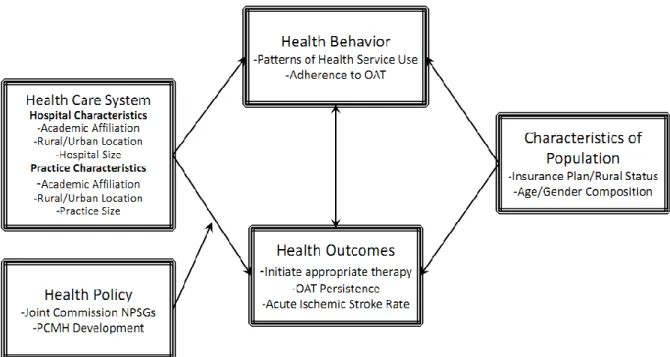
The research questions and subsequent hypotheses in this proposal draw support from a conceptual framework that is an adaptation of Andersen’s behavioral model of health
14
healthcare system influence an individual’s use of health services and subsequently their
likelihood of receiving appropriate treatment and continuing treatment. While not explicitly shown below, dynamic feedback loops also affect the external environment and other predisposing factors, such as age, gender, and insurance status of the population.
Figure 2. External Environment Changes & Their Effects on OAT Use & Persistence
For instance a hospital with an academic affiliation may be more likely to provide onsite outpatient anticoagulation management services in a dedicated anticoagulation clinic. A hospital with an academic affiliation may also have greater capacity for patient follow-up via the use of an electronic health record and additional staff resources. This greater patient follow-up capacity translates into a more efficient system of monitoring and reinforcing adherence to prescribed treatment regimens. The hospital’s urban or rural location
15
strongly influence patient access to services, it is associated with location, academic affiliation and overall capacity to provide requisite patient follow-up.
Similarly the effect of changes in the external environment would be anticipated to affect health care systems differently according to their inherent characteristics. A large academic hospital in an urban setting previously providing anticoagulation management services in an anticoagulation clinic might logically have a well developed anticoagulation policy when the NPSGs became effective. This hospital would be relatively unaffected by the change in the external environment. However, a small or medium size hospital without academic affiliation, and lacking well developed anticoagulation management services or internal anticoagulation policies, may be substantially affected by establishment of the NPSGs. Hospitals that are significantly affected by policy changes in the external environment are also more likely to modify or alter hospital practice norms.
Specific Aims
The work of this proposal is summarized in the following specific aims and tests hypotheses that follow from reflecting on the conceptual model in Figure 1 and evidence published in the peer-reviewed literature grounding the model in OAT initiation and time to discontinuation:
Aim 1: To investigate the effect of The Joint Commission National Patient Safety Goals on OAT initiation in eligible AF patients.
Hypothesis: Establishment of The Joint Commission National Patient Safety Goals has led to increased initiation of OAT among eligible patients.
16
Using novel control groups (e.g. mechanical heart valve patients with high stroke risk, and paroxysmal AF patients with minimal stroke risk) I use difference in difference regression models to compare OAT initiation following hospital discharge before and after policy changes.
Aim 2: To evaluate the effect of geographic, physician, facility and patient factors on OAT initiation and discontinuation.
Hypothesis: Rural status, health professional shortage areas, outpatient diagnosis,
increasing number comorbid chronic conditions, and increasing patient age are negatively associated with initiation and long term persistence of OAT.
Using the previously defined cohort, difference in difference regression modeling is used to estimate the effect of these factors on OAT initiation. Survival analysis using Cox
proportional hazards regressions is used to estimate the effect of these factors on time to OAT discontinuation.
Aim 3: To investigate the effect of exposure to a Patient-Centered Medical Home on OAT initiation.
Hypothesis: Receipt of care in a National Committee on Quality Assurance accredited Patient Centered Medical Home among eligible atrial fibrillation patients is directly associated with OAT initiation.
Chapter 2
THE EFFECT OF NATIONAL PATIENT SAFETY GOALS ON INITIATION OF ORAL ANTICOAGULATION THERAPY
Overview
To examine the effect of The Joint Commission’s National Patient Safety Goals
(NPSGs) on initiation of oral anticoagulation therapy for individuals with incident atrial fibrillation. Our data source is the North Carolina State Health Plan claims data from 944,500 individuals enrolled between January 1, 2006 and December 31, 2010,
supplemented with data from the Area Resource File and Online Survey, Certification and Reporting data network. We utilize a retrospective cohort new user design with two control groups: guideline positive—patients at very high risk of thromboembolism (mechanical heart valve and pulmonary embolism); guideline negative—patients at very low risk of
thromboembolism. We test for changes in oral anticoagulation therapy initiation following revision of NPSGs to include anticoagulation. We developed multivariate models using difference-in-difference estimates with control variables defined a priori. Effects were estimated with generalized estimating equations. Following revision of NPSGs to include anticoagulation, eligible individuals with incident atrial fibrillation exhibited an 11 percentage point increase in oral anticoagulation therapy initiation (SE=3.6; p<.01). NPSGs for
18 Introduction
Oral anticoagulation therapy (OAT) to reduce acute ischemic stroke risk in moderate or high risk atrial fibrillation (AF) patients, typically with Warfarin, has been recommended by guidelines from major organizations for nearly two decades [66]. However, despite its
benefit, OAT is often underutilized among eligible AF patients
[63,67,25,27,28,68,69,29,70,71,21-23,72,73,61,74-76]. Reasons for underutilization of this therapy are attributed to patients and physicians; however, health care systems also play a role [71,72,77-79,39,80].
The Joint Commission is the nation's oldest and largest standards-setting and accrediting body in health care. Its primary purpose is to [38]: “continuously improve health
care for the public, in collaboration with other stakeholders, by evaluating health care organizations and inspiring them to excel in providing safe and effective care of the highest quality and value.” To this end, the Joint Commission evaluates and accredits more than
19,000 health care organizations and programs in the United States. Joint Commission accreditation is required for reimbursement from Medicare and many private health insurance companies. The Joint Commission established a National Patient Safety Goals (NPSGs) program in 2002 to help accredited organizations address specific concerns regarding patient safety. To this end, they established the Patient Safety Advisory Group, a panel of nurses, physicians, pharmacists, risk managers, clinical engineers and other professionals who have hands-on experience in addressing patient safety issues in a wide variety of health care settings. This panel continuously evaluates and updates NPSGs to identify, prioritize, and help address a broad range of emerging patient safety issues. In 2008, the NPSGs were updated to include goals regarding OAT.
19
guidelines and expectations for hospitals that provide anticoagulant therapy and/or long-term anticoagulation prophylaxis to reduce the likelihood of patient harm associated with these therapies. Achieving compliance with NSPGs may be moderated by a hospital’s
preexisting resources and practice norms, as well as their willingness to invest in the infrastructure required to meet them. Hospitals with sufficient resources may be in
compliance with regulatory requirements before or soon after they are established. Hospitals with fewer resources may take longer to become compliant with new regulatory
requirements. In the case of OAT, hospitals may invest in resources to provide long term out-patient management and monitoring for patients receiving OAT, for example,
anticoagulation clinics. Providing anti-coagulation clinics may have an indirect effect on hospital performance, as community physicians with admitting privileges in these hospitals may be more likely to initiate OAT for eligible patients because of both hospital regulatory requirements and additional resources to manage and monitor anti-coagulation [29,39].
Implementation of NPSGs, in general, was intended to substantially impact the health care quality (especially process-oriented measures) in organizations they accredit. However, results for various other Joint Commission initiatives have been mixed. For example, compliance with Joint Commission guidelines for discharge instructions in heart failure patients was associated with decreased readmission rates [40], and there was a positive relationship between adherence to The Joint Commission heart failure core
measures and one-year survival [41]. However, other studies found no association between adherence to Joint Commission heart failure core measures and 60-90 day mortality or readmission [42] or with mortality or readmission at one year [43].
We sought to determine the effect of The Joint Commission’s NPSGs for
20
primary analysis examines a potential direct effect of the NPSGs while a set of sensitivity analyses examine potential indirect effects of the NPSGs.
Methods
Data Sources
We used data from January 1, 2006-Deceember 31, 2010 from the North Carolina State Health Plan (NCSHP), a large self-funded insurance plan for the study. The NCSHP, administered by Blue Cross and Blue Shield of North Carolina, includes almost 1 million state employees, teachers, retirees and their dependents. Approximately 10% of enrollees are retired non-Medicare participants, and 16% of enrollees are retired Medicare
beneficiaries. This claims structured database contains inpatient, outpatient and pharmacy records. Enrollee descriptors include unique encrypted member identification numbers, basic demographic information including age, gender, county, and zip code of primary residence. Records include information about diagnoses, procedures, providers, charges and payments. The database also contains physician level characteristics which include provider zip code, type of provider and provider specialty if applicable. We linked hospital facility characteristics to the database, including accreditation as a primary stroke center, hospital bed size, and participation in a stroke quality improvement program. Finally we linked individual and facility counties with additional variables from the Area Resource File providing a unique opportunity to concurrently analyze health care delivery at multiple levels including: individual patient characteristics, provider characteristics, and hospital facility characteristics.
Study Sample
21
heart valve and pulmonary embolism); and (3) guideline negative controls, that is patients with a very low risk of thromboembolism (paroxysmal atrial fibrillation). For all three cohorts, patients needed to be continuously enrolled in the NCSHP a minimum of 6 months prior to the qualifying index claim and a minimum of 6 months following the qualifying index claim. Individuals with a prescription claim for Warfarin more than 30 days prior to an index claim for any of the three cohorts (i.e. AF, mechanical heart valve, paroxysmal AF) were excluded from the sample due to a high probability of representing prevalent rather than incident conditions. Figure one provides a summary of cohort identification and determination of eligibility. Eligibility criteria for each cohort are described below.
New onset AF patients: We used either one inpatient diagnosis or two outpatient diagnoses within 12 months (International Classification of Disease 9th edition-Clinical Modification (ICD-9-CM) code 427.31) to identify individuals with AF. We designated the first outpatient AF claim or the date of admission for an inpatient claim as the date of entry into the cohort. The American College of Cardiology, The American College of Chest Physicians and the American Heart Association endorse the use of a risk based score to identify
individuals who will benefit from receiving OAT. CHADS2 is a commonly employed scoring
system [81]. Individuals receive 1 point for congestive heart failure, hypertension, age greater than 75 years, diabetes mellitus and receive 2 points for any prior stroke or stroke symptoms. It is recommended that an individual with a score of 2 or more should receive OAT. This score is readily generated using claims data and was used to identify individuals with new onset AF who should receive OAT (See Appendix Table 2.1 for ICD-9-CM codes for these diagnoses). We included all individuals meeting criteria for incident AF with a CHADS2 score > 2. While there are very few absolute contraindications to receiving OAT,
22
for contraindications and ICD-9-CM codes). Finally, to reduce the probability of including individuals with prevalent AF rather than incident AF we excluded individuals with any AF related claim in the six months preceding the index claim.
Guideline positive controls: Individuals with either one inpatient diagnosis or two outpatient diagnoses within 12 months indicating a mechanical heart valve or significant thromboembolism with at least six months of continuous eligibility prior to and six months continuous eligibility following the index claim were included in the guideline positive cohort (See Appendix Table 2.3 for diagnoses and ICD-9-CM codes). The CHADS2 score was not
applied to this cohort, as it is only validated in patients with AF. Finally, to reduce the probability of including individuals with prevalent conditions rather than incident mechanical heart valves or significant thromboembolism we excluded individuals with any condition related claim in the six months preceding the index claim.
Guideline negative controls: Individuals with either one inpatient diagnosis or two outpatient diagnoses within 12 months for paroxysmal AF (ICD-9-CM code 427.21) with at least six months of continuous eligibility prior to and six months continuous eligibility
following the index claim were included in the guideline negative cohort. Figure 2 provides a visual summary of the initial sample and final cohort size for each group.
Measures
The primary dependent variable is OAT initiation, a binary outcome defined as having a prescription drug claim for Warfarin within 30 days of the index claim. Index claims occurring in years 2006-2008 were assigned pre-NPSGs status while index claims occurring in 2009-2010 were assigned post-NPSGs status. The key explanatory variable is the
interaction term between a binary indicator for pre/post status of The Joint Commission’s
23
Control variables were created at the patient level and facility level. All control
variables were identified a priori and measured in the baseline period or immediately prior to the index AF claim to mitigate potential confounding. Patient level control variables include age, gender, Charlson Comorbidity Index, CHADS2 score, rural/urban residence, and
number of outpatient visits to a primary care provider in the 30 days prior to the index claim. Charlson Comorbidity Index was categorized as 0, 1-2, and 3 or more. CHADS2 score was
categorized as 2, 3-4, and 5 or more. Rural/Urban status was categorized as metropolitan, micropolitan or rural as defined by the Area Resource File [82].
Facility level control variables include a binary variable indicating hospital primary stroke center accreditation status (as defined by CMS) for each time period, a binary variable indicating participation in an acute stroke care quality improvement program (Get With the Guidelines Stroke or North Carolina Stroke Care Collaborative) for each time period, distance of hospital from enrollee residence, hospital bed size and rural/urban facility location. Get with the Guidelines Stroke participation was determined from the American Heart Association website (www.heart.org). Participation in the North Carolina Stroke Care Collaborative was provided by the organization. We calculated distance as a function of straight line distance from the centroid of patient and hospital zip codes using SAS 9.2. Hospital bed size was determined from the Online Survey, Certification and Reporting (OSCAR) data network maintained by the Centers for Medicare and Medicaid Services.
Statistical Analysis
We examined cohorts for differences in baseline covariates as well as differences within cohorts between pre and post time periods. Unadjusted rates of oat initiation for each cohort were also examined. We then estimated the relationship between NPSG and
24
after the policy change for the comparison group are attributed to a time effect. Subtracting this difference from the difference in the AF cohort yields an estimate that is more robust to external factors and time effects. In practice the difference in difference estimate is created by interacting the treatment (in this case time) variable with a dummy variable indicating the treatment cohort.
Pr(OATift=1|Xift) = Xβ where f(E[Y]) = Xβ and var(E[Y])=g(E[Y]) (Eqn 1)
with Xβ = β0 + β1AFi + β2Posti + β3(AFi*Posti) + β4Xi + e
where i indicates the individual. OAT is the outcome variable as defined above. AF
represents the cohort and Post indicates whether the index claim occurred pre (Post=0) or post (Post=1) NPSG development. X is a vector of individual patient and facility control variables defined above. Facility level fixed effects are taken into account by clustering within facilities and specifying an exchangeable within-group correlation structure. The coefficient that identifies the effect of interest is β3, which estimates the effect of NPSG on the probability of OAT initiation for patients with incident AF.
We utilized a generalized estimating equation model with a Poisson distribution, log link (denoted by f(E[Y]) above) and exchangeable within group correlation structure
(denoted by var(E[Y]) above) to account for within hospital correlation. Robust standard errors were included to correct for underdispersion of the binary dependent variable in the context of a count distribution. While the exponentiated coefficients may be interpreted as risk ratios when using a log link, we converted the coefficients to average marginal effects as absolute risk differences for ease of interpretation. All models were estimated in Stata 11 (StataCorp, College Station, TX).
25
Warfarin has been generic for several decades, and multiple generic formulations exist. While a claim for Warfarin is specific for OAT initiation, it may be lacking somewhat in
sensitivity. We created two additional definitions for OAT initiation using claims for laboratory blood tests associated with blood coagulation or anticoagulation management claims. (See Appendix Table 2.4 for CPT codes and ICD-9-CM codes employed) The laboratory blood tests were hypothesized to represent a sensitive measure of OAT initiation that might have less specificity for OAT initiation as it is associated with the monitoring of the effect of Warfarin, but is not specific to anticoagulation management alone. The first additional definition for OAT initiation combined either a pharmacy claim for Warfarin or a claim for associated laboratory blood tests or a claim for outpatient anticoagulation management. The second additional definition for OAT initiation excluded the pharmacy claim, utilizing only the laboratory blood test and outpatient anticoagulation management claims to define initiation. The next sensitivity analysis compared the effect of the policy on an inpatient only cohort, hypothesized to demonstrate the greatest effect, an outpatient only cohort, and a combined inpatient and outpatient cohort. The final set of sensitivity analyses involved an extensive evaluation of nonlinear effects of included model covariates and additional county level covariates that could be hypothesized to affect the observed relationship between the policy change and observed OAT initiation rates.
The study protocol was approved by the University of North Carolina at Chapel Hill Institutional Review Board.
Results
Descriptive Findings
26
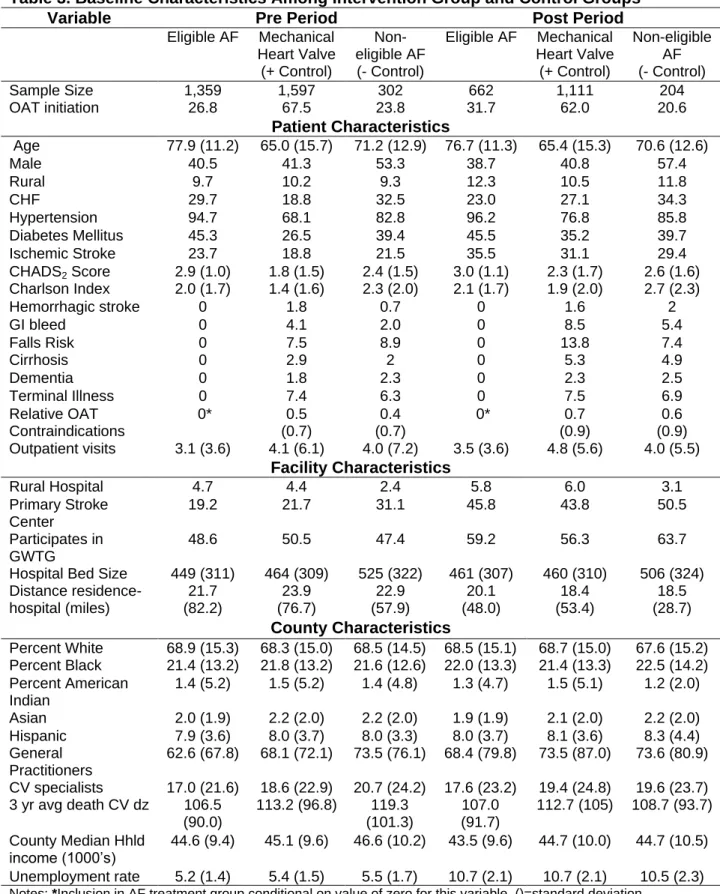
OAT initiation was decidedly higher in the guideline positive cohort (67.5%) than in the intervention (26.8%) or guideline negative cohort (23.8%). Additionally, OAT initiation in the guideline negative cohort was higher than expected. OAT initiation in the intervention group (26.8%) was within range of previous observational studies [36]. Within specific indication cohorts, average age remained stable while number of diagnoses tended to increase in the post period. Overall number of relative contraindications for OAT did not change appreciably between pre and post periods. The number of outpatient claims from primary care
physicians in the 30 days preceding entry into a cohort remained stable or marginally increased between the pre and post periods. Hospital characteristics are notable for a marked increase in the percentage of individuals treated in hospitals that were accredited primary stroke centers or participating in some form of quality improvement program for acute stroke care. This trend was observed in all cohorts. The percentage of individuals treated in rural and critical access hospitals increased marginally from the pre period to the post period. County level characteristics in general remained stable from the pre to post period. Two notable exceptions to this trend were average unemployment rate in the county and percent of persons in poverty in the county, which increased in all cohorts from the pre to post period. Consistent with unemployment rates and percent persons in poverty, median household income fell in the post period for all cohorts. The number of general practice providers and cardiovascular specialists remained stable or marginally increased in the post period for the intervention and guideline positive cohorts but decreased slightly for the guideline negative cohort. The county level race and ethnicity demographics remained stable across time for all cohorts.
Regression Results
27
between the intervention cohort and the post period represents the difference in difference estimate. The OAT initiation rate increased on average 12 percentage points (p<0.001) for this cohort in the post period. This increase in OAT initiation dropped slightly, but remained significant (11 percentage point increase, p<0.01) in multivariable models controlling for additional patient and hospital facility characteristics. While the difference in difference estimate for the guideline negative cohort suggested a decrease in OAT initiation, the marginal effect was small and insignificant. Oldest individuals (71+ years) were less likely to initiate OAT as were individuals with the highest number of co-morbid conditions. Higher CHADS2 scores, indicating greater risk of acute ischemic stroke were not associated with
greater OAT initiation. Greater number of outpatient primary care physician claims preceding entry into the cohort was associated with increased OAT initiation. Finally, residential
distance from the admitting hospital was negatively associated with OAT initiation.
Sensitivity Test Results
28 Discussion
This study assessed the effect of the Joint Commission updating NPSG to include OAT on OAT initiation within a large privately insured population across North Carolina with new onset AF. The study has several unique strengths. First, the use of guideline positive and guideline negative control groups allow for greater mitigation of potential time bias between the pre and post periods. This overcomes a traditional deficit in observational studies. Second, the nature of this statewide claims database allows for analysis of a relatively stable population of privately insured state workers, spouses, dependents and retirees in a population of approximately one million, providing support for generalizing to other privately insured populations. A third strength of the study is the data linkages with the Area Resource File to provide a rich array of county level control variables and survey information from the OSCAR database to provide hospital facility variables. A fourth strength of the study is inclusion of multiple controls for co-morbid conditions and relative
contraindications to OAT. Finally, the clustering of individuals within the hospital in which they received treatment mitigates potential effects of outlier hospitals on the population averaged effect of the policy change.
We found a positive association between revision of NPSG by The Joint Commission to include OAT and OAT initiation for individuals with new onset AF, on average a 10
percentage point increase in the rate of OAT initiation. The strong positive association between NPSG and the outpatient cohort in our sensitivity analysis suggest an indirect effect of NPSG as well. While our results suggest that OAT initiation decreased for individuals in whom OAT is not indicated (the guideline negative cohort), the effect size is small and insignificant. The rate of OAT initiation in the guideline positive cohort was smaller than anticipated, but remained relatively constant in pre and post periods; this supports our choice as a positive control which was relatively unaffected by the policy change. The
29
OAT initiation are consistent with what has been previously described in the literature [84]. The relative lack of association of increasing CHADS2 scores and OAT initiation is also
consistent with prior work [85].
The relatively low OAT initiation in the guideline positive cohort and the intervention cohort, as well as the higher than expected OAT initiation in the guideline negative cohort, are interesting. However this finding may reflect the nature of health insurance claims data that represent imperfect information collected for purposes other than the observational study. Our measured rates of OAT initiation in the AF cohort are consistent with prior work in this area [36]. We are not aware of published OAT initiation rates for individuals with
mechanical heart valves or significant thromboembolism. Using this group as a benchmark sheds new light on previous observational studies. Underutilization of OAT should be
reported with caution given the inherent limitations of using claims data. We view our results, not as an indictment suggesting poor quality of care for new onset AF, but rather as an examination of positive trends in guideline concordant care following policy change.
30
insurance and the results may not generalize to publicly insured populations. Notably, our cohorts included a large proportion of retired Medicare enrollees utilizing both their Medicare and NCSHP benefits, which serves to enhance generalizability to Medicare beneficiaries.
Despite the noted limitations, our findings suggest that NPSG concerning anticoagulation resulted in greater initiation of oral anticoagulation therapy for eligible individuals with incident atrial fibrillation, increasing guideline concordant care in this population. Finally we note that new medications for OAT were approved for reduction of stroke risk in patients with AF in late 2010. These agents do not require the same frequency of laboratory monitoring and titration of dosage as Warfarin. While more expensive than Warfarin, these new agents are anticipated to significantly reduce the burden of
anticoagulation management for both patients and providers. OAT initiation may increase to a greater degree in years following 2010 that are unrelated to policy changes and rather determined by the availability of novel anticoagulation agents with less intensive monitoring requirements. Observational studies in the future may reveal OAT initiation practice patterns more concordant with guidelines in association with the availability of novel oral
anticoagulants.
31
33
Table 3. Baseline Characteristics Among Intervention Group and Control Groups
Variable Pre Period Post Period
Eligible AF Mechanical Heart Valve (+ Control)
Non-eligible AF (- Control)
Eligible AF Mechanical Heart Valve (+ Control)
Non-eligible AF (- Control)
Sample Size 1,359 1,597 302 662 1,111 204
OAT initiation 26.8 67.5 23.8 31.7 62.0 20.6
Patient Characteristics
Age 77.9 (11.2) 65.0 (15.7) 71.2 (12.9) 76.7 (11.3) 65.4 (15.3) 70.6 (12.6)
Male 40.5 41.3 53.3 38.7 40.8 57.4
Rural 9.7 10.2 9.3 12.3 10.5 11.8
CHF 29.7 18.8 32.5 23.0 27.1 34.3
Hypertension 94.7 68.1 82.8 96.2 76.8 85.8
Diabetes Mellitus 45.3 26.5 39.4 45.5 35.2 39.7
Ischemic Stroke 23.7 18.8 21.5 35.5 31.1 29.4
CHADS2 Score 2.9 (1.0) 1.8 (1.5) 2.4 (1.5) 3.0 (1.1) 2.3 (1.7) 2.6 (1.6) Charlson Index 2.0 (1.7) 1.4 (1.6) 2.3 (2.0) 2.1 (1.7) 1.9 (2.0) 2.7 (2.3)
Hemorrhagic stroke 0 1.8 0.7 0 1.6 2
GI bleed 0 4.1 2.0 0 8.5 5.4
Falls Risk 0 7.5 8.9 0 13.8 7.4
Cirrhosis 0 2.9 2 0 5.3 4.9
Dementia 0 1.8 2.3 0 2.3 2.5
Terminal Illness 0 7.4 6.3 0 7.5 6.9
Relative OAT Contraindications
0* 0.5
(0.7)
0.4 (0.7)
0* 0.7
(0.9)
0.6 (0.9) Outpatient visits 3.1 (3.6) 4.1 (6.1) 4.0 (7.2) 3.5 (3.6) 4.8 (5.6) 4.0 (5.5)
Facility Characteristics
Rural Hospital 4.7 4.4 2.4 5.8 6.0 3.1
Primary Stroke Center
19.2 21.7 31.1 45.8 43.8 50.5
Participates in GWTG
48.6 50.5 47.4 59.2 56.3 63.7
Hospital Bed Size 449 (311) 464 (309) 525 (322) 461 (307) 460 (310) 506 (324) Distance residence- hospital (miles) 21.7 (82.2) 23.9 (76.7) 22.9 (57.9) 20.1 (48.0) 18.4 (53.4) 18.5 (28.7) County Characteristics
Percent White 68.9 (15.3) 68.3 (15.0) 68.5 (14.5) 68.5 (15.1) 68.7 (15.0) 67.6 (15.2) Percent Black 21.4 (13.2) 21.8 (13.2) 21.6 (12.6) 22.0 (13.3) 21.4 (13.3) 22.5 (14.2) Percent American
Indian
1.4 (5.2) 1.5 (5.2) 1.4 (4.8) 1.3 (4.7) 1.5 (5.1) 1.2 (2.0)
Asian 2.0 (1.9) 2.2 (2.0) 2.2 (2.0) 1.9 (1.9) 2.1 (2.0) 2.2 (2.0) Hispanic 7.9 (3.6) 8.0 (3.7) 8.0 (3.3) 8.0 (3.7) 8.1 (3.6) 8.3 (4.4) General
Practitioners
62.6 (67.8) 68.1 (72.1) 73.5 (76.1) 68.4 (79.8) 73.5 (87.0) 73.6 (80.9)
CV specialists 17.0 (21.6) 18.6 (22.9) 20.7 (24.2) 17.6 (23.2) 19.4 (24.8) 19.6 (23.7) 3 yr avg death CV dz 106.5
(90.0)
113.2 (96.8) 119.3 (101.3)
107.0 (91.7)
112.7 (105) 108.7 (93.7)
County Median Hhld
income (1000’s) 44.6 (9.4) 45.1 (9.6) 46.6 (10.2) 43.5 (9.6) 44.7 (10.0) 44.7 (10.5) Unemployment rate 5.2 (1.4) 5.4 (1.5) 5.5 (1.7) 10.7 (2.1) 10.7 (2.1) 10.5 (2.3)
34
Table 4. Estimated Marginal Effects of Policy Changes, Patient Characteristics and Inpatient Facility Characteristics on OAT initiation
Adjusted for Patient Characteristics
Adjusted for Patient and Facility Characteristics
Unadjusted Results
Guideline Positive -0.05 Guideline Negative -0.02 Intervention 0.05 Adjusted Results
Post Period -0.04* (-0.07,-0.01) -0.03* (-0.06,-0.00) Treatment Group -0.39*** (-0.43,-0.35) -0.38*** (-0.42,-0.34) Post*Treatment 0.10** (0.04,0.17) 0.11** (0.04,0.18) Post*Gldln Negative -0.03 (-0.19,0.13) -0.03 (-0.19,0.13) Patient Characteristics
18-40yrs 0.03 (-0.03,0.09) 0.03 (-0.02,0.09)
61-70yrs -0.01 (-0.04,0.02) -0.01 (-0.04,0.02)
71+years -0.10*** (-0.13,-0.07) -0.10*** (-0.14,-0.07) Gender (Male) 0.02* (0.00,0.04) 0.03** (0.01,0.05) Charlson(0) 0.01 (-0.03,0.06) 0.01 (-0.03,0.05) Charlson(2) -0.04* (-0.07,-0.00) -0.04* (-0.07,-0.00) Charlson(3-4) -0.02 (-0.06,0.03) -0.01 (-0.06,0.03) Charlson(5-11) -0.13*** (-0.17,-0.09) -0.12*** (-0.17,-0.08) CHADS2(0-1) -0.02 (-0.05,0.02) -0.01 (-0.05,0.03) CHADS2(3-4) -0.05* (-0.09,-0.01) -0.04* (-0.08,-0.00) CHADS2(5-6) -0.04 (-0.11,0.04) -0.03 (-0.10,0.04)
Rural 0.02 (-0.03,0.06) 0.01 (-0.05,0.07)
Micropolitan 0.01 (-0.03,0.04) -0.00 (-0.05,0.04) 0 Pre-Event Visits -0.05* (-0.09,-0.00) -0.04 (-0.09,0.00) 2+ Pre-Event Visits 0.06*** (0.03,0.09) 0.05*** (0.02,0.08) Facility Characteristics
Primary Stroke Center -0.01 (-0.06,0.04)
GWTG participation -0.01 (-0.03,0.02)
4-99 beds -0.04 (-0.09,0.00)
500+ beds -0.04 (-0.08,0.00)
25+ miles -0.10*** (-0.16,-0.05)
Rural provider 0.07 (-0.01,0.16)
Micropolitan Provider 0.04 (-0.01,0.09)
Observations 5235 5235
35
Table 5. Estimated Marginal Effects of Sensitivity Analyses in Alternate Outcome Definitions, Outpatient Only Cohort and Combined Inpatient/Outpatient Cohorts
OAT-RX & OAT-Labs OAT-Labs OAT-Outpatients OAT-ALL
18-40yrs 0.01 (-0.04,0.07) 0.01 (-0.03,0.06) -0.02 (-0.07,0.03) 0.01 (-0.03,0.04)
61-70yrs -0.02 (-0.04,0.01) -0.18*** (-0.21,-0.14) 0.02 (-0.01,0.06) 0.01 (-0.02,0.04)
71+years -0.12*** (-0.16,-0.09) -0.38*** (-0.43,-0.34) -0.05* (-0.09,-0.01) -0.09*** (-0.11,-0.06) Gender
(Male)
0.02 (-0.00,0.04) 0.01 (-0.01,0.03) 0.06*** (0.03,0.08) 0.04*** (0.02,0.06)
Charlson(0) 0.02 (-0.02,0.06) 0.03 (-0.00,0.05) 0.03 (-0.01,0.07) 0.01 (-0.01,0.04)
Charlson(2) -0.03 (-0.06,0.01) -0.02 (-0.05,0.01) -0.04 (-0.08,0.01) -0.05** (-0.08,-0.01)
Charlson (3-4) -0.00 (-0.05,0.04) -0.04* (-0.07,-0.00) -0.05 (-0.09,0.00) -0.05** (-0.08,-0.01)
Charlson(5-11)
-0.12*** (-0.16,-0.07) -0.07*** (-0.11,-0.03) -0.11*** (-0.17,-0.05) -0.13*** (-0.17,-0.09)
CHADS2(0-1) -0.00 (-0.04,0.04) 0.02 (-0.01,0.05) 0.02 (-0.02,0.06) 0.00 (-0.03,0.03)
CHADS2(3-4) -0.04* (-0.08,-0.00) -0.01 (-0.03,0.02) -0.01 (-0.05,0.03) -0.03* (-0.05,-0.00)
CHADS2(5-6) -0.02 (-0.08,0.04) -0.04 (-0.10,0.02) -0.04 (-0.10,0.03) -0.04 (-0.09,0.01)
Rural -0.00 (-0.07,0.06) -0.04* (-0.08,-0.01) -0.05 (-0.11,0.01) -0.03 (-0.07,0.01)
Micropolitan -0.01 (-0.06,0.04) -0.03** (-0.05,-0.01) 0.00 (-0.05,0.05) -0.01 (-0.04,0.02)
Post Period -0.02 (-0.05,0.01) 0.03** (0.01,0.05) 0.01 (-0.02,0.04) -0.01 (-0.03,0.01)
Treatment Group
-0.38*** (-0.42,-0.34) -0.14*** (-0.18,-0.10) -0.44*** (-0.50,-0.39) -0.42*** (-0.46,-0.38)
Post*Treatme nt
0.09* (0.02,0.16) 0.03 (-0.03,0.09) 0.17*** (0.09,0.25) 0.14*** (0.08,0.19)
Guideline Negative
-0.44*** (-0.53,-0.36) -0.21*** (-0.27,-0.15) -0.49*** (-0.64,-0.34) -0.49*** (-0.57,-0.40)
Post*Gldln Negative
-0.03 (-0.19,0.13) -0.02 (-0.11,0.08) 0.09 (-0.10,0.29) 0.02 (-0.10,0.14)
0 Pre-diagnosis Visits
-0.05* (-0.09,-0.00) -0.06*** (-0.10,-0.03) 0.09** (0.03,0.14) 0.02 (-0.01,0.06)
2+ Pre-diagnosis Visits
0.05*** (0.02,0.08) 0.04*** (0.02,0.07) 0.08*** (0.04,0.12) 0.06*** (0.03,0.08)
Primary Stroke Center
-0.01 (-0.06,0.04) -0.02 (-0.05,0.00)
GWTG participation
-0.01 (-0.04,0.01) -0.00 (-0.03,0.02)
4-99 beds -0.04* (-0.09,-0.00) 0.01 (-0.02,0.04)
500+ beds -0.03 (-0.07,0.01) -0.01 (-0.05,0.03)
25+ miles -0.10*** (-0.15,-0.05) -0.04*** (-0.06,-0.02)
Rural provider 0.08 (-0.00,0.17) 0.05 (-0.01,0.10) 0.12** (0.04,0.20) 0.11*** (0.05,0.17)
Micropolitan Provider
0.05* (0.00,0.09) 0.04* (0.00,0.08) 0.01 (-0.04,0.06) 0.04* (0.01,0.07)
Inpt Index Claim
-0.03** (-0.05,-0.01)
Observations 5235 5235 4694 9380
Chapter 3
THE EFFECT OF GEOGRAPHIC, PHYSICIAN, FACILITY, AND PATIENT FACTORS ON ORAL ANTICOAGULATION INITIATION AND DISCONTINUATION
Overview
Although some barriers to anticoagulation for patients with atrial fibrillation are known, little is known concerning their overlap with determinants of time to anticoagulation discontinuation or how initial inpatient versus outpatient diagnosis influences them. We identified a cohort of incident atrial fibrillation patients using five years of claims data. Based on this and other linkable data sources, we measured: patient, provider, and geographic characteristics; diagnosis setting; and anticoagulation therapy initiation and time to
37
stroke risk reduction of anticoagulation therapy is mitigated by its underutilization and early discontinuation among eligible individuals.
Introduction
Oral anticoagulation therapy (OAT) to reduce acute ischemic stroke risk in moderate or high risk atrial fibrillation (AF) patients, typically with Warfarin, has been recommended by guidelines from major organizations for nearly two decades [66]. However, despite its
benefit, OAT is often underutilized among eligible AF patients [86,87,75,76]. This underutilization may be secondary to low rates of OAT initiation or precipitous OAT discontinuation.
Barriers to OAT initiation exist at the level of patients, physicians and health care systems (see Table 6) [23,61,62,88,29,78,89,39,72,90,80]. In contrast, determinants of OAT discontinuation and the extent of their overlap with barriers to OAT initiation are not as well documented, with notable exceptions summarized in Table 6. Higher stroke risk and age >65 years at OAT initiation are inversely associated with OAT discontinuation [85,91]. Male gender [85,69] poor cognitive function [92], poverty [93], higher educational attainment [92], and homelessness [94] have been associated with OAT discontinuation.
38 Methods
Data Source
Data came from the North Carolina State Health Plan (NCSHP), a large self-funded insurance plan. NCSHP includes almost 1 million state employees, teachers, retirees and their dependents. Retired non-Medicare participants and retired Medicare beneficiaries compose 10% and 15% of the plan respectively. This claims database contains inpatient, outpatient and pharmacy records. Fields include encrypted member identification numbers, age, gender, county, and zip code of member residence. Records include diagnoses, procedures, providers, charges and payments. The database also contains provider level characteristics which include zip code, type of provider and specialty if applicable. We linked individual and hospital/practice counties with additional variables from the Area Resource File which allowed us to examine patient, provider, and county characteristics.
Procedures
We used NCSHP data from January 1, 2006-December 31, 2010 to examine OAT initiation and persistence during two time periods -- before (January 2006-December 2008) and after (January 2009-December 2010) NPSG revisions. For both periods, patients needed to be continuously enrolled in the NCSHP a minimum of 6 months prior to and a minimum of 6 months following the qualifying index claim. Individuals with a prescription claim for Warfarin more than 30 days prior to an index claim were excluded due to a high probability of representing prevalent rather than incident AF.
We used either one inpatient diagnosis or two outpatient diagnoses within 12 months (ICD-9-CM code 427.31) to identify individuals with new onset AF. Cohort entry date was defined as either the first outpatient AF claim or the inpatient admission date. CHADS2 is a
39
can be generated from claims data (See Appendix Table A3.1 for ICD-9-CM codes). We included all individuals meeting criteria for incident AF with a CHADS2 score > 2. Finally, to
reduce the probability of including individuals with prevalent AF we excluded individuals with any AF-related claim in the six months preceding the index claim.
Measures
Our key dependent variables were OAT initiation (a prescription claim for Warfarin within 30 days of index AF claim) and OAT discontinuation (greater than 60 days without Warfarin coverage by prescription claims).
Explanatory variables of interest were initial AF diagnosis setting (inpatient versus outpatient) and receipt of care in a PCMH (1 or more outpatient claims from a provider in a PCMH) in the 30 days preceding the index claim. We created control variables at the patient, provider, and county level. To mitigate potential confounding, all control variables were measured in the baseline period or immediately prior to the index AF claim [97]. Patient level control variables include age, gender, Charlson Comorbidity Index [98] (categorized as 0,1-2,3+), CHADS2 score [81] (categorized as 2,3-4,5+), rural/urban
40 Propensity Score Implementation
To reduce possible confounding with medical home enrollment, we used propensity scores to balance the two groups on pre-treatment covariates. We estimated, conditional on baseline covariates, an individual’s probability of receiving care in a medical home in the 30
days before the index event. In our models we included variables associated with OAT initiation, based on theory or prior evidence, and potentially associated with medical home status [99]. To estimate the propensity score, we employed generalized boosted regression with an iterative algorithm that optimized covariate balance based on average standardized absolute mean difference (ASAMD) [100]. We then used stabilized inverse-probability-of-treatment weights (IPTW) to estimate the average inverse-probability-of-treatment effect [101].
Statistical Analysis
We examined characteristics of eligible AF patients by OAT initiation status and then compared patient characteristics by the setting in which the initial diagnosis was made. In multivariable analysis, we used a generalized linear model with a log link, Poisson
distribution and robust clustered standard errors. This model accounted for within-facility correlation among practices and hospitals. We then re-estimated the model for inpatients and outpatients separately, followed by a generalized Hausman test to compare effects. We present marginal effects (absolute risk differences) for ease of interpretation.
41
for multiple OAT use periods and stratified by AF diagnosis year. Following model
specification and optimizing covariate functional form, we formally tested for violations to the proportional hazards assumption globally and for each covariate. All models were estimated in Stata 11. (StataCorp, College Station, TX)
Sensitivity Analysis
We conducted several sensitivity analyses to assess sensitivity to alternate
definitions of OAT initiation, OAT discontinuation and PCMH engagement. To examine OAT initiation we used the ICD-9 CM code for anticoagulation management (V58.61) and
procedure codes for corresponding blood tests (CPT codes: 99363, 99364, 85610, 85730 and, 85732) within 30 days of index event to create a non-pharmacy claims OAT initiation definition. To maximize sensitivity, a third OAT initiation definition combined the pharmacy claim and non-pharmacy claims definitions (positive if either of these two definitions were positive).
We then examined the length of time without Warfarin required to indicate OAT discontinuation. We used 30, 90, 120, 150 and 180 days without Warfarin by pharmacy claims to define OAT discontinuation in addition to our primary 60 day definition.
We examined variations in defining PCMH engagement based upon the percentage of all primary care visits to a PCMH 30 days preceding the index event. We used 30% and 50% thresholds for two additional definitions of PCMH engagement.
Finally, we performed the time to discontinuation analysis in a competing events, or cause specific framework, in which death was included as a competing event to