Effect of the lung allocation score on lung
transplantation in the United States
Thomas M. Egan, MD, MSc,
a,1and Leah B. Edwards, PhD
bFrom theaDivision of Cardiothoracic Surgery, Department of Surgery, University of North Carolina at Chapel Hill, Chapel Hill, North Carolina; and thebUnited Network for Organ Sharing, Richmond, Virginia.
KEYWORDS: lung transplant; lung allocation score; organ allocation; transplant benefit; transplant urgency
BACKGROUND: On May 4, 2005, the system for allocation of deceased donor lungs for transplant in the United States changed from allocation based on waiting time to allocation based on the lung allocation score (LAS). We sought to determine the effect of the LAS on lung transplantation in the United States.
METHODS: Organ Procurement and Transplantation Network data on listed and transplanted patients were analyzed for 5 calendar years before implementation of the LAS (2000–2004), and compared with data from 6 calendar years after implementation (2006–2011). Counts were compared between eras using the Wilcoxon rank sum test. The rates of transplant increase within each era were compared using anF-test. Survival rates computed using the Kaplan-Meier method were compared using the log-rank test.
RESULTS: After introduction of the LAS, waitlist deaths decreased significantly, from 500/year to 300/ year; the number of lung transplants increased, with double the annual increase in rate of lung transplants, despite no increase in donors; the distribution of recipient diagnoses changed dramatically, with significantly more patients with fibrotic lung disease receiving transplants; age of recipients increased significantly; and 1-year survival had a small but significant increase.
CONCLUSIONS: Allocating lungs for transplant based on urgency and benefit instead of waiting time was associated with fewer waitlist deaths, more transplants performed, and a change in distribution of recipient diagnoses to patients more likely to die on the waiting list.
J Heart Lung Transplant 2016;35:433–439
r2016 International Society for Heart and Lung Transplantation. All rights reserved.
Lung transplant (LTX) is accepted therapy to palliate patients with end-stage lung diseases. However, LTX is severely constrained by the shortage of brain-dead organ donors and suitable lung donors in particular. This situation has resulted in strict listing guidelines1and focus on organ allocation policies. In 1999, the U.S. Department of Health and Human Services released the Final Rule on organ allocation,2 which required the Organ Procurement and
Transplantation Network (OPTN) to emphasize broader sharing of organs, reduce waiting time as an allocation criterion, and create equitable organ allocation systems using objective medical criteria and medical urgency. The OPTN is the network that links the organizations of the solid-organ donation and transplantation system in the United States, including transplant centers, organ procure-ment organizations, and histocompatibility laboratories. The United Network for Organ Sharing is a private non-profit membership organization that is designated as the OPTN under contract with the U.S. Department of Health and Human Services; the United Network for Organ Sharing has held the OPTN contract since its inception in 1986.A report commissioned from the Institute of Medicine agreed that organ allocation should be based on measures of medical urgency, while avoiding futile transplants, and should
1053-2498/$ - see front matterr2016 International Society for Heart and Lung Transplantation. All rights reserved. http://dx.doi.org/10.1016/j.healun.2016.01.010
E-mail address:[email protected]
Reprint requests: Thomas M. Egan, MD, MSc, Division of Cardiothor-acic Surgery, Department of Surgery, University of North Carolina at Chapel Hill, 3040 Burnett-Womack Building, CB #7065, Chapel Hill, NC 27599-7065. Telephone: 919-966-3381.
1
minimize the effect of waiting time; it also encouraged broader geographic sharing in organ allocation.3 In 1998, the Lung Allocation Subcommittee of the OPTN Thoracic Organ Transplantation Committee was created to evaluate the U.S. lung allocation system and make recommendations to comply with the Final Rule.
Based on analyses by the OPTN and the Scientific Registry for Transplant Recipients, the Lung Allocation Subcommittee recommended a new allocation system for transplant candidates Z12 years old, changing from allocation of donor lungs based on waiting time to allocation based on a lung allocation score (LAS). The LAS is calculated using pre-transplant clinical diagnostic factors predictive of survival during the following year on the waiting list without a transplant as well as survival during the first year after a transplant.4Development of the LAS and the rationale for using it in recipientsZ12 years old are reviewed elsewhere.5,6 The policy was approved by the OPTN Board of Directors in 2004 and implemented in May 2005.
In this article, we show the effect of the LAS on LTX in the United States by comparing outcomes of patients on the waiting list and after transplantation for 5 years before introduction of the LAS with patients for 6 years after LAS implementation. Although the numbers reported here are published every year in annual reports of the Scientific Registry for Transplant Recipients,7–9this article analyzes trends over time and demonstrates the statistical and practical significance of changes observed in LTX practice associated with introduction of the LAS over more than a decade. We do not offer opinions about the pros and cons of these observed changes.
Methods
Tabulations are based on OPTN data as of March 8, 2013. The cohorts analyzed included LTX candidates ever waiting, trans-plants performed, and deceased donors recovered for the years 2000–2011. Waitlist and post-LTX mortality data were supple-mented from the Social Security Death Master File data. Restrictions on complete public release of the Social Security Death Master File since November 2011 may result in an underestimate of mortality for November and December 2011. This restriction also is the basis for not including data from 2012 or later.
Diagnoses were grouped according to the LAS classification, with some exceptions: the addition of “other,” which included patients with sarcoidosis, autoimmune diseases, and a small group of unusual diagnoses not typically associated with pulmonary
fibrosis, and retransplant as a separate group. Details of diagnostic groups and modifications are included in the Supplementary materials (available online at jhltonline.org). For this analysis, patients were assigned to emphysema (chronic obstructive pulmonary disease [COPD]), pulmonary hypertension, cystic
fibrosis, restrictive lung diseases (fibrotic lung disease), other, and retransplant.
Counts were compared between eras using the non-parametric Wilcoxon rank sum test, using the ranks of values, rather than the values themselves. Because only a limited number of ranks were compared, and the patterns of ranks were the same in several instances with regard to the number of years with higher (or lower)
ranks before the LAS compared with after the introduction of the LAS, thep-values were sometimes identical. Increased transplant rates within each era were compared by theF-test. Survival rates computed using the Kaplan-Meier method were compared using the log-rank test. Patient survival was censored at the earlier date of either last reported follow-up or retransplant. Because the system changed suddenly on May 4, 2005, data from 2005 were affected by both allocation systems and so are not shown in mostfigures for better comparison of pre-LAS and post-LAS cohorts.
Results
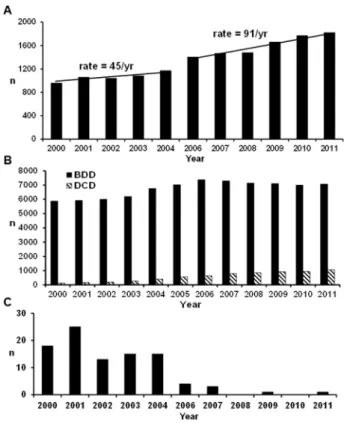
The absolute number of LTX procedures was increasing during the 5 years before introduction of the LAS. However, there was a significant 20% increase in the number of LTX procedures performed after introduction of the LAS (p ¼
0.0062). Moreover, the annual rate of LTX procedures increased significantly, from 45/year to 91/year (Figure 1A). This increase was not due to a corresponding increase in brain-dead organ donors (Figure 1B). Introduction of the LAS coincided with a dramatic reduction in living-donor bilateral lobe transplants (Figure 1C). This procedure is
analogous to living-donor kidney transplant except that 2 healthy blood type–compatible donors need lower lobes large enough to fit into a smaller recipient’s chest. This operation, infrequently performed before 2005, was almost eliminated after introduction of the LAS.
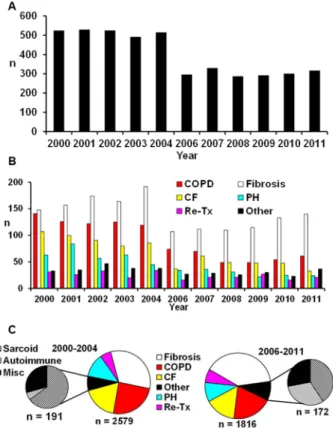
In the 5 years before the LAS, 4500 patients died annually on the U.S. LTX waitlist. After introduction of the LAS, waitlist deaths dramatically decreased by440%, to an average of 300/year (p ¼ 0.0062) (Figure 2A). For waitlist deaths, the distribution of diagnoses at listing was similar before and after introduction of the LAS (Figure 2B). Patients withfibrotic lung disease continued to represent the largest proportion of waitlist deaths (Figure 2C). This
proportion increased significantly, from 32% before to 40% after introduction of the LAS (po0.0001, chi-square test). In addition to more transplants performed, there was a striking change in indications for LTX.Figure 3A shows a significant increase in LTX procedures for patients with
fibrotic lung disease (p¼0.0062). By 2007,fibrosis became and remains the most common indication for LTX. Concomitantly with implementation of the LAS, additional diagnoses for autoimmune diseases were added, so patients with autoimmune disease were more likely to appear in both waitlist and transplant populations.
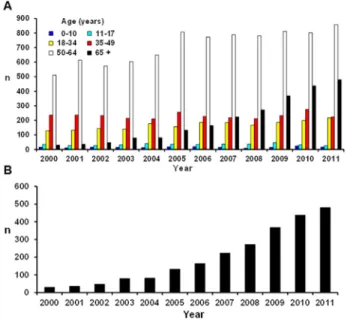
Figure 4A shows the change in LTX distribution by age.
The most substantial increases were in patients 50 to 64 years old and patientsZ65 years old (po0.0001 for each age group, chi-square test). Before introduction of the LAS, there were annual increases in LTX in patientsZ65 years old. However, this trend increased faster after introduction of the LAS (Figure 4B).
Figure 5shows a trend of increasing LAS of recipients.
Although LTX in patients with LAS 450 in 2006 was uncommon (14% of recipients), by 2011, 29% of transplants were performed in patients with LAS 450. LTX is now almost never performed in patients with LASo30. Because changes in clinical data after listing were not reported, the LAS cannot be computed on transplants before 2005. Although older patients, more patients with fibrotic lung disease, and arguably sicker patients are now undergoing
LTX, Figure 6 shows that actuarial 1-year survival after
Figure 2 Lung transplant waitlist deaths. Note: Data for 2005 are not shown. (A) Total number of deaths on the lung transplant waiting list. The number of deaths decreased significantly after the lung allocation score (LAS) was introduced (p¼0.0062, Wilcoxon rank sum test). (B) Total number of lung transplant waitlist deaths by diagnosis. In every disease category except “other” and retransplant, the absolute number of deaths decreased significantly (p o 0.01 for each diagnosis, Wilcoxon rank sum). “Other” includes sarcoid lung disease, lung disease associated with autoimmune disease, and miscellaneous (other rare types of lung diseases not classified). (C) Proportion of waitlist deaths by diagnosis. Although fewer patients withfibrotic lung disease died on the waitlist, the proportion of waitlist deaths in patients with
fibrotic disease increased significantly from 32% before the LAS to 40% after the introduction of the LAS (po 0.0001, chi-square test). The significant apparent increase in waitlist deaths among patients with autoimmune diseases is likely because more diagnoses for autoimmune diseases were added concomitantly with the introduction of the LAS. These would have been listed as “other” in the pre-LAS era. CF, cystic fibrosis; COPD, chronic obstructive pulmonary disease; PH, pulmonary hypertension; re-Tx, re-transplantation.
LTX was slightly but significantly improved after introduc-tion of the LAS.
Discussion
Lung disease is the third leading cause of death in the United States,10but the donor shortage limits the utility of transplantation. Lung Allocation Subcommittee members agreed that the existing “time waiting” allocation system was inconsistent with the Final Rule. The Subcommittee’s
first task was to decide on priorities of any new allocation system. The ethical principles considered were reviewed elsewhere.11 There was concern that basing allocation solely on risk of dying without LTX, similar to the Model
for End-Stage Liver Disease/Pediatric End-Stage Liver Disease system for liver allocation, would lead to an inordinate number of futile transplants. Thus, incorporating post-transplant survival was desired. This desire led to the concept of“transplant benefit”—essentially, the difference in estimated waitlist and post-transplant survival. The intent was to balance urgency (risk of dying on the waitlist without a transplant) with transplant benefit (defined as the differ-ence between predicted days lived on the waitlist for an additional year and predicted days lived in the first year post-transplant). Thus, calculated waitlist survival proba-bility“counts twice as much”as mortality risk after LTX.
The LAS is the only solid-organ algorithm in the United States that incorporates post-transplant survival explicitly into allocation, although the recently revised kidney allocation system includes prioritization based on estimated post-transplant survival for some organs. Estimates of waitlist and post-LTX survival were based on analyses of data provided at the time of listing and transplant. However, before May 2005, waitlisted patient data provided at the time of listing were never updated. Despite using“old”data provided at the time of listing to create the system, introduction of the LAS was associated with a significant decrease in waitlist mortality that has been sustained
(Figure 2). The significant and sustained increase in number
of transplants after the introduction of the LAS was unanticipated. Perhaps this increase was related to offering lungs to patients most in need (patients with a high LAS), rather than patients well enough to wait longer.
The annual increase in the lung utilization rate also increased; this may be related to increasing confidence using less than optimal or“marginal”lungs, possibly occasioned by offering lungs to sicker patients without reduced post-transplant survival. Using sub-optimal donors (e.g., smok-ing history, donor age) is another possible explanation. There may have been a change in practice independent of the LAS. The Health Resources and Services Administra-tion Breakthrough Collaboratives,12 introduced in 2003, likely contributed to increased brain-dead organ donors, particularly before introduction of the LAS, but the number of brain-dead organ donors has been essentially constant for
Figure 4 Age of lung transplant recipients. Note: Data for 2005 are not shown. (A) After introduction of the lung allocation score (LAS), the largest increase in lung transplant procedures was in middle-aged and older recipients, perhaps reflecting the substantial increase in lung transplants for patients withfibrotic lung disease. (B) The number of lung transplants in recipientsZ65 years old was slowly increasing before introduction of the LAS in 2005, but the number of recipients Z65 years old increased substantially after introduction of the LAS in 2005.
Figure 5 Effect of the lung allocation score (LAS) on disease severity of recipients. Since the introduction of the LAS, more patients with higher LAS are receiving transplants. By 2010, most lung transplants were being performed in recipients with LAS Z40. Virtually no transplants were performed in recipients with LASo30.
the last 6 years (Figure 1B). Increasing use of“protective” ventilatory strategies also may have contributed to more lung donors.13
Before the introduction of the LAS, patients were often listed before they were ready to undergo transplant, to accrue waiting time. After introduction of the LAS, the number of active registrations was reduced by half, and inactive registrations were almost eliminated. The change in recipient diagnosis distribution was anticipated because it was known that patients with pulmonary fibrosis had a higher waitlist mortality.14 Although the proportion of recipients with COPD declined (Figure 3), equivalent numbers of patients with COPD received LTX. More older patients are undergoing LTX, particularly after introduction of the LAS (Figure 4B), despite the apparent poorer long-term survival associated with advanced age.15This situation has sparked debate about utilization of scarce resources.16 One small analysis performed after introduction of the LAS suggested that short-term survival in LTX recipients 470 years old is similar to survival in recipients 60 to 69 years old.17 Nevertheless, as Baby Boomers age, more patients
465 years old will present for LTX. This change in LTX practice may have occurred with no changes in allocation. Updated LTX recipient guidelines suggest more scrutiny of patients465 years old and that few recipients 475 years old would qualify.1Until the number of lungs for transplants increases, ethical issues about allocation to older versus younger recipients will continue to foster debate.
The elimination of bilateral lobe transplants (Figure 1C) coincided with introduction of the LAS. Before the LAS, patients presenting late in the course of disease or who deteriorated rapidly had no option but waitlist death or accepting lungs turned down by many other centers, usually for quality. With the LAS, as patients deteriorate, their clinical data can be updated, and their score increases, enhancing likelihood of a lung being offered.
Although sicker and older patients are undergoing LTX under the new allocation system, 1-year survival has not been adversely affected. The 1-year survival actually improved, although a few patients with very high scores may have a higher post-transplant mortality risk.18,19 However, when waiting time was the only criterion for lung allocation, many of these patients would have died while on the waitlist or would never have been listed and would have died from end-stage lung disease.
Our survival comparison before and after introduction of the LAS does not take into account the temporal mortality rate changes. Survival after LTX has been improving over time.15 Because proportionately more patients with idio-pathic pulmonary fibrosis are undergoing transplant com-pared with patients with COPD, who had historically better 1-year post-transplant survival, 1-year survival may have improved more without introduction of the LAS. However, fewer transplants may have been performed, and more patients may have died on the waitlist. A recent analysis showed that 5-year survival was slightly less after introduction of the LAS, questioning its long-term benefit.20 However, this analysis did not consider the impact of increasing recipient age because of a concomitant change in
practice. Cost of post-transplant care increased after implementation of the LAS,21,22presumably because sicker patients were undergoing LTX and surviving.
Centers can update clinical data at any time but are required to update data every 6 months for actively listed patients. Thus, current data are now available for further analysis. Another unique feature of the LAS recommended by the Subcommittee was to reanalyze waitlist and post-transplant mortality every 6 months, to adjust parameters and identify any new variables that should be included in calculation of the LAS or exclude any that were no longer relevant. However, this recommendation was not imple-mented because longer periods of data accrual were deemed more appropriate.
A few changes have been made to the LAS since its inception. Current partial pressure of carbon dioxide and change in partial pressure of carbon dioxide were incorpo-rated into the LAS calculation in 2008. Factors used to calculate the LAS were reviewed by the Thoracic Organ Committee in 2010–2012. The OPTN Board of Directors approved LAS modifications to include the addition of new risk factors—cardiac index, central venous pressure, and bilirubin—into either the waitlist mortality model or the post-transplant survival model. Other changes were made on how existing risk factors were used, such as using not only the current value of creatinine but also an increase in creatinine of 150%.
Although the Final Rule stated that the OPTN must attempt to minimize the effects of geography on organ allocation, there was no consensus among Lung Allocation Subcommittee members or the LTX community about broader geographic sharing of lungs when the LAS was adopted. Since 2006, broader sharing of hearts for Status 1A and 1B patients led to a substantial decrease in mortality on the cardiac transplant waitlist. Broader geographic sharing of lungs (eliminating allocation within the Organ Procure-ment Organizationfirst) would likely further reduce waitlist mortality and increase the LAS of LTX recipients.23 Strategies to implement broader geographic sharing are currently being considered by the OPTN Thoracic Organ Committee.
After a study showed that LAS predicted mortality,24the U.S. system was enacted to allocate lungs in Germany in December 201125and was introduced into Eurotransplant to allocate lungs between member countries to recipients with a LASZ50. In April 2012, The Netherlands introduced the U.S. system to allocate lungs.26
The current U.S. lung allocation system has some limitations. The LAS can use only data collected by the OPTN. Thus, possible important objective data not collected by the OPTN were never considered in allocation. The system came under fire because of lung allocation to pediatric patients, particularly patientso12 years old.27–29 The LAS does not predict waitlist mortality well in patients with pulmonary hypertension. Both of these issues are discussed further in theSupplementary materials (available
online at jhltonline.org). Programs can apply to a Lung
online at jhltonline.org). The system is complicated and is difficult to explain to a lay audience. Because waitlisted patients’scores can change as clinical status changes, it is impossible for patients to know when they are“on the top of the list”at any center or when they might undergo LTX.
Our analysis has some limitations. Because it spans 12 years, it cannot take into account changes in practice, improvements in care, or new therapies. We rely on veracity of data entered by hundreds of staff at transplant centers. We did not analyze patients after removal from the waiting list, either before or after the introduction of the LAS. Before implementation of the LAS, data were not updated after listing; only data provided at listing were available.
In conclusion, the LAS, allocating lungs based on predicted waitlist death and transplant benefit, appears to be superior to the older system of allocation based on waiting time. This conclusion is based on reduced LTX waitlist mortality with no detrimental effect on post-transplant survival and agrees with other published opinions,30,31 although there are detractors.32 More LTX procedures were concomitantly observed, but this may not be a direct result of the LAS. Additional refinements, such as reducing reliance on geography in allocation and adding new parameters may reduce waitlist mortality further. Adoption of similar algorithms incorporating both waitlist death risk and transplant benefit may be beneficial for allocation of other organs for transplant.
Disclosure statement
Neither of the authors has a financial relationship with a commercial entity that has an interest in the subject of the present manuscript or other conflicts of interest to disclose.
This work was supported in part by U.S. Health Resources and Services Administration contract 234-2005-370011C, which sup-ported the data collection and release to researchers.
The authors thank Margaret Alford Cloud (University of North Carolina) for editorial assistance. The authors acknowledge the contributions of members of Arbor Research Collaborative for Health, which held the Scientific Registry of Transplant Recipients contract from 2000 to 2010: Rami Bustami, Tempie Shearon, Keith McCullough, Robert Merion, Susan Murray, and Robert Wolfe. The authors also acknowledge the work of Drs. Abbas Ardehali, Edward Garrity Jr, Frederick L. Grover, W. Steves Ring, Robert C. Robbins, Mark K. Robbins, Stuart C. Sweet, Elbert P. Trulock III, and Douglas E. Wood, who were members of the Lung Allocation Subcommittee when the new allocation policy was developed, and former United Network for Organ Sharing staff members Matthew Coke, Josh Czarda, and Douglas Heiney.
The content is the responsibility of the authors alone and does not necessarily reflect the views or policies of the U.S. Department of Health and Human Services; mention of trade names, commercial products, or organizations does not imply endorsement by the U.S. government.
Supplementary Materials
Supplementary material cited in this article is available online atwww.jhltonline.org.
References
1. Weill D, Benden C, Corris PA, et al. A consensus document for the selection of lung transplant candidates: 2014—an update from the Pulmonary Transplantation Council of the International Society for Heart and Lung Transplantation. J Heart Lung Transplant 2015;34: 1-15.
2. Department of Health and Human Services. Organ Procurement and Transplantation Network; Final Rule. 42 CFR—Part 121. Fed Regist 1999;64:56649-61.
3. Institute of Medicine, Committee on Non-Heart-Beating Transplanta-tion II. Non-heart-beating organ transplantaTransplanta-tion: practice and protocols. Washington, DC: National Academy Press; 2000.
4. United Network for Organ Sharing. A guide to calculating the Lung Allocation Score.http://www.unos.org/docs/lung_allocation_score.pdf. Accessed January 21, 2015.
5. Colvin-Adams M, Valapour M, Hertz M, et al. Lung and heart allocation in the United States. Am J Transplant 2012;12:3213-34. 6. Egan T, Murray S, Bustami R, et al. Development of the new lung
allocation system in the United States (The 2005 SRTR Report on the State of Transplantation). Am J Transplant 2006;6(5 Pt 2):1212-27. 7. Valapour M, Paulson K, Smith JM, et al. OPTN/SRTR 2011 Annual
Data Report: lung. Am J Transplant 2013;13(Suppl 1):149-77. 8. Valapour M, Skeans MA, Heubner BM, et al. OPTN/SRTR 2012
Annual Data Report: lung. Am J Transplant 2014;14(Suppl 1):139-65. 9. Valapour M, Skeans MA, Heubner BM, et al. OPTN/SRTR 2013 Annual Data Report: lung. Am J Transplant 2015;15(Suppl 2):1-28. 10. Kochanek KD, Xu JQ, Murphy SL, Minino AM, Kung HC. Deaths:
Preliminary data for 2009. National Vital Statistics Reports. Hyatts-ville, MD: National Center for Health Statistics; 2011.
11. Egan T. Ethical issues in thoracic organ distribution for transplant. Am J Transplant 2003;3:366-72.
12. About OPTN Breakthrough Collaborative.http://optn.transplant.hrsa. gov/converge/optn/breakthroughCollaborative.asp. Accessed June 8, 2015.
13. Ventilation with lower tidal volumes as compared with traditional tidal volumes for acute lung injury and the acute respiratory distress syndrome. The Acute Respiratory Distress Syndrome Network. N Engl J Med 2000;342:1301-8.
14. Hosenpud JD, Bennett LE, Keck BM, Edwards EB, Novick RJ. Effect of diagnosis on survival benefit of lung transplantation for end-stage lung disease. Lancet 1998;351:24-7.
15. Yusen RD, Christie JD, Edwards LB, et al. The Registry of the International Society for Heart and Lung Transplantation: Thirtieth Adult Lung and Heart-Lung Transplant Report—2013; focus theme: age. J Heart Lung Transplant 2013;32:965-78.
16. Raman SM, Cahill BC. Lung transplantation in older adults: how old is too old? J Heart Lung Transplant 2011;30:270-2.
17. Kilic A, Merlo CA, Conte JV, Shah AS. Lung transplantation in patients 70 years old or older: have outcomes changed after implementation of the lung allocation score? J Thorac Cardiovasc Surg 2012;144:1133-8.
18. Russo MJ, Worku B, Iribarne A, et al. Does lung allocation score maximize survival benefit from lung transplantation? J Thorac Cardiovasc Surg 2011;141:1270-7.
19. Merlo CA, Weiss ES, Orens JB, et al. Impact of U.S. Lung Allocation Score on survival after lung transplantation. J Heart Lung Transplant 2009;28:769-75.
20. Maxwell BG, Levitt JE, Goldstein BA, et al. Impact of the lung allocation score on survival beyond 1 year. Am J Transplant 2014;14: 2288-94.
21. Arnaoutakis GJ, Allen JG, Merlo CA, et al. Impact of the lung allocation score on resource utilization after lung transplantation in the United States. J Heart Lung Transplant 2011;30:14-21.
22. Maxwell BG, Mooney JJ, Lee PH, et al. Increased resource use in lung transplant admissions in the lung allocation score era. Am J Respir Crit Care Med 2015;191:302-8.
24. Smits JM, Nossent GD, de Vries E, et al. Evaluation of the lung allocation score in highly urgent and urgent lung transplant candidates in Eurotransplant. J Heart Lung Transplant 2011;30:22-8.
25. Gottlieb J, Greer M, Sommerwerck U, et al. Introduction of the lung allocation score in Germany. Am J Transplant 2014;14: 1318-27.
26. Eurotransplant. Introduction of the LAS in the Netherlands. July 4, 2014.https://www.eurotransplant.org/cms/index.php?page=newsitems &oid=458&action=viewitem&id=4505. Accessed June 8, 2015. 27. Ladin K, Hanto DW. Rationing lung transplants—procedural fairness
in allocation and appeals. N Engl J Med 2013;369:599-601.
28. Egan TM, Sweet SC. Rationing lung transplants. N Engl J Med 2013; 369:2064-5.
29. Ladin K, Hanto DW. Rationing lung transplants. N Engl J Med 2013; 369:2065-6.
30. Hachem RR, Trulock EP. The new lung allocation system and its impact on waitlist characteristics and post-transplant outcomes. Semin Thorac Cardiovasc Surg 2008;20:139-42.
31. McShane PJ, Garrity ER Jr. Impact of the lung allocation score. Semin Respir Crit Care Med 2013;34:275-80.