Odour - H4 Part 1
i
Technical Guidance Note
IPPC H4
Integrated Pollution Prevention and
Control (IPPC)
DRAFT
Horizontal Guidance for Odour
Part 1 – Regulation and Permitting
ii
Odour - H4 Part 1
Commissioning Organisation Environment Agency Rio House
Waterside Drive Aztec West Almondsbury Bristol BS32 4UD
Tel 01454 624400 Fax 01454 624409 © Environment Agency
First published 2002 This version October 2002 ISBN
Applications for reproduction should be made in writing to: Liz Greenland
Environment Agency
Scientific and Technical Information Service 2440 The Quadrant
Aztec West Almondsbury Bristol BS32 4AQ
All rights reserved. No part of this document may be reproduced, stored in a retrieval system or transmitted in any form or by any means, electronic, mechanical, photocopying, recording or otherwise, without the prior permission of the Environment Agency.
Record of changes
Version Date
Change
Draft for
consultation October 2002 Initial issue for consultation as a working draft document
Note:
Queries about the content of this consultation document should be made to the author, Lorraine Powell at [email protected] or sent in writing please to the address below.
Written comments or suggested improvements submitted in response to the consultation exercise should be sent to Mark Cairns at [email protected] or at:
Environment Agency Block 1
Government Buildings Burghill Road
Westbury-on-Trym Bristol.
Odour - H4 Part 1
iii
This guidance has been produced by the Environment Agency for England and Wales in collaboration with the Scottish Environment Protection Agency (SEPA) and the Northern Ireland Environment and Heritage Service (EHS). Together these are referred to as “the Agency” or “the Regulator” in this document.
This document has been released in the form of a working draft. Publication in final form will take place after wider consultation with industry, government departments, non-governmental organisations and other interested parties. Comments on this document and proposals for improved ways of working are particularly welcome during the consultation period.
The field of odour measurement and control is very wide in scope and is continually
developing. There are a number of areas where it would be desirable to have more data than is currently available, however this has been balanced against the need to provide guidance at this time. The best information available to the Agency has been used in compiling this document and some aspects have been necessarily simplified. Any additional data which is supplied to the Agency as part of this consultation which is constructive and relevant to the content and purpose of this guidance note will be most welcome and will be considered in the post-consultation review.
This guidance aims to bring consistency to the overall approach to the regulation of odorous emissions by the Agency under IPPC. It brings together a number of aspects relating to the permitting and regulation of odour-generating activities and shows how these can be applied within the BAT framework of IPPC.
The aim and scope of this guidance
In England and Wales the Environment Agency will have regulatory responsibility for IPPC installations designated as A1 and Local Authorities will have responsibility for A2 activities. In Scotland and Northern Ireland there is no such distinction between A1 and A2 activities. Therefore SEPA will regulate all Part A installations in Scotland and, similarly, EHS will regulate all Part A installations in Northern Ireland. In both England & Wales and in Scotland legislation is in place to implement IPPC. In Northern Ireland the relevant legislation is in preparation and any queries should be directed to EHS. In England and Wales guidance relating to odorous emissions from Part A2 and Part B activities can be found in the relevant Secretary of State’s Process Guidance Notes or IPPC Sector Guidance Notes. Guidance on odour control requirements which are specific to the Waste Management Licensing
regime can be found in Reference 13. As an interim measure, the aforementioned reference should also be consulted with respect to those landfill operations which will be migrating to IPPC or PPC.
Odour Management at IPPC Intensive Livestock Installations describes the odour impact
assessment requirements and odour management techniques for pig and poultry units (Reference 29). This guidance consists of two parts:
Part 1 - this document - outlines the main considerations relating to the Permitting and Regulation of odour-generating activities. It is aimed primarily at the information needs of Regulators, but also contains information which will be of use to Applicants. This Note:
describes the information relating to odorous releases that is required from the Operator for the purpose of making an application for an IPPC Permit
• • • •
• • • • •
describes the process of determination as it relates to odour
provides background information relating to the human response to odours
outlines the tools available for the assessment of the environmental impact of odour.
Part 2, “Odour Assessment & Control”, is aimed equally at Regulators and Operators. It describes: a range of odour impact assessment methodologies
the collection of odour samples
the “measurement” of odour – using analytical and sensory techniques
the control of odour by design, and by operational and management techniques the range of “end-of-pipe” odour abatement technologies available.
Part 2 forms a background to Part 1 and will assist in determining BAT for a given installation. This document provides an overview of the subject. It should be used in conjunction with the appropriate Sector Guidance Note to determine BAT and appropriate Permit conditions for a specific installation, taking local factors into account.
iv
Odour - H4 Part 1
ODOUR PRODUCING SCENARIOS (references refer to Guidance Note H4: Part 1)
Applicant Regulator
1 Are any activities on the installation potentially odorous?
YES
Go to 2 NO Applicant provides simple justification. If Regulator disagrees, go to 3. If Regulator agrees, reliance on implied BAT for permit conditions. END
2 Is this a proposed new plant which has the potential to release odour?
YES NO
Go to 3 Applicant undertakes suitable odour impact assessment in consultation with the Regulator. (Section 2.4(2), Appendices 3/4) Go to 7
Regulator checks methodology and data inputs.
(Section 2.4(2), Appendices 3/4) Go to 7
3 Is this an activity which is carried out largely in the open, containment of odour sources is not feasible?
YES NO Go to 4
Applicant undertakes impact assessment and proposes best management practice. Go to 7 (Section 2.4(2), Appendices 3/4) If this is a landfill or transfer station refer to sector guidance or WML odour guidance.
Considers best practice proposals and checks assessment
methodology.
(Section 2.4(2), Appendices 3/4) Go to 7.
4 Is it an existing plant with potential to impact on receptors but is well controlled with no odour problems outstanding?
YES NO
Go to 5 Applicant identifies sources and controls to prevent or reduce. Go to 10
If the Regulator agrees, appropriate Permit conditions are put in place to ensure plant remains under good control.
Go to 10 5 Does the installation have
potential to cause
annoyance but does not only because it is remote from receptors?
YES NO Go to 6
Applicant identifies sources and controls to prevent or reduce. Applicant proposes improvements to meet BAT
If Regulator agrees, appropriate permit conditions and improvement conditions are put in place to meet BAT over an appropriate timescale. END
6 If none of the above, the activity is therefore an existing installation with an actual or potential odour problem
YES END A detailed odour impact assessment would normally be required.
(Section 2.4(2), Appendix 3) Go to 7
Discuss detail required for odour impact assessment with Operator. What information is required and best represents the situation. (Section 2.4(2), Appendix 3) Go to 7
ADDITIONAL CONSIDERATIONS FOR DETERMINING BAT & PERMIT CONDITIONS
Applicant Regulator
7 Has an odour impact assessment been undertaken (and is it suitable)?
YES Go to 8
NO Carry out impact assessment using appropriate methodology Compare with benchmark where available/appropriate
(Section 2.4(2), Appendices 3, 4, 5, 6) Go to 8
Regulator checks methodology and data input
appropriate
(Section 2.4(2), Appendices 3, 4, 5, 6)
Go to 8 8 Is the impact acceptable? YES
Go to 9 NO
Propose techniques to meet BAT/work towards the benchmark as far as BAT allows
(Part 2 of H4) Go to 9
New plant should meet BAT from the outset. Put conditions in place to ensure that control is maintained. END
Existing plant: conditions and improvement programme to meet BAT. Go to 9
9 Are the techniques and monitoring which need to be applied self evident and agreed?
YES NO Read Part 2 of this Note
Existing plant: Applicant identifies, sources and proposes new controls
(Part 2 of H4) Go to 10
New plant should meet BAT from the outset. Put conditions in place to ensure that control is maintained. Go to 10
Existing plant: If the Regulator agrees with Operator’s proposals appropriate process-related techniques might go in the Permit . Go to 10
10 Could events outside the operators control lead to a failure of techniques?
YES NO END
Operator identifies the
events/failures and actions which will be taken to minimise the impact.
If the Regulator agrees, the information supplied by the applicant may form the basis of an odour management plan or appropriate conditions can be put into the permit. END
11 Is odour still a problem? YES NO END
Check that:
• best practice is being used at all times
• containment is being maintained
• materials have not changed
• original risk assessment considered all relevant factors
Revisit improvement programme and Permit conditions on the basis of Operators revised information.
Odour - H4 Part 1
v
1
THE REGULATORY FRAMEWORK FOR CONTROL OF ODOUR ...1
1.1 IPPC...1
1.2 IPPC
AND ODOUR...3
2 APPLICATION,
DETERMINATION & PERMITTING...7
2.1 O
VERVIEW...7
2.2 A
PPLYING FOR ANIPPC
PERMIT...7
2.3 C
ONSULTATION...8
2.4 A
SSESSMENT OF THEO
PERATOR’
SBAT
PROPOSALS...8
2.5 O
PTIONS FOR PERMIT CONDITIONS...13
2.5.1 Overview and underlying considerations ...13
2.5.2 Options for odour-related conditions...15
3 ONGOING
REGULATION ...20
3.1 C
OMPLAINT INVESTIGATION...20
3.1.1 Identification of source ...20
3.1.2 Use of complaint records ...20
3.1.3 Use of field surveys to determine nature/extent of exposure ...21
3.1.4 Other
considerations
in complaint investigation ...21
3.1.5 Sensitivity of the exposed population and individuals within it ...21
3.1.6 Common Incident Classification System ...21
REFERENCES ...23
SOURCES OF INFORMATION...24
DEFINITIONS RELATING TO THE LEGISLATION ...25
GLOSSARY OF TERMS RELATING TO ODOUR ...26
APPENDIX 1 - Attributes and quantification of odorous releases...28
APPENDIX 2 - Factors affecting human response ...32
APPENDIX 3 - An overview of odour impact assessment...35
APPENDIX 4 - Modelling of odorous releases ...45
APPENDIX 5 - Emission limit values and exposure benchmarks for odour ...50
APPENDIX 6 - Installation-specific odour exposure “acceptability” criteria for mixed
odours...53
APPENDIX 7 - Template for an Odour Management Plan...57
APPENDIX 8 - Protocol for subjective testing (“sniff-testing”) ...61
APPENDIX 9 - Tools for complaint investigation ...65
vi
Odour - H4 Part 1
Figure 1.1: “no reasonable cause for annoyance”...4
Figure 2.1: Odour impact assessment – where to look for guidance ...12
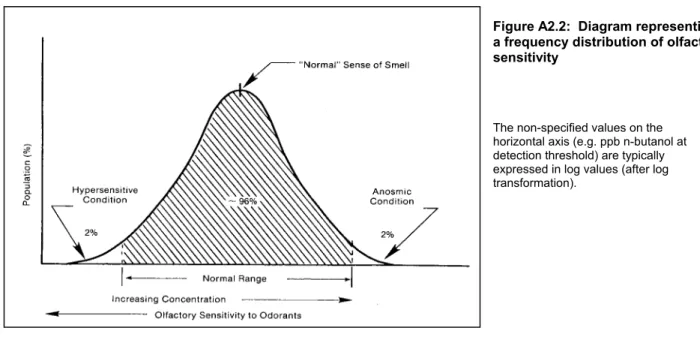
Figure A2.2: Diagram representing a frequency distribution of olfactory sensitivity...32
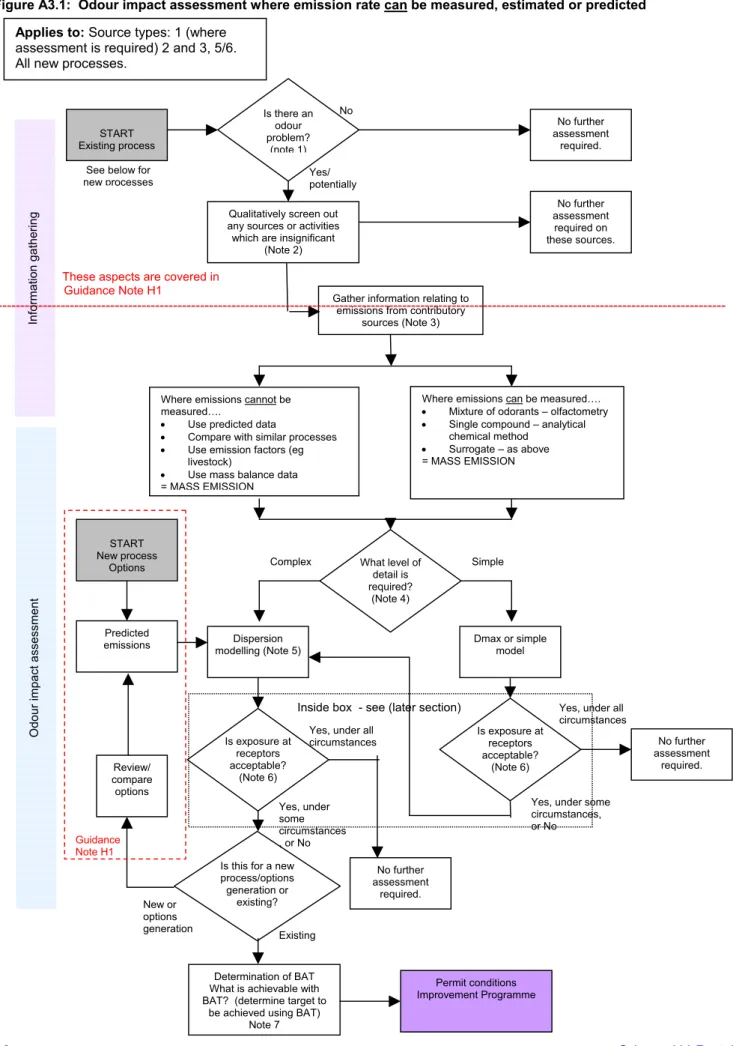
Figure A3.1: Odour impact assessment where emission rate can be measured, estimated or
predicted ...40
Figure A3.2: Odour impact assessment where emission rate cannot be measured,
estimated or predicted ...43
Figure A4.1: Dispersion modelling...45
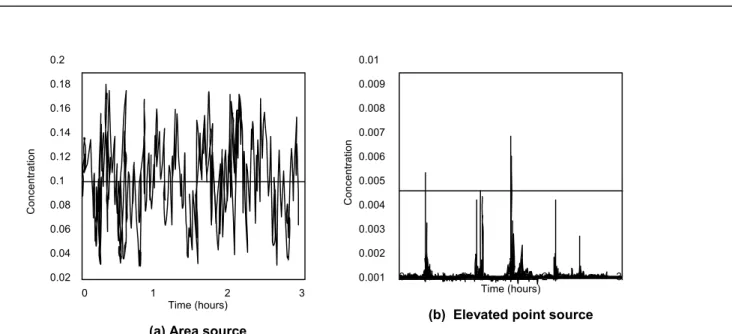
Figure A4.2: Variations in downwind concentrations from (a) an area source and (b) an
elevated point source...49
Figure A5.1: Applying installation-specific exposure standards to odour-emitting activities .51
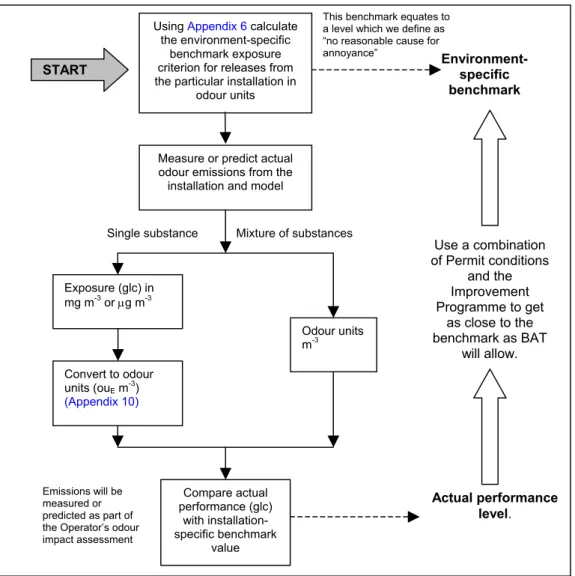
Figure A6.1: Derivation of installation-specific odour exposure criteria for existing
installations . ...53
Figure A9.1: Complaint investigation tools ...65
LIST OF TABLES
Table A1.1: Ranking table for everyday and industrial odours ...30
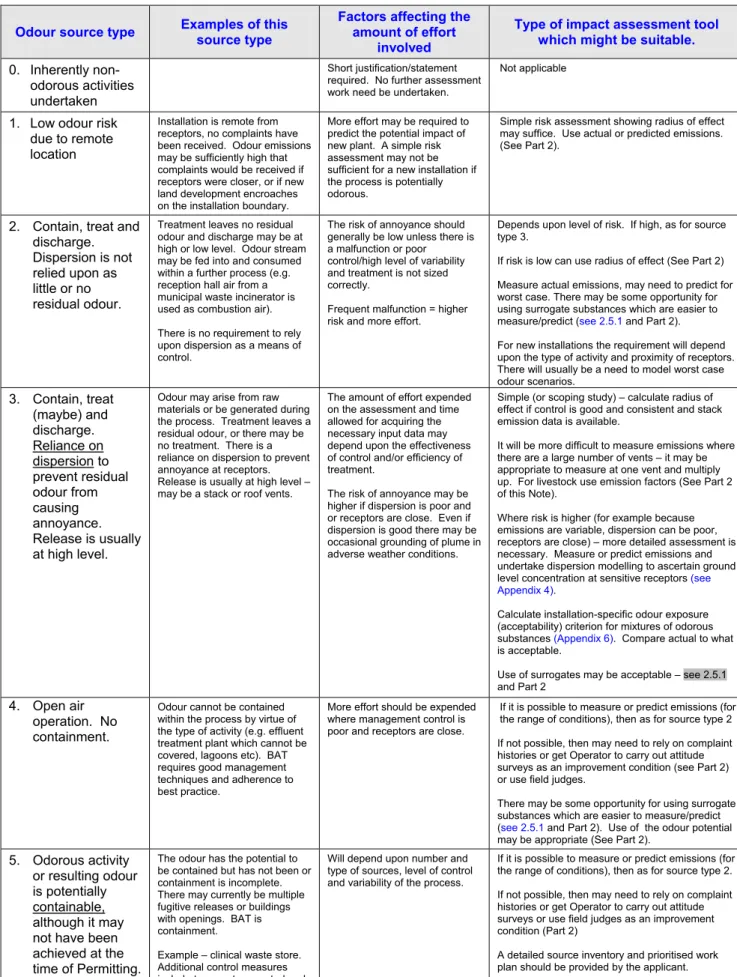
Table A3.1: Guide to Impact Assessment requirements for Permit Application purposes....38
Table A4.1: Dispersion modelling – recommended parameters...47
The appropriate sector regulatory package should be consulted before deciding upon Permit
conditions (see Section 2.5)...1
Table A5.1: Guideline values based on sensory effects or annoyance reactions, ...52
Table A6.1: Indicative odour exposure criteria for ground level concentration of mixtures of
odorants ...54
Table A7.1: Issues to consider in an Odour Management Plan ...58
Table A7.2: Suggested template for an odour management plan ...59
Table A7.3: Odour management plan – Example entries...60
Table A8.1: The Beaufort scale ...63
Table A10.1: Odour descriptors for commonly encountered compounds ...68
Table A10.2: Hedonic scores (1) ...69
Table A10.2: Hedonic scores (2) ...70
1 THE REGULATORY FRAMEWORK FOR CONTROL
OF ODOUR
1.1 IPPC
Integrated Pollution Prevention and Control (IPPC)1 is a regulatory system that takes an integrated approach to control the environmental impacts of certain prescribed industrial activities. It involves determining the appropriate controls for industry to protect the environment through a single permitting process. To gain a Permit, Operators of prescribed activities will have to show that they have
systematically developed proposals to apply the ‘Best Available Techniques’ (BAT) and meet certain other requirements, taking account of relevant local factors.
What is IPPC
In England and Wales the Environment Agency is responsible for those IPPC installations designated as “A1”. In Scotland SEPA is responsible for the regulatory control of all Part A IPPC installations. This is also the case in Northern Ireland. The legislation implementing IPPC has been put into place in England & Wales and in Scotland. In Northern Ireland, the legislation is in preparation and any queries should be directed to EHS
The Pollution Prevention and Control (England & Wales) Regulations 2000 (the “PPC Regulations”) define “pollution” as.2:
The regulatory requirements of IPPC relating to odorous emissions
“emissions as a result of human activity which may be harmful to human health or the quality of the environment, cause offence to any human senses, result in damage to material property, or impair or interfere with amenities and other legitimate uses of the environment.
Regulation 12(1)(a)3 requires that conditions are included in a Permit to ensure compliance with provisions in Regulation 12(2) to (8) relating to emission limit values:
• Regulation 12(2) states “….. a Permit shall include emission limit values for pollutants, in particular those listed in Schedule 5, likely to be emitted …. in significant quantities, having regard to their nature…”
• Regulation 12(6) states “….. the emission limit values required by paragraph (2) shall be based on the best available techniques for the description of installation…concerned but shall take account of the technical characteristics of the particular installation…, and, ……its geographical location and the local environmental conditions”.
• Regulation 12(8) states “where appropriate, the emission limit values required by paragraph (2) may be supplemented or replaced by equivalent parameters or technical measures”.
When determining the conditions of a Permit, the Regulator is required to take account of the general principles set out in Regulation 11(2) which state that an installation should be operated in such a way that:
(a) all the appropriate preventative measures are taken against pollution, in particular through application of the best available techniques; and
(b) no significant pollution is caused
In the generality of cases the Agency will aim to regulate odorous emissions by the imposition of emission limit values (ELVs), where this is feasible, or equivalent parameters and technical conditions, through the application of BAT, under Regulation 12(1)(a).
1 IPPC operates under the Pollution Prevention and Control (England and Wales) Regulations 2000 (Reference 2)and the Pollution Prevention and Control (Scotland) Regulations 2000 (Reference 3). These Regulations have been made under the Pollution Prevention and Control (PPC) Act 1999 and implement the EC Directive 96/61 on IPPC (References 4 and 5). Further information on the overall system of IPPC, together with Government policy and more detailed advice on the interpretation of the Regulations, can be found in the Department for Environment, Food and Rural Affairs (DEFRA) document “IPPC: A Practical Guide” (Reference 6) and the Scottish Executive/SEPA document “The Pollution Prevention and Control (Scotland) Regulations 2000 a practical guide” (Reference 7).
2 The legislation for Scotland and also for Northern Ireland can be presumed to be the same as that given in this guidance for England and Wales, unless specifically stated otherwise.
Odour - H4 Part 1
1
3 In Scotland, the Pollution Prevention and Control (Scotland) Regulations 2000 are numbered differently. The bullet points relating to Regulation 12 in E&W refer to Regulations 9(1)(a), 9(3), 9(7) and 9(9) respectively in Scotland
Regulation 12 (1)(b)(ii) requires the Regulator to impose such other conditions as appear to be appropriate for ensuring a high-level of protection for the environment as a whole, once again taking into account the general principles set out in Regulation 11.
It would normally be the case that the imposition of conditions securing BAT also secure that no significant pollution is caused. Should a situation arise where this is not the case then the Regulator may refuse the issue of a Permit altogether. The point at which significant pollution occurs is a professional judgement which takes into account the nature of the operation and what is technically achievable, informed by this Guidance Note and the appropriate Sector Guidance Note.
The information required by the IPPC Permit Application Form relates directly to the legal
requirements of the PPC Regulations. The IPPC Sector Guidance Notes explain, for each industrial sector, the information which the applicant must supply and the indicative standards which should normally be met in order to demonstrate compliance with each of those requirements.
The
relationship of this note to other guidance
Each IPPC Sector Guidance Note will outline indicative BAT for odour control for the specific activities associated with that sector. Where the EU has issued a BAT Reference document (BREF) for a sector, the information it contains on odour will have been taken into account in producing the UK Sector Guidance Note. Odour-related issues, however, tend to be very installation specific and, in accordance with the PPC Regulations, departures from any national standards can be justified at a local level on the grounds of the technical characteristics of the installation concerned, its geographical location and the local environmental conditions.
The purpose of this IPPC Horizontal Guidance Note is to provide supplementary information which is relevant to all sectors to assist applicants in responding to the requirements relating to odorous emissions described in the Sector Guidance Notes and the Permit application form.
This Note is made up of two parts which cover general issues relating to the regulation, assessment and control of odorous releases and should be used in conjunction with the appropriate Sector Guidance Note to determine BAT and appropriate Permit conditions for a specific installation, taking local factors into account.
Guidance on the odour control requirements of the Waste Management Licensing regime can be found in Reference 13. An explanation of the current status of that guidance with respect to IPPC and PPC landfill operations is also given in the document.
Separate odour guidance for intensive livestock installations regulated under IPPC is to be published: IPPC Guidance Note “Odour management at intensive livestock installations” (Reference 29) is likely to be released for consultation in early 2003.
Odour - H4 Part 1
3
1.2 IPPC and odour
Odour
pollution: what standard are we aiming for?
There are difficulties surrounding any quantitative assessment of whether “pollution” in the form of offence to the sense of smell is occurring and therefore what preventative measures, through the application of BAT, are appropriate. There can be a tendency to make a judgement based upon the presence or absence of complaints. However the lack of complaint should not necessarily imply the absence of an odour problem as there will be an underlying level of annoyance present before complaints are made.
The point at which “pollution” in the form of offence to the sense of smell is occurring is taken to be the point at which there is “reasonable cause for annoyance”. Consequently the aim of BAT should be to ensure that there is “no reasonable cause for annoyance”4.
Benchmarks for limiting exposure to polluting substances are usually aimed at avoiding harm to health and epidemiological evidence is used to determine appropriate numerical values for such limits. In the case of odour the scientific basis underpinning regulation is still a developing field. The response to exposure to an odour is primarily subjective – how strong is it, what does it smell like and how often/when does it occur and in what context? Each individual will make his own subjective
assessment which will either lead to a feeling of annoyance, or it will be considered to be acceptable. Limits can only be based upon a knowledge of what level of exposure is generally “acceptable” in terms of the exposure of sensitive receptors in general.
What benchmarks are there for odour pollution?
How do you determine whether exposure is acceptable?
Attributes and quantification of odorous release are discussed in Appendix 1 and factors affecting response and acceptability are discussed in Appendix 2.
An odorous emission can consist of a single substance, or there can be a dominant substance present. Alternatively it may be a mixture of several or many substances, some or all of which may be odorous. As everyone knows from experience, some odours are more offensive and have more potential to cause annoyance than others although several interlinked factors, as described above, also play a part in determining whether a particular odour is acceptable or not. Benchmarks must therefore take relative offensiveness into account if they are to be meaningful. Benchmarks should also be adjusted to take local circumstances into account.
Where emissions from an odorous activity can be measured or predicted by comparison with similar operations, and then modelled, it is possible to compare the modelled ground level concentration of odour at sensitive receptors to the installation-specific benchmark “acceptable” concentration. This gives an indication of whether there may be reasonable cause for annoyance and the degree of that annoyance. The Operator should use BAT to work toward attaining this acceptable ground level concentration but it should be remembered that there may be a delay until it can be achieved or, in some cases, BAT may not be able to deliver this. Installation-specific factors and the local receiving environment are taken into account in determining what BAT is in a particular situation. An appropriate benchmark will be determined by considering the receiving environment. Measurement of ground level concentrations of odour at sensitive receptors is rarely possible for a number of reasons – in particular the concentration is too low and often fluctuates – and so the benchmark, or the Permitted achievable concentration, has to be translated into an emission concentration at source so that compliance can be determined against this emission limit value, not the ground level concentration.
The use of benchmarks is described in Appendix 5 and the numerical values of benchmarks are listed in Appendix 6. The way in which these values are derived is explained in Appendix 2.
There are a number of different methods for assessing the impact of odorous emissions on local receptors. The amount of detail required in carrying out an assessment will depend to large extent upon the risk of causing annoyance and any complaint or enforcement history. If emissions can be measured or predicted, then acceptability can be assessed by comparing the predicted ground level concentrations with the benchmark (as described above).
If emissions cannot be measured or predicted then the acceptability of the impact has to be determined in another way because it will not be possible to make a direct comparison with a numerical
benchmark.
4 (The following does not apply in Scotland). The concept of “annoyance” occurs in several legal provisions (within the Control of Pollution Act 1974 s62(2)(d)(iii) and Noise and Statutory Nuisance Act 1993, schedule 3 6(b)). Odour is also regulated through the statutory nuisance provisions of Part III of the Environmental Protection Act 1990.
4
Odour - H4 Part 1
Impact assessment methodologies, including alternative means for assessing impact when emissions cannot be directly measured or predicted, are described in Appendix 3.
In summary, where there is potential for pollution in the form of offence to the sense of smell (i.e. where there is potential for reasonable cause for annoyance), the aim of BAT should be to achieve the following:
BAT for Odour
• To keep the exposure to odour at sensitive receptors below the level at which it would give reasonable cause for annoyance. (This would normally be the aim of most planning or other conditions applied by Local Authorities).
• To prevent the generation of odour where possible.
• To contain the odour and use effective treatment techniques, or other means of minimising emissions, where prevention is not possible.
• To promote the use of good practices for the control of odour, including adequate maintenance and cleaning, storage, containment etc.
The odour impact assessment will show if improvement is required and indicate how much improvement is needed. Exactly what constitutes BAT in any given situation will be a professional judgement informed by the Sector Guidance and this Guidance Note.
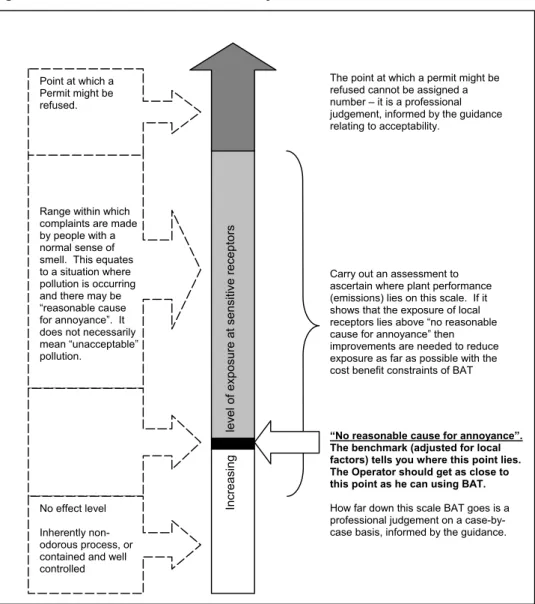
Figure 1.1, below, shows the relationship between “reasonable cause for annoyance” and the occurrence of pollution, the “no reasonable cause for annoyance” benchmark, and the aim of BAT. The benchmark will have different numerical values depending upon the nature of the odour (see Appendix 6). See below for further description.
Figure 1.1: “no reasonable cause for annoyance”.
“No reasonable cause for annoyance”. The benchmark (adjusted for local factors) tells you where this point lies. The Operator should get as close to this point as he can using BAT.
How far down this scale BAT goes is a professional judgement on a case-by-case basis, informed by the guidance. “No reasonable
cause for
annoyance”. This is the point at which we can say that pollution in the form of offence to the sense of smell has not occurred. Range within which complaints are made by people with a normal sense of smell. This equates to a situation where pollution is occurring and there may be “reasonable cause for annoyance”. It does not necessarily mean “unacceptable” pollution.
No effect level Inherently non-odorous process, or contained and well controlled
level of exposure at sensitive receptors
Increasing
Carry out an assessment to ascertain where plant performance (emissions) lies on this scale. If it shows that the exposure of local receptors lies above “no reasonable cause for annoyance” then improvements are needed to reduce exposure as far as possible with the cost benefit constraints of BAT Point at which a
Permit might be refused.
The point at which a permit might be refused cannot be assigned a number – it is a professional judgement, informed by the guidance relating to acceptability.
Odour - H4 Part 1
5
Unless the risk of causing annoyance is very low, the Operator will have carried out an odour impact assessment as part of the Permit application process (see Section 2.2). Where an existing installation has a history of odour complaints and obvious problems, a detailed odour assessment as part of the application will be required.
Where odour emissions from an installation can be measured, the actual modelled ground level concentration at sensitive receptors can be compared to the benchmark. This will provide an indication of the amount of additional control which will be needed to achieve the level of “no pollution”, in the form of offence to the sense of smell, ie “no reasonable cause for annoyance”, and the Operator should get as close to this value as BAT allows. For an existing plant such benchmarks might be used where odour cannot be contained and there is a risk of causing annoyance. For new installations or
expansion/modification to existing plant, they could be used as a planning tool to indicate whether the impact will be acceptable and/or to calculate chimney height for adequate dispersion or the efficiency required of abatement equipment.
Where odour emissions cannot be measured or predicted then comparison with these benchmarks cannot be undertaken. The assessment of odour impact can be made upon the various forms of community-based survey (described in Appendix 3) and complaint history, combined with a review of practices associated with the process or activity.
In many cases it will be appropriate to use a “standard” Permit condition for control of odorous emissions which is based on implied BAT. (Refer to Section 2.5.2). Where non-standard Permit conditions need to be applied this Guidance Note advocates a proportionate approach according to the degree of risk of causing annoyance at local receptors.
Permit conditions
Where it is necessary to impose odour-related conditions there are different types of conditions that may be appropriate. Choice will depend upon the type of operation and the nature of the emissions and whether there is an actual or potential problem.
Section 2.4 deals with the assessment of the Operator’s determination of BAT and Section 2.5 discusses the options for Permit conditions. In England & Wales the Environment Agency is currently developing an approach using Permit templates which may restrict the choice of condition in a given Sector.
The requirements set out in this Guidance Note and in the appropriate Sector Guidance Note apply to both new and existing activities, but it will be more difficult to justify departures from them in the case of new activities. New installations will be expected to meet BAT from the outset and to demonstrate that odour prevention or minimisation has been built in to process design. Where any odorous releases are to be made, a detailed odour impact assessment would normally be required, based upon predicted emissions and local topography and other local factors.
New and existing installations
For most existing plant, especially where there are no existing odour-related limits and no history of odour-related problems, the focus will be on the need to ensure that there is no reasonable cause for annoyance so far as is possible through the application of BAT, which will generally relate to “good practice”.
Where there is risk of adverse environmental impact (in terms of odour-related annoyance), BAT is likely to require a higher level of expenditure. Where insufficient information is available to effectively characterise and quantify emissions, a more detailed inventory of the materials used and subsequent releases may be required and/or monitoring undertaken (generally at source). These may indicate the need for additional odour reduction measures.
Where additions are proposed to existing plant or activities the aim should be, wherever feasible, to ensure that these do not add to the concentration or other characteristics of the exposure at sensitive receptors beyond a point where it will cause annoyance or increase the level of annoyance.
The following applies in England & Wales.
The release of odours from trade, industrial and business premises is regulated under several different legislative regimes. When an application is submitted for an IPPC Permit, the Operator may already have a framework of specific odour-related conditions in place as part of an Integrated Pollution Control (IPC) or Local Authority Pollution Control (LAPC) authorisation, a waste management licence (the relevant objectives) or arising from an abatement notice served under Part III of the Environmental Relationship
between IPPC and other regulatory regimes
Protection Act 1990 (statutory nuisance). When an A1 installation is issued with an IPPC Permit, existing IPC and LAPC authorisations relating to that activity will be superseded5.
Where installations transfer from Local Authority pollution control to the Agency, it will normally be of benefit to take advice from Local Authority officers concerning any previous odour problems.
Part III of the Environmental Protection Act 1990 is concerned with “statutory nuisances” and is regulated by Local Authorities. Unless the Secretary of State has granted consent, a Local Authority may not begin summary proceedings in respect of a nuisance where proceedings can be brought under the IPPC regime. This is to avoid “double jeopardy” for IPPC Operators, and is consistent with previous arrangements under IPC. However, activities that are not covered by IPPC, even if they are located on the same site as an IPPC installation but are not part of the installation, may be regulated under the statutory nuisance provisions. Members of the public may, however, bring private prosecutions under Section 82 of the EPA 1990.
The defence against proceedings for a statutory nuisance is that the “Best Practicable Means” (BPM) are being used to prevent the nuisance. The preventative measures that an Operator should take at an IPPC installation, through the application of BAT, to protect against odorous emissions will be broadly the same as for a BPM defence.
The Town and Country Planning Act 1990 specifies controls over development under planning law. The planning system complements the pollution control policies by regulating the location of
development and the control of operations in order to avoid or minimise adverse effects on the land use and on the environment, i.e. to ensure serious detriment to the amenities of the locality does not occur. Planning controls are not an appropriate means of regulating the detailed characteristics of potentially polluting activities and, where a new installation is concerned, it is likely that the most favourable outcome would be achieved by effective liaison between Planners and Agency officers at an early stage in the process.
Specific requirements for landfill sites which transfer from the Waste Management Licensing regime
to PPC or IPPC will be described in guidance for that sector. As an interim measure Reference 13 should be consulted.
In Northern Ireland, legislation implementing the IPPC Directive is in preparation. There are however significant differences in waste legislation and planning legislation. Further information on the interfaces between IPPC and other legislation in Northern Ireland will be included in revisions to this guidance. In the mean time please contact the Environment and Heritage Service for further information.
5 In relation to waste disposal and recovery operations coming into IPPC, the relevant objectives will still apply.
2 APPLICATION, DETERMINATION & PERMITTING
2.1 Overview
Stages of the permitting process
The process of Permitting can be broken down into a number of stages:
• Pre-application discussions and receipt of a “duly made” application (see Section 2.2);
• Consultation with statutory consultees and the public (see Section 2.3);
• Assessment of the Operator’s BAT proposals (i.e. determination of BAT) (see Section 2.4); and
• Setting Permit conditions (see Section 2.5).
On-going regulation and ensuring compliance are described in Section 3.
2.2 Applying for an IPPC permit
The application requirements are laid down in the Regulations. Detailed requirements for odour are set out in each Sector Guidance Note and any accompanying documentation.
The following issues should be taken into account.
The level of detail supplied should be in keeping with the risk of causing odour-related annoyance at sensitive receptors.
Where an installation poses no risk of odour-related environmental impact because the activities undertaken are inherently non-odorous, this should be justified in writing by the applicant and no further information relating to odour need normally be supplied.
Where an existing installation has a history of odour complaints and problems, a detailed odour assessment as part of the application will be required.
The following text provides an overview of the type of odour-related information which will be required from the Operator in his application. There is some variation between sectors however according the type of activities undertaken and the nature of the odour sources associated with those activities.
Where odour could potentially be a problem, the Operator should supply the information as indicated below.
Application requirements
- general 1. Information relating to sensitive receptors.
Type of receptor and location relative to the odour sources
• •
•
• • •
An assessment of the impact of odorous emissions on the receptors.
Where an existing installation has a history of odour complaints and obvious problems, a detailed odour assessment as part of the application will be required.
An overview of any complaints received, what they relate to (source/operation) and remedial action taken.
2. Inventory of odorous materials/sources and release points.
The types of odorous substances used or generated, intentional and fugitive (unintentional) release points and monitoring undertaken.
3. Actions taken to prevent or reduce.
A description of the actions taken to prevent and/or reduce odour annoyance for each odour source.
A demonstration that the indicative BAT requirements are being complied with. Identification of any circumstances or conditions which might compromise the ability to prevent or reduce odour annoyance, and a description of the actions that will be taken to minimise the impact.
There may be a requirement placed upon the Operator to provide some or all of this information in the form of an odour management plan. [This is described in Appendix 7 of this guidance note].
Where the activities do lead to odour emissions which are detectable beyond the installation boundary but there is no history of complaints because of remote location or other reason that could be subject to change in the future, the Operator should have due regard to the possibly temporary nature of the situation and ensure that improvement is factored into longer term plans. Significant modifications to plant should still be expected to meet standards required of new plant and in any event the general BAT requirement will still apply to existing plant.
2.3 Consultation
Where the Agency has not previously regulated a particular installation, the Local Authority statutory consultee response would normally be expected to provide an important input to inform the process of determination where there is an actual or potential odour problem. In cases where activities have previously been regulated for odour under Local Authority Pollution Control, or the nuisance provisions of EPA’90, there may be considerable value in pre-application discussion with the Local Authority rather than awaiting the formalities of statutory consultation.
There may also be other relevant factors such as the presence of a Site of Special Scientific Interest (SSSI) or Special Areas of Conservation (SACs), Special Protection Areas (SPAs) or Areas of Special Scientific Interest (ASSIs) as designated in Northern Ireland.
Whilst insufficient information is available to suggest that odour exposure causes detrimental effects in animals at the concentration likely to be experienced in the environment, areas of beauty or tranquillity are likely to be frequented by members of the public from whom consultation responses might be received.
2.4 Assessment of the Operator’s BAT proposals
1.
Is there sufficient information?
The Operator should have addressed all of the information requirements relating to odour as set out in the Sector Guidance Note and application documentation, or to have described why these are not relevant to his application.
Evaluation of the Operator's application
The amount of information supplied and the level of detail should be proportionate to the level of risk of causing annoyance (as can be gained from some knowledge of the previous odour history of the operation). The information supplied must however be sufficient to allow the actual level of risk to be determined. Depending on the circumstances, information relating to seasonal or other periodic odour-generating activities, cleaning or maintenance operations etc which may produce high levels of odour, is particularly important.
The amount and type of information required on odour impact is described in the following section. Part 2 to this note: “Assessment & Control” (Reference 1) describes assessment methodology and the most commonly encountered British Standards, CEN standards and other guidance that is relevant to this subject area.
Recommended parameters for modelling of odorous releases are described in Appendix 4 of this document.
2.
Assessing the environmental impact
The requirements described in this Section, and who is responsible for them, are summarised in Figure 2.1. This Figure also indicates sources of guidance for each step.
The impact of odour on the environment is considered in terms of offence to the human sense of smell. This is less easily defined than many other indicators of pollution. The concept of “reasonable cause for annoyance” has been adopted in this Note as the level at which pollution by way of offence to the human sense of smell can be said to be occurring.
An odour impact assessment will usually be required if:
• the application is for a new installation or an extension to an existing facility (if the activities could release odour). Note that an assessment undertaken as part of an application for Planning
permission may not be sufficient for an IPPC application (see below) although duplication of effort should be avoided as far as possible
• there is a history of complaints or odour problems and/or
• odour is detectable beyond the boundary.
Guidance Note H1: “Environmental assessment and appraisal of BAT” should be consulted when comparing the odour performance of control options – i.e. for options appraisal (Reference 12).
When should this be submitted?
This will usually be required as part of the application but exceptionally, for existing plant, it may be permissible, subject to the judgement of the Regulator, to provide this as a condition of the Improvement Programme if the work cannot be carried out in sufficient time. This may be the case where, for example, particularly detailed assessment is needed or occasional batch operations need to be assessed. However the application must contain sufficient information to allow suitable Permit conditions to be put into place.
What type of assessment is required and how detailed? What sort of
assessment is required, and how detailed?
The level of detail and scope of the assessment carried out by the Operator should be proportionate to the risk of causing offence to the human sense of smell. The higher the risk, the more detailed the investigation should be and the Operator will be expected to expend more effort at greater cost in quantifying the impact. The level of risk can be approximated by considering, for example, the complaint history, the type of operation, the proximity of housing and any previous regulatory intervention.
The Operator may have submitted monitoring or odour impact assessment reports as part of the application. These may have been commissioned to fulfil other purposes such as demonstration of compliance with planning consents or for a planning application. The Regulator will need to decide how far these go in providing useful information. The Operators should not, however, submit reports in place of the more detailed information required by the Sector Guidance. They should be additional to the requirements of the application, not instead of it.
A number of “tools” are available for assessing the environmental impact of odorous releases. These range in complexity from simple (and imprecise) to detailed (with a corresponding increase in
accuracy). It may be appropriate to undertake a simple assessment as a screening exercise or scoping study to identify and/or prioritise sources before carrying out more detailed work. In some cases where risk is low a simple screening assessment may suffice on its own.
The choice of assessment type will also be dependent upon whether odour emissions from the operation can be measured or predicted. Some forms of impact assessment need emissions to be measured, but where this is not possible assessment methodologies are available which use the subjective views expressed by local residents as input. See below for sources of information relevant to this.
It is particularly important to consider the subjective elements of an exposure in addition to any modelled output – what type of odour is it? (i.e. how offensive is it?) – under what conditions are a particular population exposed? – what is the history of this population with respect to this odour?
Sources of information
Figure 2.1 identifies the sources of information within this guidance note and other Agency guidance relating to odour impact assessment.
Appendix 3 gives an overview of the odour impact methodologies available and shows which type might be appropriate for different circumstances.
Appendix 4 outlines recommended parameters for dispersion modelling of odours. Part 2 of this Note (Reference 1) describes individual methodologies in more detail.
Reference 29 describes requirements for assessment of the impact of intensive livestock operations.
Where the results of the odour impact assessment take the form of a predicted exposure of local receptors (a concentration value at ground level), the next stage in the process is to compare the plant performance with the benchmark level of exposure that is considered to be “acceptable” (refer to Appendices 5 and 6).
Comparing actual releases with the benchmark for an “acceptable” level
of exposure. The Operator will be expected to carry out this comparison of actual and acceptable exposure. This will provide an indication of how much improvement is needed and will allow a description of the actions the Operator will take to prevent/reduce using BAT to be drawn up, as outlined in Section 2. The Operator will have to provide sufficient background information and justification to allow the Regulator to check through the calculations and agree the assumptions and outcome.
For Permitting purposes, exposure of receptors is generally expressed in terms of an equivalent emission limit value at the point of arising or discharge, as this can be measured for compliance purposes, whilst the actual exposure concentration cannot.
Appendix 6 describes a methodology for deriving installation specific emission limit values relating to acceptability.
The Operator will have to demonstrate that BAT is being used, or will be used, to get as close as possible to meeting the exposure level which is “acceptable”. Where new plant is concerned, the Operator should have considered prevention and minimisation of odours at the design stage and should be using BAT from the outset.
Where the benchmarks described above cannot be applied, other ways of determining whether odour exposure is acceptable can be used. These alternatives are outlined in Appendix 3 and described in more detail in Section 1 of Part 2 of this note (Reference 1).
3.
Indicative BAT Requirements for odour
1. The requirements for odour control will be installation-specific and dependent upon the sources and nature of the potential odour, and the proximity of sensitive receptors. In general terms:
where odour can be contained, for example within buildings, the Operator should ensure that the maintenance of the containment and the management of the operations are such as to prevent its release
•
• where odour releases are expected to be acknowledged in the Permit, (i.e. contained and treated prior to discharge or discharged for atmospheric dispersion):
- for existing installations, the releases should be modelled to demonstrate the odour impact at sensitive receptors. The target should be to prevent/reduce the frequency of exposure to ground level concentrations that are likely to cause annoyance. Where there is no history of odour problems then modelling may not be required although it should be remembered that there can still be an underlying level of annoyance without complaints being made
- where incidents or failure to control are liable, in the view of the Regulator, to increase the odour impact at receptors, the Operator should take appropriate and timely action, as agreed with the Regulator, to prevent further annoyance. It may be appropriate to document this in the form of an odour management plan (see Section 2.5.2 and Appendix 7)
- for new installations or substantial changes the releases should be modelled and it is expected that the Operator will meet the highest level of protection that is achievable with BAT from the outset
where odour generating activities take place in the open, (or potentially odorous materials are stored outside) a high level of management control and use of best practice will be expected
•
2. Where an installation releases odours but has a low environmental impact by virtue of its remoteness from sensitive receptors Operators may still be required to work towards achieving the standards described in the relevant Sector Note, but the timescales allowed to achieve this might be adjusted according to the perceived risk.
Further guidance on control techniques is given in Guidance Note H4 Part 2 “Assessment and Control” (Reference 1).
Where plant can be contained within buildings, good design and effective management can usually achieve a high level of containment. However some operations are carried on in the open (examples are lagoons and landfills), where containment is not feasible. In such cases the layout, engineering aspects, management procedures and the day-to-day operation can all reduce the odour impact at surrounding areas. In some cases a degree of containment may be possible, for example the use of covers on slurry catchment areas or waste water treatment tanks, or covered conveyors. However, where such options are unavailable it is important for Permit conditions to be based around good management techniques, taking local factors into account.
BAT for open-air operations
In the case of landfill operations, the Agency Guidance for the Regulation of Odour at Waste Management Facilities under the Waste Management Licensing regime contains useful information (Reference 13) and should be consulted until sector-specific PPC/IPPC guidance is available.
The aim should be to avoid “reasonable cause for annoyance” at sensitive receptors, i.e. to keep within a level of exposure that a high proportion of the exposed population finds “acceptable” on a long-term basis. This subject is covered in more detail in Appendix 2.
What standard are we trying to achieve?
4.
Cross media assessment (H1)
In determining BAT across an installation, odour will have to be considered and balanced within the wider context of the impact of other releases to different environmental media (air, land and water), and against usage of energy and raw materials. Odour cannot therefore be considered in isolation from other impacts on the environment. Further explanation of this relationship is given in Section 1.1. In many cases there will not be any conflict between the needs of the different environmental media but, where they do arise, Reference 12, Technical Guidance Note H1 “Environmental Assessment and Appraisal of BAT”,contains methodologies for the assessment of such cross media impacts.
Figure 2.1: Odour impact assessment – where to look for guidance Progress with making
an application Sources of guidance
If inherently non-odorous….
no further work required Sector Guidance
This guidance note Part 2 of this note: H4: - Assessment & Control Regulator has pre-application
discussions with Operator
Operator and Regulator decide how much detail is required on odour.
This guidance:
• Section 2.2
• Section 2.4(1)
If low risk….no further work required This guidance
• Section2.4(2)
• Appendix 3
• H4: Part 2 - Assessment & Control
Operator undertakes a simple scoping study (risk assessment) to see what form/detail of odour impact assessment is needed.
Operator and Regulator decide whether the scoping study is sufficient by itself to describe the risk or if a more detailed odour impact assessment is required
This guidance
• Section 2.4(2)
• Appendix 3
Undertaken during application stage
Regulator and Operator agree what form of impact assessment should be undertaken. Operator carries out necessary work.
This guidance
• Section 2.4(2)
• Appendix 3
• Appendix 4
• H4: Part 2 - Assessment & Control
Operator interprets the results to determine whether the impact is acceptable. Background information to be made available and justification for any
assumptions. Regulator checks information/justifications.
This guidance
• Section 2.4(2)
• Appendix 2
• Appendix 5
• Appendix 6
The Operator uses this information – ie how much improvement is required to produce an acceptable impact - to propose improvements.
Sector Guidance
Sector application template This guidance note
• Section 2.2
Operator draws up his
application. Regulator assesses Operator’s BAT proposals
•
• • •
2.5 Options for permit conditions
A proportionate approach should be taken to the setting of Permit conditions according to the degree of environmental risk (of causing odour-related annoyance) posed by the installation.
Regulation 12(10) states that: “there is implied in every permit a condition that, in operating the installation or mobile plant, the operator shall use the best available techniques for preventing or, where that is not practicable, reducing emissions from the installation or mobile plant.” Regulation 12(11) provides that this implied obligation does not apply in relation to any aspect of the operation of the installation which is covered by a specific Permit condition.
The role of implied BAT
Therefore, where odour-related conditions are not specifically written into a Permit, there remains an obligation on the Operator to use BAT to implement and maintain appropriate preventative measures against pollution in the form of offence to the sense of smell. This is often referred to as “implied BAT”. It may be appropriate to have no odour conditions in the Permit and rely upon this residual
responsibility. This is relevant where an installation has no history of an odour-related problem and there is no reason to believe that pollution in the form of offence to the sense of smell is likely to be caused. However, where this is due only to remoteness of location, the Operator should still be required to reduce odour emissions as far as the balance of cost and benefits allows and particular account should be taken of potential land use changes in Local Plans etc.
The following pages describe the approaches which can be taken to Permitting of odorous releases under IPPC. In England & Wales the Environment Agency is currently developing an approach using Permit templates which may restrict the choice of condition in a given Sector. Account Managers should ensure that they are using the current version of the appropriate Sector regulatory package, as developments in the regulatory approach may mean that templates are revised from time to time.
2.5.1 Overview and underlying considerations
The following general rules apply
Where odour cannot be reliably contained within the installation boundary (even using good management techniques/best practice), the target to aim for at sensitive receptors should be “no reasonable cause for annoyance”. This target must be balanced against BAT in each particular circumstance and, for existing plant, consideration given to the timescales over which this can be achieved.
Preventing the generation of odours at source is the preferred option, for example by substitution of materials or changing the process.
Where odour generation is not preventable, odours should be minimised at source and/or contained with effective treatment prior to discharge.
Where odours can be contained the target should be to maintain containment and to avoid fugitive releases.
Where full containment is not feasible, the management of odour will depend heavily upon prevention/reduction by means of good management techniques.
The following issues need to be taken into account
• As odour is a subjective issue and the legal requirement relates to preventing/reducing offence to the sense of smell, it may be appropriate to impose one or more conditions which relate to the sense of smell – the presence and offensiveness of odour - particularly where mixtures of odorous substances are present as they are less easily measured than single compounds.
• Seasonal variation in the level of annoyance experienced/expressed is common. This may relate to differences in the process or the raw materials, or it may be simply because local residents are outside when the weather is better or have the windows open in summer. Worst case is therefore a valid consideration.
The points outlined below are described in more detail in Part 2 to this document (Reference 1).
Monitoring-related
requirements. “Measurement” of odours in the conventional sense can be difficult. When drafting Permit conditions relating to compliance monitoring of odours, the following should be taken into account.
• Most odours are mixtures of compounds and a knowledge of the chemical species present in the mixture rarely gives any indication of the human response. The subjective view can be obtained by using olfactometry, although this can be expensive and time consuming. Continuous monitoring is not possible and olfactometry would only normally be specified as a means of periodic check monitoring. (Laboratory assessment typically cost about £150 per sample (average), sample collection and transport is additional to this). Samples have a short life – often less than 30 hours.
• Simplified olfactometry (also called sniff testing, or subjective testing) can be undertaken at a specified location as a compliance check by the Regulator against a condition relating to the presence of odour, or for day-to-day monitoring of the effectiveness of control by the Operator. An appropriate methodology should be followed (Appendix 8). The possibility that the Operator may have developed a tolerance or decreased sensitivity as a result of regular exposure should be considered.
• In some cases it may be possible to set up continuous or frequent monitoring of surrogates, i.e. a single substance which is representative of the odour characteristics of the emission. Once the relationship is established, there must be a linear response to changes in total odour concentration to enable quantitative information to be obtained. Linearity is rarely maintained across the whole scale - a near zero value for the surrogate may still leave a strong residual odour (this is often found in the waste water industry). Sometimes “calibration” values can be established to adjust for systematic non-linearity.
• The collection of meaningful samples of ambient air (e.g. at an affected area in the community, or at the installation boundary) for assessment by olfactometry is subject to a number of difficulties, particularly due to low concentration, and so is not commonly undertaken. Collection of samples for instrumental analysis is sometimes possible but fluctuation in concentration is often rapid and only direct reading instruments can give an indication of the exposure profile. A result which is averaged over a long period is rarely useful as it is the peaks which tend to cause annoyance, even if very transient. This would not normally be undertaken for routine compliance monitoring, (see Part 2 of this Note).
Odours are not generally additive in the same way as noise. A “new” odour cannot be added to an existing background or “ambient” odour level to give a figure for total odour. This reflects the way in which the brain responds to odour. The brain has a tendency to “screen out” those odours which are always present or those that are normal to that environment; this might take the form of a tolerance to a constant background of local odours. An intermittent or fluctuating or new odour can stand out against this background. Normal background odours such as from traffic, grass cutting, plants etc, indeed the "normal" medley of “environmental” odours amounts to anything from 5 to 40ou/m3 (see Reference 16). A new odour at much lower concentration can still be noticeable against this background. This
“screening out” is different to olfactory fatigue where receptors in the nose become fatigued and less effective at detecting a particular smell.
How to treat “background” odours
Olfactometry already assumes that all odour concentrations are above background, i.e. it effectively ignores it. There may be occasions, however, when it needs to be considered, for example if there are known to be additive or synergistic effects with other odours or substances that are present in a particular environment.
Each case must be considered on its own merits, however where receptors are exposed to high levels of industrial odours from a variety of other sources it may be appropriate to consider the cumulative burden and reduce target emission levels accordingly. (See Appendix 6).
2.5.2 Options for odour-related conditions
Options for odour conditions: Overview
This section describes the main “types” of conditions that can be applied to the control of odorous releases. However the combination to be applied in any given situation will be a judgement based upon:
• the nature of the process or activity
• the type of source – for example, is it containable or in the open air, is there an emission point?
• the level of control to be exerted
• what is achievable with BAT
• other installation-specific factors.
The relevant Sector-specific guidance note will indicate particular problems and requirements for that sector and should take precedence over the general guidance given here.
Each condition must be able to satisfactorily pass the five key tests of being reasonable, necessary, precise, relevant and enforceable, the latter being particularly important on qualitative and numerical conditions. Conditions should not conflict with each other such that an Operator may be in compliance with one condition but out of compliance with another.
The following types of condition can be considered:
1. relating to the process/activity itself or to management of the process (which may effectively form “surrogates” in place of the continuous monitoring of emissions)
2. relating to the presence of offensive odour at sensitive receptors or other specified location 3. point source emission limit values derived from acceptable exposure levels (benchmarks)
at sensitive receptors, and the associated monitoring requirements 4. the requirement to produce and maintain an odour management plan. These are described in the following sub-sections.
Generally specific process-related conditions on the management and control of odour are the most appropriate Permit conditions as they most easily meet the tests referred to above. However, in certain cases it may be appropriate to combine such conditions with an emission limit value (where odorous emissions can be measured for compliance purposes) or a sensitive receptor/boundary condition (generally where odorous emissions cannot be measured, or there is a risk of fugitive emissions, and compliance therefore needs to be assessed by reference to a subjective experience).
Process-related conditions, (equivalent parameters or technical measures)
There is a potentially wide range of conditions which may be used to restrict or direct aspects of the operation to prevent or reduce odour. Part 2 of this Note covers a range of control techniques and technologies which are applicable to a number of sectors (Reference 1). Sector Notes will give specific examples of BAT, including good practice and technology. Generic examples are given below, but the Sector Note should be consulted in the first instance.
Restrictions can be placed upon activities that have the potential to generate odour, or on the timing of odorous activities, for example:
• restrictions on the type of material which may be received:
- example (for hazardous/non-hazardous waste recovery or disposal) – restrictions on acceptance of mercaptans, low molecular weight amines etc
- restrictions placed upon the maximum allowable weight or percentage of an odorous component - for example the sulphur content of fuel
• restrictions on how odorous material is to be handled, or on containment requirements:
- relating to containment - containers to be opened only within dedicated handling areas with air extraction to an abatement system.