T
his paper describes Private Line Interconnect and Internet
Access services built on well known, easy to use and
cost-efficient Ethernet technology carried by latest generation SDH
equip-ment, thus leveraging on the large installed base of SDH networks.
tellabs.com
Ethernet Business Services
February 2003
TELLABS’
ETHERNET-OVER-SDH SOLUTION IS A
COST-EFFECTIVE WAY OF
TURNING AN SDH
TRANS-PORT NETWORK FOR
VOICE ONLY INTO A FULLY
INTEGRATED VOICE AND
DATA NETWORK
Demand for Higher Bandwidth
Enterprise LAN bandwidth has exploded over the last couple of decades. In today’s office personal computers and workstations are typically interconnected with servers at speeds of 100 Mbit/s — some even higher. Bandwidth in LAN backbone and campus networks is counted in Gigabits per second. Efficient workflow requires bandwidth.
Local server access, however is not the only requirement. Enterprise globalisation means that employees communicate with each other across the world. They use internal conference phones, video conferencing, e-mail and sharing of data servers, thus reducing travelling expenses and time. Efficient communication requires high bandwidth and low delay.
With today’s businesses demanding increasing efficiency whilst at the same time reduced costs, the Internet has become an invaluable tool for marketing, e-commerce as well as for data mining. Access to the Internet via an Internet Service Provider (ISP) has become necessary for all businesses regardless of size.
tellabs.com
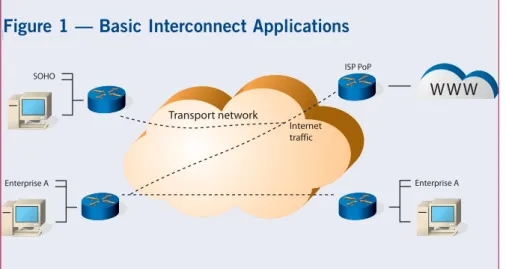
Figure 1 illustrates these basic applications of LAN-LAN and LAN-ISP point of presence (PoP) interconnects.
With increasing requirements for higher band-width, businesses are ever more concerned about operational expenses. A recent study by Analysys[1]showed that users want security, reliability and low cost. The service provided by the operator is critical to their business, and they want to be secure from eavesdropping and hackers, they want the service up and running at all times and they want it at minimal cost.
Common access speeds are n*64 kbit/s via ISDN, kbit/s to Mbit/s using xDSL and 2/34/45 Mbit/s up to STM-1 over PDH and SDH multiplexers. Current LAN equipment has to adapt to the telecommunication transmission formats, resulting in high interface costs. Calculations
show that by replacing an STM-1 interface with a Fast Ethernet interface on the LAN equipment a customer can reduce his investment by $3-4000 with zero implications on part of the operator.
Another important element is the monthly recurring fee for leasing a circuit or gaining access to the ISP. Cost reduced interconnects will facilitate new services and create demand for more bandwidth.
Private Line Interconnect
Enterprises and high bandwidth users, like ISPs, request private lines from the transport network operator because they can rely on the full capacity of the link and the security it brings. For the operator that uses standard SDH equipment with fixed rate PDH interfaces some issues are difficult to tackle:
The line interface has a fixed rate of 2/34/155 Mbit/s. At best n*2 Mbit/s is available. If the user has a 34 Mbit/s line and needs 50 Mbit/s he has to upgrade to 150 Mbit/s, and thus pays for more than actually required. This would typically lead to him postponing the order.
The service is either unprotected or 1+1 protected in the transport network1. Hence only two avail-ability classes are possible: bronze and gold.
Enterprise A SOHO
Enterprise A ISP PoP
W W W
Transport network
Internet traffic Figure 1 - Basic Interconnect Applications
Figure 1 — Basic Interconnect Applications
tellabs.com
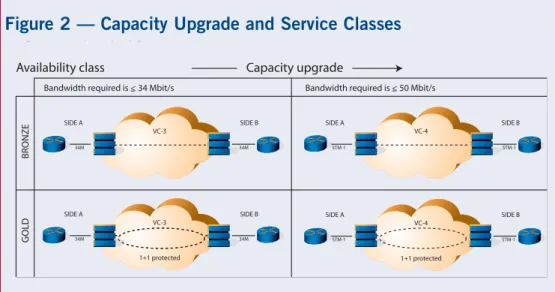
The problem of offering a 50 Mbit/s service is illustrated in Figure 2, covering both avail-ability classes. The user wants to connect two routers with a bandwidth of 50 Mbit/s, but the operator can only offer a full STM-1 service as alternative to the current 34 Mbit/s service. Accepting this would imply that the user must equip both routers with expensive STM-1 interfaces and maybe pay for the full 150 Mbit/s bandwidth. With a tight budget the user may very well say no.
On the other hand, with a “pay as you grow” type of service the user most probably would say yes. The solution is Ethernet interfaces and scalable transport capacity.
Using the above scenario as an example if we were to exchange the 34 Mbit/s interface with a Fast Ethernet interface this gives us a lower cost router interface and the capability of growing the utilised capacity from 0 to 100 Mbit/s without changing the interface module. This is because packets sent over Ethernet interfaces are bursty by nature.
In addition users have the ability to, seamlessly turn up and down the bandwidth if we exchange the fixed VC-3 circuit with a number of virtually concatenated VC-12s[2]. A packet stream sent over a virtual concatenated channel is byte-wise applied the constituent channels in a round-robin
Bandwidth required is < 50 Mbit/s Bandwidth required is < 34 Mbit/s
Availability class
34M 34M
SIDE A SIDE B
VC-3
STM-1 STM-1
SIDE A SIDE B
VC-4
34M 34M
SIDE A SIDE B
1+1 protected VC-3
STM-1 STM-1
SIDE A SIDE B
1+1 protected VC-4
BRONZE
GOLD
Figure 2 - Capacity Upgrade and Service Classes
Capacity upgrade
1: For simplicity 1+1 SNC protection is considered. Other means of SDH protection like dual homing, MS-SPRing and ring interconnect, can be utilised to differentiate the availablility, but overall the availability will be excellent, i.e. gold.
tellabs.com
fashion. See Figure 3. Due to different delay through the network the receiver must compensate for the differential delay before the packet stream can be output again. The capacity of the channel can grow and shrink in steps of VC-12 (or VC-3/VC-4).
By applying the recently standardised link capacity adjustment scheme (LCAS)[3]the capacity can be adjusted without any service degradation. Furthermore, if a member of the concatenated group is temporarily failing the link remains in service albeit at a lower capacity.
This feature can actively be used for network protection as is illustrated in Figure 4, provided the equipment can handle a differential delay for virtual concatenated signals larger than the standardised 125 usec[2]. In this case the service will only be interrupted in the time it takes to readjust to fewer members.
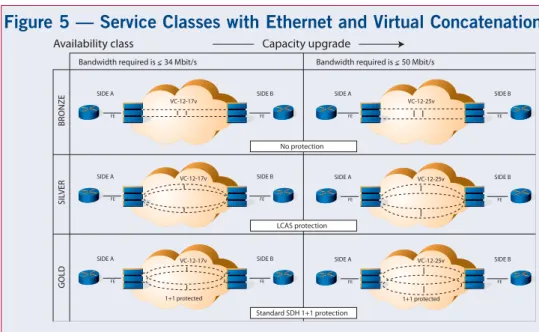
Figure 5 illustrates how the capacity can be upgraded in multiples of VC-122(here from 17 to 25, corresponding to a bandwidth of 34 Mbit/s
Figure 3 - Virtual Concatenation of CV-n Signals
Switch/Router Ethernet
VC-n
SDH network
ADM
Switch/Router Ethernet
Signaling protocol to scale bandwidth
Differential delay compensation
ADM ADM
Figure 4 - The Link Remains in Service Despite Failing Members
Switch/Router
FE FE
Diverse routed - VC-12
VC-12
SDH network
Link capacity is 4 x 2 Mbit/s = 8 Mbit/s
Switch/Router
FE FE
Diverse routed - VC-12
VC-12
SDH network
Following a failure the link capacity is reduced to 2 x 2 Mbit/s = 4 Mbit/s
ADM ADM
ADM ADM
Figure 3 — Virtual Concatenation of VC-n Signals
tellabs.com
and 50 Mbit/s, respectively). Furthermore, the level of availability can be fine tuned in three basic categories, bronze, silver, gold, based on no protection, protection using LCAS and standard 1+1 protection. Notice that the latter two can be combined so that only some of the member signals are 1+1 protected.
In summary
• A low cost Ethernet interface is introduced on the transport platform
• “Pay-as-you-grow” services are supported by a scalable interface andscalable link
• Differentiated services can be created by tuning the link availability to the user’s requirements
Internet Access
As mentioned previously all businesses — small as well as large — require access to the Internet. An Internet service is by nature “best effort”. Delay and delay-variations are perceived to be minimised by over-provisioning capacity to the links connecting the routers. “Best effort” is what the user expects, and “best effort” is what he usually gets. The problem is that he wants to pay accordingly.
The “Internet Access” described here is a service where the user gets high bandwidth in bursts at a lower cost (compared to a leased line), and the operator can minimise the investment by over-subscribing the transport network.
Availability class
FE FE
SIDE A SIDE B
VC-12-17v
FE FE
SIDE A SIDE B
VC-12-25v
FE FE
SIDE A VC-12-17v SIDE B
FE FE
SIDE A VC-12-25v SIDE B
FE FE
SIDE A SIDE B
1+1 protected VC-12-17v
FE FE
SIDE A SIDE B
1+1 protected VC-12-25v
BRONZE
SIL
VER
GOLD
Figure 5 - Service Classes with Ethernet and Virtual Concatenation
Capacity upgrade
Standard SDH 1+1 protection LCAS protection
No protection
Bandwidth required is < 50 Mbit/s Bandwidth required is < 34 Mbit/s
2: A virtual concatenated link based on VC-n signals consisting of X memebers is donated VC-n-Xv.
tellabs.com
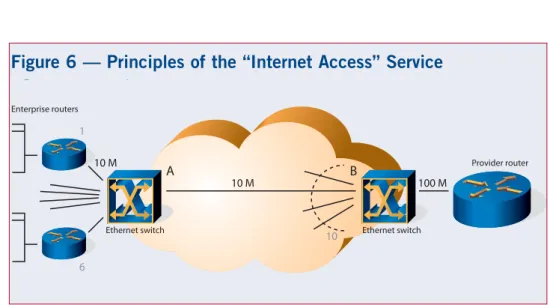
Figure 6 illustrates the basic principles of the Internet Access service in which an enterprise router is connected to the provider router at a bandwidth of maximally 10 Mbit/s. Six enter-prise routers are connected to the Ethernet switch (A), each at a rate of 10 Mbit/s. This switch is connected to another switch (B) at a rate of 10 Mbit/s, and so are 9 other switches, totalling 10 tributary connections. Switch B is connected with the provider router, which is connected to the general IP network — the Internet — over a single Fast Ethernet connection.
The operator has thus designed the network with a 1:6 over-subscription in switch A, and none in switch B. The enterprise users have a mean access rate of 10 Mbit/s /6 = 1.6 Mbit/s and can burst up to 10 Mbit/s.
Security is very important and is ensured by assigning each enterprise a separate Virtual LAN (VLAN) ID[4].
Other access rates, switch-interconnect bandwidth and over-subscription ratios in multiple levels can of cause be applied to suit a specific network.
In a straightforward network design all enter-prises get their fair share of the bandwidth simply based on the statistical nature of packet transmission in a network whose links are not overly committed.
In a more optimised design priority mechanisms are also applied to assure fairness.
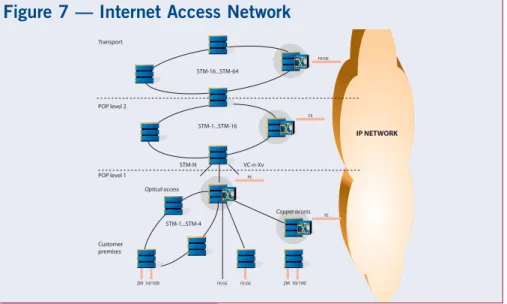
Figure 7 illustrates a typical three-tiered Internet Access services network that includes the
Figure 6 - Principles of the "Internet Access" Service
1
6
B A
10 M 100 M
10
10 M
Ethernet switch Ethernet switch
Enterprise routers
Provider router
Figure 6 — Principles of the “Internet Access” Service
tellabs.com
elements. The Internet hand-off point is deter-mined by many factors, like number of customers, customer bandwidth and concentra-tion ratios, but is shown in all tiers for generality.
The switches are connecting over virtual concate-nated VC-ns, bringing the previously described scalability and resilience into the network design.
The enterprises can access the switches in various ways:
Optical fibre
• The enterprise router has a 10/100/1000 fibre interface, which connects directly to the switch • If the interface is electrical (10/100/1000
BaseTX) a customer premises access node can convert to a scalable virtual concatenated signal. The access nodes can be connected in star and ring topologies
Copper twisted pair
• The enterprise router has a 10/100BaseTX interface, which carried over xDSL connects to the switch
In summary the Internet Access service • gives the user a scalable, high average
band-width connection with burst capability, and • is a new revenue generating, managed service,
which gives the operator transport capacity savings and IP-hand off from many customers on a single Ethernet interface
Management
Savings in capital expenditure are not worth much if they result in increased operational expenses. That is why the Internet Access transport service has to be supported by an efficient service provisioning system, which • associates Ethernet switches and physical links • allows creation of virtual LAN networks
associ-ated to customers in a point-and-click fashion • consistently provision service parameters, and
test service establishment
• can gather performance statistics to document observance of service level agreements • can detect, diagnose and circumvent network
failures that affect service Figure 7 - Internet Acess Network
IP NETWORK
FE
FE FE
Transport
POP level 2
POP level 1
Customer premises
STM-16...STM-64
STM-1...STM-16
VC-n-Xv STM-N
STM-1...STM-4
2M 10/100 FE/GE FE/GE 2M 10/100
Optical access
Copper access FE/GE
tellabs.com
How to reach us:
North America Tellabs
One Tellabs Center 1415 West Diehl Road Naperville, IL 60563 U.S.A.
+1.630.378.8800 Fax: +1.630.798.2000
Asia Pacific Tellabs
9 Temasek Boulevard #43-02 Suntec Tower Two Singapore 038989 Republic of Singapore +65.6336.7611 Fax: +65.6336.7622
Europe, Middle East & Africa Tellabs
Abbey Place 24-28 Easton Street High Wycombe, Bucks United Kingdom HP11 1NT +44.870.238.4700 Fax: +44.870.238.4851
Latin America & Caribbean Tellabs
13800 North West 14th Street Sunrise, FL 33323
U.S.A. +1.954.839.2800 Fax: +1.954.839.2828
Summary
High-bandwidth, low-cost LAN-LAN and LAN-Internet
interconnect services are vital in a world of gigabit LAN speeds and global communication.
Fortunately, Ethernet and new SDH technology lends its way to cost-efficient and scalable networks.
Replacing PDH circuits between enterprise routers with lower cost Ethernet interface and a scalable virtual concatenated link the network operator can now offer managed “pay-as-you-grow” private line interconnect services, and differentiated services based on tuning the private line’s availablility to the user’s requirements.
Private line services can be supplemented with Internet Access services based on shared bandwidth. The user will have a connection to the Internet with high average bandwidth and the capability to burst in even higher bandwidth. Users are seperated on individual virtual LANs, the
set/up of which is handled by a well/proven management system, common for all transport elements. It is a service that is scalable in capacity, when useres demands increase, and in numbers of users.
References
[1] Tim Hills, 2001, “Market Realities of IP-VPNs”:
Analysys Research Report
[2] ITU-T Rec. G.707, 2000, “Network Node Interfaces for the
Synchronous Digital Hierarchy (SDH)”
[3] ITU-T Rec. G.7042, 2001, “Link Capacity Adjustment Scheme
(LCAS) for Virtual Concatenated Signals”
[4] IEEE Std 802.1Q-1998, “Virtual Bridged Local Area Networks”
The following trademarks and service marks are owned by Tellabs Operations, Inc., or its affili-ates in the United Staffili-ates and/or other countries:
TELLABS®, TELLABS and
T symbol®, and T symbol®.
Any other company or product names may be trademarks of their respective companies.
© 2003 Tellabs. All rights reserved. 74.1200E Rev. B 2/03