VOLUME 16 ISSUE 2 (2018), Page 141 - 152
GEN Z’S ACTIVITIES AND NEEDS FOR URBAN RECREATIONAL PARKS
Nurfaezah Ghani1, Mazlina Mansor2 & Khalilah Zakariya3
1,2,3Kulliyyah of Architecture and Environmental Design
INTERNATIONAL ISLAMIC UNIVERSITY MALAYSIA
Abstract
A public recreational park for youth is important in promoting leisure activities for their health. Engagement with outdoor activity contributes to healthy growth development physically, mentally and socially. Youth prefers places that offer favourable facilities where they can express themselves with presence friends. The study focuses on Generation Z youth (Gen Z), who are born between the mid of the 1990s through the late 2000s. The study investigates Gen Z activities and needs of recreational parks in Kuala Lumpur. The study obtained 564 respondents who lived in five strategic zones in Kuala Lumpur. Their responses were statistically analyzed using the SPSS. Results showed that the Gen Z frequented recreational parks near their homes. Titiwangsa Lake Garden, KLCC Park and Kepong Metropolitan Park are among their place preference. A recreational park for them should have more natural attributes and meet their active lifestyle. The places encourage them to have an active engagement and positive socialization with others.
INTRODUCTION
Youths in Malaysia are an important asset of the future because they have the potential to achieve success in various aspects. Currently, a majority of early youths in Malaysia is among the generation Z (Gen Z). They were born between 1995 to 2001. The lifestyle and health of Gen Z need to be addressed in order to produce proactive youths, equipped with skills, talent and creativity. Leisure activities among youths are diverse and they play an important role in forming of their self-perceptions. Hence, youths need access to the outdoor environment to support their healthy development (Latifiyan & Salayati, 2015). Urban recreational park is an alternative place, other than city center (shopping mall, school and home environment) to promote outdoor leisure activities among Gen Z youths. It is a place that they can gather with friends, be alone, and learn.
Nonetheless, there is still a lack of recreational areas in Kuala Lumpur for Gen Z youth. Design of recreational park gives more priority to users such as family group and children as compared to youths’ needs (Makinen & Tyrvainen, 2008). Gen Z needs space that they can enjoy and have fun doing their favourite activities. The lack of appropriate space of leisure is feared to contribute to unhealthy activities and social problems among youths. Design attributes for youths’ recreational area include location of parks, facilities and maintenance aspects need to be improved in order to encourage them to have an active engagement with the outdoor environment.
The study aim to determine the criteria of space by identifying the relationship between the leisure time activities and the needs of Gen Z youth. The paper presents findings that explore the use of parks’ in Kuala Lumpur by Gen Z, and the types of activities needed of public recreational parks. The study is important to reveal needs and factors that can make recreational parks more attractive to fulfil this generation’s needs.
LITERATURE REVIEW
They spend an average of 7.5 hours using media and looking at the screen (Rideout, Foehr, & Roberts, 2010). As such, there is a tendency that they prefer sedentary pursuits rather than sport activities, or actively participating in games at leisure time (Poh, Safiah, Tahir, Siti Haslinda, & Siti Norazlin 2010; Wilson, 2006). It is claimed that their participation in sports or physical activities is low (Lim et al., 2016). For example, a study found that only 22% of Malaysian teenagers (15-18 years old) participate in regular sport or physical activity (at least 4200 minutes per week) (Aminuddin et. al., 2009). It was confirmed that those who prefer to stay indoor during leisure time afflict themselves to sedentary behaviour (Biddle, Marshall, Gorely, & Cameron, 2009). A sedentary behavior often begins at childhood and adolescence stages. Without intervention, the behavior will continue into adulthood, resulting in many chronic diseases. Regular physical activity, recreational activities and healthy eating habits are the mitigation steps for Gen Z to prevent the chronic diseases in their adult life.
Research has shown that youths’ outdoor leisure activities give positive effects towards their health, growth development and attitudes (Rabe et al., 2017). A recreational park is an ideal place for Gen Z to be active due to its natural attributes and facilities. It is suggested that the majority of users in recreational park is among youth generation (Rabe et al., 2017). Leisure activities in public recreational parks are preferred because it is accessible without any entrance fee. It is suggested that a high frequency of recreational park usage by youths is an indicator that the design features of the park is successful. It means that preference of youths for a recreational park is influenced by the criteria of the parks (Ngesan, Karim, Zubir, & Ahmad, 2013; Abd-Latif, Nor, & Omar-Fauzee, 2011). For example, the youths are more concerned about the condition of equipment and the natural views because these criteria influence their mood and feelings to play and enjoy activities (Kahiruddin, Mohd Yunos, Mydin, & Ujang, 2015). Distance of play area with their residential areas also influence their choice to frequent a park (Danis, Sidek, & Yusof, 2014; Zulkia, Zainol, Zainol, & Nordin, 2014). Typical types of recreational park facilities, compatible with the youths comprise of baseball fields, basketball courts, picnic areas, open lawns, jogging tracks and many more. Youths’ demands on the types of facilities change over time (Rabe et al, 2017). Currently trending activities that magnetize the youths are skateboarding, roller skating, rock climbing and bike riding (Kahiruddin et al., 2015). Hence, a park with specific themes such as skatepark, outdoor wall climbing, Parkour Park and street art park are some of the examples of play spaces anticipated by Gen Z youths.
provision of recreational parks and conducive parks’ designs for youths’ activities.
MATERIALS AND METHOD
Unit of Analysis
The respondents consist of Gen Z youth who live in Kuala Lumpur. The total population of Gen Z in Kuala Lumpur is 115, 600 (Department of Statistic Malaysia, 2016), and based on this number, the minimum sample size required for this study is 383. The survey obtained a total of 564 respondents within the age of 15 to 21 years old. The sample size is considered sufficient.
Research Instrument
A self-administered survey questionnaire serves as the primary data for this research. The survey covers parameters that include leisure time needs of Gen Z and their activities in the recreational park. The questionnaire was designed with a combination of open-ended and closed-ended questions. The questions consist of dichotomous scale, categorical scale and a positive five-point Likert format (response from 5-strongly agree with 1-strongly disagree and a 3-neutral option). The questionnaire form consists of five sections including respondents’ demographic profile, leisure time activities, outdoor public spaces, activities in recreation parks and health status. The survey items were derived from the dimensions established by a literature research especially the articles from 2008 until the current ones because the first generation of Gen Z youth emerged in 2008 at the age of 15.
Methods of Data Collection
Analysis
IBM SPSS Statistics version 23 was used to run the analysis. Descriptive analysis using percentage and mean was performed to present a demographic profile, the use of recreational park by Gen Z, their perceptions, as well as their needs. The descriptives were helpful in summarizing the sample.
FINDINGS
The findings discussed here are based on analyses of parameters, which include the respondents’ characteristics as well as use, perception and needs of Gen Z towards recreational parks of Kuala Lumpur.
Characteristic of Respondents
Four socio-demographic parameters of the study are: area of residency, education level and occupation as shown in Figure 1.
Figure 1: Characteristics of the respondents.
Sentul, Manjalara (Zone C) (23.8%), Damansara, Penchala (Zone D) (15.2%), Bandar Tun Razak, Sungai Besi (Zone F) (12.1%), Bukit Jalil, Septih (Zone E) (3.9%) and Kuala Lumpur City Centre (Zone A) (1.2%). ‘Others’ (6.9%) represent the respondents who live in the fringe of Kuala Lumpur, such as Putrajaya, Shah Alam and Petaling Jaya. Most of the Gen Z were approached in well-known recreational parks, other than residential areas around the park. For examples, Titiwangsa Lake Garden in Wangsa Maju, Maluri zone and Kepong Metropolitan Park in Sentul, Manjalara zone.
Half of the respondents were degree, diploma and certificate holders (57.5%), and another half of respondents finished their secondary education (42.5%). The majority of respondents were students (93.4%). The rest were either employed in the government sector (1.2%), private sector (3.4%) or self-employed (2.0%). Hence, most of the respondents are among university and high school students.
Types of Recreational Parks Visited
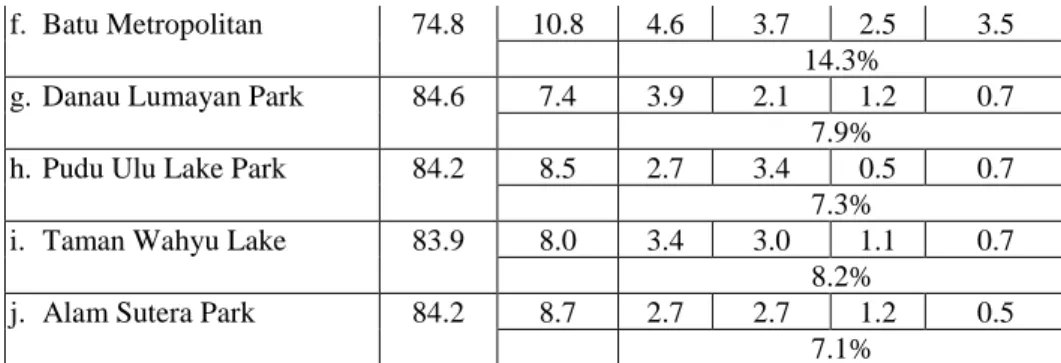
For this parameter, closed-ended questions in Likert scale format were analyzed. Table 1 shows the percentage on frequency of visit with format: (1) never and (2) love (very seldom) = twice or more a year. Moderate to high scales consist of measures (3) seldom = once a month, (4) sometimes = twice a month, (5) often = once a week and (6) very often = twice or more a week.
Table 1: Frequency of visit to recreational parks in Kuala Lumpur by Gen Z youth.
Park/Measure Never Low Moderate to high
1 2 3 4 5 6
City / Metropolitan Park
a. Perdana Botanical 60.1 22.2 9.4 5.1 2.1 1.1
17.7%
b. Lembah Kiara Park 70.4 17.7 6.7 3.2 0.7 1.2
11.8%
c. KLCC Park 22.5 39.5 16.3 15.8 3.5 2.3
37.9%
District Park
a. Bukit Gasing Park 73.4 14.7 5.7 4.4 0.9 0.9
11.9%
b. Titiwangsa Lake Garden 27.5 32.4 15.8 14.2 6.2 3.9
40.1%
c. Bukit Jalil Int. Park 67.6 16.5 7.3 5.1 2.1 1.4
15.9%
d. Permaisuri Lake Garden 64.0 14.0 8.2 6.7 4.1 3.0
22%
e. Kepong Metropolitan 58.5 15.4 9.0 8.2 6.4 2.5
f. Batu Metropolitan 74.8 10.8 4.6 3.7 2.5 3.5 14.3%
g. Danau Lumayan Park 84.6 7.4 3.9 2.1 1.2 0.7
7.9%
h. Pudu Ulu Lake Park 84.2 8.5 2.7 3.4 0.5 0.7
7.3%
i. Taman Wahyu Lake 83.9 8.0 3.4 3.0 1.1 0.7
8.2%
j. Alam Sutera Park 84.2 8.7 2.7 2.7 1.2 0.5
7.1%
Based on moderate to high percentage on visit, result suggests that the highest visitation is to Titiwangsa Lake Garden (40.1%) and KLCC Park (37.9%). Both recreational parks were well-known city parks in Kuala Lumpur. These parks were famous for their many programmes, events and activities for youth, as compared to other recreational parks in the city. They were also easily accessible because of variety of options for public transport such as LRT and buses.
Additionally, Gen Z frequently visits Kepong Metropolitan Park (26.1%) in Sentul–Manjalara zone and Permaisuri Lake Garden (22%) in Bandar Tun Razak–Sungai Besi zone. These recreational parks were the main neighborhood parks, surrounded by residential houses. Park users were living within 1 to 3 km from the main recreational parks. For Perdana Botanical Garden, despite being a city park, the park provided less space for youth activities. The park was more focused on tourist attractions, hence merely 17.7% of youths visited the park. Other parks such as Danau Lumayan Park, Pudu Ulu Lake Park and Alam Sutera Recreation Park received low percentage of visits. Gen Z was not familiar with the mentioned parks. Among the reasons that the respondents never visited the parks were transportation issues and unfamiliarity with the smaller scale parks. Limitations of the study include the bias sizes of samples from zones Wangsa Maju-Maluri (36.9%) and Sentul-Manjalara (23.8%).
Reasons for Visiting Recreational Parks
Figure 2: Reasons for visiting recreational park
The most agreed reasons for going to parks were: recreational parks offer nature experience (mean=3.95-3.99), provide emotional relieve (feeling better=3.8; relax and reduce stress=3.79), social benefits (3.77) and provision of activities (3.59). The result implied that recreational parks in Kuala Lumpur were visited due to the natural attributes, to improve emotional well-being and for socializing through various outdoor activities.
Needs of Gen Z in Recreational Park
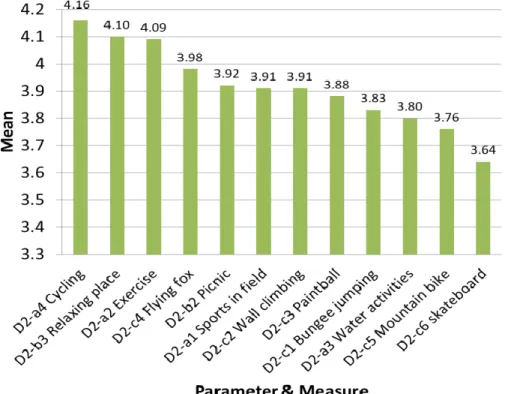
Figure 3: Needs for recreational parks (Likert scale).
An open-ended question was included in the questionnaire that asked about youths’ needs of parks in Kuala Lumpur. The question was posed to expand to complement the closed-ended question on the item. Their answers were analysed and categorized using related keywords. 28 answers were recorded from 15 respondents. The parameters emerged were summarized and categorized into five: (i) extreme activities (39%), (ii) traditional games (25%), (iii) organization programs (18%), (iv) Islamic recreation and sports (11%) and (v) art and entertainment (7%).
The responses revealed that currently extreme activities were increasingly in demand among Gen Z youth. Nonetheless, they also mentioned that traditional games in recreational park such as teng teng, galah panjang, congkak, sepak takraw, and others should also be introduced or maintained. The traditional games in a recreational park were alternative playtime activities in parks to preserve heritage and culture of people to the youth. The respondents also suggest that authorities and organizers need to offer more events or social programs in recreational parks. For examples, fitness programs (zumba, aerobic), exhibition and marathon. These events and programs acted as key attractions for some outdoor activities. Respondents also suggested that promotion on activities that were related with religious sports and recreation such as archery, horse riding and street dakwah and usrah should be conducted and could increase positive attitude among youths in their social activity. In terms of art and entertainment, the respondents prefer to have activities like busking and painting. These activities would make the recreational parks appear more exciting and invigorating for the youths.
CONCLUSION
ACKNOWLEDGEMENT
This paper was supported by grant by MOHE under Grant Nos. FRGS 15-258-0499.
REFERENCES
Abd-latif, R., Nor, M. M., & Omar-Fauzee, M. S. (2011). Influence of recreational facilities among adolescents towards leisure time physical activity (LTPA).
Asian Journal of Environment-Behaviour Studies, 2(5), 37-46.
Aminuddin, Y., Abdullah, M. N. H., Fauzee, M. S. O., Soh, K. G., Ismail, I. A., Abdullah, A. L., & Adam, Y. (2009). Kajian penglibatan golongan belia dan masyarakat
dalam sukan. Laporan akhir akademi Sukan, Universiti Putra Malaysia.
Biddle, S. J. H., Marshall, S. J., Gorely, T., & Cameron, N. (2009). Temporal and environmental patterns of sedentary and active behaviors during adolescents’ leisure time. International Journal of Behavioral Medicine, 16(3), 278-286. Danis, A., Sidek, S., & Yusof, S. M. (2014). Environmental characteristics influences on
physical activity among overweight adolescents: Urban neighbourhood parks.
Procedia - Social and Behavioral Sciences, 153, 402-409.
Department of Statistics Malaysia (2016). Population quick info. Retrieved March 1,
2017, from
http://pqi.stats.gov.my/result.php?token=bd7af7492d376bb6287f4523fbca8b5e Khairuddin, S. A., Mohd Yunos, M. Y., Mydin, M. A. O, & Ujang, N. (2015). Youth preference of extreme parks design in urban areas. Advance in Environmental Biology, 9(4), 197-200.
Lim, K. C., Mat Yusof, M., Fauzee, M. S. O., Othman, A. T., Aman, M. S., Gunathevan Elumalai, & Mohd Ali, H. (2016). Examining sport and physical activity participation, motivations and barriers among young Malaysians. Asian Social Science, 12(1), 159-171.
Latifiyan, M., & Salavati, M. (2015). Environment designing considering the needs of youth according to Abraham Maslow’s needs case study. African Journal of Business Management, 9(1), 8-17.
Makinen, K., & Tyrvainen L. (2008). Teenage experiences of public green spaces in suburban Helsinki. Urban Forestry and Urban Greening, 7, 277-289.
McCrindle, M., & Wolfinger, E. (2008). The ABC of XYZ: Understanding the global generations. Sydney, Australia: University of New South Wales Press.
Ngesan, M. R., Karim, H. A., Zubir, S. S., & Ahmad, P. (2013). Urban community perception on nighttime leisure activities in improving public park design.
Procedia - Social and Behavioral Sciences, 105, 619-631.
Poh, B. K., Safiah, M. Y., Tahir, A., Siti Haslinda, M. D., & Siti Norazlin, N. (2010). Physical activity patterns and energy expenditure of Malaysian adults: Findings from the Malaysian adult nutrition survey. Malaysian Journal of Nutrition,
16(1), 13-37.
Rideout, V. J., Foehr, U. G., & Roberts, D. F. (2010). Generation of M2 media in the lives of 8-18 years olds. Washington D. C.: Henry J. Kaiser Family Foundation. Sladek, S. & Grabinger, A. (2014). Gen Z: The first generation of the 21st Century has
arrived! Retrieved May 5, 2016, from
http://xyzuniversity.com/wp-content/uploads/2014/02/GenZ_ Final.pdf
Wilson, N. C. (2006). Preliminary study of the physical activity participation patterns of
Malaysian youth. Kuala Lumpur: Majlis Sukan Negara Malaysia.