Original Research Article
Development of multiple choice question bank in otorhinolaryngology
by item analysis: a cross-sectional study
Ajeet Kumar Khilnani
1*, Rekha Thaddanee
2, Gurudas Khilnani
3INTRODUCTION
There are many assessment tools used in medical education; such as written, oral, clinical and practical examinations. Any assessment tool should be valid and reliable. Multiple choice questions (MCQs) have been tool of assessment in medical education since long time. Many Undergraduate (UG) and postgraduate (PG) medical entrance examinations in India are MCQ based. Even in UG curriculum some portion of assessment (formative and summative) is through MCQs. It is
traditionally believed that MCQs can only assess lower levels of cognitive domain (recall of knowledge). However, evidence is building up that if properly constructed, MCQs can be an effective tool to assess higher levels of cognitive domain (synthesis and evaluation).1
MCQs are appreciated for their objectivity in assessment and ease of administration. However, better said than done, framing a MCQ or an item is both, an art and science. It takes a lot of time and efforts to frame an
ABSTRACT
Background: Multiple choice questions (MCQs) are routinely used for formative and summative assessment in medical education. Item analysis is a process of post validation of MCQ tests, whereby items are analyzed for difficulty index, discrimination index and distractor efficiency, to obtain a range of items of varying difficulty and discrimination indices. This study was done to understand the process of item analysis and analyze MCQ test so that a valid and reliable MCQ bank in otorhinolaryngology is developed.
Methods: 158 students of 7th Semester were given an 8 item MCQ test. Based on the marks achieved, the high achievers (top 33%, 52 students) and low achievers (bottom 33%, 52 students) were included in the study. The responses were tabulated in Microsoft Excel Sheet and analyzed for difficulty index, discrimination index and distractor efficiency.
Results: The mean (SD) difficulty index (Diff-I) of 8 item test was 61.41% (11.81%). 5 items had a very good difficulty index (41% to 60%), while 3 items were easy (Diff-I >60%). There was no item with Diff-I <30%, i.e. a difficult item, in this test. The mean (SD) discrimination index (DI) of the test was 0.48 (0.15), and all items had very good discrimination indices of more than 0.25. Out of 24 distractors, 6 (25%) were non-functional distractors (NFDs). The mean (SD) distractor efficiency (DE) of the test was 74.62% (23.79%).
Conclusions: Item analysis should be an integral and regular activity in each department so that a valid and reliable MCQ question bank is developed.
Keywords: Difficulty index, Discrimination index, Distractor efficiency, Item analysis, Multiple choice question, Otorhinolaryngology, Reliability, Validity
1
Department of Otorhinolaryngology, 2Department of Pediatrics, 3Department of Pharmacology, Gujarat Adani Institute of Medical Sciences and GK General Hospital, Bhuj, Kachchh, Gujarat, India
Received: 29 December 2018
Revised: 29 January 2019
Accepted: 02 February 2019
*Correspondence:
Dr. Ajeet Kumar Khilnani, E-mail: [email protected]
Copyright: © the author(s), publisher and licensee Medip Academy. This is an open-access article distributed under the terms of the Creative Commons Attribution Non-Commercial License, which permits unrestricted non-commercial use, distribution, and reproduction in any medium, provided the original work is properly cited.
‘ideal’ MCQ which is both, valid and reliable. A typical MCQ contains a question (stem) with multiple choices or options or responses (usually four), out of which one is the correct response (answer) and the rest are incorrect responses (distractors). Item analysis is a process by which each item (MCQ), and test as a whole, is assessed
for various parameters like difficulty index,
discrimination index and distractor efficiency, so that ideal items can be retained in the question bank for future use, and rest can be modified or discarded. Item analysis should be a regular process in each department as it also helps in inculcating habit of team work among faculty members. With the help of Microsoft Excel sheet, calculations for item analysis have become easy.
Item analysis has been done for various medical subjects
like community medicine, physiology, hospital
administration, pathology, pediatrics and
ophthalmology.1-9 We could not find any study on item analysis in otorhinolaryngology, hence we conducted this study so that we can develop a validated MCQ question bank.
METHODS
Type of study: Cross-sectional.
Place of study: Medical teaching hospital of Western Gujarat.
Duration of study: Two months (October 2018 to
November 2018).
Study population: 158 MBBS students of seventh
semester.
There was a test of 8 MCQs (each with four options and single best response type) having one correct response and three incorrect responses (distractors). It was prepared by the subject experts. There was no negative marking for wrong answer. The scores of all students were tabulated in Microsoft Excel sheet and arranged in descending order. Based on the marks obtained, students were divided into 3 groups; high achievers (top 33%, 52 students), mid achievers (middle 33%, 54 students) and low achievers (bottom 33%, 52 students).
Inclusion criteria
High and low achiever groups (104 students).
Exclusion criteria
Mid achiever group.
Parameters calculated
Difficulty index (Diff-I): it is a measure of the difficulty (or ease of) of an item (MCQ). Its value ranges from 0%
to 100%. Higher the value, easier the question. It is calculated by the formula:
Diff-I={(H+L)/T}×100, where ‘H’ and ‘L’ are the number of correct responses/students in the high and low achiever groups respectively and ‘T’ is the number of total responses/students in the high and low achiever groups, including non-responders.10
Table 1: Type of MCQs according to difficulty index.
Difficulty index (%) Type of MCQ
0 to 30 Difficult
31 to 40 Good MCQ
41 to 60 Very good MCQ
>60 Easy MCQ
Discrimination index (DI)
It is also known as point biserial correlation. It measures the ability of a MCQ to discriminate between high and low achievers.10 Its value ranges from -1 to +1. It is calculated by the formula:
DI={(H-L)/T}×2, where ‘H’, ‘L’ and ‘T’ are same as for Diff-I.
Table 2: Type of MCQs according to discrimination index.
Discrimination index Type of MCQ
<0.15 Poor MCQ
0.15 to 0.25 Good MCQ
>0.25 Very good MCQ
Distractor efficiency (DE)
It is a measure of effectiveness (plausibility) of the incorrect responses (distractors), i.e. ability of a distractor to attract responses.10 A distractor is deemed non-functional (NFD) if less than 5% students select it. DE ranges from 0% to 100%.
Statistical analysis used: mean, percentage, independent sample t-test.
RESULTS
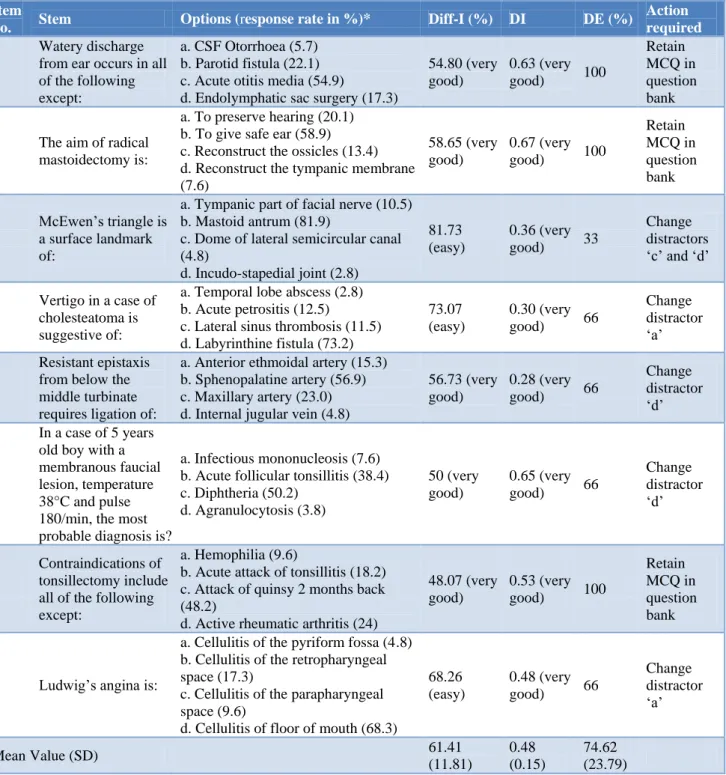
This study was conducted on an 8 MCQ test (single best response type) with four choices each (one correct answer and three distractors). Thus there were total 24 distractors. The responses of 104 students were analyzed for Diff-I, DI and DE.
good difficulty index. All items have a very good discrimination index (>0.25), hence, can be retained in the test. Overall discrimination index of the test was 0.48
± 0.15, which is highly acceptable. Though items 3, 4 and 8 were easy, still they had an acceptable power to discriminate between strong and weak student.
From Table 3 it is also evident that out of 24 distractors, 6 (25%) were NFDs. Five items of the test had 6 NFDs (item 3 had two NFDs while items 4, 5, 6 and 8 had one NFD each). The mean distractor efficiency of the test was 74.62%±23.79%.
Table 3: Analysis of individual items.
Item
no. Stem Options (response rate in %)* Diff-I (%) DI DE (%)
Action required
1
Watery discharge from ear occurs in all of the following except:
a. CSF Otorrhoea (5.7) b. Parotid fistula (22.1) c. Acute otitis media (54.9)
d. Endolymphatic sac surgery (17.3)
54.80 (very good)
0.63 (very
good) 100
Retain MCQ in question bank
2 The aim of radical
mastoidectomy is:
a. To preserve hearing (20.1) b. To give safe ear (58.9) c. Reconstruct the ossicles (13.4) d. Reconstruct the tympanic membrane (7.6)
58.65 (very good)
0.67 (very
good) 100
Retain MCQ in question bank
3
McEwen’s triangle is a surface landmark of:
a. Tympanic part of facial nerve (10.5) b. Mastoid antrum (81.9)
c.Dome of lateral semicircular canal (4.8)
d. Incudo-stapedial joint (2.8)
81.73 (easy)
0.36 (very
good) 33
Change distractors ‘c’ and ‘d’
4
Vertigo in a case of cholesteatoma is suggestive of:
a. Temporal lobe abscess (2.8) b. Acute petrositis (12.5)
c. Lateral sinus thrombosis (11.5) d. Labyrinthine fistula (73.2)
73.07 (easy)
0.30 (very
good) 66
Change distractor ‘a’
5
Resistant epistaxis from below the middle turbinate requires ligation of:
a. Anterior ethmoidal artery (15.3) b. Sphenopalatine artery (56.9) c. Maxillary artery (23.0) d. Internal jugular vein (4.8)
56.73 (very good)
0.28 (very
good) 66
Change distractor ‘d’
6
In a case of 5 years old boy with a membranous faucial lesion, temperature 38°C and pulse 180/min, the most probable diagnosis is?
a. Infectious mononucleosis (7.6) b. Acute follicular tonsillitis (38.4) c. Diphtheria (50.2)
d. Agranulocytosis (3.8)
50 (very good)
0.65 (very
good) 66
Change distractor ‘d’ 7 Contraindications of tonsillectomy include all of the following except:
a. Hemophilia (9.6)
b. Acute attack of tonsillitis (18.2) c. Attack of quinsy 2 months back (48.2)
d. Active rheumatic arthritis (24)
48.07 (very good)
0.53 (very
good) 100
Retain MCQ in question bank
8 Ludwig’s angina is:
a. Cellulitis of the pyriform fossa (4 .8) b. Cellulitis of the retropharyngeal space (17.3)
c. Cellulitis of the parapharyngeal space (9.6)
d. Cellulitis of floor of mouth (68.3)
68.26 (easy)
0.48 (very
good) 66
Change distractor ‘a’
Mean Value (SD) 61.41
(11.81)
0.48 (0.15)
74.62 (23.79)
*Options (c), (b), (b), (d), (b), (c), (c) and (d) are the correct responses for Q. Nos. 1 to 8 respectively.
DISCUSSION
It is said that assessment drives learning. Assessment can be via oral examination or written examination. Oral
are easy to administer on large number of students. MCQ test is a common mode of written examination used for assessment in medical education since long time. The advantages of MCQs are high objectivity, reliability, ease of administration, more content coverage and assessing higher levels of cognitive domain. However, framing a MCQ is a time consuming and challenging task. Item analysis is done for post validation of MCQ test.
The mean Diff-I of our study was 61.41 (±11.81), which indicates that the overall test was easy. Preferably, the Diff-I should be between 41% and 60%. 5 items (62.5%) had very good Diff-I, while 3 items (37.5%) were easy (Diff-I >60%). None of the items in the present study was difficult, which should not be the case. The average discrimination index (DI) of the whole test was 0.48 (±0.15). All items in the present study had very good Discrimination Index (DI >0.25). Sometimes DI can be negative, i.e. low achievers answer a particular item more correctly than high achievers, as reported in some studies.2,5 The reasons for negative DI can be wrong key, ambiguous framing of questions or generalized poor preparation of students. Items with negative DI decrease the validity of the test and should be removed from the collection of questions.3 Items that are either too easy or too difficult have poor DI. In our study, all items had very good DI, but three items (3, 4 and 8) were easy and required revision. Hence, while analysis of an item, Diff-I and DI should be interpreted simultaneously, rather than individually. However, it is important to note that very easy or very difficult items may have poor DI, but sometimes they are included in a test to adequately sample course content and objectives.
Distractor analysis is a very important aspect of item analysis. Ideally all distractors should be functional or plausible, i.e. attract at least 5% of responses. In our study, out of 24 distractors, 6 (25%) were NFDs. The mean distractor efficiency (DE) of the test was 74.62±23.79%. More NFDs make an item easy and decrease DE. In our study, there was a negative correlation seen between Diff-I and DE (r=-.733, p=0.03). The mean Diff-I for items with no NFD was 53.84%, while mean diff-I for items with at least one NFD was 65.96% (p=0.08). Similarly, more NFDs decrease the discrimination power of an item. In our study, mean DI of items with no NFD was 0.61, while mean DI for items with at least one NFD was 0.41 (p=0.04), and there was a positive correlation between DI and DE (r=0.632, p=0.09). In a four option MCQ, creating three plausible distractors is a daunting task, which becomes only tougher with a five option MCQ, where plausible distractors should be four. In a previous study by the first author, it was seen that NFDs were more in the four and five options MCQs as compared to three option MCQs.12 The reliability coefficient (Cronbach alpha) for our test was 0.522. This low coefficient can be due to the fact that our test had only 8 items. Increasing the number of items increases the reliability of a test.
CONCLUSION
Item analysis is an essential tool to identify items with desired Diff-I, DI and DE for future use. Item analysis should be an integral and regular activity in each department so that a valid and reliable MCQ question bank is developed.
Funding: No funding sources Conflict of interest: None declared
Ethical approval: The study was approved by the Institutional Ethics Committee
REFERENCES
1. Patil R, Palve SB, Vell K, Boratne AV. Evaluation of multiple choice questions by item analysis in a medical college at Pondicherry, India. Int J Community Med Public Health. 2016;3:1612-6. 2. Gajjar S, Sharma R, Kumar P, Rana M. Item and
test analysis to identify quality multiple choice questions (MCQS) from an assessment of medical students of Ahmedabad, Gujarat. Indian J Community Med. 2014;39:17-20.
3. Mukherjee P, Lahiri SK. Analysis of Multiple Choice Questions (MCQs): Item and Test Statistics from an assessment in a medical college of Kolkata, West Bengal. IOSR J Dent Med Sci. 2015;14:47-52. 4. Chavda P, Misra S, Duttaroy B. Item analysis of multiple choice questions based undergraduate assessment in Community Medicine. South East Asian J Med Edu. 2015;9:66-8.
5. Hingorjo MR, Jaleel F. Analysis of One-Best
MCQs: the Difficulty Index, Discrimination Index and Distractor Efficiency. J Pak Med Assoc. 2012;62:142-7.
6. Kashyap S. Item analysis of multiple choice
questions. Int J Current Res. 2015;7:24057-8. 7. Rao C, Kishan Prasad HL, Sajitha K, Permi H,
Shetty J. Item analysis of multiple choice questions: Assessing an assessment tool in medical students. Int J Educ Psychol Res. 2016;2:201-4.
8. Kheyami D, Jaradat A, Al-Shibani T, Ali FA. Item analysis of Multiple Choice Questions at th Department of Paediatrics, Arabian Gulf University, Manama, Bahrain. Sultan Qaboos University Med J. 2018;18:e68-74.
9. Ramakrishnan M, Sathe AB, Sabnis VA. Item
analysis: A tool to increase MCQ validity. Indian J Basic Applied Med Res. 2017;6:184-9.
10. Singh T, Gupta P, Singh D. Principles of Medical Education. 3rd Ed. New Delhi: Jaypee Brothers Medical Publishers (P) Ltd; 2009: 70–77.
11. Khilnani AK, Charan J, Thaddanee R, Pathak RR,
Makwana S, Khilnani G. Structured oral
examination in pharmacology for undergraduate
medical students: Factors influencing its
12. Vegada B, Shukla A, Khilnani A, Charan J, Desai C. Comparison between three option, four option and five option multiple choice question tests for quality parameters: A randomized study. Indian J Pharmacol. 2016;48:571-5.
Cite this article as: Khilnani AK, Thaddanee R, Khilnani G.Development of multiple choice question bank in otorhinolaryngology by item analysis: a cross-sectional study. Int J