Original Research Article
Morphometric analysis of human cricoid cartilage: a cadaveric study
Viswanathan Anand
1,2, Harikesh Sharma
2*, Ashwani Sethi
2, Satyanjaya Sahoo
2INTRODUCTION
Morphometric data of the larynx is useful in otorhinolaryngology during procedures like intubation, endoscopy, laryngeal micro-surgeries, phonosurgery, stenting, cricothyroidotomy and transplantation. A basic knowledge of anatomy of larynx is necessary from clinical point of view. It is necessary for those who are involved in fields of surgical treatment of larynx such as speech therapists, anesthetists, oncologists, pulmonologists, radiologists, general practitioners, ENT surgeons and phoneticians.
From embryologic, anatomic, physiologic and surgical standpoints, the larynx is one of the most complex organs of human body.1 Skeletal framework of larynx is formed by series of cartilages viz. unpaired thyroid, cricoid and epiglottis and paired arytenoids, cuneiform and corniculate.2 Further, the growing utilization of advanced electrophysiological and surgical methods in management of some of the laryngeal disorders like subglottic stenosis and post intubation stenosis of lower respiratory tract, require an intense comprehension of size and proportion of human larynx and its cartilaginous components, especially the cricoid cartilage.3-5
ABSTRACT
Background: Cricoid cartilage is the only complete ring that surrounds the airway completely. Although it is smaller than thyroid cartilage and does not house any important structures like the thyroid cartilage (vocal folds), it forms an important cog in the upper airway. Renewed interest in subglottic stenosis recently has underscored the importance of detailed knowledge of cricoid cartilage. This study aims to augment the meagre information available on this important part of upper airway.
Methods: Study design was on morphometric analysis and the setting was at tertiary health care centre. Thirty one adult human cadaveric larynges were obtained for this study. Using an electronic vernier caliper, different morphometric parameters of all the cricoid cartilages were noted down in a predesigned proforma in standard computer office software. The data thus obtained was collated and compared with existing literature.
Results: The average inner transverse diameter (F: 15.05±1.02 mm; M: 17.52±2.64 mm) is greater than the average inner antero-posterior diameter (F: 12.71±0.45 mm; M: 14.11±2.55 mm). The average height of cricoid arch was F: 6.50±0.68 mm; M: 7.69±0.63 mm and the average height of cricoid lamina was F: 18.38±0.61 mm; M: 21.17±2.31 mm.
Conclusions: Inter specimen disparity was noted in the various dimensions measured in the cricoid cartilages. The average transverse diameter was greater than the average antero-posterior diameter giving the cartilage an ovoid shape in nearly all specimens. Morphometrical data of the cricoid cartilage may be very useful in endotracheal intubation, laryngeal microsurgery and laryngeal framework surgery. These parameters can be helpful in evaluation of subglottic stenosis and its surgical repair.
Keywords: Cricoid cartilage, Larynx, Morphometry
Department of ENT, 1Institute of Aerospace Medicine and Associated Command Hospital (Air Force), Bangalore, Karnataka, 2Army College of Medical Sciences and Associated Base Hospital, Delhi Cantt, Delhi, India
Received: 03 October 2017 Accepted: 23 October 2017
*Correspondence: Dr. Harikesh Sharma,
E-mail: [email protected]
Copyright: © the author(s), publisher and licensee Medip Academy. This is an open-access article distributed under the terms of the Creative Commons Attribution Non-Commercial License, which permits unrestricted non-commercial use, distribution, and reproduction in any medium, provided the original work is properly cited.
A signet shaped ring, cricoid is the only complete cartilaginous ring of larynx. The cartilage consists of a posterior quadrate lamina and a narrow anterior arch. The cricoid is composed of hyaline cartilage, which undergoes variable ossification with advancing age which is especially pronounced in lamina.6,7 The diameters of the cricoid cartilage vary a lot and studies have found that it is oval in shape, with males having a larger cricoid cartilage compared to females.8
Many studies have been done on thyroid cartilage but only a few have been done on the cricoid cartilage. So this study was intended to accomplish information about this significant but relatively neglected laryngeal cartilage. Therefore, the aim of this study was to assimilate precise and reliable morphometric data of human cadaveric cricoid cartilages.
METHODS
The study was done at Department of ENT, Army College of Medical Sciences and associated Base Hospital, Delhi Cantt, from July 2016 to August 2017. The material for present study comprised of thirty one (n=31) adult (F:M–12:19) apparently normal human cadaveric larynges obtained from Department of Anatomy, Army College of Medical Sciences, Delhi Cantt. Laryngeal specimens excised from cadavers with any possibilities of laryngeal damage as a result of diseases or manipulations were not taken into consideration.
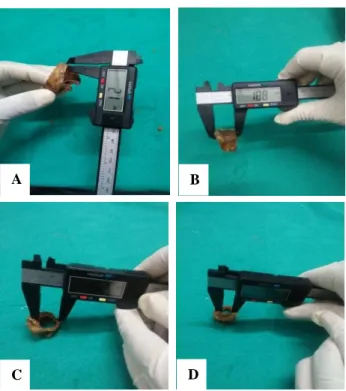
All the larynges were removed from the hyoid till the second tracheal ring. All soft tissues (ligaments and muscles) were carefully removed. These larynges were serially numbered F-01 to F-12 for female specimens and M-01 to M-19 for male specimens. The cricoid cartilage was gently separated from the rest of the laryngeal framework. An electronic Vernier caliper (with least count of 0.1 mm) as shown in Figure 1 was used to measure the different morphometric parameters described as under. The findings were recorded in the predesigned proformas.
Figure 1 (A and B): Electronic digital caliper used in this study and its schematic representation.
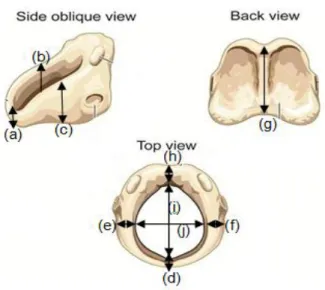
The following measurements as shown in Figures 2 and 3 were taken:
(a) Anterior height of cricoid arch (distance between the
(b) Right lateral height of cricoid arch (distance between the upper and lower borders of the cricoid arch at the right lateral most point).
(c) Left lateral height of cricoid arch (distance between the upper and lower borders of the cricoid arch at the left lateral most point).
(d) Anterior width of cricoid arch (distance between the inner and outer surfaces of cricoid arch superiorly). (e) Right lateral width of cricoid arch (distance between
the inner and outer surfaces of cricoid arch at the right lateral most point superiorly).
(f) Left lateral width of cricoid arch (distance between the inner and outer surfaces of cricoid arch at the left lateral most point superiorly).
(g) Height of cricoid lamina (distance between the midpoints of upper and lower borders of cricoid lamina posteriorly).
(h) Width of cricoid lamina (distance between inner and outer surfaces of cricoid lamina at posterior midpoint).
(i) Inner antero-posterior diameter of cricoid cartilage (maximum antero-posterior dimension between the inner walls of cricoid).
(j) Inner transverse diameter of cricoid cartilage (maximum transverse dimension between the inner walls of cricoid).
Figure 2: Schematic diagram of dimensions of cricoid cartilage measured in the study. (a) Anterior height of arch, (b) Right lateral height of arch, (c) Left lateral
height of arch, (d) Anterior width of arch, (e) Right lateral width of arch, (f) Left lateral width of arch, (g)
Height of lamina, (h) Width of lamina, (i) Inner antero-posterior diameter, (j) Inner transverse
diameter.
The data obtained was finally entered into Microsoft Excel (Microsoft Corporation, Silicon Valley, Ca. USA) and analyzed. For each of the parameters, average, standard deviation (S.D.) and range (minimum value –
Figure 3: Some of the measurements recorded using the caliper on the cricoid cartilage. (A) Anterior width
of arch, (B) Height of lamina, (C) Inner antero-post diam, (D) Inner transverse diam.
RESULTS
The average dimensions of cricoid cartilage were uniformly greater in males compared to females. The measurements of the cricoid arch are shown in Table 1. The height was shortest at its anterior midpoint (range– F: 5.5-7.4 mm; M: 6.5-8.5 mm) whence it gradually increases as we proceed laterally on either side. The difference in heights on either lateral side is minimal. Similarly the width of the arch is narrowest at its anterior midpoint (range–F: 1.8-2.3 mm; M: 2.3-2.8 mm) to gradually increase laterally.
The measurements of the cricoid lamina are depicted in Table 2. The height of the cricoid is the highest at its lamina in all the specimens (range– F: 17.4-19.2 mm; M: 17.5-24.2 mm). Similarly the cricoid was widest at its lamina (range– F: 2.3-2.6 mm; M: 2.6-3.1 mm).
The antero-posterior and transverse diameters measured are portrayed in Table 3. The transverse diameter (range– F: 13.8-16.6 mm; M: 13.4-21.5 mm) was greater than the antero-posterior diameter (range– F: 12.1-13.4 mm; M: 10.5-17.1 mm) in almost all specimens giving the cricoid an ovoid shape. In one male specimen the antero-posterior diameter (16.6 mm) was marginally greater than the transverse diameter (16.4 mm).
Table 1: Dimensions of the cricoid arch.
Dimensions (in mm) Females Males
Average Std. dev. Average Std. dev.
Height
(a) Anterior 6.50 ±0.68 7.69 ±0.63
(b) Right lat 14.10 ±0.84 15.77 ±1.12 (c) Left lat 14.08 ±0.83 15.76 ±1.17
Width
(d) Anterior 2.08 ±0.16 2.55 ±0.14
(e) Right lat 2.11 ±0.12 2.66 ±0.13 (f) Left lat 2.14 ±0.15 2.65 ± 0.12
Table 2: Dimensions of the cricoid lamina.
Dimensions (in mm) Females Males
Average Std. dev. Average Std. dev.
(g) Height 18.38 ±0.61 21.17 ±2.31
(h) Width 2.43 ±0.11 2.82 ±0.14
Table 3: Inner diameters of the cricoid cartilage.
Inner diameter (in mm) Females Males
Average Std. dev. Average Std. dev. (i) Antero-posterior 12.71 ±0.45 14.11 ±2.55 (j) Transverse 15.05 ±1.02 17.52 ±2.64
A
D C
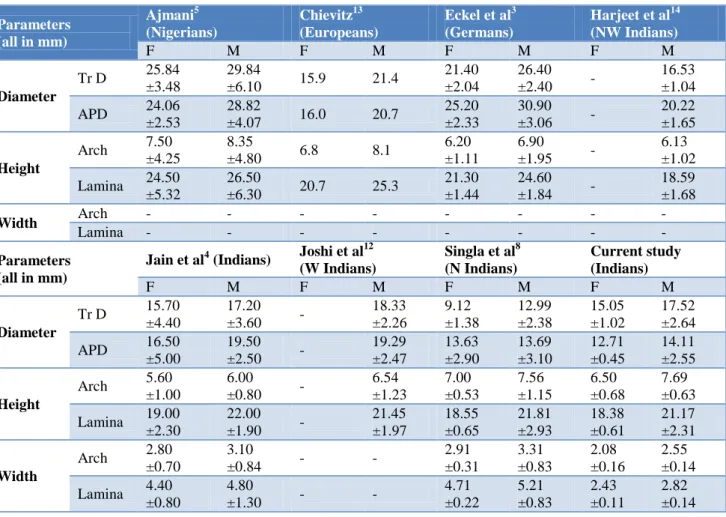
Table 4: Comparison of cricoid cartilage parameters amongst various studies.
Parameters (all in mm)
Ajmani5 (Nigerians)
Chievitz13 (Europeans)
Eckel et al3 (Germans)
Harjeet et al14 (NW Indians)
F M F M F M F M
Diameter
Tr D 25.84 ±3.48
29.84
±6.10 15.9 21.4
21.40 ±2.04
26.40 ±2.40 -
16.53 ±1.04
APD 24.06 ±2.53
28.82
±4.07 16.0 20.7
25.20 ±2.33
30.90 ±3.06 -
20.22 ±1.65
Height
Arch 7.50 ±4.25
8.35
±4.80 6.8 8.1
6.20 ±1.11
6.90 ±1.95 -
6.13 ±1.02
Lamina 24.50 ±5.32
26.50
±6.30 20.7 25.3
21.30 ±1.44
24.60 ±1.84 -
18.59 ±1.68
Width Arch - - - -
Lamina - - - -
Parameters (all in mm)
Jain et al4 (Indians) Joshi et al
12
(W Indians)
Singla et al8 (N Indians)
Current study (Indians)
F M F M F M F M
Diameter
Tr D 15.70 ±4.40
17.20 ±3.60 -
18.33 ±2.26 9.12 ±1.38 12.99 ±2.38 15.05 ±1.02 17.52 ±2.64
APD 16.50 ±5.00
19.50 ±2.50 -
19.29 ±2.47 13.63 ±2.90 13.69 ±3.10 12.71 ±0.45 14.11 ±2.55 Height
Arch 5.60 ±1.00
6.00 ±0.80 -
6.54 ±1.23 7.00 ±0.53 7.56 ±1.15 6.50 ±0.68 7.69 ±0.63
Lamina 19.00 ±2.30
22.00 ±1.90 -
21.45 ±1.97 18.55 ±0.65 21.81 ±2.93 18.38 ±0.61 21.17 ±2.31 Width
Arch 2.80 ±0.70
3.10
±0.84 - -
2.91 ±0.31 3.31 ±0.83 2.08 ±0.16 2.55 ±0.14
Lamina 4.40 ±0.80
4.80
±1.30 - -
4.71 ±0.22 5.21 ±0.83 2.43 ±0.11 2.82 ±0.14 DISCUSSION
The morphological aspects of the cricoid cartilage have been variedly studied in the Western population.9-11 Nonetheless, there is still a necessity for comprehensive data on the different physical parameters of the cricoid cartilage and their degree of variability, especially in the Indian population. Few studies on Indian population do exist which have described this variability in the North & Western Indian people.4,8,12 Inter-specimen variability in the dimensions was noted in the current study as well. The results of the present work, except for a few parameters, are by and large in concurrence with those described by other workers who conducted similar studies.4-6,8,12 Table 4 shows the comparison of the different dimensions in various studies.
The striking variance observed in this study is the average inner transverse diameter (F: 15.05±1.02 mm; M: 17.52±2.64 mm) being greater than the average inner antero-posterior diameter (F: 12.71±0.45 mm; M: 14.11±2.55 mm). Only a few studies (Ajmani in Nigerians and Chievitz in Europeans) have showed a similar finding i.e. inner transverse diameter being greater than the inner antero-posterior diameter.5,13
shown the converse i.e. inner antero-posterior diameter being greater than the inner transverse diameter.3,4,8,12,14
Further, if we compare the Indian inner transverse and antero-posterior diameters with the Western and African subjects it is seen that both these diameters are much less as compared to the Europeans, Nigerians and Germans. So an endotracheal tube that can effortlessly negotiate through the cricoid of these races may be bigger for Indians. Accordingly Indians need a smaller diameter endotracheal tube. In addition, females will require an even smaller diameter endotracheal tube as their cricoid’s diameter is lesser than the males.
The measurements of the arch of the cricoid are largely in concurrence with rest of the Indian studies. The width (F: 2.08±0.16 mm; M: 2.55±0.14 mm) and height (F: 6.50±0.68 mm; M: 7.69±0.63 mm) are comparable with Jain et al, Joshi et al and Singla et al.4,8,12 However these measurements are smaller compared to specimens from Germans, Europeans and Nigerians.3,5,13
et al and Singla et al and lesser compared to the Western and African subjects.3-5,8,12,13
CONCLUSION
This study provides a broad and complete description of different morphological parameters of the cricoid cartilage from local Indian population. Cricoid cartilage was oval in shape in nearly all the specimens, with the inner transverse diameter greater than the inner antero-posterior diameter of cricoid cartilage; males having greater diameters as compared to females. Height and thickness of cricoid arch and lamina were observed to be larger in males as compared to females.
Comparison of these outcomes to other works reveals that the morphology of the cricoid cartilage varies amongst populations in most of the parameters. This may well be due to diversity in body shape and race. The big variation in almost all sizes and shapes of the cricoid cartilage renders it hard to standardize the rigid stents utilized in these organs. Consequently appropriate sized endo-tracheal tubes should be used for intubation, taking into consideration the sex and race of the individual, apart from other factors. Understanding of such measurements and differences is of paramount importance for clinical practice in order to prevent needless damage to the larynx.
ACKNOWLEDGEMENTS
The authors recognize the assistance rendered by Department of Anatomy, Army College of Medical Sciences, Delhi Cantt in performing the study and express their gratitude.
Funding: No funding sources Conflict of interest: None declared
Ethical approval: The study was approved by the Institutional Ethics Committee
REFERENCES
1. Skandalakis J. Skandalakis surgical anatomy: The embryologic and anatomic basis of modern surgery. 1st edn. Volume 1. Greece: Pashalidis Medical Publications Ltd; 2004: 234-262.
2. Standring S. The larynx. In: Gray’s Anatomy, The anatomical basis of clinical practice. 40th edn. Philadelphia, London: Churchill Livingstone; 2008: 577-580.
3. Eckel HE, Sittel C, Zorowka P, Jerke A. Dimensions of the laryngeal framework in adults. Surgical Radiologic Anatomy. 1994;16:31-6. 4. Jain M, Dhall U. Morphometry of the Thyroid and
Cricoid cartilages in Adults. J Anatomical Soc India. 2008;57(2):119-23.
5. Ajmani ML. A metrical study of the laryngeal skeleton in adult Nigerians. J Anatomy. 1990;171:187-91.
6. Ajmani ML, Jain SP, Saxena SK. A metrical study of laryngeal cartilages and their ossification. Anatomischer Anzeiger. 1980;148(1):42-8.
7. Romanes GJ, Editor. Cunningham’s manual of practical anatomy. 15th edn. London: Oxford Med Publication; 2002: 157-166.
8. Singla RK, Kaur R, Laxmi V. Morphology and morphometry of adult human cricoid cartilage: a cadaveric study in north indian population. Int J Anatomy Res. 2015;3(1):910-4.
9. Zielinski R. Morphometrical study on senile larynx. Folia Morphologica, 2001;60(2):73-8.
10. Sprinzl G. Morphometric measurements of the cartilaginous larynx: An anatomic correlate of laryngeal surgery. Head Neck Surg. 1999;21:743-50.
11. Maue W, Dickson D. Cartilages and ligaments of the adult human larynx. Arch Otolaryngol. 1971;94:432-9.
12. Joshi M, Joshi S, Joshi S. Morphometric study of cricoid cartilages in Western India. Australasian Med J. 2011;4(10):542-7.
13. Chievitz JH. Uter Suchungen Uberdie Verknocherung. Arch fur Anatomie Physiologie; 1882: 303-349.
14. Harjeet, Jit I, Sahani D. Dimensions and weight of the cricoid cartilage in northwest Indians. Indian J Med Res. 2002;116:207-16.