International Journal of Research in Engineering and Applied Sciences(IJREAS)
Available online at http://euroasiapub.org/journals.php Vol. 7 Issue 8, August-2017, pp. 90~96
ISSN (O): 2249-3905, ISSN(P): 2349-6525 | Impact Factor: 7.196
[
A Framework for Energy Management in Smart City through Internet of Things
Dr. Ashwini K. B.
R V College of Engineering, Master of Computer Applications, Bangalore, India,
Prashanth K.
R V College of Engineering, Master of Computer Applications, Bangalore, India,
Abstract--Increasing population density demands adequate provision of services and infrastructure in urban centers to meet the needs of city inhabitants, encompassing residents, visitors and workers. The utilization of information and communications technologies to achieve this objective presents an opportunity for the development of smart cities through the Internet of Things (IoT). Since all services of IOT depend on energy, energy management becomes the most important part of smart city. This paper presents a framework for energy efficient automatic street lighting system based on low cost microcontroller. The main objective is to design energy efficient based controller for controlling street light using appropriate controllers, light sensor, zigbee, motion sensor, and ultrasonic sensor. The system is programmed to automatically turn off the street lights during daylight and only operate during the night. Around 45%-50% reduction in power consumption can be achieved through this proposed automatic street lighting system.
Keywords--Internet of Things (IoT), Wireless Sensor Networks (WSN), Information and Communications Technologies (ICTs), Street Light.
I. INTRODUCTION
International Journal of Research in Engineering and Applied Sciences(IJREAS)
Vol. 7 Issue 8, August-2017
ISSN (O): 2249-3905, ISSN(P): 2349-6525 | Impact Factor: 7.196
information, which is further converted to usable knowledge. This will enhance the decision making of city management and citizens to turn the city smart.
II. MOTIVATION
It is estimated, about 70% of the world’s population, over six billion people, will live in cities and
surrounding regions by 2050. To accommodate this massive urbanization, cities needs to find smarter ways to manage complexities, reduce expenses, increase efficiency and improve the
quality of life. So, cities need to be smart, if only to survive as platforms that enable economic,
social, and environmental well-being. Smart city systems not only offer improvements in the Quality of Life (QoL) of the inhabitants, but also greatly improve efficiency regarding asset management, including intelligent transportation systems, smart grids, street lighting management, traffic lights management, waste management, environmental monitoring, water management and many more. The citizens at large use smart phones, wearable and sensors to collect and forward a variety of visual, signal, and environmental data for data aggregation. In short smart cities spans six key areas: Governance, Mobility, Energy, Utilities, Water and Environment [7][8][9][10][11].
Since all services of IoT depend on energy, energy management becomes the most important area of smart city. IoT provides a service to monitor the energy consumption of the whole city, which enables authorities and citizens to get a clear view of the amount of energy required by the different services like public lighting, transport, traffic lights control, cameras and so on. This in turn will identify the main energy consumption sources and to set priorities in order to optimize their behaviour.
III. Street Light Application of IoT
Energy efficiency is driven mainly by social responsibility for green operations. Smart city in general and IoT-based environments, in particular, go a long way in addressing this need. Larger facilities can realize higher relative efficiency gains, based on the idea that the more energy one is already wasting, the more the opportunity they have to save. Smart city should have a centralized system that monitor, control and record the functions of smart city services systems, such as mechanical systems, elevators, electrical systems, lighting, plumbing, security/surveillance, and contingency alarms. In order to increase in the quality of life, long-term strategic planning for the city is required. Among many issues, street light management is of critical concern. The optimization for street lighting is an important feature using which we can optimize the street light intensity according to the time of the day, on weather condition and movement of the people. It is the basic step in changing from static energy consumption modes to distributed and dynamic energy control.
IV. Energy Monitoring
International Journal of Research in Engineering and Applied Sciences(IJREAS)
Vol. 7 Issue 8, August-2017
ISSN (O): 2249-3905, ISSN(P): 2349-6525 | Impact Factor: 7.196
Table 4.1 Electricity consumption by street lights
No of lights Watts consumed per hour / lamp
No of hours (Avg)
Total watt consumtion
10 40 Watt 12 480 Watt
On the streets, maximum movement of the vehicles and pedestrians will be reduced as the time passes. Based on which an architecture is proposed, by implementing it at the worst case streets lights will be switched on continuously till 11:00pm. Therefore, the total consumption will come to as shown in Table 4.2. Comparing the power, on an average 40% to 50% power can be saved.
Table 4.1 Electricity consumption by street lights
No of lamps
Watts consumed per hour / lamp
No of hours (Avg)
Total watt consumption
10 40 Watt 6 240 Watt
V. Design Architecture
The proposed architecture for the system is to achieve the proper power utilization during the late night hours where there is no movement of vehicles and pedestrians on the streets. Components used in the proposed system
5.1 Street Light Unit
International Journal of Research in Engineering and Applied Sciences(IJREAS)
Vol. 7 Issue 8, August-2017
ISSN (O): 2249-3905, ISSN(P): 2349-6525 | Impact Factor: 7.196
5.2 Motion Sensor
Since there will be very less movement during late night hours, the circuit will be switched off which results in activating the motion sensor. This sensor will be active until it finds any movement on the streets. When the sensor finds the movement immediately sends signal to controller for next set of instructions for switching on street light.
5.3 Ultrasonic Sensor
Ultrasonic sensor is used to check the distance at which the object is identified. This will also solve the problem of when the light should be switched on during the early hours. Sensor will work in the combination of the motion sensor and timer.
5.4 Light Sensor
Street light should be switched on during night so this sensor will detect the luminous of sunlight. It sends signal to the controller to switch on the street light and circuit. Timer will start from the time the light is switched on. This sensor will switch off the circuit when the luminous of sunlight is preferably high.
5.5 Controller
The factors that controller will take care is keeping the light usage minimum, efficient, communicate with set of connected light units and cloud. Controller takes care of sensing the sunlight intensity and various combinations of data from different sensor. The number of the different steps in controlling are one is with light intensity during the day. Controller has a timer to keep the street light continuously on till 11 PM and automatically switch off after post time. Two is during the post time, controller will switch to movement sensing unit. If the movement in the street is not detected light will be continue in the same state. Once the motion sensor detects any movement it captures the data and passes it on to the controller. This results in switching on the light and the timer is started automatically. As timer completes the task controller will switch to motion sensor again. This process of switching on and off will continue till morning.
5.6 Zigbee
International Journal of Research in Engineering and Applied Sciences(IJREAS)
Vol. 7 Issue 8, August-2017
ISSN (O): 2249-3905, ISSN(P): 2349-6525 | Impact Factor: 7.196
VI. Network Architecture
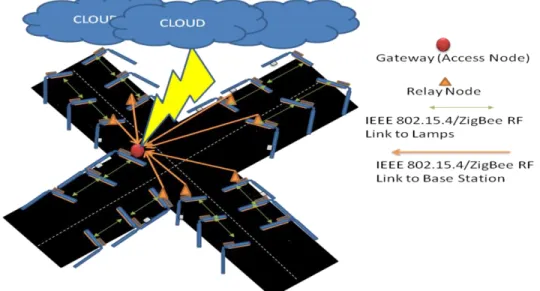
The Fig 6.1 shows the proposed architecture which contains fixed infrastructure. The WSN platform facilitates deployment flexibility to incorporate diverse sensing modalities for continuous monitoring, providing baseline reference data. The three-tier IoT architecture for street lights consists of
Level 1: The street lights at the road junction include motion sensor, zigbee and ultrasonic sensors mounted on it. Controller will keep track of the timer where lamp will be switched on continuously till the midnight. As timer completes the task controller will switch to motion sensor and ultrasonic sensor, the light will be switched automatically once a movement is detected within the range.
Level 2: Depending on movement and distance of object, the zigbee communicates the adjacent street light to switch on eventually, all the lights will be switched on for that particular road. This process will continue till the luminous of sunlight is high. Relay nodes will collect signal from zigbee and forward the signal across multiple hops to a gateway.
Level 3: Controller will collect data from the relay node and send them via the Internet to the Cloud. Concentrating on the user requirements for sensing and smartness in analysis with any IoT interconnected sensors for future analysis. Cloud computing is a promising solution for IoT based applications. Upcoming models for interacting with wireless sensors such as Internet of Things and Sensor-Cloud aim to efficiently utilize resource and overcome restrictions on it. Sensor-Cloud enables different networks, spread in a huge geographical area, to connect and be employed simultaneously by multiple users on demand. [12] Sensor-Cloud is a flexible, reconfigurable and popular platform for proper monitoring and controlling applications. [13]
International Journal of Research in Engineering and Applied Sciences(IJREAS)
Vol. 7 Issue 8, August-2017
ISSN (O): 2249-3905, ISSN(P): 2349-6525 | Impact Factor: 7.196
VII. Conclusion
With rapid development in the emerging IoT technology, key services of IoT are identified. All these services depend on energy, because of which energy management becomes the most important part of smart city. The paper presents the automatic street lighting system based on internet of Things architecture. The current system relies on environmental and traffic indicators to estimate the needs for street light intensity. It then controls the luminaries accordingly. Around 45%-50% reduction in power consumption can be achieved through this proposed automatic street lighting system.
REFERENCES
[1] Atzori, Luigi, Antonio Iera, and Giacomo Morabito. "The internet of things: A survey."
Computer networks 54.15 (2010): 2787-2805.
[2] Schaffers H., Komninos N., Pallot M., Trousse B., Nilsson M., Oliveira A. (2011) Smart Cities and the Future Internet: Towards Cooperation Frameworks for Open Innovation. In: Domingue J. et al. (eds) The Future Internet. FIA 2011. Lecture Notes in Computer Science, vol 6656. Springer, Berlin, Heidelberg
[3] Schaffers H., Komninos N., Pallot M., Trousse B., Nilsson M., Oliveira A. (2011) Smart Cities and the Future Internet: Towards Cooperation Frameworks for Open Innovation. In: Domingue J. et al. (eds) The Future Internet. FIA 2011. Lecture Notes in Computer Science, vol 6656. Springer, Berlin, Heidelberg
[4] Bélissent, Jennifer. "Getting clever about smart cities: New opportunities require new business models." (2010).
[5] Objects, Smart Networked. "Internet of Things, white paper." Association Instituts Carnot,
Greece (2011).
[6] K. Xu, Y. Qu and K. Yang, "A tutorial on the internet of things: from a heterogeneous network integration perspective," in IEEE Network, vol. 30, no. 2, pp. 102-108, March-April 2016.
[7] S. Ray, Y. Jin and A. Raychowdhury, "The Changing Computing Paradigm With Internet of Things: A Tutorial Introduction," in IEEE Design & Test, vol. 33, no. 2, pp. 76-96, April 2016.
[8] Kim, M. S., Kamiyama, N., Yi, C. W., Hong, W. K., Tonouchi, T., Chen, C., & Song, W. C. (2016). Managing a Very Connected World: A Report on APNOMS2015. Journal of Network
and Systems Management, 24(3), 754-763.
[9] Y. Zorian, "Keynote 3: "Ensuring robustness in today's IoT era"," 2015 10th International
Design & Test Symposium (IDT), Amman, 2015, pp. 1-1.
[10] F. Saffre, "Tutorial II: The green Internet of Things," 2015 11th International Conference on
Innovations in Information Technology (IIT), Dubai, 2015, pp. XXXVII-XXXVII.
[11] Lee, Jin-Shyan, Yu-Wei Su, and Chung-Chou Shen. "A comparative study of wireless protocols: Bluetooth, UWB, ZigBee, and Wi-Fi." Industrial Electronics Society, 2007. IECON
International Journal of Research in Engineering and Applied Sciences(IJREAS)
Vol. 7 Issue 8, August-2017
ISSN (O): 2249-3905, ISSN(P): 2349-6525 | Impact Factor: 7.196
[12] Madria, S., Kumar, V., & Dalvi, R. (2014). Sensor cloud: A cloud of virtual sensors. IEEE
software, 31(2), 70-77.
[13] Alamri, A., Ansari, W. S., Hassan, M. M., Hossain, M. S., Alelaiwi, A., & Hossain, M. A.
(2013). A survey on sensor-cloud: architecture, applications, and approaches. International