For learning solutions, visit cengage.com.au
ISBN: 978-0170197748
9 780170 197748
3rd Edition
JEFF
GREEN
/
ROGER
GREEN
AUSTRALIA AND NEW ZEALAND
AUTOMOTIVE AIR CONDITIONING
3rdEdition
AU
STR
AL
IA AN
D
NE
W
Z
EA
LA
ND
AU
TO
MOTI
VE
A
IR C
ON
DITI
ON
ING
JE
FF
G
RE
E
N
/
RO
G
E
R
G
RE
E
N
For the instructor
For the student Instructor’s manual, competency mapping grid and artwork from the text
Companion website: includes weblinks and downloadable templates
Register online at:
www.cengagebrain.com
for the study tools that come with your textbook!
Resources available
GREEN 3ed SB 9780170197748 CVR FINAL ART.indd 1-3 11/07/12 9:20 AM
PROPERTY
OF
CENGAGE
LEARNING
AUSTRALIA
SAMPLE
iii
Section 1
Air-conditioning
theory
1 Introduction to air conditioning, metric conversions and refrigerant
handling regulations 2
2 Climate change 10
3 The human body and heat 24
4 The refrigeration circuit 35
5 Refrigerants 48
6 Retrofitting – using a different refrigerant 56
7 Receiver dryers, accumulators,
moisture and its removal 68
8 Service valves and manifold
and gauge sets 77
9 Leak detection 84
10 Compressors 90
11 Expansion valves 103
12 Electrical and other system controls 111
13 Engine cooling, heating and
air-conditioning ducting 125
14 Electronic climate control (ECC) 133
Section 2
System diagnosis
2.1 System-diagnosis flow charts 148
2.2 System-diagnosis charts 152
2.3 System-diagnosis problem sheets 158
Brief contents
2.4 Pressure/temperature charts 170
2.5 Temperature–pressure exercises 172
2.6 System-diagnosis exercises 175
Section 3
Service procedures
3.1 Service procedure 1 Connecting the manifold and gauge set to the air-conditioning system 186
3.2 Service procedure 2 Performance testing the system 189
3.3 Service procedure 3 Purging the
system and recovering the refrigerant 192
3.4 Service procedure 4 Evacuation
of the system 194
3.5 Service procedure 5 System oil
compensation 197
3.6 Service procedure 6 Charging
the system 199
3.7 Service procedure 7 Leak testing
the system 208
3.8 Service procedure 8 Testing and
adjusting the thermostatic switch 212
3.9 Service procedure 9 Testing the
expansion valve – TX valve or FOT 215
3.10 Service procedure 10 Servicing
the Sanden SD compressor 217
3.11 Service procedure 11 Servicing
the Sanden TR70/90 compressor 229
3.12 Service procedure 12 Servicing the TRF/TRS090 and the TRF/TRS105 Sanden compressors 235
PROPERTY
OF
CENGAGE
LEARNING
AUSTRALIA
SAMPLE
Low-pressure service connection
High-pressure service connection
3
Chapter 1: IntroduCtIon to aIr CondItIonIng, metrIC ConversIons and refrIgerant handlIng regulatIons
Introduction
The purpose of this publication is to allow the automotive air-conditioning trainee or student to gain a better-than-basic working knowledge of the system and its components plus a diagnostic ability. The student should be able to apply this knowledge so as to competently repair and/ or modify an air-conditioning system in order to return it to its full working capacity.
Refrigeration and air conditioning are not discoveries of the past century. Simple forms of refrigeration and air conditioning have been in use for thousands of years.
Within the past 70 years many aspects of modern life have been made possible through the development of sophisticated air-conditioning systems. Many components associated with the worldwide space program could not have been possible without the use of air conditioning. These components were manufactured in a temperature and humidity-controlled environment. Also, modern medicine and delicate machine components are perfected in scientifically controlled air-conditioned environments.
Computer centres are only able to function properly because they are kept within a specific temperature and humidity range, which depends on complex air-conditioning systems.
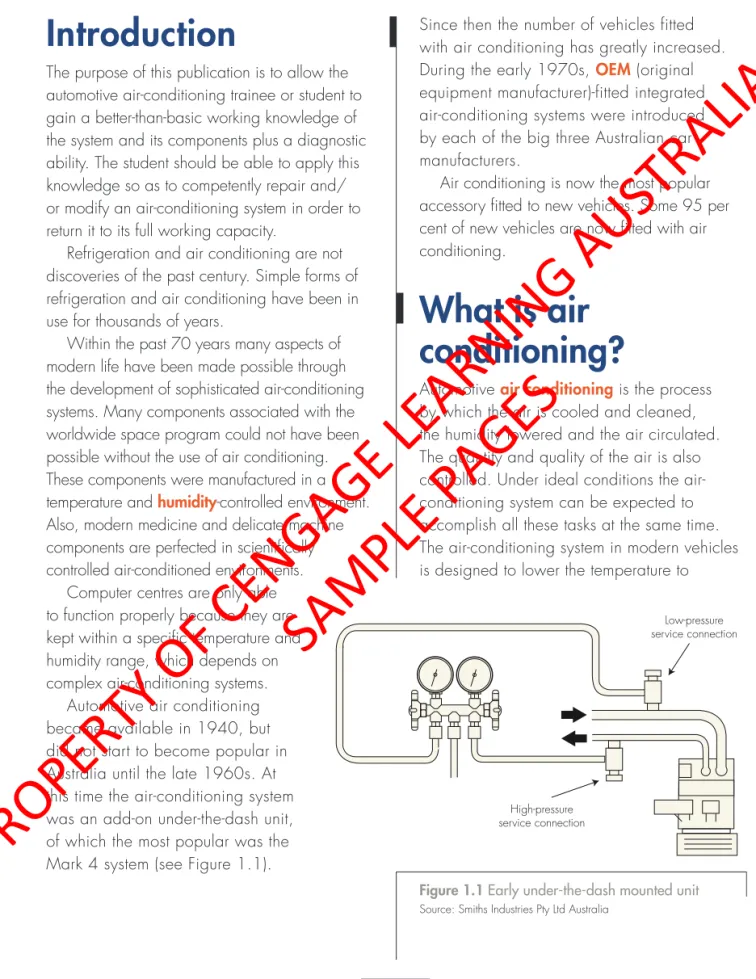
Automotive air conditioning became available in 1940, but did not start to become popular in Australia until the late 1960s. At this time the air-conditioning system was an add-on under-the-dash unit, of which the most popular was the Mark 4 system (see Figure 1.1).
Since then the number of vehicles fitted with air conditioning has greatly increased. During the early 1970s, OEM (original equipment manufacturer)-fitted integrated air-conditioning systems were introduced by each of the big three Australian car manufacturers.
Air conditioning is now the most popular accessory fitted to new vehicles. Some 95 per cent of new vehicles are now fitted with air conditioning.
What is air
conditioning?
Automotive air conditioning is the process by which the air is cooled and cleaned, the humidity lowered and the air circulated. The quantity and quality of the air is also controlled. Under ideal conditions the air-conditioning system can be expected to accomplish all these tasks at the same time. The air-conditioning system in modern vehicles is designed to lower the temperature to
Figure 1.1 Early under-the-dash mounted unit Source: Smiths Industries Pty Ltd Australia
01 Green 3ed SB 9780170197748 TXT.indd 3 16/07/12 10:40 AM
PROPERTY
OF
CENGAGE
LEARNING
AUSTRALIA
SAMPLE
16 mm
14 mm 13 mm
11 mm
R134a discharge access valve R134a suction access valve
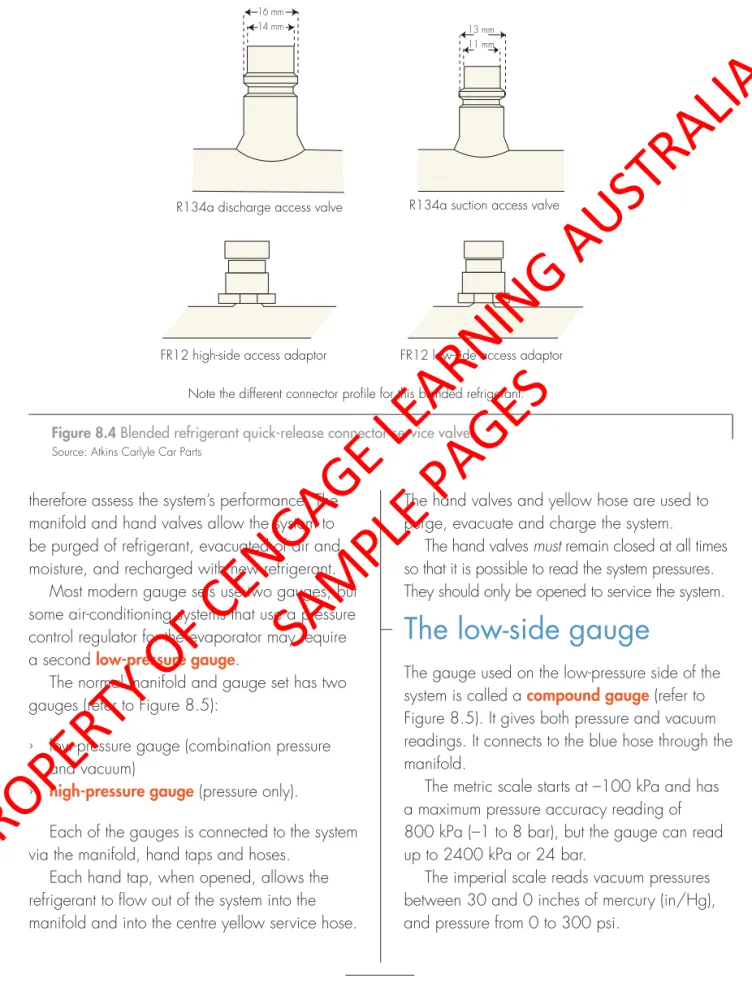
FR12 high-side access adaptor FR12 low-side access adaptor Note the different connector profile for this blended refrigerant.
80
Section 1: Air-conditioning theory
therefore assess the system’s performance. The manifold and hand valves allow the system to be purged of refrigerant, evacuated of air and moisture, and recharged with new refrigerant.
Most modern gauge sets use two gauges, but some air-conditioning systems that use a pressure control regulator for the evaporator may require a second low-pressure gauge.
The normal manifold and gauge set has two gauges (refer to Figure 8.5):
› low-pressure gauge (combination pressure and vacuum)
› high-pressure gauge (pressure only).
Each of the gauges is connected to the system via the manifold, hand taps and hoses.
Each hand tap, when opened, allows the refrigerant to flow out of the system into the manifold and into the centre yellow service hose.
The hand valves and yellow hose are used to purge, evacuate and charge the system.
The hand valves must remain closed at all times so that it is possible to read the system pressures. They should only be opened to service the system.
The low-side gauge
The gauge used on the low-pressure side of the system is called a compound gauge (refer to Figure 8.5). It gives both pressure and vacuum readings. It connects to the blue hose through the manifold.
The metric scale starts at –100 kPa and has a maximum pressure accuracy reading of 800 kPa (–1 to 8 bar), but the gauge can read up to 2400 kPa or 24 bar.
The imperial scale reads vacuum pressures between 30 and 0 inches of mercury (in/Hg), and pressure from 0 to 300 psi.
Figure 8.4 Blended refrigerant quick-release connector service valves Source: Atkins Carlyle Car Parts
PROPERTY
OF
CENGAGE
LEARNING
AUSTRALIA
SAMPLE
700 100
600
0
500
–100
70
15
80
0
90 10
100 20
110 30
120 40
250
50 60
400
1800 300
800 200
In/Hg PSIG
KPA 0
0 1000
3000 1500
3500
2000
500
2500
PSIG KPA Gauge
50
350 100
150 200 250
300
400
450 500
2.3
158
Section 2: SyStem diagnoSiS
System-diagnosis problem sheets
Note: the ambient temperature for all diagnosis sheets is 30ºC and all pressures relate to a cycling clutch system
System-diagnosis problem sheet 1
Low-gauge reading: Low
High-gauge reading: Slightly low
Complaint: Little or no cooling, especially on warmer days
System conditions:
1 Low-side gauge reading low – should read 100–180 kPa
2 High-side gauge reading slightly low – should read 1400–1600 kPa
3 Compressor cycling on time extended 4 Evaporator air cool but not cold
5 Low-pressure suction line temperature high (5 to 8ºC)
Diagnosis: Low refrigerant charge – possible leak
Corrective steps:
1 Leak test the system
2 Purge and recover the refrigerant 3 repair leak
4 Check the compressor oil level 5 replace the receiver dryer
6 Evacuate the system and make sure the system holds a vacuum as per legislation 7 recharge the system to specifications and
retest for leaks
8 Performance test the system
15 Green 3ed SB 9780170197748 TXT.indd 158 16/07/12 10:13 AM