Optimal synchronization of directed complex networks
Per SebastianSkardal,1,a)DaneTaylor,2and JieSun3 1
Department of Mathematics, Trinity College, Hartford, Connecticut 06106, USA 2
Department of Mathematics, Carolina Center for Interdisciplinary Applied Mathematics, University of North Carolina, Chapel Hill, North Carolina 27599, USA
3
Department of Mathematics, Clarkson University, Potsdam, New York 13699, USA
(Received 19 February 2016; accepted 16 May 2016; published online 23 June 2016)
We study optimal synchronization of networks of coupled phase oscillators. We extend previous theory for optimizing the synchronization properties of undirected networks to the important case of directed networks. We derive a generalized synchrony alignment function that encodes the interplay between the network structure and the oscillators’ natural frequencies and serves as an objective measure for the network’s degree of synchronization. Using the generalized synchrony alignment function, we show that a network’s synchronization properties can be systematically optimized. This framework also allows us to study the properties of synchrony-optimized networks, and in particular, investigate the role of directed network properties such as nodal in- and out-degrees. For instance, we find that in optimally rewired networks, the heterogeneity of the in-degree distribution roughly matches the heterogeneity of the natural frequency distribution, but no such relationship emerges for out-degrees. We also observe that a network’s synchronization properties are promoted by a strong correlation between the nodal in-degrees and the natural frequencies of oscillators, whereas the rela-tionship between the nodal out-degrees and the natural frequencies has comparatively little effect. This result is supported by our theory, which indicates that synchronization is promoted by a strong alignment of the natural frequencies with the left singular vectors corresponding to the largest singu-lar values of the Laplacian matrix.Published by AIP Publishing.
[http://dx.doi.org/10.1063/1.4954221]
Synchronization is vital to the functionality of many natu-ral and engineered systems,1–3 including cardiac pace-maker cells,4 circadian rhythms,5 Josephson junction arrays,6 and power grids.7 This has generated consider-able interest in optimizing the synchronization properties of networks.8–13 In a recent publication, we developed a theoretical framework for optimizing the synchronization properties of undirected networks of heterogeneous oscil-lators.13Here, we extend this theory to the important case of directed networks and derive a generalized synchrony alignment function (SAF) that can be used to systemati-cally optimize a network’s synchronization properties. Furthermore, this approach allows us to examine which structural properties promote synchronization in directed networks. Potential applications include systems where strong synchronization is essential for efficient functional-ity, including cardiac electrophysiology,14,15synthetic cell engineering,16and power grid dynamics.17–20
I. INTRODUCTION
The tendency for large groups of individual units to reach consensus despite having heterogeneous dynamical properties has served as strong motivation for scientists to study synchronization of coupled dynamical systems.1,2 A paradigmatic model for studying the synchronization and the
emergence of collective behavior was developed by Kuramoto,21who showed that under appropriate conditions, the dynamics ofNoscillators can be reduced to the evolution of Nphases,hi, fori¼1;…;N. When placed on a network
that indicates the oscillators’ interaction, the phases evolve according to
_
hi¼xiþK
XN
j¼1
AijHijðhjhiÞ; (1)
where xi is the natural frequency of oscillator i, K is the
global coupling strength, HijðhÞ is a 2p-periodic coupling
function, andA is the adjacency matrix that encodes the net-work structure such thatAij¼1 if a link exists from nodejto
nodei. In many cases, the topology of the network is assumed to be undirected, so thatA¼AT; however, here we will
con-sider the more general case of a possibly directed network to-pology.22 Furthermore, to ensure for the possibility of synchronization from Eq. (1), we assume that the coupling frustration23is sufficiently small,jHijð0Þ=
ffiffiffi 2
p
Hij0ð0Þj 1. Extensive research has demonstrated that the interplay between dynamics and network structure has nonlinear effects on the synchronization of a network. For instance, different networks can give rise to different synchronization patterns,24–29 and at the same time synchronization can be utilized to analyze the properties of a given network.30,31 The macroscopic synchronization dynamics of Eq.(1)is typ-ically quantified using the classical Kuramoto order parame-terrdefined by the complex number
a)
Electronic mail: [email protected]
reiw¼1
N XN
j¼1
eihj; (2)
which represents the centroid of phasesfhigafter mapping
them onto the complex unit circle. In particular, r ranges between 0 and 1, representing completely incoherent and perfectly synchronized states, respectively, with intermediate values representing partially synchronized states. In a recent publication,13 we developed a theoretical framework for optimizing the synchronization properties of a given undir-ected network, as defined by maximizing the order parameter r. In particular, we derived thesynchrony alignment function (SAF), a functional that encodes the interplay between the local dynamical properties (i.e., the oscillators’ natural fre-quenciesfxig) and the network structure (via the
eigenval-ues and eigenvectors of the network Laplacian matrix). We showed that the SAF can be used to systematically optimize the synchronization properties of a network under a wide va-riety of constraints.
As in the study of other network-coupled dynamical processes, extending analysis for undirected networks to directed networks represents a non-trivial hurdle for theoreti-cal and practitheoreti-cal progresses.32–34 In the case of identical oscillators, our understanding of synchronization on directed networks is well-developed through the framework of Master Stability Functions,35 and in fact, directed coupling can be utilized to achieve improved and moreover optimized synchronization, although sometimes at the expense of reduced robustness.36–38
In this paper, we extend our previous results13 for opti-mizing synchronization of heterogeneous oscillators in undirected networks to the case of directed networks. We derive a generalized SAF and demonstrate its utility with several examples. In particular, we show that the generalized SAF can be used to optimize synchronization under several constraints: (i) choosing the oscillators’ natural frequencies for a given network; (ii) arranging a set of pre-chosen natural frequencies on a given network; and (iii) building a network for a given set of natural frequencies. We emphasize that our approach allows for efficient optimization of a network’s synchronization properties based on objective measures, not heuristics. Furthermore, the generalized SAF approach allows us to investigate the dynamical and topological prop-erties of synchrony-optimized networks. For example, we study the directed network properties of nodal in- and out-degrees and find that synchronization is promoted by a strong, positive correlation between the nodal in-degrees and magnitude of the natural frequencies; however, the relation-ship between the nodal out-degrees and the natural frequen-cies has comparatively little effect on synchronization. We additionally observe that synchronization is enhanced by a negative correlation between the natural frequencies of neighboring oscillators. These results extend the previous research8–13 that observed similar correlations to promote synchronization, but only considered the case of undirected networks.
The remainder of this paper is organized as follows: In Sec.II, we present our theoretical framework and derive the
generalized SAF. In Sec.III, we provide several examples of optimizing synchronization using the generalized SAF. In Sec.IV, we study the effects that directed network properties have on optimal synchronization and the effect that optimiz-ing synchronization has on directed network structure. In Sec.V, we study the relationship between structural and dy-namical properties of synchrony-optimized networks. In Sec. VI, we conclude with a summary and discussion of our results.
II. DERIVATION OF THE GENERALIZED SYNCHRONY ALIGNMENT FUNCTION (SAF)
The derivation of the generalized SAF begins as in Ref. 13, by considering the dynamics of Eq. (1) in a state of strong synchronization, i.e., r1. For a generic network, such a state can be obtained in several ways, typically by ei-ther (i) sufficiently increasing the coupling strengthKor (ii) sufficiently decreasing the spread or standard deviation of the natural frequencies. In fact, up to a rescaling of time, these two actions are equivalent. In this regime, the oscilla-tors become strongly clustered about the mean phasewsuch that jhjhij 1 for all 1i;jN, and thus Eq. (1) can
be linearized to
_
hix~iKH0ð0Þ
XN
j¼1
Lijhj; (3)
where we have assumed for simplicity that each coupling function is the same, i.e.,HijðhÞ ¼HðhÞfor all 1i;jN,
we have defined an effective natural frequency
~
xi¼xiþKHð0Þkini ; (4)
Lis the Laplacian matrix defined for directed networks with entries defined
Lij¼dijkini Aij; (5)
wheredijis the Kronecker delta, and the nodal in- and
out-degrees are given by
kiin¼
XN
j¼1
Aij; kouti ¼
XN
j¼1
Aji: (6)
In the vector form, Eq.(3)can be more conveniently rewrit-ten as
_
h¼x~KH0ð0ÞLh; (7)
whereh¼ ½h1;…;hN T
andx~ ¼ ½x1~ ;…;x~N T
.
We now search for a phase-locked solution of Eq.(7),
_
h¼X1, where Xrepresents the collective frequency of the networks. To find xand X, we require the Moore-Penrose pseudoinverse L† that satisfies LL†L¼LandL†LL†¼L†.39 In the case of directed networks whereLT 6¼L, the
formula-tion for the pseudoinverse requires the singular value decom-position ofL
which is defined by the set of 2Nequations
Lvi¼riui; LTui¼rivi: (9)
In particular, the left and right singular vectorsuiandvi
popu-late the columns ofU and V, respectively, and the singular valuesripopulate the diagonal matrixR¼diagðr1;…;rNÞ.
The singular vectors are normalized such that each setfuigN i¼1 andfvigN
i¼1forms an orthonormal basis forR
N
andUandV are orthogonal matrices. Importantly, the singular values ri
are all real and non-negative.40Since each row ofLsums to zero, the first singular valuer1 is precisely zero and corre-sponds to right singular vectorv1 ¼ ½1;…;1T
. If the network is strongly connected, i.e., any node can be reached from any other node, then all other singular values are positive and can be ordered 0¼r1<r2…rN. Finally, defining R† ¼diagð0;r1
2 ;…;r
1
N Þ, the pseudoinverseL†is given by
L†¼VR†UT¼X N
j¼2
vjujT
rj
: (10)
The formulation of the pseudoinverseL†in terms of the singular value decomposition in the case of a directed net-work has a number of implications on the collective dynam-ics of networks. First, the collective frequency X of the synchronized population is not necessarily equal to the mean
hx~i, but rather is given by a weighted average of the entries ofx.~31 Specifically, the weights are given by the entries of the first left singular vectoru1
X¼hu
1;~ xi hu1;1i ¼
P
iu
1
ix~i
P
iu
1
i
; (11)
where hx;yi ¼xTy¼P
ixiyi denotes the inner product.
Returning to the dynamics of Eq.(7), we enter the rotating frame hi7!hiþXt and apply the pseudoinverse L† to find
the steady-state solution,
h¼ L
†x~
KH0ð Þ0 : (12)
To evaluate the order parameter rfor a state given by Eq. (12), we note that with a suitable shift in initial conditions the mean phasewof the population can be set to zero. Thus, the order parameter can be expanded to
r1kh
k2
2N ; (13)
wherek kdenotes the Euclidean norm. Finally, noting that the squared norm can be evaluated by kxk2¼ hx;xi, we arrive at
r1 Jðx~;LÞ
2K2H02ð Þ0 ; (14)
whereJð;Þis thegeneralized synchrony alignment function defined as
Jðx~;LÞ ¼ 1
N XN
j¼2
huj;x~i2
r2
j
: (15)
Equations(14) and (15)serve as an objective measure of the degree of synchronization for a given network. Importantly, Eq. (14)implies that maximizing the order pa-rameter ris equivalent to minimizing the generalized SAF, thus providing a framework for optimizing the synchroniza-tion properties of a directed network. Specifically, the SAF encodes the interplay between the local oscillator dynamics
~
xand the network structure, here represented by the left sin-gular vectors uj and singular values rj, and can be used to
optimize synchronization analytically and/or algorithmically, depending on the given constraints. In Section III, we will demonstrate the utility of the generalized SAF in optimizing synchronization in directed networks for several classes of constraints.
Before demonstrating the utility of the generalized SAF via concrete examples, a few remarks are in order. The SAF Jðx~;LÞfor a directed network given by Eq.(15)represents the generalization from the undirected case. The analysis presented here for directed networks includes undirected net-works as a special case: For undirected netnet-works where LT¼L, the singular values are precisely the eigenvalues of
L, and the left and right singular vectors become equal and correspond to the eigenvectors ofL. In the directed case, the left singular vectors and singular values play equivalent roles as the eigenvectors and eigenvalues in the undirected case; they determine the alignment of the local oscillator dynamics
~
xwith the network structure. We note that the effective nat-ural frequencies x~ depend not only on the natural frequen-cies xbut also on the coupling strength K, nodal in-degree kin, and coupling function viaH(0). Therefore, optimization of synchronization using the SAF can generally depend on the coupling strength. However, if the oscillator coupling is not frustrated, i.e., Hð0Þ ¼0, then the system simplifies,
~
x¼x, and optimization via the SAF is independent of cou-pling strength.
III. OPTIMIZING NETWORK SYNCHRONIZATION
We now demonstrate with several examples the utility of the generalized SAF for optimizing the synchronization properties of directed networks. We will study three classes of constrained optimization problems: (i) allocation of natu-ral frequencies given a fixed network (Sec. III A); (ii) arrangement of a set of pre-chosen natural frequencies given a fixed network (Sec. III B); and (iii) construction of a net-work for a set of pre-chosen natural frequencies (Sec.III C). In all cases, we will consider natural frequency vectors with mean zero, hxi ¼ 1
N
PN
j¼1xi¼0, and fixed, nonzero
stand-ard deviation,r2¼1
N
PN
j¼1ðxi hxiÞ
2
>0, to avoid a triv-ial solution.
For all numerical experiments, we will consider two net-work models: Erd}os-Renyi (ER) random networks45that are constructed such that a directed linkj!iexists with proba-bility pand networks with scale-free (SF) degree distribu-tions PðkinÞ / ðkinÞc;PðkoutÞ / ðkoutÞc with enforced minimum degreekin;kout k
respectively. Furthermore, we will consider as an illustrative example Kuramoto-type coupling, i.e.,HðhÞ ¼sinðhÞ. Note that in this case, the coupling is not frustrated [i.e., Hð0Þ ¼0] so that the effective natural frequencies of the lin-earized system are precisely the natural frequencies,x~ ¼x [see Eq.(4)]. One benefit of this choice is that becausex~ is independent of the coupling strengthK, so is the optimiza-tion of the SAF. However, we stress that our results can be applied from other choices of coupling function, for instance, Sakaguchi-Kuramoto coupling41 as well as coupling with higher harmonics.42–44
A. Oscillator allocation
We consider first the case of oscillator allocation. We assume that an underlying network structure is given, and we can freely choose the natural frequencyxi at each node. In
this case, the optimal choice ofxcan be found analytically. By considering the expansion x¼PNj¼1ajuj and
substitut-ing it into Eq.(15), we find thatJðx;LÞcan be minimized by placing as much weight as possible into the N-th singular vector coefficient aN. However, since the collection of left
singular vectors uj tends to have non-zero mean, an addi-tional shift is required to ensure thathxi ¼0. It is straight-forward to show that the optimal choice of natural frequencies is precisely
x¼6rpffiffiffiffiN uNhu Ni
hu1iu 1
! ffiffiffiffiffiffiffiffiffiffiffiffiffiffiffiffiffiffiffi 1hu
Ni2
hu1i2 s
; (16)
wherehuli ¼1
N
PN j¼1u
l
j represents the mean entry of the lth
left singular vector. Thus, the optimal choice of frequencies is proportional to the dominant left singular vectoruNwith a shift to retain a mean of zero.
We now demonstrate the effectiveness of the optimal so-lution given by Eq.(16)in comparison to a random alloca-tion of natural frequencies. Specifically, we consider both ER and SF networks of size N¼100 with mean degree
hki ¼4 (for SF networks, we letc¼3) with (i) the optimal choice given in Eq.(16)withr¼1 and (ii) a set of natural frequencies drawn randomly from the standard normal distri-bution. We consider 50 networks each of type ER and SF, and for each network we simulate Eq.(1) over a range of coupling strengths for both the optimal and random set of
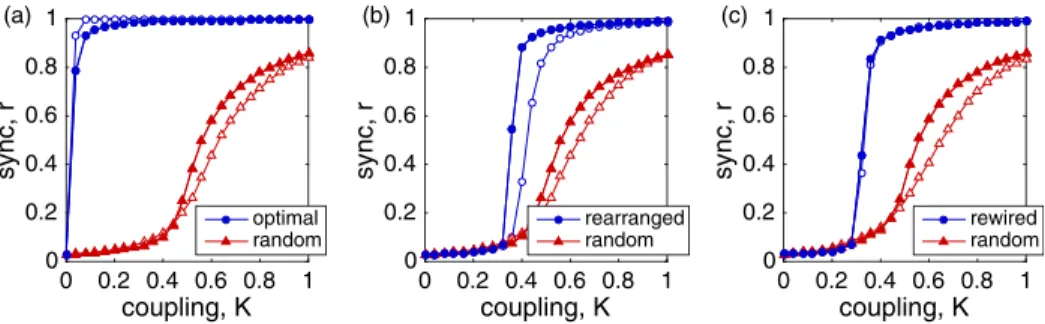
natural frequencies. In Fig. 1(a), we plot the resulting syn-chronization profiles r vsK (averaged over the 50 network realizations), indicating optimal and random natural fre-quency results in blue circles and red triangles, respectively. We denote results using ER and SF networks with filled and unfilled markers, respectively. The optimal choice of natural frequencies clearly outperforms the random allocation over the entire range of coupling strength, leading to strong syn-chronization (i.e.,r1) even for very smallK.
B. Oscillator arrangement
Next, we consider oscillator arrangement. Here, we assume that an underlying network structure is given, but rather than choosing natural frequencies freely (i.e., as in Sec.III A), we are given a set of pre-chosen natural frequen-cies fxigthat must be arranged on the network. In general,
the optimal solution depends on the particular network struc-ture and set of natural frequencies given, making analytical treatment impossible. Specifically, since there are N! possi-ble arrangements, it is infeasipossi-ble to conduct an exhaustive search for the best arrangement even for a moderately sized network. We thus develop a computationally feasible solu-tion for minimizing the SAF.
We propose here a simple greedy algorithm to produce an approximation of the optimal solution. Initially, we arrange the set of natural frequencies (here chosen from the standard normal distribution) randomly on the network. Then, in each step, we propose a switch of a single pair of oscillators, xi$xj, obtain a new frequency vectorx0, and compute the
new SAF Jðx0;LÞ. If the new SAF is less than the previous SAF,Jðx0;LÞ<Jðx;LÞ, then the switch is accepted, and oth-erwise it is rejected. This process is repeated until a chosen number S of switches is proposed. We note that the initial arrangement of oscillators needs not be random, and in fact, we can start closer to an optimal arrangement by setting an initial arrangement that aligns closely with one or more of the dominant left singular vectors ofL, saving a significant num-ber of proposed switches.
We demonstrate the power of this approach by simulating the dynamics of Eq.(1)on ER and SF networks before and af-ter the natural frequencies are rearranged using the algorithm above. We consider again networks of size N¼1000 with mean degree hki ¼4 and c¼3, first arranging normally
distributed natural frequencies randomly, then rearranging them withS¼105 proposed switches. We plot the resulting synchronization profiles in Fig. 1(b), indicating the random and rearranged natural frequency results with blue circles and red triangles, respectively. We again denote ER and SF net-works with filled and unfilled markers. As in the case of oscil-lator allocation, the system with rearranged natural frequencies significantly outperforms the system with ran-domly arranged natural frequencies. Comparing to the results of optimal allocation that are shown in Fig.1(a), in the case of pre-chosen natural frequencies the abrupt transition to syn-chronization occurs at a larger coupling strength (i.e., K0:3) and the order parameters are generally smaller. Nevertheless, as in the case of optimal arrangement, the net-works with optimally arranged frequencies significantly out-perform those with randomly arranged frequencies.
C. Network construction
We now consider the problem of network construction. We assume that a set of pre-chosen natural frequencies is given, and a network must be build to best synchronize the oscillators. We will assume that a fixed numberMof directed links can be made. As in the case of oscillator arrangement, the problem sensitively depends on the particular set of natu-ral frequencies given. Furthermore, there is a combinatorially large number of possible networks without copied or self links
that can be built, ðNðN1Þ
M Þ, which makes a full search unfeasible. Thus, we again proceed algorithmically.
We implement an accept-reject algorithm that is initial-ized with a random network. We begin by constructing a ran-dom network with M links around the pre-chosen natural frequencies, which we ensure to be strongly connected. Next, we propose link rewiring: uniformly at random, we select a linkj!ito delete, and we replace it with a new link between the two previously disconnected nodesj0!i0, which are also selected uniformly at random. This yields a new directed Laplacian matrix,L0, and new SAF,Jðx;L0Þ. If the new SAF is less than the previous SAF,Jðx;L0Þ<Jðx;LÞ, then the link replacement is accepted, and otherwise it is rejected. As before, this process is repeated untilSproposed rewirings are considered.
We highlight the effectiveness of this method by simu-lating the dynamics of Eq.(1)on networks before and after the iterative rewiring process. We initialize the rewiring algorithm with both ER and SF networks of size N¼500 and mean degreehki ¼4 andc¼3 with normally distributed frequencies and proposeS¼104link rewirings. We plot the resulting synchronization profiles in Fig.1(c), indicating the random and rewired network results with blue circles and red triangles, respectively. We denote the results using ini-tialized ER and SF networks with filled and unfilled markers, respectively. As expected, the networks that are rewired to minimize the SAF outperform the initial networks. Similar to the oscillator arrangement case, the transition to synchro-nization occurs at a larger coupling strength [i.e.,K0:3] than in the oscillator allocation case, and it remains abrupt. We note that since the rewiring algorithm is greedy, in
principle, the initial network structure may have an effect on the final network. However, we find that initializing the algo-rithm with ER and SF networks yields very similar results, which suggests that the network initialization does not have a significant effect on the outcome of the rewiring process.
IV. EFFECT OF STRUCTURAL PROPERTIES OF DIRECTED NETWORKS
Having demonstrated the effectiveness of the general-ized SAF for optimizing a network’s synchronization proper-ties, we next investigate the role of directed network structure in the optimization of synchronization. In particu-lar, we consider two general questions. First, what are the effectsofvarious directed network structuresonoptimal syn-chronization? Second, what are the effects ofoptimal syn-chronization on directed network structures? We address these questions below in Secs.IV AandIV B, respectively.
A. Degree assortativity
We begin by investigating the effects that directed net-work properties have on optimal synchronization. Perhaps the property that differentiates directed from undirected net-works is the characterization of each node by two degrees rather than one (specifically, the in- and out-degrees kini and
kiout for a given nodei). Thus, a given directed network can
easily be classified with a particular degree assortativity, measuring the correlation between in- and out-degrees at each node in the network. This can be measured with the degree assortativity coefficient,47i.e., the Pearson correlation coefficient, defined as
ckin;kout¼
P
i kini hki
kout
i hki
ffiffiffiffiffiffiffiffiffiffiffiffiffiffiffiffiffiffiffiffiffiffiffiffiffiffiffiffiffiffiffiffiffiffiffiffiffiffiffiffiffiffiffiffiffiffiffiffiffiffiffiffiffiffiffiffiffiffiffiffiffiffiffiffiffiffiffiffiffiffi P
i kini hki
2
h i P
i kouti hki
2
h i
r ; (17)
where1ckin;kout1 such thatckin;kout >0 andckin;kout<0 indicate a positive and negative correlation, respectively, and ckin;kout0 indicates no correlation. The results presented in Sec. III and Fig. 1used random networks with no correla-tions between in- and out-degrees. This begs the question: What is the effect of degree assortativity on optimal synchronization?
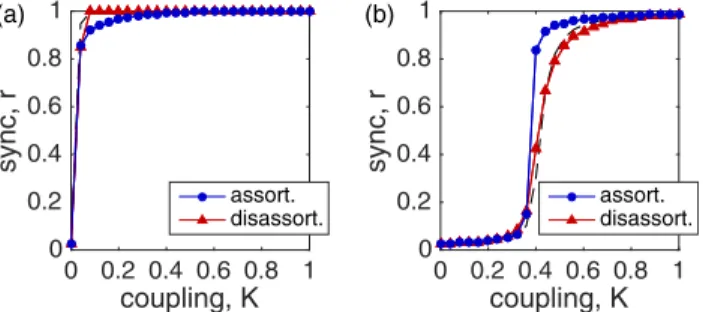
over 50 network realizations, and in the case of oscillator arrangement, the frequencies are normally distributed. We repeat these simulations on SF networks of sizeN¼1000 with hki ¼4 and c¼3, plotting the results from optimal allocation and arrangement in Figs. 3(a) and 3(b), respectively.
We note first that, while there is a difference between optimal synchronization in assortative and disassortative net-works, the optimization methods presented above are effec-tive in both cases. Interestingly, we find that the effect of degree assortativity on synchrony optimization differs between the cases of optimal allocation and optimal arrange-ment. In particular, we observe that in both ER and SF net-works when oscillators are optimally allocated, disassortative networks tend to outperform assortative networks [see Figs. 2(a) and 3(a)]. However, when oscillators are optimally arranged, assortative networks tend to outperform disassorta-tive networks [see Figs. 2(b) and3(b)]. Thus, we conclude that positive/negative degree assortativity in directed networks does not necessarily imply improved or diminished synchroni-zation properties and depends on the nature of the constraints on the optimization problem. However, we do point out that these tendencies do not appear to depend much on network heterogeneity, since the results for ER and SF networks are similar.
B. Evolution of network structure
Next, we investigate the effect that optimization has on a given directed network’s structure. In particular, we con-sider the case of network rewiring and study the evolution of the degree distribution P(k) for both in- and out degreeskin and kout. We proceed as follows. We initialize an ER net-work of size N¼500 withhki ¼4 and a set of pre-chosen natural frequencies. After noting the initial degree distribu-tions of kin and kout, we apply the rewiring algorithm described in Sec. III C for S¼5104 proposed rewirings and study the resulting degree distributions of kin and kout. Importantly, we consider two classes of natural frequencies. First, we consider frequencies drawn from the standard nor-mal distribution (as used above), representing a homogene-ous collection of frequencies. Second, we consider frequencies drawn from a much broader, heavy-tailed distri-bution described by
PðxÞ ¼ ðb1Þ=2bx0 ifjxj<x0; ððb1Þxb01=2bx0Þjxj
b ifj
xj x0;
(18)
which represents a symmetric (continuous and piecewise-smooth) distribution onR that is uniform forjxj x0 and has a power-law decay with exponent b for jxj>x0. We chooseb¼2:5 andx0 ¼1.
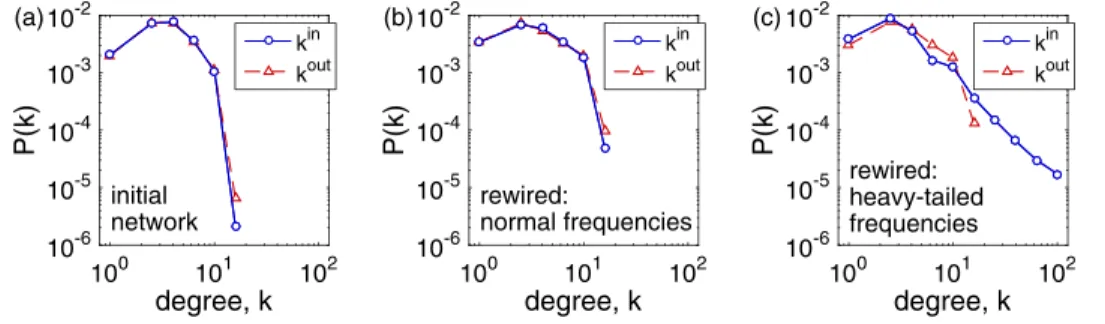
We present results for this experiment in Fig.4, plotting the degree distributionsPðkinÞandPðkoutÞfor the initial net-works in panel (a) in blue circles and red triangles, respec-tively, and the resulting distributions after rewiring for optimal synchronization for the cases of normal and heavy-tailed frequencies in panels (b) and (c), respectively. Results represent an average over 50 network realizations. We emphasize that the initial networks used for the cases of nor-mal vs heavy-tailed frequencies are identical, and thus the difference in the distributions after rewiring for optimality is due solely to the effect that the different frequency distribu-tions have on the rewiring process. Noting that results are plotted in log-log format, both the in- and out-degree distri-butions of the initial networks are thin and in fact, they remain thin after rewiring for the case of normal frequencies. However, in the case of heavy-tailed frequencies, we observe that while the out-degree distribution remains thin, the in-degree distribution becomes very wide, indicating the emer-gence of nodes with very large in-degree compared with the rest of the network, or hubs.
These results shed some light on the role of directedness of networks in optimal synchronization. In the case of undir-ected networks, we found13in a similar rewiring experiment that the heterogeneity of the degree distribution of an opti-mized network roughly matches the heterogeneity of the fre-quency distribution—heavy-tailed frefre-quency distributions give rise to heavy-tailed degree distributions, and thin fre-quency distributions give rise to thin degree distributions. The results for directed networks provide an interesting con-trast to this phenomenon. In particular, the heterogeneity of the in-degree distribution matches the heterogeneity of the frequency distribution, but no such relationship is observed for the out-degree distribution. This suggests that in the case
FIG. 2. Effect of degree assortativity (ER networks): Synchronization pro-filesrvsKfor optimally (a) allocated and (b) arranged frequencies on ER networks withN¼1000,hki ¼4 (dashed curves) as well as these networks rewired to be assortative withckin;kout¼0:99 (blue circles) and disassortative withckin;kout¼ 0:92 (red triangles). Results represent an average over 50 network realizations, and the frequencies are normally distributed for (b). Uncorrelated results are plotted with a dashed curve.
of directed networks, in-degrees play an important role in optimizing synchronization properties, while out-degrees are much less significant. As we will see below, the role of in-and out-degrees extends to the correlations we observe between the degrees and frequencies.
V. EFFECT OF INTERPLAY BETWEEN STRUCTURAL AND DYNAMICAL PROPERTIES
Having investigated the effects of directed network structure on optimal synchronization, and vice versa, we now consider the relationship between the structural and dy-namical properties of optimal networks. In particular,what relationships between dynamical and structural properties promote synchronization in directed networks? In our previ-ous work,13 we observed two general properties that are common to undirected synchrony-optimized networks: (i) a strong positive correlation between an oscillator’s nodal degree and its natural frequency and (ii) a strong negative correlation between an oscillator’s natural frequency and the average natural frequencies of its network neighbors. These results are consistent with those found to promote global synchronization in other studies;8–12 however in each of these cases, only undirected networks were considered. This leaves a significant gap in our understanding of which directed network properties promote synchronization.
In Sec.IV B, we observed that in-degrees play a particu-larly important role in synchrony optimization compared with the out-degrees. This begs the question: How does the relationship between in-degrees and frequencies compare to the relationship between out-degrees and frequencies? To address this question, we study the system properties of synchrony-optimized networks resulting from the optimiza-tion of the general SAF. In Sec.V A, we study correlations between oscillators’ natural frequencies and their nodal in-and out-degrees. In Sec. V B, we study the correlations between the natural frequencies of neighboring oscillators.
A. Degree-frequency correlations
We begin our investigation by considering correlations between each oscillator’s nodal in- and out-degree,kini and
kout
i , with their respective natural frequency in absolute
value,jxij. We present the results for synchrony-optimized
networks arising for the optimization problem of rearranging a set of pre-chosen frequencies on a given network (see Sec. III B); however, we emphasize that these results are in close agreement with our study of networks resulting for the other optimization problems discussed in Sec.III.
In Fig.5, we show scatter plots ofjxijversus (a)kiinand
(b) kiout. Black dashed lines indicate the least squares line of
best fit for each case. We show the results, for example, ER network of sizeN¼1000 with mean degreehki ¼4 and nat-ural frequencies that are drawn from the standard normal dis-tribution. The natural frequencies are arranged on the network by following the algorithm described in Sec. III B with S¼105 proposed switches. By comparing Figs. 5(a) and 5(b), we observe contrasting relationships that natural frequencies have with in-degrees and out-degrees. In particu-lar, a strong positive relationship is clear between natural fre-quencies and in-degrees, but no such relationship is clear between natural frequencies and out-degrees. To support this observation, we calculate the assortativity coefficient between the respective quantities,
ck;jxj¼
P
iðki hkiÞ jðxij hjxjiÞ
ffiffiffiffiffiffiffiffiffiffiffiffiffiffiffiffiffiffiffiffiffiffiffiffiffiffiffiffiffiffiffiffiffiffiffiffiffiffiffiffiffiffiffiffiffiffiffiffiffiffiffiffiffiffiffiffiffiffiffiffiffiffiffiffiffiffiffiffiffiffiffi P
iðki hkiÞ
2
h i P
iðjxij hjxjiÞ
2
h i
r : (19)
We find that in our particular example,ckin;jxj¼0:8530 and ckout;jxj¼0:0726.
B. Frequency-frequency correlations
Next, we consider the relationship between natural fre-quencies of neighboring oscillators. We note that in the directed case, this relationship is more nuanced than in the undirected case, and therefore we consider the relationships between a given oscillator’s natural frequency and the mean natural frequency of its neighbors (i) along in-coming links and (ii) along out-going links. To investigate these
FIG. 4. Effect of optimization on directed network structure: Degree dis-tributionsP(k) of networks (a) before and (b) and (c) after rewiring for opti-mal synchronization. In (b), the natural frequencies are normally distributed, while in (c) the frequency distribution is heavy-tailed as defined in Eq.(18). The initial network is ER withN¼500 andhki ¼4. Results represent an aver-age over 50 network realizations.
FIG. 5. Degree-frequency correlations: For an ER network of sizeN¼1000 withhki ¼4 and normally distributed natural frequencies, the natural fre-quencyjxijin magnitude vs (a) the nodal in-degreekin
i and (b) nodal out-degreekout
relationships, we define the mean neighboring frequencies, respectively, as
hxiini ¼
1 kin
i
XN
j¼1
Aijxj; hxiouti ¼
1 kout
i
XN
j¼1
Ajixj: (20)
Physically, the mean in-frequency for oscillatori,hxiini , rep-resents the mean frequency of all the oscillators that influ-enceoscillatori, while the mean out-frequency for oscillator i,hxiini , represents the mean frequency of all the oscillators that areinfluenced byoscillatori.
Using the same network as in the previous example, we plot hxiini and hxi
out
i in Figs. 6(a) and 6(b), respectively,
against the natural frequency xi. In both panels, one can
observe a negative relationship. However, the two cases differ in their structure—note the strong “bow-tie”-like structure in Fig. 6(a). This bow-tie structure is reminiscent of the frequency-frequency relationship that we previously observed for undirected networks.13To quantify this structure, we count the fraction of pairs ðxi;hxiiÞ that fall into each quadrant,
which we indicate in the respective corners of Figs.6(a)and 6(b). This allows us to quantify the proportion of oscillators whose natural frequency shares their sign with the frequencies opposite incoming and outgoing links. Approximately 20% of the natural frequencies share a sign with their respective mean in-frequency, while 30% share a sign with their respective mean out-frequency. This finding suggests that the relation-ship between each natural frequency and its respective mean in-frequency has a more significant effect on synchronization than the relationship with its respective mean out-frequency.
C. Evolution of correlations
Finally, we investigate the evolution of a network’s properties during the optimization process. Again, we restrict our attention to oscillator arrangement, as discussed in Sec. III B, and we thus consider the evolution of a network through a process of switching the natural frequencies. Throughout this evolution, we will consider the correlation between both in- and out-degrees and natural frequencies, measured by the assortativity coefficient in Eq.(19), as well as frequency-frequency correlations measured by
cx;x¼
P
i;jAijðxi hxiÞxj hxi
ffiffiffiffiffiffiffiffiffiffiffiffiffiffiffiffiffiffiffiffiffiffiffiffiffiffiffiffiffiffiffiffiffiffiffiffiffiffiffiffiffiffiffiffiffiffiffiffiffiffiffiffiffiffiffiffiffiffiffiffiffiffiffiffiffiffiffiffiffiffiffiffiffiffiffiffiffiffiffiffiffiffiffiffiffi P
i;jAijðxi hxiÞ2
P
i;jAijxj hxi2
r ;
(21)
which in this case quantifies the assortativity between neigh-boring natural frequencies.
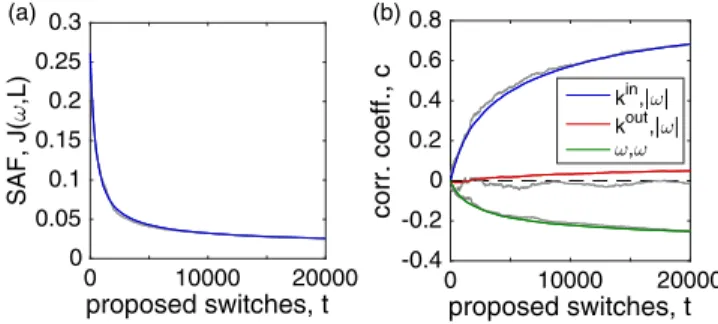
In Fig.7, we plot the results obtained from optimally rearranging natural frequencies drawn from a standard nor-mal distribution on an ER network of size N¼1000 with mean degree hki ¼4 over the course of S¼2104 pro-posed switches. For context, we plot the evolution of the SAFJðx;LÞin Fig.7(a). In Fig.7(b), we plot the correlation coefficients ckin;jxj;ckout;jxj, andcx;x in blue, red, and green, respectively. (We note that these also align from top to bot-tom, respectively.) Results represent an average over 50 net-work realizations. For comparison, results for a single realization are plotted as gray curves.
Our main observation is that as more switches are pro-posed, we see a rapid shift in the SAF, ckin;jxj, andcx;x, but only a slight shift in ckout;jxj. As the network’s synchroniza-tion properties improve, the correlasynchroniza-tion coefficients ckin;jxj and cx;x quickly saturate to approximately 0.7 and 0.3, respectively. In contrast,ckout;jxjremains small in comparison but is on average positive. These findings are consistent with the numerical results presented in Secs.V AandV Bon the degree-frequency correlations and frequency-frequency cor-relations observed in optimally rewired networks.
VI. DISCUSSION
In this paper, we have developed a framework for opti-mizing the synchronization properties of directed networks of coupled oscillators. Our results can be regarded as an extension to the previous work that focused on the case of undirected networks.13Our main theoretical result is the der-ivation of the generalized synchrony alignment function given by Eq.(15), which we have shown can be used to sys-tematically optimize the synchronization properties of net-works under several constraints, including oscillator allocation (Sec. III A), oscillator arrangement (Sec. III B), and network construction (Sec. III C). We emphasize that
FIG. 6. Frequency-frequency correlations: For an ER network of size N¼1000 with hki ¼4 and normally distributed natural frequencies, the mean (a) in-frequencyhxiin
i and (b) out-frequencyhxi
out
i vs the oscillator’s natural frequencyxi. Note the “bow-tie” structure in panel (a). Numbers in each corner indicate the fraction ofðxi;hxiiÞpairs that fall in each respec-tive quadrant.
this approach is efficient, does not require large-scale simula-tion of dynamics [i.e., either Eq.(1)or Eq.(3)], and is based on an objective measure of synchronization (i.e., a perturba-tion analysis of the Kuramoto order parameter) and not heuristics.
The generalized SAF approach presented here shows that the synchronization properties of a general directed net-work depend on the alignments of the natural frequency vec-tor with the left singular vecvec-tors of the Laplacian, weighted appropriately by the left singular values. In particular, stron-ger synchronization is attained as the natural frequency vec-tor becomes aligned with dominant singular vecvec-tors, i.e., those associated with larger singular values. This is a natural generalization from the undirected case, where it was found that stronger alignments of the natural frequency vector with the more dominant eigenvectors of the Laplacian promote synchronization. We emphasize that our approach is designed to maximize the Kuramoto order parameter in the regime where strong synchronization may occur, but point out that even for relatively small coupling strengths the approach works remarkably well. We also point out that the method is not designed to minimize the critical coupling strength associated to the onset of synchronization. Furthermore, we hypothesize that our results may be applied to better understand the effect that failures and other pertur-bations have on synchronization in complex networks.20
To provide further insight into the mechanisms that enhance synchronization and the role of directedness, we investigated the effects that directed network properties have on optimal synchronization and the effects that optimization has on directed network structures. In undirected networks, it has been observed that after rewiring for optimal synchroni-zation, the heterogeneity of the degree distribution roughly matches the heterogeneity of the frequency distribution. We have found a contrasting phenomenon for directed networks: after rewiring for optimal synchronization, the heterogeneity of the in-degree distribution roughly matches the heterogene-ity of the frequency distribution; no such relationship was found for the out-degrees. We have also studied the relation-ship between structural and dynamical properties of opti-mized networks. In the undirected case, it is well known that a positive correlation between degrees and natural frequen-cies and a negative correlation between neighboring oscilla-tors’ frequencies promote synchronization. We have shown that these relationships become more nuanced in the directed case; synchronization is promoted by a positive correlation between the nodal in-degree of an oscillator and its respec-tive natural frequency, while the relationship between the nodal out-degree of an oscillator and its respective natural frequency has comparatively little effect. We also studied correlations between the natural frequencies of neighboring oscillators and found that directed synchrony-optimized net-works display a stronger relationship between each natural frequency and the mean natural frequency of its neighbors along in-coming links than its neighbors along out-going links. Taken together, these results indicate that in-degrees play a significant role in the synchronization properties of directed networks, while out-degrees are much less significant.
ACKNOWLEDGMENTS
D.T. acknowledges the support from NIH Award No. R01HD075712. J.S. acknowledges the support from Simons Foundation Grant No. 318812 and Army Research Office Grant No. W911NF-12-1-0276.
1
S. H. Strogatz, Sync: The Emerging Science of Spontaneous Order (Hyperion, 2003).
2A. Pikovsky, M. Rosenblum, and J. Kurths,Synchronization: A Universal
Concept in Nonlinear Sciences(Cambridge University Press, 2003).
3
A. Arenas, A. Dıaz-Guilera, J. Kurths, Y. Moreno, and C. Zhou,Phys. Rep.469, 93 (2008).
4
L. Glass and M. C. Mackey,From Clocks to Chaos: The Rhythms of Life (Princeton University Press, Princeton, 1988).
5
S. Yamaguchiet al.,Science302, 1408 (2003).
6K. Wiesenfeld, P. Colet, and S. H. Strogatz, Phys. Rev. Lett.
76, 404 (1996).
7
A. E. Motter, S. A. Myers, M. Anghel, and T. Nishikawa,Nat. Phys.9, 191 (2013).
8
M. Brede,Phys. Lett. A372, 2618 (2008).
9
L. Buzna, S. Lozano, and A. Dıaz-Guilera, Phys. Rev. E 80, 066120 (2009).
10D. Kelly and G. A. Gottwald,Chaos21, 025110 (2011). 11
F. Scafuti, T. Aoki, and M. di Bernardo,Phys. Rev. E91, 062913 (2015).
12
R. S. Pinto and A. Saa,Phys. Rev. E92, 062801 (2015).
13
P. S. Skardal, D. Taylor, and J. Sun,Phys. Rev. Lett.113, 144101 (2014).
14T. Krogh-Madsen and D. J. Christini,Annu. Rev. Biomed. Eng.
14, 179 (2012).
15
A. Karma,Annu. Rev. Condens. Matter Phys.4, 313 (2013).
16A. Prindle, P. Samayoa, I. Razinkov, T. Danino, L. S. Tsimring, and J.
Hasty,Nature481, 39 (2012).
17
M. Rohden, A. Sorge, M. Timme, and D. Witthaut,Phys. Rev. Lett.109, 064101 (2012).
18F. D€orfler, M. Chertkov, and F. Bullo,Proc. Natl. Acad. Sci. U. S. A.110,
2005 (2013).
19
P. S. Skardal and A. Arenas,Sci. Adv.1, e1500339 (2015).
20D. Witthaut, M. Rohden, X. Zhang, S. Hallerberg, and M. Timme,Phys.
Rev. Lett.116, 138701 (2016).
21
Y. Kuramoto, Chemical Oscillations, Waves, and Turbulence(Springer, New York, 1984).
22J. G. Restrepo, E. Ott, and B. R. Hunt,Chaos16, 015107 (2006). 23
P. S. Skardal, D. Taylor, J. Sun, and A. Arenas, Phys. Rev. E 91, 010802(R) (2015).
24J. G. Restrepo, E. Ott, and B. R. Hunt,Phys. Rev. E71, 036151 (2005). 25J. Gomez-Garde~nes, Y. Moreno, and A. Arenas, Phys. Rev. Lett.
98, 034101 (2007).
26
J. Gomez-Garde~nes, S. Gomez, A. Arenas, and Y. Moreno,Phys. Rev. Lett.106, 128701 (2011).
27
P. S. Skardal and J. G. Restrepo,Phys. Rev. E85, 016208 (2012).
28
J. G. Restrepo and E. Ott,Europhys. Lett.107, 60006 (2014).
29
P. S. Skardal, J. G. Restrepo, and E. Ott, Phys. Rev. E91, 060902(R) (2015).
30
A. Arenas, A. Dıaz-Guilera, and C. J. Perez-Vicente,Phys. Rev. Lett.96, 114102 (2006).
31P. S. Skardal, D. Taylor, J. Sun, and A. Arenas,Phys. Rev. E93, 042314
(2016).
32
A. Sanchez, J. M. Lopez, and M. A. Rodrıguez, Phys. Rev. Lett.88, 048701 (2002).
33J. G. Restrepo, E. Ott, and B. Hunt,Phys. Rev. Lett.100, 058701 (2008). 34
H. H. K. Lentz, T. Selhorst, and I. M. Sokolov,Phys. Rev. E85, 066111 (2012).
35L. M. Pecora and T. L. Carroll,Phys. Rev. Lett.80, 2109 (1998). 36T. Nishikawa and A. E. Motter,Phys. Rev. E
73, 065106 (2006).
37
T. Nishikawa and A. E. Motter,Proc. Natl. Acad. Sci. U. S. A.107, 10342 (2010).
38B. Ravoori, A. B. Cohen, J. Sun, A. E. Motter, T. E. Murphy, and R. Roy,
Phys. Rev. Lett.107, 034102 (2011).
39
A. Ben-Israel and T. N. E. Grenville,Generalized Inverses(Springer, New York, 1974).
40G. H. Golub and C. F. Van Loan, Matrix Computations (The John
41
H. Sakaguchi and Y. Kuramoto,Prog. Theor. Phys.76, 576 (1986).
42
C. Bick, M. Timme, D. Paulikat, D. Rathlev, and P. Ashwin,Phys. Rev. Lett.107, 244101 (2011).
43P. S. Skardal, E. Ott, and J. G. Restrepo,Phys. Rev. E84, 036208 (2011). 44M. Komarov and A. Pikovsky,Phys. Rev. Lett.
111, 204101 (2013).
45
P. Erd}os and A. Renyi, Publ. Math. Inst. Hung. Acad. Sci., Ser. A5, 17 (1960).
46
A. Bekessy, P. Bekessy, and J. Komlos, Stud. Sci. Math. Hung. 7, 343 (1972).
47M. E. J. Newman,Phys. Rev. E