MORTALITY AMONG AUTOWORKERS MANUFACTURING ELECTRONICS IN HUNTSVILLE, ALABAMA
Nathan L. L. DeBono
A dissertation submitted to the faculty of the University of North Carolina at Chapel Hill in partial fulfillment of the requirements for the degree of Doctor of Philosophy in the Department
of Epidemiology.
Chapel Hill 2018
Approved by:
David Richardson
Alex Keil
Whitney Robinson
Melissa Troester
ii © 2018
iii ABSTRACT
Nathan L. L. DeBono: Mortality among autoworkers manufacturing electronics in Huntsville, Alabama
(Under the direction of David Richardson)
This research was initiated in response to concerns raised by former workers at
automotive electronics manufacturing facilities in Huntsville, Alabama regarding a suspected
excess of mortality among their colleagues. Interviews conducted with workers identified
exposure to a variety of industrial agents, including lead-based solder and chlorinated organic
solvents, in addition to hazardous working conditions at the original plant building, as sources of
concern. This work describes an epidemiologic investigation of mortality among workers at the
Huntsville facilities.
A prospective cohort study of 4,396 hourly and salaried members of the United
Autoworkers (UAW) ever-employed at the Huntsville facilities between 1972 and 1993 was
conducted. The cohort was enumerated from UAW employment and pension records with
mortality follow-up through 2016. Standardized mortality ratios (SMR) were estimated to
compare cause-specific mortality in the cohort with U.S. and Alabama general population
reference rates. Poisson regression was used to estimate mortality rate ratios (RR) within the
cohort according to proxies for exposure, including duration of employment, calendar period of
hire, and skilled trade job status.
Relative to U.S. referent rates, there was a modest excess of all-cause mortality among
iv
1.10, 95% CI: 0.99-1.22). There was a moderate excess of nervous system disorder (SMR 1.24,
95% CI: 0.91-1.65) and brain and nervous system cancer (SMR 1.31, 95% CI: 0.67-2.28)
mortality in the overall cohort. Internal comparison analyses showed that pre-1977 hires
exhibited elevated adjusted all-cause (RR = 1.29; 95% CI 1.09, 1.52), cardiovascular (RR = 1.38;
95% CI 1.03, 1.86), and digestive system disease (RR = 2.31; 95% CI: 1.04, 5.10) mortality rates
relative to 1984-1993 hires.
All-cause mortality estimates from SMR analyses were greater than anticipated based on
findings from other UAW cohorts. The moderate excess of malignant and non-malignant
nervous system disease mortality is consistent with exposure to neurotoxic agents used in
manufacturing processes. Elevated mortality among pre-1977 hires is also consistent with
concerns over hazardous working conditions at the original plant building. The results of this
v
vi
ACKNOWLEDGEMENTS
I would like to thank David Richardson for agreeing to advise me on this undertaking and
for serving as a role model for my future career. His mentorship and patience were invaluable. I
would like to thank Kaitlin Kelly-Reif for making the vital status ascertainment possible and for
providing continuous support through the Institute of Occupational Medicine. I would like to
thank Alex Keil for making himself readily available for lengthy discussions which taught me a
great deal about the practice of our discipline. I am extremely grateful to others on my doctoral
committee, Whitney Robinson, Melissa Troester, and Steve Marshall, who believed in the
importance of this work and dedicated significant time to improving it. Their support throughout
this process has been a deep source of motivation. I owe many thanks to Bonnie Rogers and the
North Carolina Occupational Safety and Health Research Center, not only for funding my
education for several years, but for funding all of the data collection necessary for this project. I
feel immense gratitude for Steve Wing, who first introduced me to the concept of an
occupational mortality investigation, and for telling me shortly before he passed that taking on
this project would be a whole lot of fun.
I am thankful to Naeema Muhammad of the North Carolina Environmental Justice
Network, for inspiring me to pursue community-oriented research, and to Valerie Tyson of the
Concerned Citizens of West Badin, for sharing her story of work at the aluminum smelter. I
would like to thank three of my lifelong friends, Mitchell Tome and Alex Wiseman, for sharing
their experiences working on the production floor at Chrysler, and Nathan Lesperance, for using
vii
grateful to two close friends I made during this process, Ryan Brady and Brett Doherty, who
helped me cope with the rigors of my training. I would never have made it to this point without
the support of Sarah Rhodes, who is the fiercest scientist I have ever met, and whose leadership
gave me the courage to take this on. I would like to thank Robert Park for having the foresight to
recognize the value those boxes of reel-to-reel tapes would have twenty five years later. I would
like to thank both Robert and Andy Comai for teaching me about the practice of health and
safety in the automotive industry, and for entrusting me with the responsibility to do good work.
Most of all, I owe my most sincere feelings of gratitude to the UAW members who had the
courage to speak with me about their experiences, and who shared documents, stories, and
viii
TABLE OF CONTENTS
LIST OF TABLES………...………...xi
LIST OF FIGURES………..………xiii
LIST OF ABBREVIATIONS………...……xiv
CHAPTER 1. SPECIFIC AIMS………...1
CHAPTER 2. BACKGROUND………...4
2.1 Worker concerns over excess mortality………..4
2.2 History of Chrysler electronics manufacturing in Huntsville, Alabama………....5
2.3 Worker descriptions of process history and exposures………...……..……..9
2.4 Previous mortality studies in autoworkers………14
2.5 Previous mortality studies in workers manufacturing electronic circuit boards………16
2.6 Diseases associated with suspected workplace exposures………21
CHAPTER 3. MATERIALS AND METHODS………26
3.1 Study design……….……26
3.2 Data sources……….26
3.3 Enumeration of the study population……….………..29
ix
3.5 Study population……..………...….32
3.6 Exposure ascertainment………..……….34
3.7 Vital status ascertainment………..…..37
3.8 Cause of death ascertainment………...………42
3.9 Referent mortality rates………....46
3.10 Effect measures………..46
CHAPTER 4. MORTALITY AMONG AUTOWORKERS MANUFACTURING ELECTRONICS IN HUNTSVILLE, ALABAMA: EXTERNAL COMPARISONS OF CAUSE-SPECIFIC MORTALITY……….…….48
4.1 Introduction………..48
4.2 Methods………49
4.3 Results……….. 56
4.4 Discussion………...….60
4.5 Figures and Tables……….……..72
CHAPTER 5. EMPLOYMENT CHARACTERISTICS AND CAUSE-SPECIFIC MORTALITY AT AUTOMOTIVE ELECTRONICS MANUFACTURING FACILITIES IN HUNTSVILLE, ALABAMA………..………..…….79
5.1 Introduction………..79
5.2 Methods………80
5.3 Results………..…………87
x
5.5 Figures and Tables………..….98
CHAPTER 6. DISCUSSION………...106
6.1 Fulfillment of the specific aims……….106
6.2 Future investigations with the UAW……….113
6.3 Conclusion……….116
xi
LIST OF TABLES
Table
2.1 Causes of death of a priori interest based on suspected workplace
exposures at Huntsville facilities………...…….25
3.1 Actual and observed operational history of plant codes at Chrysler
electronics manufacturing facilities in Huntsville, Alabama
(n = 4,396)………..…31
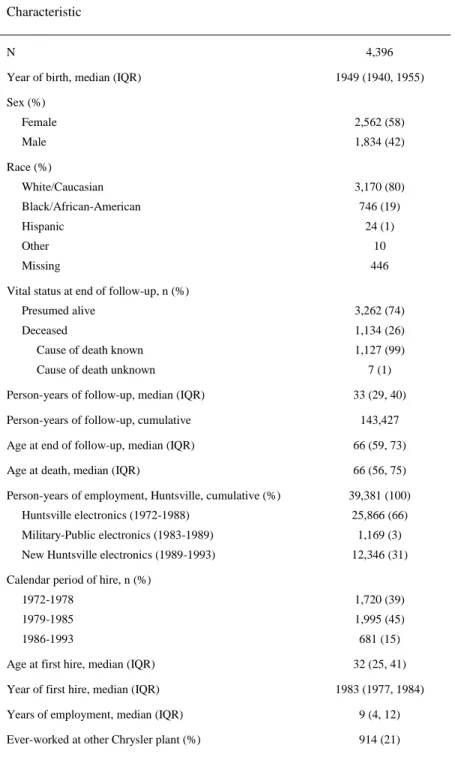
3.2 Descriptive characteristics of the study population of 4,396 UAW
hourly and salaried workers ever-employed at Chrysler electronics
in Huntsville, Alabama from 1972-1993………33
3.3 Criteria for selection and number of individuals submitted to the
National Death Index for vital status ascertainment (n = 1,714)………40
3.4 Calendar years of death and number of individuals searched in each
data source used for vital status ascertainment………...……41
3.5 Observed number of deaths in the study population due to specific
causes according to the NIOSH-119 major and minor cause of death
categories………44
4.1 Descriptive characteristics of 4,396 hourly and salaried UAW
members ever-employed at automotive electronics manufacturing
facilities from 1972-1993 in Huntsville, Alabama……….…………72
4.2 Standardized mortality ratios comparing cause-specific mortality
among 4,396 UAW members ever-employed from 1972-1993 to
U.S. and Alabama referent rates……….………73
4.3 Standardized mortality ratios comparing mortality due to select
Causes of death among White female and White male UAW members ever-employed from 1972-1993 to U.S. referent rates (estimates for
Black or other females and males shown in supplemental Table S4.2)…………...…..75
4.4 Standardized mortality ratios comparing mortality due to select
causes of death among 4,396 UAW members to U.S. referent rates
according to hire period and years since first hire……….…….76
4.5 Standardized mortality ratios comparing mortality due to select causes
of death among 4,396 UAW members to U.S. referent rates according
xii
S4.1 Sensitivity analyses for race imputation methods on overall
standardized mortality ratio estimates using U.S. referent rates……….…………77
S4.2 Standardized mortality ratios comparing mortality due to select
causes of death among Black (or other) female and male UAW
members ever-employed from 1972-1993 to U.S. referent rates………...………78
5.1 Descriptive characteristics of 4,396 hourly and salaried UAW
members ever-employed at automotive electronics manufacturing
facilities between 1972-1993 in Huntsville, Alabama………98
5.2 Rate ratios for all-cause, all cancer, and cardiovascular disease
mortality according to employment characteristics overall and according to sex among 4,396 hourly and salaried UAW members ever-employed at automotive electronics manufacturing facilities
in Huntsville, Alabama, between 1972-1993………..…………99
5.3 Rate ratios for select malignant causes of death according to
employment characteristics among 4,396 hourly and salaried UAW members ever-employed at automotive electronics manufacturing
facilities in Huntsville, Alabama, between 1972-1993……….……101
5.4 Rate ratios for mortality due to select chronic diseases according
to employment characteristics among 4,396 hourly and salaried UAW members ever-employed at automotive electronics manufacturing
facilities in Huntsville, Alabama, between 1972-1993……….…………102
5.5 Rate ratios for mortality due to genitourinary and renal diseases
according to employment characteristics among 4,396 hourly and salaried UAW members ever-employed at automotive electronics
manufacturing facilities in Huntsville, Alabama, between 1972-1993………103
5.6 Evaluation of ‘healthy worker’ effect with exclusion of short-term
workers and stratification according to active versus inactive person-time in estimates of mortality rate ratios according to employment
characteristics in the study cohort (n = 4,396)………..……104
S5.1 Sensitivity analysis for the imputation of employment duration for
xiii
LIST OF FIGURES
Figure
2.1 Satellite image of the site of the original plant buildings at the former
Chrysler automotive electronics operation in Huntsville, Alabama
(circa 2017)………...…………7
2.2 Satellite image of the site of the newest plant building (Plant 3) at the
former Chrysler automotive electronics operation near Huntsville,
Alabama (crica 2017)………9
3.1 Illustration of the relationship between UAW data sources used to
enumerate the study population………..30
3.2 Number of study members active per year according to plant code at
Chrysler electronics facilities in Huntsville, 1972-1993 (n = 4,396)………..36
3.3 Number of deaths identified in each data source and concordance
between data sources used for vital status ascertainment………...42
5.1 Kaplan-Meier estimated overall survival proportion according to
calendar period of first hire among UAW members employed at
xiv
LIST OF ABBREVIATIONS
AL Alabama
CI Confidence Interval
EPA Environmental Protection Agency
GM General Motors
IARC International Agency for Research on Cancer
IBM International Business Machines
IQR Interquartile Range
NIOSH National Institute of Occupational Safety and Health
OSHA Occupational Safety and Health Administration
RR Rate Ratio
SMR Standardized Mortality Ratio
TCE Trichloroethylene
UAW United Autoworkers
1
CHAPTER 1: SPECIFIC AIMS
Former employees at automotive electronics manufacturing facilities in Huntsville,
Alabama raised concerns over a suspected excess of mortality among their colleagues. In 2015, a
list of over 400 deceased individuals formerly employed at the facilities was brought to the
attention of the United Autoworkers (UAW) Health and Safety Department by a group of
workers who have been maintaining a record of deaths among their colleagues for several years.
Workers have reported exposure to lead-based solder, asbestos, and chlorinated solvents while
employed at the facilities. The UAW requested the support of epidemiologists to investigate
worker concerns.
Mortality rates in autoworkers are generally lower than expected for most causes of death
with the exception of cancer, for which rates tend to be elevated for lung, reproductive, and
digestive cancers compared to the general U.S. population 1-3. Two studies in UAW-based
cohorts have indicated employment in automotive and aerospace electronic equipment
manufacturing is associated with prostate and brain cancer mortality 4,5. However, mortality among workers employed at the Huntsville facilities has never been studied, nor have previous
studies addressed mortality more broadly among workers employed in automotive electronic
component manufacturing.
The overall objective of this study was to investigate cause-specific mortality among
4,396 workers employed at automotive electronics manufacturing facilities in Huntsville,
UAW-2
based cohort through a partnership with the UAW and the National Institute of Occupational
Safety and Health (NIOSH). Primary data collection on individual demographic, employment,
vital status, and cause of death information was conducted. The specific aims of the study were:
Aim 1: Address concerns about excess mortality among UAW members formerly employed at
the Huntsville electronics manufacturing facilities. Compare the age-, sex-, race-, and calendar
year-standardized cause-specific mortality rate for all major cause of death categories among
workers ever-employed at the Huntsville facilities between 1972 and 1993 to reference rates for
the general population of the U.S. and Alabama.
Sub-Aim 1 (a): Estimate age-, sex-, race-, and calendar year-standardized cause-specific
mortality ratios stratified by new hires before and after the opening of a new plant
building in 1977.
Sub-Aim 1 (b): Estimate age- and calendar period-standardized cause-specific mortality
ratios among male, female, White, and Black (or other) workers.
Sub-Aim 1 (c): Investigate the potential for ‘healthy worker’ bias by estimating age-,
sex-, race-, and calendar year-standardized cause-specific mortality ratios stratified by
time since company first hire and by using employed versus post-termination
person-time.
Aim 2: Estimate associations between employment characteristics and cause-specific mortality
within the study population. Estimate incidence rate differences in all major categories of
cause-specific mortality according to employment characteristics including skilled trade job status and
3
Sub-Aim 2 (a): Estimate the association between skilled trade job status, duration, plant
code, and calendar period of employment and cause-specific mortality in male, female,
White, and Black (or other) employees.
Sub-Aim 2 (b): Investigate the potential for ‘healthy worker’ bias by estimating the
association between employment duration and cause-specific mortality with exclusion of
short-term workers.
The results of this investigation address former worker concerns over a suspected excess of
mortality at automotive electronics manufacturing facilities. The facilities are no longer
operational, however, the results may support the advancement of the rights and safety of UAW
4
CHAPTER 2: BACKGROUND
2.1 Worker concerns over excess mortality
Former employees at automotive electronics manufacturing facilities in Huntsville,
Alabama have raised concerns over a suspected excess of mortality among their colleagues.
Workers have been maintaining a record of deaths among their former colleagues and fellow
retirees for several years. A list of names of deceased workers, including their job, death date,
and cause of death, is being maintained by a concerned group of former workers on social media.
The list is posted to a social media group of over 1,200 former workers at the Huntsville facilities
and is continually updated through feedback on the site. The facilities closed in 2010, however, a
recent asbestos lawsuit, in addition to public knowledge of widespread soil contamination at the
plant site with chlorinated organic solvents, has increased former worker’s awareness of
potential health hazards associated with employment at the facilities. The list was widely shared
on social media during contract negotiations with Chrysler and was brought to the attention of
UAW representatives at the union’s offices in Detroit, Michigan (Solidarity House).
In 2015, Huntsville electronics UAW Local 1413 representatives submitted a complaint
over adverse working conditions and the perceived elevated rate of mortality among former
workers at the facilities to the UAW Health & Safety Department at Solidarity House. The list of
names of deceased workers was used by Local 1413 representatives as evidence to support their
claim, which at the time had over 400 individuals listed. The UAW Health & Safety Department
sought the support of epidemiologists to respond to worker concerns by conducting a mortality
5
UAW and the director of the Health & Safety Department at Solidarity House in Detroit,
Michigan in August of 2016 and obtained approval to conduct the investigation. The UAW
authorized the investigation and released necessary study data two months later. Local 1413
members in Huntsville were notified of the investigation and were active collaborators in
accomplishing study aims. As of September 2017, the list of deceased circulating on social
media contained over 700 names and continues to be updated on a regular basis.
2.2 History of Chrysler electronics manufacturing in Huntsville, Alabama
An extensive description of the operational history of Chrysler electronics manufacturing
facilities in Huntsville is available as an online resource 6. The facilities served as the core of Chrysler’s electronics division for over 40 years and pioneered numerous advancements in
automotive technology. Chrysler’s first electronics plant in Huntsville (Plant 1) was constructed
in an industrial park adjacent to a military facility in 1952, when the company secured a defense
contract to provide technical service and manufacturing support for the U.S. Army’s Redstone
guided-missile arsenal. The success of the Redstone program led Chrysler to become the primary
contractor for rocketry and missile development for the Department of Defense. Chrysler began
production of the Jupiter missile arsenal in Huntsville shortly after, manufacturing a variety of
electronics and rocketry components for U.S. military over the next decade. In 1962, Chrysler
began fulfilling electronics contracts for NASA. The Huntsville plant manufactured the telemetry
systems for the Saturn rockets and the lunar excursion module used in NASA’s Apollo missions.
Three years later, Chrysler expanded the plant by 176,000 square feet to meet production
requirements.
In 1968, Chrysler’s involvement in the military and aerospace manufacturing began to
6
focus on the development of electronics for automobiles. Many quality control and engineering
processes used for the manufacture of aerospace equipment were transformed for automotive
production, giving Chrysler an advantage in the automotive industry’s shift toward producing
cars installed with electronics. Given the anticipated growth of the market for automotive
electronics, Chrysler’s Huntsville electronics plant was considered a prime strength of the
corporation and given significant investment.
In 1971, Chrysler’s Huntsville plant began manufacturing several mass-production lines
of electronic components for Chrysler vehicles. These products included electronic ignition
modules, digital engine control computers, exhaust emission analyzers, and radio systems,
including speakers, tape-decks, and head units. Engine control computers and emission analyzers
consisted of printed circuit boards with soldered-on capacitors and resistors connected via copper
traces. In the mid-1970’s, Plant 1 was expanded twice and began manufacturing vacuum
fluorescent display digital clocks, electronic trip computers (e.g. distance, fuel mileage, average
speed calculator and display), and fully digital car radios. In 1977, Chrysler constructed a second
225,000 square foot plant (Plant 2) adjacent to the original Plant 1 building to support the
growing market for automotive electronics. A satellite image of the original Plant 1 and 2
buildings is shown in Figure 2.1.
In the early 1980’s, other notable product lines were added to the manufacturing
processes at the Huntsville facilities. The facilities began producing electronic instrument
clusters for vehicle dashboards, such as digital readout panels for displaying vehicle information,
as well as digital fuel injection systems which included spark control computers and electronic
feedback-carburetor controllers. They also produced the ‘Navistar’ electronic navigation system
7
In 1983, Chrysler revived some military manufacturing operations at a separate plant
building located in the same industrial park as the two original automotive plants. The new
operation was named Military-Public Electronics Systems and specific products manufactured
there are largely unknown, although workers reported general processes similar to those at the
automotive plants. The plant reportedly manufactured a computerized rail traffic and power
control system for the Northeast corridor of the U.S. railway system. The operation was closed
after six years of production and its small workforce returned to Chrysler automotive
manufacturing. The physical plant for this operation was never again used by Chrysler.
As the demand for electronics in cars continued to grow, Chrysler completed construction
on a third automotive electronics plant in Huntsville in 1988 (Plant 3). The new 750,000 square
foot facility was larger than the previous two combined and was located on a separate 325 acre
8
site outside of the city. The state-of-the-art complex largely replaced the manufacturing
operations at the previous plants. Most of the workforce and equipment were transferred to the
new location and production began there in early 1989. Some manufacturing operations
continued intermittently at the original plants after the new facility was constructed, typically
when new production lines were added or reorganized. A satellite image of the Plant 3 facility is
shown in Figure 2.2.
In 1996, Chrysler’s new Plant 3 facility reached peak production. The facility had 24
different assembly lines, which involved screen printers, various ovens, high-speed placement
systems, wave solder machines, and printed computer board loaders. The plant manufactured
radio/stereo systems, engine, transmission, four-wheel drive, body (e.g. power door, window,
mirror, light) computers, and dashboard instrument clusters. The complex was operational for
three eight-hour shifts and produced 49,000 units per day. Approximately 70% of electronics
found in Chrysler vehicles were manufactured at the complex in Huntsville. The complex also
held Chrysler’s first internal child care center and was reported to have a total of 2,804
employees (unionized and managerial).
In 1998, Chrysler merged with Daimler Benz, and the resulting restructuring process led
to the Huntsville electronics facilities being sold to Siemens in 2004. After the sale, workers at
the facilities remained unionized through the UAW and continued to manufacture automotive
electronics under Siemens and then Continental. In 2010, Continental shut down all
manufacturing operations in Huntsville, leaving all plant buildings abandoned for several years.
9
2.3 Worker descriptions of process history and exposures
I conducted interviews with nine former employees at the Huntsville electronics facilities
to understand plant process histories and identify exposures of concern. Interviewees were
contacted through the retiree group of the local UAW chapters, Local 1413 (hourly) and Local
1929 (salaried). The interviewees included two former Local 1413 presidents, the
UAW-Chrysler retiree benefits representative, two Local 1413 health and safety representatives, one
plant clerical worker, and one Chrysler chemical engineer. The former health and safety
representatives were able to describe common exposure concerns voiced by workers during their
time in the positions. The employment history of the interviewees spans the entire operational
history of the plants from 1971 to 2010. Interviews were conducted by phone, email, and
in-person during the spring of 2017. I visited all of the plants in-in-person during this time to verify
10 information obtained through interviews.
Interviewees described two exposures of primary concern related to plant processes:
inhalation and dermal exposure to lead-based solder and chlorinated organic solvents,
specifically trichloroethylene (TCE) and 1,1,1-trichloroethane. Other major exposures of concern
included asbestos, which was discovered in the ceiling of Plant 1 in the 1980’s, conformal
coating fumes, and fiberglass dust inhalation.
The operational history of the plants was characterized predominantly by the assembly of
electronic circuit boards. Boards were cut from fiberglass sheets and would enter production
lines to have electronic components soldered to them. The transistors and capacitors soldered to
boards were not manufactured at the facilities, but were shipped to Huntsville from elsewhere.
Once boards were assembled and soldered, they were sprayed with a conformal coating
(silicone- or polyurethane-based resin for moisture and heat protection) and baked in industrial
ovens. The circuit boards would then be installed into various enclosures including radio or
dashboard units before being wired and sealed for shipment to vehicle assembly plants.
Hand soldering, solder paste application, and wave soldering were the three main solder
processes used throughout each plant’s history. Wave soldering was an automated process where
circuit boards were loaded into machines and transferred over a tub of molten solder. Hand
soldering required workers to solder individual components to boards by hand, often for boards
needing repair or when wave solder machines underwent maintenance. Solder paste application
involved the spreading of solder onto boards with adhesive tape or handheld tools. All three of
these soldering processes were used until all facilities were closed in 2010, although wave
11
shrunk in size. Wave solder machines had been used at the original plants as early as 1983 and
were introduced to increase production speed. No workers on the solder lines wore personal
protective equipment. The hand and paste solder workers were provided gloves, but they were
rarely worn.
The UAW health and safety representatives stated that the solder contained lead up until
at least 2001. It was common for workers in the solder lines to inhale solder fumes, and those
working with solder manually would often finish their shifts with paste on their hands and
clothing. Wave solder machines were attended by workers who would stand at the machines for
an entire shift and could smell the molten solder fumes at their workstation. Their tasks involved
the loading and removal of circuit boards from the machine and adding bricks of hardened solder
to the molten mixture. At the original Plant 1 and 2 buildings, wave solder machines had no
ventilation, however, most machines at the newer Plant 3 facility had ventilation units to reduce
the intensity of the fumes. In the mid-1990’s, one interviewee applied a home lead testing kit to
dust samples collected from the intake vent over their wave solder machine. The sample tested
positive for lead, indicating that lead was present in the fumes emanating from their machine.
Chlorinated organic solvents are chemicals that were used widely at the facilities for
solder degreasing. Excess solder on circuit boards, tools, and machine components was removed
using a variety of chlorinated solvents including trichloroethylene (TCE) and
1,1,1-trichloroethane. Workers were required to manually scrub solder from circuit boards using
solvents that they would apply to metal brushes. Some workers were also required to spray
solvents on circuit boards or machinery in enclosed spaces with little or no ventilation. At the
original plants, workers would clean solder from their hands by washing them in open containers
12
management told them that trichloroethylene was safe enough to drink. Large drums of
trichloroethylene were available for workers to use freely and those who worked with the
chemical rarely wore any personal protective equipment. Trichloroethylene was used primarily
during earlier years of facility operation, as this chemical was phased out of use broadly in the
U.S. during the 1980’s in response to emerging evidence of its toxicity. While
1,1,1-trichloroethane largely replaced trichloroethylene for degreasing purposes, the extent to which
specific solvents were used throughout facility history is unknown.
The Plant 2 building constructed in 1977 housed a 5,000 gallon tank of chlorinated
solvents that was used as a reservoir for the plant’s manufacturing operations. In the mid-1980’s,
it was discovered that the tank had been leaking into the soil around the plant for several years.
Employees frequently played softball on a field adjacent to the plant during their breaks, but after
the contamination was discovered, they were prohibited from using it. This caused alarm among
workers as they had already been directly exposed to solvents in the workplace for years. Many
workers were prepared to go on strike in protest of their solvent exposure, but it never occurred.
High school baseball teams were also prohibited from using the field during this time and this
policy has persisted to the present. After the plants closure in 2010, a firm was hired to clean the
site so the property could be sold to a community college. A news article published in 2010
reported the site was contaminated with 1,1,1-trichloroethane, dichloroethane (a feedstock in
chemical synthesis of 1,1,1-trichloroethane), and 4,4’-methylenebis(2-chloroaniline) (MOCA) 7.
Skilled tradespeople were hourly workers who were trained or apprenticing in specific
skills not directly related to manufacturing processes. Skilled tradespeople at the Huntsville
facilities consisted predominantly of electricians, machine repairers, carpenters, tool makers, and
13
electricians would be required to rewire electrical lines in the plant to provide machinery with
power. In the 1980’s, asbestos was discovered when new electrical lines were being installed in
the ceiling at the original Plant 1 building. Electricians who often worked in the ceilings and
walls of the original plant may have been routinely exposed to asbestos without their knowledge.
Working conditions at the original Plant 1 building were described as the most adverse
and were of particular concern. Plant 1 was used exclusively until 1977 had no ventilation in
production areas or enclosures on wet processing lines. Interviewees described the production
area to be excessively hot with strong chemical odors. There were windows near the ceiling that
would be opened occasionally, but this did little to keep the production space aerated. Fiberglass
dust contaminated the air on production lines where circuit boards were cut from large sheets of
fiberglass cloth before being implanted with epoxy resin. The dust was a large source of irritation
and workers often complained it interfered with their breathing. The most common health and
safety complaints at the original plant included musculoskeletal strains, burns, nose bleeds,
headaches, and excessive heat. There was at least one instance of a solder spill that resulted in an
OSHA complaint and UAW health and safety investigation.
The new Plant 3 facility constructed in 1989 was considered a ‘state of the art’
manufacturing complex at the time of its opening. The facility had significantly improved
ventilation, enclosures, and air conditioning compared to the original plants. In addition to
ventilation units over the wave solder machines, chlorinated solvent use was better restricted to
enclosed booths and ventilated spaces. However, employees were occasionally transferred to the
original plants for certain manufacturing operations after the new facility was constructed. This
typically occurred when new products were added to production or when production lines were
14
Despite Chrysler’s sale of the Huntsville facilities in 2004, workers indicated that the
general processes at the plants, as well as the workforce itself, largely remained the same. The
workforce remained unionized even after ownership of the plants changed. The workforce
gradually declined during the last decade of plant operation. When the facilities were shut down
in 2010, workers were given the option to transfer to other automotive manufacturing facilities in
the U.S.
2.4 Previous mortality studies in autoworkers
The mortality experience of autoworkers in the U.S. has been characterized by two large
UAW-based cohorts in Ford and GM employees 1-3,8. The UAW-Ford cohort consists of 198,245
hourly employees active from 1973 to 1990 in a range of automotive production sectors
nationwide. Delzell et al. reported results of standardized mortality ratio analyses (SMR) from
the UAW-Ford cohort using U.S. general population reference rates and a median of 27 years of
follow-up for mortality. Their results indicate a lower than expected mortality rate for all-causes
(SMR 0.92, 95% CI: 0.91, 0.92) and for all major cause of death categories except for cancer,
which was similar to the expected (SMR 1.00, 95% CI: 0.98, 1.02). The deficit in the SMR for
all-cause mortality was greater among Black (or other) compared to White workers, however,
Black (or other) workers had a higher all-cause and cancer mortality rate compared to their
White counterparts. Among shorter-term (<20 years) workers hired >20 years prior to the end of
follow-up, mortality rates were greater than expected for all causes (SMR 1.20, 95% CI: 1.17,
1.23), including heart disease (SMR 1.22, 95% CI: 1.17, 1.27) and all cancers (SMR 1.18, 95%
CI: 1.12, 1.23). SMRs were elevated for non-Hodgkin’s lymphoma and stomach, lung, breast,
15
Delzell et al. did not report results for workers employed in electronic component
manufacturing. However, among vehicle assembly workers, those ever-employed in
welding/soldering jobs had lower than expected mortality rates overall and for all cancers and
heart disease. Those ever-employed in maintenance/skilled trade jobs also had lower than
expected rates for the same cause-of-death categories, although this job group exhibited an
excess of lung cancer mortality (SMR 1.16, 95% CI: 1.06, 1.27).
The UAW-GM cohort consists of 46,399 hourly employees hired between 1917 and 1981
at three automotive plants in Michigan that manufactured transmissions and metal gear, axel, and
drivetrain components. This cohort was enumerated to investigate health hazards associated with
occupational exposure to metalworking fluids. Eisen et al. reported results of SMR analyses
among males in the UAW-GM cohort using reference rates from the U.S. general population and
mortality follow-up through 1994. Among White men, the mortality rate in the cohort was
similar to the expected for all-causes (SMR 1.01, 95% CI: 0.99, 1.03) and for all-cancers (SMR
1.05, 95% CI: 1.01, 1.09). Among Black men, the mortality rate was lower than expected for
all-causes (SMR 0.86, 95% CI: 0.82, 0.90) and for all-cancers (SMR 0.95, 95% CI: 0.86, 1.04).
Friesen et al. reported SMR results among females with updated mortality follow-up through
2004 using Michigan reference rates. The mortality rate was lower than expected for all-causes
(SMR 0.82, 95% CI: 0.77, 0.87) but elevated for all-cancers (SMR 1.10, 95% CI: 0.98, 1.22).
Excess mortality was reported for lung, brain, leukemia, and pancreatic cancer. Other studies in
smaller populations of autoworkers employed in engine foundry or metalworking facilities
corroborate the findings of the UAW-GM cohort, in that external comparisons of mortality show
similar or lower than expected mortality for non-malignant causes, but greater mortality for lung,
16
Results from external comparison analyses in the UAW-Ford and UAW-GM cohorts are
valuable for characterizing the mortality experience of autoworkers in the U.S. All-cause
mortality rates are generally lower than expected while rates tend to be greater for
cancer-specific causes. Estimates of lower than expected overall mortality and elevated SMR estimates
in shorter-term workers with greater time since hire are indicative of ‘healthy worker’ biases.
The greater deficit in SMR estimates in Black (or other) compared to White workers indicates
that healthy worker biases are stronger in this group. While both cohorts are predominantly
comprised of workers who never worked in electronics manufacturing, it is common for UAW
members, including those employed in Huntsville, to work in a variety of automotive production
sectors, as members frequently transfer to multiple plants in their lifetime due to layoffs and
closures. Results from these cohorts provide useful information about mortality patterns in the
UAW workforce more broadly, and describe the mortality experience of a population with
similar insurance, benefits, and socioeconomic characteristics to the study population in
Huntsville.
2.5 Previous studies of mortality in workers manufacturing electronic circuit boards
Few epidemiological studies have investigated mortality hazards associated with
employment in electronic circuit board manufacturing. Two studies have investigated mortality
risks in autoworkers with some analyses specific to electronics manufacturing. Two other
investigations were conducted in employees who manufactured computer products for IBM. A
wider body of literature describes mortality risks associated with electronic semiconductor and
capacitor manufacturing, however, these components were not manufactured at the facilities in
17
Electronics manufacturing and mortality in autoworkers
There are few studies that have investigated health hazards associated with employment
in automotive electronics manufacturing. Two mortality studies by Park et al. and Brown et al.
investigated risks associated with electronics work in UAW members 4,5. Park et al. conducted a
proportional mortality study using national reference proportions among hourly UAW workers at
an aerospace electromechanical systems manufacturer. Processes at the facility included the
machining and assembly of gyroscopes, accelerometers, and the production of electronic circuit
boards. The analysis involved 583 deaths between 1950 and 1986 among workers employed at
the facility for at least 10 years. Results indicated an increased proportion of deaths due to all
cancers (PMR 1.19, 95% CI: 0.96, 1.48), brain cancer (PMR 5.15, 95% CI, 2.07, 10.61), and all
lymphopoietic (PMR 1.74, 95% CI: 0.75, 3.43) cancers. The proportion of deaths due to lung,
digestive cancers, heart disease, and respiratory diseases were similar to or below expectation.
Brown et al. conducted a case-control study of employment history in the automotive
manufacturing industry and prostate cancer mortality. Their analysis included 322 prostate
cancer deaths occurring between 1973 and 1987 and 1,288 individually matched controls drawn
from the UAW-Ford cohort. They analyzed employment history according to longest worked
production sector and used never-workers in a given sector as the referent. They reported a
positive association between employment in electronic equipment manufacturing and prostate
cancer mortality (OR 2.1, 95% CI: 1.2, 3.7). The association remained similar after imposing a
10 year truncation of work history (lag) prior to death.
The studies by Park et al. and Brown et al. indicate elevated risk of certain cancers among
18
although they are based on a relatively small number of deaths and provide little description of
process-specific exposures.
Electronics manufacturing and mortality at IBM
Two studies have characterized mortality risks among former employees at IBM
computer electronics manufacturing facilities 14,15. Similar to the concern that emerged in Huntsville, both studies were initiated through litigation in response to worker complaints over
excess mortality. The first investigation by Clapp consisted of a company-wide proportionate
mortality ratio analysis of 31,941 deceased hourly employees who worked ≥5 years and who
died between 1969 and 2001 14. The U.S. general population was used for comparison. Overall,
Clapp reported a small excess in the proportion of deaths due to all cancers among males (PMR
1.07, 95% CI: 1.05, 1.09) and females (PMR 1.15, 95% CI: 1.10, 1.19), while estimates for heart
disease, non-malignant respiratory disease, and all external causes of death were either equal to
or below expectation for both sexes. A significant excess in the proportion of deaths due to
nervous system disorders was reported but a point estimate was not provided. Among decedents
with known work history (32%) who were ever-employed in manufacturing operations and who
died of cancer (1,180 men and 302 women), PMRs were elevated (>1.4) in men for rectal,
pancreatic, kidney, and brain and nervous system cancer. A small excess was reported for
non-Hodgkin’s lymphoma. Among women, PMRs were elevated for stomach and kidney cancer, as
well as for leukemia and lymphopoietic cancers, although estimates in women were imprecise
due to the small number of decedents.
The second study was conducted by the National Institute of Occupational Safety and
Health (NIOSH) among 34,494 salaried and hourly workers ever-employed between 1969 and
19
mortality at the facility, evidence of soil and groundwater contamination with trichloroethylene
and other industrial solvents in the community prompted the New York State Department of
Health and Congressional representatives to request an occupational mortality investigation at
the facility.
NIOSH’s investigation consisted of historical exposure reconstruction and the creation of
a department-specific exposure matrix 16. The facility began manufacturing electronic circuit
boards for computers and business machines in the mid 1960’s. The manufacture of circuit
boards continued as a major process at the facility until 2002. Trichloroethylene was introduced
at the facility in the mid 1960’s but was discontinued in 1985. Lead was used in solder
throughout the facility’s history. Of the 34,494 workers in the cohort, an estimated 59% were
ever-exposed to chlorinated solvents, including 24% to 1,1,1-trichloroethane (methyl
chloroform), 15% to dichloromethane, 12% to perchloroethylene (PCE), and 9% to
trichloroethylene. A total of 29% were ever-exposed to lead and 15% to fiberglass dust.
Approximately 21% of total employed person-time involved exposure to chlorinated solvents,
11% to lead, and 4% to fiberglass dust. Annual mean cumulative worker exposure scores were
highest from 1974 to 1985 for chlorinated solvents and from 1986 to 1993 for fiberglass and
lead. Among solvents, 1,1,1-trichloroethane was responsible for the greatest mean cumulative
exposure in all manufacturing eras.
Results of the mortality investigation showed 17% of the cohort (5,966 individuals) had
died after a mean of 25 years of follow-up. SMRs were reported using U.S. general population
reference rates. Among male hourly workers, SMRs were below expectation for all causes (SMR
0.76, 95% CI: 0.73, 0.78) and for all cancers (SMR 0.83, 95% CI: 0.78, 0.88). However, SMRs
20
CI: 0.88, 4.50), and non-Hodgkin’s lymphoma (SMR 1.49, 95% CI: 1.15, 1.89). SMRs for all
causes and all cancers were well below expectation among male salaried workers. Among
females, SMRs for all causes and all cancers were similar to those observed in males for both
hourly and salaried workers. Among female hourly workers, the SMR was elevated for leukemia
only (SMR 1.61, 95% CI: 0.94, 2.57). The authors reported that SMRs did not change markedly
with the use of New York state reference rates or when workers employed less than one year
were excluded.
Internal comparisons of mortality were conducted according to duration of employment
in specific departments and cumulative exposure scores to specific agents. For analyses by
duration, workers employed ≥5 years in specific departments were compared to the rest of the
cohort with model adjustment for paycode (i.e. hourly, salaried) and sex. The authors reported
that ≥5 years of employment in circuit board and substrate manufacturing departments was
associated with an elevated risk of non-chronic lymphocytic leukemia mortality (HR 1.59, 95%
CI: 1.02, 2.49). No other associations were observed for other causes of death within circuit
board manufacturing departments. For comparisons of cumulative exposure score, hazard ratio
(HR) estimates were elevated but not significant for trichloroethylene exposure and kidney
cancer (HR 1.24, 95% CI: 0.87, 1.77), trichloroethylene and non-chronic lymphocytic leukemia
(HR 1.31, 95% CI: 0.98, 1.75), and perchlorethylene and non-Hodgkin’s lymphoma mortality
(HR 1.25, 95% CI: 0.90, 1.73). A significant, elevated association was found for cumulative
perchloroethylene exposure and mortality due to non-malignant diseases of the nervous system
(HR 1.31, 95% CI: 1.01, 1.69).
Results of the NIOSH study are broadly consistent with a prior proportionate cancer
21
of lymphoma mortality (PCMR 2.20, 95% CI: 1.01, 4.19) in males, and suggested potential
excesses of death due to kidney and brain cancer. However, this analysis was based on a small
number of cancer deaths (115) and used reference rates for New York State only.
Overall, NIOSH’s investigation at the IBM facility in New York State benefits from a
large number of decedents and department-specific exposure ascertainment to several chemical
agents. However, the mean age of the cohort at the end of follow-up was only 59, suggesting
SMR estimates were biased downward due to ‘healthy hire’ biases attributable to recency of
active employment. With respect to exposure, the NIOSH study is extremely valuable for
corroborating worker descriptions of manufacturing processes and exposures of concern at the
automotive facilities in Huntsville. Both workplaces involved exposure to fiberglass dust, lead,
and chlorinated solvents including trichloroethylene and 1,1,1-trichloroethane. NIOSH
investigators also noted an excess of mesothelioma and pleural cancer mortality among early
hires at the IBM facility and suggested the potential for workplace exposure to asbestos.
2.6 Diseases associated with suspected workplace exposures
Exposures of concern at the Huntsville facilities were identified based on interviews with
former workers and published news articles describing soil contamination at Plant 2. Information
obtained from these sources was corroborated using results from the NIOSH exposure
assessment at the IBM electronics plant in New York State. These exposures are briefly
22
Lead
Lead is a systemic toxicant affecting all major organ systems. Chronic exposure to
elevated doses of lead in adults is primarily associated with chronic kidney disease, including
impaired renal function or kidney failure, and diseases of the central nervous system, including
neurodegenerative diseases and cognitive impairment 18,19. A large body of evidence has also
established a positive association between blood lead levels and various cardiovascular disease
endpoints, with the strongest evidence indicating increased risk of hypertension and
cerebrovascular disease 20-22. Defects in cardiac conduction and rhythm have also been
documented in populations chronically exposed to lead at low doses 23-25.
In occupational settings, several studies have described mortality risks among males with
elevated lead exposure through employment at lead smelter and battery manufacturing plants.
These studies have consistently reported associations between employment and elevated risk of
non-malignant kidney disease, cerebrovascular disease, and ischemic heart disease mortality
26-31. A study of 1,990 workers at a U.S. lead smelting plant with extended follow-up and
quantitative exposure ascertainment reported an elevated association between cumulative lead
exposure and ischemic heart, cerebrovascular, and chronic kidney disease mortality 32. An
external comparison also indicated excess mortality due to amyotrophic lateral sclerosis (ALS),
although the estimate was imprecise due to the rarity of the disease. However, a meta-analysis of
nine case-control studies of ALS reported a positive association between ALS incidence and
prior occupational exposure to lead 33. Some studies of workers occupationally exposed to lead
have reported elevated risk of stomach, lung, or kidney cancer, although these findings may be
confounded by exposure to other heavy metals, such as arsenic and cadmium 26,28,34,35. Overall,
23
Chlorinated organic solvents
Trichloroethylene has been widely studied with respect to its cancer and non-cancer
toxicity. A re-evaluation of trichloroethylene by IARC in 2012 resulted in its classification as
carcinogenic to humans (Group 1) based on strong epidemiological and animal evidence for
kidney cancer and limited evidence for liver cancer and non-Hodgkin’s lymphoma 38. A
meta-analysis of epidemiological studies investigating trichloroethylene exposure and cancer risk
reported an elevated association for kidney cancer, liver cancer, and non-Hodgkin’s lymphoma,
although estimates for the latter two cancer sites were subject to issues of study heterogeneity
and a weaker exposure-response relationship 39.
The non-cancer health effects of trichloroethylene include toxicity to several major organ
systems. An in-depth toxicological review by the U.S. Environmental Protection Agency (EPA)
concluded strong evidence that trichloroethylene exposure is toxic to the immune system, central
nervous system, reproductive system, kidney, and liver 40. Epidemiological and experimental
evidence indicated that exposure can cause autoimmune disease (particularly generalized skin
disorders), impairment of nerve function, tubular nephropathy, and toxicity to the liver and
testes.
Other chlorinated solvents of interest include 1,1,1-trichloroethane and dichloroethane.
Both chemicals were last reviewed by IARC in 1979 and classified in a monographs supplement
in 1987 41,42. 1,1,1-trichloroethane was classified as having inadequate evidence for carcinogenicity in humans and experimental animals (Group 3), and dichloroethane was
classified as having inadequate evidence in humans, but sufficient evidence in animals (Group
24
central nervous system43. Chlorinated solvents have been associated with non-malignant liver
and nervous system diseases, including neurobehavioral impairment 43-46.
Asbestos
The health effects of asbestos exposure have been extensively studied. The latest
evaluation by IARC in 2012 classified asbestos as a human carcinogen due to strong evidence
for mesothelioma and cancer of the lung, larynx, and ovary (Group 1) 47. Much of the
epidemiological evidence of the cancer risk of asbestos exposure comes from occupational
studies of workers with long term or high exposure to asbestos, although there is evidence of
elevated risk of malignant lung disease even at low levels. Asbestos exposure also causes
non-malignant lung disease, including fibrosis of the lungs and asbestosis 48.
Fiberglass dust
Exposure to man-made vitreous fibers, including fiberglass, was last reviewed for its
carcinogenic potential by IARC in 2002. It was concluded that there was inadequate evidence in
humans and limited evidence in experimental animals for the carcinogenicity of glass wool fibers
49. A retrospective cohort study of 32,110 employees at several U.S. fiberglass manufacturing
plants from 1945 to 1978 found no excess of mortality due to non-malignant respiratory disease
and a small excess of respiratory system cancer compared to national reference rates 50. There
were no excesses observed for other non-malignant causes of death. Internal comparisons of
exposure showed little evidence of association with respiratory system cancer. A systematic
review of the association between fiber glass exposure and respiratory system cancer published
25
Cause of death Exposure
Malignant
Kidney cancer TCE
Non-Hodgkin’s lymphoma TCE
Respiratory system cancer Asbestos
Non-Malignant
Hypertension Lead
Cerebrovascular disease Lead
Ischemic heart disease Lead
Cardiac conductive/rhythm disease Lead Amyotrophic lateral sclerosis (ALS) Lead
Central nervous system disease Lead, TCE, other solvents
Chronic kidney disease Lead, TCE
Liver disease TCE, other solvents
Non-malignant lung disease Asbestos
26
CHAPTER 3: MATERIALS AND METHODS
3.1 Study design
The specific aims were addressed through a prospective observational study of an
occupational cohort. The study population was enumerated for the first time for the purposes of
this investigation. All study information was obtained from administrative data sources.
Statistical analyses were conducted on the cohort data set to achieve the study aims.
3.2 Data sources
There were three data sources that contributed to the enumeration of the study population
for this investigation: 1) UAW employment records, 2) UAW-Chrysler pension records, and 3)
the UAW pension information system. All of these data sources originated from the UAW,
however, the first two have been maintained by a study collaborator at NIOSH since 1994. Data
from all three sources were received on October 11th 2016.
UAW employment records (magnetic tape storage)
The study population was first identified in historical employment records collected by
the UAW. In 1967, the UAW entered contractual agreements with Chrysler that required the
company to provide the UAW with employment records for all UAW members actively
employed by Chrysler in the United States. The records were generated by management at the
automotive companies through the administrative process for collecting union dues. The records
were sent to the UAW biannually on magnetic reel-to-reel tapes. Members of the UAW Health &
27
staff. The tapes were last updated in 1993 and subsequently transferred from UAW offices
(Solidarity House) in Detroit, Michigan to the Education and Information Division at NIOSH
headquarters in Cincinnati, Ohio. Employment records for all years (1967 to 1993) were
transferred, except for 1971, as the tape for this year was lost in UAW file management. In 2014,
NIOSH initiated the conversion of UAW employment records from magnetic tape storage to a
digital format. The conversion was performed by an external data management firm (Iron
Mountain) that provided all employment records to NIOSH in a digital file that was later
converted to a SAS data set by NIOSH staff.
The newly created digital file contained employment history on approximately 311,000
individuals employed for any duration at any Chrysler-owned plant in the United States from
1967-1970 and 1972-1993. This file is referred to as the Chrysler global work history file. The
file contains information on work history for each individual, including year and month of
company first hire, plant code of employment (yearly), department of employment (yearly),
skilled trade job code, and the year the job code first appeared (up to 1993). The file also lists the
social security number, first five letters of the last name, first name initial, birth date, and sex as
unique identifiers of each individual. The study population for this investigation was enumerated
from this file.
UAW-Chrysler pension records (magnetic tape storage)
In addition to employment records, a separate agreement required Chrysler to provide
company-generated pension records to the UAW. These records were also stored on magnetic
reel-to-reel tapes and were created for years 1987 to 1993. The UAW Health & Safety
Department managed these records and transferred them to NIOSH in 1994 along with the
28
The file contains pension information for some individuals listed in the Chrysler global work
history file, including retirement code, retirement status, last known state of residence, date of
death, last plant worked, seniority date, credited service date (date of hire for pension calculation
if there were gaps in employment), and date of termination. The file also contains identifiable
information including social security number, full first name, middle initial, and full last name.
The pension file was linked with the Chrysler global work history file by NIOSH staff using
social security number. Name information from the UAW-Chrysler pension records was used to
supplement missing or incomplete information in the Chrysler global work history file. However,
pension data from this source were available for only 7% of the study population and several
variables had a high proportion of missing data.
UAW pension information system (digital database)
The UAW pension information system is a computerized database of information on
active and inactive UAW members. The pension information system contains demographic, vital
status, and employment information on most UAW members who were receiving UAW pension
benefits as of 2000 (approximate), or who are actively employed but are not yet receiving
pension benefits.
UAW staff at Solidarity House in Detroit, Michigan linked records from their pension
information system with the UAW employment and historical pension records provided by
NIOSH. The linkage was done to provide additional and updated data on individuals in the
historical files. I met with UAW staff at Solidarity House prior to the linkage to obtain details of
the linkage process and determine what information was available in the pension system. This
29
Prior to the linkage, records in the system were updated with the latest name, birth date,
sex, and race information from company (Chrysler, Ford, General Motors) active employee and
pension files, the Local Union Information System (LUIS), and the American Federation of
Labor and Congress of Industrial Organizations (AFL-CIO) COPE file (Committee on Political
Education). UAW staff also updated the deceased status of records through a query of the most
recent version of the Social Security Death Index (SSDI).
Once all updates of the UAW pension information system were complete, the system was
able to provide the social security number, full first name, middle initial, full last name, previous
first name, previous middle initial, previous last name, birth date, death date, seniority date, sex,
race, last known state of residence, SSDI full name, SSDI birth date, and SSDI death date on
UAW members listed in the employment and historical pension records held at NIOSH.
3.3 Enumeration of the study population
The study population was selected from the UAW employment records contained within
the Chrysler global work history file. Any individual with a plant code in their work history that
corresponded to any of the Huntsville electronics manufacturing facilities was selected into the
study population. The plant codes were provided by the UAW Health & Safety Department and
encompass all Chrysler electronics manufacturing facilities in Huntsville up to 1993. No
exclusion criteria or sampling methods were used in selecting the study population. The
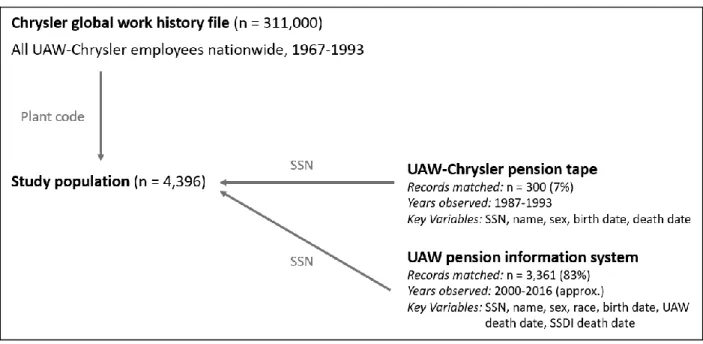
relationship between data sources used to enumerate the study population is illustrated in Figure
30
A total of 4,396 individuals who were ever-employed at the electronics manufacturing
facilities in Huntsville from 1972 to 1993 were selected into the study population from the global
work history file. The operational history and number of workers ever-employed at each plant is
displayed in Table 3.1. All individuals identified in the study population were searched in the
UAW pension information system by UAW staff using the social security number as a unique
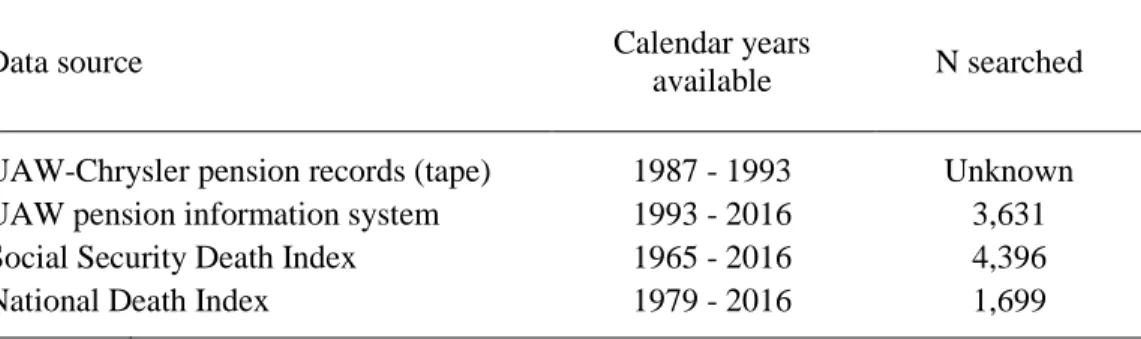
identifier. The system contained a correct match for 3,631 individuals (83% of the study
population). Once all data had been received at UNC, data from the pension information system
were merged with the UAW employment and historical pension records using social security
number as a matching variable. The resulting data set was used to accomplish the aims of the
investigation.
31
Plant code name Plant code
start year
Plant code end year
Observed start year
Observed end year
Huntsville Electronics (original) 1971 1989 a 1972 b 1989
Military-Public Electronics 1983 1989 1983 1989
New Huntsville Electronics 1989 2010 1989 1993
a Original plants officially ceased operations in 1989, although some production continued intermittently until 2010. b Operations began in 1971 but work history tape for this year was lost in UAW file management.
3.4 Data cleaning
The initial quality of the data set was assessed in several ways. The data set was assessed
for duplicate records, social security numbers that did not have exactly 9 digits, and excessive
missing data or implausible values for important study variables. No duplicate records or
erroneous social security numbers were found in the data set. All birth dates were verified to
ensure a correct and consistent format. Implausible birth dates were corrected by specifying the
20th century as the century of birth when year of birth had been parsed using the last two digits only. Work history, including plants and departments worked from 1967-1970 and 1972-1993,
was available for all individuals.
The Lexis Nexis ‘Accurint’ commercial public information database was used to correct
missing or discordant information on sex, race, or birth date for a total of 952 individuals. The
web-based database was manually searched over a four week period beginning in January 2017.
Individuals were searched one at a time using their social security number as a unique identifier.
Accurint’s voter registration database was used to determine race as listed on voter registration
cards. Birth date and sex were determined from the ‘People Plus’ search, which is based on a
32
variety of different public information sources. In situations where sex or birth date information
in UAW files was discordant with Accurint, the latter source was given priority if the record was
a strong match in Accurint (i.e. name and social security number match, residential address in
Huntsville). This was done for a total of 5 records.
The Accurint product provided the sex and birth date for all individuals who were
missing this information from UAW sources (95 and 102 individuals, respectively). Race was
obtained for 48% of the 883 individuals missing this information, as some study members were
not found in Accurint’s voter registration database or did not provide race on their voter
registration form. The proportion of White individuals found in the voter registration database
(85% White) was similar to the proportion found in the UAW pension information system (80%
White).
3.5 Study population
The study population consisted of 4,396 unionized men and women ever-employed at the
automotive electronics manufacturing facilities in Huntsville, Alabama between 1972 and 1993.
The population may exclude workers first hired at the facilities part way through 1993.
Descriptive characteristics of the study population are presented in Table 3.2.
The population includes both hourly and salaried employees, although it was not possible
to distinguish workers in each pay grade with the available data. Hourly workers include those
who worked on production lines in the manufacturing area of the plants. Salaried workers consist
of those employed in clerical, supervisory, or professional (i.e. engineering) occupations. These
workers were generally isolated from the production area of the plant, however, many salaried
33 Characteristic
N 4,396
Year of birth, median (IQR) 1949 (1940, 1955)
Sex, n (%)
Female 2,562 (58)
Male 1,834 (42)
Race, n (%)
White/Caucasian 3,170 (80)
Black/African-American 746 (19)
Hispanic 24 (1)
Native American/Alaskan Native 6
Asian/Pacific Islander 3
Other 1
Missing 446
Huntsville plants, median (IQR)
Age first worked 32 (26, 41)
Year first worked 1983 (1977, 1984)
Years since first hire 32 (28, 39)
Years of employment 9 (4, 12)
Chrysler company, median (IQR)
Age first worked 30 (25, 39)
Year first worked 1979 (1976, 1984)
Years since first hire 33 (30, 39)
Years of employment 10 (5, 16)
Ever-worked at other Chrysler plants, n (%) 914 (21)
Last known state of residence, n (%)
Alabama 3,338 (81)
Tennessee 265 (6)
Michigan 97 (2)
Florida 70 (2)
Indiana 63 (2)
Georgia 59 (1)
Illinois 35 (1)
Missouri 31 (1)
Texas 29 (1)
Ohio 22 (1)
Other a 120 (3)
Missing 267