Evidence for the Transcription Factor Occupancy Theory: An in-silico Analysis of
DNA Methylation Responses to Metal Exposure in Adults
Saideep Gona
Honors Thesis ENHS
Department of Environmental Sciences and Engineering
Gillings School of Global Public Health
The University of North Carolina at Chapel Hill
April 2016
Abstract
Introduction
DNA methylation patterning is of interest for its role as an epigenetic modifier and its
responsiveness to environmental toxicants (Baccarelli 2009). Specific methylation patterns have been linked to numerous end points including cell differentiation, disease development, and aging (Horvath 2013). Additionally, certain methylation patterns have been associated with environmental
contaminants (Baccarelli 2009). However, it is not well understood how observed gene-specific methylation patterns are established. In humans, it is known that patterning occurs early on in development after total demethylation events (Lees-Murdock). Importantly, while these patterns are heritable between subsequent generations of cells, methylation patterns are actively modified by several enzymes including readers, writers, and erasers. Methylation readers include UHRF1, and aid writers in localizing to correct genome loci (Kyohei et al.). There are two types of methylation writers: de novo methyltransferases, such as DNMT1 that can add methyl groups to previously unmethylated sequences, and maintenance methyltransferases that add methyl groups in an informed fashion, using knowledge of complimentary strand methylation to inform its methylation decisions (Bestor). Lastly methylation erasers, such as the ten eleven translocation (TET) enzyme family have been recently shown to convert methylation tags to hydroxymethyl and formylmethyl leading to demethylation (Kohli,
Zhang). However, knowledge of the role of these enzymes does not answer the fundamental
mechanistic question of when, where, and how they are recruited or inhibited to give rise to the gene-specific methylation patterns.
This hypothesis suggests the act of transcription factor binding to the promoter region of genes biases the gene towards altered methylation. Possible mechanisms include physical obstruction of methylating enzymes from their active site gene regions, as well as co-recruitment of downstream demethylating enzymes (such as TET enzymes) with TF binding. In humans, methylation occurs on cytosine residues. CpG sites are those cytosine residues that lie adjacent to a guanine residue. CpG islands in turn are genomic regions of high CpG content often located in gene promoter regions (Cuadrado et al.). Their methylation status is of interest due to high correlation with changes in gene expression. Previous work conducted by the Fry lab has shown that in response to environmental exposure, common transcription factor binding sequences are found in gene promoter CpG islands with differential methylation levels (Sanders et al. 2014). This provided concrete evidence linking transcription factors to methylation patterning, and was labeled the Transcription Factor Occupancy Theory. Further work by Rojas et al. with arsenic exposure and Martin et al. in the context of in-utero exposure provided concurrent evidence towards this theory. Together, the evidence has pointed strongly in favor of the Transcription Factor Occupancy theory. Here, we look at environmental exposures, specifically metals, using a similar approach as before to investigate and extend the Transcription Factor Occupancy theory to the adult demographic. While early development is understood to be a more critical period with regards to establishment of methylation patterning, epigenetic regulation remains an important process in disease development during adulthood. It is therefore worthwhile to consider the Transcription Factor
Methods
Study Compilation
Studies to be included were identified using the PubMed database (US National Library of Medicine and National Institutes of Health) in August 2015. Inclusion criteria were as follows:
1.) Study must have involved adult subjects
2.) Study contained cross-comparison of environmental exposures between exposed and unexposed individuals (Case-Control)
3.) Study examined methylation at the gene specific level using methylation array technologies (Illumina 450K, Methylated CpG Island Recovery Assay, etc.).
4.) Exposures considered were heavy metal exposure (arsenic, cadmium, lead, mercury.)
searched. These metals included arsenic, cadmium, lead, and mercury. Arsenic search yielded 538 hits of which three studies fulfilled inclusion criteria. Cadmium search yielded 324 hits of which one study fit inclusion criteria. Lead and mercury yielded 95 and 178 hits respectively, although none fit inclusion criteria. The total number of hits was 1135.
Formation of Gene Lists for Comparison
From the 4 identified studies, a master list of 336 differentially methylated unique genes was compiled (Figure 3) along with information such as the directionality of methylation (hyper/hypo-methylated). Python was used to generate, clean, and manage the gene database while minimizing human error. Data were checked for potential white space or spelling errors, inconsistency in
methylation direction for the same gene, and overlap with known age-related genes. Additionally, it was used to subset gene lists based on gene, study, major exposure (metal), minor exposure (Cd or As), tissue type, and methylation direction for further analysis (Figures 3&4).
Functional Annotation
The Database for Annotation, Visualization and Integrated Discovery (DAVID) was used to provide pathway enrichment analysis on a selected subset of the gene lists. Clustering annotation was chosen as the preferred data visualization method from which conclusions were drawn. The p-value determined by DAVID represents an absolute enrichment p-value (Huang da et al. 2009). Enrichment was performed on the whole set of DMGs for each study.
Common Transcription Factor Binding Analysis
Results
Gene List Characterization
Four metal-related studies looking at differentially methylated genes were identified,
with three studies being arsenic-related and one cadmium-related. The cadmium study
(Sanders et al.), involved mothers participating in the Children’s Environmental Health Initiative
(CEHI) prospective study. Of the arsenic studies, Liu et al., involved White participants drawn
from the Coronary Artery Risk Development in Young Adults (CARDIA) prospective study, Argos
et al. involved adults in Bangladesh exposed to Arsenic in well water, and Smeester et al.
involved subjects with arsenicosis from Zimapan, Mexico. Gene datasets were compiled
producing 334 unique genes that were identified as either hyper- or hypo- methylated for each
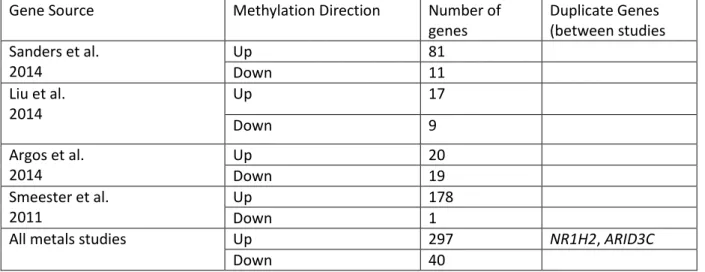
study (tables 1, 2, figure 1). Of note, only 2 genes (of 334) were shared across multiple studies:
ARID3C (AT-rich interaction domain 3C) was hyper-methylated in response to cadmium
(Sanders et al.) and hyper-methylated in response to arsenic (Smeester et al.), and NR1H2
(Nuclear Receptor Subfamily 1, Group H, Member 2) was hyper-methylated in response to
Study Authors Exposure Type Reported Differentially Methylated Gene Count Tissue Type
Technology PMCID
Sanders et al. 2014
Cadmium 74 Blood MIRA + Affymetrix
Human Promoter 1.0 Array
PMC3962531
Liu et al. 2014
Arsenic 26 Blood Illumina 450K PMC4167014
Argos et al. 2014
Arsenic 39 Blood Illumina 450K PMC4286273
Smeester et al. 2011
Arsenic 179 Blood MIRA + Affymetrix
Human Promoter 1.0 Array
PMC3042796
Table 1. Characteristics of studies included for analysis.
Gene Source Methylation Direction Number of genes
Duplicate Genes (between studies Sanders et al.
2014
Up 81
Down 11
Liu et al. 2014
Up 17
Down 9
Argos et al. 2014
Up 20
Down 19
Smeester et al. 2011
Up 178
Down 1
All metals studies Up 297 NR1H2, ARID3C
Down 40
DAVID Functional Annotation
The four study gene lists were analyzed using in DAVID functional annotation (Huang et
al.) The annotation model of interest was the clustering annotation, a tool intended to group
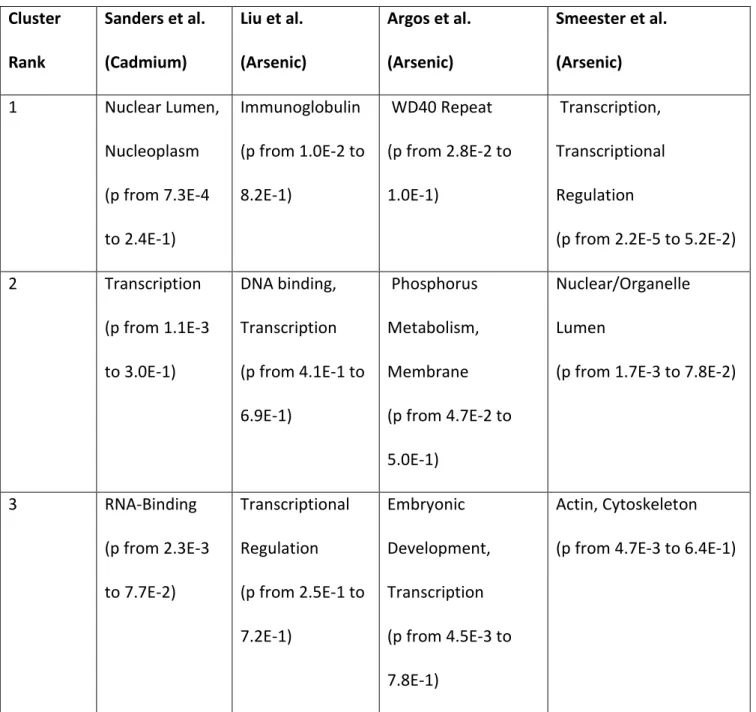
similar annotations together to reduce redundancy. Results are shown in table 3. For the one
study looking at methylation responsiveness to cadmium, the most enriched clustering
pertained to transcription, nucleus, ribonucleoprotein functions and structures. For the Liu et
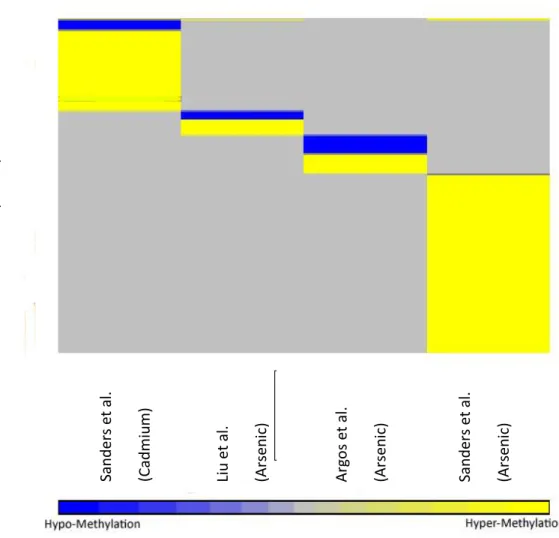
Figure 2. Heat map of genes by study type and direction of methylation
al. Arsenic study, highest enrichment pertained to Immunoglobulin function, followed by
transcription. The Argos et al. arsenic enrichment showed enrichment in the WD40 protein,
phosphorus metabolism, and transcription. Smeester et al. arsenic enrichment favored
transcription and nucleus related processes. Together, transcription processes enrichment
appears to be common amongst these varied metal exposure study gene lists. Interestingly, this
is consistent with previous work in which similar analysis was conducted with infant exposure
Cluster
Rank
Sanders et al.
(Cadmium)
Liu et al.
(Arsenic)
Argos et al.
(Arsenic)
Smeester et al.
(Arsenic)
1 Nuclear Lumen,
Nucleoplasm
(p from 7.3E-4
to 2.4E-1)
Immunoglobulin
(p from 1.0E-2 to
8.2E-1)
WD40 Repeat
(p from 2.8E-2 to
1.0E-1)
Transcription,
Transcriptional
Regulation
(p from 2.2E-5 to 5.2E-2)
2 Transcription
(p from 1.1E-3
to 3.0E-1)
DNA binding,
Transcription
(p from 4.1E-1 to
6.9E-1)
Phosphorus
Metabolism,
Membrane
(p from 4.7E-2 to
5.0E-1)
Nuclear/Organelle
Lumen
(p from 1.7E-3 to 7.8E-2)
3 RNA-Binding
(p from 2.3E-3
to 7.7E-2)
Transcriptional
Regulation
(p from 2.5E-1 to
7.2E-1)
Embryonic
Development,
Transcription
(p from 4.5E-3 to
7.8E-1)
Actin, Cytoskeleton
(p from 4.7E-3 to 6.4E-1)
Table 3. Summary of top three DAVID clustering analysis results
Common Transcription Factor Motif Analysis
Seven gene lists were formed from the four studies by dividing genes into hyper- and
(hypo-methylation in Smeester et al. included only a single gene, making it not applicable to common
TF analysis).
The results of common individual TF analysis included a total of 49 specific TF matrices
found across all gene lists. Of these, 43 matrices showed at least one statistically significant
result (p<0.05). Only 24 of these showed statistically significant results across multiple gene lists
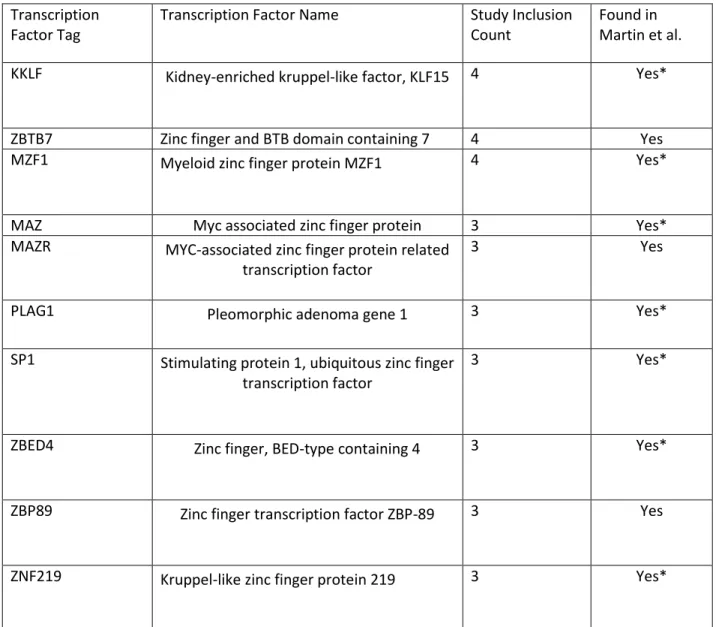
from at least 2 different studies. Seven TFs were found to be common across three of the four
studies. These were MAZ (MYC-associated zinc finger protein related transcription factor),
MAZR (MYC-associated zinc finger protein related transcription factor), PLAG1 (Pleomorphic
adenoma gene 1), SP1 (Stimulating protein 1), ZBED4 (Zinc finger, BED-type containing 4),
ZBP89 (Zinc finger transcription factor ZBP-89), and ZNF219 (Kruppel-like zinc finger protein
219). Three TFs were found across all studies. These were KKLF (Kidney-enriched kruppel-like
factor, KLF15), ZBTB7 (Zinc finger and BTB domain containing 7), and MZF1 (Myeloid zinc finger
protein MZF1). These ten TFs of interest are tabulated in table 4. Additionally, seven of the
genes associated with the ten TFs were found to contain glucocorticoid receptor (GR)
responsive elements. These were KKLF, MZF1, MAZ, PLAG1, SP1, ZBED4, and ZNF219.
Transcription Factor Tag
Transcription Factor Name Study Inclusion Count
Found in Martin et al.
KKLF Kidney-enriched kruppel-like factor, KLF15 4 Yes*
ZBTB7 Zinc finger and BTB domain containing 7 4 Yes
MZF1 Myeloid zinc finger protein MZF1 4 Yes*
MAZ Myc associated zinc finger protein 3 Yes*
MAZR MYC-associated zinc finger protein related transcription factor
3 Yes
PLAG1 Pleomorphic adenoma gene 1 3 Yes*
SP1 Stimulating protein 1, ubiquitous zinc finger transcription factor
3 Yes*
ZBED4 Zinc finger, BED-type containing 4 3 Yes*
ZBP89 Zinc finger transcription factor ZBP-89 3 Yes
ZNF219 Kruppel-like zinc finger protein 219 3 Yes*
Table 4. Summary of common TFs enriched in a majority of studies. (*) Indicates presence TF
Tran
scrip
tio
n
Fact
o
rs (n
=4
9
)
Figure 3. Heat map of transcription factors by study and associated methylation direction. TFs in green indicate presence dual presence of TF
Sanders (Cadmium)
Argos (Arsenic)
Smeester (Arsenic)
Discussion
The transcription factor occupancy theory is a possible explanation for methylation
patterning that occurs in response to specific environmental exposures (Sanders et al., Rojas et
al., Martin et al.). Under this theory, gene regions such as CpG islands expressing differing
methylation levels in response to exposures do so due to the action of transcription factor
binding (Rojas, Sanders). Martin et al. investigated this question for pre-natal exposures and
found evidence supporting the transcription factor occupancy theory. A similar approach to
Martin et al. was used here to answer a different question. Does the transcription factor
occupancy theory hold up for adult populations as well? The epigenome is malleable in
adulthood, but doesn’t compare to the wholesale patterning that occurs in-utero. A similar
approach to that used by Martin et al. is used here to indirectly evaluate the transcription
factor occupancy theory. By compiling differentially methylated genes from gene-specific
studies of metal exposure (the specific environmental exposure examined here), a database of
relevant genes was compiled which was then used for downstream sequence-level comparison.
Interestingly, the results showed remarkable similarity to those of Martin et al. Despite very
little gene overlap between studies, underlying gene function and transcription factor binding
site sequence similarity were still present. Some of these transcription factors were found
across all present studies. Furthermore, some of these were also in common with those found
by Martin et al. Together, these results support the transcription factor occupancy theory.
Gene overlap between studies was miniscule, with only two of 334 genes having overlap
play a role in development and differentiation (Patsialou et al.).NR1H2 is a nuclear receptor
involved in lipid metabolism also shown to be involved in the pregnancy disorder, preeclampsia
(Mouzat et al.). Although both genes have some functional overlap, they do not seem to be
directly related. Furthermore these two genes showed overlap between only two studies each.
It is unlikely that this commonality is reflective of gene response for all metal exposure.
Although study cohorts were similar with regards to major exposure, this lack of gene overlap is
unsurprising given the variety of demographic background between cohorts. Two of the studies
involved non-US populations (Argos et al., Smeester et al.). Of the US derived studies, one
involved only White subjects (Liu et al.) and the other primarily involved Black mothers
(Sanders et al.). As such, differences in demographics may explain lack of gene-level overlap.
Low rates of gene overlap have been similarly reported in Martin et al., which drew from a
different study base. Functional annotation results help demystify these observations. Between
the top three functional clustering categories for each study derived from DAVID functional
annotation, transcription clusters were common across all studies. This occurs despite raw gene
overlap, and supports a common transcriptional response to metal exposure. This in turn is
consistent with transcription factor occupancy theory. However, it is not sufficient evidence by
itself as it does not mechanistically link causation.
The 43 common transcription factors found here included 24 that were duplicated
across at least one study. Ten of these were represented in at least 3 (majority) of the studies.
As such they are worth targeting for discussion. Interestingly, all of these ten TFs were also
found in the Martin et al. investigation of in-utero exposure (Martin et al.). Note that the
such as smoking although the degree of overlap between metal and nonmetal-related TFs was
high. Furthermore, the in-utero study reported three common TFs across all exposures: PLAG1,
MZF1, and KLF15. These TFs were also found in the ten common TFs reported here, with MZF1
and KLF15 (reported here is KKLF) being present in four of four source studies.
These results correlate with what would be expected outcome of transcription factor
occupancy. Presented with multiple gene lists with very little direct gene overlap,
commonalities are observed at the functional and transcription factor level. Given the nature
and stringency of associated p-values, and the sensitivity of methylation arrays used to
generate the gene lists, such co-occurrence is exceedingly unlikely due to chance. Transcription
factor occupancy represents a unifying explanation for this trend, one which has remained
prevalent across multiple previous analyses (Sanders et al., Rojas et al., Martin et al.). Here we
provide evidence suggesting that this theory extends outside the realm of in-utero exposure
(previous analyses focused on this), to at least some subset of adults.
In investigating a common biological mechanism linking exposure to expression of the
common TFs guiding differential methylation, the glucocorticoid receptor pathway (GR) was
found to be a common regulator of these TFs in Martin et al. GR is sensitive to environmental
contaminants, making this finding a consistent one (Asada et al., Masuno et al.). Specifically, the
promoters of these TF genes were found to have GR response elements, suggestive of a
common pathway controlling subsequent expression of these TFs. Interestingly, seven of the
ten main TFs uncovered in the current study also contained GR responsive elements including
response to GR signaling (Asada et al.). Once again, this is consistent with the findings in the
in-utero study. The evidence for involvement of the GR pathway in environmental exposure
remains strong, even with different study populations.
Although this analysis has produced results that are consistent with previous work,
there are several limitations worth considering. First is the issue of age. Age was kept very
general during study selection to promote study inclusion. The only stipulation was for studies
to involve “adult” populations, ignoring the possibility of age-dependent differences in
methylation patterning within this large age group. This concern was addressed by
cross-comparing a list of 729 genes containing genes known to be involved in aging as well genes
known to exhibit differential promoter methylation in response to aging (Human Aging
Resource, Bell et al.). Only 4 genes (1.20%) were found to be age-related, making age an
unlikely factor. However, these results do not address another possible role of aging.
Specifically that methylation patterning established in-utero could explain the observed
patterns in adults. This question is more difficult to address because the studies used here were
cross-sectional rather than longitudinal, making backward examination of adult participants
impossible. Another concern is the inherent complexity of utilizing multiple cross-sectional
studies. Selection bias is a real concern given these study designs, and comparison across
studies can cause interactions which are difficult to handle. A last concern to mention is an
inherent bias in this study as well as other sister studies investigating the transcription factor
occupancy theory. This bias is in the tissue type used for the component studies, namely that
study tissue types are predominantly blood tissue. The GR pathway is ostensibly blood-based,
tissue types, it is unknown whether blood tissue may be predisposed to increased GR signaling
which may “mask” other mediators of TF, methylation response (Marketon et al).
In conclusion, this study serves multiple purposes. It serves as a form of replication of
previous work investigating the relationship between TF occupancy and methylation. In this
respect it succeeds in reproducing previously seen results. Once again, non-overlapping genes
methylated in response to environmental exposures show underlying sequence similarity,
particularly TF binding domains. Furthermore, these TFs show overlap with those observed
previously. These remarkable similarities occur despite differences in target population: adult
vs. fetus. Although opening up this avenue, weaknesses in this study design should be tested
Bibliography
Ahir, B. K., Sanders, A. P., Rager, J. E., & Fry, R. C. (2013). Systems biology and birth defects prevention: Blockade of the glucocorticoid receptor prevents arsenic-induced birth defects. Environmental Health Perspectives, 121(3), 332–338. http://doi.org/10.1289/ehp.1205659
Argos, M., Chen, L., Jasmine, F., Tong, L., Pierce, B. L., Roy, S., … Ahsan, H. (2015). Gene-specific differential DNA methylation and chronic arsenic exposure in an epigenome-wide
association study of adults in bangladesh. Environmental Health Perspectives, 123(1), 64–
71. http://doi.org/10.1289/ehp.1307884
Arita, K., Ariyoshi, M., Tochio, H., Nakamura, Y., & Shirakawa, M. (2008). Recognition of
hemi-methylated DNA by the SRA protein UHRF1 by a base-flipping mechanism. Nature,
455(7214), 818–821. http://doi.org/10.1038/nature07249
Asada, M., Rauch, A., Shimizu, H., Maruyama, H., Shibamori, M., Kawasome, H., … Asahara,
H. (2011). Expression, 91(2), 203–215. http://doi.org/10.1038/labinvest.2010.170.DNA
Baccarelli, A., & Bollati, V. (2009). Epigenetics and environmental chemicals. Current Opinion
in Pediatrics, 21(2), 243–251. http://doi.org/10.1097/MOP.0b013e32832925cc
Bell, J. T., Tsai, P., Yang, T., Pidsley, R., Nisbet, J., Glass, D., … Spector, T. D. (2012). Epigenome-Wide Scans Identify Differentially Methylated Regions for Age and
Age-Related Phenotypes in a Healthy Ageing Population, 8(4).
http://doi.org/10.1371/journal.pgen.1002629
Bestor, T. H. (2000). The DNA methyltransferases of mammals. Human Molecular Genetics,
9(16), 2395–2402. http://doi.org/10.1093/hmg/9.16.2395
Breitling, L. P., Yang, R., Korn, B., Burwinkel, B., & Brenner, H. (2011).
Tobacco-Smoking-Related Differential DNA Methylation: 27K Discovery and Replication. The American
Journal of Human Genetics, 88(4), 450–457. http://doi.org/10.1016/j.ajhg.2011.03.003
Chotalia, M., Smallwood, S. a, Ruf, N., Dawson, C., Lucifero, D., Frontera, M., … Kelsey, G. (2009). Transcription is required for establishment of germline methylation marks at
imprinted genes. Genes & Development, 23(1), 105–17. http://doi.org/10.1101/gad.495809
Cuadrado, M., Sacristán, M., & Antequera, F. (2001). Species-specific organization of CpG
island promoters at mammalian homologous genes. EMBO Reports, 2(7), 586–92.
http://doi.org/10.1093/embo-reports/kve131
Elliott, H. R., Tillin, T., McArdle, W. L., Ho, K., Duggirala, A., Frayling, T. M., … Relton, C. L. (2014). Differences in smoking associated DNA methylation patterns in South Asians and
Harlid, S., Xu, Z., Panduri, V., Sandler, D. P., & Taylor, J. A. (2014). Ehp.1307480, 122(7), 673–678.
Horvath, S. (2013). DNA methylation age of human tissues and cell types. Genome Biology,
14(10), R115. http://doi.org/10.1186/gb-2013-14-10-r115
Hou, L., Smith, J. M., Health, C., & Lurie, R. H. (2014). BLOOLD METHYLMICS IN
RESPONSE TO ARSENIC EXPOSURE, 24(2), 145–149.
http://doi.org/10.1038/jes.2013.89.BLOOLD
Huang, D. W., Lempicki, R. a, & Sherman, B. T. (2009). Systematic and integrative analysis of
large gene lists using DAVID bioinformatics resources. Nature Protocols, 4(1), 44–57.
http://doi.org/10.1038/nprot.2008.211
Huang, D. W., Sherman, B. T., & Lempicki, R. A. (2009). Bioinformatics enrichment tools:
Paths toward the comprehensive functional analysis of large gene lists. Nucleic Acids
Research, 37(1), 1–13. http://doi.org/10.1093/nar/gkn923
Kohli, R. M., & Zhang, Y. (2013). TET enzymes, TDG and the dynamics of DNA
demethylation. Nature, 502(7472), 472–479. http://doi.org/10.1038/nature12750
Lees-Murdock, D. J., & Walsh, C. P. (2008). DNA methylation reprogramming in the germ line. Epigenetics, 3(1), 5–13. http://doi.org/5553 [pii]
Lienert, F., Wirbelauer, C., Som, I., Dean, A., Mohn, F., & Schübeler, D. (2011). Identification
of genetic elements that autonomously determine DNA methylation states. Nature Genetics,
43(11), 1091–1097. http://doi.org/10.1038/ng.946
Marchal, C., & Miotto, B. (2015). Emerging concept in DNA methylation: role of transcription
factors in shaping DNA methylation patterns. Journal of Cellular Physiology, 230(4), 743–
51. http://doi.org/10.1002/jcp.24836
Martin, E. M., Fry, R. C., Carolina, N., Hill, C., & Martin, E. M. (2016). RESEARCH ARTICLE A cross-study analysis of prenatal exposures to environmental contaminants and the
epigenome : support for stress-responsive transcription factor occupancy as a mediator of gene-specific CpG methylation patterning, 1–9. http://doi.org/10.1093/eep/dvv011
Masuno, K., Haldar, S. M., Jeyaraj, D., Mailloux, C. M., Huang, X., Panettieri, R. A., … Gerber, A. N. (2011). Expression profiling identifies klf15 as a glucocorticoid target that regulates
airway hyperresponsiveness. American Journal of Respiratory Cell and Molecular Biology,
45(3), 642–649. http://doi.org/10.1165/rcmb.2010-0369OC
Monick, M. M., Beach, S. R. H., Plume, J., Sears, R., Gerrard, M., Gene, H., & Philibert, R. A.
(2013). NIH Public Access. Am J Med Genet B Neurospychiatr Genet, 159B(2), 141–151.
Mouzat, K., Mercier, E., Polge, A., Evrard, A., Baron, S., Balducchi, J.-P., … Gris, J.-C. (2011).
A common polymorphism in NR1H2 (LXRbeta) is associated with preeclampsia. BMC
Medical Genetics, 12(1), 145. http://doi.org/10.1186/1471-2350-12-145
Patsialou, A., Wilsker, D., & Moran, E. (2005). DNA-binding properties of ARID family
proteins. Nucleic Acids Research, 33(1), 66–80. http://doi.org/10.1093/nar/gki145
Ruiz-Hernandez, A., Kuo, C.-C., Rentero-Garrido, P., Tang, W.-Y., Redon, J., Ordovas, J. M., … Tellez-Plaza, M. (2015). Environmental chemicals and DNA methylation in adults: a
systematic review of the epidemiologic evidence. Clinical Epigenetics, 7(1), 55.
http://doi.org/10.1186/s13148-015-0055-7
Sanders, A. P., Smeester, L., Rojas, D., DeBussycher, T., Wu, M. C., Wright, F. A., … Fry, R. C. (2014). Cadmium exposure and the epigenome: Exposure-associated patterns of DNA
methylation in leukocytes from mother-baby pairs. Epigenetics : Official Journal of the
DNA Methylation Society, 9(2), 212–21. http://doi.org/10.4161/epi.26798
Schweitzer, A., Knauer, S. K., & Stauber, R. H. (2010). Nuclear receptors in head and neck
cancer: current knowledge and perspectives. International Journal of Cancer. Journal
International Du Cancer, 126(4), 801–809. http://doi.org/10.1002/ijc.24968
Smeester, L., Rager, J. E., Bailey, K. A., Guan, X., Smith, N., García-Vargas, G., … Fry, R. C.
(2011). Epigenetic changes in individuals with arsenicosis. Chemical Research in
Toxicology, 24(2), 165–7. http://doi.org/10.1021/tx1004419
Subach, O. M., Maltseva, D. V, Shastry, A., Kolbanovskiy, A., Klimasauskas, S., Geacintov, N. E., & Gromova, E. S. (2007). The stereochemistry of benzo[a]pyrene-2’-deoxyguanosine
adducts affects DNA methylation by SssI and HhaI DNA methyltransferases. The FEBS
Journal, 274(8), 2121–34. http://doi.org/10.1111/j.1742-4658.2007.05754.x
Webster Marketon, J. I., & Sternberg, E. M. (2010). The glucocorticoid receptor: A revisited
target for toxins. Toxins, 2(6), 1357–1380. http://doi.org/10.3390/toxins2061357
Wilhelm-Benartzi, C. S., Christensen, B. C., Koestler, D. C., Houseman, E. A., Schned, A. R., Karagas, M. R., … Marsit, C. J. (2011). Association of secondhand smoke exposures with
DNA methylation in bladder carcinomas. Cancer Causes & Control : CCC, 22(8), 1205–13.
http://doi.org/10.1007/s10552-011-9788-6
Wilsker, D., Patsialou, A., Dallas, P. B., & Moran, E. (2002). ARID proteins: a diverse family of DNA binding proteins implicated in the control of cell growth, differentiation, and
development. Cell Growth Differ., 13(3), 95–106. Retrieved from
Wrzodek, C., Büchel, F., Hinselmann, G., Eichner, J., Mittag, F., & Zell, A. (2012). Linking the Epigenome to the Genome: Correlation of Different Features to DNA Methylation of CpG
Islands. PLoS ONE, 7(4), e35327. http://doi.org/10.1371/journal.pone.0035327