THE MANY TIES OF THE PETITES NATIONS:
RELATIONSHIPS, POWER, AND DIPLOMACY IN THE LOWER MISSISSIPPI VALLEY, 1685-1785
Elizabeth N. Ellis
A dissertation submitted to the faculty of the University of North Carolina at Chapel Hill in partial fulfillment of the requirements for the degree of Doctor of Philosophy in the Department of History.
Chapel Hill 2015
Approved by Kathleen DuVal Kathryn Burns Wayne Lee
Malinda Maynor Lowery Theda Perdue
ABSTRACT
Elizabeth N. Ellis: The Many Ties of the Petites Nations: Relationships, Power, and Diplomacy in the Lower Mississippi Valley, 1685-1785
(Under the direction of Kathleen DuVal)
Over the course of the eighteenth century, the petites nations of the Lower
Mississippi Valley survived enormous political, demographic, and social change. By the
1690s, these petites nations, as the region’s many small Native polities were collectively
known, seemed to be on the verge of destruction. The combined forces of the arrival of
British and French colonizers in the Southeast, the spread of devastating epidemics, and
the escalation of the Indian slave trade threated to shatter their nations and annihilate their
peoples.
This dissertation compares the diverse experiences of a few of these petites
nations—including the Tunicas, Ofogoulas, Biloxis, Koroas, Mugulashas, Bayagoulas,
Mobilians, Chitimachas, and Tensas—as they fought to preserve their homelands and
protect their peoples. Unlike the more well-known Southeastern Indian nations, these
Native groups did not coalesce or confederate into a single larger polity. Rather, these
groups developed extensive alliance networks that would allow them to exert sufficient
political and military influence to protect their communities while preserving their
autonomy as groups of fewer than 1,000 individuals.
The relationships the petites nations forged with their black, white, and Indian
southeast, but also of European settlement in the Lower Mississippi Valley. By
demonstrating the importance of Indigenous networks on colonial Louisiana, this
dissertation highlights the influence of politics within Indian country on the region as a
whole. Ultimately by relying on combinations of strategic mobility and violence, social
and economic adaptability, and numerous political relationships with both their Native
and European neighbors, many of these nations were able not only to survive this
ACKNOWLEDGEMENTS
I am tremendously indebted to a number of people for their support and guidance
over the last five years. I was extremely fortunate to have both a wonderful committee
and a terrific group of friends and colleagues at UNC and beyond. Their contributions
were invaluable
First I would like to thank my committee, I am grateful to Vin Steponaitis for
walking me through Lower Mississippi archaeology and cartography and to Wayne Lee
for his guidance on interpreting the violence that punctuates this dissertation. I am
thankful to Malinda Maynor Lowery and Kathryn Burns for their enthusiastic support of
my work, and to Theda Perdue for her generous mentorship. Most of all I would like to
thank Kathleen DuVal for supporting this project every step of the way. Her unfailing
patience, sarcasm, and humor sustained me through graduate school.
The support of a number of institutions allowed me to pursue my research for this
project both in North Carolina and across the country. In particular I would like to thank
the Newberry Library in Chicago, The New Orleans Center for the Study of the Gulf
South at Tulane University, and the Peoria Tribal Education Program. I was also very
fortunate to have received support from many centers and programs at UNC including the
program in Medieval and Early Modern Studies, the Center for the Study of the
American South, the History Department, the Graduate School, and the Royster Society
I have been extremely lucky to get to work alongside so many wonderful people
at UNC and to have been part of an amazing American Indian Studies community.
During my time in North Carolina the First Nations Graduate Circle, the American Indian
Center, and my fantastic cohort within the History Department have made this place a
second home for me. In particular, I want to thank Brooke Bauer and Jami Powell for
inspiring me and keeping me smiling through this experience. Sarah McNamara, you
know this dissertation would not have been possible without you, and I cannot thank you
enough for all of the editing, encouragement, laughter, and quite literally saving my life
on multiple occasions.
I also owe debts of gratitude to a number of individuals outside of UNC. Laura
Kelley introduced me to the Indigenous Lower Mississippi Valley and encouraged me to
pursue my passion for History. I cannot thank her enough for her continued mentoring
over the last nine years. I would also like to thank John D. Barbry of the Tunica Biloxi
Tribe of Louisiana for his guidance, Coll Thrush for his support, and Yevan Terrien for
his translation help.
Finally, like to thank my family for their tremendous support in all my endeavors.
My parents Pat Truscelli and Bud Ellis, my brother Ethan Ellis, and my grandmother
Edythe Truscelli all encouraged me to pursue my research and they continue to inspire
me each step of the way. I am so very grateful to my wonderful partner Ben Donahue.
His love, encouragement, and continual insistence that I “hurry up and just turn in” my
submissions have made this dissertation possible and kept me sane through graduate
TABLE OF CONTENTS
List of Figures ……….………ix
Introduction ……….………..……..1
Chapter 1-In the Lands of the Man-Eaters:
The Slave Trade, Alliances, and Political Warfare, 1680-1700……….……….15
Chapter 2-Establishing Relationships with the French, 1699-1710...53
Chapter 3-Enslaving their Allies:
Petites Nations Slaves in French Settlements 1700-1720...96
Chapter 4- The Gathering Storm
Frustrations with the French in the Decade Before the Natchez War……….…....143
Chapter 5- The Storm Breaks:
The Natchez War and Its Consequences……….………170
Chapter 6-Navigating the Transition:
Tunica Diplomacy After the Seven Years War……….…….218
Conclusion………. 258
Bibliography………...………262
LIST OF FIGURES
Figure 1- Musical Instruments………... .29
Figure 2- Engraving of Snakes Identifying Military Rank on an Eighteenth-Century Gorget……….… 37
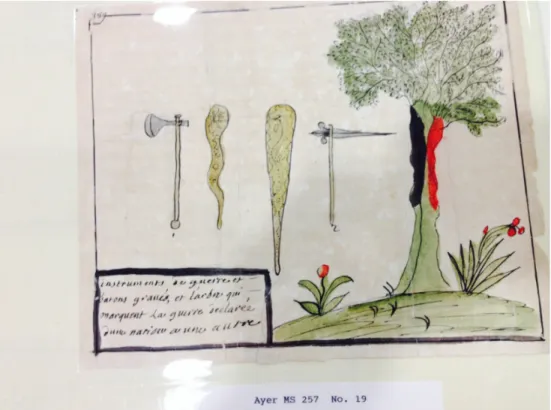
Figure 3- Instruments of War……….…..44
Figure 4- Tattooed Warrior.……….…45
Figure 5- Petites Nations Locations Circa 1699………. 52
Figure 6- Map of Mobile Bay Settlements………..84
Figure 7- Dumont de Montigny’s Illustration of Indian women in Louisiana…………122
Figure 8- Koroa, Yazoo, and Ofogoula locations near Fort St. Pierre circa 1729……..185
Figure 9- Illustration of the Public Torture and Burning of the Wife of the Chief of the Flour Village of the Natchez …………....………197
Figure 10- Tunica Chief Bride-les-Boeuf with Natchez Scalps………. 200
Figure 11- Spanish Louisiana and British West Florida……….………... 220
Introduction
In late October of 1722, the primary chief of the Acolapissa nation came down
with a terrible illness. The Acolapissas had already lost many men, women, and children
to the waves of epidemics that plagued the gulf coast, and they feared their chief would
be next. As their chief’s health declined, they decided to call for external help. The
Acolapissas had heard tales of the wondrous cures of the healer of the Ouachas, so they
sent urgent messengers to retrieve him from the village of the Tensas where he was
treating another patient. These small Native nations all lived within a thirty-five mile
radius of New Orleans, and so the medicine man was able to travel quickly to the ailing
chief.
Yet rather than saving their beloved leader, the Ouacha healer betrayed the
Acolapissas by murdering their chief, and the Acolapissas were forced to seek retribution.
Given the medicine man’s considerable skill, the Acolapissas reasoned that he must have
“put into his [the chief’s] body the teeth of serpents and other evil things,” as the Ouacha
man surely could have saved this chief if he wanted to.1 The grieving Acolapissa nation
sent a diplomat to New Orleans to enlist the support of their French allies in punishing
this murderous medicine man. Yet the French governor was also direly ill, and therefore
he was unable to receive the diplomat or offer assistance, so the Acolapissas decided to
seek retribution independently.
1 Diron D’Artaguiette, “Journal of Diron D’Araguiette, Inspector General of Louisiana, 1722-1723,”
The Acolapissas’ vengeance was swift. Within a week of the death of their chief,
they attacked the Ouacha nation. They sent the Ouacha warriors fleeing and captured
dozens of Ouacha women and children whom they took back to their village as prisoners.
The Ouachas who managed to escape this raid sought temporary refuge with their
neighboring allies, the Chaouchas and the French, pulling them into the conflict. Having
distraught and furious Ouacha refugees within the Chaouacha and New Orleans
settlements forced both of these nations to confront the Acolapissas and seek resolution
of this dispute on behalf of their Ouacha allies.2 By the end of November, with the help
of the French and Chaouachas, most of the Ouachas had been freed from the Tensa
villages, and the peace among the four nations was restored.
In 1722 the Chaoucha, Ouacha, Tensa, and Acolapissa nations were teetering on
the edge of crisis. At the turn of the eighteenth century, the gulf coast was home to at
least forty small, fiercely independent polities that ranged in size from 50 to 2,000 people.
These small polities, or “petites nations” as the French called them, were politically,
culturally, and linguistically diverse. Yet the one thing that these nations shared was a
desire to protect their communities from the chaos that spilled into the region at the end
of the seventeenth century. The vibrant exchange networks and protected settlements that
these polities had developed in the fertile Lower Mississippi Valley seemed to be under
attack from all sides. Raiders from larger and more powerful Native nations assaulted
their villages, and devastating epidemics, like the one that killed the Acolapissa chief,
threatened their families. These dangers forced the petites nations to develop creative
new approaches to defend their people and rely on traditional systems of networks,
alliances, and military strategies to combat powerful outsiders.
When the French arrived in the Lower Mississippi Valley in 1699, they stumbled
into a complex geopolitical landscape and quickly found themselves embroiled in
conflicts and alliances that they could not control and often failed to comprehend. These
outsiders were forced to negotiate with the petites nations, as they had washed ashore
lost, poorly provisioned, and desperately outmanned. Throughout their six-decade
tenancy in the land they called Louisiana, the French remained dependent on their
relationships with these small nations to provide their struggling settlements with food,
defense, and critical labor. Although these French were desperately needy and few in
numbers, never exceeding 4,000 settlers, the petites nations incorporated these
newcomers into their diplomatic networks, into their villages, and sometimes even into
their families.3 The petites nations saw potential in the political and economic
connections of the French, and these small nations were well aware of the value of added
alliances during that tumultuous era.
As the French governor recognized when he found himself caught in a conflict
between Louisiana’s Ouacha and Acolapissa allies in 1722, there were no clean lines or
simple political divisions in the Lower Mississippi Valley. The region’s great powers—
the Choctaws, Chickasaws, and Creeks—and the small powers—including the
Acolapissas, French, and Ouachas—were all intertwined in tangled webs of political,
economic, and social connections. In a region where no single nation reigned supreme,
these peoples were forced to build relationships with a wide variety of nations in order to
exercise power. This is a story of those relationships and of the ways that the political and
economic connections of the petites nations shaped the worlds of all of the peoples of the
gulf south.
European Declension and Continental Networks
Scholars have long framed the history of the eighteenth-century gulf coast as
narratives of declension and failure. The French failed to create a lucrative colony on the
Mississippi River. The Natchez executed a disastrous revolt that ended with the
destruction of their nation. The Spanish were unable to halt American expansion and
usurpation of Spanish “Luisiana.” British officials controlled West Florida for barely two
decades before they were forced out, and the region’s small Native nations were wiped
out or fell into dependency on these other polities.4
Much of the twentieth-century historical scholarship on Louisiana focused on
colonial policy and struggles for empire, and from this approach the colony did seem to
be a failure, especially in comparison to the British Atlantic colonies. Marcel Giraud and
Mathé Allain, who published works on French colonial Louisiana in 1953 and 1989
respectively, are among the most prominent of the francophone historians of this
tradition.5 These scholars pushed the boundaries of colonial studies and moved beyond
the grandiose epics of Justin Winsor, Francis Parkman, and Charles Gayarré, the
powerhouses of the previous generation.6 Allain and Giraud’s meticulously researched
studies critique the French colonial venture and highlight its economic struggles. For the
Spanish period, the biographical works of Jack D. L. Holmes and the impressive
archival-based analyses of Gilbert C. Din have been tremendously influential in English language
studies of Spanish imperial tactics and helped situate the gulf coast within Latin
American and borderlands history. Among British focused studies, Robert R. Rea’s
insightful studies of colonial administrators are among the best twentieth-century
publications.7 Yet the larger scholarship of early America has largely moved beyond
policy studies, as the emphasis on imperial policy and the actions of colonial officials
tends to obscure or oversimplify the actions of the women, laborers, enslaved and free
people of color, and the Indigenous inhabitants of these lands.
In the last 25 years scholars more interested in social and Atlantic histories have
revitalized Louisiana history. In 1992 Daniel H. Usner published Indians, Settlers, and
5 Giraud’s five volume Histoire de la Louisiane Française was originally published in France between 1953 and 1974 and translated and published in English between 1974 and 1991. Marcel Giraud, A History of French Louisiana, 5 vols. (Baton Rouge: Louisiana State University Press, 1974-1991); Mathé Allain, “Not Worth a Straw”: French Colonial Policy and the Early Years of Louisiana (Lafayette: University of Southwestern Louisiana, 1988).
6 Francis Parkman, France and England in North America Vol 1 &2. (New York: Literary Classics of the United States Inc., 1983); Justin Winsor, The Mississippi Basin: The Struggle in America Between England and France, 1679-1763 (Boston: Houghton, Mifflin and Co, 1895); Charles Gayarré, History of Louisiana: The French Domination (New York: William J. Widdleton, 1867).
7 Mathé Allain, “Colbert and the Colonies,” “Colbert’s Policy Crumbles,” and “In Search of a Policy,” in
The Louisiana Purchase Bicentennial Series in Louisiana History:The French Experience in Louisiana ed. Glenn R. Conrad (Lafayette: University of Southwestern Louisiana, 1995), 5-31; Gilbert C. Din, Spaniards, Planters, and Slaves: The Spanish Regulation of Slavery in Louisiana (Austin: Texas A&M University Press, 1999); Gilbert C. Din, “Protecting the ‘Barrera’: Spain’s Defenses in Louisiana, 1763-1779,”
Slaves in a Frontier Exchange Economy, and Gwendolyn Midlo Hall published Africans
in Colonial Louisiana.8 These two works reinterpreted the Lower Mississippi Valley as
the product of not only colonial initiatives, but of the negotiations and influences of
Indian and African peoples. Hall and Usner’s works also examined the ways that African
and Indian peoples and free and enslaved laborers both exercised power and were
themselves exploited by European settlers. Their scholarship influenced a new generation
of Louisiana studies that returned the long neglected region back into the broader focus of
early American studies. The pioneering works of Jennifer M. Spear and Kimberly Hanger
brought to life the worlds of African, Native, and French settlers of all classes in New
Orleans and challenged assumptions about the connections between legal codes and
social practice.9 Most recently, the Atlantic turn has connected Louisiana to the French
imperial world. The edited volumes of Bradley Bond, French Colonial Louisiana and the
Atlantic World, and Cecile Vidale, Louisiana: Crossroads of the Atlantic, have helped us
better understand Louisiana in the greater context of eighteenth-century global
developments and have illuminated the multicultural peoples that shaped the gulf coast
settlements.10
Yet for a region that was predominantly Indigenous throughout the eighteenth
century, taking a continental rather than Atlantic perspective is more appropriate, if we
8 Daniel Usner, Indians, Settlers, and Slaves in a Frontier Exchange Economy: The Lower Mississippi
Valley Before 1783 (Chapel Hill: University of North Carolina Press, 1992); Gwendolyn Midlo Hall,
Africans in Colonial Louisiana: The Development of Afro-Creole Culture in the Eighteenth Century (Baton Rouge: Louisiana State University Press, 1992).
9 Kimberly S. Hanger, Bounded Lives, Bounded Places: Free Black Society in Colonial New Orleans,
1769-1803 (Durham: Duke University Press, 1997); Jennifer M. Spear, Race, Sex, and Social Order in Early New Orleans (Baltimore: Johns Hopkins University Press, 2009).
are to focus on the Lower Mississippi Valley rather than simply the colony of Louisiana.
While Atlantic history is wonderful for examining colonial societies, it inevitably locates
Native peoples on the margins of imperial networks and empires. In recent years
scholarship on Native North America has increasingly highlighted the ways that Native
political endeavors, economic connections, and kinship networks structured the lives of
early North Americans.11 In the last forty years, ethnohistorical scholarship on the Native
southeast has completely shifted the way that we understand the seventeenth, eighteenth,
and nineteenth centuries. Historians including Theda Perdue, Patricia Galloway, Robbie
Ethridge, Joshua Piker, and James Merrell have changed not only the way that we
understand the societies of Cherokee, Choctaw, Chickasaw, Creek, and Catawba peoples,
but also how powerful Native nations shaped both colonial and Native societies.12 As
Kathleen DuVal and Daniel Usner have definitively shown, in the Mississippi River
Valley, Native peoples exercised tremendous influence over European settlers, and
relationships among Native nations often were much more influential in shaping Native
peoples’ actions than the policy initiatives of European settlers.13
11 Daniel K. Richter, The Ordeal of the Longhouse: the Peoples of the Iroquois League in the Era of
European Colonization (Chapel Hill: University of North Carolina Press, 1992); Juliana Barr, Peace Came in the Form of a Woman: Indians and Spaniards in the Texas Borderlands (Chapel Hill: University of North Carolina Press, 2007); Mapping the Mississippian Shatter Zone, ed. Robbie Ethridge and Sheri M. Shuck-Hall (Lincoln: University of Nebraska Press, 2009); Richard White, The Middle Ground: Indians, Empires, and Republics in the Great Lakes Region, 1650-1815 (Cambridge: Cambridge University Press, 1991); Pekka Hämäläinen, The Comanche Empire (New Haven: Yale University Press, 2008).
12 Joshua A. Piker, Okfuskee: A Creek Indian Town in Colonial America (Cambridge: Harvard University Press, 2004); Patricia K. Galloway, Practicing Ethnohistory: Mining Archives, Hearing Testimony, Constructing Narrative (Lincoln: University of Nebraska Press, 2006); Theda Perdue, Cherokee Women: Gender and Culture Change, 1700-1835 (Lincoln: University of Nebraska Press, 1998); Robbie Ethridge,
From Chicaza to Chickasaw: The European Invasion and the Transformation of the Mississippian World, 1540-1715 (Chapel Hill: University of North Carolina Press, 2010); James H. Merrell, The Indians’ New World: Catawbas and their Neighbors from European Contact through the Era of Removal (Chapel Hill: University of North Carolina Press, 1989).
Native Power on the Great American River
My work builds on this scholarship and seeks to provide a fresh prospective on
the Lower Mississippi Valley by centering on the experiences of the petites nations.
Traditionally the story of the petites nations has been told as one of dependency and
decline. With the notable exception of Daniel Usner, much of the contemporary
scholarship on French Louisiana has labeled the petites nations as “settlement Indians,”
“eurodependent polities,” and “client” tribes of the French, or completely ignored their
influence.14 These narratives and terminology overwhelmingly suggest that these small
and powerless nations quickly fell into dependency and decline, or as one 2012
publication succinctly put it, “As their usefulness to colonists diminished, so did their
development in the Americas than did broad colonial policy. James Pritchard, In Search of Empire: The French in the Americas, 1670-1730 (Cambridge: Cambridge University Press, 2004); Kathleen DuVal, The Native Ground: Indians and Colonists in the Heart of the Continent (Philadelphia: The University of Pennsylvania Press, 2006).
14 The term “settlement Indians” has often been applied to small Native groups in South Carolina as well. This term has its origins in the locations of Native peoples at the edges of British colonial settlements in South Carolina and always carries the connotation that these nations were less powerful than the
settlements they attached themselves to. Yet this terminology does not accurately describe the relationships between the petites nations and the French. Rather in this region French newcomers settled on the edges of Native towns or multi-ethnic settlements. During the 1700s, 1710s, and 1720s, French inhabitants set up small villages within or alongside the nations of the Biloxis, Mobilians, Tunicas, Natchez, Koroas, Yazoos, and many others. Therefore, if anything, we ought to call them “settlement French.” Fortunately the scholarship on American Indians has begun to move beyond dependency theory terminology. Theda Perdue’s 2007 article on the survival of the small Native polities of South Carolina into the present day revisits the cultural and economic adaptability of these native groups not as evidence of decline and dependency, but rather as strategies that allowed their people to maintain their Native identities and lands through the onslaught of colonial settlement. Theda Perdue, “American Indian Survival in South Carolina,” The South Carolina Historical Magazine, vol. 108, no. 3 (2007), 215-234; Amy Turner Bushnell, “The First Southerners: Indians of the Early South,” A Companion to the American South, ed. John Boles (Malden: Blackwell Publishers, 2002), 13; Charles L. Heath, “Catawba Militarism: An
overall numbers, and settlement Indians and les petites nations slowly faded out of the
historic record and into extinction.”15
Yet a more careful inspection of French, Spanish, and British documents tells a
very different story of gulf coast development. Far from being marginalized or
disappearing, these small autonomous nations remained at the center of both colonial
society and regional diplomacy through the 1780s. Perhaps more importantly, rather than
vanishing, these small nations’ diplomatic finesse and economic adaptability help explain
how so many of these nations and their descendants have been able to preserve their
lands and communities in Louisiana through the present day.16
My dissertation examines the efforts of the Lower Mississippi Valley’s Native
peoples to navigate the social and political changes of the eighteenth century. These
“petites nations,” as the French called them, were a diverse set of autonomous Indigenous
polities who controlled territories along the gulf coast waterways. Each of my chapters
compares the experiences of a few of these small polities—including the Tunicas, Ofos,
Biloxis, Koroas, Mugulashas, Bayagoulas, Mobilians, Chitimachas, and Tensas—and
foregrounds their relationships with one another. My analysis highlights the diverse goals
and relationships that the petites nations pursued throughout the century. Ultimately, I
argue that many of these groups were able to sustain their autonomy as polities of fewer
than 1,000 individuals because of their ability to build relationships with external groups,
15 Bowne, “Southeastern Indian Polities of the Seventeenth Century,” 77; George E. Lankford, Cultural
Resources Reconnaissance Study of the Black Warrior-Tombigbee System Corridor, Alabama (Mobile: Department of Geology and Geography, University of South Alabama, 1983), 65-67; Marcel Giraud, A History of French Louisiana,trans. Joseph C. Lambert (Baton Rouge: Louisiana State University Press, 1974), 1: 30-42, 73, 76, 77.
both Native and European.
Chapter One introduces readers to the petites nations at the end of the eighteenth
century. Beginning in the mid seventeenth century, conflict drove many refugee peoples
into the Lower Mississippi Valley, and by the 1680s foreign raiders had begun to attack
the small nations along the gulf coast. This chapter examines the integration of the
refugee group of Ofogoulas into multi-ethnic joint settlements, the ways that Bayagoula
and Houma people negotiated borders, and the efforts of the Tensas to replenish the
people they had lost to slave raiders. By examining political and military tactics for
protecting nations and incorporating outsiders, I argue that petites nations used a
combination of joint settlement living and military reputation management to protect
their nations. Chapter Two examines the integration of the French into these existing
diplomatic and military systems and argues that the petites nations treated the first French
settlers as a refugee nation. Similar to the process of incorporating other vulnerable
outsiders, nations like the Mobilians, Acolapissas, and Tunicas allowed the French to
settle alongside and within their villages and to hook into their trade and diplomatic
networks. French dependency forced the early settlers to rely heavily on their petites
nations allies and to negotiate on their terms. Yet not all of the petites nations were
successful in creating and exploiting partnerships with the French. Chapter Three
examines the experiences of the Tensas and Chitimachas, two nations who both initially
formed alliances with the French but failed to secure protection from these relationships.
Between 1700 and 1730 the French held enslaved Tensas and Chitimachas within their
colonial settlements. This chapter examines the effects of this enslavement on the Tensas
relationships with the Native nations of the region.
By the 1720s many of the petites nations were frustrated with the French, and
Chapter Four explores the ways this frustration changed their relationships with the
Louisiana settlers. By focusing on the Mobilians, one of France’s first and closest allies,
and the Chitimachas, a nation who had always had fraught relations with Louisiana, this
section argues that French failures to maintain respectful and mutually-beneficial
relationships with the petites nations led to outright hostility by the late 1720s. In 1729
Natchez frustrations with the French exploded into a bloody war. This conflict rocked the
region and forced the petites nations to fight their kin. By examining the related petites
nations of Ofogoulas, Yazoos, Koroas, and Tunicas in the Yazoo River region, Chapter
Five illustrates why many of the petites nations were deeply conflicted about which side
to back. The second half of the chapter explores the outcomes of the Natchez War and
argues that this conflict made both the petites nations and the French recognize they
needed each other’s alliances to counter the power of the Choctaws. The final chapter
follows the Tunicas’ experiences after the Seven Years War as they negotiated the
transition of French Louisiana to British West Florida and Spanish Louisiana and the
outbreak of the Creek and Choctaw War. During the 1760s and 1770s the Tunicas were
able to exercise seemingly outsized influence in the region through their many political
connections. Together these chapters illustrate the diverse approaches of the petites
nations to negotiating the rapidly shifting demographic and geopolitical composition of
the Lower Mississippi Valley
By demonstrating the importance of Native networks on colonial Louisiana, this
whole. This approach has led me to conclude that much of the violence that has
traditionally been explained as culturally driven, and many of the relationships that have
been framed as petites nations’ economic dependency, were actually the result of a much
wider array of relationships and forces within Indian country. This continental focus has
also led me to draw new conclusions about the local significance of watershed events in
the century, including French settlement at Mobile, the Natchez War, and the transition of
French Louisiana to Spanish and British claimants. Ultimately, this approach has led me
to four primary conclusions. Firstly, the small French, Spanish, and British settlements
were integrated into petite nations networks and alliances in much the same way that they
incorporated other Native nations. Secondly, the Natchez War dramatically altered the
way that the petites nations both formed relationships with the French and conducted
diplomacy with each other. This conflict led to a cessation in the practice of surprise
mass-killings as a way to sever soured relationships, and it convinced both the French
and the petites nations that they desperately needed each other’s alliances. Third, the
chronology of the petites nations is not one of continual decline. Rather for many of the
nations who survived the Natchez War, they were able to build fruitful and even lucrative
partnerships with Europeans between 1730 and 1770, and some populations actually
began to increase again by the 1760s. Finally, I argue that Native influence in colonial
Louisiana persisted well beyond the conclusion of the Seven Years War—a transition that
historians often view as the turning point toward the decline of Native power in the East.
Using this Indian-centered analysis, my work concludes that these Indigenous continental
networks had at least as much influence on the lives of early Louisianans as did the
Beyond the confines of the Red and Escambia Rivers, I see my work as
contributing to the emerging discussion of “non-confederated” Indian nations and Indian
laborers in Early America.17 For the past few decades, historical scholarship on colonial
era and pre-colonial Native peoples has largely focused on nation building and tribal
coalescence in response to colonialism and Mississippian collapse.18 However, in the
Lower Mississippi Valley, I argue that coalescence of the petites nations into a larger
confederacy was neither the obvious nor logical response to dealing with enemy Indian
groups or the destabilizing forces of colonialism. In recent years historians have begun to
go beyond the study of recognizable proto-nation states to appreciate that, for example,
enslaved Indians and the loosely affiliated Shawnees also exerted powerful influences on
early America.19 My dissertation contributes to these analyses of the alternative roles of
Indian peoples both through my discussion of the ways that Indian labor, free and unfree,
shaped colonial Louisiana and through my focus on the social, economic, and political
networks of these small polities.
I hope that by better understanding the experiences of small Native polities during
the eighteenth century, we can begin to better understand how the descendants of many
17 Jason Baird Jackson, Yuchi Indian Histories Before the Removal Era (Lincoln: University of Nebraska Press, 2012); Sami Lakomaki, Gathering Together: The Shawnee People through Diaspora and
Nationhood (New Haven: Yale University Press, 2014).
18 Ethridge, From Chicaza to Chickasaw; Eric E. Bowen, The Westo Indians: Slave Traders of the Early
Colonial South (Tuscaloosa: University of Alabama Press, 2005); Patricia K. Galloway, Choctaw Genesis, 1500-1700 (Lincoln: University of Nebraska Press, 1995); Robin Beck, Chiefdoms, Collapse, and
Coalescence in the Early American South (New York: Cambridge University Press, 2013); Sheri M. Shuck-Hall, “Alabama and Coushatta Diaspora and Coalescence in the Mississippian Shatter Zone,” in
Mapping the Mississippian Shatter Zone, 250-267; Steven C. Hahn, The Invention of the Creek Nation 1670-1763 (Lincoln: University of Nebraska Press, 2004); James Taylor Carson, Searching for the Bright Path: The Mississippi Choctaws from Prehistory to Removal (Lincoln: University of Nebraska Press, 1999).
of these nations have been able to maintain their communities and even homelands in
Louisiana through this day. Surely the political strategies and economic adaptability that
these small Indigenous nations demonstrated in negotiating with the French, Spanish,
British, Choctaws, Chickasaws, and Creeks informed their decisions as to how to
navigate the expansion of the United States and the creation of the modern American
1
In the Lands of the Man-Eaters:
The Slave Trade, Alliances, and Political Warfare, 1680-1700
At the place where the Tunica Chief lived, some other Indians were eating too many of his people. Now he got tired of it. He sent the other chief a challenge to fight. The other chief was willing to fight. Then they made hickory sticks. After they had made them just right they met in the woods. When they met, they fought. As they beat each other with the hickory sticks, they were whooping. They beat each other until each had killed the other.1
Tunica elder Sesostrie Youchigant recalled this tale in 1933. Yougichant was one
of the last remaining fluent speakers of Tunica, and he had agreed to work with Mary
Hass, a linguistics student at the University of California to record his nation’s origin
stories in the Tunica language for posterity. Hass visited Youchigant at his home in
Marksville, Louisiana, not far from where many Tunicas still reside today. As
Youchigant recounted the histories of his people, he told Hass of a time when the Tunica
nation was suffering from the attacks of another Indian group, one who was “eating too
many” of their people, and so their chief was forced to take violent measures to stop this
horror. At first glance, this cannibalism may appear to be simply a mythic element of this
tale. Yet the fear of man-eating Indians was a very real part of the lives of Youchigant’s
eighteenth-century ancestors. Far from being mythical, this fear of man-eating Indians
conveys the terror of a time when the Tunica nation was literally being consumed by their
Native enemies.
In 1700 the prospects of the Tunicas and other small nations of the gulf coast
were bleak. The Tunicas were one of at least forty small autonomous polities who called
the lands along the Lower Mississippi and Mobile rivers home.2 During the seventeenth
century, this region was a trade hub that connected the southeastern, southwestern, and
plains exchange networks. After the fall of the Mississippian Chiefdoms, most Native
peoples migrated away from these fractured urban centers and gravitated towards new
economic opportunities in the southeast.3 As in many trade regions, the people of the
Lower Mississippi Valley were of a multiplicity of ethnic backgrounds and represented at
least six distinct language groups.
The small nations of the gulf were fiercely autonomous. In this densely populated
region, small polities settled close alongside their neighbors without the wide buffer
zones that surrounded Indigenous polities elsewhere in the Southeast. Yet even in such
close proximity, these groups maintained separate political, religious, and social orders.4
This diversity and political autonomy was so striking to the French that when they
encountered these peoples in the eighteenth century they referred to them as the “petites
nations” to differentiate them from the larger and more interior southeastern Nations such
as the Choctaws or Chickasaws. Despite these political and cultural boundaries, from
2 Guillaume de L’Isle, “Carte des Environs du Missisipi,” 1701, Louis C. Karpinski Map Collection, The Newberry Library, Chicago.
3 Ethridge, Chicaza to Chickasaw,139; David H. Dye, “Warfare in the Protohistoric Southeast: 1500-1700,” Between Contacts and Colonies: Archaeological Perspectives on the Protohistoric Southeast, ed. Cameron B. Wesson and Mark A. Rees (Tuscaloosa: University of Alabama Press, 2002), 137.
4 Joseph Zitomersky, French Americans-Native Americans in Eighteenth-Century French Colonial
1600 to 1700 the petites nations managed to facilitate a vibrant cross-cultural commodity
exchange.5 They relied on the Muskhogean trade language of Mobilian to help them trade
salt, bear oil, buffalo hides, orangewood bows, shell gorgets, and arrow points across
ethnic boundaries and throughout the continent.6
Yet at the turn of the eighteenth century the petites nations’ cosmopolitan world
seemed on the verge of collapse. During the sixteenth and seventeenth centuries, disease,
warfare, and political destabilization set in motion by colonial forces and the collapse of
the Mississippian world took their toll on these gulf coast polities and greatly reduced
their populations. Then, between 1680 and 1710 the gulf coast suffered a new wave of
epidemics and violence fueled by the expansion of the southeastern slave trade. This
onslaught of slave raiders caused great suffering for all of Native groups in the region and
further depleted their communities.7 As these nations shrunk in size they became more
vulnerable to predations of larger and more powerful nations.
Youchigant’s recollection of old tales of Indian nations who ate human beings
conveys the fears of his ancestors from long ago. At the turn of the eighteenth century,
petites nations peoples had witnessed their friends, families, and political leaders
captured and carried off or killed by outsiders. As Youchigant’s tale conveys, they lived
5 John R. Swanton, “Indian Tribes of the Lower Mississippi Valley and the Adjacent Coast of the Gulf of Mexico,”Bureau of American Ethnology, Bulletin 43 (Washington D.C.: Smithsonian, 1911), 17-20; Usner, Indians, Settlers, and Slaves, 44-45.
6 Frank F. Schambach, “Spiro and the Tunica: A New Interpretation of the Role of the Tunica in the Culture History of the Southeast and the Southern Plains, A.D. 1100-1750,” Arkansas Archaeology: Essays in Honor of Dan and Phillis Morse, ed. Robert C. Mainfort, Jr. and Marvin D. Jeter (Fayetteville:
University of Arkansas Press, 1999),189-197.
7 Robbie Ethridge, “Introduction: Mapping the Mississippian Shatter Zone,” Mapping the Mississippian
in fear of foreign raiders and looked to their chiefs to regulate this violence and protect
their people from “man-eaters,” the slave raiders who were consuming their people.
In the late seventeenth century, the growing demands of the British Atlantic
world for cheap labor led to an increase in the trade of American Indian captives. Native
captives were cheaper than imported Africans, and the merchants at Charlestown
discovered that they could make a fortune selling enslaved Indians from enemy nations to
colonists in New England, the Carolinas, and the Caribbean. Beginning in the 1670s these
slave traders formed a series of lucrative partnerships with the Westos, Chickasaws,
Creeks, and other southeastern nations who could provide them with a steady stream of
Native captives. All told, between 1685 and 1715 slave raiders took between 24,000 and
51,000 Indians from across the Southeast to the slave markets in Carolina.8 Thus, for
American Indians east of the Mississippi, fear of “man eaters” was a way to express the
destruction wrought on their communities by slave raiders. Native peoples across eastern
North America described intense fear of this violent process of national destruction.
Sowee Indians called the Westo slave traders who attacked their villages “man eaters,”
while the Shawnees claimed that their nation was almost swallowed by Iroquois raiders.
Even the raiders themselves employed this metaphor. In 1708 the Chickasaws threatened
to attack the tiny French settlement at Mobile and “eat up a village of white men.”9
8 These numbers exclude those slaves taken by Spanish or French and deaths from related factors, such as movement of disease and violence across the southeast. Furthermore, Robbie Ethridge posits that the slave trade could account for up to half of the total population losses of the Southeast during this same era, suggesting that the destruction wrought on the Southeast by the slave trade was roughly equal in magnitude to that of the waves of epidemics that are so often blamed for depopulating the southeast and paving the way for a new eighteenth-century political order. Ethridge, Chicaza to Chickasaw, 237.
Yet, to be small was not necessarily to be powerless. In the late seventeenth
century the petites nations developed a variety of strategies to cope with threats from
these enemies. In the densely populated and heavily trafficked Lower Mississippi Valley,
the petites nations’ ability to defend and sustain their communities and territories
depended upon their ability to shape interactions with outsiders. Since each nation
independently was quite small, they relied on partnerships with other small nations to
cope with the threats and disturbances of disease and slave traders. They developed
methods to communicate across linguistic, geographic, and cultural boundaries and
military practices to protect their nations. Two of the most important of the petites
nations’ strategies for coping with external threats were the development of flexible
multi-ethnic community settlements and military tactics that discouraged raiding and
enforced territorial boundaries.
The Slave Trade in the Lower Mississippi Valley
Like most of the Native polities in the seventeenth-century Southeast, the petites
nations emerged out of the “shock waves” of disease, warfare, and slave raids that rocked
the region. As the colonial trade system expanded across the southeast into the
Mississippi River Valley, the accompanying pathogens, political reorganizations, and
violence led to the fracturing of older and larger Native groups.10
(Lincoln: University of Nebraska Press, 2007), 42, 113; Jean-Baptiste Bénard de la La Harpe, The Historical Journal of the Establishment of the French in Louisiana, ed. Glenn R. Conrad, trans. Joan Cain and Virginia Koenig (Lafayette: University of Southwestern Louisiana, 1971), 147.
Most of these small tribes, including the Tunicas, were the descendants of
Mississippian peoples who had migrated south after the disintegration of their chiefdoms
to settle along the Mississippi River and its adjacent waterways in order to take advantage
of trade opportunities. Although it is difficult to link the groups encountered by Spanish
explorer Hernando de Soto to eighteenth-century nations, archaeologists posit that the
Tunicas of the seventeenth century were the descendants of the Tanico salt traders of the
Quiz Quiz chiefdom.11 Quiz Quiz was a chiefdom located below present day Hot Springs,
Arkansas, and the home of a complex and highly stratified Mississippian society. Like
most Mississippian chiefdoms, Quiz Quiz shattered, perhaps due to resource depletion,
disease, or internal conflict. During the late sixteenth and seventeenth centuries, Quiz
Quiz’s descendants reorganized into new communities and the Tunicas and the Yazoos—
two petites nations—emerged from this restructuring.12 Like many other descendants of
these southeastern chiefdoms, the Yazoos and Tunicas migrated south to the Lower
Mississippi Valley to seek new economic opportunities.13
When French explorers Louis Joliet and Jacques Marquette journeyed down the
Mississippi River in 1673, they encountered the Tunicas and noted that they were
11 Schambach, “Spiro and the Tunica,” 173-190.
12 The origins of the late seventeenth century Tunicas are not entirely understood, but Archaeologists agree that Tunican peoples, including the Tunicas, Koroas, and Yazoos, had deep roots in the Mississippi, Yazoo, and Arkansas River valley region. Jeffrey P. Brain, Tunica Archaeology (Cambridge: Harvard University Press, 1988), 21-25; H. Edwin Jackson, The Ables Creek Site: A Protohistory in Southeast Arkansas
(Fayetteville: Arkansas Archaeological Survey, 1992), 113-114; Ian Brown, “Historic Indians of the Lower Mississippi Valley: An Archaeologists View,” Towns and Temples Along the Mississippi,ed. David H. Dye and Cheryl Anne Cox (Tuscaloosa: University of Alabama Press, 1990), 231.
13 Francoise Jolliet de Montigny,” Letter of Mr. De Montigny,” Early Voyages Up and Down the
producing salt and were heavily invested in the local trade.14 From their homes at the
junction of the Yazoo and Mississippi, the Tunicas had access to trade networks along
both rivers and had carved out a niche for themselves as vendors in the salt trade. In
addition to growing corn, peaches, and persimmons and hunting to sustain their families,
the Tunicas drew upon their experiences as salt merchants. They both boiled their own
saline water into salt crystals and purchased pre-processed salt from the Natchitoches
nation to sell to their neighbors. Although they specialized in salt, they also had a strong
trade in horses with their Caddo allies to the Southwest.15
Yet in the last decades of the seventeenth century, the same networks that brought
goods across the southeast began to bring disease and the dreaded man-eaters. The
captive trade of the east coast had been steadily growing for roughly a half-century prior:
however, a shift in the 1680s expanded the reach of this insidious exchange. Beginning in
the 1620s Iroquoian peoples began heavily raiding the nations of the Ohio Valley and the
mid Atlantic. This wave of violence sent many peoples fleeing south and west out of the
reach of these raiders.16 Other groups, like the Eries, migrated south and became slavers
themselves. In the 1660s and 1670s the Eries (then known as the Westos) formed
economic ties first with Virginia and then with Carolina by trading in captives. The Eries’
relationships with colonial governments in turn provided protection for their people. In
14 Ethridge, Chicaza to Chickasaw, 12, 101; Brain, Tunica Archaeology, 21-30,117; Earnest C. Downs, “Documentation of the Tunica-Biloxi-Ofo-Avoyel Community near Marksville, Louisiana,” Report on Terminated and Nonfederally Recognized Indians: Final Report to the American Indian Policy Review Commissions, American Indian Policy Review Commission, Task Force 10 (Washington D.C.,1976), 193-195.
15 Brown, “Historic Indians of the Lower Mississippi Valley” Towns and Temples, 234.
16 Marvin T. Smith, “Aboriginal Movements in the Postcontact Southeast,” in The Transformation of the
1670, the British founded Charleston, and the city quickly became a hub of the
southeastern deerskin trade.17 The nascent plantation economy of South Carolina
developed concurrently with the expansion of the deerskin trade and created a growing
demand for cheap labor. Carolina merchants turned to the Indian captive trade to fulfill
their labor needs, and they formed a close partnership with the Westos in order to secure
these captives. This alliance fueled an expansion in the trade in Indian slaves.
By the 1680s, British merchants had tired of the power that their Westo allies had
gained from their roles as purveyors of captives in the Native slave trade.18 To unhinge
the Westos’ grip on the slave market, British traders began searching for other Native
nations who could provide them with a steady supply of captive men, women, and
children.19 Among these replacement groups were the Chickasaws, a powerful nation of
700 warriors, located in Black Prairie in the northern part of present day Mississippi, who
were eager to gain entry into the British markets of the East Coast.20
In 1685 the Chickasaws forged an alliance with the British. They received
traveling emissary Henry Woodward in their villages and created a partnership with the
17 Ethridge, Chicaza to Chickasaw, 91; Eric E. Bowne, The Westo Indians: Slave Traders of the Early
Colonial South (Tuscaloosa: University of Alabama Press, 2005), 37-38.
18 Christina Snyder, Slavery in Indian Country: The Changing Face Of Captivity in Early America (Cambridge: Harvard University Press 2010), 48-50; Ethridge, Mapping the Mississippi Shatter Zone, 25, 30, 31, 33-34.
19 Pierre Le Moyne d’Iberville and Jean-Jacques-Blaise d’Abbadie, A Comparative View of French
Louisiana, 1699 and 1762: the Journals of Pierre Le Moyne d’Iberville and Jean-Jacques-Blaise d’Abbadie, trans. and ed. Carl A. Brasseaux (Lafayette: Center for Louisiana Studies, University of Southwestern Louisiana, 1979), 111, 116 ; Alan Gallay, The Indian Slave Trade: The Rise of the English Empire in the American South, 1607-1717 (New Haven: Yale University Press, 2002), 150.
British that would both allow the Chickasaws to gain direct access to European guns and
provide them with a measure of protection against other slave raiders in the southeast.
The Chickasaws seized the opportunity to claim a position within the Indigenous slave
trade. Supplied with British firearms, the Chickasaws led devastating raids against the
Choctaws and their other Native neighbors, who had not yet gained direct access to the
European arms. Within a decade, the Chickasaws had successfully exploited this
advantage to become among the primary suppliers of Indian captives at Charlestown. The
Chickasaws began by raiding their old enemies and neighbors the Choctaws, but they
quickly began to search for new supplies of captives. Although the Choctaws did not
have access to European guns in the 1690s, they still vastly outnumbered the Chickasaws,
and their revenge raids took a heavy toll on the Chickasaw villages. Thus, the
Chickasaws turned their eyes west for more appealing targets.21
Unlike the Choctaws, the petites nations of the Lower Mississippi Valley seemed
to offer an ideal supply of captives. These nations were much smaller than the
Chickasaws, lacked guns, and were located further south and west, meaning they would
be less likely to carry out retaliatory raids against the Chickasaws. The Tunicas, in
particular, were easy targets as their villages on the Yazoo river were located right at the
western edge of the upper trade path that the Chickasaws relied on to move captives
east.22 Although neither archaeological investigations nor written records have provided
concrete numbers of captives taken from the southeast, historian Alan Gallay
21 Snyder, Slavery In Indian Country, 51-54, 61; Patricia Galloway, “Colonial Transformations in the Mississippi Valley,” in Transformation of the Southeastern Indians, 242-243.
conservatively estimates that in the first two decades of the eighteenth century about
3,000 individuals became enslaved as the result of Chickasaw, Natchez, and Yazoo raids
in the Lower Mississippi Valley.23 Using John Swanton’s conservative population
estimates for 1698, the petites nations collectively totaled 16,485 people, which means
that some 18% of the Lower Mississippi Valley’s Indigenous population was taken as
captives between 1700 and 1720 alone.24
The expansion of the captive market along the gulf coast pulled the petites nations
into a violent vortex that led to massive social and political upheaval and severe
population loss. By the turn of the century, many of these nations had already lost nearly
half of their population since the 1680s.25 In 1699, when French explorer Pierre Le
Moyne d’Iberville arrived along the gulf coast, the region was fully in chaos. He recorded
encountering a landscape strewn with abandoned and burned villages and palisaded
towns. Iberville and his men were unsure whether disease or conflict or some
combination of the two was responsible for the bulk of the devastation, but they were
well aware that they had entered a region in turmoil.26 Just before Iberville’s arrival,
smallpox, fever, and dysentery had spread from Carolina along the southeastern trade
paths and seeped into the villages of the gulf coast. Iberville reported encountering
23 Iberville suggests that by 1702 500 Choctaws had been enslaved by the Chickasaws and that 1,800 had been killed by the violence meaning that these number of those who were actually enslaved could be as low as 20% of total casualties for all who were the victims of this violence. Gallay, Indian Slave Trade, 150, 296-297.
24 Swanton, Indian Tribes of the Lower Mississippi Valley, 40-43.
25 The Mobile River petites nations of Mobiles and Tohomes were each reduced from populations of roughly 1,000 each in 1650 to populations of about 600 by 1702. Jay Higginbotham, The Mobile Indians
(Mobile: Sir Rey’s, 1966), 80.
mounds of bones from men, women, and children as he sailed along the gulf coast.27
Even though they were traveling along the Mississippi just decades after the La Salle and
Joliet and Marquette voyages, Iberville and his men struggled to locate the towns and
chiefdoms recorded by previous travelers, and they found that many of these polities had
seemingly vanished from the earth.28 Some nations were indeed eaten by disease and the
violence of the slave trade. But many also regrouped and reorganized into new polities.
Multi-Ethnic Settlements and Refugees in the Yazoo River Region
The experience of the Mosopeleas, one of the nations who encountered La Salle
in the 1680s, helps explain how some petites nations survived this violence while
simultaneously vanishing from European records. In the mid seventeenth century, the
Mosopeleas, a small Siouan-speaking nation, fled the Ohio River Valley seeking to
escape the violence of the captive trade.29 The Mosopeleas’ efforts to escape raiders took
them on a dangerous journey south and west all the way to the Mississippi River. As
displaced and landless people without regional connections, they were prime targets for
raiders. In the process of their migration down the Mississippi River, at least some of
their peoples were captured by the Quapaw nation of the Arkansas River Valley. Fleeing
27 Iberville, A Comparative View, 28-33.
28 Iberville, A Comparative View 34, 48; Ethridge, “Indian Slave Traders and the Collapse of Southeastern Chiefdoms,” 214; Louis de la Porte de Louvigny, “Carte du fleuve Missisipi: avec les noms des peuples qui l’habitent et des establissements des Espagnols et Anglois qui en sont proches,” 1697, Cartographic Collections, Newberry Library.
29 Marvin D. Jeter, “Shatter Zone Shock Waves Along the Lower Mississippi,” in Mapping the
Mississippian Shatter Zone, 474-476;Richard L. Haithcock, “The Ohio River Valley Sioux and the Siouan, Monacna, Mannahoac and the Siouan Piedmont Catawba of the Virginia, Carolina Piedmont,”
further south, the Mosopeleas sought refuge with the petite nation of Tensas, a
Natchezean speaking nation located on the western bank of the Mississippi.30 By the
1680s the Mosopeleas had settled with the Tensas in their impressive town complex.31
Their grand cabins and temples covered in woven and painted mats and the Tensa elite’s
immaculate white gowns must have impressed the Mosopeleas, and perhaps they
believed that an alliance with this powerful nation could offer them the protection they
sought. This was a wise choice for the Mosopeleas. The Tensas and Quapaws were allied
during the 1670s. Accordingly the Mosopeleas could use the Tensas to help them
negotiate a peace with the Quapaws, and by residing at the Tensa village they would be
safe from Quapaw assaults.32
Over the next decade the Mosopeleas built regional networks. Living with the
Tensas gave this nation time to recuperate from its losses, and by the 1690s the
Mosopeleas who had not been integrated into Tensas society moved again and settled on
the junction of the Yazoo River. At this trade hub they settled alongside the petites
nations of Tunicas and Yazoos and here they became known as the Ofos. By 1690, this
Yazoo junction had become a densely populated multi-ethnic community. In addition to
the Yazoos, Tunicas and Ofos, the Koroas, Tioux, and possibly three or four other small
nations settled in this region. Even after the waves of smallpox in 1699, the Yazoo
30 Swanton, Indian Tribes of the Lower Mississippi Valley, 262-264. 31 Ethridge, Chicaza to Chickasaw, 123-124, 137.
32 Nicolas de la Salle, The La Salle Expedition on the Mississippi River: A Lost Manuscript of Nicolas de
La Salle, 1682,ed. William Foster, trans. Johanna Warren (Austin: Texas State Historical Association, 2003), 106; Swanton, Indian Tribes of the Lower Mississippi Valley, 260-265; Gabriel Gravier,
settlements had a population of greater than 2,000.33 Yet, despite this proximity, these
nations maintained at least two separate languages, and each was a distinct political unit
that pursued independent negotiations with external groups.34
Thus the Mosopeleas did not vanish, they were not destroyed by the slave trade,
and they did not have to sacrifice their autonomy. Rather, their community coped with
this destabilization by migrating to safer territory, building new connections, and then
capitalizing on new economic opportunities for their community. This multi-pronged
strategy of migration, alliance building, shared settlement, and economic adaptability was
a hallmark of the petites nations’ experiences and a process that many petites nations
repeated again and again throughout the eighteenth century.
Multi-national settlements were surely stressful for their inhabitants, but the
petites nations recognized their advantages for both refugees and host communities. On
his voyage down the Mississippi River in the 1682, French explorer La Salle recorded
that the Tensas and their allies the Quapaws were at war with roughly twenty other
nations in the region. This constant combat took heavy tolls on the Tensas, and, although
some of their population could be replenished via captives, more than forty Mosopelea
families made an appealing addition to their nation. The Mosopelea men could reinforce
Tensas’ raiding parties, and the women could help harvest the plentiful persimmons,
walnuts, plums, and apples that grew on their lands. These refugees also came bearing
valuable trade goods. In 1673 Joliet and Marquette recorded that the Mosopeleas
possessed not only guns but also glass containers, metal hatchets and knives, and colored
glass beads.35 The Tensas had trade connections into the Ohio River Valley, and so it is
likely that the Mosopeleas and Tensas could communicate in Illinois if the Mosopeleas
could not speak Mobilian. However, by 1670s the most crucial diplomatic introduction
among unfamiliar nations was not language as much as the ritual of the peace calumet
ceremony.
The destabilization of the Lower Mississippi Valley in the seventeenth century
had forced the petites nations to become adept diplomats, and they were obligated to
work with outsiders if they hoped to survive. Yet, as the petites nations peoples knew,
outsiders could be dangerous, and from a distance it could be difficult to determine if an
approaching group of diplomats were seeking diplomacy or war. By the 1670s the nations
of the Lower Mississippi Valley had developed a highly structured series of meeting
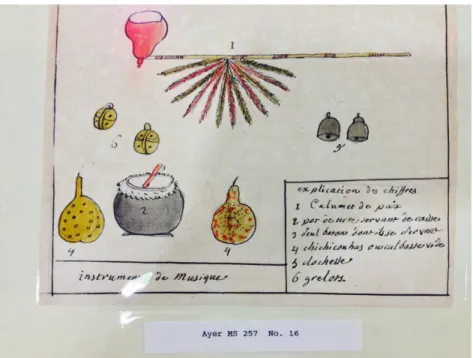
rituals centered on the peace calumet ceremony.36 A calumet was a ritual pipe composed
of a reed stem of two to three feet in length with a polished stone bowl for tobacco.
Peace calumets usually had polished red stone bowls and long white feathers attached to
their stems. Indian peoples, and later Europeans who wished to negotiate with Native
nations, would approach a foreign village with the calumet held aloft signaling their
peaceful intentions. Archaeologist Ian Brown has described the calumet as functioning as
symbolic armor and as a mechanism by which “groups that normally were mortal
enemies could safely complete their transactions” either for a period of trade or
diplomacy.37 Thus, during a time when raiders plagued the petites nations, the calumet
35 Ethridge, Chicaza to Chickasaw, 123-124; Swanton, Indian Triebs of the Lower Mississippi Valley, 243-267.
36 Ethridge, Chicaza to Chickasaw, 131.
ceremony allowed these nations to continue the essential trade and diplomatic
interactions that sustained their peoples.
Figure 1- Musical Instruments. Object #1 is a calumet.38
The calumet ceremony also helped the petites nations smooth the process of
incorporating foreigners into their communities. Almost certainly, the Tensas and
Mosopeleas engaged in a calumet ceremony upon meeting. After smoking with the chiefs
and honored men of their host village, foreigners were expected to partake in an evening
feast, listen to a series of speeches given by the local nation’s leaders, and then either
watch or participate in a night of dancing to celebrate the union of these two peoples.
United States, 1085-88; Ian Brown, “The Calumet Ceremony in the Southeast and Its Archaeological Manifestations,” American Antiquity 54 (1989), 313-315; Bienville to Antoine de la Mothe, Siuer de Cadillac, 6/23/1716, Mississippi Provincial Archives: French Dominion, 3: 214; Baron de Lahontan, New Voyages to North America, ed. Reuben Gold Thwaites (Chicago: A. C. McClurg and Co., 1905), 423-424.
38
Dumont de Montigny, “Mémoire de Lxx Dxx officier ingénieur, contenant les evenements qui se sont passés à la Louisiane depuis 1715 jusqu’à present [manuscript] : ainsi que ses remarques sur les moeurs,
After an initial gift exchange, the warriors and headmen of each nation would recite their
most significant military exploits. These warriors would often remove the home village’s
calumet from the central pole where it normally hung, and sing and dance with the
calumet, acting out their victories and striking the pole as they recalled the battles their
nation had won and the captives they had taken. This process could take hours, or even
days.39 The French, who the Indians joked spoke all at once during meetings “like a flock
of geese,” had no patience for these extended individual speeches.40 Yet these
performances of military might were of critical importance to petites nations’ societies.
By reinforcing the military prestige of the nation’s headmen and elite warriors, these
singers highlighted the power of their nation’s leaders and reminded foreign nations of
the value of their alliance. After proclaiming their nations’ might, Native leaders were
able to use these ceremonies to express their desires to trade, their love for the other
nation, or in the case of the Mosopelea, their need for refuge.
Carrying calumets helped refugees gain acceptance within a village, as it
demonstrated that they were not a threat and that they wished to create a relationship with
the new group. Vast numbers of refugees arrived at petites nations villages in the last
decades of the seventeenth and the first decades of the eighteenth centuries. Sometimes
individual villages abandoned their homes to seek refuge with a neighboring people, or,
as with the Mosopeleas, entire nations might migrate long distances seeking shelter.
39 Jean-Francois- Benjamin Dumont de Montigny, The Memoir of Lieutenant Dumont 1715-1747, trans. Gordon M. Sayre, ed. Gordon M. Sayre and Carla Zecher (Chapel Hill: University of North Carolina Press, 2012), 341-342.
40 Le Page Du Pratz, The History of Louisiana, or of the western parts of Virginia and Carolina: