COMPARATIVE EFFECTIVENESS OF THE MODE OF DELIVERY FOR PREVENTING DENTAL CARIES IN YOUNG CHILDREN
Ashley Merrill Kranz
A dissertation submitted to the faculty of the University of North Carolina at Chapel Hill in partial fulfillment of the requirements for the degree of Doctor of Philosophy in the Department of Health Policy and Management, Gillings School of Global Public Health.
Chapel Hill 2013
ii © 2013
iii Abstract
ASHLEY MERRILL KRANZ: Comparative Effectiveness of the Mode of Delivery for Preventing Dental Caries in Young Children
(Under the direction of R. Gary Rozier, DDS, MPH)
Background. Most state Medicaid programs reimburse primary care providers for providing preventive oral health services to young children in medical offices. Since 2000, North Carolina (NC) Medicaid has reimbursed these services through the Into the Mouths of Babes (IMB) program. To understand how the provider of oral health services may affect children’s subsequent oral health-related outcomes, we compared children enrolled in NC Medicaid who received only IMB visits, only dentist visits, both IMB and dentist visits, and neither before 3 years of age.
Methods. Using a combination of NC administrative and public health surveillance data from 2000 to 2006, this study used regression methods to examine the following outcomes occurring after a child’s third birthday: (1) time to a dentist visit; (2) receipt of caries-related treatment (CRT) and associated payments; (3) and the number of decayed, missing, and filled teeth (dmft) and proportion of untreated decayed teeth.
iv
kindergarten, but children with only IMB visits had a higher proportion of untreated decayed teeth.
v
Acknowledgements
I would like to sincerely thank my dissertation committee: Dr. R. Gary Rozier, Dr. Jessica Lee, Dr. John Preisser, Dr. Sally Stearns, and Dr. Morris Weinberger. They were generous with their time, provided valuable guidance, and helped to make this an enjoyable journey. I am especially appreciative of my advisor, Dr. Rozier, for his unwavering patience, support, and encouragement during the past five years. I want to acknowledge the help and support received from friends and colleague at UNC (Susan Andrews, Heather Beil, John Cantrell, Bhanva Pahel, and Leslie Zeldin) and from fellows and faculty at the Sheps Center for Health Services Research. I also appreciate the support, encouragement, and feedback from friends who have learned more about pediatric dental health than they ever expected, in particular Jeff Federspiel, Kim Geissler, and Liz Holdsworth La. Lastly, I want to thank those who bring balance and joy to my life: Marina and Linnea, Nick D, and my family, in
particular Elise.
vi Preface
vii
Table of Contents
List of Tables……….. x
List of Figures……….… xi
List of Abbreviations……….… xii
1. Introduction……… 1
1.1 Background………..………..………..………..………..……… 1
1.2. Overall study purpose and approach………..………...………...…….. 2
1.3 Specific aims………..………..………..………..……… 3
1.4. Summary and Significance………..………..………..………..….…… 5
References……….. 6
2. Literature Review……….……….. 8
2.1. Background………..………..………..………...….... 8
2.2. Dental disease is a major public health problem for young children…. 9 2.3. Preventive services can promote oral health during early childhood……….... 9
2.4. Barriers to dentist visits persist for young Medicaid-enrolled children……….. 11
2.5. To improve access to preventive oral health services, most Medicaid programs reimburse physicians for providing these services in the medical office………...…. 13
2.6. Gaps exist in the literature about the comparative effectiveness of delivering preventive oral health services during IMB visits compared to dentist visits………....….. 15
viii
2.8. New contributions……….. 18
References……….. 21
3. Methods……...………..… 28
3.1. Overview of methods………...……....……. 28
3.2. Research design………..………….... 28
3.3. Data sources………..……….. 28
3.4. Overview of data analysis……….…….. 31
References……….. 38
4. Effect of the mode of delivery for preventive oral health services before 3 years of age on the time to a dentist visit after a child’s third birthday………… 40
4.1. Overview……..………..………..…………..………..……..…………. 40
4.2. Introduction………..………..………..………..………..………..……. 40
4.3. Methods………..………..………..………..………..………..………... 43
4.4. Results………..………..………..………..………..………..…………. 47
4.5. Discussion………..………..………..………..………..………. 49
References……….. 60
5. Effect of the mode of delivery for preventive oral health services before 3 years of age on caries-related treatment and associated payments during ages 3 to 5 years……..……….. 63
5.1. Overview……..………..………..………..………..………..….…….. 63
5.2. Introduction………..………..………..………..………..………...…… 64
5.3. Methods………..………..………..………..………..………..……... 66
5.4. Results………..………..………..………..………..………... 71
ix
References……….. 90
6. Effect of the mode of delivery for preventive oral health services before 3 years of age on the dental caries experience of kindergarten children………….. 93
6.1. Overview ………..………..………..………..………...…….... 93
6.2. Introduction………..………..………..………..………..……..…. 94
6.3. Methods………..………..………..………..………..………..……..…. 95
6.4. Results………..………..…………..……..………..………..……..…… 100
6.5. Discussion………..………..………..………..…………..…..………… 101
References……….. 112
7. Discussion……….…….. 116
7.1. Study 1: Effect of the mode of delivery for preventive oral health services before 3 years of age on the time to a dentist visit after a child’s third birthday………...….. 117
7.2. Study 2: Effect of different modes of delivery on caries-related treatments and associated payments during ages 3 to 5 years………… 118
7.3. Study 3: Effect of the mode of delivery for preventive oral health services before 3 years of age on the dental caries experience of kindergarten children………... 119
7.4. Limitations……… 120
7.5. Policy implications and future research………... 122
x List of Tables Table
3.1. Description of variables……….. 37
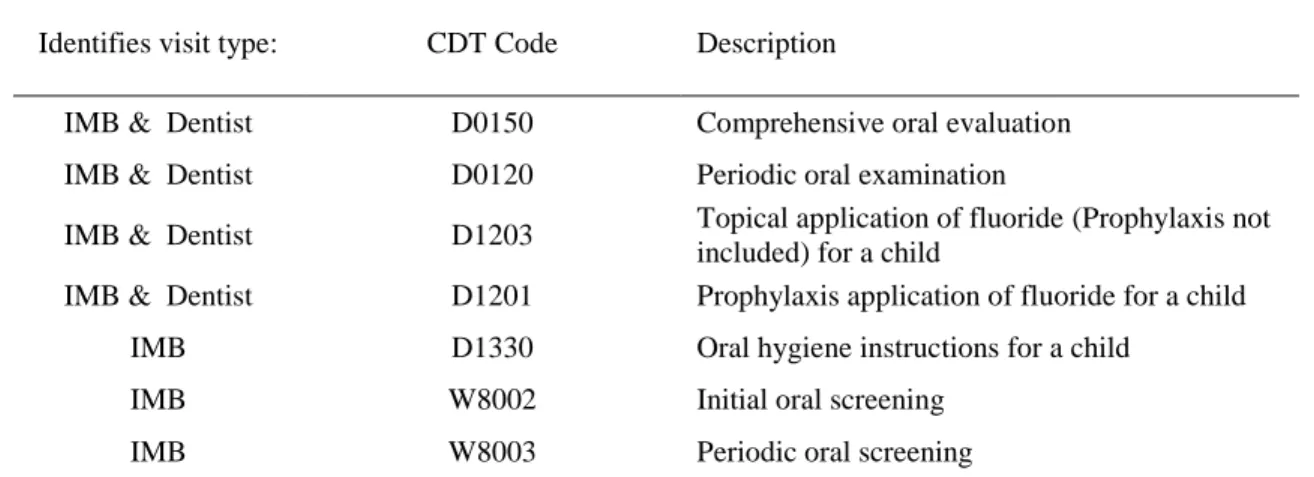
4.1. Description of Current Dental Terminology (CDT) codes used to identify preventive oral health services received
during IMB visits………. 54
4.2. Characteristics of young children enrolled in NC Medicaid
during 2000-2006……… 55
4.3. Adjusted hazard ratios of time to dentist visit after third
birthday for young children enrolled in North Carolina Medicaid…………. 56 5.1. Description of CDT codes used to identify preventive oral health
services received during dentist and IMB visits………….……… 79 5.2. Baseline characteristics of NC Medicaid-enrollees aged 3 to 5 years……… 80 5.3. Results of zero-inflated negative binomial regression estimating
annual number of caries-related treatments for propensity score
matched sample………... 81
5.4. Results of two-part regression estimating annual payment for
caries-related treatment for propensity score matched sample………... 83 6.1. Description of CDT codes used to identify preventive oral health
services received in dental and medical offices……….……..…... 105 6.2.Baseline characteristics of NC Medicaid-enrollees entering
kindergarten in 2005-2006……… 106
6.3. Adjusted differences in predicted dmft score and proportion untreated decay at 5 years old compared to child with only dental
xi List of Figures
Figure
2.1. Conceptual framework………..…. 20
4.1. Kernel density plots illustrating distribution of propenstiy
scores in unadjusted and IPTW-adjusted samples………. 57 4.2. Difference in absolute standardized differences for covariates
in the unadjusted and weighted samples……….... 58 4.3. Cumulative IPTW-adjusted probability of a dentist visit after
3 years of age……….. 59
5.1. Difference in absolute standardized differences for covariates in full and matched samples according to provider of preventive
oral health services………...……….. 85
5.2. Predicted number of treatments per year………..…….. 87 5.3. Predictions of annual payment from two-part model……….… 88 5.4. Predicted annual payment, combined results of two-part model………..…. 89 6.1.Kernel density plots illustrating distribution of propenstiy scores
in unadjusted and IPTW-adjusted samples……… 108 6.2. Difference in absolute standardized differences for covariates in
the unadjusted and weighted samples……… 109 6.3. Adjusted mean dmft score per child among NC Medicaid-enrollees
at 5 years old age, by mode of delivery and analytic sample……… 110 6.4. Adjusted mean proportion of untreated decayed teeth per child
among NC Medicaid-enrollees at 5 years of age with dmft>0,
xii
List of Abbreviations AHR Adjusted hazard ratio
dmft decayed, missing, or filled primary teeth CRT Caries-related treatment
ECC Early childhood caries IMB Into the Mouths of Babes
IPTW Inverse-probability-of-treatment-weights
NC North Carolina
NCSoDC North Carolina Surveillance of Dental Caries System OLS Ordinary Least Squares
1. Introduction 1.1 Background
Early childhood caries (ECC), or tooth decay in young children, is prevalent in the United States, as over 25% of children aged 0 to 5 years old have the disease.1 In addition to causing pain and decreased quality of life, ECC is costly to treat.2 In 2006, Medicaid paid for 53% of children’s hospital-based emergency department visits attributed to dental caries totaling $14.33 million.3 Compared to children from higher-income families, children living in poverty are more likely to have dental caries, but less likely to receive treatment.1 This difference is due in part to access to care, which is negatively affected by dental workforce shortages and dentists’ low rate of participation in Medicaid.4,5
Recognizing that young children make more visits to medical offices than dental offices, many state Medicaid programs now reimburse primary care providers (PCPs) for applying fluoride varnish in the medical office. Since 2000, the NC Into the Mouths of Babes (IMB) program has trained PCPs to provide oral health counseling to parents, conduct an open-mouth evaluation, and apply fluoride varnish to children younger than 3 years of age.6 Children suspected of having ECC or assessed to be at elevated risk are referred to dentists when they are available in the community. The IMB program, as well as similar programs in other states, has helped increase access to preventive dental services and improved the oral health of young children enrolled in Medicaid.7-9
2
eligible to receive preventive oral health services from PCPs. Compared to children not having IMB visits, children receiving at least four IMB visits received fewer treatments during ages 40-72 months and had a significantly lower monthly probability of having a dentist or hospital visit with caries-related treatment up to 6 years of age.8,10 While these findings suggest IMB visits may be associated with better oral health, these studies did not control for preventive services received from dentists or examine whether IMB visits promote oral health as well as visits to dentists, the conventional provider of these services. Some barriers to dental care for children may ease as they age because dentists are more willing to care for older children;11 however, workforce shortages and dentists’ low rate of participation in Medicaid likely remain as barriers to dental care when children age out of the IMB program.
1.2. Overall study purpose and approach
3
these four modes of delivery and examined caries experience and the proportion of untreated decayed teeth among kindergarten children enrolled in NC Medicaid.
1.3. Specific aims
All three studies use Medicaid claims to examine oral health-related outcomes
occurring after a child’s third birthday. Using Medicaid claims, the first two studies compare the effectiveness of the mode of delivery for preventing dental caries in young children by examining the time to a dentist visit (Study 1) and receipt of dental treatment and associated payments (Study 2). Study 3 uses a combination of NC Medicaid claims data and oral health surveillance data to compare clinical measures of dental caries experience. The aims for the three studies are as follows:
Study 1: To estimate the effect of the mode of delivery for preventive oral health
4
Study 2: To estimate the effect of different modes of delivery on caries-related
treatments and associated payments during ages 3 to 5 years. This retrospective cohort included children who were enrolled in the NC Medicaid program before 1 year of age, enrolled for at least 12 months before their third birthday, and enrolled for at least 8 months following their third birthday to allow time to observe the outcomes. The two dependent variables measured the number of dental CRT and total payments for CRT per year during ages 3 to 5 years. The key explanatory, mode of delivery for preventive oral health services before age three, was operationalized as a 4-category variable: dentists only, PCPs only, both dentists and PCPs, or neither. A zero-inflated negative binomial regression was used to estimate the total number of dental CRT received per year. Annual Medicaid payments for CRT at ages 3 to 5 years were estimated using a two-part regression model, with a logit model to estimate the likelihood of having any payments and an Ordinary Least Squares (OLS) regression model to estimate the expected payment for children having any CRT in a given year. All regression models controlled for relevant child- and county-level
characteristics. Propensity score matching adjusted for selection bias.
Study 3: To estimate the effect of the mode of delivery for preventive oral health
5
logistic regression was used to estimate the proportion of untreated decayed teeth (i.e., d/dmft). Regression models adjusted for relevant child- and county-level characteristics and used propensity scores with inverse-probability-of-treatment-weights.
1.4. Summary and significance
Widespread support exists for the integration of dentistry and medicine to promote young children’s oral health, yet to date no study has directly compared the oral health-related outcomes of children utilizing modes of delivery for preventing dental caries in young children in medical and dental settings.12-15 As both the number of PCPs providing preventive oral health services and the number of children eligible for Medicaid increases, it becomes increasingly important to compare the effect of preventive oral health services delivered by PCPs to dentists, the conventional provider of these services.16,17 Furthermore, because children from low-income families are more likely to experience tooth decay and less likely to visit dentists than children from higher-income families,1 Medicaid programs that
reimburse services provided in medical offices can increase access to prevention for children living in poverty and thus may help to lessen oral health disparities. This dissertation
compared the effectiveness of modes of delivery for preventing dental caries in young
children in medical and dental settings by examining individual oral health- related outcomes including continuity of care, treatment utilization and associated payments, and dental
disease. Results of the study can inform Medicaid policy on the reimbursement of preventive oral health services in the medical office and inform strategies to improve access to
6 References
1. Edelstein BL, Chinn CH. Update on disparities in oral health and access to dental care for America's children. Acad Pediatr. 2009;9(6):415-419.
2. Low W, Tan S, Schwartz S. The effect of severe caries on the quality of life of young children. Pediatr Dent. 1999;21(6):325-326.
3. Nalliah RP, Allareddy V, Elangovan S, Karimbux N, Allareddy V. Hospital based emergency department visits attributed to dental caries in the united states in 2006. J
Evid Based Dent Pract. 2010;10(4):212-222.
4. U.S. Government Accountability Office. States made multiple program changes, and beneficiaries generally reported access comparable to private insurance [Internet]. Washington (DC): 2012 [cited January 30 2013]; Available from:
http://www.gao.gov/assets/650/649788.pdf.
5. The U.S. oral health workforce in the coming decade: workshop summary [Internet].
Washington (DC): Institute of Medicine; 2009 [cited February 8 2013]; Available from: http://www.iom.edu/Reports/2009/OralHealthWorkforce.aspx.
6. North Carolina Oral Health Section. Into the Mouths of Babes: Medicaid oral
evaluation [Internet]. Raleigh (NC): NC Department of Health and Human Services; 2009 [cited June 14 2011]; Available from:
http://www.ncdhhs.gov/dph/oralhealth/library/includes/IMBresources/2_Medicaid%2 0Oral%20evaluation-%20toolkit.pdf.
7. Okunseri C, Szabo A, Jackson S, Pajewski NM, Garcia RI. Increased children's access to fluoride varnish treatment by involving medical care providers: effect of a medicaid policy change. Health Serv Res. 2009;44(4):1144–1156.
8. Pahel BT, Rozier RG, Stearns SC, Quiñonez R. Effectiveness of preventive dental treatments by physicians for young Medicaid enrollees. Pediatrics.
2011;127(3):e682-689.
9. Rozier RG, Stearns S, Pahel B, Quinonez R, Park J. How a North Carolina program boosted preventive oral health services for low-income children. Health Aff.
2010;29(12):2278-2285.
10. Stearns SC, Rozier RG, Kranz AM, Pahel BT, Quiñonez RB. Cost-effectiveness of preventive oral health care in medical offices for young Medicaid enrollees. Arch
Pediatr Adolesc Med. 2012;166(10):945-951.
11. Seale N, Casamassimo PS. Access to dental care for children in the United States: a survey of general practitioners. J Am Dent Assoc. 2003;134(12):1630-1640.
7
13. The cost of delay: state dental policies fail one in five children [Internet]. Washington (DC): Pew Center on the States; 2010 [cited September 27 2010] ; Available from: http://www.pewcenteronthestates.org/uploadedFiles/Cost_of_Delay_web.pdf. 14. Hanlon C. Reimbursing medical providers for preventive oral health services: state
policy options [Internet]. Washington (DC): National Academy for State Health Policy; 2010 [cited September 20 2010]; Available from:
http://nashp.org/sites/default/files/Pew%20Oral%20Health.pdf.
15. Committee on Oral Health Access to Services. Improving access to oral health care for vulnerable and underserved populations [Internet]. Washington ( DC): National Academies of Science; 2011 [cited January 30 2013]; Available from:
http://www.iom.edu/Reports/2011/Improving-Access-to-Oral-Health-Care-for-Vulnerable-and-Underserved-Populations.aspx.
16. Deinard A, Cantrell C. Caries prevention services reimbursement table [Internet]. Chicago (IL): American Academy of Pediatrics Oral Health Initiative,
Medicaid/CHIP, Dental Association, National Academy for State Health Policy; 2011 [cited May 18 2012]; Available from:
http://www2.aap.org/oralhealth/docs/OHReimbursementChart.pdf.
17. Silberman P, Liao CE, Ricketts TC. Understanding health reform: a work in progress.
2. Literature review 2.1. Background
Young children encounter difficulty accessing dental care, which contributes to increasing rates of early childhood caries (ECC) that disproportionally affect infants and toddlers living in poverty.1 Recognizing that young children make more visits to medical offices than dental offices, many state Medicaid programs now reimburse primary care providers (PCPs) to deliver preventive oral health services.2 Since 2000, North Carolina (NC) Medicaid’s “Into the Mouths of Babes” (IMB) program has trained pediatric and family medicine PCPs to provide preventive oral health services to young children less than three years of age. Similar to preventive services received in a dental office for young children, IMB visits include oral health counseling for parents, application of fluoride varnish to prevent ECC, and an oral evaluation and risk assessment with referral to a dentist if needed.3
9
received preventive oral health services before age three during only IMB visits, only dentist visits, both IMB and dentist visits, and neither.
2.2. Dental disease is a major public health problem for young children
ECC, which is defined as the presence of tooth decay in children less than six years of age, is the most common chronic disease of childhood. ECC is five times more common than asthma and is increasing in prevalence.12,13 Among children 2-5 years old, ECC prevalence increased from 18% during 1988-1994 to 24% during 1999-2004.14 Despite this increase, treatment for ECC is underutilized, as 23.4% of young children suffer from untreated dental caries.15 Low-income children are twice as likely to experience ECC yet only half as likely to visit a dentist, suggesting that many young children with ECC who live in poverty do not receive necessary treatment.14,16 Because untreated ECC causes pain, which may limit participation in school activities and affect a child’s ability to eat, speak, and sleep, ECC and its under treatment are important public health problems.17-21
In addition to causing pain and decreased quality of life, ECC is costly to treat.21 In 2006, Medicaid paid for 53% of children’s hospital-based emergency department visits attributed to dental caries totaling $14.33 million.22 A study conducted in Iowa found that although fewer than 5% of children on Medicaid received care for ECC in the hospital, these children consumed 25-45% of dental resources.23 For children under 6 years of age enrolled in NC Medicaid, the average predicted payment for a dental caries-related treatment (CRT) episode ranges from $334 for an office visit to $3,051 for a hospital visit.24
2.3. Preventive services can promote oral health during early childhood
10
Because ECC can rapidly progress in young children, the early introduction of oral health promotion activities may help to avoid the consequences associated with it.26 Early dentist visits are useful for establishing good oral health practices and evaluating caries-risk factors. A dentist visit by 12 months old is recommended by numerous professional organizations, including the American Academy of Pediatrics, American Academy of Pediatric Dentistry and American Dental Association.27-29 A dentist visit for a young child typically involves an oral exam and risk assessment, anticipatory guidance for parents about their child’s oral health, and caries-prevention strategies such as use of topical fluoride.29 An oral exam provides an opportunity to identify disease and develop a treatment plan based on ECC experience. A risk assessment is conducted to assess a child’s likelihood of developing caries. Because caries is a disease caused by the interaction of multiple factors, dentists consider a child’s exposure to variety of protective and harmful biological, behavioral and social characteristics.27
Anticipatory guidance shared with parents is shaped by a dentist’s assessment of risk. Following the medical model of anticipatory guidance, the dental model aims to provide developmentally appropriate information to parents about their child’s oral health-related milestones.30 Anticipatory guidance promotes good oral health behaviors early in the child’s life by preparing parents for their child’s future oral health needs.31-34
The American Academy of Pediatrics recommends that providers educate parents about their child’s oral hygiene and brushing habits, bottle use, and diet.8
11
and convenient type of topical fluoride that provides an effective way to prevent dental caries in young children.36,37 Both the American Academy of Pediatric Dentistry and American Dental Association recommend young children at high risk of developing caries receive topical fluoride every three to six months.27,38
In addition to the aforementioned activities, early dentist visits are important for establishing a dental home. The American Academy of Pediatric Dentistry defines a dental home as a “source of continuous, accessible, comprehensive, family-centered, coordinated, compassionate, and culturally effective oral health care delivered or directed by a
professional dentist.”39
Establishing a dental home is important for long-term oral health because it allows for the monitoring and treatment of potential problems.39
2.4. Barriers to dentist visits persist for young Medicaid-enrolled children
Despite the expected benefits of preventive oral health services, early dentist visits may not be feasible for all young children, particularly for children from low-income
families. The distribution and preferences of the dental workforce limit access to dentists for young children. According to the Institute of Medicine, over 49 million people live in federally recognized dental health provider shortage areas.40 Nationally there are
12
any clinical hands-on experience related to infant oral health.43 Nationwide only 3% of dentists are pediatric dentists who receive special training on how to care for young children.44 Similarly, NC has 3.31 pediatric dentists per 100,000 children.45
Furthermore, Medicaid reimbursement rates affect access to dentists. Dentists
routinely report low reimbursement rates as a reason for not participating in Medicaid.46,47 A recent study by Decker found that increasing Medicaid reimbursement to dentists was significantly associated with increased access to dental care for low-income children.48 However, since 2000 few states have increased Medicaid dental payments and many states that have are considering reducing payments to control costs.48,49 Rate increases alone are unlikely to improve access adequately.11 NC experienced only a marginal improvement in access to dental care after the state expanded eligibility and increased reimbursement.50 Onerous administrative procedures and perceived difficulty dealing with patients may further discourage dentists’ participation in Medicaid and negatively affect access to dental care for low-income children.51,52 Parents of children enrolled in Medicaid report difficultly finding providers, restrictive scheduling policies, and long wait times for appointments.53 Moreover, the Medicaid reimbursement schedule may limit receipt of recommended preventive
services. Although the American Academy of Pediatric Dentistry and the American Dental Association recommend young children at high risk of developing caries receive fluoride varnish every three to six months, many state Medicaid programs only reimburse preventive dentist visits every six months.27,38,54 Thus children may miss out on recommended care that is intended to prevent and interrupt the development of ECC.
13
needs were more likely to have lower oral health literacy than parents of children with mild to moderate treatment needs.55 Furthermore, parents’ beliefs about dental practices and primary teeth can affect utilization of dental care and oral health outcomes. Studies have found that parents who visit dentists are more likely to take their children to the dentist.56,57 However, lack of knowledge about oral health is common among low-income parents, particularly among parents of minority racial and ethnic backgrounds.58 A study of low-income Hispanic mothers found that the mothers generally had limited knowledge of oral health promotion and their young children infrequently visited dentists.58 In Detroit, Sohn and colleagues found an association between parental perception of their child’s oral health and belief that poor oral health is acceptable and inevitable.59 Although less than 30% of parents perceived their child’s oral health as poor, nearly all of these parents (94%) reported fatalistic beliefs about oral health. A qualitative study of parents of young children from a racial-minority background, the majority of whom used public insurance, found that most parents placed little value on primary teeth often expressing the opinion that “they will ‘just fall out anyway.’” 60
Most parents in this study expressed a preference in visiting a pediatrician over a dentist for their child’s first dental evaluation, suggesting greater familiarity and comfort with services delivered in the medical office and an opportunity to expand dental services in this setting.
2.5. To improve access to preventive oral health services, most Medicaid programs reimburse physicians for providing these services in the medical office
14
family medicine PCPs to provide preventive oral health services to young children less than three years of age. Following an American Medical Association approved continuing medical education course, PCPs can provide preventive oral health services at a flat rate of about $55 per child visit. Similar to preventive services provided in a dental office for young children, IMB visits include oral health counseling for parents, application of fluoride varnish to prevent ECC, and an oral evaluation and risk assessment.3 Children suspected of having ECC or assessed to be at elevated risk are referred to dentists when they are available in the
community. IMB services may be provided at either well- or sick- child visits, although it is suggested they coincide with well-child visits occurring at 6, 9, 12, 15, 18, and 24 months of age. Consistent with recommendations from the American Academy of Pediatrics, children in NC are eligible to receive IMB services up to six times until 42 months of age, however during our study period children were only eligible until 36 months of age.8
The medical office provides a convenient setting to deliver preventive dental care to young children for several reasons. To begin, young children frequently visit the medical office because they are advised to have 11 well-child visits before their fourth birthday.61 Data from the Medical Expenditure Panel Survey revealed that 89% of children under two years old had an annual visit to the medical office, compared to only 1.5% who visited a dentist.8 Similarly, Yu and colleagues found that the proportion of children not making recommended visits was much lower for well-child visits than dentist visits.62
15
more frequent participation in oral health activities.63 One year after oral health training, most PCPs (70.3%) reported routinely providing dental services.64 Fewer than half (42.1%) reported it was difficult to integrate dental procedures into practice and only 14.8% indicated that they lacked sufficient knowledge to provide dental services effectively.64 Furthermore, parents report high satisfaction with these services.65
The IMB program has helped to increase access to preventive oral health services for young children enrolled in Medicaid. Since 2000, the IMB program has supported over one million visits for preventive dental care in more than 425 health departments, physician practices and residency programs.6 Overall, the percent of Medicaid children younger than five years old obtaining oral health services in NC increased from 17% in 2002 to 59% in 2011.66 In 2006, the rate of IMB visits was nearly four times the rate of dentist visits with fluoride; with 18-39% of children, depending on age, receiving at least one fluoride varnish application from a PCP.6
2.6. Gaps exist in the literature about the comparative effectiveness of delivering preventive oral health services during IMB visits compared to dentist visits
Although the benefits of IMB visits are well-documented, less is known about what happens to the oral health of these children after three years of age, when they are no longer eligible to receive preventive oral health services during IMB visits. Children who received 4 or more IMB visits compared to no IMB visits had a lower likelihood of receiving CRT in
both hospital and office settings and a 17% reduction in CRT up to 6 years of age.5,24
Additionally, having 4 or more IMB visits was associated with lower Medicaid payments for
hospital or dentist office treatments, suggesting fewer treatments within a treatment
16
control for preventive services received from dentists or examine whether IMB visits promote oral health as well as visits to dentists, the conventional provider of these services.
IMB visits are intended to prevent and control the development of ECC until young children can more easily establish a dental home. Although not an explicit goal of the
program before 2006, establishing a dental home is important for the long-term oral health of the child. Establishing a dental home is particularly important because IMB and a large percentage of these Medicaid programs limit benefits to children younger than 4 years of age, after which most of these children continue to be at high-risk of developing ECC and
encounter barriers to dental care.2 A study examining the IMB program during 2001-2002 found that only 3.4% of children had a dentist visit within six months of their first IMB visit.67 Studies report that young children are more likely to have a dental visit if they
received a referral from a physician.67,68 Nationally, fewer than half of young children aged 2 to 5 years old receive these types of referrals.68,69 Referral success is constrained by the availability of dentists willing to see young children enrolled in Medicaid.40,70 Early studies of the IMB program suggest that PCPs providing IMB services have low referral rates and tend to under-refer children with ECC.67 Factors associated with referral include presence of ECC, PCP reported high confidence in screening for ECC, and availability of dentists.4,67,71 Although these studies of the IMB program provide information about the referral experience of children less than three years old, they do not address the experience children aging out of the IMB program.
17
achieved through successful referral from PCPs to dentists.72 This definition of continuity is related to the “health home” concept discussed by the American Association of Public Health Dentistry, which emphasizes the need for communication between patients and all of their healthcare providers in order to promote overall health.73 Some barriers to dental care for children may ease as they age because dentists are more willing to care for older children;7 however, workforce shortages and dentists’ low rate of participation in Medicaid remain as barriers to dental care when children age out of the IMB program.
2.7. Conceptual framework
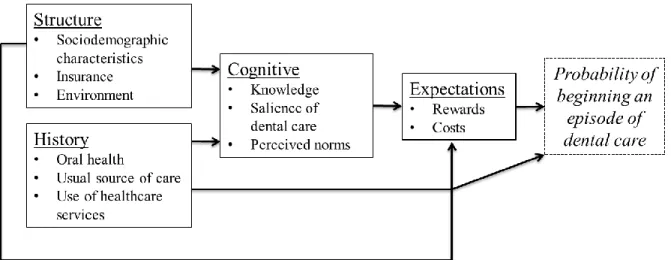
As illustrated in Figure 2.1, our framework for understanding utilization of dental care for young Medicaid enrollees posits that an individual’s decision to visit a dentist, or in this case a caregiver’s decision to take a child to the dentist, is influenced by four interrelated factors: history (past dental use), structure (sociodemographic characteristics and
18
For studies 2 and 3, we examined how the provider of preventive oral health services before age 3 may affect subsequent dental treatment, payment for treatment, and dental caries experience. Children who received preventive oral health services during IMB or dentist visits before 3 years of age are expected to benefit from early screenings, parental counseling and applications of fluoride varnish.38,75 These actions correspond to the cognition factors in the conceptual framework and are expected to increase a parent’s knowledge about their child health and encourage positive beliefs and attitudes about oral health promotion. Structural factors, such as the availability of dentists, may inhibit dentist visits for children who receive only IMB visits or no prevention. However, the preventive benefits extended to parents and children during IMB visits are expected to promote children’s oral health status. Therefore, we hypothesized that children who have IMB or dentist visits before age 3 will have similar outcomes to each other, but fewer treatments, lower payments, and fewer dental caries than children who did not receive any prevention before age 3. Because children who have early dentist visits may do so to obtain treatment or because they are at increased risk of ECC, we also considered that our results may reflect this unobserved risk status and indicate that early dentist visits are associated with more treatment. Furthermore, because the IMB program instructs PCPs to refer children with existing dental disease to dentists, and having decay at an early age is a strong predictor of subsequent decay,76 we hypothesized that children who received both IMB and dentist visits before 3 years of age will have more treatment, higher payments, and more dental caries than children who had only IMB or only dentist visits before age 3.
2.8. New contributions
19
dental providers has been conducted in silos, with no studies directly comparing the
outcomes associated with these modes of delivery. No studies have compared the oral-health related outcomes of children who had only IMB visits to children who had only dentist visits before three years of age. Furthermore, studies evaluating the IMB program have not
controlled for dentist visits when reporting the effect of IMB utilization, which is an
21 References
1. Edelstein BL, Chinn CH. Update on disparities in oral health and access to dental care for America's children. Acad Pediatr. 2009;9(6):415-419.
2. Deinard A, Cantrell C. Caries prevention services reimbursement table [Internet]. Chicago (IL): American Academy of Pediatrics Oral Health Initiative,
Medicaid/CHIP, Dental Association, National Academy for State Health Policy; 2011 [cited May 18 2012]; Available from:
http://www2.aap.org/oralhealth/docs/OHReimbursementChart.pdf.
3. North Carolina Oral Health Section. Into the Mouths of Babes: Medicaid oral
evaluation [Internet]. Raleigh (NC): NC Department of Health and Human Services; 2009 [cited June 14 2011]; Available from:
http://www.ncdhhs.gov/dph/oralhealth/library/includes/IMBresources/2_Medicaid%2 0Oral%20evaluation-%20toolkit.pdf.
4. Pierce KM, Rozier RG, Vann Jr WF. Accuracy of pediatric primary care providers' screening and referral for early childhood caries. Pediatrics. 2002;109(5):e82-91. 5. Pahel BT, Rozier RG, Stearns SC, Quiñonez R. Effectiveness of preventive dental
treatments by physicians for young Medicaid enrollees. Pediatrics.
2011;127(3):e682-689.
6. Rozier RG, Stearns SC, Pahel BT, Quinonez RB, Park J. How a North Carolina program boosted preventive oral health services for low-income children. Health Aff.
2010;29(12):2278-2285.
7. Seale N, Casamassimo PS. Access to dental care for children in the United States: a survey of general practitioners. J Am Dent Assoc. 2003;134(12):1630-1640.
8. American Academy of Pediatrics. Preventive oral health intervention for pediatricians. Pediatrics. 2008;122(6):1387-1394.
9. The cost of delay: state dental policies fail one in five children [Internet]. Washington (DC): Pew Children’s Dental Campaign; 2010 [cited May 18 2012]; Available from: http://www.pewstates.org/uploadedFiles/PCS_Assets/2010/Cost_of_Delay_web.pdf. 10. Hanlon C. Reimbursing medical providers for preventive oral health services: State
policy options [Internet]. Washington (DC): National Academy for State Health Policy and The Pew Center on the States; 2010 [cited May 18 2012]; Available from: http://nashp.org/sites/default/files/Pew%20Oral%20Health.pdf.
11. Committee on Oral Health Access to Services. Improving access to oral health care for vulnerable and underserved populations [Internet]. Washington (DC): National Academies Press; 2011 [cited August 20 2011]; Available from:
22
12. Newacheck PW, Hughes DC, Hung YY, Wong S, Stoddard JJ. The unmet health needs of America's children. Pediatrics. 2000;105(4):989-997.
13. U.S. Department of Health and Human Services. Oral Health in America: A Report of
the Surgeon General. Rockville (MD): U.S. Department of Health and Human
Services, National Institute of Dental and Craniofacial Research, National Institutes of Health, 2000.
14. Dye BA, Tan S, Smith V, et al. Trends in oral health status. United States, 1988-1994 and 1999-2004. Vital Health Stat. 2007;11(248):1-92.
15. National Center for Health Statistics Health, United States, 2008 with chartbook.
Hyattsville (MD): 2009.
16. Edelstein B. Disparities in oral health and access to care: findings of national surveys.
Ambul Pediatr. 2002;2(2):141-147.
17. Edelstein BL, Chinn CH, Laughlin RJ. Early childhood caries: definition and epidemiology. In: Berg JH, Slayton RL, eds. Early Childhood Oral Health: Wiley-Blackwell; 2009:18-25.
18. Reisine ST. The impact of dental conditions on social functioning and quality of life.
Annu Rev Public Health. 1988;9:1-19.
19. McGrath C, Broder H, Wilson-Genderson M. Assessing the impact of oral health on the life quality of children: Implications for research and practice. Community Dent Oral Epidemiol. 2004;32:81-85.
20. Edelstein BE, Vargas CM, Candelaria D, Vemuri M. Experience and policy
implications of children presenting with dental emergencies to US pediatric dentistry training programs. Pediatr Dent. 2006;28(5):431-437.
21. Low W, Tan S, Schwartz S. The effect of severe caries on the quality of life of young children. Pediatr Dent. 1999;21(6):325-326.
22. Nalliah RP, Allareddy V, Elangovan S, Karimbux N, Allareddy V. Hospital based emergency department visits attributed to dental caries in the united states in 2006. J
Evid Based Dent Pract. 2010;10(4):212-222.
23. Kanellis MJ, Damiano PC, Momany ET. Medicaid costs associated with the hospitalization of young children for restorative dental treatment under general anesthesia. J Public Health Dent. 2000;60(1):28-32.
24. Stearns SC, Rozier RG, Kranz AM, Pahel BT, Quiñonez RB. Cost-effectiveness of preventive oral health care in medical offices for young Medicaid enrollees. Arch
23
25. Al-Shalan TA, Erickson PR, Hardie NA. Primary incisor decay before age 4 as a risk factor for future dental caries. Pediatr Dent. 1997;19(1):37-41.
26. Prevention and control of early childhood tooth decay [Internet]. Sparks (NV): Association of State and Territorial Dental Directors; 2011 [cited July 1 2011]; Available from: http://www.astdd.org/docs/BPAEarlyChildhood.pdf.
27. Guideline on caries-risk assessment and management for infants, children, and adolescents [Internet]. Chicago (IL): American Academy of Pediatric Dentistry ; 2010 [cited May 23 2012]. Available from:
http://www.aapd.org/media/Policies_Guidelines/G_CariesRiskAssessment.pdf. 28. American Dental Association. Baby's first teeth. J Am Dent Assoc. 2002;133:255. 29. American Academy of Pediatrics. Oral health risk assessment timing and
establishment of the dental home. Pediatrics. 2003;111(5):1113-1116.
30. Nowak AJ, Casamassimo PS. Using anticipatory guidance to provide early dental intervention. J Am Dent Assoc. 1995;126(8):1156-1163.
31. Lee JY, Bouwens TJ, Savage MF, Vann Jr WF. Examining the cost-effectiveness of early dental visits. Pediatr Dent. 2006;28(2):102-105.
32. Farias D, Leal S, de Toledo O, Faber J, Bezerro A. Effect of oral anticipatory guidance on oral health and oral hygiene practices in preschool children. J Clin Pediatr Dent. 2006;30(1):23-28.
33. Holm AK, Blomquist HK. A comparative study of oral health as related to general health, food habits and socioeconomic conditions of 4 year old Swedish children.
Community Dent Oral Epidemiol. 1975;3(1):34-39.
34. Hoist K, Köhler L. Preventing dental caries in children: Report of a Swedish programme. Dev Med Child Neurol. 1975;17(5):602-604.
35. Marinho VC. Cochrane reviews of randomized trials of fluoride therapies for preventing dental caries. Eur Arch Paediatr Dent. 2009;10(3):183-191.
36. Weintraub JA, Ramos-Gomez F, Jue B, et al. Fluoride varnish efficacy in preventing early childhood caries. J Dent Res. 2006;85(2):172-176.
37. Marinho VCC, Higgins JPT, Logan S, Sheiham A. Fluoride varnishes for preventing dental caries in children and adolescents2002. Art. No.: CD002279.
24
39. Council on Clinical Affairs. Policy on the dental home [Internet]. Chicago (IL): American Academy of Pediatric Dentistry; 2010 [cited April 15 2012]; Available from: http://www.aapd.org/media/Policies_Guidelines/D_DentalHome.pdf.
40. The U.S. oral health workforce in the coming decade: workshop summary [Internet].
Washington (DC): Institute of Medicine; 2009 [cited February 8 2013]; Available from: http://www.iom.edu/Reports/2009/OralHealthWorkforce.aspx.
41. Financing dental education: public policy interests, issues, and strategic considerations [Internet]. Rockville (MD): Health Resources and Services Administration; 2005 [cite July 13 2011]; Available from:
http://bhpr.hrsa.gov/healthworkforce/reports/financedentaledu.pdf.
42. Stamm JW. The dentist workforce in North Carolina 2005: a commentary. NC Med J.
2005;66(6):445-451.
43. McWhorter AG, Seale NS, King SA. Infant oral health education in US dental school curricula. Pediatr Dent. 2001;23(5):407-409.
44. American Dental Association. 2009 distribution of dentists in the United States by region and state. Chicago, IL2011.
45. Nainar H, Feigal RJ. Geographic distribution of pediatric dentists in private practice in the United States. Pediatr Dent. 2004;26(6):526-529.
46. Gehshan S, Snyder A, Paradise J. Filling an urgent need: improving children’s access to dental care in Medicaid and SCHIP report [Internet]. Washington (DC): Kaiser Commission on Medicaid and the Uninsured; 2008 [July 13 2011]; Available from: http://www.kff.org/medicaid/upload/7792.pdf.
47. Increasing access to Medicaid dental services for children trhough collaborative partnerships. Chicago (IL): American Dental Association; 2004 [cited July 14 2011]; Available from:
http://www.ada.org/sections/professionalResources/pdfs/medicaid_introduction.pdf. 48. Decker SL. Medicaid payment levels to dentists and access to dental care among
children and adolescents. JAMA. 2011;306(2):187-193.
49. Smith V, Gifford K, Ellis E. Hoping for economic recovery, preparing for health reform: a look at Medicaid spending, coverage and policy trends [Internet].
Washington (DC): Kaiser Commission on Medicaid and the Uninsured; 2010 [cited July 14 2011]; Available from: http://www.kff.org/medicaid/upload/8105.pdf. 50. Mayer ML, Stearns SC, Norton EC, Rozier RG. The effects of Medicaid expansions
25
51. Children’s dental services under Medicaid: access and utilization [Internet].
Washington (DC): U.S. Department of Health and Human Services; 1996 [cited July 14 2011] Available from: https://oig.hhs.gov/oei/reports/oei-09-93-00240.pdf. 52. Borchgrevink A, Snyder A, Gehshan S. The effects of Medicaid reimbursement rates
on access to dental care [Internet]. Washington (DC): National Academy for State Health Policy; 2008 [cited June 20 2011]; Available from:
http://www.nashp.org/sites/default/files/CHCF_dental_rates.pdf.
53. Mofidi M, Rozier RG, King RS. Problems with access to dental care for Medicaid-insured children: what caregivers think. Am J Public Health. 2002;92(1):53-58. 54. 50-State dental periodicity schedules [Internet]. Washington (DC): National Health
Law Program; 2005 [cited October 18 2010]; Available from:
http://www.healthlaw.org/index.php?option=com_content&view=article&id=198%3 A50-state-dental-periodicity-schedules&catid=38&Itemid=192.
55. Miller E, Lee JY, DeWalt DA, Vann WF. Impact of caregiver literacy on children's oral health outcomes. Pediatrics. 2010;126(1):107-114.
56. Sohn W, Ismail A, Amaya A, Lepkowski J. Determinants of dental care visits among low-income African-American children. J Am Dent Assoc. 2007;138(3):309-318. 57. Isong IA, Zuckerman KE, Rao SR, Kuhlthau KA, Winickoff JP, Perrin JM.
Association between parents' and children's use of oral health services. Pediatrics.
2010;125(3):502-508.
58. Watson MR, Horowitz AM, Garcia I, Canto MT. Caries conditions among 2-5 year old immigrant Latino children related to parents' oral health knowledge, opinions and practices. Community Dent Oral Epidemiol. 1999;27(1):8-15.
59. Sohn W, Taichman SL, Ismail AI, Reisine S. Caregiver's perception of child's oral health status among low-income African Americans. Pediatr Dent. 2008;30(6):480-487.
60. Hilton IV, Stephen S, Barker JC, Weintraub JA. Cultural factors and children's oral health care: a qualitative study of carers of young children. Community Dent Oral Epidemiol. 2007;35(6):429-438.
61. Douglass JM, Douglass AB, Silk HJ. A practical guide to infant oral health. Am Fam
Physician. 2004;70(11):2113-2120.
62. Yu SM, Bellamy HA, Kogan MD, Dunbar JL, Schwalberg RH, Schuster MA. Factors that influence receipt of recommended preventive pediatric health and dental care.
26
63. Schaff-Blass E, Rozier RG, Chattopadhyay A, Quiñonez R, Vann WF. Effectiveness of an educational intervention in oral health for pediatric residents. Acad Pediatr.
2006;6(3):157-164.
64. Close K, Rozier RG, Zeldin LP, Gilbert AR. Barriers to the adoption and
implementation of preventive dental services in primary medical care. Pediatrics.
2010;125(3):509-517.
65. Rozier RG, Slade GD, Zeldin LP, Wang H. Parents' satisfaction with preventive dental care for young children provided by nondental primary care providers. Pediatr Dent. 2005;27(4):313-322.
66. North Carolina child health report card [Internet]. Raleigh (NC): North Carolina Institute of Medicine; 2012 [cited May 18 2012]; Available from:
http://www.nciom.org/nc-health-data/child-health-report-cards/.
67. Pahel BT. Referrals for dental care in medical office-based preventive dental program [PhD thesis]. University of North Carolina at Chapel Hill; 2008.
68. Beil HA, Rozier RG. Primary health care providers' advice for a dental checkup and dental use in children. Pediatrics. 2010;126(2):e435-e441.
69. Chu M, Sweis LE, Guay AH, Manski RJ. The dental care of U.S. children: access, use and referrals by nondentist providers, 2003. J Am Dent Assoc. 2007;138:1324-1331.
70. U.S. Government Accountability Office. Efforts under way to improve children’s access to dental services, but sustained attention needed to address ongoing concerns [Internet]. Washington (DC): 2010 [cited January 30 2013]; Available from:
http://www.gao.gov/new.items/d1196.pdf.
71. dela Cruz GG, Rozier RG, Slade G. Dental screening and referral of young children by pediatric primary care providers. Pediatrics. 2004;114:e642-652.
72. Shortell SM. Continuity of medical care: conceptualization and measurement. Med Care. 1976;14(5):377-391.
73. Toward a health home: the need for integrating the mouth to the body [Internet]. Springfield(IL): American Association of Public Health Dentistry; 2011 [cited May 18 2012]. Available from:
http://www.aaphd.org/docs/AAPHD%20Final%20Health%20Home%20Resolution% 20-%20Last%20Revision%20Oct%202011.pdf.
74. Grembowski D, Andersen RM, Chen M. A public health model of the dental care process. Med Care Res Rev. 1989;46:439-496.
27
[Internet]. Chicago(IL): American Academy of Pediatric Dentistry; 2009; [cited February 7 2013]; Available from:
http://www.aapd.org/media/Policies_Guidelines/G_Periodicity.pdf. Accessed Feb 7 2013.
76. Powell LV. Caries prediction: a review of the literature. Community Dent Oral
Epidemiol. 1998;26(6):361–371.
77. Silberman P, Liao CE, Ricketts TC. Understanding health reform: a work in progress.
3. Methods
3.1. Overview of methods
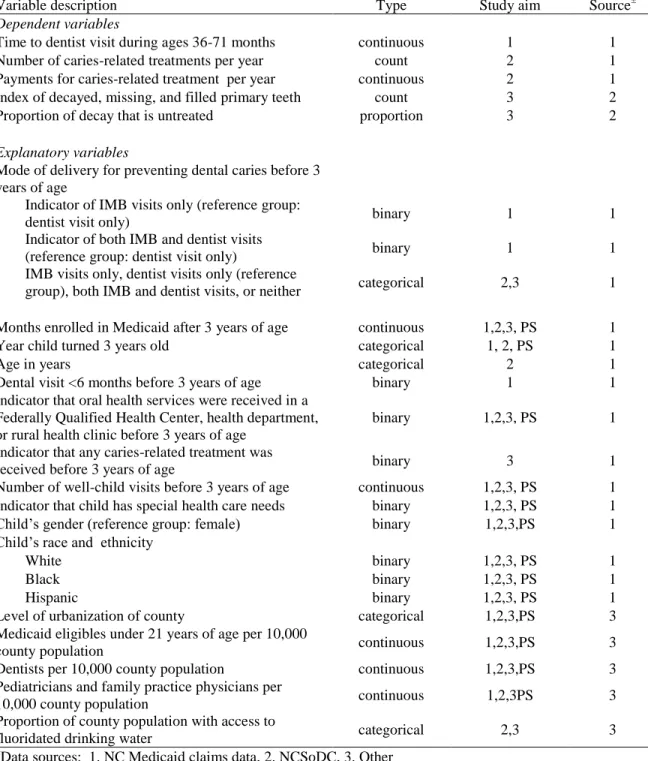
This dissertation is comprised of three manuscripts contained in chapters 4, 5 and 6 which are referred to as study 1, study 2, and study 3, respectively. This chapter provides an overview of the methods used in each study. Because the manuscripts must stand alone, there are redundancies in each manuscript and this chapter. Study 1 and study 2 primarily used data from NC Medicaid claims during years 2000-2006. Study 3 used Medicaid claims that were previously linked to oral health surveillance data. All studies also used additional publically available data to construct relevant county-level variables.
3.2. Research design
This dissertation compared the effectiveness of modes of delivery for preventing dental caries in young children in medical and dental settings by examining the time to a dentist visit (Study 1), receipt of dental treatment and associated payments (Study 2), and dental caries experience in kindergarten (Study 3). Study 1 used a retrospective cohort design to compare the time to a dentist visit for children who had only IMB visits, only dentist visits, or both IMB and dentist visits before age 3. Studies 1 and 2 used a retrospective cohort design to compare children who received preventive oral health services before age 3 during only IMB visits, only dentist visits, both, or neither and examined receipt of caries-related treatment, payment, and dental caries experience.
3.3. Data sources
29
enrollment and claims files. Study 3 used NC Medicaid files along with oral health
surveillance data to examine a cohort of children entering kindergarten during the 2005-06 school year. All studies included additional county level data. The variables used for each study are listed in Table 3.1.
3.3.1. Medicaid claims and enrollment files
Obtained from the NC Division of Medical Assistance, these files provide
information about the dental and medical Medicaid claims of children enrolled from 2000-2006. These files were originally obtained in order to evaluate the effectiveness of the direct referral component of the IMB program and later used to examine the effect of an early preventive dentist visit on oral health outcomes.1,2 Enrollment files provide information about demographic characteristics and Medicaid enrollment (length of time enrolled, reason child is eligible for Medicaid, etc.). Claims files provide information about the type of procedure received, the amount paid for the procedure, where the procedure occurred, and what type of provider submitted the claim (e.g., dentist or physician). Pharmacy or drug claims were not obtained.
3.3.2. NC Surveillance of Dental Caries System (NCSoDC)
The NC Oral Health Section conducts annual oral health assessments of all children in kindergarten and fifth grade. NC began conducting assessments during the 1996-97 school year and is the only state to annually collect this type of surveillance data. Each year, public health dental hygienists conduct standardized open mouth screenings, which provide
information about dental disease levels, treatment needs and presence of sealants.3,4 The Oral Health Section uses this data to identify communities with the greatest need for dental
30
missing (molars only), and filled primary teeth for each child. NCSoDC also collects
demographic information, such as the child’s name, date of birth, sex, race, gender, county of residence, school name, and classroom identification number. Study 3 used data collected during the 2005-06 school-year, which includes information on 92,127 children, 82% of the state’s public school kindergarten enrollment, from 98 of 100 counties.5
The NCSoDC data and NC Medicaid files were previously linked by Beil and colleagues using Link King
software, which uses probabilistic and deterministic methods, based on the child’s name, date of birth, gender, race, and county of residence.6 Children were included in the Medicaid sample if they were enrolled in Medicaid before their first birthday, still enrolled after one year old, and subsequently identified in the NCSoDC data.
3.3.3. County-level data sources
Several publicly available data sources were used to obtain measures of county-level characteristics. The North Carolina Health Professionals Data System , maintained by the Cecil G. Sheps Center for Health Services Research at the University of North Carolina at Chapel Hill, provided county-level estimates of the number of dentists and the number of pediatricians and family practice physicians per 10,000 population.7 We obtained annual measures of the number of Medicaid eligible children under 21 years old per county from the NC Division of Medical Assistance.8 A measure of the proportion of each county’s
31 3.4. Overview of data analysis
3.4.1. Study 1: Effect of the mode of delivery for preventive oral health services before 3 years of age on the time to a dentist visit after a child’s third birthday
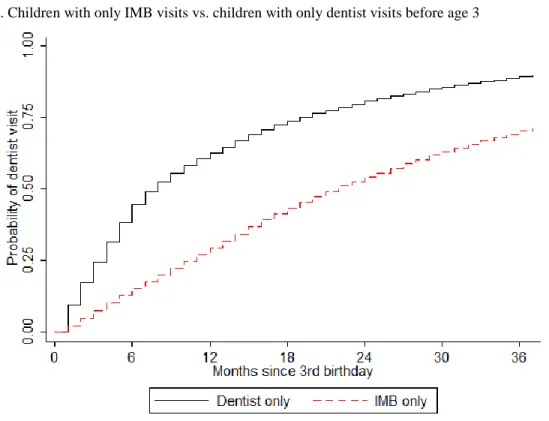
For study 1, we hypothesized that past use of dental care, specifically visiting only dentists before age 3 would be associated with a shorter time to a dentist visit after a child’s third birthday. Because children who received both IMB and dentist visits before age 3 have a history of visiting dentists and may encounter fewer structural barriers, we hypothesized that these children would have a similar time to a dentist visit after their third birthday as children who visited only dentists before age 3.
The primary outcome was the time in months from a child’s third birthday until his or her first dentist visit in an office-based setting, which was operationalized as any paid claim filed by a dentist up to three years following the child’s third birthday. Observations were censored when the child had an office-based dentist claim, was no longer enrolled in
Medicaid, or turned 6 years old. To compare children with only IMB visits and children with only dentist visits before age 3, we constructed a binary explanatory variable indicating the child received only IMB visits before 3 years of age. Visits to a dentist office for any reason were identified as any paid claim filed by a dentist before a child’s third birthday. To
compare children with both IMB and dentist visits and children with only dentist visits before age 3, we constructed a binary variable indicating receipt of both IMB and dentist visits before 3 years of age.
32
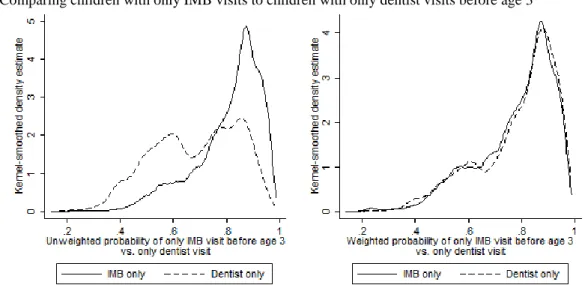
Table 3.1 and included squared terms of continuous variables and estimated two propensity scores by (1) predicting the likelihood of having only IMB visits compared to only dentist visits before age 3 (excluding children with both IMB and dentist visits) and (2) predicting the likelihood of having both IMB and dentist visits compared to only dentist visits before age 3 (excluding children with only IMB visits). We compared the time to a dentist visit after a child’s third birthday (IMB only versus dentist only and both IMB and dentist versus
dentist only) by constructing IPTW-adjusted Kaplan-Meier (KM) curves (calculated 1-KM) and tested for differences by using IPTW-adjusted Cox proportional hazard models,
including IMB only or both IMB and dentist visits as the only covariate.11 Huber-White empirical standard errors adjusted for intra-group correlation due to clustering of children within counties. Additionally, we conducted a sensitivity analysis to explore whether the number of dentists per county altered the effect of IMB visits on the time to a dentist visit by estimating a Cox model with an interaction term between a continuous measure of the number of dentists and the IMB indicator variable. Adjusted hazard ratios were compared using Wald tests and 95% confidence intervals.
3.4.2. Study 2: Effect of different modes of delivery on caries-related treatments and associated payments during ages 3 to 5 years
33
beginning with D2, D3, D4, D5, D6, D7, D8, and D9, which include amalgam restorations, composite restorations, extractions, crowns, and nerve-related treatments
(pulpotomies/pulpectomies). Payment for CRT was identified in Medicaid claims and summed to estimate annual treatment payments for ages 3, 4, and 5 years. To account for inflation over the study period, treatment payments were adjusted to constant 2006 U.S. dollars using the Gross Domestic Product price index.12 The main explanatory variable was operationalized as a 4-category variable indicating the delivery setting and provider for preventive oral health services before age three: IMB visits only, dentist visits only (reference group), both dentist and IMB visits, and neither.
34
Stata program PSMATCH2 and performed single nearest neighbor matching using a caliper equal to 0.20 of the standard deviation of the propensity score. Second, we estimated the likelihood of having a dentist visit only before age 3 for children who received only dentist visits or both dentist and IMB visits before age 3 because these two groups have the fewest observations. We excluded children beyond the common support region and performed single nearest neighbor matching. Using only the matched observations stemming from these two regression models, we then estimated the likelihood of having a dentist visit (with or without IMB visits) before age 3. We excluded children beyond the common support region and performed single nearest neighbor matching. To evaluate covariate balance in the final matched sample across our four-group treatment variable, we compared the distribution of propensity scores from the final regression model in the full and matched samples.
Additionally, we examined changes in absolute standardized differences of variables across treatment groups in the full and matched samples.14
A zero-inflated negative binomial regression was used to estimate the total number of dental CRT received per year per child for ages 3, 4, and 5 years old, a model appropriate for a count dependent variable with excess zeros.15 This model included an offset term equal to the logged number of months the child was enrolled in Medicaid at each age. Annual Medicaid payments for CRT at ages 3 to 5 years were estimated using a two-part regression model, which is appropriate for a continuous dependent variable with excess zeros.16 First, a logistic regression model was used to estimate the likelihood of having any treatment
35
heteroskedastic and normal errors. Regression models controlled for the covariates described in Table 3.1. Standard errors were clustered at the child-level to adjust for repeat
observations over time. Estimates from the logistic and OLS regression models were combined using 200 bootstrap replications to obtain an estimate of the expected annual payments for children aged 3 to 5 years receiving preventive oral health services during IMB visits, dentist visits, both IMB and dentist visits, and neither. Differences in mean expected outcomes were examined using Wald tests and 95% confidence intervals.
3.4.4. Study 3: Effect of the mode of delivery for preventive oral health services before 3 years of age on the dental caries experience of kindergarten children
For study 3, we hypothesized that children who received preventive oral health services before age 3 during IMB visits and dentist visits will have a similar number of decayed, missing and filled primary teeth (dmft) and proportion of untreated decayed teeth as each other, but fewer dmft and a lower proportion of untreated decayed teeth than children who did not receive prevention before age 3. To understand the effect of the mode of
delivery for preventive oral health services before 3 years of age on dental caries experience, we examined two outcomes. First, caries experience was measured, based on visual
inspection, as the total number of dmft of children enrolled in kindergarten. Second, to better understand a child’s access to dental treatment, we examined the proportion of a child’s caries experience that was untreated at the examination, defined as the number of decayed teeth divided by the total dmft score among those with dmft>0. As described in study 2, the main explanatory variable was operationalized as a 4-category variable indicating the
36
Propensity scores with IPTW were used to address selection bias that could arise because of systematic differences between children with and without dentist visits. We were concerned about selection bias associated with visits to dentists because it is unknown if these visits are due to existing disease or demand for preventive services. Propensity scores were estimated using logistic regression, controlling for the covariates identified in Table 3.1 and squared terms of continuous variables, and predicted the likelihood of having a dentist visit with preventive services before age three. To ensure appropriate comparison groups, we excluded children without dentist visits with a propensity score higher than the maximum or lower than the minimum propensity score of children with dentist visits. We calculated standardized weights for each child.17
A zero-inflated negative binomial regression model was used to compare the overall mean number of dmft at five years old for children according to use of the four modes of delivery for preventive oral health services. A binomial logistic regression for d/dmft (where d/dmft is the number of “events”/number of “trials”) was used to estimate the mean
37 Table 3.1. Description of variables
Variable description Type Study aim Source±
Dependent variables
Time to dentist visit during ages 36-71 months continuous 1 1
Number of caries-related treatments per year count 2 1
Payments for caries-related treatment per year continuous 2 1
Index of decayed, missing, and filled primary teeth count 3 2
Proportion of decay that is untreated proportion 3 2
Explanatory variables
Mode of delivery for preventing dental caries before 3 years of age
Indicator of IMB visits only (reference group:
dentist visit only) binary 1 1
Indicator of both IMB and dentist visits
(reference group: dentist visit only) binary 1 1
IMB visits only, dentist visits only (reference
group), both IMB and dentist visits, or neither categorical 2,3 1
Months enrolled in Medicaid after 3 years of age continuous 1,2,3, PS 1
Year child turned 3 years old categorical 1, 2, PS 1
Age in years categorical 2 1
Dental visit <6 months before 3 years of age binary 1 1
Indicator that oral health services were received in a Federally Qualified Health Center, health department, or rural health clinic before 3 years of age
binary 1,2,3, PS 1
Indicator that any caries-related treatment was
received before 3 years of age binary 3 1
Number of well-child visits before 3 years of age continuous 1,2,3, PS 1
Indicator that child has special health care needs binary 1,2,3, PS 1
Child’s gender (reference group: female) binary 1,2,3,PS 1
Child’s race and ethnicity
White binary 1,2,3, PS 1
Black binary 1,2,3, PS 1
Hispanic binary 1,2,3, PS 1
Level of urbanization of county categorical 1,2,3,PS 3
Medicaid eligibles under 21 years of age per 10,000
county population continuous 1,2,3,PS 3
Dentists per 10,000 county population continuous 1,2,3,PS 3
Pediatricians and family practice physicians per
10,000 county population continuous 1,2,3PS 3
Proportion of county population with access to
fluoridated drinking water categorical 2,3 3
±Data sources: 1. NC Medicaid claims data, 2. NCSoDC, 3. Other
38 References
1. Pahel BT. Referrals for dental care in medical office-based preventive dental program [PhD thesis]. University of North Carolina at Chapel Hill; 2008.
2. Beil HA. Effect of early preventive dental care on dental treatment, expenditures, and oral health among Medicaid enrolled children. [PhD thesis]. University of North Carolina at Chapel Hill; 2010.
3. King RS, Rozier RG. School-based dental disease prevention and oral health education: programs of the North Carolina Oral Health Section. NC Med J.
2008;69(6):490-494.
4. 2008-2009 annual report: North Carolina oral health section [Internet]. Raleigh (NC): NC Department of Health and Human Services; 2009 [cited June 29 2011]; Available from:
http://www.ncdhhs.gov/dph/oralhealth/library/includes/08-09%20OHS%20Annual%20Report.pdf.
5. County level oral health status data 2005-2006 [Internet]. Raleigh (NC): North Carolina Division of Public Health; 2006 [cited October 15 2011].; Available from: http://www.ncdhhs.gov/dph/oralhealth/library/includes/AssessmentData/2005-2006_County_Level_Oral_Health_Data.pdf.
6. Beil HA, Preisser JS, Rozier RG. Accuracy of record linkage software in merging dental administrative datasets. J Public Health Dent. 2012;doi: 10.1111/j.1752-7325.2012.00343.x.
7. Cecil G. Sheps Center for Health Services Research. North carolina health
professionals data system. Chapel Hill (NC): UNC Chapel Hill; 2007 [cited June 29 2011]. Available from: http://www.shepscenter.unc.edu/hp/prof07.htm..
8. North Carolina Division of Medical Assistance. Authorized medicaid and health choice for children eligibles reports. 2012 [cited October 15 2011]; Available from: http://www.ncdhhs.gov/dma/elig/index.htm.
9. North Carolina Oral Health Section. County-level water fluoridation data. Raleigh (NC): North Carolina Department of Health and Human Services; 2007 [cited June 29 2011].
10. Economic Research Service. Rural-urban continuum codes. Washington (DC): US department of Agriculture; 2003 [cited June 29 2011]. Available from:
http://www.ers.usda.gov/Data/RuralUrbanContinuumCodes/.11. Cole SR, Hernan MA. Adjusted survival curves with inverse probability weights. Comput Methods
Programs Biomed. 2004;75:45-49.