Analytical Solution for Telegraph Equation by Modified of
Sumudu Transform "Elzaki Transform"
Tarig. M. Elzaki1* & Eman M. A. Hilal21. Mathematics Department, Faculty of Sciences and Arts-Alkamil, King Abdulaziz University, Jeddah-Saudi Arabia.
Mathematics Department, Faculty of Sciences, Sudan University of Sciences and Technology-Sudan. 2. Mathematics Department, Faculty of Sciences for Girles King Abdulaziz University
Jeddah-Saudi Arabia
* E-mail of the corresponding author: [email protected] and [email protected]
The research is financed by Asian Development Bank. No. 2006-A171(Sponsoring information)
Abstract
In this work modified of Sumudu transform [10,11,12] which is called Elzaki transform method ( new integral transform) is considered to solve general linear telegraph equation, this method is a powerful tool for solving differential equations and integral equations [1, 2, 3, 4, 5]. Using modified of Sumudu transform or Elzaki transform, it is possible to find the exact solution of telegraph equation. This method is more efficient and easier to handle as compare to the Sumudu transform method and variational iteration method. To illustrate the ability of the method some examples are provided.
Keywords: modified of Sumudu transform- Elzaki transform - Telegraph equation - Partial Derivatives
1. Introduction
Telegraph equations appear in the propagation of electrical signals along a telegraph line, digital image processing, telecommunication, signals and systems.
The general linear telegraph equation is
U
tt+
aU
t+
bU
=
c U
2 xx (1) With the initial conditions:
U x
( , 0)
=
α
,
U x
t( , 0)
=
β
(2) Whereα β
,
are functions ofx
.Vol.2, No.4, 2012
[
]
0( )
( )
,
0
t uE f t
u f t e dt
t
∞ −=
∫
>
(3)Tarig M. Elzaki and Sailh M. Elzaki in [1,2,3,4,5,6], showed the modified of Sumudu transform [10,11,12] or Elzaki transform was applied to partial differential equations, ordinary differential equations, system of ordinary and partial differential equations and integral equations.
In this paper, Elzaki transform is applied to solve telegraph equations, which the solution of this equation have a major role in the fields of science and engineering.
To obtain Elzaki transform of partial derivative we use integration by parts, and then we have:
[
]
[
]
2 2 2 2 2 2 2( , )
1
( , )
1
( , 0)
( , )
( , )
( , 0)
( , )
( , )
( , )
( , )
f x t
f x t
f x
E
T x u
u
E
T x u
f x
u
t
u
t
u
t
f x t
d
f x t
d
E
T x u
E
T x u
x
dx
x
dx
∂
∂
∂
=
−
=
−
−
∂
∂
∂
∂
∂
=
=
∂
∂
Proof:To obtain ELzaki transform of partial derivatives we use integration by parts as follows:
(
)
(
)
(
)
0 0 0 0,
lim
( , )
( , )
,
, 0
lim
p p p t t t t u u u u p pf
f
f
x t
u
e dt
ue
dt
ue f x t
e f x t dt
t
t
t
T x u
uf
x
u
− − − − ∞ →∞ →∞
∂
∂
∂
Ε
=
=
=
−
∂
∂
∂
=
−
∫
∫
∫
We assume that
f
is piecewise continuous and it is of exponential order. Now(
)
(
)
(
)
0 0,
,
,
sin
t t uf
x t
uf
ue
dt
ue f
x
t dt
u
g the Leibnitz rule
x
x
x
∞ − − ∞∂
∂
∂
Ε
=
=
∂
∂
∂
∫
∫
T x u
(
,
)
and
f
d
T x u
(
,
)
x
x
dx
∂
∂
=
Ε
=
∂
∂
Also we can find:(
)
2 2 2 2
,
f
d
T x u
x
dx
∂
Ε
=
∂
. To find: 2 2( , )
f
x t
t
∂
Ε
∂
Letf
g
,
then
t
∂
=
∂
we have(
)
(
)
(
)
(
)
2 2,
,
,
g x t
g x t
, 0
f
x t
ug x
t
t
u
∂
∂
Ε
= Ε
= Ε
−
∂
∂
(
)
(
)
(
)
(
)
2 2 21
,
,
, 0
, 0
f
f
x t
T x u
f
x
u
x
t
u
t
∂
∂
Ε
=
−
−
∂
∂
(4)We can easily extend this result to the nth partial derivative by using mathematical induction.
2. Applications
In this section, modified of Sumudu transform or Elzaki transform method will be applied for solving some equations of linear forms. The results reveal that the method is very effective and simple.
To find the solution of equation (1), applying Elzaki transform of that equation and making use the initial conditions to find: 2 2 3 2 2 2 2 2 2 2 2 2 2 3 2 2
( , )
( , )
( , )
( , )
0
( , ) (1
) ( , )
d
T x u
u
u
auT x u
au
u bT x u
u c
T x u
dx
d
u c
T x u
au
u b T x u
u
u
a u
dx
α
β
α
α
β
α
−
−
+
−
+
+
=
⇒
+ +
+
=
+
+
This is the second order linear differential equation. The particular solution of this equation is obtained as:
2 3 2 2 2 2 2
( , )
( ). ( )
,
(1
)
u
u
a u
d
T u x
F u G x
D
c u D
au
bu
dx
α
+
β
+
α
=
=
=
+ +
+
Where
F u G x
( ) ,
( )
are functions ofu x
,
respectively.Now apply the inverse Elzaki transform to find the solution of the general telegraph equation (1) in the form
(
)
1
( , )
( )
( )
( ) ( )
U x t
=
G x E
−F u
=
G x f t
Assume that the inverse Elzaki transform is exists.
Example 2.1:
Consider the telegraph equation:
2 2 2
2
U
U
U
U
x
t
t
∂
∂
∂
=
+
+
∂
∂
∂
(5) With the initial conditions:
( , 0)
x,
( , 0)
2
x tVol.2, No.4, 2012
[
]
2 2 2 2 2 2 2 2 2( , )
( , )
( , )
2
2
2
( , )
(1
)
,
( , )
.
:
( , )
1 2
x x x x x t x x td
T x u
T x u
T x u
e
ue
ue
T x u
dx
u
u
u e
u T
u T
u e
and T x u
then U x t
e
e
e
u
− −=
−
+
+
−
+
′′
⇒
− +
= −
=
=
=
+
This is the exact solution of equation (5).Example 2.2:
Consider the telegraph equation:
2 2 2 2
4
4
U
U
U
U
x
t
t
∂
∂
∂
=
+
+
∂
∂
∂
(7) With the initial conditions:
( , 0) 1
2x,
( , 0)
2
t
U x
= +
e
U x
= −
(8) Take Elzaki transform of (7), and use (8) to find that:2 2 2 2 2
1
4
( , )
( , ) (1
x) 2
( , ) 4
4
x4 ( , )
d
T x u
T x u
e
u
T x u
u
ue
T x u
dx
=
u
− +
+
+
u
−
−
+
Andu T
2′′
( , ) (1 2 )
x u
− +
u T x u
2( , )
= −
(2
u
3+
u
2) (4
−
u
3+
u e
2)
2x The solution of equation is:2 2 2
( , )
1 2
xu
T x u
u e
u
=
+
+
, and the inverse of this equation gives the solution of equation (7) in the form:2 2
( , )
t xU x t
=
e
−+
e
Example 2.3:
Let us consider the telegraph equation:
2 2 2 2
4
4
U
U
U
U
x
t
t
∂
∂
∂
=
+
+
∂
∂
∂
(9) With the initial conditions:
U x
( , 0)
=
e
x,
U x
t( , 0)
= −
e
x (10) Take Elzaki transform of (9), and use (10) to find that:2 2 2 3
(4
4
1)
(
3
)
x2
( , )
1
xu e
T x u
u
=
+
, and the inverse of this equation gives the solution of equation (9) in the form:( , )
t.
x x tU x t
=
e
−e
=
e
−Example 2.4:
Consider the telegraph equation:
2 2 2 2
U
U
U
U
x
t
t
∂
∂
∂
=
+
+
∂
∂
∂
(11) With the initial conditions:
( , 0)
x,
( , 0)
x tU x
=
e
U x
= −
e
(12) Take Elzaki transform of (11), and use (12), and use the same method to find the solution of equation (11) in the form:( , )
t.
x x tU x t
=
e
−e
=
e
−3. Conclusion:
In this work, Elzaki transform is applied to obtain the solution of general linear telegraph equation. It may be concluded that Elzaki transform is very powerful and efficient in finding the analytical solution for a wide class of initial boundary value problems.
Acknowledgment:
Authors gratefully acknowledge that this research paper partially supported by Faculty of Sciences and Arts-Alkamil, King Abdulaziz University, Jeddah-Saudi Arabia, also the first author thanks Sudan University of Sciences and Technology-Sudan.
References
[1] Tarig M. Elzaki, The New Integral Transform “Elzaki Transform” Global Journal of Pure and Applied Mathematics, ISSN 0973-1768,Number 1(2011), pp. 57-64.
[2] Tarig M. Elzaki & Salih M. Elzaki, Application of New Transform “Elzaki Transform” to Partial Differential Equations, Global Journal of Pure and Applied Mathematics, ISSN 0973-1768,Number 1(2011), pp. 65-70.
[3] Tarig M. Elzaki & Salih M. Elzaki, On the Connections Between Laplace and Elzaki transforms, Advances in Theoretical and Applied Mathematics, ISSN 0973-4554 Volume 6, Number 1(2011),pp. 1-11. [4] Tarig M. Elzaki & Salih M. Elzaki, On the Elzaki Transform and Ordinary Differential Equation With Variable Coefficients, Advances in Theoretical and Applied Mathematics. ISSN 0973-4554 Volume 6, Number 1(2011),pp. 13-18.
Vol.2, No.4, 2012
[6] Tarig M. Elzaki, Existence and Uniqueness of Solutions for Composite Type Equation, Journal of Science and Technology, (2009). pp. 214-219.
[7] Lokenath Debnath and D. Bhatta. Integral transform and their Application second Edition, Chapman & Hall /CRC (2006).
[8] A.Kilicman and H.E.Gadain. An application of double Laplace transform and Sumudu transform, Lobachevskii J. Math.30 (3) (2009), pp.214-223.
[9] J. Zhang, Asumudu based algorithm m for solving differential equations, Comp. Sci. J. Moldova 15(3) (2007), pp – 303-313.
[10] Hassan Eltayeb and Adem kilicman, A Note on the Sumudu Transforms and differential Equations, Applied Mathematical Sciences, VOL, 4,2010, no.22,1089-1098
[11] Kilicman A. & H. ELtayeb. A note on Integral transform and Partial Differential Equation, Applied Mathematical Sciences, 4(3) (2010), PP.109-118.
[12] Hassan ELtayeh and Adem kilicman, on Some Applications of a new Integral Transform, Int. Journal of Math. Analysis, Vol, 4, 2010, no.3, 123-132
[13] C. Hchen, S.H.Ho.Solving Partial differential by two dimensiona differential transform method, APPL. Math .Comput.106 (1999)171-179.
[14] Fatma Ayaz-Solution of the system of differential equations by differential transform method .Applied .math. Comput. 147(2004)547-567.
[15] F. Kanglgil .F .A yaz. Solitary wave Solution for kdv and M kdv equations by differential transform method, chaos solutions and fractions do1:10.1016/j. Chaos 2008.02.009.
[16]Hashim,I,M.SM.Noorani,R.Ahmed.S.A.Bakar.E.S.I.Ismailand A.M.Zakaria,2006.Accuracy of the Adomian decomposition method applied to the
Lorenz system chaos 2005.08.135.
[17] J. K. Zhou, Differential Transformation and its Application for Electrical eructs .Hunzhong university press, wuhan, china, 1986.
[18] Montri Thong moon. Sasitornpusjuso.The numerical Solutions of differential transform method and the Laplace transform method for a system of differential equation. Nonlinear Analysis. Hybrid systems (2009) d0I:10.1016/J.nahs 2009.10.006.
[19] N.H. Sweilam, M.M. Khader. Exact Solutions of some capled nonlinear partial differential equations using the homotopy perturbation method. Computers and Mathematics with Applications 58 (2009) 2134-2141.
[20] P.R. Sharma and Giriraj Methi. Applications of Homotopy Perturbation method to Partial differential equations. Asian Journal of Mathematics and Statistics 4 (3): 140-150, 2011.
[21] M.A. Jafari, A. Aminataei. Improved Homotopy Perturbation Method. International Mathematical Forum, 5, 2010, no, 32, 1567-1579.
[22] Jagdev Singh, Devendra, Sushila. Homotopy Perturbation Sumudu Transform Method for Nonlinear Equations. Adv. Theor. Appl. Mech., Vol. 4, 2011, no. 4, 165-175.
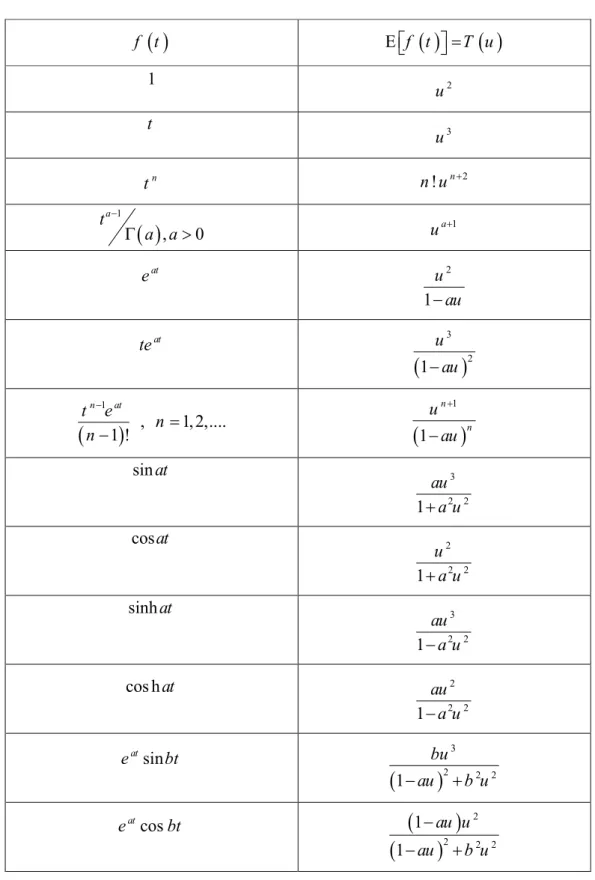
Table 1. Modified of Sumudu transform or ELzaki transform of some functions
( )
f t
Ε
f t
( )
=
T u
( )
1
2u
t
3u
nt
n u
!
n+2( )
1,
0
at
a a
−Γ
>
u
a+1 ate
21
u
au
−
atte
(
)
3 21
u
au
−
(
)
1,
1, 2,....
1 !
n att
e
n
n
−=
−
(
)
11
n nu
au
+−
sin
at
3 2 21
au
a u
+
cos
at
2 2 21
u
a u
+
sinh
at
3 2 21
au
a u
−
cos h
at
2 2 21
au
a u
−
sin
ate
bt
(
)
3 2 2 21
bu
au
b u
−
+
cos
ate
bt
(
)
(
)
2 2 2 21
−
au u
−
+
Vol.2, No.4, 2012
sin
t
at
4 2 22
1
au
a u
+
( )
0J
at
2 21
u
au
+
(
)
H t
−
a
2 a uu e
−(
t
a
)
δ
−
u e
−ua Tarig M. ElzakiDepartment of Mathematics, Faculty of Sciences and Arts-Alkamil, King Abdulaziz University, Jeddah-Saudi Arabia
E-mail: [email protected] and [email protected]
Eman M. A. Hilal
Department of Mathematics, Faculty of Sciences for Girls King Abdulaziz University, Jeddah- Saudi Arabia