Volume I, Issue IV, AUG - 2014
406
Classification Using Max-Margin and Kernel
Dimensionality Reduction
Kumudhaveni.K,Maheswari.R Student , Assistant Professor (CSE)
Nandha College of Technology, Erode. [email protected],[email protected]
Abstract: Classification is a data mining process that is used for assigning the data into different classes according to specific constraints. Classification plays important role in data analysis. A classification task begins with a data set in which the class assignments are known. It consists of predicting a certain outcome based on a given input. To predict the outcomes, the algorithm processes a training set containing a set of attributes and the respective outcome, usually called prediction attribute. In this paper various classification techniques for object detection were surveyed.
I. INTRODUCTION
Data Mining is a part of knowledge discovery process. It is a clever technique that can be applied to extract useful patterns. Images are considered as one of the most important medium of communication in the field of computer vision. There is a need for understanding and extracting patterns. For classification of any data the first step is data analysis, which can be used to extract models describing important classes or predict future data. They are
Classification
Prediction
Classification techniques in data mining are capable of processing a large amount of data. It can predict categorical class labels and classifies data based on training set and class labels and hence can be used for classifying newly available data. Classification and prediction are two forms of data analysis that can be used to extract models describing the important data classes or to predict the future data trends. The classification predicts categorical (discrete, unordered) labels, prediction model, and continuous valued function. Some of the most famous classification methodologies including decision tree induction, max margin classifier (SVM), bayesian classification, artificial neural network, and K-nearest neighbors were discussed in this survey.
2 CLASSIFICATION TECHNIQUES The emergence of classification techniques has recently grown in advance. The various classification techniques were analyzed in detail.
A. Decision tree induction
Decision tree induction is the learning of decision trees from class-labeled training tuples. A
decision tree is a flowchart-like tree structure, where each internal node (nonleaf node) denotes a test on an attribute, each branch represents an outcome of the test, and each leaf node (or terminal node) holds a class label. Decision tree is a classifier which has the form similar to that of a tree and has the following structure elements:
Root node: Left-most node in a decision tree
Decision node: Specifies a test on a single attribute
Leaf node: Indicates the value of target attribute
Edge: Split of an attribute
End-point: Right most node representing final outcome.
DT is constructed using divide and conquer (D&C) method [1].A suitable decision tree for the weekend decision choices would be as follows:
Volume II, Issue IV, AUG - 2014
407
The construction of decision tree classifiers does not require any domain knowledge or parameter setting, and therefore is appropriate for exploratory knowledge discovery. It is scalable for large database because the tree size is independent of the database size and it can handle high dimensional data. The learning and classification steps of decision tree induction are simple and fast. In general, decision tree classifiers have good accuracy.
B. Max margin classifier
The simplest form of SVM classification is the max margin classifier [6]. SVM is one of the most popular and useful techniques for data classification and regression [7]. It can be used for classify the both linear and non linear data. It uses a non-linear mapping to transform the original training data into a higher dimension. SVM is widely applied to the field of pattern recognition and is also used for an intrusion detection system. [8] The objective of SVM is to produce a model that predicts the target value of data occurrence in the testing set. [7] The classification goal in SVM is to separate the two classes by means of a function prepare from available data. It is used to solve the most basic classification problem, namely the binary classification with linear separable training data. [9] The aim of the max margin classifier is to find the hyperplane with the largest margin, i.e., the maximal hyperplane, in real-world problems, training data are not always linear separable.
The kernel technique is used by SVM are Regression, density estimation, kernel PCA, etc. Consider some training data D, a set of n points of the form
where the yi is either 1 or −1, indicating the class to
which the point belongs. Each is a p-dimensional real vector. If we want to find the maximum-margin hyperplane that divides the points having from those having . Any hyperplane can be written as the set of points satisfying
where denotes the dot product and W is the normal vector to the hyperplane. The region bounded by them is called "the margin". These hyperplanes can be described by the equations and
C. Artificial neural network
Volume II, Issue IV, AUG - 2014
408
Basic topology of neural network consists of feed forward neural network and recurrent network. In feed forward neural network information flow starts from the input node. The information flow is one direction only from input node to hidden node and finally leads to the output node. In each node one or more processing elements (PE) may be active. PE is used to simulate the neurons in the brain. PE receives input from the outside world or from the previous layer. No cycles or loops in this network. But in recurrent neural network data flows bi-directionally and feedback connections exists here. Neural network consist of three parts architecture, learning algorithm and the activation function [11]. Neural networks are programmed to store, recognize and retrieve patterns or database entries for solving ill defined problems, to filter noise from measured data
The Network Structure of ANN should be simple and easy. ANN is only introduce to enlarge the concept of parallel processing in the computer field. Parallel Processing is done by the human body in human neurons are very complex but by applying basic and simple parallel processing techniques we implement it in ANN like Matrix and some matrix calculations [12].
Ahmed [13] proposed Image Texture Classification technique based on Artificial Neural Networks (ANN). Firstly, image is captured and pre-processing is performed, after it, feature extraction [14] is performed, whereas, NN classifier [15] is used for texture classification, Clustering is performed to separates background from sub-images. Trained ANN combines the input pixels into two clusters which give results. It produces the texture classification and segmentation of image.
D. Bayesian network
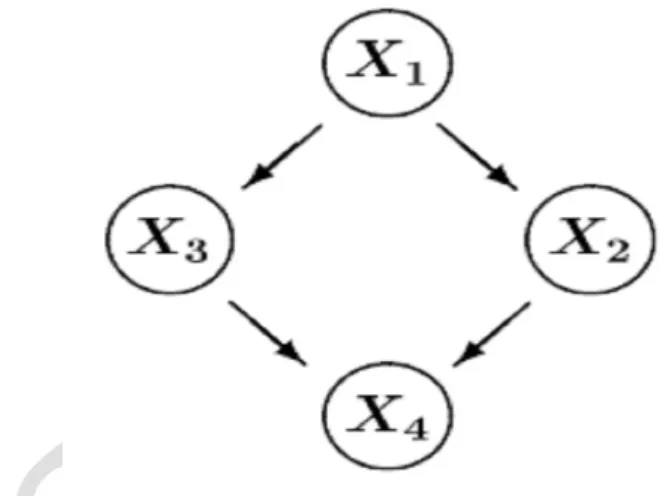
Bayesian network (BN) is also called belief networks. A BN is a graphical representation of probability distribution. This BN consist of two components. First component is mainly a directed acyclic graph (DAG) in which the nodes in the graph are called the random variables and the edges between the nodes or random variables represents the probabilistic dependencies among the corresponding random variables. Second component is a set of
parameters that describe the conditional probability of each variable given its parents. The conditional dependencies in the graph are estimated by statistical and computational methods [16], [17]. Thus the BN combine the properties of computer science and statistics. An example of such a BN with four variables is depicted as follows:
Figure 2: Example of Bayesian network
A BN encodes the joint probability P over a set of variables V = {X1,X2, ...,Xn} and decomposes it into a product of the conditional probability distributions over each variable given its parents in the graph.
BNs take account of prior information for a given problem. This prior expertise about the structure of Bayesian network can take the following forms:
Declare that a node is root node.
Declare that a node is leaf node.
Declaring that a node has direct effect of another node.
Declaring that a node is not directly connected to another node.
Declaring that two nodes are independent, giving a condition set.
Providing partial ordering among the nodes. Bayesian Network can be used by investigators to use their domain expert knowledge in the knowledge discovery process but other techniques primarily depend upon coded data to extract knowledge. BN model can be easily understood compared to many other techniques by the use of nodes and arrows. Researchers can encode the domain expert knowledge by the use the graphical diagrams, so they can easily understand the output of BN.
Volume II, Issue IV, AUG - 2014
409
E. K-nearest neighbors
Nearest neighbor (NN) also known as Closest Point Search is a mechanism that is used to identify the unknown data point based on the nearest neighbor whose value is already known. It has got a wide variety of applications in various fields such as Pattern recognition, Image databases, Internet marketing, Cluster analysis etc.
Nearest Neighbor mechanism can be classified into two types. They are Structure based and Structure less NN classification techniques. K-NN comes under the structure less classification technique [18]. Structure based deals with the basic structure of the data where as structure less mechanism is associated with training data samples. Latter overcomes the memory limitation whereas the former reduces the computational complexity.
It makes use of the more than one nearest neighbor to determine the class in which the given data point belongs to and hence it is called as K-NN. These data samples are needed to be in the memory at the run time and hence they are referred to as memory-based technique. All these data points are necessary in order to make a decision in determining the class of the given data point. There are a large number of machine learning algorithms and K-NN is the most simplest among them.
K-NN mechanism is easy to implement and hence it makes the implementation and debugging process to be faster. It can also help in easy analysis of the neighbor points. Hence the major advantage of this method is that training can be done in a faster manner, simple and easy to learn.
Large training data can be determined and hence is a robust mechanism [19]. It basically focuses on large training data sets. Several noise reduction techniques can be used that can be used to improve the classifier mechanism.
CONCLUSION
In this survey, various techniques of classification were described in detail. These techniques are most important for the detection of interesting patterns, images and points. The image classification techniques mentioned in this survey paper are used in many advanced machine learning for identification of faces, images and recognition of pattern. These classification techniques shows how a data can be determined and grouped when a new set of data is available. Based on the needed conditions, one
of the classification techniques can be selected for their needs.
REFERENCES
[1] A Fast Decision Tree Learning Algorithm Jiang Su and Harry Zhang Faculty of Computer Science
University of New Brunswick, NB, Canada, E3B 5A3.
[2] R.M. Haralick,"The table look-up rule," in Proc. Conf. on Pattern Recognition, 1976.
[3] C. R. P. Hartmann, P. K. Varshney, K. G.Mehrotra, C.L. Gerberich,"Application of information theory to the construction of efficient decision trees," IEEE Trans. Inform. Theory vol. IT-28, No.4, 565-577 (1982).
[4] D. E. Knuth, "Optimum binary search trees," ACTA Informatica, vol. 1, 14-25(1971).
[5] K.S. Fu, Sequential methods in pattern recognition and machine learning, Academic Press, 1968.
[6] Vipin Kumar , J. Ross Quinlan, Joy deep Ghosh , Qiang Yang ,Hiroshi Motoda, Geoffrey J. McLachlan , Angus Ng , Bing Liu, “Survey paper on Top 10 Algorithms in Data Mining”,4 December 2007© Springer-Verlag London Limited 2007.
[7] A. H. Nizar, Z. Y. Dong, and Y. Wang, “Power Utility Nontechnical Loss Analysis with Extreme Learning Machine Method”, VOL. 23, NO. 3, AUGUST 2008.
[8] Galit Shmueli, Nitin R.Patel, Peter C.Bruce, “Data Mining Business Intelligence” Wiley India Edition.
[9] Jiawei Han, Micheline Kambar, Jian Pei, “Data Mining Concepts and Techniques” Elsevier Second Edition
.[10] Artificial Neural Networks Ajith Abraham Oklahoma State University, Stillwater, OK, USA.
[11] Abraham, A. (2004) Meta-Learning Evolutionary Artificial Neural Networks, Neurocomputing Journal, Vol. 56c, Elsevier Science, Netherlands, (1–38)
[12] Christos Stergiou and Dimitrios Siganos, “Neural
Networks”.
Volume II, Issue IV, AUG - 2014
410
(ANN)," in Proc. 2nd National Conference on Emerging Trends and Applications in Computer Science (NCETACS), pp. 1-4, 2011.
[14] M. Sharif, M. Raza, S. Mohsin, and J. H. Shah, "Microscopic feature extraction method," Int. J. Advanced Networking and Applications, vol. 4, pp. 1700-1703, 2013.
[15] I.Irum, M. Raza, and M. Sharif, "Morphological techniques for medical images: A review," Research Journal of Applied Sciences, vol. 4, 2012.
[16] Charniak, E. 1991, .Bayesian Networks without tears. AI Magazine, Winter 1991.
[17] Ben-Gal I., Bayesian Networks, in Ruggeri F., Faltin F. & Kenett R Encyclopedia of Statistics in Quality & Reliability, Wiley & Sons (2007).
[18] Survey of Nearest Neighbor Techniques Nitin Bhatia (Corres. Author) Department of Computer Science DAV College Jalandhar, Vandana SSCS