Url: http://usnsj.com/index.php/JEE Email: [email protected]
The Difficulties of Writing Scientific Work
at the English Education Students
Suggestion for the Citation and Bibliography Citation in text:
Sulaiman & Muhajir (2019) or (Sulaiman & Muhajir, 2019) Bibliography:
Sulaiman, R. & Muhajir. (2019). The Difficulties of Writing Scientific Work at the English Education Students. Journal of English Education, 4(1), 54-60. doi: http://dx.doi.org/10.31327/jee.v4i1.923 Rizkariani Sulaiman
Universitas Muslim Indonesia Makassar [email protected]
+628190222324 Muhajir
Universitas Muslim Indonesia Makassar [email protected]
+628187260367
o-ISSN: 2502-6909 p-ISSN: 2502-9207 Vol. 4, No. 1, June 2019
URL: http://dx.doi.org/10.31327/jee.v4i1.923
Received : 27 May 2019 Reviewed : 28 May 2019 Accepted : 13 June 2019
© Sulaiman & Muhajir, 2019 All rights reserved
Abstract
T
he purpose of this study was to determine the students’ difficulties in writing scientific papers at the English Language Education, Universitas Muslim Indonesia (UMI) and to find out the needs and learning objectives of the students. The sample was consisted of 44 English Education students registered at the UMI, Faculty of Literature during the 2018/2019 academic year. To examine this problem, the study was conducted in a descriptive quantitative design. The instrument used in this study was questionnaires. Research questions consist of: 1) what are the difficulties faced by English Education major students in academic/scientific writing? 2) what are the common errors of English Education students in writing scientific papers? 3) what teaching approach can facilitate success in scientific writing? Based on the results of the study, the difficulties faced in the process of writing scientific papers were related to aspects of grammar (31%), scientific writing style/rules (24%), vocabulary, spelling and coherence (11%), writing arrangement (7%) and punctuation (5%); Three common errors that occur in writing scientific papers namely spelling (29.2%), use of capital letters (17, 75%), and punctuation (15.27%). The approaches needed by the teachers to strengthen and help students to improve their scientific writing referred to reviewing writing such as the level of words, sentences, paragraphs, and grammar, making outlines, applying three steps in the writing process such as planning, writing and revision, and understanding the formal and informal styles as well as oral and written forms so as to be able to avoid words and phrases that were not needed. Keywords: scientific writing, writing difficulties, EFL students, writing errors, teaching approachAUTHORS INFO ARTICLE INFO
A. Introduction
A
cademic/scientific writing in English is a challenge even for most native speakers. Likewise with EFL (English as a Foreign Language) students usually face difficulties and pressures in scientific writing, such as the difficulty of making paragraphs that are understandable and coherent, identifying skills needed for successful writing, and avoiding less effective words and phrases. However, the problems they face may be due to lack of knowledge or proficiency in English language as they do not have much experience in scientific writing. The scientific writing ability of EFL students may be influenced by factors such as writing style, motivation, anxiety over expression, author, and other emotional factors.Scientific writing can be defined as "mental and cognitive activities because it is a product of the mind" (Al Fadda, 2012). He shows that one of the basics of academic writing is the ability of students to access relevant references and evaluate various ideas and choices so that they can develop their own opinions. As noted by Al- Khasawneh & Mahen (2010) that the fundamental conventions of writing are outlining, summarizing, and paraphrasing. Al Fadda (2012) shows that learners must be familiar with punctuation such as dots, commas, colons, colons, hyphens, and uppercase letters. In addition, according to Al Badi (2015), there are four basic writing difficulties for postgraduate students: the most frequent difficulties are the use of language, coherence, and cohesion and choosing significant topics and relevant references. Conversely, paraphrasing, references, and quotations are the least problematic.
Previous researches above discussed the point of difficulties and writing approach partially while this present research focuses on identifying the difficulties and common errors students made in the students’ scientific papers writing. Therefore, teaching approaches are also needed by the teachers to improve the students’ writing skills, especially the scientific writings.
B. Literature review
According to Swales & Feak (2008) that scientific writing is the result of several considerations, namely: goals, organization, style, flow, and presentation.
Objective: in this case, the author must understand the interests of the author in the topic to be discussed. The next is Organization: the information submitted has a structured format. Scientific writing also uses several drafting patterns, such as chapters, sub-chapters and paragraphs. One of the most common strategies in scientific writing is compiling information using problem strategies - solutions (Hoey, 1983 in Swales & Feak, 2008). This pattern usually has four parts: Description of the situation, identification of problems, description of the solution, and evaluate the solution.
The third is Style: scientific writers must be sure that their communication through writing can be conveyed in the right and consistent style. Although challenges continue to increase in describing the style of scientific writing, but which needs to be the basis that one of the special characteristics of the style of scientific writing is choosing a more or more formal alternative when choosing verbs, nouns or other parts. English has very rich words because it comes from many languages. Therefore, there are often more than one way / word to express an idea. In oral lectures, conversations that are less formal are usually heard, but, in scientific writing, if there is more than one word to express an idea, it is necessary to choose a more formal and appropriate one. The last is Flow: one of the important considerations in communication through writing is flow - that is how to move from one statement to the next in a text. One strategy that can be used is to make connections between ideas clearly so that readers can follow and understand the flow of the text.
As a consequence, the instructor continues to question the lack of certain knowledge and skills needed in academic writing for non-native speakers of English. Some of these skills are outlining, paraphrasing, and summarizing (Al-Shabanah 2005). Besides, scientific writing often requires students to write in positions as experts, even when students do not consider themselves experts in the topics discussed (Tardy, 2010). In addition, poor language skills remain a problem. Beginner writers have poor language skills, and, due to this factor, cannot have effective discussions in the target language.
C. Methodology
1. Design
This study applied a descriptive quantitative method to collect information and data related to the research objectives. According to Sugiyono (2017), “descriptive quantitative research is data obtained from the sample study population analyzed according to statistical method used.” Descriptive research in this study intended to get an overview and information about the difficulties of students in writing scientific work.
2. Population and Sample
a. Population
According to Sugiyono (2017), “population is a generalization area consisting of objects/subjects that have certain qualities and characteristics determined by researchers to be studied and then conclusions drawn”. The population in this study was the seventh semester students majoring in English language education in the 2018/019 academic year. The population was consisted of two classes, where each class consisted of 25 students, so the total population was 50 students.
b. Sample
Sample is part of the number and characteristics possessed by the population (Sugiyono, 2017). In determining the number of sample, the researcher used the general table and rules R.V. Krejcie and D.W. Morgan. Based on the general table and rules, the sample obtained is 44 (N = 50, then S = 44) (Gay, 1987: 110-111);
3. Instruments
To collect data, the questionnaire was designed and distributed to forty-four (44) students majoring in English education at the Indonesian Muslim University. The questionnaire was close – ended. The purpose of using this questionnaire was to obtain information about the facts, opinions, and attitudes of the students regarding to their writing difficulties. The total number of questionnaire was 21 questions and consists of three parts. The first part: includes student identity, the second part: student difficulties in learning academic writing, and the third part: approach to teaching academic writing.
4. Data Collection Technique
To answer the research question, the questionnaire consisting of three parts was distributed to the seventh semester students of the English Education Department, UMI Faculty of Literature. To anticipate students who were not present, the researcher provided a questionnaire at the next meeting. Whereas to find out the general errors of students in writing scientific papers, essay test was given by first giving writing instructions.
5. Data Analysis Technique
After data has been collected, appropriate statistical tests are carried out to analyze the data, and answer research questions. All data obtained from questionnaires was coded. Descriptive statistics including frequency and percentage are used to present general condition of sample in this research.
D.Findings
1. Analysis of Academic Writing Difficulties
languages in English is also an aspect that becomes the difficulty of students in academic writing (56.81%). The fifth sequence is to make a paragraph that is easy to understand and interconnected (54.54%) also still perceived as difficult for half of the students. The sixth and seventh sequences are difficulties in combining sentences (52.27%) and adjusting subjects and verbs (43.18%).
Table 1. Writing difficulties
Academic Writing Difficulties F No % F No idea % F Yes %
1 Will the grammatical features be one of the problems you face in your English writing?
6 13.63 5 11.36 32 72.72
2 Do you often make sentence
fragment errors in your writing? 8 18.18 4 9.09 30 68.18 3 Do you often make subject-verb
disagreement errors in your writing?
9 20.45 15 34.09 19 43.18
4 Do you experience difficulty in using pronouns and pronoun-antecedent agreement?
5 11.36 7 15.90 30 68.18
5 Do you experience difficulty combining sentences in your writing?
11 25 8 18.18 23 52.27
6 Is it difficult to create an understandable and coherent paragraph?
8 18.18 11 25 24 54.54
7 Do you often notice the stylistic differences between spoken and written English in English texts?
6 13.63 12 27.27 25 56.81
2. Analysis of Students’ Essay
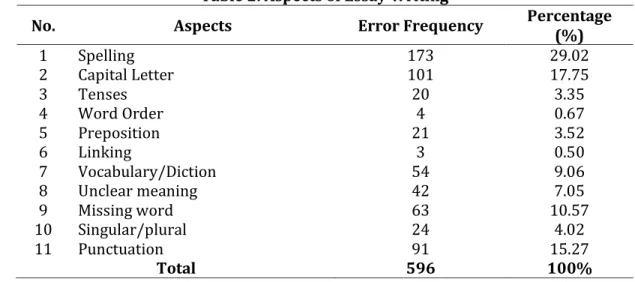
The Table 2 shows the analysis of the students’ essay. According to the table, there were three main errors with high frequency. Spelling errors and capitalization were the most found errors during checks with 29.02% and 17.75% respectively, while punctuation / not using punctuation errors was the third highest error with a percentage of 15.27%. Furthermore, lack of words in a sentence (10.57%), diction selection errors (9.06%), and the meaning was less clear in a sentence (7.05%). However, there were few errors in the use of subjects, single / plural bed words (4.02%), prepositional use (3.52%), tenses use (3.35%), word order (0.67%) and the last use of conjunctions (0.50%).
Table 2. Aspects of Essay Writing
No. Aspects Error Frequency Percentage (%)
1 Spelling 173 29.02
2 Capital Letter 101 17.75
3 Tenses 20 3.35
4 Word Order 4 0.67
5 Preposition 21 3.52
6 Linking 3 0.50
7 Vocabulary/Diction 54 9.06
8 Unclear meaning 42 7.05
9 Missing word 63 10.57
10 Singular/plural 24 4.02
11 Punctuation 91 15.27
3. Approaches of Writing Instruction
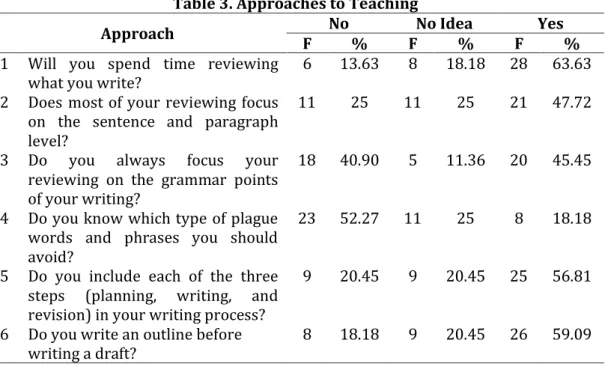
There are several approaches needed by the teachers that can help students in completing scientific work well. As the Table 3 shows that the highest percentage approach was to review / review the writing (63.63%). Furthermore, making an outline before writing the draft (59.09%), entering the three steps in the writing process (56.81%), emphasizing review on sentence and paragraph levels (47.72%), paying attention to grammar when reviewing (45.45%) and finally understanding the word and phrases that need to be avoided (18.18%).
Table 3. Approaches to Teaching
Approach F No % F No Idea % F Yes %
1 Will you spend time reviewing
what you write? 6 13.63 8 18.18 28 63.63
2 Does most of your reviewing focus on the sentence and paragraph level?
11 25 11 25 21 47.72
3 Do you always focus your reviewing on the grammar points of your writing?
18 40.90 5 11.36 20 45.45
4 Do you know which type of plague words and phrases you should avoid?
23 52.27 11 25 8 18.18
5 Do you include each of the three steps (planning, writing, and revision) in your writing process?
9 20.45 9 20.45 25 56.81
6 Do you write an outline before
writing a draft? 8 18.18 9 20.45 26 59.09
E. Discussion
The analysis of the students’ questionnaire showed that most students were interested in the Writing course. The first part of the questionnaire showed that most of the samples were women, and half of them classified themselves as having average abilities in English. In this case, students relate their abilities to the four foreign language skills, namely Listening, Reading, Speaking and Writing. In the second part of the student's questionnaire, the majority of students also stated that they had high motivation for writing learning, although almost half of the students (47.72) still stated their writing ability in the average category.
Aspects of difficulties in the next medium category are vocabulary, spelling and coherence with the same percentage of 11%. In accordance with Swales (2008) statement that the challenge in writing scientific papers continues to increase so that what needs to be the foundation is a special characteristic of scientific work, namely choosing the most formal alternative when choosing verbs, nouns or other types of words. English has a very rich vocabulary because it comes from many languages. Therefore, there are often more than one way / word to express an idea. This point is one of the difficulties for students, because in oral lectures usually less formal language is used, but in scientific writing, they are faced with a more formal choice of words. Low-level difficulties are in writing / organization writing (7%) and punctuation (5%). The organization / formulation and punctuation presented and applied to students are generally almost the same as the writing organization applied by the APA (American Psychologist Association) style, although there are differences that need to be adjusted.
To get an overview of the students’ real abilities and common errors in writing scientific papers, an examination of their writing is carried out. The results of the examination and analysis show that the three most common errors that occur frequently are spelling errors, capital letters and punctuation. Regarding spelling errors, caused by several factors: 1) less familiar with the word (minimal input skills: reading and listening); 2) not thorough in writing; 3) not reviewing the writing. Furthermore, the use of capital letters corresponds to the highest results in the aspects of students' difficulties in writing scientific works, namely grammar. In English material, the use of capital letters is also included in the discussion of grammar. Özer (2009) emphasized the spelling errors by his finding of some examples for causes of spelling errors are as follows: Lack of care in anatomic structures of letters; Very short of long extensions on shape of letters; Disproportional shapes of letters; Unnecessary ornaments and additions on shape of letters; Forgetting punctuation of letters; Writing letters very close; Disproportional spaces between letters and words; Lack of care in page setup; Lack of care in spelling; and Lack of care in alignment of lines. The third highest common error is punctuation.
The third research question is what approach needs to be strengthened to help students improve their scientific work. Some of these approaches are reviewing writing (at the level of words, sentences, and paragraphs, grammar) making outlines, applying three steps in the writing process (planning, writing and revision), and understanding formal and informal styles and oral and written forms so that they are able avoid words and phrases that are not needed.
F. Conclusion
Based on the results and discussion of this study, it was concluded that: (1) Difficulties faced in the process of writing scientific papers related to aspects of grammar (31%), scientific writing style / rules (24%), vocabulary, spelling and coherence (11%), compilation of writing (7%) and signs read (5%); (2) Three common errors that occur in writing scientific papers are on spelling (29.2%), use of capital letters (17, 75%), and punctuation (15.27%); and (3) The approach that needs to be strengthened to assist students in improving and improving their scientific writing is reviewing writing (at the level of words, sentences, and paragraphs, grammar,) making outlines, applying three steps in the writing process (planning, writing and revising) , and understand formal and informal styles and oral and written forms so as to be able to avoid words and phrases that are not needed.
G. References
Al Badi, I. A. H. (2015). Academic Writing Difficulties of ESL Learners. WEI International Academic Conference Proceedings. The West East Institute, Barcelona. Available at https://www.westeastinstitute.com/wp-content/uploads/2015/02/Ibtisam-Ali-Hassan-Al-Badi-full-Paper.pdf
Al Fadda, H. (2012). Difficulties in Academic Writing: From the Perspective of King Saud University Postgraduate Students. English Language Teaching, 5(3), 123-130. doi: https://doi.org/10.5539/elt.v5n3p123
Al-Khasawneh & Mahen (2010). Writing For Academic Purposes: Problems Faced By Arab Postgraduate Students of the College of Business, UUM. ESP World, Issue 2 (28), Volume 9. Available at http://www.esp-world.info/Articles_28/issue_28.htm.
Al-Shabanah, A. I. (2005). Summarization Strategies Adopted by the Senior Level Female Students of the Department of English at King Saud University. Master’s thesis, Arab
World English Journal. Available at
http://www.awej.org/index.php?option=com_content&view=article&id=1130:asma-ibrahim-alshabanah&catid=20&Itemid=117
Can, G. (2009). A Model for Doctoral Students’ Perceptions and Attitudes toward Written Feedback for Academic Writing. Doctoral Dissertation, Utah State University. Available at https://digitalcommons.usu.edu/etd/227/
Kereni, I. (2004). Developing Academic Writing at the National University of Rawanda: A Case Study of First Year Economics and Management. Master’s Thesis, University of the
Western Cape. Available at http://hdl.handle.net/11394/1485
Klimova, B. F. (2014). Constraints and Difficulties in the Process of Writing Acquisition.
Procedia - Social and Behavioral Sciences, Vol. 122, 433–437. doi: https://doi.org/10.1016/j.sbspro.2014.01.1367
Özer, N. Ö. (2009). Consciousness of Writing, Spelling Errors and Their Causes in Turkish Alphabet. Procedia - Social and Behavioral Sciences, Vol. 1, 1353–1356. doi: https://doi.org/10.1016/j.sbspro.2009.01.239.
Shafie, L. A., Maesin, A., Osman, N., Nayan, S., & Mansor, M. (2010). Understanding Collaborative Academic Writing Among Beginner University Writers in Malaysia.
Studies in Literature and Language, 1(2), 58-69. doi: http://dx.doi.org/10.3968/n
Sugiyono. (2017). Metode Penelitian Kuantitatif, Kualitatif, dan R & D. Bandung, Indonesia: Alfabeta.
Swales, J. M & Feak, C. B. (2008). Academic Writing for Graduate Students. USA: The University of Michigan Press.
Tardy, C. M. (2010). Writing for the World: Wikipedia as an Introduction to Academic Writing.