Automatic Port to OpenACC/OpenMP for Physical
Parameterization in Climate and Weather Code
Using the CLAW Compiler
Valentin Clement1 , Philippe Marti1 , Xavier Lapillonne2 ,
Oliver Fuhrer2 , William Sawyer3
c
The Authors 2019. This paper is published with open access at SuperFri.org
In order to benefit from emerging high-performance computing systems, weather and climate models need to be adapted to run efficiently on different hardware architectures such as accel-erators. This is a major challenge for existing community models that represent extremely large codebase written in Fortran. Large parts of the code can be ported using OpenACC compiler directives but for time-critical components such as physical parameterizations, code restructuring and optimizations specific to a hardware architecture are necessary to obtain high performance. In an effort to retain a single source code for multiple target architectures, the CLAW Compiler and the CLAW Single Column Abstraction were introduced. We report on the extension of the CLAW SCA to handle ELEMENTAL functions and subroutines. We demonstrate the new capability on the JSBACH land surface scheme of the ICON climate model. With the extension, JSBACH can be automatically ported to OpenACC or OpenMP for accelerators with minimal to no change to the original code.
Keywords: compiler, directive, GPU, OpenACC, OpenMP, automatic port.
Introduction
Numerical Weather Prediction and Climate modeling can highly benefit from computer tech-nologies advances by increasing resolution or model complexity. In the recent years, architectures such as Graphics Processing Unit (GPU) have emerged for scientific high performance comput-ing offercomput-ing new opportunities. Most of the current Numerical Weather Prediction and Climate models are large Fortran based community codes which require to be adapted or re-written to run on non traditional CPU architectures such as GPU. In order to prepare for heterogenous supercomputer architectures, the global weather and climate model ICON [2, 4] is being ported to accelerators. The major part of the porting is currently achieved using OpenACC [10] com-piler directives. For many code sections simple insertion of OpenACC comcom-piler directives is an appropriate porting approach. But, for time-critical components such as the physical parameter-izations, code restructuring and optimizations it is necessary to obtain optimal performance [6]. In some cases, the required code restructuring and optimization for GPU architectures have a negative impact when running the same code on a CPU architecture. Multiple solutions to address this problem have been proposed to achieve performance portability across architec-tures [3, 5, 8]. Here we focus on CLAW [1], an open-source source-to-source translator that allows to perform architecture-specific code transformations with minimal code modifications.
The CLAW SCA is designed to address the physical parameterizations of atmospheric mod-els in Fortran. Physical parameterizations are typically horizontally independent so each vertical column can be computed separately. With the CLAW SCA, the physical parameterizations are written in Fortran only considering the vertical dependencies while the horizontal directions are abstracted out. The CLAW Compiler can transform the code for a specific target architecture
1Centre for Climate System Modeling, Zurich, Switzerland
and insert horizontal loops and compiler directives such as OpenMP [11] for accelerator (version
≥4.5) or OpenACC.
In this paper, we focus on an CLAW SCA incorporation that extends CLAW capability to address such performance portability issues without imposing disturbing changes to the code base. We introduce a special case of the CLAW SCA connected with ELEMENTAL functions and subroutines. We demonstrate the new feature on the JSBACH land surface scheme [7] used in the ICON climate model. This paper is structured as follows: Section 1 describes the JSBACH land surface scheme and its use of ELEMENTALs. In Sections 2 and 3 we present the CLAW Compiler and the extension of SCA for ELEMENTALs. In Sections 4 and 5 we discuss our performance results and some code metrics. Finally, in Section 5 we draw our conclusion and discuss future work.
1. The JSBACH Land Surface Scheme and ELEMENTAL
In this section, we briefly describe the concept of ELEMENTAL subroutines and functions and its application in the JSBACH land surface scheme. Further, we summarize its structure.
1.1. ELEMENTAL subroutines and functions
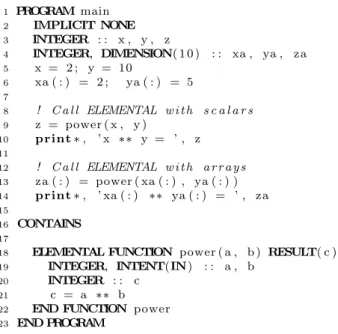
In Fortran, an ELEMENTAL function or subroutine is defined as a scalar operator. Dummy arguments as well as potential return value must be scalars but it may be called with arrays of arbitrary dimensionality as actual arguments. In this case, the operations defined in the function or the subroutine are applied element-wise on the full arrays. The main benefit of ELEMENTAL functions or subroutines is that it allows the user to write more compact code and allows the compiler to parallelize function or subroutine execution.
1 PROGRAMmain
2 IMPLICIT NONE 3 INTEGER : : x , y , z
4 INTEGER, DIMENSION( 1 0 ) : : xa , ya , za
5 x = 2 ; y = 10
6 xa ( : ) = 2 ; ya ( : ) = 5
7
8 ! C a l l ELEMENTAL w i t h s c a l a r s 9 z = power ( x , y )
10 print∗, ’ x ∗∗ y = ’ , z
11
12 ! C a l l ELEMENTAL w i t h a r r a y s 13 za ( : ) = power ( xa ( : ) , ya ( : ) )
14 print∗, ’ xa ( : ) ∗∗ ya ( : ) = ’ , za 15
16 CONTAINS 17
18 ELEMENTAL FUNCTION power ( a , b ) RESULT( c )
19 INTEGER, INTENT(IN) : : a , b 20 INTEGER : : c
21 c = a ∗∗ b
22 END FUNCTION power
23 END PROGRAM
Figure 1.Code example with a basic ELEMENTAL function
1.2. JSBACH
JSBACH is the land surface scheme of the global ICON model in climate mode. It is designed to serve as a land surface boundary for the atmosphere in the coupled simulation but it can also be used offline as a standalone model. JSBACH simulates photosynthesis, phenology and land physics with hydrological and bio-geochemical cycles.
JSBACH code is written in 2008 Fortran object-oriented style. It is designed as a pipeline of tasks where each task is applied on various tiles of the soil depending on their properties. Each task retrieves a number of fields from the internal memory object and applies several ELEMENTAL functions and/or subroutines as well as vector operations to them.
JSBACH interface
Radiation interface
update surface radiation
calc radiation surface net
lwnet from lwdown
calc radiation surface net
lwnet from lwdown
Vector notation to expand
calc radiation surface net
lwnet from lwdown
Figure 2. Example of a typical task workflow using ELEMENTALs in JSBACH - update radi-ation surface from the radiradi-ation interface
To hide some aspects of the design such as the memory access and pointers, JSBACH includes a non-Fortran Domain Specific Language (DSL). The code must be preprocessed by a Python script in order to obtain standard Fortran code. Section 2.1 describes where this preprocessing sits in the CLAW Compiler workflow. The choices of using ELEMENTAL functions and subroutines and the JSBACH DSL significantly simplify the code for the domain scientist. In its original form, the code is not suited to be ported easily to accelerators using OpenACC or OpenMP as compilers do not allow directives in PURE or ELEMENTAL functions and subroutines. In some cases vector notation can be handled by compilers with the !$acc kernels
In order to execute the code on a GPU, we need to either fundamentally refactor JSBACH or to take advantage of a source-to-source translator such as CLAW. CLAW can automatize the port while taking advantage of the current information we can extract from it. The latter solution is the one described in this paper and has the advantage to bring portability across compiler directives by supporting OpenACC and OpenMP simultaneosly.
Figure 2 is a typical call graph of a single task defined in JSBACH. update radiation surface is part of the radiation interface. This task is calling a single ELEMENTAL subroutine three times with different fields as arguments. This ELEMENTAL subroutine (calc radiation surface net) calls another ELEMENTAL function.
As all ELEMENTAL code needs to be transformed to accept compiler directives, everything in the task is transformed to be executed on the accelerator.
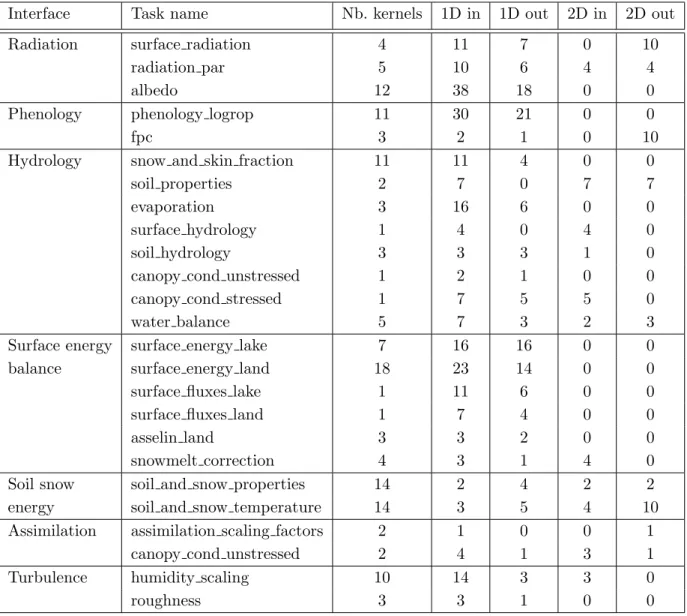
Table 1.JSBACH tasks with the number of automatically generated kernel and the number of 1 dimensional (1D) and 2 dimensional (2D) input/output fields for each task
Interface Task name Nb. kernels 1D in 1D out 2D in 2D out
Radiation surface radiation 4 11 7 0 10
radiation par 5 10 6 4 4
albedo 12 38 18 0 0
Phenology phenology logrop 11 30 21 0 0
fpc 3 2 1 0 10
Hydrology snow and skin fraction 11 11 4 0 0
soil properties 2 7 0 7 7
evaporation 3 16 6 0 0
surface hydrology 1 4 0 4 0
soil hydrology 3 3 3 1 0
canopy cond unstressed 1 2 1 0 0
canopy cond stressed 1 7 5 5 0
water balance 5 7 3 2 3
Surface energy surface energy lake 7 16 16 0 0
balance surface energy land 18 23 14 0 0
surface fluxes lake 1 11 6 0 0
surface fluxes land 1 7 4 0 0
asselin land 3 3 2 0 0
snowmelt correction 4 3 1 4 0
Soil snow soil and snow properties 14 2 4 2 2
energy soil and snow temperature 14 3 5 4 10
Assimilation assimilation scaling factors 2 1 0 0 1
canopy cond unstressed 2 4 1 3 1
Turbulence humidity scaling 10 14 3 3 0
roughness 3 3 1 0 0
Table 1 describes the list of tasks automatically ported to GPU. For each tasks, the number of kernels generated and their corresponding inputs and outputs are detailed. 1 dimensional fields includes only the horizontal dimension where 2 dimensional include the number of soil layer as their second dimension.
2. The CLAW Compiler and the Single Column Abstraction
This section presents the CLAW Compiler and the Single Column Abstraction on which our work is based.
2.1. The Compiler
The CLAW Compiler is an extensible open-source source-to-source compiler for modern Fortran code. It is based on the OMNI Compiler Project [9].
original.f90
dsl4jsb
original dsl4jsb.f90
Fortran Preprocessor (FPP)
original.pp.f90
OMNI F-Front
XcodeML/F IR input
CLAW X2T
XcodeML/F IR output
OMNI F-Back
transformed.f90
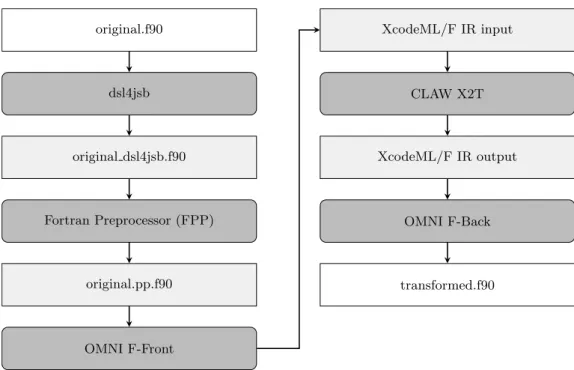
Figure 3. CLAW Compiler workflow including the JSBACH DSL preprocessing
Figure 3 illustrates the internal workflow of the compiler. JSBACH code is pre-processed by a dedicated Python script which initially translates the JSBACH DSL to standard Fortran before entering the CLAW workflow. Fortran code is pre-processed and then parsed to the XcodeML/F Intermediate Representation (IR) [12]. This IR - represented as an Abstract Syntax Tree (AST) - is then manipulated by CLAW XcodeML to XcodeML Translator (X2T) to produce the refactored version of the code for a specific target with inserted directives. Finally, the IR is decompiled to standard Fortran code before being compiled by default compilers. Major contribution to extend its transformations for ELEMENTALs was introduced in the CLAW X2T.
2.2. CLAW Single Column Abstraction (SCA)
independently and does not have any data dependencies on its neighbors. The CLAW Single Column Abstraction DSL [1] was introduced to exploit this information. A CLAW SCA source code is fully standard Fortran code with the addition of specific CLAW directives. The code has no notion of the horizontal dimensions in the declaration of the fields as well as in the execution part. Loops iterating over horizontal dimension are omitted.
Figure 4. Invocation of the CLAW Compiler with a specified target architecture and desired directives
The SCA code is processed by the CLAW Compiler as shown in Fig. 4. The user defines the target architecture as well as the compiler directives to be used. Under the hood, the CLAW Compiler performs create a data dependency graph to decide where to create kernels and there-fore which temporary fields have to be promoted. Based on this analysis it inserts the necessary iterations over the parallel dimensions and promotes the appropriate fields within the physical parametrization. In addition, the compiler inserts the required compiler directives to parallelize the loops and to manage data movement between the host and the device memory. The SCA transformation comes with various user-configurable options to manage promotion and data movement strategy, giving the end-user freedom to test various configurations.
3. Extension for ELEMENTAL Subroutines and Functions
An ELEMENTAL function or subroutine can be seen as a specific case of the CLAW SCA [1]. The land surface scheme is a point-wise computation on the grid that can be viewed as a column-wise computation with a limited number of vertical level.
The depth of the subroutine or function in the call graph determines the transformation applied to it. In Fig. 2, the leaf function lwnet from lwdown can be considered as a function to be inlined but calc radiation surface net is a perfect candidate to apply SCA transformation rules.
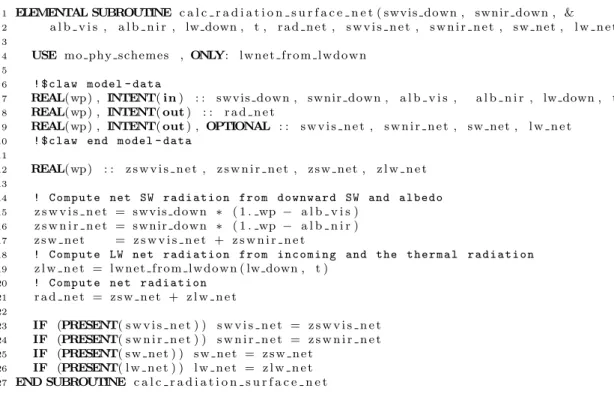
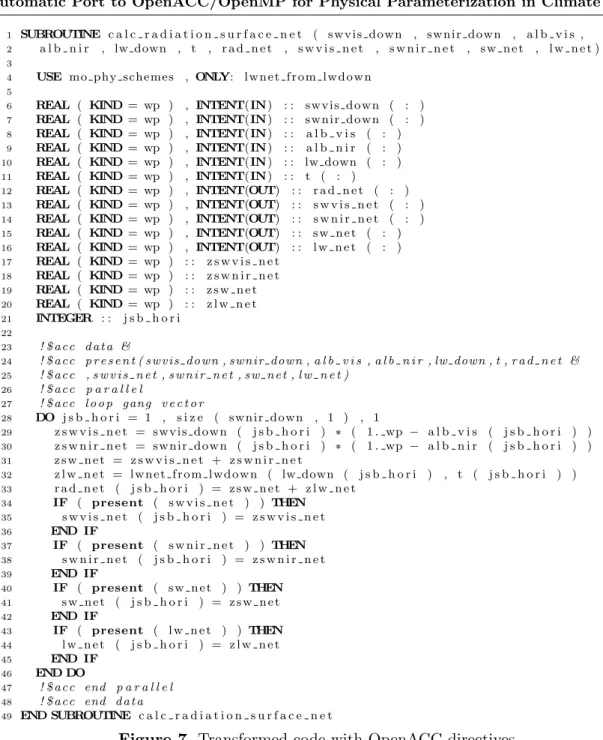
Figure 5 is the original code of calc radiation surface net processed by the user with CLAW SCA directive. Line 6 and 10 are defining the block of field coming from the model. These fields are often defined globally and therefore have to comply with the memory layout imposed by the calling model. The compiler then manages whether to apply promotion or not. The block directive also marks the whole subroutine as a SCA subroutine and thus activates the CLAW SCA transformation on it.
When a field is promoted or when a parallel iteration is inserted back into the code by the compiler, the dimension information is taken from the SCA model configuration file. This TOML formatted file defines the dimensions omitted in ELEMENTAL as well as layouts to be applied during the promotion transformation. This allows the user to investigate different data layouts depending on the target architecture. The user can update the default layout in the configuration file (Fig. 6) or add a layout clause to themodel−datadirective with the desired
layout. The SCA model configuration file used for JSBACH is shown in Fig. 6. This file is read by the compiler before applying transformation.
1 ELEMENTAL SUBROUTINE c a l c r a d i a t i o n s u r f a c e n e t ( swvis down , swnir down , &
2 a l b v i s , a l b n i r , lw down , t , r a d n e t , s w v i s n e t , s w n i r n e t , sw net , l w n e t ) 3
4 USE mo phy schemes , ONLY: l w n e t f r o m l w d o w n
5
6 ! $claw model - data
7 REAL(wp) , INTENT(in) : : swvis down , swnir down , a l b v i s , a l b n i r , lw down , t 8 REAL(wp) , INTENT(out) : : r a d n e t
9 REAL(wp) , INTENT(out) , OPTIONAL : : s w v i s n e t , s w n i r n e t , sw net , l w n e t
10 ! $claw end model - data
11
12 REAL(wp) : : z s w v i s n e t , z s w n i r n e t , z s w n e t , z l w n e t 13
14 ! Compute net SW r a d i a t i o n from d o w n w a r d SW and albedo
15 z s w v i s n e t = swvis down ∗ ( 1 . wp − a l b v i s )
16 z s w n i r n e t = swnir down ∗ ( 1 . wp − a l b n i r )
17 z s w n e t = z s w v i s n e t + z s w n i r n e t
18 ! Compute LW net r a d i a t i o n from i n c o m i n g and the thermal r a d i a t i o n
19 z l w n e t = l w n e t f r o m l w d o w n ( lw down , t )
20 ! Compute net r a d i a t i o n
21 r a d n e t = z s w n e t + z l w n e t
22
23 IF (PRESENT( s w v i s n e t ) ) s w v i s n e t = z s w v i s n e t 24 IF (PRESENT( s w n i r n e t ) ) s w n i r n e t = z s w n i r n e t
25 IF (PRESENT( s w n e t ) ) s w n e t = z s w n e t
26 IF (PRESENT( l w n e t ) ) l w n e t = z l w n e t
27 END SUBROUTINE c a l c r a d i a t i o n s u r f a c e n e t
Figure 5. Original source code for an ELEMENTAL subroutine enhanced with CLAW SCA directive inserted by the user
1 # CLAW SCA model c o n f i g u r a t i o n f o r JSBACH i n ICON 2
3 [ model ]
4 name = ”ICON JSBACH”
5
6 [ [ d i m e n s i o n s ] ] # D e f i n i t i o n o f d i m e n s i o n s t h a t can be used i n l a y o u t s 7 i d = ” j s b h o r i ” # H o r i z o n t a l dimension d e f i n i t i o n f o r JSBACH
8 [ d i m e n s i o n s . s i z e ]
9 l o w e r = 1 # i f no t s p e c i f i e d , 1 by d e f a u l t 10 upper = ” nc ” # Number o f columns
11
12 [ [ d i m e n s i o n s ] ]
13 i d = ” j s b s o i l ” # Dimension d e f i n i t i o n f o r t h e number o f s o i l l a y e r s 14 [ d i m e n s i o n s . s i z e ]
15 l o w e r = 1 # Lower bound
16 upper = ” n s o i l ” # Upper boudn f o r t h e number o f s o i l l a y e r s 17
18 [ [ l a y o u t s ] ] # D e f i n i t i o n o f l a y o u t s and d e f a u l t l a y o u t f o r s p e c i f i c t a r g e t 19 i d = ” d e f a u l t ” # mandatory l a y o u t , used i f no s p e c i f i c t a r g e t l a y o u t
20 # s p e c i f i e d i n t h e s c a d i r e c t i v e
21 p o s i t i o n = [ ” j s b h o r i ” , ” : ” ] # I n s e r t j s b h o r i b e f o r e t h e e x i s t i n g d i m e n s i o n s 22
23 [ [ l a y o u t s ] ]
24 i d = ” n c n s o i l ” # Name o f t h e l a y o u t
25 # Dimension l a y o u t f o r promotion . j s b h o r i and j s b s o i l a r e i n s e r t e d b e f o r e 26 # e x i s t i n g d i m e n s i o n s i n t h e g i v e n o r d e r .
27 p o s i t i o n = [ ” j s b h o r i ” , ” j s b s o i l ” , ” : ” ]
1 SUBROUTINE c a l c r a d i a t i o n s u r f a c e n e t ( swvis down , swnir down , a l b v i s , & 2 a l b n i r , lw down , t , r a d n e t , s w v i s n e t , s w n i r n e t , s w n e t , l w n e t )
3
4 USE mo phy schemes , ONLY: l w n e t f r o m l w d o w n
5
6 REAL ( KIND= wp ) , INTENT(IN) : : swvis down ( : ) 7 REAL ( KIND= wp ) , INTENT(IN) : : swnir down ( : )
8 REAL ( KIND= wp ) , INTENT(IN) : : a l b v i s ( : )
9 REAL ( KIND= wp ) , INTENT(IN) : : a l b n i r ( : )
10 REAL ( KIND= wp ) , INTENT(IN) : : lw down ( : ) 11 REAL ( KIND= wp ) , INTENT(IN) : : t ( : )
12 REAL ( KIND= wp ) , INTENT(OUT) : : r a d n e t ( : )
13 REAL ( KIND= wp ) , INTENT(OUT) : : s w v i s n e t ( : )
14 REAL ( KIND= wp ) , INTENT(OUT) : : s w n i r n e t ( : )
15 REAL ( KIND= wp ) , INTENT(OUT) : : s w n e t ( : ) 16 REAL ( KIND= wp ) , INTENT(OUT) : : l w n e t ( : ) 17 REAL ( KIND= wp ) : : z s w v i s n e t
18 REAL ( KIND= wp ) : : z s w n i r n e t
19 REAL ( KIND= wp ) : : z s w n e t
20 REAL ( KIND= wp ) : : z l w n e t
21 INTEGER : : j s b h o r i 22
23 !$acc d a t a &
24 !$acc p r e s e n t ( swvis down , swnir down , a l b v i s , a l b n i r , lw down , t , r a d n e t & 25 !$acc , s w v i s n e t , s w n i r n e t , s w n e t , l w n e t )
26 !$acc p a r a l l e l
27 !$acc l o o p gang v e c t o r
28 DO j s b h o r i = 1 , s i z e ( swnir down , 1 ) , 1
29 z s w v i s n e t = swvis down ( j s b h o r i ) ∗ ( 1 . wp − a l b v i s ( j s b h o r i ) )
30 z s w n i r n e t = swnir down ( j s b h o r i ) ∗ ( 1 . wp − a l b n i r ( j s b h o r i ) )
31 z s w n e t = z s w v i s n e t + z s w n i r n e t
32 z l w n e t = l w n e t f r o m l w d o w n ( lw down ( j s b h o r i ) , t ( j s b h o r i ) )
33 r a d n e t ( j s b h o r i ) = z s w n e t + z l w n e t
34 IF ( present ( s w v i s n e t ) ) THEN 35 s w v i s n e t ( j s b h o r i ) = z s w v i s n e t
36 END IF
37 IF ( present ( s w n i r n e t ) ) THEN 38 s w n i r n e t ( j s b h o r i ) = z s w n i r n e t
39 END IF
40 IF ( present ( s w n e t ) ) THEN 41 s w n e t ( j s b h o r i ) = z s w n e t 42 END IF
43 IF ( present ( l w n e t ) ) THEN 44 l w n e t ( j s b h o r i ) = z l w n e t
45 END IF 46 END DO
47 !$acc end p a r a l l e l 48 !$acc end d a t a
49 END SUBROUTINE c a l c r a d i a t i o n s u r f a c e n e t
Figure 7. Transformed code with OpenACC directives
target in this case. We rely here on the Fortran compiler to efficiently compile ELEMENTAL on CPU.
When applied to GPU, the following actions occur for non-leaf subroutine or function:
• The signature of the subroutine/function is updated and the ELEMENTAL or PURE specifiers are discarded.
• The flagged fields are promoted according to the specified layout. If no layout is speci-fied, the default layout is assumed. The promotion and layout information come from the configuration file as shown in Fig. 6.
• Iterations over new dimensions specified in the layout are inserted.
• Data analysis is performed and temporary fields or scalars that need promotion are pro-moted.
• As for other ELEMENTAL subroutines/functions, the signature is updated and the EL-EMENTAL or PURE specifiers are discarded.
• Compiler directives are inserted to set the subroutine or function as an OpenACC routine or OpenMP target code.
Once the code is annotated with CLAW SCA directives, the CLAW Compiler is called the same way for file with SCA or SCA with ELEMENTALs. Listing 4 can be executed in the same way.
3.1. Expansion Directive
As mentioned in Section 1, vector notation is used widely in tasks. To automatize the port of these blocks of Fortran code to OpenACC and OpenMP, the CLAW expand directive is used.
1 ! $claw expand p a r a l l e l
2 r a d s r f n e t ( : ) = ( 1 . wp − f r a c t l i c e ( : ) ) ∗ r a d n e t l w t r ( : ) + f r a c t l i c e ( : ) ∗
r a d n e t l i c e ( : )
3 s w s r f n e t ( : ) = ( 1 . wp − f r a c t l i c e ( : ) ) ∗ s w n e t l w t r ( : ) + f r a c t l i c e ( : ) ∗
s w n e t l i c e ( : )
4 l w s r f n e t ( : ) = ( 1 . wp − f r a c t l i c e ( : ) ) ∗ l w n e t l w t r ( : ) + f r a c t l i c e ( : ) ∗
l w n e t l i c e ( : )
5 ! $claw end expand
Figure 8.Block of vector notation with CLAW expand directive
Figure 9.Expanded vector notation
Figure 8 presents a block of vector notation operations surrounded by a CLAW expand block. The expand block works only for specific target as the CLAW SCA for ELEMENTAL. Before the transformation is applied to the block, an analysis is performed to make sure all the array dimensions are compatible to be transformed within the same loop structure. If the criteria are met, iteration are inserted on appropriate range and parallelization for the given directives. Figure 9 is the same code after transformation applied to it.
4. Performance Comparison
CPU as well as the GPU OpenACC results. The CPU reference is obtained using multi-core OpenMP parallelism available in the original version of ICON. The GPU OpenMP target results were obtained with Cray Compiler CCE 8.7.4 and by running standalone version of the kernels since the full ICON model is not ready to have a code mixing OpenMP for multi-core and for accelerator.
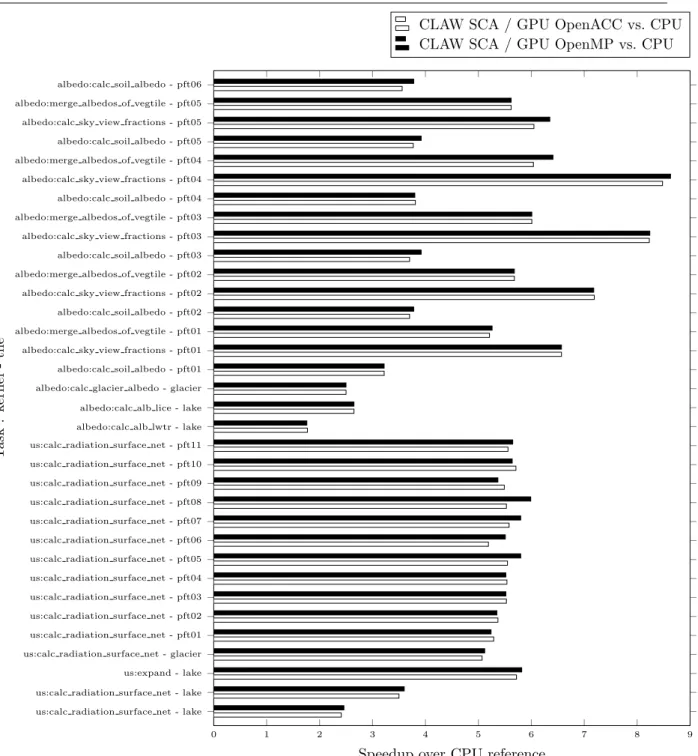
Figure 10 shows the speedup achieved from the CLAW SCA transformed version with Ope-nACC directives and the CLAW SCA transformed version with OpenMP directives over the CPU reference. The original version of the code is exploiting the 12 cores available on the Intel Xeon E5-2690 v3 Haswell CPU of Piz Daint at CSCS parallelized with multi-core OpenMP. The CLAW OpenACC and OpenMP versions are executed on one NVIDIA P100 GPU. The theo-retical floating point peak performance of the Intel Haswell is 500 GFLOPS, while the NVIDIA P100 is 5.3 TFLOPS. In term of memory bandwidth, the Haswell has a theoretical peak at 68 GB/s while the P100 can reach up to 732 GB/s. For both compute and memory bandwidth limited problem one can expect a maximum speedup of 11x.
As shown, OpenACC and OpenMP results are very similar and expected. Kernels issued from the ELEMENTAL transformation are pretty simple to be handled by a compiler and we did not expect PGI and Cray to fundamentally generate different code for them. Depending on the size of the kernel and the tile it has to process, we are able to achieve speedup between 1.7x up to 8.6x for kernel like thealbedo: calc sky view fractions. Tiles can be viewed as a collection of grid points from a specific type of land (e.g., lake or glacier) or as a mask for this specific type of land. Therefore tiles can have more or less work to be performed due to a different set of grid points. As GPUs need enough work to exploit massive parallelism, a reduced set of grid points is one of the reason the speedup can vary this much. Another factor is the size of the kernel. Some ELEMENTAL functions/subroutines are very small and the kernels generated from them are also small. Kernel’s launch and synchronization is then a non-negligible part of the overall kernel execution time. These overhead can be hidden in the execution of the full model with asynchronous mechanism.
5. Code Metrics
This section briefly compares the original code with its CLAW SCA version before and after applying transformations. Unlike the original SCA the SCA for ELEMENTAL imposes less changes to the code. In order to comply with the specification, the user only annotates the ELEMENTAL subroutines and functions to be executed on GPU, and relies on the compiler from then on. There is no need to apply other code change in the ELEMENTALs.
The full JSBACH model is annotated with 40 CLAW SCA directives and about 130 CLAW expansion directives to convert vector notation to parallelizable loops. In the transformed code there are almost 2000 lines of OpenACC directives or OpenMP depending the user’s choice. This is the amount of compiler directives a user would have had to write by hand to achieve the same goal. A hand-written version would also have to change the code structure significantly, for example by promoting fields and adding loops.
Conclusion
heteroge-0 1 2 3 4 5 6 7 8 9 us:calc radiation surface net - lake
us:calc radiation surface net - lake us:expand - lake us:calc radiation surface net - glacier us:calc radiation surface net - pft01 us:calc radiation surface net - pft02 us:calc radiation surface net - pft03 us:calc radiation surface net - pft04 us:calc radiation surface net - pft05 us:calc radiation surface net - pft06 us:calc radiation surface net - pft07 us:calc radiation surface net - pft08 us:calc radiation surface net - pft09 us:calc radiation surface net - pft10 us:calc radiation surface net - pft11 albedo:calc alb lwtr - lake albedo:calc alb lice - lake albedo:calc glacier albedo - glacier albedo:calc soil albedo - pft01 albedo:calc sky view fractions - pft01 albedo:merge albedos of vegtile - pft01 albedo:calc soil albedo - pft02 albedo:calc sky view fractions - pft02 albedo:merge albedos of vegtile - pft02 albedo:calc soil albedo - pft03 albedo:calc sky view fractions - pft03 albedo:merge albedos of vegtile - pft03 albedo:calc soil albedo - pft04 albedo:calc sky view fractions - pft04 albedo:merge albedos of vegtile - pft04 albedo:calc soil albedo - pft05 albedo:calc sky view fractions - pft05 albedo:merge albedos of vegtile - pft05 albedo:calc soil albedo - pft06
Speedup over CPU reference
T
ask
:
k
ernel
-tile
CLAW SCA / GPU OpenACC vs. CPU CLAW SCA / GPU OpenMP vs. CPU
Figure 10. Performance comparison (socket to socket) between CLAW OpenACC, CLAW OpenMP and the CPU reference of kernels from two JSBACH tasks on Intel Haswell E5-2690v3 and NVIDIA P100. Domain size (number of horizontal grid points × number of soil layers) = 20480×5
nous architecture. The ELEMENTAL construct as exploited in JSBACH provides the necessary abstraction to implement automatic code transformation and target GPU architectures with-out writing lots of compiler directives by hand. Promotion, loop parallelization and compiler directive generation are handled by the CLAW Compiler automatically.
results show up to 8.6x speedup against a 12-core parallel CPU version for a specific kernel. All kernels are a least 1.7x faster than the CPU version. The overall performance of the JSBACH model running on GPU is typically between 5x to 6x speedup depending on its configuration.
In the current implementation of the extension, a single parallel subroutine or function is generated from its ELEMENTAL counterpart. This is fine for the JSBACH use case as a single ELEMENTAL is always called with the same kind of arguments. Future improvement to generate several versions of a subroutine or a function if the type of argument used to call them is different.
As it is possible to generate any source code, we can imagine to take advantage of new compiler development such as exploiting the DOCONCURRENT construct from Fortran 2008 to target accelerators as it is investigated in latest version of PGI. Instead of generating compiler directives the CLAW Compiler could exploit this new Fortran feature.
Acknowledgements
This work was supported by a grant from the Swiss National Supercomputing Centre (CSCS) under project ID c15. We would like to show our gratitude to the OMNI Compiler Team at RIKEN CCS for their effort and support to provide a very useful open-source tool-chain. We would also like to thank Reiner Schnur, a scientific programmer at the Max-Plank-Insitut fr Meteorologie for his insights in the JSBACH code base and review of our changes. This work was partly funded by ETH Zurich and the PASC Initiative under the ENIAC project.
This paper is distributed under the terms of the Creative Commons Attribution-Non Com-mercial 3.0 License which permits non-comCom-mercial use, reproduction and distribution of the work without further permission provided the original work is properly cited.
References
1. Clement, V., Ferrachat, S., Fuhrer, O., et al.: The CLAW DSL: Abstractions for performance portable weather and climate models. In: Proceedings of the Platform for Advanced Scien-tific Computing Conference. pp. 2:1–2:10. PASC ’18, ACM, New York, NY, USA (2018), DOI: 10.1145/3218176.3218226
2. Crueger, T., Giorgetta, M.A., Brokopf, R., et al.: ICON-A, the atmosphere component of the ICON Earth system model: II. model evaluation. Journal of Advances in Modeling Earth Systems 10(7), 1638–1662 (2018), DOI: 10.1029/2017MS001233
3. Fuhrer, O., Osuna, C., Lapillonne, X., et al.: Towards a performance portable, architecture agnostic implementation strategy for weather and climate models. Supercomputing Frontiers and Innovations 1(1), 45–62 (2014), DOI: 10.14529/jsfi140103
4. Giorgetta, M.A., Brokopf, R., Crueger, T., et al.: ICON-A, the atmosphere component of the ICON Earth system model: I. model description. Journal of Advances in Modeling Earth Systems 10(7), 1613–1637 (2018), DOI: 10.1029/2017MS001242
High Performance Computing, Networking, Storage and Analysis. pp. 41:1–41:12. SC ’15, ACM, New York, NY, USA (2015), DOI: 10.1145/2807591.2807627
6. Lapillonne, X., Fuhrer, O.: Using compiler directives to port large scientific applications to GPUs: An example from atmospheric science. Parallel Processing Letters 24(1) (2014), DOI: 10.1142/S0129626414500030
7. Mauritsen, T., Bader, J., Becker, T., et al.: Developments in the MPI-M Earth System Model version 1.2 (MPI-ESM1.2) and Its Response to Increasing CO2. Journal of Advances in Modeling Earth Systems 11(4), 998–1038 (2019), DOI: 10.1029/2018MS001400
8. Muller, M., Aoki, T.: Hybrid Fortran: High productivity GPU porting framework applied to Japanese weather prediction model. CoRR abs/1710.08616 (2017), http://arxiv.org/ abs/1710.08616
9. Omni CompilerProject: Omni Compiler Project - An Infrastructure for Source-to-Source Transformation. http://omni-compiler.org(2013-2019), accessed: 2019-09-02
10. OpenACC Standard: The OpenACC application programming interface - version
2.7. https://www.openacc.org/sites/default/files/inline-files/OpenACC.2.7.pdf
(2018), accessed: 2019-09-02
11. OpenMP Architecture Review Board: OpenMP application programming interface - version
5.0. https://www.openmp.org/wp-content/uploads/OpenMP-API-Specification-5.0.
pdf (2018), accessed: 2019-09-03
12. XcalableMP Specification Working Group: XcodeML/Fortran Specification. https:
//omni-compiler.org/download/xcodeml/stable/XcodeML-F-1.0.pdf (2017), accessed: