SMART CITY
*Anjana Sengupta, Ayan Ghosh and Shamik Chattaraj
Department of Electrical Engineering,
ARTICLE INFO ABSTRACT
India is going through a rapid urbanization. With increasing population and increasing population density, arises t
user friendly and custom made technologies serve the purpose of addressing the challenges faced. Thus comes the idea of smart city. Smart city uses technology to observe, measure, monitor and control 3 fol
Smart city is a
environment, society, economy and technology. This paper deals with the basic plan and prospect of a smart city.
Copyright©2016, Anjana Sengupta et al. This is an open
use, distribution, and reproduction in any medium, provided the original work is properly cited.
INTRODUCTION
There is substantial literature on the definition of smart cities which could be categorized into three major sources:
Research and academic view: Puts sustainability, (mainly
environmental sustainability) as the primary agenda to be achieved, where quality of life and economy emerge as second-level priority factors.
Corporate sector's (mainly technology companies)
definition : Looks at ICT as a panacea, assuming that the
required outcomes such as city efficiency, management, infrastructure, environment, and quality of life follow automatically. Notably, there is nominal emphasis on the overall functionality, resilience, city form and urban design of the smart city.
Government sector - This sector reflects a larger
understanding of the use of ICT in delivering governance, recognizes the critical relevance of human resources, and puts emphasis on quality of life as well as environment. However, a very limited number of definitions have emerged from this sector.
*Corresponding author: Anjana Sengupta,
Department of Electrical Engineering, Technique Polytechnic Institute/WBSCTVESD, India
ISSN: 0975-833X
Article History:
Received 23rd March, 2016
Received in revised form 10th April, 2016
Accepted 26th May, 2016 Published online 15th June,2016
Key words:
Governance; Smart City; Sustainable Behavior; Sustainable Planning, Information and communication technology (ICT).
Citation: Anjana Sengupta, Ayan Ghosh and Shamik (06), 32439-32444.
RESEARCH ARTICLE
SMART CITY- PLAN AND PROSPECT
Anjana Sengupta, Ayan Ghosh and Shamik Chattaraj
Department of Electrical Engineering, Technique Polytechnic Institute/WBSCTVESD, India
ABSTRACT
India is going through a rapid urbanization. With increasing population and increasing population density, arises the need of optimized and smart use of resources. With the ever developing science user friendly and custom made technologies serve the purpose of addressing the challenges faced. Thus comes the idea of smart city. Smart city uses technology to observe, measure, monitor and control 3 fold services-
Only utilities- by shifting the social behavior of citizens towards a more efficient and sustainable utilization of city resources
Where utilities and revenues are generated- allowing service providers (such as utilities and transit companies) and government to provide more efficient and sustainable services Fun / leisure.
Smart city is a “smart”,” intelligent” or ”cognitive” concept which has a multidimensional affect on environment, society, economy and technology. This paper deals with the basic plan and prospect of a smart city.
is an open access article distributed under the Creative Commons Attribution License, which use, distribution, and reproduction in any medium, provided the original work is properly cited.
There is substantial literature on the definition of smart cities which could be categorized into three major sources:
Puts sustainability, (mainly environmental sustainability) as the primary agenda to be ity of life and economy emerge as
Corporate sector's (mainly technology companies)
Looks at ICT as a panacea, assuming that the required outcomes such as city efficiency, management, , and quality of life follow automatically. Notably, there is nominal emphasis on the overall functionality, resilience, city form and urban design
This sector reflects a larger ivering governance, recognizes the critical relevance of human resources, and puts emphasis on quality of life as well as environment. However, a very limited number of definitions have
Department of Electrical Engineering, Technique Polytechnic
The motivation behind the thought of smart city is that the city, as a government unit, is growing increasingly larger, more complex and more important as the populati
areas swell with ever increasing speed. With the rapid increase of the urban population worldwide, cities face a variety of risks, concerns, and problems; for example, physical risks such as deteriorating conditions in air and transportat
economic risks such as unemployment.
The unprecedented rate of urban growth creates urgency to finding smarter ways to manage the accompanying challenges From general view smart city is a planned residential area which follows the idea of optimi
different resources. The planning should provide the advantage of giving the right information to the right person at the right time and thus helps to control different parameters in order to achieve sustainable use of city resou
Proper planning of a smart city also allows the Government and different service providers to provide more efficient and sustainable services. The planning has technological aspects related with it. The use of different renewable resources, sensors, transducers, signal conditioners helps to plan and lay the smart city.
Available online at http://www.journalcra.com
International Journal of Current Research Vol. 8, Issue, 06, pp.32439-32444, June, 2016
INTERNATIONAL
Anjana Sengupta, Ayan Ghosh and Shamik Chattaraj, 2016. “Smart City- Plan and Prospect”,International Journal of Current Research z
Anjana Sengupta, Ayan Ghosh and Shamik Chattaraj
Technique Polytechnic Institute/WBSCTVESD, India
India is going through a rapid urbanization. With increasing population and increasing population use of resources. With the ever developing science user friendly and custom made technologies serve the purpose of addressing the challenges faced. Thus comes the idea of smart city. Smart city uses technology to observe, measure, monitor and
by shifting the social behavior of citizens towards a more efficient
allowing service providers (such as utilities and transit companies) and government to provide more efficient and sustainable services
“smart”,” intelligent” or ”cognitive” concept which has a multidimensional affect on environment, society, economy and technology. This paper deals with the basic plan and prospect of a
ribution License, which permits unrestricted
The motivation behind the thought of smart city is that the city, as a government unit, is growing increasingly larger, more complex and more important as the population ranks of urban areas swell with ever increasing speed. With the rapid increase of the urban population worldwide, cities face a variety of risks, concerns, and problems; for example, physical risks such as deteriorating conditions in air and transportation, and economic risks such as unemployment.
The unprecedented rate of urban growth creates urgency to finding smarter ways to manage the accompanying challenges. From general view smart city is a planned residential area which follows the idea of optimized and sustainable use of different resources. The planning should provide the advantage of giving the right information to the right person at the right time and thus helps to control different parameters in order to achieve sustainable use of city resources.
Proper planning of a smart city also allows the Government and different service providers to provide more efficient and sustainable services. The planning has technological aspects related with it. The use of different renewable resources, , transducers, signal conditioners helps to plan and lay
INTERNATIONAL JOURNAL OF CURRENT RESEARCH
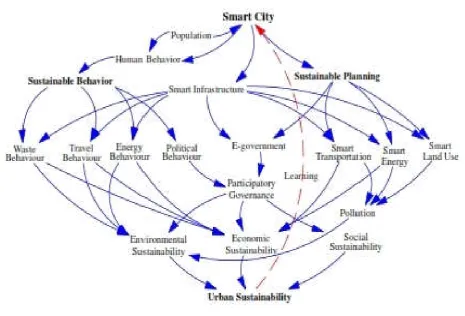
Fig. 1. Process of achieving urban sustainability
Stakeholders
Government
The Government has framed the objectives as follows:
A city needs to be sustainable to become smart
Principles of good governance need to be fostered as
they are important for achieving sustainability
Technology is an important enabler in achieving the
above mentioned features along with a supportive policy environment, long-term vision and domestic stability. Innovation will follow as a result
Urban institutions need capacity to achieve and/or
nurture.
India needs to build its own terms of reference for
developing smart cities, being cognizant of the four important imperatives .
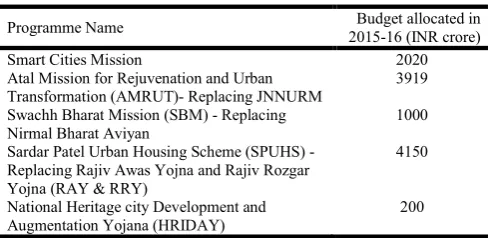
[image:3.595.41.288.315.434.2]The following are some data which would throw light on the effort government is putting in the smart and sustainable urbanization.
Table 1. Major Ministry of Urban Development Programmes since 2014
Programme Name Budget allocated in
2015-16 (INR crore)
Smart Cities Mission 2020
Atal Mission for Rejuvenation and Urban Transformation (AMRUT)- Replacing JNNURM
3919
Swachh Bharat Mission (SBM) - Replacing Nirmal Bharat Aviyan
1000
Sardar Patel Urban Housing Scheme (SPUHS) - Replacing Rajiv Awas Yojna and Rajiv Rozgar Yojna (RAY & RRY)
4150
National Heritage city Development and Augmentation Yojana (HRIDAY)
200
The smaller objectives the Government follows in order to address the bigger challenge in achieving the process-oriented path rather than a project-oriented path are as follows:
Establishing an Efficient Urban Management Systems
Indian cities are not equipped with any comprehensive monitoring and evaluation platforms for measuring the performance of projects and plans.
Building Adequate Capacity of Urban Institutions and Local Governments
The technology domain and its application in cities are developing at a fast pace.
Achieving the Decentralization Agenda
This includes the creation of platforms for citizen engagement in identifying, planning and implementing city-level programmes and projects. A smart city must address this by not only applying technology, but also by adequately altering institutionalized decision-making processes.
Minimizing Conflicts in the Urban Environment
A holistic decision-support platform will allow cities to be treated as spaces and as a system of systems, while minimizing conflicts.
Creating Enabling Conditions for Inclusive and Equitable Urbanization
Gaps in income, opportunity, and quality of life standards need be addressed through better access to infrastructure, facilities and information.
Utility providers
The utility providers such as real estates, the local government bodies and other bodies concerned with the planning and execution of the smart city may take into account the following ways of achieving sustainable development:
City monitoring and operation systems: The aim of a city
system is to combine city level operation with co-operation between different local systems in order to monitor performance and optimize processes. Intelligence and inter-operable interfaces are added between separate systems, e.g. lighting systems, the energy grid and mobility systems, in order to input information from these into the city decision-making services. Available solutions are often off-line and ad-hoc, not replicable or suitable for comparisons between cities. The new developments on fused sensing, data monitoring technologies and the Internet of Things (IoT) are key to efficient and real-time collection of “raw” information from various sources that are then enriched into information through KPI calculations and further into decision-making services.
The performance measurement system meta-data model
and calculation methodologies are based on: Defining the
required data sets to be collected based on the specified indicators. Identifying available data sources, their reliability, accessibility and data models. Specifying the collection system
and calculation methodologies for the performance
measurement. Integration into the system of intelligence and interoperability interfaces between separate systems, input specifications and calculation methodology. Development of user-friendly interface and information visualization.
City interoperatability environment: The application of ICT
in a city environment can bring about a significant increase in productivity and well-being. However, smart city solutions seem to be fragmented across cities and sectors, which subsequently leads to a situation in which innovations do not diffuse widely and reach their full potential.
Themes for enabling interoparatability: It seems clear that
there is a need for an open and modular interoperability environment for smart city solutions that spans across cities and sectors. In such a model, cities would be able to define a modular architecture together with infrastructure vendors and service providers, which in turn would form a basis for multi-vendor solutions, continual innovation and progress. To address fragmentation across sectors and cities we see three important horizontal layers in which modular and open processes need to be planned:
Common innovative practices for public sectors related
to, e.g., innovative procurement, regulation and opening of common resources (e.g. data) for the citizens’ use.
Multi-actor business ecosystems with multiple buyers and multiple vendors and service providers all delivering their solutions over the same modular ICT architecture.
Modular ICT architectures with commonly agreed open
interfaces, standards and an established interoperability certification mechanism for vendor products.
Smart energy concepts: Much effort has recently been
put into research and technical development for improving energy efficiency, increasing the use of renewable energy and improving districts’ energy systems. Many of the technologies for these already exist, and we have experience of integrating them together into several pilot areas. However, the wide-scale roll-out of sustainable district level energy sys-tems is yet to come. Here, the development of business models plays a key role in the wide-scale implementation of new neighbourhood energy systems.
Public procurement of innovation for smart city
solutions: The development and adoption of smart
solutions in cities is largely dependent on procurement decisions made by city administrations and local governments. Public procurement plays a key role in creating demand for innovative and smart solutions to urban challenges. Conventional approaches to public procurement are not favourable for sourcing innovative products and solutions from technology supplier firms and service providers. This research has identified drivers and bottlenecks for public procurement of innovative solutions and reviewed available approaches to empowering local governments to become smart buyers.
Real-time decision support systems for city
management: the complexity of the current major
societal challenges, in urban centres, demands the wide-scale deployment of solutions and services based on accurate and timely information. This will allow cities to move towards a sustainable transformation while spending less public resources and improving services offered to its citizens. The implementation of a common performance measurement framework based on a set of relevant indicators, open data applications and decision-support user-interfaces enables stakeholders to learn from each other, create trust in solutions, and monitor progress.
Virtual model facilitating citizen interaction: A
continuous flow of public projects is required for the development and maintenance of built environment. Performance, achievements and decision-making in those projects are of public interest, and, thus easy access towards the relevant information is required in a growing manner. Interaction is one of the key elements in current design practice. The building act in Finland states that interaction with citizens is obligatory , and
similar practices are present elsewhere. Still,
communicative events between experts and citizens
utilising interactive models have been studied in a very limited manner.
Social media for citizen participation: What
opportunities and challenges do social media, openness and self-organising bring about for collaboration and
communication between citizens and public
organisations? Can social media be used as an effective participative environment? Projects are being set out to explore these questions by making a number of case studies where citizens and public sector representatives developed and utilised social media tools and services to tackle societal issues.
Decision-Making Support: Decision-makers typically
have trouble evaluating alternative designs and justifying technology investments because the benefits are typically difficult to estimate. Decision-makers responsible for planning and introducing investments on new technologies and smart solutions usually find themselves confronted with numerous stakeholders with multiple needs, requirements and value perceptions. In this multi-stakeholder situation, consistent estimates and other information on costs, benefits and risks of investment alternatives are crucial for decision-making and increase transparency and reliability of decisions. To balance increasing need for security and economic constraints, decision-makers have to increase their awareness of the overall impacts of their decisions.
The above form some very important aspects of designing a smart city. The utility providers should keep I mind the same points during planning.
Residents: The residents are the most important stakeholder of
the process as the plan and process to a huge extent depends on the need and participation of the residents. The following may be some ways how residents contribute in the process.
Automatic real-time responses to people behaviour:
The depth sensor based people tracker provides accurate real-time information on people behaviour: track visualization, heat maps, statistics and behaviour segmentation. This system helps by providing just the right services at the right time in the best possible way without direct control of the services by the users. The people tracking and modelling system can provide a competitive advantage for various application domains, from immersive spaces to smart lighting, facility management and retail.
Occupancy Sensor: The idea of intelligent lighting
Lighting with presence of sensors and switches to select ‘auto’ lighting is just one of many technologies in which the users are actively connected to the realization of the calculated potential.
Mobile interfaced system for building maintenance:
Building maintenance workers have a number of locations to visit and are constantly on the move, thus their tools should support mobile work. The workers also frequently meet with new locations and unknown equipment, requiring tools to provide them with up-to-date information on site. Mobile Augmented Reality can be used to visualize alerts and operating instructions directly on the target, thus helping mobile workers with improved situational awareness and reducing the workers’ need to shift their attention from the work target to external devices or manuals. Mobile user finds warnings and alarms in a room. Alerts are highlighted in mobile interface view.
Self controlled management system for building and
locality: By this system energy flow of each building is
studied and acted upon to contribute in the optimization of energy in a area, in a district and in a state as a whole.
Multi objective optimization: Proper combination of
all energy resources, storage and utilities can contribute in the optimization of energy resources, financial resources and other resources such as land and labour.
Intellegent street light system: Rising energy costs
and concerns over carbon emissions are the primary driving factors for the adoption of new technology in lighting globally. Energy savings in lighting are currently reached via the switch from traditional light sources to more efficient ones such as LEDs. Nonetheless, smart control is required to achieve the green targets set by many countries. Smart lighting can be defined as a technology developed for energy savings and user comfort with added benefits such as a long operating time and reduced maintenance costs. In addition to these much-appreciated features, there are major refurbishment needs in lighting. Street lighting is an excellent demonstrator of the energy savings of smart control. It is estimated that the world’s 220 million street lights use 159 TWh of energy annually, generating 81 megatons of CO2 emissions. By employing new LED- based street lighting systems, a city of one million inhabitants, for example, could generate energy savings worth 2-3 million euros annually.
Fig. 3. Possible connections of on-site/off-site energy generation and storage, energy sharing between buildings,
interaction with different grids and energy-efficiency measures
The environmental and economic impact is significant because street lighting is widely deployed, the power level in luminaires is high (18-400 W) and the intelligence level is traditionally low.
Traditional street lights work on full power when turned on, and the amount of light is not usually adjusted. Active control of street lighting was not previously feasible due to the difficulty of dimming traditional light sources. With the current LED revolution, smart features have become reality, and intelligent software-controlled street lighting systems have started to emerge on the market.
Energy Management: The city energy system is
currently in transition. Optimal use of local and renewable energy sources together with others with low
emissions is becoming increasingly important.
Currently, the district-level heat and power demand is decreasing due to energy-efficient smart buildings and connections to vehicles. At the same city level, electricity use is increasing due to electric vehicles and the rise in devices in the buildings. The use of various combinations of renewable resources helps in reducing emissions and finding a balance. Energy management is important to maintain people’s wellbeing under the challenge of high efficiency.
Smart Metering: Full-scale AMM (Automatic/
Advanced Meter Management. The smart metering systems are connected to many other systems in order to make the roll-out profitable. Beside consumption data, smart metering can furnish other systems with voltage and disruption data, remote switching and load control operations, on-line status of meter installations and operational condition and over-the-air update of meter configurations and software. As part of this totality, the Distribution System Operator (DSO) is liable for smart metering and cyber security.
ICT supported neighbourhood, transport and
business hub: In an energy-positive neighbourhood,
the total average yearly energy production is bigger than the energy consumption. This can be achieved through solutions based on the integration of advanced ICT, energy and automation technologies. One of the key issues is efficient integration, management and operation of energy supply and demand. Optimal use and management of local and renewable energy sources are also important. The objective of the eHub project (Energy-Hub for residential and commercial districts and transport) is to develop a centralized system for multi-resource input, conversion, storage and
distribution of energy carriers for maximum use of the renewable energy potential harvested at central level. Energy hub systems optimize the use of renewable energy and required information exchange in a district. An Energy Hub is “a physical cross point, similar to an energy station, in which energy and information streams are coordinated, and where different forms of energy (heat, electricity, chemical, biological) are converted between each other or stored for later use” If a vehicle and cooperative systems are designed ergonomically and used appropriately, they have the potential to significantly enhance safety, mobility and driving comfort. The services are well received among the study participants, in particular those with an affinity towards technology and innovation. Users see the potential of these services to increase their driving comfort and enable more relaxed driving.
Prospect
The establishment of smart cities is not a matter of experiment now but it has become the need of the hour. Each and every citizen in whatever way he may be a part of the society should be aware of the alarming rate in which we are losing the nature and its resources and approaching towards extinction. It is our foremost responsibility to plan sustainable development. The planning and execution of smart ways of using resources is the objective of making people aware of the importance of smart city. It is high time that each of us contribute to the optimized and sustainable development and be the proud stakeholders of the process.
Conclusion
The paper is only an overview of the probable areas the stakeholders can focus for the practical application of establishing a smart city. The areas are open to continuous development and there are many more areas where application of technology is possible.
REFERENCES
Conceptualizing Smart City with Dimensions of Technology, People, and Institutions, The Proceedings of the 12th Annual International Conference on Digital Government Research
Reconceptualising Smart Cities: A Reference Framework for India, Center for Study of Science, Technology and Policy, September, 2015
Understanding Smart Cities: An Integrative Framework, 2012 45th Hawaii International Conference on System Sciences.