599 | P a g e
A Study on Job Satisfaction among Regular School
Teachers working with Special Needs Children
Aarti Gupta
1, Dr. Satyanarain Nai
21
TGT(MATHEMATICS), Montfort Senior Secondary School, Delhi (India)
2Assistant Professor,TTISE, YMCA, Nizamuddin East,New Delhi-(India)
ABSTRACT
This study explored on Job Satisfaction among Regular School Teachers working with Special Needs Children. As we know that Job satisfaction is an emotional reaction to an employee’s work situation. This can be defined as an overall impression about one’s job in terms of specific aspects of the job (e.g., compensation, autonomy, colleagues). With regular school teachers, satisfaction with their jobs may have strong implication for improving the quality of education. It is crucial for policy makers to measure the level of teachers’ job satisfaction exactly in order to improve the quality of education given to children with special needs. For the sample the investigator randomly selected 200 regular school teachers out of which 100 teacher from Government and 100 from private for the present study and descriptive survey method was used . In the present study results shows that Male regular school teachers of above 35 years of age working with special needs children of standard IX and X in Government schools are more satisfied with their jobs of teaching. Because they receive a great deal of support from parents for the work they do. There is great deal of cooperative effort among the staff members. They are also satisfied with their teaching salary.
Key Words: Job Satisfaction, Regular School Teachers, Special Needs Children
I.INTRODUCTION
Attitude is a „learned predisposition to respond in a consistently favorable or un favorable manner with respect
to a given object, people, event and/or situation(s)‟. One of the work attitudes that have been a topic of great
interest for researchers and practitioners, in a wide range of fields, including organizational psychology, public
administration, and management is Job satisfaction. Especially in this dynamic work life situation, the study of
job satisfaction becomes more important and necessary, for the development of the organization. There are
basically two job factors viz., job intrinsic and job extrinsic factors that affects the attitude towards the job. Job satisfaction is an affective or emotional response toward various facets of one‟s job. This topic is important
because of its implications for job-related variables. It expresses the extent of match between worker‟s
expectations (also aspirations) and the rewards the job provides and the values it creates and gets cherished
(Singh & Sharma, 1986). According to Dawis, R. V. (1992), overall job satisfaction is actually a combination of
intrinsic and extrinsic job satisfaction. Intrinsic jobsatisfaction is when workers consider only the kind of work theydo, the tasks that make up the job. Extrinsic job satisfaction is when workers consider the conditions of work, such as their pay, co-workers, and supervisor.
Many theories have been proposed concerning the causes of job satisfaction. They can be classified in three
600 | P a g e
Job satisfaction and personal characteristics are related in some way. Sex differences mainly were observed andit was found that females were more satisfied than males (Padmavathi, 1995). The relationship between job
satisfaction and gender has been examined frequently. However, the results of many of the studies have been
contradictory. Some studies have shown women to be more satisfied than men Clark, 1996, 1997; Sloane &
Williams, 1996), whereas other studies have shown men to be more satisfied than women (Chiu, 1998; Shapiro
& Stern, 1975; Weaver, 1974).
In regard to what men and women look for in a job, the evidence is also inconsistent (De Vaus & McAllister,
1991). Moreover, a very limited number of studies have focused on job satisfaction in Asian countries. Bilgic
(1998) did not find clear gender differences in overall job satisfaction in Turkey, but did find clear and
significant gender differences related to pay satisfaction and satisfaction with the physical environment. Despite
the growing body of knowledge on job satisfaction, much of it has been limited to certain occupations such as
factory workers, teachers, and bank employees. More recently, the literature has begun to expand in its coverage
and it includes policing, as an occupation, in which job satisfaction can have impact and influence behavior.
II.RESEARCH QUESTIONS
Following research questions came in the mind of the investigator when he started to think about the present
study:
i.Is there any relationship between level of job satisfaction and gender among regular school teachers working
with special needs children?
ii.Is there any relationship between level of job satisfaction and age among regular school teachers working with
special needs children?
iii.Is there any relationship between level of job satisfaction and different type of schools (government and
private) in which regular school teachers teach the special needs children?
iv.Is there any relationship between level of job satisfaction and different standards (Std. VI-VIII and Std. IX-X)
in which regular school teachers teach the special needs children?
Statement of the Problem
The problem of the present study may be stated as: “A Study on Job Satisfaction among Regular School Teachers working with Special Needs Children.”
Operational Definition of the Terms
Job Satisfaction: It is an affective reaction to an individual‟s work situation. It can be defined as an overall feeling about one‟s job or in terms of specific facets of the job and it can be related to specific outcomes. Regular School Teachers: In the present study, „Regular school teachers‟ refers to teachers who teach in
formal system of schooling at elementary (VI - VIII) and secondary (IX - X) levels.
Special Needs Children: For the present study, „special needs children‟ mean children with disabilities such
as visual impairment, hearing impairment and orthopedic impairment.
Objectives of the Study
601 | P a g e
i. To develop a questionnaire to measure level of job satisfaction among regular school teachers working withspecial needs children.
ii. To find the relationship between level of job satisfaction and gender among regular school teachers working
with special needs children.
iii. To find the relationship between level of job satisfaction and age among regular school teachers working
with special needs children.
iv. To find the relationship between level of job satisfaction and different type of schools (government and
private) in which regular school teachers teach the special needs children.
v. To find the relationship between level of job satisfaction and different standards (Std. VI-VIII and Std. IX-X)
in which regular school teachers teach the special needs children.
III.HYPOTHESES OF THE STUDY
In order to achieve the above objectives ii, iii, iv and v, the investigator formulated following null hypotheses:
H01: There is no significant relationship between level of job satisfaction and gender among regular school
teachers working with special needs children.
H02: There is no significant relationship between level of job satisfaction and age among regular school
teachers working with special needs children.
H03: There is no significant relationship between level of job satisfaction and different type of schools
(government and private) in which regular school teachers teach the special needs children.
H04: There is no significant relationship between level of job satisfaction and different standards (Std.
VI-VIII and Std. IX-X) in which regular school teachers teach the special needs children.
Population and Sample of the Study
All regular school teachers working with special needs children either in government or private
schools of Southern region of Delhi constitute the population of this study. For the sample the
investigator randomly selected 200 regular school teachers out of this population. The detail of sample
size is given below:
Std. VI-VIII
Std. IX-X
Total
Government
Teachers
50
50
100
Private Teachers
50
50
100
Total
100
100
200
Variables of the Study
Independent
Gender
Male
Female
Age
Below 35 years
602 | P a g e
Variables
Type of School
Government
Private
Standard
VI-VIII
IX-X
Dependent
Variable
Level of Job Satisfaction
Low
High
Tool used for the Study
The questionnaire used in this study consisted of two parts. Part 1 elicited background information about the
participants. Part 2 consisted of 30 statements related to job satisfaction. For each statement there were two
responses (low and high) which indicate the levels of job satisfaction of teachers. The statements expressing the
job satisfaction were scored as:
Level of Satisfaction
Low
High
Score
1
2
IV.RESULTS AND DISCUSSION
The level of job satisfaction of regular school teachers working with special needs children is given below:
Table 1: Level of Job Satisfaction of Regular School Teachers
Variable
Attribute
Level of Job Satisfaction
Low
High
Gender
Male
26.27%
73.73%
Female
57.32%
42.68%
Age
< 35 Years
67.82%
32.18%
> 35 Years
26.55%
73.45%
Type of School
Government
19.00%
81.00%
Private
67.00%
33.00%
Standard
VI - VIII
63.00%
37.00%
IX - X
26.00%
74.00%
H01: There is no significant relationship between level of job satisfaction and gender among regular
603 | P a g e
Table 2: Contingency Table with Expected Frequency for Gender of Regular Teachers and their Level of JobSatisfaction
Gender
Level of Job Satisfaction
Total
Low
High
Male
31 (46.02)
87 (71.98)
118
Female
47 (31.98)
35 (50.02)
82
Total
78
122
200
χ
2= 19.59
(Number of Degrees of Freedom = 1)
Critical value of
χ
2= 3.841 at 0.05 level of significance.
The computed value of χ2 is much more than the critical value of χ2 at 0.05 level of significance. Hence, it is to
be taken as significant. Consequently, the null hypothesis can be rejected and we say that there is significant
relationship between level of job satisfaction and gender among regular school teachers working with special
needs children.
It means gender affects the level of job satisfaction of regular school teachers working with special needs
children. Also, from Table 1, it is clear that male teachers working with special needs children are more satisfied
to their job of teaching these children as compared to female teachers.
H
02: There is no significant relationship between level of job satisfaction and age
among regular school teachers working with special needs children.
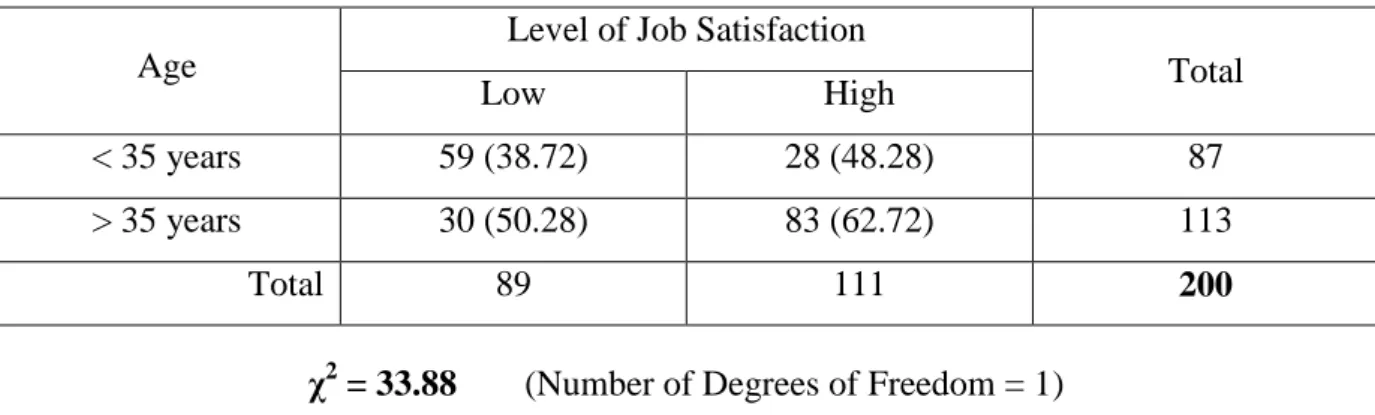
Table 3: Contingency Table with Expected Frequency for Age of Regular Teachers and their
Level of Job Satisfaction
Age
Level of Job Satisfaction
Total
Low
High
< 35 years
59 (38.72)
28 (48.28)
87
> 35 years
30 (50.28)
83 (62.72)
113
Total
89
111
200
χ
2= 33.88
(Number of Degrees of Freedom = 1)
Critical value of χ2 = 3.841 at 0.05 level of significance.
The computed value of χ2 is much more than the critical value of χ2 at 0.05 level of significance.
Hence, it is to be taken as significant. Consequently, the null hypothesis can be rejected and we say that there is
significant relationship between level of job satisfaction and age among regular school teachers working with
special needs children.
It means age of regular school teachers working with special needs children affects their job
satisfaction. Also, from Table 1, it is clear that regular school teachers of above 35 years of age are more
604 | P a g e
H03: There is no significant relationship between level of job satisfaction and different type of schools
(government and private) in which regular school teachers teach the special needs children.
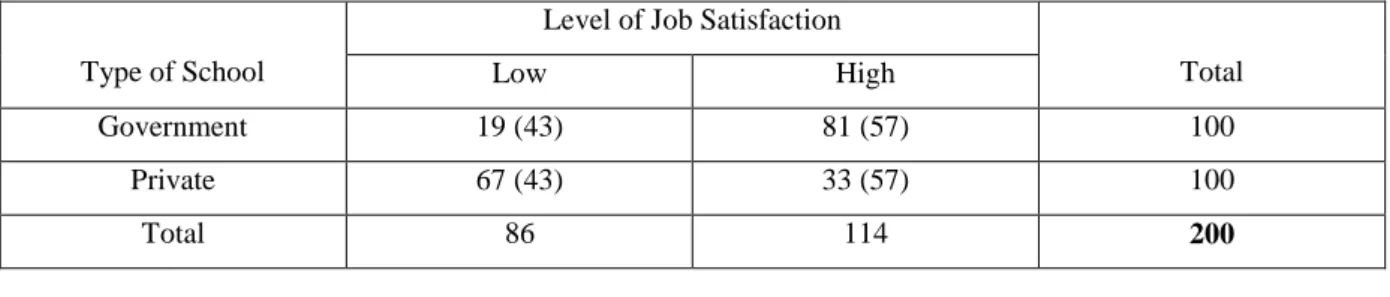
Table 4: Contingency Table with Expected Frequency for Type of School of Regular Teachers and their Level
of Job Satisfaction
Type of School
Level of Job Satisfaction
Total
Low High
Government 19 (43) 81 (57) 100
Private 67 (43) 33 (57) 100
Total 86 114 200
χ2= 47.02 (Number of Degrees of Freedom = 1)
Critical value of χ2 = 3.841 at 0.05 level of significance.
The computed value of χ2 is much more than the critical value of χ2 at 0.05 level of significance.
Hence it is to be taken as significant. Consequently, the null hypothesis can be rejected and we say that there is
significant relationship between level of job satisfaction and type of schools in which regular school teachers
deal with special needs children.
It means type of school in which regular school teachers teach special needs children affects their level
of job satisfaction. Also, from Table 1, it is clear that Government school teachers are more satisfied to their job
of teaching these children as compared to private school teachers.
H04: There is no significant relationship between level of job satisfaction and different standards (Std.
VI-VIII and Std. IX-X) in which regular school teachers teach the special needs children.
Table 5: Contingency Table with Expected Frequency for Standard of Regular Teachers and their Level of Job
Satisfaction
Standard
Level of Job Satisfaction
Total
Low High
VI - VIII 63 (44.5) 37 (55.5) 100
IX - X 26 (44.5) 74 (55.5) 100
Total 89 111 200
χ2= 27.72 (Number of Degrees of Freedom = 1)
Critical value of χ2 = 3.841 at 0.05 level of significance.
The computed value of χ2 is much more than the critical value of χ2 at 0.05 level of significance.
Hence it is to be taken as significant. Consequently, the null hypothesis can be rejected and we say that there is
significant relationship between level of job satisfaction and standard in which regular school teachers deal with
special needs children.
It means standard in which regular school teachers are working with special needs children affects their
level of job satisfaction. Also, from Table 1, it is clear that regular school teachers working with these children
of standard IX & X are more satisfied with their jobs as compared to teachers working with children of standard
605 | P a g e
V.CONCLUSION
Male regular school teachers of above 35 years of age working with special needs children of standard IX and X
in Government schools are more satisfied with their jobs of teaching. Because they receive a great deal of
support from parents for the work they do. There is great deal of cooperative effort among the staff members.
They are also satisfied with their teaching salary.
Suggestions for School Administrators
a. Let participate regular school teachers working with special needs children in making important school
decisions.
b. Evaluate teachers in the school fairly.
c. Behavior towards the teachers should be supportive and encouraging.
d. Recognize the teachers for a job well done.
e. Goals and priorities for the school should be clear.
Suggestions for School Principals
i. Let regular school teachers working with special needs children know what is expected from them.
ii. Allow teachers to participate in making most of the important educational decisions in the school.
iii. Make available necessary materials (e.g., textbooks, supplies, copy machine) by the teachers.
iv. Talk with teachers frequently about their instructional practices.
v. Communicate to the teachers what kind of school he/she wants.
Suggestions for Regular School Teachers working with Special Needs Children
a. Regular school teachers should have complete control in the classroom.
b. Share their beliefs and values to the colleagues about what the central mission of the school should be.
c. They should be satisfied with their class sizes.
d. They should plan with the library media specialist/ librarian for the integration of library/ media services into
their teaching.
REFERENCES
[1.] Bilgic, R. (1998). The relationship between job satisfaction and personal characteristics of Turkish workers.
Journal of Psychology, 132, 549-557.
[2.] Chiu, C. (1998). Do professional women have lower job satisfaction than professional men? Lawyers as a
case study. Sex Roles, 38, 521-537.
[3.] Clark, A.E. (1997). Job satisfaction and gender: Why are women so happy at work? Labor Economics, 4,
341-372.
[4.] Dawis, R.V. (1992). Job satisfaction. In L. K. Jones (Ed.), Encyclopedia of career change and workissues
(pp. 142-143). Phoenix: The Oryx Press.
[5.] De Vaus, D., & McAllister, I. (1991). Gender and work orientation: Values and satisfaction in Western
Europe. Work and Occupation, 18, 72-93.
[6.] Judge, T.A., Parker, S., Colbert, A.E., Heller, D., & Ilies, R. (2001). Job satisfaction: A cross-cultural
review. In N. Anderson, D.S. Ones, H.K. Sinangil, & C. Viswesvaran (Eds.), Handbook of industrial, work
606 | P a g e
[7.] Padmavathi, M.(1995). Job satisfaction among teachers at primary and secondary levels. Compendium onGood practices in Police (Welfare of men)- Volume- II, SVP National Police Academy.
[8.] Shapiro, H.J., & Stern, L.W. (1975). Job satisfaction: Male and female, professional and non-professional
workers. Personnel Journal, 28, 388-407.
[9.] Singh, A. and Sharma, T.R. (1986): Manual for Job satisfaction Scale. Agra: National Psychological
Corporation.
[10.] Sloane, P., & Williams, H. (1996). Are „overpaid‟ workers really unhappy? A test of the theory of
cognitive dissonance. Labour, 10, 3-15.
[11.] Weaver, C.N. (1974). Correlates of job satisfaction: Some evidence from the national surveys.