Boosting Document Retrieval with
Knowledge Extraction and Linked Data
Marco Rospocher
*, Francesco Corcoglioniti and Mauro Dragoni
Fondazione Bruno Kessler, Trento, Italy
Editor:Andreas Hotho, Julius-Maximilians-Universität Würzburg, Germany
Solicited reviews:Sébastien Harispe, Ecole des Mines d’Alès, France; Harald Sack, FIZ Karlsruhe, Germany; One anonymous reviewer
Abstract.Given a document collection, Document Retrieval is the task of returning the most relevant documents for a speci-fied user query. In this paper, we assess a document retrieval approach exploiting Linked Open Data and Knowledge Extraction techniques. Based on Natural Language Processing methods (e.g., Entity Linking, Frame Detection), knowledge extraction al-lows disambiguating the semantic content of queries and documents, linking it to established Linked Open Data resources (e.g., DBpedia, YAGO) from which additional semantic terms (entities, types, frames, temporal information) are imported to realize a semantic-based expansion of queries and documents. The approach, implemented in theKE4IRsystem, has been evaluated on different state-of-the-art datasets, on a total of 555 queries and with document collections spanning from few hundreds to more than a million of documents. The results show that the expansion with semantic content extracted from queries and documents enables consistently outperforming retrieval performances when only textual information is exploited; on a specific dataset for semantic search,KE4IRoutperforms a reference ontology-based search system. The experiments also validate the feasibility of applying knowledge extraction techniques for document retrieval — i.e., processing the document collection, building the expanded index, and searching over it — on large collections (e.g., TREC WT10g).
Keywords: Information Retrieval, Document Retrieval, Knowledge Extraction, Semantic Web, Large-scale Processing
1. Introduction
Document Retrieval is a well-know Information Re-trieval (IR) task consisting in returning documents rel-evant to a given user query from a document collec-tion. Traditional IR approaches solve this task by com-puting the similarity between terms or possible term-based expansions (e.g., synonyms, related terms) of the query and the documents. These approaches tend to suffer of known limitations, that we exemplify with the query “astronomers influenced by Gauss”: relevant documents may not necessarily contain all the query terms (e.g., terms “influenced” or “astronomers” may not be used at all in a relevant document); similarly, some relevant documents may be ranked lower than others containing all three terms, but in an unrelated
*Corresponding author. E-mail: [email protected]
way (e.g., a document about some astronomer, con-taining the information that he was born centuries be-fore Gauss and was influenced by Leonardo Da Vinci). In this paper we investigate the benefits of ex-ploiting a semantic-based expansion of queries and documents that combines the use of Linked Open Data (LOD) and Knowledge Extraction (KE) tech-niques. KE techniques, implemented in state-of-the-art approaches such as FRED [1], NewsReader [2] and PIKES [3], exploit Natural Language Process-ing (NLP) methods to extract semantic content from textual resources, such as queries and documents. Ex-tracted content is expressed (and disambiguated) using identifiers and vocabulary terms from well-established LOD resources (e.g., DBpedia [4], YAGO [5]), thus connecting to a growing body of LOD background knowledge from which related assertional and termi-nological knowledge can be injected in the IR task.
This way, queries and documents can be expanded with additional semantic terms not explicitly men-tioned in them. In particular, the semantic-based ex-pansion that we consider includes terms from the fol-lowingsemantic layers:
1. entities, e.g., termdbpedia:Carl_Friedrich_Gauss
extracted from mention “Gauss” in query “as-tronomers influenced by Gauss”;
2. types of entities, either explicitly mentioned, such as yago:Astronomer109818343 from “as-tronomers”, or indirectly obtained from exter-nal resources for mentioned entities, such as
yago:GermanMathematiciansobtained from men-tion “Gauss” (viadbpedia:Carl_Friedrich_Gauss); 3. temporal information, either explicitly
men-tioned in the text or indirectly obtained from external resources for mentioned entities, e.g., via DBpedia properties such as dbo:dateOf-Birth (1777) and dbo:dateOfDeath (1855) for mentioned entitydbpedia:Carl_Friedrich_Gauss; and,
4. semantic frames andframe roles, such as term hframebase:Subjective_influence, dbpedia:Carl_-Friedrich_Gaussi derived from “influenced by Gauss”.
We then match query and documents considering both their textual and semantic content, according to a simple retrieval model based on the Vector Space Model (VSM) [6]. This way, we can match docu-ments mentioning someone who is an astronomer (i.e., entities of type yago:Astronomer109818343) even if “astronomers”, or one of its textual term-based vari-ants, is not explicitly written in the document. Sim-ilarly, we can exploit the entities and the temporal content to better weigh the relevance of documents mentioning dbpedia:Carl_Friedrich_Gauss vs. dbpe-dia:GAUSS_(software), as well as to differently rank documents about Middle Age and 17th/18th centuries astronomers.
We implemented the approach in a system, called
KE4IR (read: kee-fer), that exploits PIKES for the KE analysis of queries and documents, and Apache Lucene1 for indexing the document collection and computing the relevance between queries and docu-ments. A preliminary assessment of the approach was conducted in [7], where KE4IR was evaluated on a recently released, small-size dataset (WES2015) [8].
1http://lucene.apache.org/
Those preliminary results gave hints that enriching tex-tual information with semantic content outperforms re-trieval performances over using textual data only. In this paper we build on those results, assessingKE4IR
performances on several additional large-scale datasets (TREC Ad-hoc, TREC WT10g, the F&al. dataset de-scribed in [9]).
These new evaluations allow to:
– strengthen many of the findings in [7], confirming that the addition of semantic content enables con-stantly outperforming the retrieval performances obtained using textual data only;
– show that KE4IR performs better than a refer-ence semantic-based IR approach [9], that builds only on ontology terminological knowledge (e.g., types, subtypes);
– give evidence that performing KE, enriching with LOD content, indexing, and searching collections up to millions of documents withKE4IRis feasi-ble.
As for [7], we release all the synthetic evaluation re-sults, the code (including evaluation scripts), and the auxiliary data we used (TREC datasets excluded due to copyright restrictions) on our website,2to allow repli-cating and extending our work and experiments.
While other works (e.g. [7–9]) have given evidences that semantic technologies are capable to enhance (text-based) document retrieval, the evaluation con-ducted in this paper — on a total of 555 queries over more than 2.2 million documents from different collec-tions — provides a solid, unprecedented assessment of the impact of semantic technologies for the document retrieval task.
The paper is structured as follows. In Section 2, we review the state of the art in IR and KE. Section 3 presents the KE4IR approach, detailing the semantic layers and the retrieval model used for combining se-mantic and textual information. In Section 4, we de-scribe the actual implementation of KE4IR, while in Section 5, we report on the comprehensive assessment over several datasets of the effectiveness of adding se-mantic content for IR, discussing in details some out-comes and findings in Section 6. Section 7 concludes with some final remarks and future work directions.
2. State of the Art
Previous works have exploited some semantic in-formation for IR. An early tentative in injecting do-main knowledge information for improving the ef-fectiveness of IR systems is presented in [10]. In this work, authors manually built a thesaurus support-ing the expansion of terms contained in both docu-ments and queries. Such a thesaurus models a set of relations between concepts including synonymy, hy-ponymy and instantiation, meronymy and similarity. An approach based on the same philosophy is pre-sented in [11], where the authors propose an index-ing technique where WordNet [12] synsets, extracted from each document word, are used in place of tex-tual terms in the indexing task. An evolved version of such approach is described in [13] where each synset is weighted accordingly to its number of explicit and implicit occurrences.
In the last decade, semantic IR systems started to embed ontologies for addressing the task of retriev-ing domain-specific documents. An interestretriev-ing review on IR techniques based on ontologies is presented in [14], while in [15] the author studies the application of ontologies to a large-scale IR system for Web usage. Two models for the exploitation of ontology-based knowledge bases are presented in [16, 17]. The aim of these models is to improve search over large doc-ument repositories. Both models include an ontology-based scheme for the annotation of documents, and a retrieval model based on an adaptation of the clas-sic Vector Space Model (VSM) [6]. A general IR sys-tem aimed at facilitating domain specific search is il-lustrated in [18]. The system uses fuzzy ontologies and is based on the notion of “information granula-tion”, a computational model aiming at estimating the granularity of documents. The presented experiments confirm that the proposed system outperforms a vec-tor space based IR system for domain specific search. A further work exploring the use of semantic similar-ity measures for ontology-based IR has been presented in [19]. The main difference between the discussed ap-proach and traditional VSM extensions is that it relies on Yager’s aggregation operators — preference mod-els that capture end user expectations — for perform-ing a direct assessment of semantic similarity analysis. More in details, queries are expressed using concepts of an ontology applied to index documents. The sys-tem estimates the overall relevance of documents w.r.t. a given query, obtained by aggregating, via Yager’s op-erators, the partial similarity measurements between
each ontology concept of the query and those index-ing the document (i.e., each document is scored w.r.t. every single concept of the query). Then, as a result of the proposed aggregation method, the most rele-vant documents (indexed with the query concepts) are ranked higher than least relevant ones (indexed with more general or more specific concepts than query’s ones). Finally, in [20] an analysis of the usefulness of ontologies for the retrieval task is discussed.
More recently, approaches combining many dif-ferent semantic resources for retrieving documents have been proposed. In [9], the authors describe an ontology-enhanced IR platform where a repository of domain-specific ontologies is exploited for addressing the challenges of IR in the massive and heterogeneous Web environment. Given a query, this is annotated with concepts extracted from ontologies modeling the do-mains that the query belongs to. Documents of the col-lection used for evaluating the approach are annotated by using the Wraetlic NLP Suite3to enrich them with representative concepts that ease the retrieval process. While on the one hand the presented approach repre-sents a full-fledged solution for semantic IR, on the other hand it suffers from requiring specific ontolo-gies for performing the query annotation task. This drawback is avoided by approaches leveraging DBpe-dia [4] and other established LOD datasets as general-purpose sources of knowledge, like the retrieval mod-els recently presented in [8, 21] and assessed on one of the evaluation datasets (WES2015) considered for
KE4IRin this paper (see Section 5.1.4).
A further problem in IR is the ranking of retrieved results. Users typically make short queries and tend to consider only the first ten to twenty results [22]. In [23], a novel approach for determining relevance in ontology-based IR is presented, different from VSM. When IR approaches are applied in a real-world en-vironment, the computational time needed to evaluate the match between documents and the submitted query has to be considered too. Systems using VSM have typically higher efficiency with respect to systems that adopt more complex models to account for semantic information. For instance, the work in [24] implements a non-vectorial data structure with high computational times for both indexing and retrieving documents.
In [7], we firstly presentedKE4IR, an approach for document retrieval that exploits KE techniques and LOD resources. The work stemmed from the recent
advances in KE, resulting in several approaches and tools capable of performing comprehensive analyses of text to extract quality knowledge. Among them: FRED [1], a tool that extracts Discourse Represen-tation Structures, mapping them to linguistic frames in VerbNet4 and FrameNet,5 which in turn are trans-formed in RDF/OWL via Ontology Design Patterns;6 NewsReader [2], a comprehensive processing pipeline that extracts and corefers events and entities from large (cross-lingual) news corpora; and, PIKES7 [3, 25], an open-source frame-based KE framework that com-bines the processing of various NLP tools to distill knowledge from text, aligning it to LOD resources such as DBpedia and FrameBase8 [26] (a broad-coverage SW-ready inventory of frames based on FrameNet).
In particular, KE4IR builds on PIKES for analyz-ing queries and documents, and linkanalyz-ing them to ex-ternal knowledge resources from which related se-mantic information (i.e., background knowledge) can be imported for use in the retrieval task. To the best of our knowledge, KE4IR is the first approach that applies comprehensive KE techniques on documents and queries to improve document retrieval perfor-mances. Besides ontological types, Wordnet synsets, and named entities — the kind of semantic content previously considered by other state-of-the-art IR ap-proaches —KE4IR leverages additional knowledge, such as frames and time information, made available by the KE techniques exploited. To accommodate and effectively exploit this additional content, KE4IR re-lies on a specifically developed adaptation of VSM, that accounts (possibly) for multiple semantic content available on a single textual term, and the fact that the same semantic content may originate from different terms in the query/document. A detailed description of the latest development ofKE4IR, as used in this paper, is provided in Section 4.
Previous works (e.g. [7–9]) have shown evidences that semantic technologies are capable to enhance (text-based) document retrieval. However:
– [7, 8] report evaluation results only on a single, small dataset (WES2015, with 35 queries and 331 documents) compared to traditional document
re-4http://verbs.colorado.edu/ 5http://framenet.icsi.berkeley.edu/ 6http://ontologydesignpatterns.org/ 7http://pikes.fbk.eu/
8http://framebase.org/
trieval datasets which consists of collections of millions of documents;
– [9] was evaluated only on a single dataset (F&al., with 20 queries and 1.6 million documents) and a small number of queries;
– only [7] reports details on the statistical signifi-cance of the achieved results.
Compared to these works, the evaluation presented in this paper is conducted on multiple datasets (in-cluding general — i.e. not specifically devised for se-mantic technologies — state-of-the-art document re-trieval datasets) with 4 document collections and 12 query sets, for a total of 555 queries over more than 2.2M documents, an unprecedented evaluation setting for semantic technologies in IR. Given the size and the variety of the considered document collections and query sets, we believe the work presented in this paper provides a solid assessment of the impact of semantic technologies for the document retrieval task.
It is worth noting that, beside the well-known docu-ment retrieval task, knowledge representation features have been used also for improving the effectiveness of systems for question answering [27–30]. This task consists in answering a user’s unstructured query with a structured response taken from a knowledge base. As such, this task is substantially different from document retrieval one, investigated in this work.
3. Approach
Standard IR systems treat documents and queries as bags oftextual terms(i.e., stemmed tokens). InKE4IR
we consider additional semantic terms coming from semantic annotation layers produced using NLP-based KE techniques and LOD background knowledge (Sec-tion 3.1), and we propose a retrieval model using this additional semantic information to find and rank the documents matching a query (Section 3.2).
3.1. Semantic Layers
We consider four semantic layers —URI, TYPE, TIME,FRAME— that complement theTEXTUALlayer with semantic terms.9 These terms are extracted from the RDF knowledge graph obtained from a text using KE techniques. This graph contains a structured
“ Astronomers influenced by Gauss ”
dbpedia:Carl Friedrich Gauss :influence_event
:astronomers_entity
yago:Astronomer109818343 framebase:Subjective_influence-influence.v
yago:Physicist110428004 yago:Person100007846
framebase:Subjective influence framebase:Frame
rdf:type rdf:type
“1777-04-30”^^xsd:date
“1855-02-23”^^xsd:date yago:GermanMathematicians
yago:NumberTheorists yago:FellowsOfTheRoyalSociety
yago:Astronomer109818343 yago:Physicist110428004 yago:Person100007846 rdf:type dbo:birthDate dbo:deathDate
… other 9 types ...
framebase:fe-subjective _influence-entity framebase:fe-subjective
_influence-cognizer
▲ super-classes imported from YAGO taxonomy starting from yago:Astronomer109818343
▲ super-classes imported from FrameBase schema starting from framebase:Subjective_influence-influence.v
temporal properties imported from Dbpedia and types imported ► from YAGO for entity dbpedia:Carl_Friedrich_Gauss
mention m1 mention m2 mention m3
Query:
… other 27 types ...
t4
t5
t6
t7
t26
t27
t28
t26
t27
t28
t48t49 t50
t38
t39
t40
... ...
t1 t2 t3
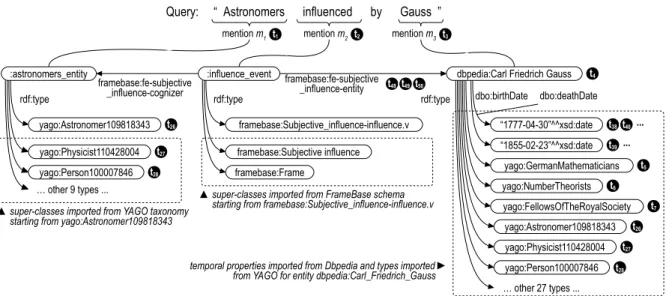
Fig. 1. RDF knowledge graph and terms extracted from “astronomers influenced by Gauss”. The top of the graph (:astronomers_entity, :influ-ence_event,dbpedia:Carl_Friedrich_Gauss, their links and most-specific types) comes from KE, while the rest comes from background knowl-edge resources: DBpedia, YAGO, FrameBase.
Table 1
Terms extracted from the example query “astronomers influenced by Gauss”, with mentionsm1= “astronomers”,m2 = “influenced”,m3= “Gauss”,w(l)= 0.5 for theTEXTUALlayer,w(l)= 0.125 for each semantic layer;idfvalues computed on the WES2015 dataset (Section 5.1).
Layerl Termti M(ti,q) tfq(ti,q) idf (ti,q) w(l) qi
t1 TEXTUAL astronom m1 1.0 2.018 0.5 1.009
t2 TEXTUAL influenc m2 1.0 3.404 0.5 1.702
t3 TEXTUAL gauss m3 1.0 1.568 0.5 0.784
t4 URI dbpedia:Carl_Friedrich_Gauss m3 1.0 3.404 0.125 0.426
t5 TYPE yago:GermanMathematicians m3 0.030 2.624 0.125 0.010
t6 TYPE yago:NumberTheorists m3 0.030 2.583 0.125 0.010
t7 TYPE yago:FellowsOfTheRoyalSociety m3 0.030 1.057 0.125 0.004
. . . TYPE . . . other 18 terms . . . m3 0.030 . . . 0.125 . . .
t26 TYPE yago:Astronomer109818343 m1,m3 0.114 1.432 0.125 0.020
t27 TYPE yago:Physicist110428004 m1,m3 0.114 0.958 0.125 0.014
t28 TYPE yago:Person100007846 m1,m3 0.114 0.003 0.125 ∼0
. . . TYPE . . . other 9 terms . . . m1,m3 0.114 . . . 0.125 . . .
t38 TIME day:1777-04-30 m3 0.1 3.404 0.125 0.043
t39 TIME day:1855-02-23 m3 0.1 3.404 0.125 0.043
t40 TIME century:17 m3 0.1 0.196 0.125 0.002
. . . TIME . . . other 7 terms m3 0.1 . . . 0.125 . . .
t48 FRAME hSubjective_influence-influence.v,dbpedia:Carl_Friedrich_Gaussi m2 0.333 5.802 0.125 0.242
t49 FRAME hSubjective_influence,dbpedia:Carl_Friedrich_Gaussi m2 0.333 5.802 0.125 0.242
t50 FRAME hFrame,dbpedia:Carl_Friedrich_Gaussi m2 0.333 3.499 0.125 0.146
resentation of the entities, events, and relations men-tioned in the text, each one linked to the specific snip-pets of text, calledmentions, that denote that element, as shown in Figure 1 for the example text of Section 1: “astronomers influenced by Gauss”. From each men-tion, a set of semantic terms is extracted by consider-ing the elements of the knowledge graph rooted at that mention, as explained later for each layer and as ex-emplified in Table 1 (first four columns) for the
con-sidered example. A mention may express multiple se-mantic terms (differently from the textual case) and a semantic term may originate from multiple mentions, whose number can be used to quantify the relevance of the term for a document or query.
entity mention). Disambiguated URIs result from two NLP/KE tasks:10Named Entity Recognition and Clas-sification (NERC), which identifies proper names of certain entity categories (e.g., persons, organizations, locations) in a text, and Entity Linking (EL), which disambiguates those names against the individuals of a knowledge base. The Coreference Resolution NLP task can be also exploited to “propagate” a disam-biguated URI from a mention to another coreferring mention in the text, to better count the number of en-tity mentions for each URI. In the example of Figure 1, theURItermdbpedia:Carl_Friedrich_Gauss(t4) is ex-tracted from the corresponding DBpedia entity men-tioned as “Gauss” in the text.
TYPElayer The terms of this layer are the URIs of the ontological types (and super-types) associated to entities of any kind mentioned in the text. For disam-biguated named entities with a URI (from NERC and EL), associated types are obtained from LOD back-ground knowledge describing those entities, likeTYPE term yago:NumberTheorists (t6) obtained from the DBpedia description of entity dbpedia:Carl_Friedrich-_Gauss, in Figure 1. For other entities and common nouns, disambiguation against WordNet through Word Sense Disambiguation (WSD) returns synsets that can be mapped to ontological types via existing mappings, like TYPEterm yago:Astronomer109818343(t26) ob-tained by disambiguating word “Astronomers” to WordNet 3.0 synsetn-09818343. An ontology particu-larly suited to both extraction techniques is the YAGO taxonomy [5], as its types are associated to WordNet synsets as well as DBpedia entities.
TIMElayer The terms of this layer are the tempo-ral values related to the text, either because explicitly mentioned in a time expression (e.g., the text “eigh-teenth century”) recognized through the Temporal Expression Recognition and Normalization (TERN) NLP task, or because associated to a disambiguated entity via some property in the background knowl-edge, such as the birth date 1777-04-30 associated to
dbpedia:Carl_Friedrich_Gaussin the example of Fig-ure 1 and Table 1. To support both precise and fuzzy temporal matching of queries and documents, each temporal value is represented with (max) five TIME terms at different granularity levels — day, month,
10We briefly mention in this section the main NLP/KE tasks in-volved in the extraction of semantic terms. Some of these tasks typ-ically build on additional NLP analyses, such as Tokenization, Part-of-Speech tagging, Constituency Parsing and Dependency Parsing.
year, decade, and century — as, e.g., value 1777-04-30 mapped to terms day:1777-04-30 (t38),
month:1777-04,year:1777,decade:177,century:17(t40).
FRAME layer A semantic frame is a star-shaped structure representing an event or n-ary relation, which has a frame type and zero or more participants each playing a specific semantic role in the context of the frame. An example of frame is:influence_eventin Fig-ure 1, having type framebase:frame-Subjective_influ-ence (among others) and participants dbpedia:Carl-_Friedrich_Gauss (a disambiguated entity) and :as-tronomers_entity (a non-disambiguated entity). Se-mantic frames can be extracted using NLP tools for Semantic Role Labeling (SRL), which are based on predicate models that define frame types and roles, such as FrameNet. The outputs of these tools are then mapped to an ontological representation using an RDF/OWL frame-based ontology aligned to the predicate model, such as FrameBase [26]. Seman-tic frames provide relational information that can be leveraged to match queries and documents more pre-cisely. To this end, in KE4IR we map each hframe type, participanti pair whose participant is a dis-ambiguated entity, such as pair h framebase:frame-Subjective_influence, dbpedia:Carl_Friedrich_Gaussi in Figure 1, to aFRAMEterm (t49), including also the terms obtainable by considering the frame super-types in the ontology (the use of non-disambiguated partici-pant entities leads to worse retrieval results).
3.2. Retrieval Model
TheKE4IRretrieval model is inspired by the Vec-tor Space Model (VSM). Given a document collec-tionD, each documentd ∈D(resp. queryq) is repre-sented with a vectord = (d1. . .dn)(q = (q1. . .qn))
where each elementdi(qi) is the weight
correspond-ing to termti, whilenis the number of distinct terms
in the collection D. Differently from text-only ap-proaches, the terms of our model come from multi-ple layers, both textual and semantic, and each docu-ment (query) vector can be seen as the concatenation of smaller, layer-specific vectors [31]. Given a termt, we denote the layer it belongs to with l(t) ∈ L = {TEXTUAL,URI,TYPE,TIME,FRAME}.
The goal of the retrieval model is to compute a sim-ilarity scoresim(d,q)between each documentd ∈D and queryq. The documents matching queryqare the ones withsim(d,q)>0, and they are ranked based on decreasing similarity values. To derive sim(d,q), we start from the definition of the cosine similarity used in VSM:
simVSM(d,q) = d·q
kdk2· kqk2
=
Pn i=1di·qi q
Pn i=1d
2
i · q
Pn i=1q
2
i (1)
and we remove the normalizations by the Euclidean normskdk2andkqk2, obtaining:
sim(d,q) =d·q= n X
i=1
di·qi (2)
Normalizing by kqk2 serves to compare the scores of different queries and does not affect the ranking, thus we drop it for simplicity. Normalizing bykdk2 makes the similarity score obtained by matching m query terms in a small document higher than the score obtained by matching the same m query terms in a longer document. This normalization is known to be problematic in some document collections (it is de-fined differently and optionally disabled in production systems such as Lucene and derivatives) and we con-sider it inappropriate in our scenario, where the docu-ment vector is expanded with large amounts of seman-tic terms whose number depends not just on the docu-ment length (as for textual terms) but also on the rich-ness of the entity descriptions those semantic terms are derived from, both in the RDF knowledge graph ex-tracted from text and the background knowledge.
To assign the weights of document and query vec-tor elements, we adopt the usual product of Term Fre-quency (tf) and Inverse Document Frequency (idf):
di= tfd(ti,d)·idf(ti,D) (3) qi= tfq(ti,q)·idf(ti,D)·w(l(ti)) (4)
The values of tf are computed in different ways for documents (tfd) and queries (tfq), while the weights w(l(ti)), withw(l)>0for alll∈LandPl∈Lw(l) = 1, are “hyper-parameters” of our approach that permit balancing the contribution of different layers to the fi-nal similarity score.11Given the form of Equation 2, it suffices to applyw(l(ti))only to one ofd andq; we
choseqto allow selecting weights on a per-query ba-sis.12 Table 1 (last four columns) reports thetf
q,idf,
w, andqi values for the terms of the example query
“astronomers influenced by Gauss”.
Several schemes for computingtfandidfhave been developed in the literature. Given f(t,x)and f0(t,x)
two ways of measuring the frequency of a termtin a text (document or query)x, we adopt the scheme:13
tfd(t,d) = 1 + log(f(t,d)) (5)
tfq(t,q) = f0(t,q) (6)
idf(t,D) = log |D|
|{d∈D|f(t,d)>0}| (7)
wheretfd(t,d)andidf(t,D)are set to 0 if the referred termtdoes not appear respectively in documentd or corpusD(as logarithm and division are undefined).
Theraw frequency f(t,x)is defined as usual as the number of times termtoccurs in textx. To account for semantic terms, we denote withM(t,x)the set of men-tions in textxfrom where termtwas extracted, valid also for textual terms whose mentions are simply their occurrences in the text, and define f(t,x) =|M(t,x)|. Thenormalized frequency f0(t,x), instead, is newly in-troduced to account for the fact that in a semantic layer multiple terms can be extracted from a single mention,
11w(l) = 0indicates that layerlhas no effect at all on similarity, whilew(l) = 1indicates thatlis the only layer affecting similarity as other layersl0must havew(l0) = 0. Moving from0to1the layer “importance” increases, although not necessarily linearly.
12Alternatively,w(l(t
i))may be introduced with the same effects in Equation 2, i.e.,sim(d,q) =Pn
i=1di·qi·w(l(ti)).
differently from the textual case. It is defined as:
f0(t,x) = X
m∈M(t,x)
1
|T(m,l(t))| (8)
whereT(m,l)denotes the set of terms of layerl ex-tracted from mentionm. Since|T(m,TEXTUAL)| = 1
for any mention,f(t,x) = f0(t,x)for any textual term. Note thatf(t,x)or f0(t,x)can be indifferently used in Equation 7.
The formulation of f0(t,x) and its use in Equa-tion 6 aim at giving each menEqua-tion the same impor-tance when matching a query against a document col-lection. To explain, consider a query with two men-tionsm1 andm2, from which respectivelyn1 andn2 disjoint terms of a certain semantic layer (e.g.,TYPE) were extracted,n1 >n2; also assume that these terms have equal idf and tfd values in the document col-lection. If we give these terms equalt fq values (e.g.,
t fq(t,q) = f(t,q) = 1as their raw frequency), then
a document matching then1terms ofm1(and nothing else) will be scored and ranked higher than a document matching then2terms ofm2(and nothing else). How-ever, the fact thatn1>n2does not reflect a preference ofm1by the user; rather, it may reflect the fact thatm1 is described more richly (and thus, with more terms) thanm2in the background knowledge. Our definition of normalized frequency corrects for this bias by as-signing each query mention a total weight of 1 for each semantic layer, which is equally distributed among the terms extracted from the mention for that layer (e.g., weight1/n1for terms ofm1,1/n2for terms ofm2).
Similarly, the use of f0(t,x)in place of f(t,x)in Equation 5 would be inappropriate. Consider a query whose vector has a single TYPE term t (similar con-siderations apply to other semantic layers). Every-thing else being equal (e.g., idf values), two docu-ments mentioning two entities of typetthe same num-ber of times should receive the same score. While this happens when using f(t,x)fort fd(t,d), with f0(t,x)
the document mentioning the entity with fewestTYPE terms (beyondt) would be scored higher, although this clearly does not reflect a user preference.
4. Implementation
We built an evaluation infrastructure including an implementation of the KE4IR approach presented in Section 3. The infrastructure allows the batch applica-tion and assessment ofKE4IRon arbitrary documents
Tokenize Stop word Stemming
KE
(PIKES) Enrichment extractionTerm
Terms
Semantic Analysis Textual Analysis
FRAME TIME TYPE URI TEXTUAL
Document or query
text
Background knowledge (a)
Indexer
(Lucene) Searcher(Lucene) Scorer Query
terms Document
terms Relevance judgments
Ranker (KE4IR)
Measures Inverted index
Matched documents & their terms
Ranked documents
(b)
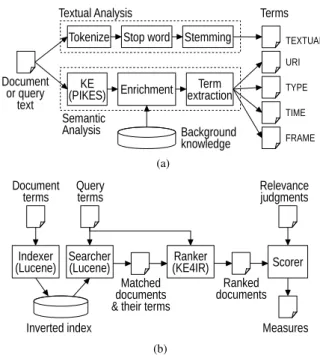
Fig. 2.KE4IRimplementation: (a) term extraction for documents and queries; (b) query execution and evaluation against gold relevance judgments.
and queries with their gold relevance judgments. All the source code, binaries, and necessary data are avail-able onKE4IRwebsite.14
Figure 2a shows the pipeline used to map the text of a document or query to a set of terms, combin-ing both textual and semantic analysis. Textual analy-sis aims at extracting textual terms through the usual combination of text tokenization, stop word filtering, and stemming techniques, implemented using stan-dard components from Apache Lucene. Semantic anal-ysis, instead, aims at extracting semantic terms of the four layers considered in KE4IR. It uses a KE tool (PIKES) to transform the input text into an RDF knowledge graph whose nodes (RDF URIs and liter-als) are entities mentioned in the text, entity types, and property values, and whose edges (RDF triples) de-scribe entities and their relations. Well-known nodes in the graph (DBpedia entities, YAGO and Frame-Base concepts) are enriched with additional triples about them from a persistent key-value store popu-lated with LOD background knowledge (YAGO and FrameBase schemas, DBpedia mapping-based prop-erties with xsd:date, xsd:dateTime, xsd:gYear, and
xsd:gYearMonthobjects, to provide for additional
poral information). As both ABox and TBox triples are inserted, RDFS reasoning is applied to material-ize inferablerdf:typetriples that affect the extraction of TYPE and FRAME terms.15 The resulting graph is finally queried to extract semantic terms according to their definitions as of Section 3.1.
Figure 2b shows the pipeline that accepts extracted document and query terms, executes queries according to theKE4IRmodel, and computes evaluation metrics against gold relevance judgments. To efficiently find the documents matching a query in large collections, the pipeline employs a Lucene inverted index popu-lated with the term vectors of the documents in the col-lection, including their raw frequencies. When execut-ing a queryq, its terms are OR-ed together to form a Lucene boolean query that is evaluated on the index and returns the list of matching documentsd contain-ing at least one query term, so thatsim(d,q) > 0. A ranker component external to Lucene (for ease of test-ing) implements theKE4IRmodel of Section 3.2 and is responsible for ranking the matched documents, based on their term vectors extracted from the index, the term vector of the query, and some index statistics (number of documents and document frequencies) required to computeidfvalues. A scorer component compares the resulting ranking with the gold relevance judgments, computing a comprehensive set of evaluation measures that are averaged along queries.
The most complex and computationally expensive task inKE4IRimplementation is KE. We use PIKES, a frame-based KE framework providing state-of-the-art performances via a 2-phase approach. In the first lin-guistic feature extractionphase, an RDF graph of men-tions is obtained by running and combining the outputs of several state-of-the-art NLP tools, including Stan-ford CoreNLP16 (tokenization, lemmatization, POS-tagging, TERN, NERC, coreference resolution, pars-ing), DBpedia Spotlight17 (EL), UKB18 (WSD), Se-mafor19and Mate-tools20(SRL). In the second
knowl-edge distillation phase, the mention graph is
trans-15Specifically, we only need to materialize implicitrdf:typetriples based on rdfs:domain, rdfs:range, rdfs:subClassOf, and rdfs:sub-PropertyOfTBox axioms in background knowledge. This inference is inexpensive compared to NLP analysis, and most of it can be done in a pre-processing step that computes the closure of background knowledge, simplifying inference at document/query analysis time.
16http://nlp.stanford.edu/software/corenlp.shtml 17http://spotlight.dbpedia.org/
18http://ixa2.si.ehu.es/ukb/
19http://www.cs.cmu.edu/~ark/SEMAFOR/ 20http://code.google.com/p/mate-tools/
formed into an RDF knowledge graph through the evaluation of mapping rules, using the RDFpro21[33] tool for RDF processing that we also use for RDFS reasoning in Figure 2a. Using multiple instances of PIKES on a server with 12 cores (24 threads) and 192 GB RAM, we obtained a throughput of∼700K token-s/h (∼30K tokens/h per core), corresponding to∼3180 documents/h for the average document length of 220 tokens observed in our experiments. Processing time is almost totally spent in the NLP analysis of texts. By mappingKE4IRsemantic layers to the required NLP tasks, their impact on the whole processing time re-sults to be: 3.5%URI, 16.3%TYPE, 2.9%TIME, 77.3% FRAME.
Note that the current version of PIKES works only on English texts, and thus the currentKE4IR imple-mentation can be applied out-of-the-box only on En-glish document collections. However, the adaptation to different languages requires changes only on the term extraction pipeline in Figure 2a (on the textual and semantic analysis steps, and possible the enrich-ment/background knowledge step) and no changes are needed on the query execution pipeline in Figure 2b.
Regarding entity linking, in line with what noted in Section 3.1, a mention is linked to at most one en-tity in DBpedia by DBpedia Spotlight, even if multiple candidate entities might be proposed for it (e.g., db-pedia:Carl_Friedrich_Gauss,dbpedia:Gauss_(unit)for entity mention “Gauss”);22 if multiple candidate enti-ties are equally likely (i.e., they get the same confi-dence score), the most popular is chosen lacking addi-tional context for disambiguation.
5. Evaluation
In this section, we empirically assess whether the enriching of document and query term vectors with semantic terms significantly affects IR performances. More precisely, we investigate the following research question:
21http://rdfpro.fbk.eu/
Table 2
Main characteristics of the document collections used in the evaluations. TREC Disk 4&5(-) identifies the TREC Disk 4&5 document collection from which congressional records are removed.
Collection Document Type Size (% of) Documents having Layer Terms per Layer (avg. on docs)
TEXTUAL URI TYPE TIME FRAME TEXTUAL URI TYPE TIME FRAME
WES2015 blog posts 331 100.00 100.00 100.00 99.70 99.70 282.13 22.11 434.29 75.39 176.53 TREC Disk 4&5 news, notices, congress. records 555949 100.00 98.91 100.00 94.13 95.85 206.39 12.53 284.53 41.39 77.12 TREC Disk 4&5(-) news, notices 528027 100.00 98.86 100.00 93.85 95.78 202.55 12.05 280.77 40.24 74.79 TREC WT10g crawled web pages 1687241 100.00 97.29 99.15 88.24 85.65 225.86 25.05 274.36 43.49 67.66
Table 3
Main characteristics of the query sets used in the evaluations.
Query Set Size (% of) Queries having Layer Terms per Layer (avg. on queries) Collection Relevance Evaluation
TEXTUAL URI TYPE TIME FRAME TEXTUAL URI TYPE TIME FRAME Judgments Section
WES2015 35 100.00 71.43 94.29 31.43 31.43 3.57 1.16 26.18 11.55 4.82 WES2015 5-value (0-4) Section 5.1 F&al.2011 20 100.00 35.00 95.00 10.00 15.00 5.15 1.00 20.37 5.00 8.00 WT10g binary (0-1) Section 5.2 TREC 6 title 50 100.00 18.00 98.00 6.00 8.00 2.64 1.22 15.53 11.67 5.00 TREC Disk 4&5 binary (0-1)
Section 5.3 TREC 7 title 50 100.00 20.00 92.00 4.00 6.00 2.56 1.00 15.41 8.00 4.00 TREC Disk 4&5(-) binary (0-1)
TREC 8 title 50 100.00 24.00 98.00 16.00 4.00 2.46 1.17 15.63 11.25 4.50 TREC Disk 4&5(-) binary (0-1) TREC 9 title 50 100.00 54.00 86.00 20.00 16.00 2.92 1.11 19.51 9.10 4.13 WT10g binary (0-1) TREC 2001 title 50 100.00 28.00 92.00 18.00 16.00 3.80 1.07 19.63 7.11 4.00 WT10g 3-value (0-2) TREC 6 desc 50 100.00 38.00 100.00 16.00 30.00 13.78 1.26 36.76 10.88 7.27 TREC Disk 4&5 binary (0-1) TREC 7 desc 50 100.00 24.00 100.00 6.00 16.00 9.92 1.33 28.28 12.67 6.38 TREC Disk 4&5(-) binary (0-1) TREC 8 desc 50 100.00 32.00 100.00 24.00 20.00 9.24 1.69 28.76 11.33 5.30 TREC Disk 4&5(-) binary (0-1) TREC 9 desc 50 100.00 60.00 100.00 38.00 40.00 9.90 1.37 35.98 9.00 5.65 WT10g binary (0-1) TREC 2001 desc 50 100.00 32.00 100.00 20.00 28.00 7.70 1.13 25.54 6.70 5.57 WT10g 3-value (0-2)
RQ Does document and query enrichment with se-mantic terms enable to significantly outperform document retrieval when only raw textual infor-mation is used?
To address this research question, we conducted three evaluations with different datasets. Each evaluation consisted in performing a set of queries over a doc-ument collection for which the list of gold relevance judgments is available, and comparing the retrieved documents with such judgments. A summary of the main characteristics of the document collections and query sets used in each evaluation is reported in Ta-bles 2 and 3.
For each dataset, we report KE4IR performances, comparing them with the ones of thetextual baseline, obtained by indexing the raw text with Lucene tuned with the scoring formula of Section 4. In our experi-ments, this tuning provides the same performances of a standard Lucene configuration, and allows properly as-sessing the impact of semantic layers by excluding any interference related to slight differences in the scoring formula.
To assess the performances ofKE4IRand the textual baseline we adopted the following measures:
– precision values after the first (Prec@1), fifth (Prec@5), and tenth (Prec@10) document,
re-spectively. The rationale behind this choice is the fact that the majority of search result click activ-ity (89.8%) happens on the first page of search re-sults [22] corresponding to a set varying from 10 to 20 documents.
– Mean Average Precision (MAP), computed on the entire rank and after the first ten documents re-trieved (MAP@10). Validation on the MAP met-ric enables assessing the capability of a system of returning relevant documents, independently of the ranking.
– Normalized Discounted Cumulated Gain (NDCG) [34], computed both on the entire rank and after the first ten documents retrieved (NDCG@10). Validation on the NDCG metric is necessary in scenarios where multi-value relevance is used. This choice of measures makes our evaluation protocol analogous to the one adopted in the TREC [35] evalu-ation campaigns, with the addition of the NDCG met-ric. All the evaluation materials are available onKE4IR
website.
ser-vice23). For instance, in case of DBpedia Spotlight, PIKES uses a configuration tuned to optimize recall.
5.1. WES2015 Dataset
In this section, we summarize the results of a first evaluation ofKE4IRon a recently released dataset [8], here referenced as WES2015, specifically developed to assess semantic search effectiveness. This evalua-tion (excluding the tuning of weights via brute force and RankLib at the end of Section 5.1.3, and the newly added comparison with other retrieval models in Sec-tion 5.1.4) was originally reported in [7] where addi-tional details are provided.24
5.1.1. Evaluation Set-up
The peculiarity of the WES2015 collection and query set (see Tables 2 and 3 for their characteris-tics) is the underlying semantic purpose with which they were built. Indeed, the set of queries was selected by varying from queries very close to keyword-based search (e.g., query “Romanticism”) to queries requir-ing semantic capabilities for retrievrequir-ing relevant doc-uments (e.g., “Aviation pioneers’ publications”). We compare KE4IRagainst the textual baseline, initially using equal weights for textual and semantic informa-tion, i.e.,w(TEXTUAL) = w(SEMANTICS) = 0.5with
w(SEMANTICS)divided equally among semantic lay-ers, and then we study the impact on performances of using unequal layer weights. We conclude the section with a complementary comparison with the retrieval models proposed in [8, 21].
5.1.2. Results
Table 4 shows the comparison between the results achieved byKE4IRexploiting all the semantic layers with equal weights for textual and semantic informa-tion, and the results obtained by the textual baseline.
KE4IRoutperforms the baseline for all the metrics, thus contributing to positively answer our research question. The highest improvements are registered on the MAP, MAP@10, and Prec@10 metrics that quan-tify the capability ofKE4IRof producing an effective documents ranking when documents are considered
ei-23http://demo.dbpedia-spotlight.org/
24In [7], we also considered a baseline exploiting the Google cus-tom search API for indexing pages containing our documents. How-ever, this Google-based baseline was heavily outperformed by the textual baseline on the considered dataset, due to Google, being heavily tuned for precision, returning far less results thanKE4IRand the textual baseline for the evaluation queries.
ther relevant or not relevant (i.e., binary relevance). On the other hand, the improvements on the NDCG and NDCG@10 metrics highlight that produced rank-ings are effective also from a qualitative point of view where the different degrees of relevance provided in WES2015 are taken into account. These improve-ments are statistically significant for MAP, MAP@10, NDCG, and NDCG@10 (significance threshold 0.05), based on the p-values computed with the one-tailed paired approximate randomization test [36].25
Table 5 reports all the dataset queries, the semantic layers for which terms were automatically identified via PIKES analyses, and the performances (on MAP and NDCG@10) ofKE4IRand the textual baseline.26
The table shows that for NDCG@10 (resp. MAP)
KE4IRoutperform the textual baseline on 17 (resp. 19) queries out of 35, with improvements ranging from 0.002 (resp. 0.001) to 0.155 (resp. 0.283).
Queries q27 and q44 are examples where semantic information significantly boost performances. In q44, the correct link todbpedia:Napoleonand the type and time information associated to that entity in DBpe-dia allow extracting URI, TYPE and TIME terms that greatly help ranking relevant documents higher. In q27, the major improvement derives from the extrac-tion and matching ofFRAME termh framebase:frame-Destroying,dbpedia:Nazismi; whileTIMEinformation is also available (asdbpedia:Nazismis linked to cate-gorydbc:20th_centuryin DBpedia), ourKE4IR imple-mentation is not sophisticated enough to extract it.
Query q46 is an example where semantic informa-tion has no effects. This is because entities at different granularities are injected in theURIlayers of query and documents. Specifically, the query is annotated with
dbpedia:Nobel_Prize, while relevant documents have annotations likedbpedia:Nobel_Prize_in_X, whereXis one of the disciplines for which Nobel Prizes are as-signed. Unfortunately, these entities are not related in
25We used the one-tailed approximate randomization test with al-ternative hypothesis that the mean of a given measure over queries forKE4IRis higher than the mean of the same measure for the tex-tual baseline. The opposite alternative hypothesis, i.e., thatKE4IRis worse than the baseline, is always rejected in our tests and we omit it. All the statistical significance results in this paper are confirmed also by the paired one-tailed t-test (p-values reported onKE4IR web-site), in line with [37] where both tests are found to produce similar results, and where approximate randomization is recommended.
Table 4
Comparison of KE4IR against the Textual baseline (WES2015 query set and document collection).
Approach/System Prec@1 Prec@5 Prec@10 NDCG NDCG@10 MAP MAP@10
Textual 0.943 0.669 0.453 0.832 0.782 0.733 0.681
KE4IR 0.971 0.680 0.474 0.854 0.806 0.758 0.713
KE4IRvs. Textual 3.03% 1.71% 4.55% 2.64% 2.99% 3.50% 4.74%
p-value (approx. random.) 0.500 0.251 0.055 0.000 0.007 0.008 0.012
Table 5
Queries, available semantic layers per query, andKE4IRvs textual baseline performances (NDGC@10 and MAP) on WES2015 [8].
Query Layers NDCG@10 MAP
ID Text URI TYPE TIME FRAME Textual KE4IR Textual KE4IR
q01 Fabrication of music instruments X 0.589 0.589 0.478 0.478
q02 famous German poetry X 0.634 0.634 0.724 0.726
q03 Romanticism X X 0.913 0.915 1.000 1.000
q04 University of Edinburgh research X 0.895 0.895 0.962 0.962
q06 bridge construction X 0.945 0.945 0.911 0.911
q07 Walk of Fame stars X 0.405 0.405 0.314 0.319
q08 Scientists who worked on the atomic bomb X 0.901 0.950 0.852 0.864
q09 Invention of the Internet X X 0.955 0.984 1.000 1.000
q10 early telecommunication methods X 0.474 0.567 0.441 0.502
q12 Who explored the South Pole X X X 0.935 0.935 0.950 0.950
q13 famous members of the Royal Navy X X X 0.913 0.980 0.927 0.927 q14 Nobel Prize winning inventions X X X 0.497 0.512 0.622 0.627
q16 South America X X 0.755 0.772 0.417 0.700
q17 Edward Teller and Marie Curie X X X 0.903 0.903 0.750 0.775
q18 Computing Language for the programming of Artificial Intelligence X X 0.981 0.983 0.937 0.948
q19 William Hearst movie X X X 0.714 0.714 0.500 0.513
q22 How did Captain James Cook become an explorer X X X X 0.704 0.717 0.681 0.701 q23 How did Grace Hopper get famous X X X X 0.604 0.604 0.284 0.299
q24 Computers in Astronomy X X 0.369 0.369 0.303 0.284
q25 WWII aircraft X X 0.775 0.930 0.729 0.854
q26 Literary critics on Thomas Moore X X X X 1.000 1.000 1.000 1.000 q27 Nazis confiscate or destroy art and literature X X X 0.631 0.785 0.522 0.622 q28 Modern Age in English Literature X X 0.926 0.809 0.833 0.738
q29 modern Physiology X X X 0.965 0.967 0.833 0.833
q32 Roman Empire X X X 1.000 1.000 1.000 1.000
q34 Scientists who have contributed to photosynthesis X 1.000 1.000 1.000 1.000
q36 Aviation pioneers’ publications X 0.914 0.898 0.981 0.981
q37 Gutenberg Bible X X 0.864 0.864 0.667 0.680
q38 Religious beliefs of scientists and explorers X 0.595 0.623 0.559 0.556 q40 Carl Friedrich Gauss influence on colleagues X X X X 0.827 0.872 0.898 0.906
q41 Personalities from Hannover X X X 0.776 0.897 0.860 1.000
q42 Skinner’s experiments with the operant conditioning chamber X X X X 0.699 0.709 0.454 0.477
q44 Napoleon’s Russian Campaign X X X 0.802 0.953 0.820 0.967
q45 Friends and enemies of Napoleon Bonaparte X X X 0.933 0.931 0.931 0.938 q46 First woman who won a Nobel Prize X X X 0.584 0.584 0.512 0.512 Mean 0.782 0.806 0.733 0.758
KE4IRvs. Textual 2.99% 3.50%
p-value (approx. random.) 0.007 0.008 DBpedia (also in terms of types), thus it is not
possi-ble to expand the query in order to find matches with relevant documents.
Only in three cases for NDCG@10 (resp. MAP),
KE4IR performs worse than the textual baseline. In particular, for query q28 worse performances are
incor-rect and refer to irrelevant documents where dbpe-dia:English_literatureis wrongly linked to mentions of other “English” things (e.g. “English scholar”, “En-glish society”, “En“En-glish medical herbs”).
Complementary analyses on this dataset (e.g., im-pact of using different layer combinations) are reported in [7]. Briefly, the results show that each semantic layer contributes positively to performances and using all the layers leads to the best results for all the consid-ered metrics. TheURIlayer provides the greatest aver-age improvement,27although it leads to worse perfor-mances for some queries (due to KE errors), while the TIMEandFRAMElayers consistently provide positive improvements. As shown in Table 5, theTYPElayer is the most widely available layer, followed byURI,TIME andFRAME. Overall, these results show that the injec-tion of semantic informainjec-tion improves the retrieval ca-pabilities of IR systems, and provide interesting cues for understanding the impact of each layer on docu-ment ranking and, consequently, on the effectiveness of the approach.
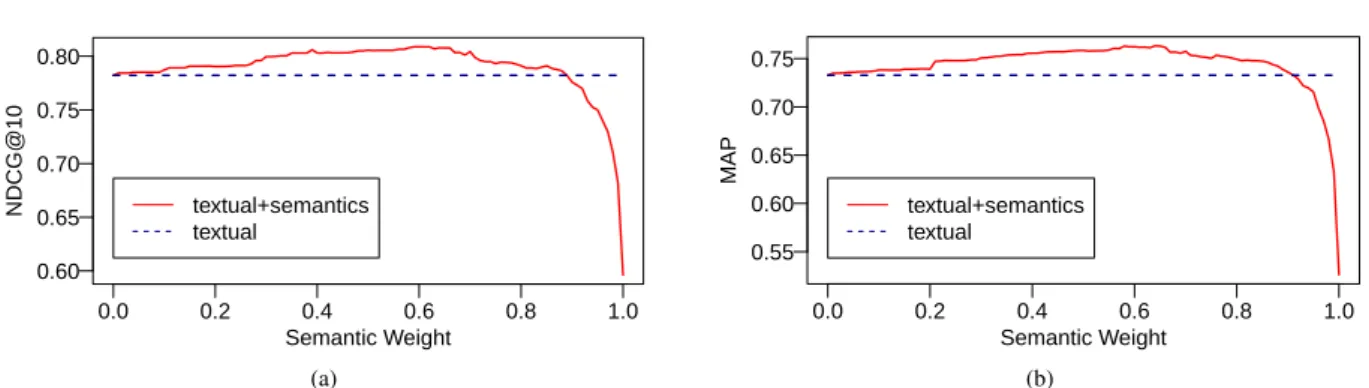
5.1.3. Balancing semantic and textual content We also evaluatedKE4IRusing different weights for textual and semantic layers. Figure 3 shows how the NDCG@10 and MAP metrics change when the im-portance given to the semantic information changes as well. The y-axes report the NDCG@10 (Figure 3a) and MAP (Figure 3b) values, while the x-axis reports the weightw(SEMANTICS)assigned to all the seman-tic information and divided equally among semanseman-tic layers, withw(TEXTUAL) = 1−w(SEMANTICS); a
w(SEMANTICS)value of 0.0 means that only textual information is used (and no semantic content), while a value of 1.0 means that only semantic information is used (and no textual content).
The results in Figure 3 show that semantic infor-mation impacts positively on system performances up to w(SEMANTICS) 6 0.89 for NDGC@10 and w(SEMANTICS)60.92for MAP, reaching the highest scores (NDCG@10 = 0.809, MAP = 0.763) around 0.61 and 0.65, respectively. Similar behaviors can be observed for NDCG and MAP@10. We remark that these scores are better than the ones obtained with equal textual and semantic weights.
We further investigated whether tuning ad-hoc each single layer weight would lead to substantial improve-ment of the overall performances. We applied both
27Performances of entity linking on queries: precision 96.6%, re-call 93.4%, F194.9% (28 correct, 1 incorrect, 2 missing URIs).
brute-force and learning-to-rank approaches (as imple-mented in RankLib28) to find the layer weight assign-ments that maximize either NDGC@10 or MAP. How-ever, no substantial improvement (i.e., greater or equal than 0.005) over the optimal scores in Figure 3 was observed. Therefore, for the other evaluations reported next in the paper (Section 5.2 and 5.3), we adopted the weights
w(TEXTUAL) = 0.35
w(URI)=w(TYPE)=w(TIME)=w(FRAME) = 0.1625
optimizing MAP in Figure 3b.
5.1.4. Comparison with retrieval models in [8, 21] We compare here the performances ofKE4IRagainst other approaches in the literature that have been evalu-ated on WES2015 and employ semantic information.29 In [8], the authors propose and evaluate some meth-ods exploiting LOD knowledge bases and some vari-ations of the Generalized Vector Space Model. These methods are evaluated only over annotations manu-ally validated by experts(i.e., perfect linking to DB-pedia entities), so in order to fairly compare the scores reported in [8, Table 4] with KE4IR performances, we removed theURIlayer automatically produced by PIKES analysis, replacing it with the manually vali-dated URIs used by [8]. Thus, thisKE4IRsetting (la-belledKE4IRGU to remark that gold URIs were used)
leverages manually validated content for theURIlayer, the LOD background content (if any) corresponding to these URIs for TYPE andTIME, plus the content au-tomatically obtained via the remaining PIKES analy-ses (i.e., without entity linking) for theTYPE(as result of WSD),TIME (as result of TERN) and FRAME (as result of SRL) layers.
First, we compare the performance of KE4IRGU
against the textual baseline and KE4IR, to better ap-preciate the benefit of having “correct” entity linking information for the URI layer. The results, reported in Table 6, show that KE4IRGU clearly outperforms
both other systems, with an improvement >6% on NDCG@10 and>9% on MAP over the textual
base-28http://sourceforge.net/p/lemur/wiki/RankLib/
0.0 0.2 0.4 0.6 0.8 1.0 0.60
0.65 0.70 0.75 0.80
Semantic Weight
NDCG@10 textual+semantics textual
(a)
0.0 0.2 0.4 0.6 0.8 1.0
0.55 0.60 0.65 0.70 0.75
Semantic Weight
MAP
textual+semantics textual
(b)
Fig. 3. Trends of (a) NDCG@10 and (b) MAP based on the amount of semantic information considered with respect to the textual one.
line, and an improvement >3% on NDCG@10 and
>5% on MAP overKE4IR.
Then, we compare the performance of KE4IRGU
against all the semantic methods discussed in [8]. Three main methods are evaluated in [8, Table 4]: (i) Concept+Text, that considers URIs of entities as tex-tual terms in building the index in Lucene; (ii) Con-nectedness, that exploits the level of connectedness of entities within documents for computing the relevance score, evaluated in two variants, with and without us-ing term frequency; and, (iii) Taxonomic, that lever-ages taxonomic relationships of the entity classes in the construction of the term vectors, evaluated in two variants, with and without using Resnik similarity.
Table 7 reports the scores in [8, Table 4], together with the relative improvement ofKE4IRGU over each
method on each measure.30 KE4IR
GU performs
con-sistently better than all the methods in [8]. In partic-ular, KE4IRGU scores similarly to those methods on Prec@1 and NDCG, while it consistently outperforms them on the first 10 documents returned (from 8.49% to 10.51% improvement on NDCG@10, from 23.80% to 32.10% improvement on MAP@10), as well as on MAP (improvement from 4.17% to 12.52%). To com-plete the comparison, it is interesting to observe (con-sidering the scores in Tables 6 and 7) that alsoKE4IR
(i.e., the standard version relying only on automat-ically annotated content) outperforms all the meth-ods in [8] on the first 10 documents returned, both in terms of quantity (17.85% to 25.75% improvement on MAP@10) and quality (6.17% to 7.58% improvement on NDCG@10).
In [21], the authors reproduce the results ofKE4IR
and investigate a family of retrieval models featuring
30No Prec@5 and Prec@10 scores are reported in [8, Table 4], so we restrict the comparison on Prec@1, NDCG, NDCG@10, MAP, and MAP@10.
BM25 (and one of its variants) as the similarity mea-sure and URI andTYPE as semantic layers. The lat-ter are used forconceptual ranking, by extending the BM25 function, and/or forsemantic filtering, by ex-cluding the documents not mentioning any of theURI andTYPE terms of the query. Compared toKE4IRon the WES2015 dataset, semantic filtering is shown to substantially improve precision (P@5, P@10) at the expense of other measures, whereas some configura-tions of conceptual ranking manage to slightly improve MAP and NDCG at the expense of precision. BM25 alone does not provide significant improvements over VSM, whereas the inclusion of URI andTYPE terms from the Wikipedia abstracts of entities appearing in queries and documents does not affect performances. Overall, the results in [21] provide additional evidence that the enrichment of documents and queries with se-mantic terms may allow improving performances over the use of textual information alone, even when a dif-ferent retrieval model is used.
5.2. Fernández et al. 2011 Benchmark for Semantic Search Systems
In our second evaluation, we assessed the perfor-mances ofKE4IRon the evaluation dataset proposed in [39] (WT10g collection with F&al. query set in Ta-bles 2 and 3, derived from TREC 9 title and TREC 2001 title) for benchmarking semantic search systems, i.e., systems exploiting semantics- or ontology-based retrieval models.
5.2.1. Evaluation Set-Up
As for the WES2015 evaluation, we compared
perfor-Table 6
KE4IRGUperformances and comparison with the textual baseline andKE4IR(WES2015 query set and document collection). Approach/System Prec@1 Prec@5 Prec@10 NDCG NDCG@10 MAP MAP@10
Textual 0.943 0.669 0.453 0.832 0.782 0.733 0.681
KE4IR 0.971 0.680 0.474 0.854 0.806 0.758 0.713
KE4IRGU 0.971 0.691 0.482 0.879 0.831 0.800 0.749
KE4IRGUvs. Textual 3.03% 3.42% 6.49% 5.63% 6.18% 9.18% 9.98%
p-value (approx. random.) 0.500 0.135 0.012 0.003 0.006 0.001 0.004
KE4IRGUvs.KE4IR 0.00% 1.68% 1.86% 2.91% 3.09% 5.49% 5.00%
p-value (approx. random.) 0.500 0.293 0.211 0.065 0.079 0.011 0.039
Table 7
Comparison ofKE4IRGUagainst all the methods reported in [8] (WES2015 query set and document collection).
Approach/System Prec@1 NDCG NDCG@10 MAP MAP@10
Concept+Text (α= 1) 0.971 0.872 0.761 0.736 0.573
KE4IRGUvs. Concept+Text (α= 1) 0.00% 0.80% 9.20% 8.70% 30.72%
Connectedness (only) 0.971 0.862 0.752 0.711 0.567
KE4IRGUvs. Connectedness (only) 0.00% 1.97% 10.51% 12.52% 32.10% Connectedness (with tf) 0.943 0.874 0.766 0.749 0.583
KE4IRGUvs. Connectedness (with tf) 2.97% 0.57% 8.49% 6.81% 28.47% Taxonomic (no similarity,α= 1/2) 0.943 0.875 0.758 0.766 0.603
KE4IRGUvs. Taxonomic (no similarity,α= 1/2) 2.97% 0.46% 9.63% 4.44% 24.21% Taxonomic (Resnik-Zhou,α= 1/2) 0.943 0.877 0.762 0.768 0.605
KE4IRGUvs. Taxonomic (Resnik-Zhou,α= 1/2) 2.97% 0.23% 9.06% 4.17% 23.80% Table 8
Comparison of KE4IR against the textual baseline in dataset of [39] (“F&al.” query set, “WT10g” collection).
Approach/System Prec@1 Prec@5 Prec@10 NDCG NDCG@10 MAP MAP@10
Textual 0.400 0.420 0.410 0.367 0.344 0.159 0.051
KE4IR 0.550 0.460 0.440 0.496 0.374 0.227 0.077
KE4IRvs. Textual 37.50% 9.52% 7.32% 35.14% 8.65% 42.89% 50.56%
p-value (approx. random.) 0.125 0.153 0.268 0.000 0.257 0.001 0.057 mances (as in Section 5.1). To complement this
assess-ment, we also comparedKE4IRperformances against the semantic search engine proposed in [9], here-after named “F&al.”, with the goal of understanding whether the simple VSM enriched with semantic terms achieves performances comparable/better/worse than other state-of-the-art semantic-based IR approaches.
5.2.2. Results
Table 8 reports the comparison of KE4IR against the textual baseline. As shown by the results,KE4IR
outperforms the textual baseline for all the consid-ered measures. In particular,KE4IRsubstantially out-performs the textual baseline on Prec@1 (∼37%), MAP@10 (∼51%), MAP (∼43%), and NDCG (∼35%), a result, for the latter two measures, statistically signif-icant according to the paired approximate randomiza-tion test. Hence, also on this dataset we observe that considering semantic terms enables a substantial im-provement of the performances of document retrieval.
Again, these results contribute to positively answer our research question.
Table 9 reports the semantic layers exploited by
KE4IR(extracted with PIKES) on each query of the dataset. Note that for one query (q457) no semantic in-formation was extracted, mainly due to the plural suf-fix on Chevrolet; nevertheless, we recall that in these cases,KE4IRresorts to the textual information. For all other queries,TYPElayer content was extracted, while URI content was available for about one third of the queries (7 queries).TIME andFRAME were available only on few queries (2 and 3 queries, respectively).
5.2.3. Comparison with F&al. [9]
Table 9 shows the Prec@10 and MAP results31 for the comparison ofKE4IRagainst the F&al. semantic search engine proposed in [9], query-by-query. Values
Table 9
Queries, available semantic layers per query, andKE4IRvs F&al. performances (Prec@10 and MAP) on the dataset of [39].
Query Layers Prec@10 MAP
TREC ID NL Question URI TYPE TIME FRAME F&al. KE4IR F&al. KE4IR q451 Provide information on the Bengal cat breeders. x x 0.7 0.8 0.42 0.54
q452 Describe the habitat for beavers. x 0.2 0.7 0.04 0.11
q454 What are the symptoms of Parkinson? What is the treatment for Parkinson? x x x 0.8 0.8 0.26 0.42
q457 Find Chevrolets. 0.1 0.2 0.05 0.04
q465 What deer diseases can infect humans? What human diseases are transferred by deers?
x 0.3 0.5 0.13 0.18
q467 Show me all information about Dachshund dog breeders. x x 0.4 0.4 0.10 0.23
q476 Show me the movies of Jennifer Aniston. x x x 0.5 0.6 0.13 0.53
q484 Show me the auto production of Skoda. x x x x 0.2 0.5 0.19 0.39
q489 What is the effectiveness of Calcium supplements? What are the benefits of Cal-cium?
x 0.2 0.3 0.09 0.24
q491 Show me all tsunamis. Describe disasters produced by tsunamis. x 0.2 0.1 0.08 0.06 q494 Show me all members of the rock group Nirvana. What are the members of
Nir-vana?
x x x 0.9 0.5 0.41 0.16
q504 What is the diet of the manatee? x 0.2 0.6 0.13 0.40
q508 Of what diseases hair loss is a symptom? Find diseases for which hair loss is a symptom. What diseases have symptoms of hair loss?
x 0.5 0.2 0.15 0.07
q511 What diseases does smoking cause? What diseases are caused by smoking? x 0.4 0.7 0.07 0.30 q512 How are tornadoes formed? Describe the formation of tornadoes. x 0.4 0.2 0.25 0.16 q513 What causes earthquakes? Where do earthquakes occur? x 0.1 0.2 0.08 0.14 q516 What is the origin of Halloween? What are the original customs of Halloween? x 0.1 0.4 0.07 0.16 q523 How are the clouds formed? Describe the formation of clouds. Explain the process
of cloud formation.
x 0.9 0.7 0.29 0.17
q524 How to erase a scar? How to remove a scar? x 0.2 0.3 0.11 0.19
q526 What is BMI? x x 0.1 0.1 0.09 0.04
Mean 0.37 0.44 0.16 0.23
KE4IRvs. F&al. 18.92% 43.75%
p-value (approx. random.) 0.101 0.026 in bold correspond to the best results for the
corre-sponding metric and query (also known as “question” in the considered dataset). KE4IRoutperforms F&al. both on Prec@10 and MAP, scoring respectively 0.44 and 0.23 on average on all queries. This accounts for a ∼19% and a∼44% increase in performance, the latter statistically significant according to the paired approx-imate randomization test. For Prec@10, KE4IR pro-vides better results than the other semantic-based ap-proach on 11 queries (55%) and equal results for other 3 queries (15%). For MAP,KE4IRprovides better re-sults than F&al. on 13 queries (65%).
Interestingly, in the single case where all seman-tic layers were available, KE4IR substantially out-performs the other approach, as well as in all the cases where theTIME layer was available. Consider-ing only queries containConsider-ing some URIs, KE4IR out-performs the other approach in 5 of the 7 cases, performing worse in q494 (likely due to “Nirvana” wrongly linked to DBpedia entity dbpedia:Nirvana
rather thandbpedia:Nirvana_(band)) and q526 (likely due to “BMI” wrongly linked to DBpedia entity
dbpe-dia:Broadcast_Music,_Inc. rather than dbpedia:Body-_mass_index).32
For the sake of completeness, we recall that in [9] the F&al. approach is also compared against two keyword-based approaches, namely Lucene and the best TREC automatic system (i.e., the system achiev-ing the best performances on MAP), usachiev-ing as in-put queries the original titles of the TREC 9 and TREC 2001 Web Track topics from which the 20 F&al. queries were derived from. Lucene achieved 0.25 and 0.10 on Prec@10 and MAP respectively, while the best TREC automatic system scored 0.3 and 0.2 for the same measures. All these values are substantially lower that the performances ofKE4IRreported in Ta-ble 9.
5.3. Keyword-based Datasets: TREC 6-7-8-9-2001
In this third evaluation ofKE4IRperformances, we applied our approach on some standard IR datasets
from TREC typically used for evaluating keyword-based approaches (see TREC document collections and query sets in Tables 2 and 3). In particular, these datasets were adopted as benchmark in the Ad-hoc track of TREC 6, 7, and 8, and the Web track of TREC 9 and 2001.
5.3.1. Evaluation Set-Up
Similarly to the previous two evaluations, we com-pared KE4IR against the textual baseline. First, we compared the two approaches considering as input queries the titles of the TREC topics, which resem-ble the queries users typically fire to a search en-gine. This is the typical and widely-accepted evalu-ation setting, also recommended by TREC guideline documents (e.g., [35]). Then, to collect more evidences for our assessment, we also investigated the query vari-ant comprising the topic title together with the corre-spondingdescriptionprovided by TREC, a short text explaining the expected results of the query. The fol-lowing query (q311) from TREC 6 highlights the dif-ference between title and description:
<id>q311</id>
<title>Industrial Espionage</title>
<desc>Document will discuss the theft of trade secrets along with the sources of information: trade journals, business meetings, data from Patent Offices, trade shows, or analysis of a competitor’s products.</desc>
Topic title usually consists of one or more keywords (on average 3 ± 1.5 tokens), sometimes forming a multi-word expression (like q311 title) or short phrase, while description usually consists of well-formed and verbose sentences (on average14±8tokens, longest one reaching 62), explaining the criteria for identify-ing relevant documents, and frequently involvidentify-ing sev-eral words that do not characterize the query (e.g., “Documents will discuss...”, “Find/Identify documents that...”, “Give examples of”, “Provide information...”). That is, the description is not a query per se, but rather an explanation of how to answer the query.
Finally, similarly to what done for the F&al. bench-mark, we complemented this assessment by analyzing
KE4IR performances in light of the best performing systems (with respect to MAP and Prec@10) that par-ticipated in the TREC 6, 7, 8, 9, and 2001 competitions where the considered TREC datasets were used, with
the goal of understanding whether the simple VSM enriched with semantic terms achieves performances comparable/better/worse than other state-of-the-art IR approaches, typically exploiting more elaborated and performing retrieval models than VSM.
5.3.2. Results
Table 10 reports the comparison of KE4IRagainst the textual baseline, for the various TREC datasets and considering the query variant consisting of the topic ti-tle only. Statistically significant results are highlighted in bold.
As shown by the results,KE4IRoutperforms the tex-tual baseline in 33 out of the 35 measures (5 datasets, 7 measures each) reported in Table 10, the only ex-ceptions being Prec@1 on TREC 8 and MAP@10 on TREC 9. In particular, KE4IR performs substan-tially better than the textual baseline on Prec@10 (relative increments from 0.52% to 9.52%), NDCG (from 1.51% to 22.20%), NDCG@10 (from 0.34% to 12.18%), and MAP (from 0.89% to 38.97%). NDCG and MAP results, which assess the whole rankings produced by the system, are statistically significant in half of the cases. The improvement on NDCG@10, which consider the first 10 ranking positions, is signif-icant for TREC 2001, possibly benefiting from the use of fine-grained 3-value relevance judgments. Overall, also on all these datasets (summing up to 250 queries and 2.2M documents) we observe that considering se-mantic terms substantially improves IR performances. We continue our analysis comparingKE4IRagainst the textual baseline on the various TREC datasets, considering the query variant that concatenates the topic titles with the corresponding descriptions. Ta-ble 11 reports the results (statistical significant ones are highlighted in bold). As shown by the results,
KE4IR outperforms the textual baseline in 34 out of the 35 measures reported in Table 11, the only ex-ception being Prec@1 on TREC 2001. In particular,