for the M.S. in L.S. degree. April, 2002. 47 pages. Advisor: Evelyn H. Daniel.
A questionnaire survey of 86 North Carolina elementary school media centers was conducted to determine media center compliance levels to the American Library
Association’s Guidelines for Library Services to Hispanics. Information was gathered to determine compliance levels in the areas of Spanish language materials and access, and Spanish language programming and reading encouragement activities.
Analysis of the survey data revealed that the majority of libraries studied achieved fair to moderate compliance levels in the areas of Spanish materials and access performance. The performance levels for Spanish language programming and reading encouragement activities were somewhat lower with the majority of libraries studied showing no or only fair compliance to the standards outlined by the American Library Association.
Headings:
School libraries - Services to Spanish Americans School libraries - North Carolina
School libraries - Book selection Multiculturalism
MATERIALS AVAILABILITY AND PROGRAMMING ACTIVITIES FOR HISPANIC STUDENTS;
A SURVEY OF NORTH CAROLINA ELEMENTARY SCHOOL MEDIA CENTERS
by
Susan K. Mikkelsen
A Master's paper submitted to the faculty of the School of Information and Library Science of the University of North Carolina at Chapel Hill
in partial fulfillment of the requirements for the degree of Master of Science in
Library Science.
Chapel Hill, North Carolina April, 2002
Approved by:
Table of Contents
List of Tables and Charts………..2
Introduction………3
Literature Review………..4
Methodology………...11
Survey Results and Data Analysis………..14
Conclusions and Recommendations………...36
Works Cited………..40
Appendices………42
Appendix A - Survey Cover Letter………42
List of Tables and Charts
Chart 1 - Spanish Materials and Access Performance Levels………...………..15
Chart 2 - Spanish Programming and Reading Encouragement
Performance Levels………17
Table 1 - Survey Criterion Compliance……….18
Table 2 - Relationship between Extra Funding for Spanish Language Materials and Adequate Number of Spanish Titles in the Collection……….23
Table 3 - Relationship between Collection Constraints and Adequate Number
of Spanish Titles in the Collection……….25
Table 4 - Relationship between Collection Constraints and Cultural
Representativeness of the Collection……….26
Table 5 - Relationship between Staff Development Training and Adequate
Number of Spanish Titles in the Collection………..28
Table 6 - Relationship between Staff Development Training and Physical
Accessibility………...……..29
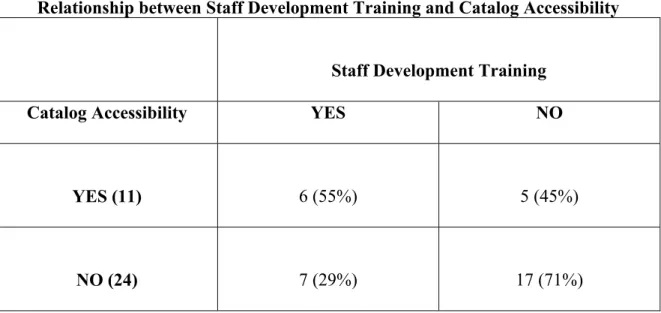
Table 7 - Relationship between Staff Development Training and Catalog
Accessibility……….29
Table 8 - Relationship between Staff Development Training and Cooperative
Programs with Other Libraries or Institutions………30
Table 9 - Relationship between Spanish Speaking Personnel and Catalog
Accessibility……….32
Table 10 - Relationship between Spanish Speaking Personnel and Reading
Encouragement Activities in Spanish………..32
Table 11 - Relationship between Spanish Language Classes and Reading
Introduction
North Carolina has experienced a dramatic increase in its Hispanic immigrant population over the last decade. State officials say public school enrollment of Hispanics grew 285 percent from 1990-91 to 1997-98 (Patterson, 1998). Census figures show that some North Carolina counties have nearly ten times more Hispanics today than they did in 1990. Many of these immigrants speak little or no English when they arrive. The public schools of North Carolina have struggled to meet the learning needs of these children because of this language barrier. Most schools have ESL programs for these students, but more needs to be done to provide these children with language experience in their primary language as they begin the process of learning English.
The school media center provides an ideal environment to help Hispanic children make the transition from language experiences in Spanish to language experiences in English. Providing library reading encouragement activities in both English and Spanish and adapting collection development practices to include purchasing materials written in Spanish are two important ways that the School Media Center Coordinator can support the language development of this emerging population.
In 1988 the American Library Association published a document entitled, Guidelines for Library Services to Hispanics. Included in these guidelines are specific recommendations for librarians of medium-to-small institutions regarding their
recommendations should serve as a standard for all school libraries and coordinators as they examine how their programs and collections are adapting to meet the needs of Hispanic students.
The research project I have undertaken seeks to determine if North Carolina elementary school media centers are responding to the recommendations of the ALA report that relate to language development. In addition, I will examine other school-wide variables that may influence compliance with the standards outlined therein.
Specifically, I propose that my research will answer the following question:
Based on selected recommendations from the ALA's Guidelines for Library Services to Hispanics, are North Carolina elementary school media centers adapting their programs and collections to meet the language development needs of their Spanish speaking students?
Literature Review
have the ability to utilize many of the community's educational resources, such as public libraries. This places public schools, and particularly the public school media center, with the primary responsibility for providing programs and materials to help Spanish speaking children develop language skills in both Spanish and English.
Some debate in this country has occurred about bilingualism and our society's obligation to provide non-English speaking residents with materials and/or information in their native languages. The educational community also disagrees about the most
effective way to develop proficiency in a second language. It is beyond the scope of this research to enter into this debate, other than to acknowledge that there is more than one school of thought on how best to educate Spanish speaking children in English-speaking schools. This research will be based on two assumptions that have support in the current library and educational literature. First, I will assume that Spanish speaking children must have opportunities to develop skills in English while at the same time learning content through their native language (Wadham, 1999). Second, I will assume that denying children the opportunity to become literate in their first language may cause them to wind up illiterate in two languages in the end (Cummins, 1989).
The most common method of teaching the English language to Spanish-speaking children as they enter North Carolina schools is through the use of English as a Second Language (ESL) instruction. In a typical elementary school ESL program, the non-English speaking students leave their regular classroom to spend a part of their
expression and enjoyment, and to extend their communicative competence. Once a student has attained this level of English language competence, he is taught to use the second language to acquire, process, construct and provide information in spoken and written form (Becker, 2001).
It is important to note that most ESL programs maintain an English-only policy in their classrooms, and most ESL teachers speak only in English to their students. Nearly all ESL textbooks and materials are written exclusively in English (Valdes, 2001). This English immersion philosophy produces a "sink or swim" scenario for most immigrant children. While some students in ESL programs "swim" and become competent in the English language, too many others sink. The high dropout rate among Hispanic students is often the result of their failure to acquire adequate skills in the English language (Valdes, 2001).
A recent study of ESL students and their educational outcomes produced several important recommendations on constructing appropriate school programs for newly arrived immigrants (Valdes, 2001). Among these recommendations, the following have direct application to school librarians:
respective roles in building language skills in the ESL student population (Hurren, 1993).
2. Schools must find ways to end the isolation of immigrant students. Hispanic students must feel welcome at school and in the library (Kreicker, 1998).
Collecting books for the English speaking student body that are culturally
meaningful and correct will help students accept and welcome their new Spanish speaking peers. Celebrations of the Latino culture that include library displays of ESL student projects encourage immigrant students to take ownership of their library (Filson, 1992). Special programs, such as booktalks and storytelling can be conducted in both English and Spanish. Whenever possible, bilingual library personnel should be hired, or Spanish-language instruction offered to the existing staff (Gonzalez, 1999 and Allen, 1993). Bilingual signage in the library can help a Spanish speaking student or parent feel a part of the school community (Moller, 2001).
3. ESL textbooks and workbooks must be supplemented with materials that
4. Students must be given access to the curriculum while they are learning
English. In the library, access to the curriculum means providing content area materials in the student's primary language (Moller, 2001). Access in the library is also accomplished by placing Spanish-language materials in highly visible areas. Although separate collections can be problematic in some cases, separate Spanish-language collections are often maintained to provide easier access to students who speak little or no English (Bush, 1996). Another critical point of access for Hispanic students is to provide Spanish-language subject headings for Spanish materials in the library catalog (Allen, 1993). Finally, connecting the school library with other information organizations can give the Hispanic student access to more materials that support the school curriculum. Partnering with institutions, such as public libraries, can extend the school libraries resources and help students tap into other information networks (Davie, 1999).
The school librarian then, is in a unique position to act as a facilitator for language development in Hispanic children. By providing programs and materials in Spanish that support curriculum goals, the library provides content area support for non-English speaking students. Further, by expanding the Spanish-language fiction collection and by conducting reading encouragement activities in both English and Spanish, librarians can support language development in the student's native tongue. Guidelines provided by the ALA can help the school librarian to determine how well programs and materials in their libraries are being adapted to meet the language development needs of their
language development will be studied. The following selected guidelines from the ALA's Guidelines for Library Services to Hispanicsrepresent the areas that I chose as the basis for my research questionnaire:
Collection and Selection of Materials
Persons in the Hispanic communities in the United States do not speak and read only Spanish; they do not all speak and read only English, nor are they all
bilingual. The members of these communities have diverse needs and are entitled to access to materials diverse enough to meet those needs. There are criteria to aid in the selection of these library materials.
Language
The collection should contain materials in Spanish, materials in English, and bilingual materials. Materials selected should reflect the particular linguistic characteristics of the community served. They should also include Standard Spanish language titles from Spain and other Hispanic cultures.
Physical Access
If a separate collection of materials for Hispanics is maintained by the library, it should be visible and accessible to the community. In libraries that do not separate these materials, adherence to bibliographic access is strongly recommended.
Programs Services and Community Relations
Programming, both traditional and nontraditional, is an effective vehicle to attract and meet the needs of the members of the Hispanic community. This is
particularly true for those who have recently immigrated and who are unfamiliar with the library services available in the United States. As a result of the
potentially limited resources available for service to Hispanics within any given institution, cooperation among all libraries serving the target population is encouraged. Such cooperation may manifest itself in the sharing of program costs, cooperative acquisitions, or joint borrowing privileges, to name a few.
Intercultural Understanding
As part of its activities in working with local populations in which a multiplicity of cultures is represented, the library should actively promote intercultural communication and cooperation among them.
Bibliographic Instruction
In keeping with the ALA policy in support of multilingual services, the language used for programming and services (Spanish, English, bilingual or monolingual) as well as vocabulary, accent, and nuance must be
carefully selected. Choices should be based upon the characteristics of the local community.
Personnel
Librarians serving Hispanic communities should be actively recruited. Staff Development
Librarians and support staff should be provided opportunities to exchange information and ideas as well as to participate in continuing education programs that would enhance the services provided to libraries in Hispanic communities. Examples of programs that could be explored include training in teaching English as a second language, acquisition of Spanish-languages materials, citizenship requirements, and community information services.
Buildings
The library building, through its location, architecture, and appearance, should be an attraction, not a barrier, to members of the Hispanic community.
Signage
In any library serving a bilingual community, signs should be bilingual. Attention must be paid to the particular dialect of Spanish used so that the wording, phraseology, and connotation of the language conform to the culture of the community. Signage should be both prominent and visible (American Library Association, 1988).
By comparing these guidelines with a study done in 1993 (Allen, 1993), I identified the following criteria on which to base my questionnaire:
Materials
• Percentage of Spanish-language books in the collection compared with the percentage
of Hispanic children in the school
• Special funding sources for the purchase of Spanish-language materials
• Cultural representativeness of the collection
• Accessibility of Spanish-language collection
• Spanish fluency among library staff
Programs
• Cooperation with other libraries/organizations for the purpose of sharing
Spanish-language resources
• Library signage in Spanish
• Staff-development/training in programming for Hispanic children
• Spanish fluency among library staff
• Providing reading encouragement activities in Spanish
While not exhaustive, the above standards provide a set of basic practices that the school libraries in the study should be implementing. Questions on the survey were crafted to reveal trends and patterns in the way the libraries in the sample are responding to the language experience needs of Hispanic children.
Methodology
Sample Frame
Questionnaire
Questionnaire and cover letter drafts were reviewed and approved by the
Academic Affairs Institutional Review Board at the University of North Carolina, Chapel Hill for use in human subjects research (Appendices A and B). Once approved, the cover letter and questionnaire, along with an index card and a self-addressed stamped envelope for returning the survey, were sent by US mail to each elementary school in the sample. The index card was included in the mailing so that the respondents could send back an email address to receive information about the results of the survey. The purpose for this index card was described in the cover letter. Each questionnaire was identified with a tracking number to aid in the follow-up process for surveys that were not returned in a three-week period. Once a survey was returned, the tracking number was removed to insure the anonymity of the respondents. Follow-up postcards were mailed to libraries that did not respond within three weeks of the estimated date of receipt of the instrument.
The questionnaire consisted of 20 questions and was three pages in length (See Appendix B). It included questions designed to measure the extent to which each library is providing materials and programs to aid in the language development of Spanish-speaking children, based on recommendations set forth by the American Library
Association. In addition, some questions on the survey were aimed at exploring certain characteristics of the school environment. These questions were used to examine
Address information for the schools was located on the DPI website and then put into a simple database program to create mailing labels. Whenever possible, the mailings were addressed with the name of the media center coordinator (obtained from many school websites). When the name of the media coordinator was unknown, the mailing was sent to "Media Center Coordinator" at the school's address.
The first step in analysis of the survey data was descriptive in nature. The object was to examine the survey responses to determine the level of compliance to the ALA standards for each unit in the study. Questions on the survey addressed six areas relating to materials acquisition and accessibility. Each unit was given a score from 0-6 on the materials criterion based on their survey responses. Other questions on the survey addressed five areas relating to library programming. Each unit was given a score from 0-5 on programming based on their survey responses. The responses to question #18 were scored based on what reading encouragement activities the unit conducted in both Spanish and English. If any activities were conducted in Spanish, the unit received one additional point toward their total score. The results from this table were also analyzed and then expressed as a percentage to represent the portion of the total number of activities the unit conducted in Spanish.
The second step of the analysis was to look at relationships between school variables to explore possible explanations for the results of the descriptive analysis. For example, the relationship between “Spanish Speaking Personnel" and "Reading
Survey Results and Data Analysis
A total of 35 surveys were returned, making the survey response rate almost 41%. The data was analyzed in three different ways. First, individual unit performance was examined. Next, aggregate compliance levels to criterion standards were determined. Finally, relationships among variables were studied.
Analysis of Unit Performance
Each respondent was given two performance scores based on their survey responses. The first score reflected performance in the area of Spanish materials acquisition and access. The second score reflected performance related to Spanish language programming.
Spanish Materials Acquisition and Access
Six areas of library practices and activities relating to materials acquisitions and access were addressed in the survey:
1. Percentage of Spanish titles in the collection (Question #3)
2. Cultural representativeness of titles in the collection (Question #5) 3. Access to Spanish titles (Questions #6, #7, and #8)
4. Staff development (Questions #11 and #12)
5. Spanish fluency among library staff members (Questions #15 and #16) 6. Special funding for Spanish materials (Question #17)
• Score = 6 areas Outstanding Practices/Activities
• Score = 5 areas Very Good Practices/Activities
• Score = 4 areas Good Practices/Activities
• Score = 3 areas Moderate Practices/Activities
• Score = 2 areas Fair Practices/Activities
• Score = 1 areas Poor Practices/Activities
• Score = 0 areas No Practices/Activities
The following chart illustrates the range of performance levels among the survey respondents.
Chart 1
Spanish Materials and Access Performance Levels
0 2 4 6 8 10 12
None Poor (1) Fair (2) Moderate (3) Good (4) Very Good (5) Outstanding (6)
Practices and Activities
Number of Libraries
Spanish Language Programming
Five areas of practices and activities relating to Spanish language programming were addressed in the survey.
1. Cooperative programs with other libraries or information agencies (Question #9) 2. Library signage in Spanish (Question #10)
3. Reading encouragement activities in Spanish (Question #18) 4. Staff development (Questions #11 and #12)
5. Spanish fluency among library staff members (Questions #15 and #16)
Positive survey responses for each area were totaled to give each library a score between zero and six. Scores are reflected in the following performance scale:
• Score = 5 areas Outstanding Practices/Activities
• Score = 4 areas Very Good Practices/Activities
• Score = 3 areas Good Practices/Activities
• Score = 2 areas Fair Practices/Activities
• Score = 1 areas Poor Practices/Activities
• Score = 0 areas No Practices/Activities
Chart 2
Spanish Programming and Reading Encouragement Performance Levels
0 2 4 6 8 10 12 14
None Poor (1) Fair (2) Good (3) Very Good (4) Outstanding (5)
Practices and Activities
Number of Libraries
The performance levels for Spanish language programming and reading
encouragement activities were generally lower than for Spanish language materials and access. Twenty-two libraries were categorized as performing poorly or not performing at all relative to their efforts in this area. Thirteen libraries indicated activities in two or three areas. No libraries were categorized as performing at the very good or outstanding level.
Compliance Levels to Criterion Standards
Table 1
Survey Criterion Compliance
Criteria Number of Libraries
Indicating Compliance
Percentage of Libraries Indicating Compliance
Adequate number of Spanish-language books in the library's collection
3 8.5%
Special funding sources for purchase of Spanish-
language materials 6 17%
Culturally representative
collection 27 77%
Physical access to Spanish-
language collection 19 54%
Catalog access to Spanish- language collection through Spanish language subject
headings 13 37%
Library signage in Spanish 2 5.5%
Cooperative programs with
other libraries/agencies 4 11%
Spanish speaking library
personnel 16 46%
Staff development
opportunities 11 31%
Spanish programming for reading encouragement activities
5 14%
had a collection percentage to match the population percentage, the other two libraries had a substantial portion of the collection made up of Spanish books.
Special funding sources for purchase of Spanish language materials
Six libraries indicated that they had received additional funding specifically for the use of Spanish language materials. Three of these libraries received extra funds from grant money. Grant sources included the State Library, LSTA and Title VI. Other sources of additional funding included ESL money, book fair profits and what one respondent termed "pork barrel money."
Culturally representative collection
The survey asked respondents whether their collection represented the various backgrounds of the children in their school. Seven respondents answered no to this question, and one failed to respond. The remaining survey participants indicated that their collections were either somewhat representative or fully representative of the cultural backgrounds of their students. Respondents who indicated some compliance were scored positively in this category.
Physical access to Spanish language collection
collections placed them in an area of high visibility. The remaining five with separate collections had placed their Spanish language collection in an area of low visibility. Two survey respondents did not answer this question.
Catalog access to Spanish language collection through Spanish language subject headings Twelve participants in the study said that their library catalog included Spanish language subject headings for Spanish language materials. One participant indicated that some of the collection has been cataloged in this manner. Twenty-two participants answered that no Spanish language subject headings were available in their catalog. One of these respondents wrote in "Not Yet" to this question, indicating awareness of the need, and intent to become compliant.
Library signage in Spanish
Two libraries have done some work with providing signage in Spanish. One library mentioned that they had posted one sign in Spanish. The remaining libraries indicated that they do not have signs in Spanish.
Cooperative programs with other libraries/agencies
Four libraries have found opportunities to partner with other libraries or
Spanish speaking library personnel
Sixteen respondents indicated that they have media center specialists, media aides, volunteers or other school personnel who speak some Spanish in the library. Three libraries categorized these Spanish speakers as fluent. None of these fluent speakers were in the library full time. One was an ESL assistant, one was an aide who worked two days a week, and one was a volunteer. Fourteen respondents indicated that they had one or two people in the library that could speak some Spanish. Nine of these people with some Spanish proficiency were media center specialists. Two were teachers at the school; four were media center aides; and two were volunteers.
Staff development opportunities
Eleven participants said that they had received some staff development training relating to materials and programming for Hispanic students. One participant stated that the training received was self-initiated. Two participants received training only from the school district; one of these participants indicated that the training included Spanish classes. Three participants received training only from the school. Four participants received training at both the school and district levels.
indicated that only one of their normal programming activities had been conducted in Spanish as well as English. Three participants did not respond to this question. These libraries were scored as if they had no activity in this area.
Relationships Among Variables
Four data areas seem to provide some potential causative explanations for the performance of individual school libraries in relation to the study. These areas include Additional Funding, Staff Development Training, Collection Constraints, and Spanish-speaking library staff. Additional insight into these factors was obtained from comments made at the end of the survey in answer to question #19, “What do you feel are your greatest needs and concerns in providing appropriate programs and materials for the Hispanic students in your school?”
Additional Funding for Spanish Language Materials
Table 2
Relationship between Extra Funding for Spanish Language Materials and Adequate Number of Spanish Titles in the Collection
Extra Funding For Spanish Language Materials
Adequate Number of
Titles in Spanish YES NO
YES (3) 1 (33%) 2 (66%)
NO (32) 5 (16%) 27 (84%))
This comparison tells us that 66% of the libraries with an adequate Spanish language collection did not receive extra funding for these materials. This could mean that these libraries already have adequate funds in their budgets to collect in this area. It is also possible that extra funding was obtained before the respondent was employed as the librarian in the school.
The more meaningful numbers may be those describing the libraries that do not have an adequate Spanish language collection. Although 16% of these libraries
indicated that they had received additional funds, their collections were still deficient in the number of Spanish language materials. A far greater percentage, 84%, had no additional funding at all
We always try to add to our Spanish collection, but as always, money, or lack of money is a hindrance.
Our budget is not totally adequate to support the curriculum for our English speaking students.
Publishers are charging so much more for other cultures and languages books and materials that it is difficult to almost impossible to get many out of a small
budget.
Collection Constraints
When a library operates with collection constraints such as the Accelerated Reader Program or district mandated Core Curriculum collection practices, it is more difficult to adapt the collection to meet the needs of a new population such as non-English speaking students. Collection constraints effectively result in the same inability to collect for this population as having insufficient funds. In essence, collection
Table 3
Relationship between Collection Constraints and Adequate Number of Spanish Titles in the Collection
Collection Constraints
Adequate Number of
Titles in Spanish YES NO
YES (3) 1 (33%) 2 (67%)
NO (32) 17 (53%) 15 (47%)
Table 4
Relationship between Collection Constraints and Cultural Representativeness of the Collection
Collection Constraints
Culturally Representative
Collection YES NO
YES (27) 12 (44%) 15 (56%)
NO (8) 6 (75%) 2 (25%)
Of those libraries indicating a culturally representative collection, more than half had no collection constraints. On the other hand, 75% of the libraries dealing with collection constraints did not have a culturally representative collection. Additional evidence of a possible relationship is supported further by comments from survey participants.
My selections are based on curriculum. These our teachers use. Less emphasis on AR/Reading Renaissance.
collect bilingual books and low level, high interest books, rather than Spanish-only materials. One survey comment describes this ESL paradigm.
The goal of the ESL program is obviously to teach the students English. What we need are more bilingual books so that there is something the students can read while also helping them learn English. We also need more low level high interest books for those students who have begun to read English but are not ready for picture books.
Another related comment addresses bilingual books.
I need more bilingual books. Most of our Hispanic students can’t read Spanish, but their parents can. Bilingual books would teach both parents and students. One comment addressed the difficulty of including ESL students in the Accelerated Reader program.
At the beginning, LEP (limited English proficient) students are scared, but willing to do something if they can understand what to do. They like the AR program, but there aren’t enough low-level books (0.1-1.5). It would be good if we get some more of those, and if they are bilingual, better.
Staff Development Training
institutions. Table 5 shows the results of the survey relative to the relationship between staff development training and an adequate Spanish language collection.
Table 5
Relationship between Staff Development Training and Adequate Number of Spanish Titles in the Collection
Staff Development Training
Adequate Number of Titles in Spanish
YES NO
YES (3) 2 (67%) 1 (33%)
NO (32) 9 (28%) 23 (72%)
Two of the three respondents with adequate Spanish materials in the collection had received staff development training. Conversely, there has been no training in 23 of the 32 libraries where more Spanish materials are needed. Perhaps this can be clarified by some comments included on the surveys, which indicated a problem with finding
suitable materials to collect.
Finding available titles in both English and Spanish. Greater availability of K-5 bilingual titles.
Locating bilingual materials that are suitable for elementary schools.
Training on how to make Spanish language materials more accessible in the library is also needed. Table 6 points out the relationship between physical accessibility (separate collection with high visibility) and staff development training.
Table 6
Relationship between Staff Development Training and Physical Accessibility
Staff Development Training
Physical Accessibility YES NO
YES (15) 7 (47%) 8 (53%)
NO (18) 4 (22%) 14 (78%)
Table 7 shows the relationship between catalog accessibility (Spanish Subject Headings) and staff development training.
Table 7
Relationship between Staff Development Training and Catalog Accessibility
Staff Development Training
Catalog Accessibility YES NO
YES (11) 6 (55%) 5 (45%)
In the areas of both physical accessibility and catalog accessibility, there appears to be a possible relationship between performance and training. Fourteen of the survey participants who had received no staff development training failed to provide physical access to the Spanish language collection. Additionally, seventeen of the respondents whose libraries did not have Spanish language subject headings in the catalog had no staff development training.
The survey data show a clear relationship between libraries with cooperative programs in the community, and the opportunity for staff development. Table 8 demonstrates this relationship.
Table 8
Relationship between Staff Development Training and Cooperative Programs with Other Libraries or Institutions
Staff Development Training
Cooperative Programs YES NO
YES (4) 3 (75%) 1 (25%)
NO (31) 8 (26%) 23 (74%)
cooperative programs, 23 had not participated in any kind of staff development training. One survey participant commented on the importance of cooperative programs by responding that the most important need in the library was “Community support.”
Spanish Speaking Library Personnel
The survey data show that the presence of Spanish speaking personnel in the library is related to both catalog access and the programming of reading encouragement activities in Spanish. The possible explanation for these relationships is fairly obvious, as both of these variables require the involvement of someone with Spanish language skills. Survey questions differentiated between personnel with some ability to communicate in Spanish and those that were fluent in the language. However, for the purposes of analysis, libraries that reported Spanish speakers at any level were counted as having Spanish-speaking personnel. Personnel included media specialists, aides, volunteers and other teachers in the school.
Table 9
Relationship between Spanish Speaking Personnel and Catalog Accessibility
Spanish Speaking Personnel
Catalog Access YES NO
YES (14) 9 (64%) 5 (36%)
NO (21) 7 (33%) 14 (67%)
The presence of Spanish speaking personnel is also associated with the incidence of programming reading encouragement activities in Spanish. Table 10 displays the extent of this relationship.
Table 10
Relationship between Spanish Speaking Personnel and Reading Encouragement Activities in Spanish
Spanish Speaking Personnel
Reading Encouragement Activities in Spanish
YES NO
YES (5) 4 (80%) 1 (20%)
Again, the relationship between these variables is easily observable. There is a much greater likelihood that reading encouragement programming can be conducted in Spanish if the library has access to people who speak Spanish. This is further supported by the data that correlates the number of schools where Spanish language classes are taught to English speaking students to the presence of Spanish language reading encouragement activities.
Table 11
Relationship between Spanish Language Classes and Reading Encouragement Activities in Spanish
Spanish Language Classes
Reading Encouragement Activities in Spanish
YES NO
YES (5) 2 (40%) 3 (60%)
NO (30) 6 (20%) 24 (80%)
Two (40%) of the libraries that conducted Spanish language reading
Survey respondents commented often on this need to bridge the language gap with Hispanic students. Eleven survey participants included remarks indicating that learning to communicate with students in Spanish was their greatest concern. These responses included the following comments.
It is difficult to communicate effectively with these students because my Spanish is so limited. I can say basic things and we always send written communication in English and Spanish. I would like to become fluent in Spanish so my instruction could be more easily understood by ESL kids.
As a Media Specialist, I need to eventually become fluent in Spanish. Training in conversational Spanish.
It would be helpful if my school provided Spanish classes for the entire staff as well as the students (non-Spanish speaking).
Limitations of the Study
opportunity to learn to speak Spanish emerged as the most important standards for improving services to Hispanic students relative to their language development needs.
The results of the study were further limited by the fact that only three of the 35 survey participants indicated an adequate number of Spanish titles in their collections. An adequate Spanish language collection is a critical first step in providing materials and services to the Hispanic population. Because the number of units in compliance in this area was so small, it was difficult to draw conclusions about the possible causative factors for this variable.
There is another important consideration in understanding what the survey data actually tell us about how school libraries are responding to the language development needs of Hispanic students. Most of these libraries have had very little time to make adjustments relative to the needs of this emerging population. For most librarians, the first step will be to improve the Spanish language collection. As the collection develops and more materials in Spanish are available, more activity in Spanish language
programming and reading encouragement activities will likely follow.
Conclusions and Recommendations
Although it is evident from the survey responses and comments that many school media centers are making the effort to provide materials and programming for Hispanic students, too many others are not responding adequately to the problem. Very few of the standards and practices recommended by the ALA can be implemented quickly or
process. Learning to speak Spanish cannot be accomplished in a one-day training session. Changing school-wide attitudes regarding collection priorities will happen gradually. There are no quick fixes for these problems.
These realities notwithstanding, there are some things that almost every school library can do with minimal effort and expense that will improve the way they serve Hispanic students. Making the Spanish language collection physically accessible, adding Spanish language subject headings to the catalog and providing library signage in Spanish are simple first steps in the process of providing appropriate services to Hispanic students. Establishing a cooperative program with the public library calls for only a small investment of time and resources. Providing reading encouragement activities in Spanish can be done with a little extra planning and a willing Spanish-speaking helper.
The data that has been produced by this study show that North Carolina
how well the schools have helped them to develop proficiency in English. Providing activities and materials in Spanish will facilitate this language development.
School media centers certainly need more Spanish speaking personnel. Schools and districts should provide Spanish language training for teachers and librarians. When they do not provide this service, the motivated media specialist should seek training elsewhere. Schools and districts need to provide comprehensive training on how to respond to the Hispanic population. When training is not being provided, media center specialists need to band together and demand it.
Perhaps the greatest challenge that school media center coordinators will face as they work to provide appropriate services to Hispanic children will be to convince their professional colleagues that Spanish language materials in the library are not just nice, they are necessary. Although every good school administrator and teacher shares the same concern for the education of the Hispanic student, the librarian may have a unique perspective on how to educate the child best. The professional responsibilities of the librarian are clear regarding the issues of access to materials and equality of patron services. Librarians are obligated to serve all students. ESL instructors and classroom teachers may have justifiable reasons for limiting Spanish language materials in their programs. Librarians do not.
very little is written about the response of school libraries in this state because the problem is so new.
There is no question that the growing population of non-English-speaking Hispanics in our state is forcing us to reexamine our educational processes and look for solutions to the language-barrier problem. Along with the ESL emphasis on learning English, it is critical that elementary-age Spanish-speaking students be given the opportunity to acquire language skills in Spanish as well. Without this opportunity, these children may ultimately be illiterate in not one, but two languages. School media centers must be made aware of their potential to make important contributions to the language development of Hispanic children by providing materials and programs in the Spanish language as well as low-level English and bilingual materials.
As more and more Hispanic immigrant families arrive in North Carolina each year, the make-up of our state and our communities is changing. As our communities change, so do our schools. These changes require adjustments not only in the classroom, but also in all areas of the school, perhaps most importantly in the school library.
Librarians must always be committed to providing appropriate services to all of their patrons. In school libraries, this means equivalent opportunities for appropriate language experiences to build a solid foundation for future learning. For Hispanic children still in the process of learning English, this means that appropriate language experiences in Spanish must be provided.
Works Cited
Allen, Adela Artola. 1993. The School Library Media Center and the Promotion of Literature for Hispanic Children. Library Trends 41(3):437-61.
American Library Association. 1988. Guidelines for Library Services to Hispanics.
Available from http://www.ala.org/rusa/stnd_hispanic.html ; Internet; accessed 28 September 2001.
Becker, Helene. 2001. Teaching ESL K-12: Views from the Classroom. Scarborough, Ontario, Canada: Heinle & Heinle.
Bush, Gail. 1996. The High Interest Collection: A Stepping Stone to Students. School Library Journal 42(10):44-45.
Cummins, Jim. 1989. Empowering Minority Students. Sacramento California: California Association for Bilingual Education.
Davie, Judith F. 1999. Learning Connections and the School Library Media Program: It Takes a Whole Village to Raise a Child. North Carolina Libraries 57(1):13-17. Gonzalez, Lena. 1999. Public Libraries Reach Out to New North Carolinians: Meeting
the Information Needs of Immigrants and Refugees. North Carolina Libraries 57(1):4-7.
Filson, Anne H. 1992. Librarian-Teacher Partnerships: Serving the English-as-a-Second Language Students. Journal of Youth Services in Libraries 5(4):399-406. Hurren, Patti. 1993. Expanding the Collaborative Planning Model to Meet the Needs of
ESL Students. Emergency Librarian 20(5):8-12.
Kreicker, Kimberley. 1998. Collaborating to Meet the Needs of Non-English Speaking Patrons. Library Review 47(3):171-173.
Moller, Sharon Chickering. 2001. Library Services to Spanish Speaking Patrons: A Practical Guide. Englewood Colorado: Libraries Unlimited.
Valdes, Guadalupe. 2001. Learning and Not Learning English: Latino Students in American Schools. New York: Teachers College Press.
Appendix A
January 9, 2002
Dear Media Center Specialist,
I am contacting you to ask for your assistance with a research questionnaire for my masters paper. My name is Sue Mikkelsen, and I am a graduate student in the School of Information and Library Science at the University of North Carolina at Chapel Hill. I plan to finish my degree this spring and eventually work as a librarian in a school setting.
My program here at UNC has helped me to develop an interest in how libraries provide services to special populations. For my masters paper, I am surveying elementary school media centers in North Carolina to learn more about what adaptations in programs and collections are being made to better serve Hispanic children. Many North Carolina schools have seen the enrollment of Spanish-speaking children increase dramatically over the last 5-10 years. Your library was selected to participate in the survey because of the relatively high percentage of Hispanic students in your school. There are approximately 85 other North Carolina elementary schools being asked to participate in the survey.
I would greatly appreciate your participation in this survey. I anticipate that you will be able to complete the questionnaire in approximately 15 minutes. Your responses will provide the information I need to learn more about how North Carolina school media centers are responding to this emerging population. Additionally, I hope my paper will make a needed contribution to the current body of research being done in this area. There are many North Carolina schools that could benefit from the information that you will share with me.
Your response to this survey is completely voluntary and anonymous. You will notice a tracking number on the bottom right hand corner of the first page of the survey. This number will be used only as a means of determining which surveys have been returned. Once I check your survey in, I will remove the number from the survey, and there will be no way to know which survey came from which school. By returning the survey, you are giving your consent for me to aggregate your responses with those of others who respond.
If you have questions about this study, please feel free to contact me (information below) or my faculty advisor, Dr. Evelyn H. Daniel (CB #3360) Manning Hall, University of North Carolina at Chapel Hill, Chapel Hill, NC 27599, 919-962-8062, (email: [email protected]). If you have questions or concerns about your rights as a study participant, please contact the Academic Affairs Institutional Review Board, Barbara Goldman, Chair (CB#4100) 201 Bynum Hall, University of North Carolina at Chapel Hill, Chapel Hill, NC 27599, 919-962-7761, (email:
Your timeliness in returning the survey is greatly appreciated. It is my hope that within two weeks of receiving the survey, you will have a chance to complete it and drop it in the mail. Please find enclosed a self-addressed stamped envelope for your convenience. I wish to thank you in advance for your cooperation with this research project. If you are interested in the results of this study, please include your email address on the enclosed index card and send it back with your survey. Upon completion of the analysis, I will send you the web address where I have published the results. Thank you again for your time and consideration.
Sincerely, Sue Mikkelsen 100 Manning Hall
University of North Carolina, Chapel Hill Chapel Hill, NC 27599
Appendix B
School Media Center Survey
For the purposes of this survey the term Hispanic will be used to refer to any people who are from or who descend from a Spanish-speaking country.
1. What is the approximate percentage of students in your school whose primary language is Spanish? __________
2. What is the approximate number of titles in the collection of your library? ________
3. What is the approximate percentage of titles written in Spanish in your collection? __________
4. Are there any constraints on the selection of new titles for your collection such as Accelerated Reader or other programs, District Level selection, etc.? No________ Yes (specify) __________________________________________
5. Hispanic students come from a variety of backgrounds and cultures. Do you feel that your collection has materials to represent the various cultures of the children in your school? Yes _________ Some but not enough _________ No _________
6. Some libraries keep their Spanish-language and English-language materials in separate physical locations, while other libraries integrate their Spanish-language titles among their English titles. Which of these approaches does your library use? Separate collections ______ Integrate collections _______ Other (explain) _______________________________________________________________
7. (Please answer only if your answer to question #6 is "Separate collections") Which of the following descriptions best characterizes the location where you shelve your Spanish-language collection? High visibility ________ Low visibility ________
9. Does your library currently participate in any cooperative programs with public libraries or other organizations with the purpose of sharing Spanish-language resources and/or materials? Yes ________ No _________
10. Is the signage in your library displayed in Spanish as well as English? Yes _________ No _________
11. Have you received staff-development training to aid you in your efforts to provide programs and materials for the Hispanic students in your school? Yes ________ No _________
12. (Please answer only if your answer to question #11 was Yes) Who has provided this staff-development training? (Check all that apply) District ________ School ________ Other (specify) _________________________
13. Does your school have an ESL program? Yes ________ No ________
14. Does your school provide Spanish instruction for English-speaking students? Yes ________ No ________
15. Please indicate the number of personnel in your library that speak fluent Spanish: Media Specialist(s) _______ Media Aide(s) _______ Parent Volunteer(s) ______ (Your answer will be a numeral; you may answer more than once)
16. Please indicate the number of personnel in your library who speak some Spanish but would not be considered fluent in the language: Media Specialist(s) ________ Media Aide(s) ________ Parent Volunteer(s) _______ (Your answer will be a numeral; you may answer more than once)
18. Below are various activities that are part of some school library programs. Check those that are part of your library's programming for the current school year. Please indicate which activities are conducted in English and/or Spanish.
English Spanish
Book Talks
Choral Readings
Dramatizations
Puppet Shows
Author Visits
Storytelling
Poetry Readings
Readalouds
Bibliographic Instruction
Other (describe)
19. What do you feel are your greatest needs and concerns in providing appropriate programs and materials for the Hispanic students in your school?
______________________________________________________________________________ ______________________________________________________________________________ ______________________________________________________________________________ ______________________________________________________________________________ ______________________________________________________________________________
20. Other comments _____________________________________________________________ ______________________________________________________________________________ ______________________________________________________________________________ ______________________________________________________________________________ ______________________________________________________________________________