I would like to thank several individuals for their help with this project. First of all, I would like to thank Dr. Virginia Gray. Without her help as my advisor, this project would not have been possible. She has served as my mentor, advisor, and favorite professor at UNC ever since I met her during my freshman year. Her guidance has led me on my current path to
graduate school, and I cannot thank her enough for all of her help. She is a fantastic person, and was immensely helpful as my advisor. Next, I want to thank the two other members of my thesis committee, Dr. Frank Baumgartner and Dr. Thomas Carsey. Their insight helped me make some key revisions that improved my thesis. I also want to thank Dr. Stephen Gent, who guided all of the thesis writers through the general process. His help was invaluable.
Table of Contents
I. Introduction 4
II. Literature Review 6
III. Theory 11
IV. General Research Design 13
V. Goal 1: “Better Access to Care”
§ i. Specific Research Design
§ ii. Data Analysis: OLS Regression
§ iii. Data Analysis: IV Regression
§ iv. Results/Conclusion
16
16
22
26
31
VI. Goal 2: “More Affordable Coverage”
§ i. Specific Research Design
§ ii. Data Analysis: OLS Regression
§ iii. Data Analysis: IV Regression
§ iv. Results/Conclusion
33
33
36
39
43
VII. Conclusion
VIII. Works Cited
45
47
I. Introduction
For the past few years, the Patient Protection and Affordable Care Act (ACA) has been a
constant source of debate among the American public. Whether it has been in the halls of
Congress or on the street corners of U.S. cities, everyone seems to have an opinion on this
divisive law. Many scholars agree that “Obamacare,” as it is known colloquially, is an integral
part of the rise in ideological polarization among our lawmakers. Due to this political
polarization, implementation of the Affordable Care Act has varied across the United States.
Generally, states with liberal legislatures have embraced the act, while states with conservative
legislatures have attempted to block it (Obama Care Facts 2013, 1). This ideological divide has
very important implications for citizens. Many of the provisions of the law contain health
insurance provisions that will affect the daily lives of nearly every citizen. The implementation
of these provisions is essential to their success. My thesis seeks to discover the true effects of the
ideological divide on the Affordable Care Act by doing a state-by-state analysis. In doing this, I
answer the question: “How have state government actions altered the effectiveness of the
Affordable Care Act?”
I answer this question because of its importance in current American politics. Because it
deeply affects the lives of citizens, it is the duty of researchers like myself to investigate the
ACA thoroughly. This thesis provides a guide with which to examine future state
implementation actions. In a broader sense, this study is also important because it examines the
manner in which truly federal policies work. When I mention the term “truly federal”, I mean
that the ACA requires both the national and state governments to cooperate on implementation.
While the ACA is a national law, states were given a considerable amount of power in its
governments in implementing federal laws. Because of its current relevance and its broader
implications for federal policies, I study ACA implementation.
The next section of this study presents a review of current literature on the Affordable
Care Act. By summarizing this literature, I provide a scholastic introduction to the Affordable
Care Act for the reader. After providing a summary of this literature, I describe how my thesis
fits into the existing research and expands upon it. Next, I provide a theoretical argument for the
topic, outlining the manner in which state government actions impact Affordable Care Act
implementation. In doing this, I present a causal mechanism, which describes each phase of this
process in detail. The causal mechanism leads to my hypothesis, which predicts a link between
state government actions and effectiveness of the ACA. I then propose to test the hypothesis by
testing the impact of state government actions on two goals of the Affordable Care Act: “better
access to care” and “more affordable coverage”. Next, I present several regression analyses to
test these goals. For goal one, while exchange implementation had some effect, states that
expanded Medicaid were most likely to provide “better access to care” for citizens (goal one).
The result for goal two is less conclusive. While there is some evidence to support the hypothesis
that state government actions impacted the goal of “more affordable coverage”, there were
conflicting results among my models. Ultimately, I conclude that states that acted on exchange
implementation or expansion of Medicaid are more likely to have positive results than those that
II. Literature Review
Pre-First Enrollment Period
The existing literature on the Affordable Care Act covers a broad range of topics and
theirrelationship with the law. As discussed in this review, the current research focuses on
individual states and their specific outcomes. It also discusses individual health issues and their
relation to the Affordable Care Act. However, while there is a large amount of research on
specific states and issues, the current literature lacks a comprehensive analysis that describes the
link between state government actions and effectiveness for all 50 states. As I detail later, this is
where my research will fit in. By providing a causal mechanism to describe ACA outcomes for
all 50 states, I add to the current research base on the topic.
One of the major works that addresses implementation of the ACA is by Haeder and
Weimer (2013). Their article provides two methods to analyze state government actions toward
implementation of the law: whether a state joined a lawsuit against the ACA, and whether a state
created its own insurance exchange. According to this research, 22 states joined a lawsuit, while
28 did not. As for creating their own exchanges, 15 initially created one, while 35 did not. It is
important to note that these statistics slightly changed as the law’s implementation moved
forward. These statistics present a general trend among the states. In states that are under
Democratic control (specifically of the legislature), there is much less opposition toward the
ACA. Conversely, states that are controlled by Republicans tended to take negative action
toward the ACA’s implementation. These metrics, as well as the context behind them, are vital in
analyzing state government actions toward the law.
The authors also describe several different themes of exchange implementation. Divided
Democrat-leaning states moved quickly after enactment of the ACA and established exchanges between
December 2010 and July 2011” (Haeder and Weimer 2013, 38). The other end features
“Republicans outside Washington, D.C. [that] found themselves confronted with an interesting
dilemma: either support the implementation of the ACA and develop local, conservative
solutions or come out vocally against it and refuse to cooperate at all costs” (Haeder and Weimer
2013, 38). It is extremely important to consider each state’s individual dilemmas when analyzing
implementation of the Affordable Care Act. Once again, this article illustrates the general trend
in state government actions on the ACA among party lines. While the metrics at the beginning of
the paper provide important data on the nation as a whole, it also includes some specific cases
that provide important context.
While Haeder and Weimer (2013) briefly mention these important specific cases,
Benjamin, Slagle, and Jones (2013) expand on them. This article, which mentions the Haeder
and Weimer paper as a starting point, provides an in-depth view of states like “Oregon, [in
which] the adoption of a rigorous rate review process resulted in […] lowered premium rates”
(Benjamin, Slagle, and Jones 2013, 48). It also discusses “New York, [which had] a radical
reduction in premiums (in some cases by nearly 50 percent) and the launch of an
all-payer-claims database that is expected to further reduce costs and regularize the health care
marketplace” (Benjamin, Slagle, and Jones 2013, 48). Examples like these provide an excellent
idea of the success that the law has had in states that took positive actions towards implementing
it. While this article presents cases of successful implementation, it lacks examples of states that
did not take positive actions on the law. A more complete analysis of ACA implementation
Along with these specific state cases, Benjamin, Slagle, and Jones (2013) also address
national measures that were adopted to ease state implementation as a whole, especially in states
that did not accept the ACA right away. One such measure that they address is “postponing the
employer mandate [until 2015, which] will potentially benefit the state-based individual
insurance exchanges by increasing the number of covered lives in those exchanges” (Benjamin,
Slagle, and Jones 2013, 38). The inclusion of this national policy reveals an important trend
about ACA implementation. Because many states were vehemently opposed to implementing the
law from the outset, the national government had to adjust its policies. This article, combined
with Haeder and Weimer’s (2013) analysis, provides excellent detail about implementation of
the ACA as well as each state’s actions toward it.
While the Benjamin article presents a broadened view of health care effectiveness by
focusing on the system as a whole, Martin, Strach, and Schackman (2013) focus on a single
issue. In narrowing its view to just HIV care, this article provides another way to evaluate the
effectiveness of the ACA. The article does this by discussing the link between state government
action and success. The authors found that, “States such as California and Maryland that have
strong political commitment to implement the ACA (including Medicaid expansion) […] are
likely to do better than under current conditions” (Martin, Strach, and Schackman 2013, 95). By
accounting for states’ actions toward the ACA in the context of HIV care, the authors were able
to find a positive link between state government actions and effectiveness. Later in the paper, the
authors address states that did not take action on the ACA. According to their findings, “there
may be no change or possibly worse HIV health outcomes in states without political commitment
link between state government actions and effectiveness of the ACA. However, a more complete
analysis would feature many different health outcomes, not just a single issue.
Post-First Enrollment Period
While there is a plethora of articles on the time before the first enrollment period, the
research from after the first enrollment period is much more limited. However, despite these
limitations, there are some key studies on this period. One of the major analyses on this period is
by Blumenthal and Collins (2014). This study provides a report on the progress of the Affordable
Care Act nationwide. In completing this report, Blumenthal and Collins (2014) come to three
main conclusions. First, they conclude that, “As the number of individuals benefitting from the
law grows, its wholesale repeal will grow less likely, although the law could still be importantly
modified in the future” (Blumenthal and Collins 2014, 281). This consideration is important
when examining the implementation of the law. If the law were to be repealed in the future,
current analyses would be rendered mostly irrelevant. However, because the law will not be
repealed, research on its current form is relevant.
The second conclusion that Blumenthal and Collins (2014) draw is that “experience with
the ACA will vary enormously among states” (Blumenthal and Collins 2014, 281). While there
are many differences between states, the article specifically mentions that, “those deciding not to
expand Medicaid will benefit far less from the law” (Blumenthal and Collins 2014, 281). Lastly,
the article’s third conclusion maintains that, “the sustainability of the coverage expansions will
depend to a great extent on the ability to control the overall costs of care in the United States”
(Blumenthal and Collins 2014, 281). If the costs are not controlled properly, the premiums will
contention that, “Developing and spreading innovative approaches to health care delivery that
provide greater quality at lower cost is the next great challenge facing the nation” (Blumenthal
and Collins 2014, 281). Blumenthal and Collins (2014) present an excellent focus on health care
costs and the future problems that these costs could cause for the Affordable Care Act.
My project is an excellent addition to the current literature on the Affordable Care Act’s
implementation and effectiveness. All of the articles mentioned in this review provide specific
examples and detailed statistics on the Affordable Care Act. While some focus on
implementation/action, others focus on effectiveness. In some cases, the authors even link these
variables, as I do in this study. However, the authors of these papers often focus on specific state
cases, as in the Benjamin article, or specific issues, as in the Martin article. My thesis contributes
to this existing research by aggregating these specific examples and inferring about the system as
a whole. There is not much scholarly research about the law’s effectiveness nationwide. This
III. Theory
Causal Mechanism
My thesis tests the impact of state government actions on implementation of the ACA. I
hypothesize that the law will have its greatest impact in states that have fully embraced it through
their actions. Conversely, it will have the least impact in states that have inhibited its
implementation. In this case, I am considering two specific state government actions: the
creation of a state exchange, and the expansion of Medicaid. In my analysis, I compare the states
that chose to take these actions to the states that opted against these actions. I seek to find
whether these actions truly affected the desired outcomes of the law in each state.
My causal mechanism relies on this approach. I argue that the ideological composition of
a state determined its initial actions in response to the law’s implementation. States that are
controlled by Democrats tended to take action on the law, while Republican-controlled states
tried to inhibit its implementation. The states that took proactive actions toward implementing
the law adapted it to fit their state the best, mostly through the design of their exchange and
Medicaid expansion. Instead of spending energy opposing the law, the legislatures and governors
of these states have devoted their legislative power to improving it and promoting it to the
public. In turn, these state-level improvements and promotions led to more effective outcomes
for the law in states that took action before the first enrollment period. This causal mechanism
describes the exact elements that link state government actions to effectiveness of the Affordable
Hypothesis: In a comparison of states, those that set up Affordable Care Act exchanges and/or
expanded Medicaid will be more likely to have positive results than those that did not.
Conversely, those that did not set up Affordable Care Act exchanges and/or expanded Medicaid
will be more likely to have negative results than those that did.
Other Factors
While the actions of a state have a great impact on the effectiveness of the ACA, other
factors are also compelling. As mentioned before, the party composition plays a large role in
state government decision-making. Another important factor has to do with the wealth of a state.
The income of citizens within a state also may have had an effect on the number of citizens that
previously had insurance. If more citizens could initially afford insurance in a state, it follows
that the effectiveness of the law in insuring new people may have been lower in these states. I
control for these income differences in my theory. I also argue that the racial composition of a
state may affect the success of the law. The ability of some racial groups to obtain health care is
limited by certain barriers to access, and it is important to account for these barriers in the theory.
Lastly, it is important to recognize the importance of structure of care delivery in the theory.
While some citizens may receive health care under new plans, the method in which they receive
this care within these plans can vary greatly. Generally, managed care systems tend to be more
innovative and these systems drive down costs in the insurance market. Pay for service systems
tend to cause opposite results. It is important to control for the structure of care delivery offered
within a state to account for these differences. While this list just presents the most relevant
IV. General Research Design
Unit of Analysis: The States
Pristine research design is critical in my analysis. First, I must define the cases to be used
in this analysis. For the statistical segment of this analysis, I use data from all 50 states. The data
covers the differences in health care before and after the first ACA enrollment period. Therefore,
the data that I present on the uninsured population and the differences in cost comes from 2013
and 2014. Every other measure that I use for the independent variables comes from 2013. This is
due to the fact that I want to capture the conditions each state was under as it entered the first
enrollment period. By collecting data from every state, I am able to successfully determine the
impact of state government actions on effectiveness through statistical analysis.
Independent Variable: State Government Actions
Figure 1 (Source: Kaiser Family Foundation, 2013)
0 5 10 15 20 25 30
Exchange Creation Medicaid Expansion
N
u
m
b
er
o
f S
ta
te
s
State Government Actions on the ACA
Next, it is important to define the concepts that shape this research question. The first
concept that must be defined is “state government actions.” This variable serves as the
independent variable of interest in my thesis. While this concept could be defined in many
different ways, I operationally define “state government actions” based on two criteria: whether
or not a state formed its own Affordable Care Act exchange and whether or not a state decided to
expand Medicaid. The data for these criteria come from Kaiser Family Foundation (2013)
research on health care reform. The expansion of Medicaid is a relatively simple concept to
incorporate into a statistical model due to the fact that there are only two outcomes to this
process: either “expansion” or “no expansion.” Overall, 24 states expanded Medicaid before the
first enrollment period, and 26 chose not to expand (Kaiser Family Foundation 2013, 1). The
data is presented in figure one.
However, while this concept is simple, a state’s decision to build its own exchange is
more complex. In deciding whether or not to build its own exchange, a state could choose one of
three options: build it themselves, work with the federal government to build it, or leave it
completely for the federal government to build. In this analysis, I classify states into two
categories. States that have built their own exchanges or worked with the federal government are
grouped in one category. The states that decided to leave their exchange creation completely to
the federal government form the other category. This distinction makes sense because my
analysis seeks to analyze the difference between states that took action on the Affordable Care
Act and states that did not take action. Based on this distinction, 23 states took action in forming
their own exchange and 27 did not (Kaiser Family Foundation 2013, 1). The data for this
variable is also presented in figure one. It is important to note that exchange creation and
indicates that many of the states that built their own exchange also expanded Medicaid. Both a
state’s decision to create an exchange and its decision to expand Medicaid are the variables that
operationalize “state government actions”.
Dependent Variable: Effectiveness
While the variables for state government actions represent the key independent variables
in this analysis, effectiveness is the dependent variable. On the surface, effectiveness can be
defined in several different ways. For this analysis, the concept of effectiveness of the ACA is
defined as the extent to which states exhibit the law’s intended effects. The law’s intended
effects, as described by the White House website, are “better access to care, more affordable
coverage, stronger rights and protections, and stronger Medicare.” (Obama 2014, 1) The last two
mentioned goals, “stronger rights and protections” and “stronger Medicare”, are not included in
my analysis. These goals deal with insurance rights that are written into federal law, and are not
V. Goal 1: “Better Access to Care”
i. Specific Research Design
Dependent Variable: Change in Uninsured Population
Figure 2 (Source: Gallup-Healthways Well-Being Index, 2014)
The first of the two goals is “better access to care.” This goal basically addresses the
number of people that have the ability to obtain health care in each state. In my analysis, this
concept is operationalized by the percentage point difference in insured persons in each state
before and after the first Affordable Care Act enrollment period. The Gallup-Healthways
Well-Being Index (2014) released a report on the percentage of people insured in each state before and
after the first enrollment period, along with the difference between the two values.It is important
to note that the negative values in this report indicate a drop in the uninsured population, and
therefore, a positive impact of the law. The orientation of this variable is important during the
analysis section of this thesis. The Gallup-Healthways Well-Being Index (2014) provides a
0
.05
.1
.15
.2
Pro
ba
bi
lit
y
D
en
si
ty
-10 -5 0 5
Change in Uninsured Population (%)
perfect set of values that I use to measure “better access to care” in each state. The probability
density of this variable is presented in figure two.
Control Variables: Poverty, Political Party, Managed Care Penetration, Minority Population
Figure 3 (Sources: Gallup-Healthways Well-Being Index, 2014 and U.S. Census Bureau, 2010)
Along with the key dependent and independent variables in this analysis, I include
several control variables. These variables are carefully selected due to their perceived impact on
access to care. The first variable I have selected is the poverty rate of each state. As I mentioned
in the theory section, this variable is important to consider because it affects the number of
citizens who originally had access to health care, as well as the number of citizens who could
enroll in it after the new subsidies were enacted. The more impoverished citizens that a state has,
the more subsidies available for its citizens to enroll in health care. Aside from this dynamic, the
-1 0 -5 0 5 C h a n g e i n U n in su re d Po p u la ti o n (% )
5 10 15 20
Poverty Rate (%)
poverty rate may also have an effect on the cost of health care. If the citizens of a state are too
poor to afford health insurance, insurers may be incentivized to lower the costs and sell to more
people. The data for this variable comes from the United States Census Bureau (2010). The
correlation coefficient between poverty rate and change in uninsured population shows a weakly
inverse relationship between the two variables (r = -0.2408, sig = 0.0921). As the poverty rate of
a state increases, the percent change in uninsured population from 2013 to 2014 tends to
decrease. A scatter plot of the data is presented in figure three.
Figure 4 (Sources: Gallup-Healthways Well-Being Index and Kaiser Family Foundation, 2014)
As mentioned in the Theory section, it is also important to have control variables for the
political party control in each state. In this case, I use dummy variables for the party of the
Governor and Senate. The mean changes in uninsured population are presented in the figure four
-‐4 -‐3.5 -‐3 -‐2.5 -‐2 -‐1.5 -‐1 -‐0.5 0
Governor Senate
M ea n C h an ge in U n in su re d P op u la ti on ( % )
Mean Change in Uninsured Population
based on Political Party
bar graph. This graph indicates that the uninsured population decreased more in
Democratic-controlled states than Republican-Democratic-controlled states. The data for these variables (as presented in
figure four), comes from the Kaiser Family Foundation (2014).
Figure 5 (Sources: Gallup-Healthways Well-Being Index and Kaiser Family Foundation, 2014)
As I mentioned in the Theory section, it is also important to control for the structure of
care delivery within a state. In order to control for structure of care delivery, I use the managed
care penetration of a state. The managed care (HMO) penetration rate is defined as, “the
percentage of business that an HMO is able to capture in a particular subscriber group or in the
market as a whole” (Patient-Physician Network 2014, 1). The level of access to care, as well as
the cost of care, often hinge on the type of insurance provided in the area (with managed care
-1 0 -5 0 5 C h a n g e i n U n in su re d Po p u la ti o n (% )
0 20 40 60
Managed Care Penetration (%)
being cheaper and easier to access typically). The HMO penetration of an area provides a perfect
measure to analyze the structure of care delivery. The data for this variable comes from the
Kaiser Family Foundation (2014). The correlation coefficient between the managed care
penetration rate and the change in uninsured population illustrates a weakly positive relationship
between HMO penetration and the change in the uninsured population (r = 0.0269, sig = 0.8529).
As the HMO penetration rate of a state increases, the percent change in uninsured population
from 2013 to 2014 tends to increase. A scatter plot of the data is presented in figure five.
Figure 6 (Sources: Gallup-Healthways Well-Being Index, 2014 and U.S. Census Bureau, 2010)
Lastly, I also include a variable for the racial differences between states in my model. As
I mentioned in the Theory section, different racial groups often face barriers to accessing health
care. I control for the percentage of racial minorities in a state in order to account for these
-1 0 -5 0 5 C h a n g e i n U n in su re d Po p u la ti o n (% )
0 20 40 60 80
Minority Population (%)
barriers. This variable is measured using the percentage of minorities in each state. The data for
this variable comes from the United States Census Bureau (2011). The correlation between the
percentage of minorities in a state and the percentage change in the uninsured population is
weakly negative (r = -0.120, sig = 0.4066). This indicates that states with a greater percentage of
minorities tended to experience a greater reduction in their uninsured population. A scatter plot
of the data is presented in figure six.
Summary Statistics
Table 1 (Sources: Gallup-Healthways Well-Being Index, 2014; Kaiser Family Foundation,
2013-14; U.S. Census Bureau, 2010)
Variable Mean Standard Deviation
Change in Uninsured -2.800 2.535
Exchange Type 0.460 0.503
Medicaid Expansion 0.480 0.505
Poverty Rate 12.142 3.044
Governor’s Party 0.420 0.500
Senate Party Control 0.400 0.495
HMO Penetration 17.613 11.677
Minority Percentage 28.600 15.480
The relevant summary statistics for my choice variables are presented in table one. From
these statistics, I notice several important trends in the data. First, the mean values for exchange
states that acted on the Affordable Care Act, match up with the values presented in figure one.
These numbers appear to correlate well with the values for governor’s party and senate party
control. At means of .42 and .40, these numbers represent the percentage of governorships and
senate chambers held by democrats. The numbers for poverty (12.14), HMO penetration (17.61),
and minority percentage (28.60) all represent the average percentage values for these
characteristics in each state. The standard deviation values for each of the variables are not
incredibly significant. However, it is important to note that the standard deviation in poverty rate
(3.04) is much smaller than the standard deviation in HMO penetration (11.68) and minority
percentage (15.48). While these statistics do not describe much on their own, they are important
to keep in mind throughout the analysis.
ii. Data Analysis: OLS Regression
The analysis of goal one requires the before and after estimates of several different
metrics. In order to analyze the ACA’s effectiveness in each grouping of states, I use regression
analysis. Specifically, I use an ordinary least squares (OLS) regression. For the goal of “better
access to care,” I regress the change in uninsured population on the model that I outlined in the
Research Design section. My null hypothesis is that the type of exchange that a state opted for
has no effect on the percentage point change in enrolled population. My alternative hypothesis is
that exchange type has a significant effect on enrolled population. In this section, positive
coefficients are interpreted as a rise in uninsured population and negative coefficients are
interpreted as a decline in uninsured population. This implies that a positive result is represented
by a negative regression coefficient. The concept of “better access to care” implies that the law
Table 2: “Better Access to Care” OLS Model
OLS Regression (Dependent Variable: Percentage Point Change in Uninsured Population)
Variable Coefficient Standard Error P-Value (*Sig)
Exchange Type -1.192 0.873 0.179
Medicaid Expansion -1.953 0.671 0.006*
Poverty Rate -0.261 0.102 0.014*
Governor’s Party -0.899 0.847 0.295
Senate Party Control 0.729 1.109 0.515
HMO Penetration 0.056 0.031 0.077
Minority Percentage -0.023 0.023 0.335
Coefficient 1.610 1.400 0.257
N = 50, Prob > F = 0.003, R-Squared = 0.3815, Adjusted R-Squared = 0.2784
*Represents .05 significance level; two-tailed test
First, I analyze the goal of “better access to care” using an OLS regression. The results
are presented above. Most notably, the variable for Medicaid expansion is significant at the 95%
confidence level. This leads me to reject the null hypothesis that, when controlling for other
relevant variables, Medicaid expansion has no effect on the change in uninsured population in
each state. This indicates that my findings support the hypothesis that Medicaid expansion has an
effect on the change in uninsured population while controlling for all other factors. Specifically,
the coefficient on this variable indicates a reduction of approximately 1.19% more of the
uninsured population in states that decided to expand Medicaid. Conversely, states that did not
states who did expand, controlling for other relevant factors. The complete results of the
regression are shown in table two.
It is also important to note that the variable for exchange type is not significant at the
95% confidence level. This finding leads me to fail to reject the hypothesis that, controlling for
other factors, the type of exchange that a state opted for has no effect on the change in uninsured
population. While the coefficient is negative, indicating that the state’s decision to act on
exchange creation tended to cause a decrease in the uninsured population, this variable is not
significant. Therefore, I do not conclude that the type of exchange has an effect on the uninsured
population.
As for the control variables, only poverty rate is significant at the 95% confidence level.
This variable is “poverty level”, which indicates the percentage of citizens below the poverty line
in each state. In this case, I reject the hypothesis that the poverty level of a state has no effect on
the percentage change in uninsured citizens, controlling for all other relevant factors.
Alternatively, my findings support that the more impoverished citizens that a state has, the
greater the reduction in uninsured population that occurred during the first enrollment period.
Specifically, the coefficient indicates that a one percent increase in the impoverished population
Table 3: “Better Access to Care” OLS Hypothesis Test
Joint Significance Test
Variables P-Value (*Sig)
Exchange Type, Medicaid Expansion 0.016*
*Represents .05 significance level; two-tailed test
Because my hypothesis directly mentions the impact of state government actions, it is
important to quantitatively test whether or not they have a significant impact on the uninsured
population. I use a joint significance test to directly evaluate this hypothesis. The results of the
test illustrate that the type of exchange and Medicaid expansion are jointly significant at the 95%
confidence level. This leads me to reject the hypothesis that, when controlling for other factors,
exchange type and Medicaid expansion have no effect on the change in uninsured population.
Specifically, as I have discussed, the coefficients on these two variables illustrate their marginal
effects on the uninsured population. This conclusion, as well as the magnitude of the coefficient,
iii. Data Analysis: IV Regression
Figure 7 (Source: Kaiser Family Foundation, 2014)
After completing this initial regression, I wondered about the exogeneity of my key
independent variable. One of the key conditions for OLS regression is that the independent
variables in a model must be randomly determined. In this case, I believe that the variable for
exchange type may not be randomly determined. This is due to the importance of the political
party of a state in selecting an exchange type. Rather than the exchange type of a state being
randomly determined, the political party of the governor and senate in the state often determines
the exchange type that it has. This relationship between the variables is presented in figure seven.
As indicated by the graph, Republican governors and senators chose to create a state exchange
17.2 and 16.7 percent of the time, respectively. This greatly contrasts with Democratically
controlled governorships and senate chambers, which chose to create a state exchange 85.7 and
90 percent of the time, respectively. Clearly, the decision to create a state exchange is not
0 5 10 15 20 25 30
Republican
Governor Democratic Governor Republican Senate Democratic Senate
N
u
m
b
er
o
f S
ta
te
s
Exchange Decisions by Political Party
randomly determined. There is a large relationship between the political control in a state and the
exchange type that it chose to pursue. This relationship is furthered by the correlation
coefficients between both the party of the governor and senate, and the type of exchange created.
For the governorship, the correlation coefficient between political party and exchange type is
.678 (sig. = .000). In the case of the senate, the correlation coefficient between political party and
exchange type is even stronger at .721 (sig = .000). Based on these correlations, I have
determined that the exchange type is endogenous. It is largely determined by the political party
of the governor and senate.
Figure 8: Instrumental Variables Model
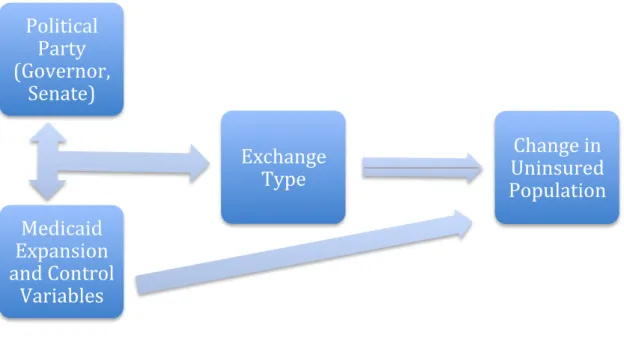
In order to address this problem of endogeneity, I propose an instrumental variables
model as a viable alternative approach to OLS regression. While I do not discredit my initial
OLS findings, I believe that it is important to present a different model that addresses the
Political
Party
(Governor,
Senate)
Exchange
Type
Medicaid
Expansion
and Control
Variables
potential problem of endogeneity. As I have mentioned before, the type of exchange that was
chosen by a state government is often determined by its political party control. Because of the
strong correlation between these two concepts, I propose using the two political party variables
as instruments on the type of exchange. However, before using these variables as instruments, I
must first make sure that they do not have their own unique effects on the dependent variable
(change in uninsured population).
First, I look back at my OLS regression results. In this regression, both the governor and
senate political party variables did not have a significant effect on the change in uninsured
population. From these results, it appears that these variables do not greatly impact the change in
uninsured population directly. After looking at these initial results, I also tabulated the
correlations between the governor’s party (r = -.321) and senate’s party (r = -.231) and found that
the political party variables were not strongly correlated with the change in uninsured population.
Based on these two findings, as well as the strong correlations between political party and
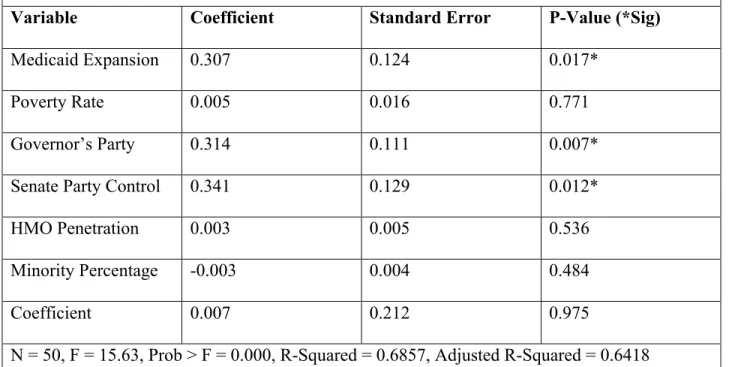
Table 4: “Better Access to Care” IV Model (First Stage)
IV Regression (Dependent Variable: Exchange Type)
Variable Coefficient Standard Error P-Value (*Sig)
Medicaid Expansion 0.307 0.124 0.017*
Poverty Rate 0.005 0.016 0.771
Governor’s Party 0.314 0.111 0.007*
Senate Party Control 0.341 0.129 0.012*
HMO Penetration 0.003 0.005 0.536
Minority Percentage -0.003 0.004 0.484
Coefficient 0.007 0.212 0.975
N = 50, F = 15.63, Prob > F = 0.000, R-Squared = 0.6857, Adjusted R-Squared = 0.6418
*Represents .05 significance level; two-tailed test
The first stage of the regression illustrates the reasoning behind using governor’s party
and senate party control as instruments. Along with Medicaid expansion, both the governor’s
party and senate party control are significant at the 95% confidence level. This indicates that they
are effective instruments for determining the exchange type of a state. As I originally predicted,
these two variables are the most important predictors of exchange type. The p-value of the entire
model is also important to note in this situation. At .000, the p-value shows that our instruments
are effective in predicting the outcome of exchange type. Based on these statistics in the first
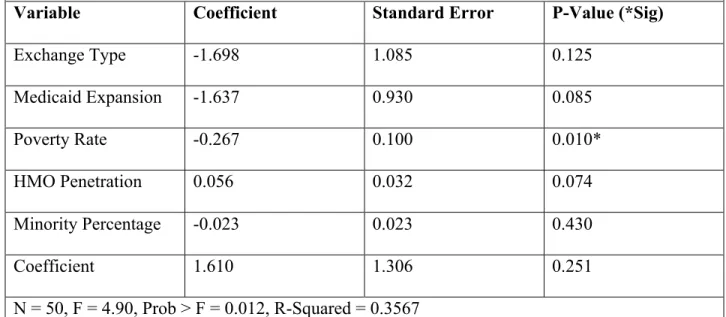
Table 5: “Better Access to Care” IV Model (Second Stage)
IV Regression (Dependent Variable: Percentage Point Change in Uninsured Population)
Variable Coefficient Standard Error P-Value (*Sig)
Exchange Type -1.698 1.085 0.125
Medicaid Expansion -1.637 0.930 0.085
Poverty Rate -0.267 0.100 0.010*
HMO Penetration 0.056 0.032 0.074
Minority Percentage -0.023 0.023 0.430
Coefficient 1.610 1.306 0.251
N = 50, F = 4.90, Prob > F = 0.012, R-Squared = 0.3567
*Represents .05 significance level; two-tailed test
The second (and final) stage of the regression reveals important new characteristics about
the independent variables. When viewing the two choice variables, it is evident that neither is
significant at the 95% confidence level. However, both exchange type (p = 0.125) and Medicaid
expansion (p = 0.085) have very low p-values, and appear to contain joint significance. I test this
significance later in the analysis. Based on the negative coefficients of these variables, it appears
that their presence reduced the percentage of uninsured citizens within a state. As for the control
variables, the only one that is significant at the 95% level is the poverty rate of a state. The
coefficient on this variable is negative at -0.267. This indicates that the more impoverished a
state is, the more likely its uninsured population dropped during the first enrollment period. The
other control variables are not significant at the 95% level. However, the managed care
penetration of a state seems to play a role in the model (p = .074). Ultimately, this model
Table 6: “Better Access to Care” IV Hypothesis Test
Joint Significance Test
Variables P-Value (*Sig)
Exchange Type, Medicaid Expansion 0.001*
*Represents .05 significance level; two-tailed test
As I already did in the OLS model, it is important to find the direct impact of state
government actions on “better access to care.” Once again, I use a joint significance test to
determine whether or not exchange type and Medicaid expansion have a joint effect on the
change in uninsured population. The results of the test illustrate that the type of exchange and
Medicaid expansion are jointly significant at the 95% confidence level based on the instrumental
variables model. This leads me to reject the hypothesis that, when controlling for other factors,
exchange type and Medicaid expansion have no effect on the change in uninsured population.
Specifically, the coefficients on these two variables (-1.698 for exchange type, -1.637 for
Medicaid expansion) illustrate their marginal effects on the uninsured population. This
conclusion, as well as the magnitude of the coefficient, lends support to my initial hypothesis.
iv. Results/Conclusion
This section includes two unique models to analyze the impact of state government
actions on “better access to care”. While each model presents slightly different numbers, they
both contain very similar results. The OLS model isolates Medicaid expansion as the key factor
in providing “better access to care”. According to the model, states that expanded Medicaid saw
a decrease in uninsured population of 1.95 percentage points more than states that chose not to
statistically significant in this model, but it was significant when jointly tested with Medicaid
expansion. For the instrumental variables model, neither Medicaid expansion nor exchange
creation was statistically significant on its own. However, the joint significance test showed that
the two state government actions are significant at the 99% confidence level. Both models lead
me to conclude the following result.
Result for Goal 1: In supporting the goal of “better access to care”, I find that states that acted
on exchange implementation or expansion of Medicaid are more likely to have positive results
than those that did not. Specifically, states that expanded Medicaid were most likely to provide
“better access to care” for citizens. However, there is considerable evidence that exchange
VI. Goal 2: “More Affordable Coverage”
i. Specific Research Design
Dependent Variable: Insurance Premium
Figure 9 (Source: Kaiser Family Foundation, 2015)
The last of the two goals that must be operationally defined is “more affordable
coverage.” To measure the effectiveness of the ACA on affordability, I do a state-by-state
comparison of premium rates (with subsidies included) adjusted for cost of living for similar
plans. It is important to note that this method is slightly different from the method that I use for
“better access to care”. Instead of doing a time comparison for each state’s premium rate, I
compare premium rates across states at a fixed time (2015). I selected this method because I did
not have viable time-series data for premium rate. Using data from the Kaiser Family Foundation
data on the average price for a bronze plan after tax credits for a 40-year-old non-smoker in
different cities. The specific cities and their individual pricing are presented in the appendix. I do
not include them here for the sake of preserving space. It is important to note that there is exactly
one city for all 50 states. I use the cost of living (Pay Scale 2015, 1) adjustment to observe the
real cost of health care in each area instead of the less meaningful, nominal rate. The probability
density of this variable is presented above in figure nine. It is slightly skewed left, but not
enough to greatly alter the mean.
Control Variables: City Poverty, Managed Care Penetration, Minority Population
Table 7: Bivariate Correlations with Insurance Premium
Variable Correlation Coefficient Significance
City Poverty 0.208 0.147
HMO Penetration -0.129 0.371
Minority Population -0.301 0.034*
*Represents .05 significance level; two-tailed test
For this model, I use the same control variables as I did for the first goal with some minor
adjustments. I keep the model the same because it contains the most relevant predictors of the
insurance market. Because the dependent variable that I use is for cities instead of states, I try to
implement city-level data where available. Unfortunately, I was only able to find comprehensive,
city-level data for poverty (Congressional Research Service 2013, 47), so the other variables
remain unchanged. However, because most of the cities used in this set encompass the majority
of the population in their respective states, I find it appropriate to still use state level data for the
relevance in determining cost. However, it is included as an instrumental variable in the
instrumental variables model. The correlations for these variables with my independent variable
are presented in table seven.
Summary Statistics
Table 8 (Sources: Gallup-Healthways Well-Being Index, 2014; Kaiser Family Foundation, 2014
2015; U.S. Census Bureau, 2010; Congressional Research Service, 2013)
Variable Mean Standard Deviation
Insurance Premium 120.765 29.197
Exchange Type 0.46 0.50
Medicaid Expansion 0.48 0.50
City Poverty Rate 14.074 3.163
Governor’s Party 0.42 0.50
Senate Party Control 0.40 0.49
HMO Penetration 17.61 11.68
Minority Percentage 28.60 15.48
In table eight, I present the relevant summary statistics for the variables in my model for
“more affordable coverage”. Most of these variables are contained in my original discussion of
the summary statistics for “better access to care”, so I do not discuss them here. Instead, I focus
on the two new variables for this section: insurance premium and city poverty rate. The mean for
insurance rate is 120.765, indicating that the mean premium rate for my given insurance plan and
idea of the dispersion of premium rates among different cities. As for the city poverty rate, the
mean is at a value of 14.074%. This value is easily compared to the mean poverty rate by state,
which is 12.142%. I expected that the city poverty rate mean would be slightly higher due to the
large concentration of impoverished Americans in cities. The standard deviation of 3.163
indicates a moderate dispersion among city poverty values. While these summary statistics do
not say much on their own, they are important to keep in mind for the next stage of the thesis.
ii. Data Analysis: OLS Regression
Table 9: “More Affordable Coverage” OLS Model
OLS Regression (Dependent Variable: Insurance Premium)
Variable Coefficient Standard Error P-Value (*Sig)
Exchange Type -9.558 9.252 0.307
Medicaid Expansion 3.976 8.582 0.645
City Poverty Rate 2.969 2.094 0.163
HMO Penetration 0.297 0.497 0.553
Minority Percentage -0.867 0.347 0.016*
Coefficient 101.047 29.471 0.001*
N = 50, Prob > F = 0.012, R-Squared = 0.2074
*Represents .05 significance level; two-tailed test
The OLS regression presents inconclusive results. Based on the p-values for exchange
creation and Medicaid expansion, I cannot draw a conclusion about their individual effect on
effect on insurance premiums. The same case is true for Medicaid expansion. At the 95%
confidence level, I fail to reject that Medicaid expansion has no effect on insurance premiums.
Despite the lack of meaningful effect for my choice variables, one of my control
variables is statistically significant. At the 95% confidence level, I reject the hypothesis that
minority population has no effect on insurance premiums. Based on its coefficient, I conclude
that an increased level of minorities in a city causes its insurance premiums to decrease. This
finding provides some meaningful information about the insurance market, but it does not
describe a meaningful relationship between state government actions and the goal of "more
affordable coverage". In order to evaluate this relationship in a more complete manner, I turn to a
joint significance test for my two choice variables.
Table 10: “More Affordable Coverage” OLS Hypothesis Test
Joint Significance Test
Variables P-Value (*Sig)
Exchange Type, Medicaid Expansion 0.575
*Represents .05 significance level; two-tailed test
In this case, the joint significance test is also inconclusive. At the 95% confidence level, I
fail to reject the hypothesis that both exchange type and Medicaid expansion have no effect on
insurance premiums. While these variables are not statistically significant, it is important to view
their coefficients and evaluate them. This regression is especially notable because the two choice
variables seem to work in opposite directions. Exchange type has a negative coefficient,
indicating that states that chose a state exchange are more likely to have lower premiums. I
positive outcomes for the law. However, the coefficient for Medicaid expansion weakens support
for this assumption. As shown in table nine, the coefficient for Medicaid expansion is positive.
This indicates that states that chose to expand Medicaid tend to have higher insurance premiums.
This coefficient is very notable because it represents a positive state government action resulting
in a negative outcome. This phenomenon requires further analysis, which is done in the second
model for "more affordable coverage". It is important to note that the coefficients for these two
variables are to not be taken as completely relevant, as both variables are not statistically
iii. Data Analysis: IV Regression
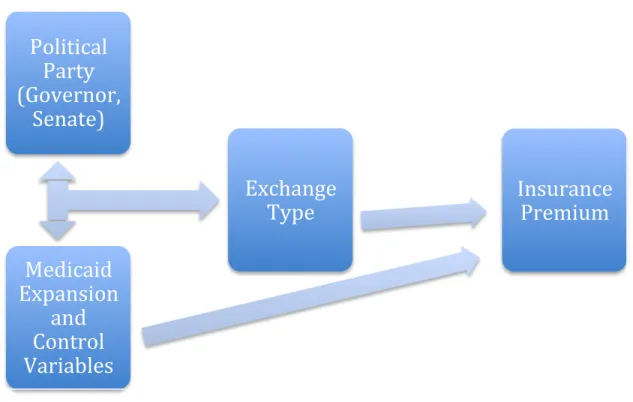
Figure 10: Instrumental Variables Model
The same endogeneity problems exist for the goal of “more affordable coverage” as they
did with “better access to care”. Once again, the problems are with the choice variable of
exchange type. The variable is not randomly assigned but rather highly correlated with the
political party control of a state. For this reason, I use the same instrumental variables method for
the goal of “more affordable coverage”. As visually illustrated in figure 10, this model uses the
political party of the governor and senate as instruments for exchange type. I hope to eliminate
the problem of endogeneity by utilizing this model in this stage of the project.
Political
Party
(Governor,
Senate)
Exchange
Type
Medicaid
Expansion
and
Control
Variables
Table 11: “More Affordable Coverage” IV Model (First Stage)
IV Regression (Dependent Variable: Exchange Type)
Variable Coefficient Standard Error P-Value (*Sig)
Medicaid Expansion 0.299 0.124 0.020*
City Poverty Rate 0.011 0.015 0.476
Governor’s Party 0.327 0.112 0.006*
Senate Party Control 0.351 0.129 0.009*
HMO Penetration 0.003 0.005 0.576
Minority Percentage -0.003 0.003 0.415
Coefficient -0.078 0.219 0.721
N = 50, F = 15.68, Prob > F = 0.000, R-Squared = 0.6888, Adjusted R-Squared = 0.6454
*Represents .05 significance level; two-tailed test
Much like the IV regression for “better access to care”, the first stage of the regression
illustrates the reasoning behind using governor’s party and senate party control as instruments.
The estimates are very similar to the first goal, as only the poverty rate variable is altered to
reflect city-level data instead of state-level. Along with Medicaid expansion, both the governor’s
party and senate party control are significant at the 95% confidence level. This indicates that they
are effective instruments for determining the exchange type of a state. The p-value of the entire
model is also important to note in this situation. At .000, the p-value shows that our instruments
are effective in predicting the outcome of exchange type. Based on these statistics in the first
Table 12: “More Affordable Coverage” IV Model (Second Stage)
IV Regression (Dependent Variable: Insurance Premium)
Variable Coefficient Standard Error P-Value (*Sig)
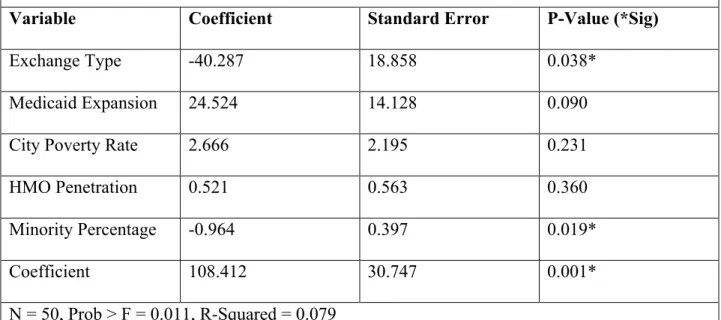
Exchange Type -40.287 18.858 0.038*
Medicaid Expansion 24.524 14.128 0.090
City Poverty Rate 2.666 2.195 0.231
HMO Penetration 0.521 0.563 0.360
Minority Percentage -0.964 0.397 0.019*
Coefficient 108.412 30.747 0.001*
N = 50, Prob > F = 0.011, R-Squared = 0.079
*Represents .05 significance level; two-tailed test
The IV model presents several notable results. First, as with the OLS model, the minority
percentage is significant at the 95% confidence level. At this level, I reject the hypothesis that the
percentage of minority citizens in a state has no effect on city-level insurance premiums,
controlling for all other factors. This result is consistent with the OLS model, so I generally
expected it to occur. However, for the first time in this analysis, this regression presents a new
result that is not present in the OLS model. According to the IV model, at the 95% confidence
level, I reject the hypothesis that exchange type has no effect on city-level insurance premiums.
The coefficient on this variable indicates that states that chose a state marketplace can expect to
have $40.29 less in insurance premium rates than those that opted for a federal exchange.
This significant result represents a potentially important finding in relation to state
certain result for two main reasons. The first reason deals with the fact that it contrasts with the
OLS regression results. In the initial regression that I use for “more affordable care”, the
exchange type variable does not approach significance. It exhibits a p-value of 0.307, indicating
that exchange type is not a significant factor in determining insurance premium rates. Because of
this insignificance, I do not consider the significant finding for the IV regression to be certain.
Secondly, I do not consider the IV finding to be completely legitimate because of the
coefficient for Medicaid expansion. Throughout this process, one of my key assumptions has
been that positive state government actions are not detrimental to the implementation of the
Affordable Care Act. However, the coefficient for Medicaid expansion presents a positive state
government actions resulting in a negative outcome for “more affordable coverage”. While I do
not reject the hypothesis that Medicaid expansion has no effect on insurance premiums, it is still
important to recognize that this variable has a negative coefficient. If state government actions
truly have an impact on “more affordable coverage”, I expect that positive actions will result in
positive results. Next, I turn to the joint significance test as another way to test my choice
variables.
Table 13: “More Affordable Coverage” IV Hypothesis Test
Joint Significance Test
Variables P-Value (*Sig)
Exchange Type, Medicaid Expansion 0.113
*Represents .05 significance level; two-tailed test
The joint hypothesis test for my IV model exhibits the same results as my OLS model. At
expansion have no effect on insurance premiums. I expected this result, due to the fact that the
two variables work in opposite directions. In this case, the joint p-value is lower than each of the
p-values for exchange type and Medicaid expansion as individual variables. This can be
contributed to the different direction of their coefficients, as mentioned before. While the two
variables are not jointly significant in either model, that does not render the result of this part of
the investigation insignificant. I discuss the broader relevance of these findings in the succeeding
Results/Conclusion section.
iv. Results/Conclusion
This section includes two unique models to analyze the impact of state government
actions on “more affordable coverage”. While each model is designed to present similar
numbers, they contain different results. The OLS model does not isolate either state government
action variable as the deciding factor in “more affordable coverage”. The joint significance test is
also inconclusive, and the variables for exchange type (negative) and Medicaid expansion
(positive) actually work in opposite directions. For the instrumental variables model, I received
slightly different results. In this model, both variables work in opposite directions again. This
time, however, the exchange type is significant. The differing results in each model present
problematic evidence for analyzing the exact effect of state government actions on “more
Result for Goal 2: In supporting the goal of “more affordable coverage”, I find the exact effect
to be inconclusive for states that acted on exchange implementation or expansion of Medicaid.
The results are inconclusive for two main reasons: conflicting results in my two models, and the
presence of considerable evidence that positive state government actions caused both positive
and negative results for the goal of “more affordable coverage”. Specifically, there is some
support for the hypothesis that state exchange creation caused lower premium rates as indicated
by the IV model (but not the OLS model). But, there is also some support that Medicaid
expansion caused higher premium rates as indicated by the positive coefficients in both models.
Due to these conflicting factors, I am unable to present a conclusive finding for “more affordable
coverage”. While I cannot be sure, this inconclusive finding could potentially indicate that
insurance costs rely more on the private sector than government actions. The government can
only control the structure of the market and encourage competition; it does not have much
VII. Conclusion
For this analysis, I execute every step of the research process in trying to find a solution
to my initial research question. First, I introduce the reader to the topic and the relevant literature
within this topic. Next, I provide a theoretical model and causal mechanism that underlines my
theory on the topic. In this section, I also hypothesize about the impact of state government
actions on the Affordable Care Act. My hypothesis is that in a comparison of states, those that
set up Affordable Care Act exchanges and/or expanded Medicaid will be more likely to have
positive results than those that did not. Conversely, those that did not set up Affordable Care Act
exchanges and/or expanded Medicaid will be more likely to have negative results than those that
did. I then present a research design that tests my hypothesis. This design focuses on two
specific goals of the ACA: “better access to care” and “more affordable coverage”. After
explaining these goals, I execute two different empirical models for each goal. These models
lead me to several conclusions.
In supporting the goal of “better access to care”, I conclude that states that acted on
exchange implementation or expansion of Medicaid are more likely to have positive results than
those that did not. Specifically, states that expanded Medicaid were most likely to provide “better
access to care” for citizens. In supporting the goal of “more affordable coverage”, I find the exact
effect to be inconclusive for states that acted on exchange implementation or expansion of
Medicaid. The results are inconclusive for two main reasons: conflicting results in my two
models, and the presence of considerable evidence that positive state government actions caused
both positive and negative results for the goal of “more affordable coverage”. Ultimately, I find
hypothesis to be fully supported by my research. While some of the details are conflicting, there
were more likely to have positive results than those that did not. Conversely, there is also no
doubt that states that did not act on the law were more likely to encounter negative results.
My research presents a very important finding for the health care literature. However, it
also expands beyond this narrow finding. More broadly, it illustrates an important concept for
truly federal laws. When states are required to aid the implementation of a federal law, their
cooperation is important for its success. If a state does not support a law, it can cause some truly
devastating effects for the law’s goals, as indicated by my findings. Despite these important
findings, there is considerable room for other researchers to add to this study and investigate
other important areas.
Specifically, I suggest three expansions/additions. First, it is important for other
researchers that are investigating health care to try other independent variables that they find
intriguing. While I believe my model to be an accurate predictor of the insurance industry, it is
important for other researchers to use other models and come to alternative conclusions. I tested
this model thoroughly and found it to be useful, but other researchers should be able to alter it.
Another valuable extension involves more current data. My analysis mostly focuses on the first
enrollment period and the statistics that stemmed from it. While this represents an important time
for the ACA, it is just as important to study other enrollment periods and how the law develops
over time. I would suggest that other researchers address this development in future studies.
Lastly, I suggest that researchers explore other truly federal laws and how state government
actions affect them. It would be valuable to have another study that describes this phenomenon.
Ultimately, I have presented a comprehensive analysis of the interaction between state
government actions and the Affordable Care Act that has broader implications for federalism.
VIII. Works Cited
Benjamin, Elisabeth R., Arianne Slagle, and David R. Jones. 2013. “Commentary: Sink or Swim: The State Ground Game Implementing Insurance Exchanges under the Affordable Care Act.” Public Administration Review 73: S47–S48.
Blumenthal, David, and Sarah R. Collins. 2014. “Health Care Coverage under the Affordable Care Act — A Progress Report.” The New England Journal of Medicine 371: 275-281.
Centers for Medicare and Medicaid Services. 2014. “State Effective Rate Review Programs.”
CMS.gov 1.
Congressional Research Service. 2013. “Poverty in the United States: 2013.” Congressional Research Service 47-59.
Dinan, John. 2011. “Shaping Health Reform: State Government Influence in the Patient Protection and Affordable Care Act.” Publius: The Journal of Federalism 41(3): 395–420.
Gallup-Healthways Well-Being Index. 2014. “Change in Percentage of Uninsured by State, 2013 vs. Midyear 2014.” Gallup 1.
Garthwaite, Craig L. 2012. “The Doctor Might See You Now: The Supply Side Effects of Public Health Insurance Expansions.” American Economic Journal: Economic Policy 4(3): 190–215.
Haeder, Simon F., and David L. Weimer. 2013. “You Can’t Make Me Do It: State Implementation of Insurance Exchanges under the Affordable Care Act.” Public Administration Review 73: S34– S47.
Harrington, Scott E. 2010. “U. S. Health-Care Reform: The Patient Protection and Affordable Care Act.” The Journal of Risk and Insurance 77(3): 703–8.
Hofer, Adam N., Jean Marie Abraham, and Ira Moscovice. 2011. “Expansion of Coverage under the Patient Protection and Affordable Care Act and Primary Care Utilization.” The Milbank
Quarterly 89(1): 69–89.
Jacobs, Lawrence R. 2010. “What Health Reform Teaches Us about American Politics.” PS: Political Science and Politics 43(4): 619–23.
Jacoby, Jeff. 2014. “Mass. model of health care: Wait for it.” Boston Globe. 1.
Joondeph, Bradley W. 2011. “Federalism and Health Care Reform: Understanding the States’ Challenges to the Patient Protection and Affordable Care Act.” Publius 41(3): 447–70.