33 pages. Advisor: Claudia J. Gollop
Job announcements always reflect needs and requirements of specific positions. This paper examined job advertisements for Chinese studies librarian in College & Research Libraries News from 2001 to 2010. It identifies job titles, locations, responsibilities, qualifications, and the experience required of potential Chinese studies librarians by analyzing the content of job advertisements. The analysis of 24 advertisements indicated that this position demands potential job candidates should have a high level of
qualification. The results also showed that Chinese studies librarians have multiple responsibilities for selecting related materials, collections development, providing reference service for subject studies, cataloging, raising funding for program as well as other duties. The goal of the studies is to help library school students better prepare for their careers.
Headings:
Chinese Studies Librarian Content Analysis
Job Qualification East Asian Collections Job Analysis
CONTENT ANALYSIS OF JOB QUALIFICATIONS FOR CHINESE LIBRARIANS IN AMERICAN ACADEMIC LIBRARIES
by Yanjuan Zou
A Master's paper submitted to the faculty of the School of Information and Library Science of the University of North Carolina at Chapel Hill
in partial fulfillment of the requirements for the degree of Master of Science in
Library Science.
Chapel Hill, North Carolina July, 2011
Approved by:
Table of Contents
INTRODUCTION ... 4
CURRENT STATUS OF CHINESE AND EAST ASIAN COLLECTIONS ... 6
Volume Holdings ... 6
Fiscal Support ... 7
Personnel Support ... 8
LITERATURE REVIEW ... 10
Context for growing Chinese studies ... 10
Current challenges for Chinese studies librarianship ... 12
METHODOLOGY ... 15
FINDINGS AND DISCUSSIONS ... 19
Job Title ... 19
Job Location ... 20
Education and Experience ... 20
Responsibility ... 22
Skills and Knowledge... 25
Table of Figures
Figure 1 Volume holdings of East Asian materials and Chinese materials ... 7
Figure 2 Fiscal support for East Asian collections and Chinese collections ... 8
Figure 3 Personnel support for East Asian Collections and Chinese Collections ... 9
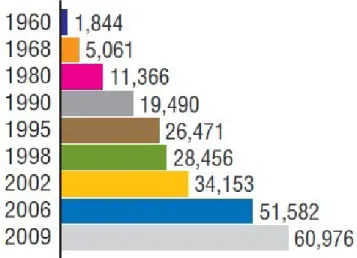
Figure 4 Chinese language class enrollments from 1960 to 2009 ... 11
Figure 5 Job location ... 20
Figure 6 Years of experience ... 21
Figure 7 Ratio of most frequently mentioned job responsibilities ... 24
INTRODUCTION
Content analysis for job advertisements has been prevalent in information library science and professional practices since at least the 1980s. Many researchers use content analysis as a tool to examine job advertisements in order to develop a picture of the work
performed by academic librarians over time. Some of those studies have taken an in-depth view of trends in employer expectations, while others have looked at opportunities across the field or have focused on positions in specific functional areas of libraries. Researchers have typically employed methodologies involving quantitative analysis of data derived from a content analysis, which has yielded statistics on geographic
distribution of jobs, salaries, types of experience required, personality, and technical skills necessary to be successful in the job (Reeves and Hahn 103-119).
Many specific positions, such as reference librarians and science librarians, have been addressed in previous study, but not as much has been researched about job
CURRENT STATUS OF CHINESE AND EAST ASIAN
COLLECTIONS
Chinese studies librarianship developed with the growing interest in Chinese studies in American society and the proliferation of East Asian collections across the nation. The Council of East Asian Libraries (CEAL) has conducted East Asian collections surveys since 1958, including Chinese, Japanese, and Korean (CJK)
collections. These survey statistics reflect library collections, funding, and subject service for the North American member libraries of CEAL. They also encourage information sharing among the East Asian studies community. Problematically, the survey does not cover all East Asian collections and the statistics are varied depending on the
participation of surveyed libraries. However, this survey represents the mainstream of East Asian collections in United State academic libraries. Volume holdings, fiscal support and Personnel support are the three main elements to evaluate the growth of collection. Graphs below are drawn according to the CEAL statistics.
Volume Holdings
have grown steadily every decade with a spike in growth after 1990, according to Figure 1.
1950 1960 1970 1980 1990 2000 2010
0.00 2.50M 5.00M 7.50M 10.00M 12.50M 15.00M 17.50M 20.00M 22.50M
East Asian Volume Holdings
Chinese Volume Holdings
vol
um
e
Year
Figure 1 Volume holdings of East Asian materials and Chinese materials
Fiscal Support
1985 1990 1995 2000 2005 2010 2015 0.00
2.50M 5.00M 7.50M 10.00M 12.50M 15.00M
US
$
Year
East Aisan Fiscal Support (appropriations) Chinese Fiscal Support (appropriations)
Figure 2 Fiscal support for East Asian collections and Chinese collections
Personnel Support
1960 1970 1980 1990 2000 2010 0
100 200 300 400 500 600
num
ber
of
per
sonnel
Year
Personnel Support of East Asian Libraries
LITERATURE REVIEW
Compared to other library professional positions such as reference librarians, system librarians, or cataloging librarians, Chinese studies librarian positions are limited. Most Chinese collections are located in large research university libraries. Accordingly, literature on this specialized field is not abundant. The limited literature is rich in articles discussing the following research topics:
• Why and how Chinese studies grew rapidly in America?
• Current problems the Chinese collections faced and how subject librarians respond to these challenges.
Context for growing Chinese studies
United States. Growing interest in sinology is generally believed to be the important reason for expansion of Chinese collections. Ka-Chuen Gee and Wendy Tang suggested that it was inspired by the expanding trade relations with China and influx of Chinese immigrants.
The growing business relationship after 1980s between the United States and China creates many career opportunities for students with Chinese knowledge and
experience. Chinese history and culture courses have been added to the curricula of many universities to satisfy students’ needs, forming the nucleus of a Chinese studies program. Language classes are also in great demand. Since 1958, the Modern Language
Association has gathered and analyzed data on undergraduate and graduate course enrollments in languages other than English in United States colleges and universities. The data show that Chinese language class enrollment increased from 1,844 in 1960 to 60,976 in 2009 (Furman). More and more second generation or young Chinese
immigrants who are seen as Heritage language learners have also driven up enrollment.
Increasing emphasis on inter-area and cross-disciplinary scholarship has been seen as the other reason for the expansion of Chinese collections. Today, “Think globally, act locally” has become the common view. As Arjun Appadurai postulates, locality itself is a historical product and histories through which localities emerge are eventually subject to the dynamics of the global. The changing philosophy and direction in scholarship must inevitably impact libraries. Chinese or East Asian collections are the essential components of “think globally” trend and the global focused academic context. Area Studies librarians are in good position to widen their perspectives to encompass the cross-regional scholarly research avenues and to serve multilingual and multidisciplinary-focus users who may be in pursuit of these global phenomena and process more
effectively (Hickey 77-84).
Current challenges for Chinese studies librarianship
In the last decade, we witnessed a dramatic reform in libraries. The digital and internet revolution has changed the nature of information. The prevalent format, the speed of information creation, delivery and dissemination, and user needs and expectations have all changed (Ross and Sennyey 145-152). Card catalogs have
In recognition of the new competitive environment in which libraries now operate, many libraries are already experimenting with new service models, workflows, and building redesigns. At the same time, the definition of librarianship has changed. East Asian librarians are not immune to these changes. This new reality has forced them to rethink their new roles and their way of building collections, providing services, and cooperation.
According to David Hickey, the management of the area studies collections in a digital and multicultural era is challenging to subject librarians. Traditionally, libraries with less than 100,000 volumes housed the Chinese language materials separately from the main holdings. These collections often became isolated because of this separation. In addition, due to large scale acquisition activities in the past decade, most Chinese
collections have more than doubled their original sizes (Gee and Tang 139-162). New and innovative ways to manage these collections should be found. For example, many libraries have resorted to storing lesser used materials offsite, where they can be retrieved and delivered to the library at the user's request. This arrangement allows the library to move many large size rare books offsite, saving precious space, but at the expense of the user's convenience. Some scholars suggest that digitalizing and relying more on
electronic resources is the best way.
METHODOLOGY
Advertisements reflect the current needs and desires of employers at certain times and under certain social conditions. A content analysis was performed to achieve my research goal. This study was driven by the following research questions:
• How is Chinese studies librarianship developed in America?
• What are the skills and abilities that employers are looking for in a job candidate? • Are future Chinese studies librarians preparing for this career to meet employers’
needs and expectations?
Content analysis, as noted by Berelson, is a research technique for the objective, systematic, and quantitative description of the manifest content of communication. According to Earl Babbie in The Practice of Social Research, content analysis is the study of recorded human communications. Communication delivers or exchanges information and the ways of communication are developed with time and technology. The ways of communication now includes web pages, as well as books and magazines, among many other forms. This Method can be applied to most forms of communication, although it is predominately used to analyze written communication. Content analysis is essentially a coding operation in which communications “are coded or classified
There are a number of reasons for choosing this method. First, in comparison with other means of research such as surveys or experiments, content analysis allows
researchers to observe the communications at times and places that are most convenient. Second, it can be a useful method for allowing us to discover and describe the focus of individual, group, institutional, or social attention. Usually, three problems may occur when conducting content analysis. First, when a substantial number of documents from the population are missing, the content analysis must be abandoned. Second,
inappropriate records (e.g., ones that do not match the definition of the document required for analysis) should be discarded. Finally, some documents might match the requirements for analysis but are uncodable because they contain missing passages or ambiguous content. In order to avoid these problems and ensure the quality of this research, some questions will be addressed based on Klaus Krippendorff.
Which data are analyzed?
Job advertisements for Chinese studies librarians posted in the College &
Research Libraries News from January 2001 to April 2010 were analyzed for this study. The College & Research Libraries News is the major source for library job
How are Chinese studies librarians defined?
Chinese studies librarians are defined in this paper as librarians who work with Chinese studies materials in an academic context. The words “Chinese studies librarians” employed in this paper incorporates many varying job titles and duties found throughout the nation’s academic libraries, including:
• Chinese bibliographer • Subject specialist
• Area studies librarian for Chinese/East Asian • Asian language cataloger
• Chinese collections developer and selector
It is quite common for a Chinese studies librarian to also work with other East Asian collections, such as Japanese and Korean collections. Job announcement titles with East Asian will be examined if they require Chinese culture and language skills. Positions that were classified as cataloging positions in the job title will also be analyzed in this study because some Chinese language catalogers conduct the same job responsibilities as Chinese studies librarians. Additionally, high-level positions such as library head or director were not counted, as the skill-set is different, or, at the very least, more
administrative. Moreover, the area studies librarian just entering this field will likely not qualify for these positions. To be included in this study, an announcement had to have a clear indication that the job was for a full-time professional position.
FINDINGS AND DISCUSSIONS
Job Title
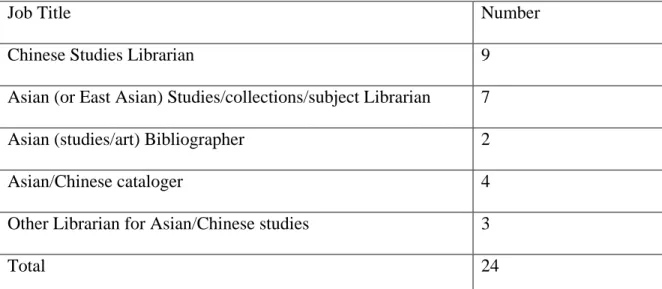
Using the criteria described above, a total of 24 full-time professional Chinese subject librarian positions sampled from 2001-2011 are comprised this study. A job title may be seen as a brief summary of a position's role within an organization. The job titles are different between different job announcements, and can include Chinese studies librarian, subject specialist, Electronic resource librarian for Chinese studies, and public service librarian for East Asian collections, Asian Bibliographer as well as others. These job titles were divided in to five categories according to the primary focus of the position.
Table 1 Librarian job title
Job Title Number
Chinese Studies Librarian 9
Asian (or East Asian) Studies/collections/subject Librarian 7
Asian (studies/art) Bibliographer 2
Asian/Chinese cataloger 4
Other Librarian for Asian/Chinese studies 3
As Table 1 shows, Chinese (language) Studies Librarians and Asian (area) Librarians are the most popular titles at 69.5% of the sample.
Job Location
Job regional distribution will be based on the Library and Information
Technology Association (LITA) regional classification system, which has been used on their website to classify job locations. All 50 states are divided into four geographic areas: the Northeastern region, the Southern region, the Midwestern region, and the Western region. Figure 5 displays the Chinese studies librarian positions located in different states; six of those are located in the Northeastern region, four in the South, six in the Midwest and eight in the West. Of all the positions, institutions in California advertised the most with a total of 6 (University of California system accounts for 5), which constitutes 25% of the jobs sampled.
Figure 5 Job location
Education and Experience
Education was the first major category examined and the most essential
component of any job announcement. As expected, the data shows that the MLS (Master of Library Science) requirement is the most common required educational background demanded for the Chinese studies librarian. All of the 24 (100%) positions require an MLS from an ALA-accredited library school, while three job advertisements (12.5%) stated that Ph.D. in the subject area related to the position is also necessary in order to apply. Besides an MLS, 12 (50%) positions required or preferred the candidate to have an additional advanced degree in Asian studies or social science.
Experience was described in different ways. Some advertisements listed
experience as a required qualification and others listed it as preferred qualification. Of all job announcements, 13 (54%) stated that experience was as requirement and 9 (37.5%) as a preference. Only 2 job advertisements did not mention any experience at all.
Figure 6 Years of experience
0 5 10 15 20
Generally, experience, as stated in the job announcements, can be divided into three categories: years of experience, type of work experience (experience in teaching bibliographic instruction or with CJK record), and work environment (academic library or research library). As can be seen in Figure 6, the number of years specifically
mentioned appeared as follows: 1 year – one occurrence; 2 years – 4 occurrences; 3 years – 4 occurrences. 15 positions (62.5%) didn’t state specific requirement for year of
experience.
The most requested or preferred types of experience were experience in academic or research libraries with East Asian collections, and experience in similar positions, such as catalog, reference, and instruction. Fewer advertisements mentioned experience in supervision, grant writing, or special collections. From these findings, it seems extremely important for job applicants to gain library experience prior to the MLS degree or while working on the degree, considering the high demand for related experience. While many issues cannot be covered in graduate level coursework, some frustrations could occur during the transition from being a student to becoming a professional. MLS students would try to avoid these frustrations and get experience through a part-time job, a practicum or internship, or membership and participation in professional organizations.
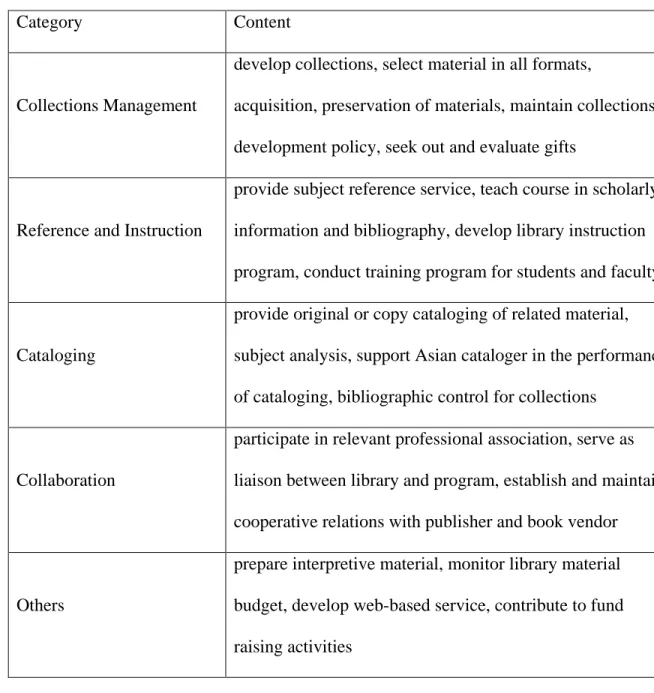
Responsibility
focuses or special description styles about the position; however these random responsibilities would be divided into five categories as listed in the table below:
Table 2 Categories of job responsibilities
Category Content
Collections Management
develop collections, select material in all formats,
acquisition, preservation of materials, maintain collections development policy, seek out and evaluate gifts
Reference and Instruction
provide subject reference service, teach course in scholarly information and bibliography, develop library instruction program, conduct training program for students and faculty
Cataloging
provide original or copy cataloging of related material, subject analysis, support Asian cataloger in the performance of cataloging, bibliographic control for collections
Collaboration
participate in relevant professional association, serve as liaison between library and program, establish and maintain cooperative relations with publisher and book vendor
Others
prepare interpretive material, monitor library material budget, develop web-based service, contribute to fund raising activities
Collections management, reference, and cataloging are the traditional
responsibilities were most frequently mentioned: 21 (87.5%) posts for collections management, 16 (66.6%) posts for reference, and 11 (45.8%) for cataloging. Other subject librarians like science librarians or law librarians don’t need to conduct cataloging, which would be processed by the technical services department. Chinese studies librarians are usually responsible for some cataloging work, due to the language requirement. One of the key factors affecting libraries over the past few decades has been the rise of computer technology and automation, so it is the trend that electronic resource and online instruction based on web 2.0 are emphasized.
Figure 7 Ratio of most frequently mentioned job responsibilities
As mentioned above, inter-area and cross-disciplinary scholarship has been recognized by most people and organizations. The changing philosophy was also reflected in these job advertisements. More and more job advertisements add collaboration to the responsibility section. Chinese studies librarians are no longer
0.00% 10.00% 20.00% 30.00% 40.00% 50.00% 60.00% 70.00% 80.00% 90.00% 100.00%
isolated, but are required to participate in many activities like sharing the responsibility of fund-raising and contributing to library-wide strategy decisions. These kinds of changes and transitions will definitely influence the required qualifications for job candidates.
Skills and Knowledge
Different positions require disparate skills and knowledge. For example, a reference librarian is required to have more demonstrated teaching ability, while a cataloger is required to know more about metadata management skill. Chinese studies librarians, like other positions in the library, must have some similar qualification such as inter-personal skills and technology skills. However, they are also required to know some special skills and knowledge related to the subject field including special language skills, book trade, and publishes trend knowledge. Skills and Knowledge also were mentioned either as a requirement or as a preference.
Figure 8 Skills and knowledge 0
5 10 15 20 25
Language
The five categories in the skill section are language, personal skills, technology, book trades knowledge, and cataloging related skills. Each category is also rich in content. Language is a basic skill for an area studies librarian. As a Chinese studies librarian, fluency in Chinese is a required skill most of the time. According to Figure 8, of all 24 positions, 23 (95.8%) of them require fluency in Chinese and 16 (66.6%) require good English-language oral and written communication skills. Many job advertisements also indicated preference for candidates knowing a second Asian language, like Japanese or Korean.
The role of a librarian as a traditional book manager has transitioned to an information provider in last decades. Librarians spend most of their time with students, faculty, and staff either with respect to reference queries or public service, so personal skills have become a more important component in job announcements. They also include inter-person skills, organizational ability, independent work ability, leadership, problem-solving skills, and ability to work in changing environment. Overall, personal skills were listed 21 times.
In the technology section, knowledge of HTML, webpage design, web search skills, management of electronic resources, and familiarity with database tools were the most required skills. As Chinese studies librarians usually take on some responsibilities for cataloging, cataloging related skills are commonly required (37.5%) in job
CONCLUSION AND FURTHER EFFORT
The results of this study show that Chinese studies librarians have multiple responsibilities for selecting related materials, collections development, providing reference service for subject studies, cataloging, raising funding for program as well as other duties. These multiple tasks, which usually were conducted separately by librarians in different departments, are now loaded on one librarian. It definitely demands that potential job candidates have a high level of qualification.
Those recruiting for Chinese studies librarian positions are looking for candidates who are well educated and have knowledge or prior experience in the academic library or research library with graduate work in East Asian studies. They also require that
candidates have developed interpersonal and communication skills, are fluent in Chinese, have knowledge of on-line sources and the ability to conduct searches within those sources, have library reference and instruction skills, and are proficient with computers. Area studies librarians are also particularly involved with the book trades and publishing trends of the region; this emphasis was also reflected in the advertisements. Employers would most often prefer a candidate with a second advanced degree in a related subject, who also has knowledge of second Asian language.
are seeking a job should note that there are some positions with different titles that may have the same responsibilities. They can use this information to be better prepared for their careers. This study can also be applied for future area studies specialists, not only Chinese studies librarian.
While in school, students should take every basic class seriously and take multiple courses related to the specialty in which they are planning to work. Taking courses in interpersonal communication, computer applications, and website design, whether offered in the library science school or as an elective from another department, can greatly benefit the student. Seizing every intern or campus job opportunities to gain work experience is especially helpful for fresh graduates.
Due to the special language requirement of this position, most of Chinese studies librarians are Chinese immigrants. They usually do not have any problem with oral and written Chinese, instead, good English communication skills are challenging for them. For this group people, they should use their time at school to enhance their English. Also low demand for Chinese studies librarians has limited the library school in planning special curricula for this position. According to Zhijia Shen and Karen Wei, during the last half century, the only degree program focusing on East Asian librarianship was the Joint program for Far Eastern Librarianship offered at the University of Chicago through its graduate library school and the department of Far Eastern Languages and Civilization between 1964 and 1979. The program produced six Ph.Ds. and about thirty-five
Potential Chinese studies librarians are unable to receive formal training in special subjects in library school, so it is a good idea to take advantage of professional
organization membership. The Chinese American Librarians Association (CALA) and the Council on East Asian Librarian (CEAL) are two major national-wide professional organizations for Chinese studies librarians. They always offer summer schools or workshops on East Asian librarianship. In addition, the CEAL Committee on Chinese Materials will occasionally offer workshops for Chinese studies librarians. Although it was designed to assist Chinese studies librarians in renewing their knowledge and skills to reflect the changes and new developments in the field, students can also take
advantage of this opportunity. The CALA mentorship program also helps potential Chinese studies librarians shape their career. This program encourages and guides Chinese or Chinese American students of Library and Information Science with career planning. It will assign each attendant an experienced librarian to provide advice and share their experience with students and new librarians. Students can also find an
REFERNCE
Alonso-Regalado, Jess, and Mary K. Van Ullen. "Librarian for Latin American Caribbean Studies in U.S. Academic and Research Libraries: A Content Analysis of Position Announcements, 1970-2007." Library Resources & Technical Services 53.3 (2009): 139-58.
Appadurai, Arjun, 1949-. Modernity at Large: Cultural Dimensions of Globalization. Minneapolis, Minn.: University of Minnesota Press, 1996.
Babbie, Earl R. The Practice of Social Research. Belmont, Calif: Wadsworth Cengage, 2010.
Berelson, Bernard. Content Analysis in Communication Research. New York, Hafner, 1971 [c1952].
Elmborg, James K. "Framing a Vision for 21st-Century Librarianship: LIS Education in Changing Times." The Serials Librarian 55.4 (2008): 499-507.
Furman, Nelly, David Goldberg, and Natalia Lusin. "Enrollments in Languages Other Than English in United States Institutions of Higher Education, Fall 2009." Modern Language Association (MLA): Format, Bibliography, Style, Convention. Dec. 2010. Web. 02 July 2011. <http://www.mla.org/2009_enrollmentsurvey>.
Gee Ka-Chuen, and Wendy Tan. "Chinese Collections of Top East Asian Libraries on the East Coast of the United States." Journal of Educational Media & Library Sciences 41.2 (2003): 139-62.
Hickey, C. David. "Area Studies Libraries in the Global Studies Milieu: Implications for Non-Roman Script Print Resource Management and University Library Budgets and Staffing." Library Collections, Acquisitions, and Technical Services 30.1/2 (2006): 77-84.
Jurkowski, Odin, Patricia Antrim, and Jennifer Robins. "Building Bridges between Students and Practitioners." Journal of Education for Library and Information Science 46.3 (2005): 198-209.
Koide, Izumi. "The East Asian Library in the Twenty-First Century." Committee on East Asian Libraries Bulletin.101 (1993): 21-5.
Krippendorff, Klaus. Content Analysis: an Introduction to Its Methodology. Thousand Oaks, Calif: Sage, 2004.
Liu, Mengxiong. "The History and Status of Chinese Americans in Librarianship." Library Trends 49.1 (2000): 109-37.
Reeves, Robert K., and Trudi Bellardo Hahn. "Job Advertisements for Recent Graduates: Advising, Curriculum, and Job-Seeking Implications." Journal of Education for Library and Information Science 51.2 (2010): 103-19.
Ross, Lyman, and Pongracz Sennyey. "The Library is Dead, Long Live the Library! the Practice of Academic Librarianship and the Digital Revolution." The Journal of
Academic Librarianship 34.2 (2008): 145-52.
Shen Zhijia, and Karen Wei. "Chinese Studies Librarians Training and the Luce Summer Institute at the University of Pittsburgh." Journal of East Asian Libraries.130 (2003): 42-5.
Shen, Zhijia. "The State of the Field of Chinese Studies Librarianship." Journal of East Asian Libraries.149 (2009): 5-12.
Troost, Kristina Kade. "East Asian librarians and the World Wide Web: familiarization, infiltration, classification and construction." Journal of East Asian Libraries Oct. 1997: 21-5.
Troost, Kristina Kade. "The Future of East Asian Libraries: A New Vision for Public Services?" Journal of East Asian Libraries.122 (2000): 4-6.
Troost, Kristina Kade. "The State of the Field of East Asian Librarianship." Journal of East Asian Libraries.149 (2009): 1-4.
"U.S. GAO - Content Analysis: A Methodology for Structuring and Analyzing Written Material." U.S. Government Accountability Office (U.S. GAO). Web. 02 July 2011. <http://www.gao.gov/products/PEMD-10.3.1>.
Wu, Ai-Hwa. "Reality Check: The Changing Role of the East Asian Studies Librarian in North America." Journal of East Asian Libraries.119 (1999): 1-10.