(c) Copyright 1995 AT&T. All Rights Reserved.
Reprinted with AT&T's permission.
Edited by
Balachander Krishnamurthy
John Wiley & Sons, Inc.
Publisher: Katherine Schowalter Senior Editor: Diane D. Cerra Managing Editor: Maureen B. Drexel
Text Design & Composition: Balachander Krishnamurthy
Designations used by companies to distinguish their products are often claimed as trademarks. In all instances where John Wiley & Sons. Inc. is aware of a claim, the product names appear in initial capital or all capital letters. Readers, however, should contact the appropriate companies for more complete information regarding trademarks and registration.
This text is printed on acid-free paper.
Copyright c1995 by AT&T. All rights reserved.
Published by John Wiley & Sons, Inc.
Published simultaneously in Canada.
This publication is designed to provide accurate and authoritative information in regard to the subject matter covered. It is sold with the understanding that the publisher is not engaged in rendering legal, accounting, or other professional service. If legal advice or other expert assistance is required, the services of a competent professional person should be sought.
Reproduction or translation of any part of this work beyond that permitted by section 107 or 108 of the 1976 United States Copyright Act without the permission of the copyright owner is unlawful. Requests for permission or further information should be addressed to the Permissions Department, John Wiley & Sons, Inc.
LibraryofCongressCataloging-in-Publicatio n Data:
Practical reusable UNIX software / edited by Balachander Krishnamurthy.
p. cm.
Includes bibliographical references and index. ISBN 0-471-05807-6 (acid-free paper)
1. Operating systems (Computers) 2. UNIX (Computer le) 3. Computer software{Reusability. 4. Computer software{
-Development. I. Krishnamurthy, Balachander, 1961- . QA76.76.063R48 1995
005.1{dc20 94-37119
CIP Printed in the United States of America
Trademarks
X Windows System is a trademark of Massachusetts Institute of Technology. UNIX is a registered trademark of X/Open Inc.
watchd, libft, REPL are registered trademarks of AT&T Corporation. SoftBench is a trademark of the Hewlett-Packard Company.
Encapsulator is a trademark of the Hewlett-Packard Company. DOMAIN is a registered trademark of HP-Apollo.
Foreword
This book describes a collection of software of a sort that people have known was needed for years, but has been neglected. Most of the computer-using population sees machines that run applications created by others. It's hardly surprising that most of the ink on paper and pixels on the screen, that talk about computers are devoted to the result{the quality, usefulness, and attractiveness of the applications. Most people don't program.
But someone has to create these applications, and the software in-dustry has known for a long time that handcrafted software is expensive. AT&T, the company for which I work, has undergone a lot of change since I rst joined it; one of the most profound, albeit not the most obvious from the outside, is its transformation to an essentially software-based organization. The communications services and the telephone switches AT&T sells are, in a real sense, enabled by an enormous number of lines of code in various languages, running on a vast assortment of hardware; writing and maintaining software dominates our development budget.
The tools and libraries described in this book show a variety of ap-proaches to help reduce these costs. It doesn't claim to be a cure-all; it doesn't say, \Buy our object-oriented distributed gizmo and your prob-lems are over." Instead it oers, for example, a library portable to many environments that improves software resilience in the presence of failure. It oers tools for understanding programs, for visualizing them, for keep-ing track of software development, for application buildkeep-ing. It's a wide-ranging congeries, and pretty far from the slick shrinkwrapped box in the local software shop. Nevertheless, the contents share a valuable theme{by emphasizing portability and reusability, by being used in real projects, the software described in this book makes the insights and hard work
x Foreword
that might have remained entangled in one software system available for others to use.
Preface
In the mid-1990s, with new software paradigms being introduced on a regular basis, it might be instructive to take a step back and look at a successful experiment in creating practical reusable software. This book is a description of one such experiment. I came in midway through the experiment and have had the benet of learning several of the lessons described here.
As a discipline, software engineering is still maturing; we believe that managing a software engine requires some key precepts to be kept in mind. The life cycle of software begins with good design and architecture, a proper environment in which it can be constructed. That environment should include a good repository of tools and ongoing help for the rest of the life cycle.
There is a great variety of hardware and software platforms on which modern software has to run; the environments change rapidly. It is no longer enough to build stable software on a specic platform|the soft-ware has to run and be maintained on multiple platforms. UNIX was well ahead of its time by being portable and introducing the concept of linking programs in pipelines to achieve a sum greater than the parts. In the past twenty ve years, UNIX tools have become a key reason for the success of UNIX. With the explosion in sites running UNIX both in academia, and, increasingly, in business, the need for high quality portable UNIX soft-ware is felt increasingly. Within AT&T the number of UNIX-dependent projects soared and with it the need for quick solutions. Our department was formed to aid software developers and, in the process, we brought about high quality tools.
The origin of the term software reuse has been attributed to Doug McIlroy, a UNIX pioneer at AT&T Bell Labs, who compared the role of
xii Preface
software routines to the role of screws or resistors in mechanical designs. For software in the large, one needs to have the full range of artifacts from high-quality library routines to generic architectural services that can be tted into a variety of applications to as modular and reusable components. The collection of software described in this book covers this range.
Chapter 1 sets up the environment in which the software described in the rest of the chapters was constructed. It describes the assumptions un-der which we worked as well as theAdvsoftrepository and distribution scheme. As one of the lessons learned, we discuss our view of architectural style and services|ideas we consider important for reuse. In conjunction with Chapter 12, practical suggestions on how to run a reuse program are presented.
Chapter 2 is in some sense the core of our reuse repository: the col-lection of most of the highly reused libraries. The descriptions of the libraries are both at the conceptual level|what niche they ll|as well as the nitty gritty level, replete with examples. The libraries range from the porting base (libast) to graph and le system services. Chapter 2 also introduces the concept of discipline and method; techniques dealing with safe resource management and library portability. This chapter consti-tutes the substrate level of the four levels of partitioning that we have done.
Chapters 3 and 4 deal with the base level tools: nmake{a build tool that represents the state of the art amongst the successors of make, the original UNIX conguration and build tool; n-DFS{a n-Dimensional File System which provides a variety of operating system services; ksh{the widely used Korn Shell command interpreter;Easel{a system for writing end-user applications via interactive constructs. The tools in this layer are considered base tools since we use many of them on an everyday basis for building and maintaining our software.
Preface xiii
availability. Chapter 8 discusses three reusable components (watchd, libft, and Repl) that makes software fault tolerant. Tools at the standalone layer all reuse libraries at the substrate level as well as tools at the base level.
Chapters 9 through 11 discuss connected tools covering the areas of event action systems, software process, visualization, testing, and ani-mation. In Chapter 9, Yeast, an extensible event-action specication system, is discussed, along with its extensive reuse of a variety of enti-ties described earlier in the book. Chapter 10 discusses Provence, a process visualization and enactment environment, made by combining several tools at the component level. Chapter 11 discusses four vertically integrated tools: dotty, a customizable graph editor; TestTube, a tool for selective regression testing; Xray, a function call animator, andVpm, a real-time, network-wide process execution visualizer. The connected tools are all formed by linking to lower layer tools.
The practical bent of our software operating system illustrated by the thousands of users of our tools (for example, so, ksh, and nmake) as well as the fact that companies other than AT&T sell them as prod-ucts (for example, Tandem's HATS version of watchd/libft). The cycle time between identifying a reusable component and its deployment has been steadily shrinking. Fortunately, we have a large testbed within our company, making rapid experimentation feasible.
I believe that our ongoing experiment will bear out our belief in rapid construction of higher-level connected tools. Our strengths include the strong foundation (libraries) that we build on, our understanding of the software development process, and the remarkable environment in which we work. The environment is not just the software tools environment but the Bell Labs culture that has engendered such a diverse, yet closely knit, collection of useful tools. We do not simply advocate our tools and methodology: We have tried and tested it, and it works.
xiv Preface
I thank my department head David Belanger for encouraging me to pursue this book. He is largely responsible for creating a stable atmo-sphere in the department that enabled the creation of virtually all the software described in the book.
My thanks to to Dennis Ritchie for graciously agreeing to write the foreword and Brian Kernighan for his insightful review and valuable com-ments.
I thank Valerie Torres and Randy Hackbarth for jointly evolving the Advsoft process, Geeti Granger at Production Technology of John Wi-ley & Sons, Inc. (Chichester) for her LaTeX style le to build on, Terry Anderson and Steven Bellovin for freely sharing their LaTeX wisdom, Lorinda Cherry for her index-generating program, Berkley Tague, Moses Ling, Steve Lally, and Fred Douglis for their comments. I thank Diane D. Cerra and Maureen Drexel of John Wiley & Sons, Inc. (New York), for their help in guiding me through the editing process.
Above all, without the contributors this book wouldn't have come about: my thanks to all of them.
Historical Overview
In the mid-1980s, it became clear in AT&T Bell Laboratories that our primary development activities revolved around producing software for products and services. Having recently gone through divestiture, it was also clear that for AT&T to be more competitive in the marketplace prod-ucts would have to be produced with less cost, higher quality, and in less time. One of the responses to this realization was to bring together, in 1986, a Software Technology Center chartered with delivering to AT&T developers the best software tools, technologies, and processes available. One group brought into the Software Technology Center was a small software research department then known as the Advanced Software De-partment. That department had been established a few years earlier as an experiment to connect software researchers more closely to the product development community. This book presents some of the work of that department.
The timing of this book is driven by a number of factors, most impor-tant of which is the coming together of a capability. The capability is to put together very quickly small teams of experts to create new software tools and systems that embody research breakthrough concepts that can be made available to nonexpert users. Examples are sprinkled throughout the book, with several concentrated in Chapter 11 (\Intertool Connec-tions"). This process of integration is continuing, and it is quite exciting to view the sophisticated new applications that are now built in peri-ods of weeks by small teams of researchers. These systems display the desirable characteristics of good prototypes in that they mature rapidly as they generate feedback from users. On the other hand, they have the characteristics of good products in that they are fast, portable, robust,
xvi Historical Overview
and are in several cases used in AT&T Products & Services, sometimes by hundreds of users.
How did this capability come about? Simply through the eorts of some very good people in a stable environment. There is, however, more to the story. It is the evolution through several stages of knowledge on our part. The goal of the department was to have as much impact on AT&T's software prociency as possible. Therefore, our software had to be usable in a wide variety of production environments. This approach had a signicant impact on the way the research eort itself worked. In the beginning, tools were typically built as individual entities. There was not enough infrastructure to provide common support for the diversity and scale of the early tools. Original versions of tools such asEasel, ksh, and nmake cooperated with each other but shared little code. As these tools were revised, a set of libraries was created and shared by these tools and newer tools. This process continued as tools that started with little relationship to the original core of tools, like graph layout tools (dot, dotty) and reliability tools (watchd, libft), became cores of integrated applications. Finally, the set of experts, along with the systems that they have created, have evolved into a village of experts with the ability to reuse code eectively in building integrated systems. The total amount of code that we distribute is now on the order of 750,000 lines divided across close to 100 tools and libraries.
Historical Overview xvii
suggestions, and sometimes their code. Working in partnership with the development community has led to wide acceptance of many of the tools, and early discovery of where tools did not meet an essential development need. Surveys and user counts show that the mature libraries/tools either have hundreds of users, or in a few cases (such as nmake and ksh) are de facto standards of large AT&T business units.
The evolution in maturity of reuse and system integration described earlier and documented within this book illustrates a crucial aspect of reuse. It is that the evolution through dierent stages of reuse was also an evolution through stages of knowledge. This has been a learning process that leads to successful reuse. It can be replicated but one cannot skip to the endpoint without obtaining the prerequisite knowledge.
Contents
1 Software Reuse: A Decade-Long Experiment
1
David Belanger and Balachander Krishnamurthy
1.1 Introduction : : : : : : : : : : : : : : : : : : : : : : : : : : 1
1.2 The Free-Market Assumption : : : : : : : : : : : : : : : : 3
1.3 Rapid Evolution: : : : : : : : : : : : : : : : : : : : : : : : 5
1.3.1 Advsoft Process Example : : : : : : : : : : : : : 8
1.4 Systems Architecture : : : : : : : : : : : : : : : : : : : : : 11
1.5 Four Levels : : : : : : : : : : : : : : : : : : : : : : : : : : 15
1.5.1 Substrate : : : : : : : : : : : : : : : : : : : : : : : 15
1.5.2 Base : : : : : : : : : : : : : : : : : : : : : : : : : : 16
1.5.3 Standalone Tools : : : : : : : : : : : : : : : : : : : 17
1.5.4 Connected Tools : : : : : : : : : : : : : : : : : : : 17
1.5.5 Reuse Experiences : : : : : : : : : : : : : : : : : : 18
1.6 An Example of Architectural Style and Service : : : : : : : 20
1.6.1 Architectural Style : : : : : : : : : : : : : : : : : : 20
1.6.2 Architectural Services : : : : : : : : : : : : : : : : 21
1.7 Summary : : : : : : : : : : : : : : : : : : : : : : : : : : : 23
1.8 Reading This Book : : : : : : : : : : : : : : : : : : : : : : 23
2 Libraries and File System Architecture
25
Glenn Fowler, David Korn, Stephen North, Herman Rao, and Kiem-Phong Vo
2.1 Libraries : : : : : : : : : : : : : : : : : : : : : : : : : : : : 25
2.2 The ast Libraries : : : : : : : : : : : : : : : : : : : : : : : 26
2.2.1 Design Considerations : : : : : : : : : : : : : : : : 28
2.2.2 libast: The ast Base : : : : : : : : : : : : : : : : : : 36
xx Contents
2.2.3 libcmd: Enhanced UNIX Commands : : : : : : : : 38
2.2.4 screen: Character Screen Management : : : : : : : 39
2.2.5 stak: Stacklike Memory Allocation : : : : : : : : : 41
2.2.6 libcoshell: Shell Coprocess : : : : : : : : : : : : : : 43
2.2.7 libcs: Connect Streams : : : : : : : : : : : : : : : : 44
2.2.8 libexpr: C Expression : : : : : : : : : : : : : : : : : 47
2.2.9 libpp: C Preprocessor Library : : : : : : : : : : : : 49
2.2.10 Discussion : : : : : : : : : : : : : : : : : : : : : : : 51
2.3 Disciplines and Methods : : : : : : : : : : : : : : : : : : : 51
2.3.1 so: Safe/Fast I/O : : : : : : : : : : : : : : : : : : 53
2.3.2 vdelta: Dierencing and Compression : : : : : : : : 57
2.3.3 libdict: Online Dictionaries : : : : : : : : : : : : : : 59
2.3.4 vmalloc: Virtual Memory Allocation: : : : : : : : : 62
2.3.5 Discussion : : : : : : : : : : : : : : : : : : : : : : : 65
2.4 libgraph : : : : : : : : : : : : : : : : : : : : : : : : : : : : 67
2.4.1 Previous Work : : : : : : : : : : : : : : : : : : : : 69
2.4.2 File Language : : : : : : : : : : : : : : : : : : : : : 71
2.4.3 Primitives and Implementation : : : : : : : : : : : 75
2.4.4 Experience: : : : : : : : : : : : : : : : : : : : : : : 77
2.5 n-DFS: The Multiple Dimensional File System : : : : : : : 78
2.5.1 Architecture : : : : : : : : : : : : : : : : : : : : : : 82
2.5.2 Implementation : : : : : : : : : : : : : : : : : : : : 84
2.5.3 Evaluation : : : : : : : : : : : : : : : : : : : : : : : 87
2.5.4 Discussion : : : : : : : : : : : : : : : : : : : : : : : 89
2.5.5 Conclusion: : : : : : : : : : : : : : : : : : : : : : : 90
2.6 Summary : : : : : : : : : : : : : : : : : : : : : : : : : : : 90
3 Conguration Management
91
Glenn Fowler, David Korn, Herman Rao, John Snyder, and Kiem-Phong Vo
3.1 The Common Bond : : : : : : : : : : : : : : : : : : : : : : 91
3.1.1 Build: nmake : : : : : : : : : : : : : : : : : : : : : 92
3.1.2 Test : : : : : : : : : : : : : : : : : : : : : : : : : : 98
3.1.3 Install : : : : : : : : : : : : : : : : : : : : : : : : : 98
Contents xxi
3.1.5 Bootstrap : : : : : : : : : : : : : : : : : : : : : : : 104
3.2 Feature Based Portability : : : : : : : : : : : : : : : : : : 106
3.2.1 A Programming Style for Portability : : : : : : : : 107
3.2.2 The ie Language : : : : : : : : : : : : : : : : : : 110
3.2.3 The ie Interpreter : : : : : : : : : : : : : : : : : : 112
3.2.4 Discussions : : : : : : : : : : : : : : : : : : : : : : 113
3.3 Versioning and Viewpathing : : : : : : : : : : : : : : : : : 114
3.3.1 Introduction : : : : : : : : : : : : : : : : : : : : : : 114
3.3.2 Viewpathing Service : : : : : : : : : : : : : : : : : 115
3.3.3 Versioning Service: : : : : : : : : : : : : : : : : : : 118
3.3.4 Event Notication Service : : : : : : : : : : : : : : 120
4 Tool- and Application- Building Languages
121
David Korn, John Snyder, and Kiem-Phong Vo
4.1 ksh{A Tool-Building Language: : : : : : : : : : : : : : : : 121
4.1.1 Introduction : : : : : : : : : : : : : : : : : : : : : : 121
4.1.2 History: : : : : : : : : : : : : : : : : : : : : : : : : 122
4.1.3 How ksh Evolved for Reuse : : : : : : : : : : : : : 126
4.1.4 How ksh Is Used : : : : : : : : : : : : : : : : : : : 129
4.1.5 New Features in ksh-93 : : : : : : : : : : : : : : : : 130
4.1.6 Requirements for a Reusable Scripting Language: : 133
4.1.7 Pros and Cons of Using ksh : : : : : : : : : : : : : 134
4.1.8 Alternatives : : : : : : : : : : : : : : : : : : : : : : 137
4.1.9 Possible Reuse Extensions : : : : : : : : : : : : : : 137
4.1.10 Conclusion: : : : : : : : : : : : : : : : : : : : : : : 138
4.2 Easel{An Application-Building Language : : : : : : : : : 139
4.2.1 Introduction : : : : : : : : : : : : : : : : : : : : : : 139
4.2.2 Challenges in Building End-user Applications : : : 140
4.2.3 End-user System Architecture : : : : : : : : : : : : 141
4.2.4 Easel Language for Building End-user Systems : : 143
4.2.5 Experience with Building an Application Family with Easel : : : : : : : : : : : : : : : : : : : : : : 153
4.2.6 Reuse Experiences inEasel's Evolution : : : : : : 155
4.2.7 Alternatives : : : : : : : : : : : : : : : : : : : : : : 157
xxii Contents
5 Self-Checking Programs and Program Instrumentation 159
David Rosenblum
5.1 Introduction : : : : : : : : : : : : : : : : : : : : : : : : : : 159
5.2 Assertion Constructs : : : : : : : : : : : : : : : : : : : : : 160
5.3 Violation Actions, Predened Macros, and Severity Levels 165 5.4 Generating and Running Self-Checking Programs : : : : : 167
5.5 Instrumentation for Tracing : : : : : : : : : : : : : : : : : 169
5.6 The Architecture of App : : : : : : : : : : : : : : : : : : : 171
5.7 Contributions to Reuse : : : : : : : : : : : : : : : : : : : : 173
5.8 Conclusion : : : : : : : : : : : : : : : : : : : : : : : : : : : 175
6 Reverse Engineering
177
Yih-Farn Chen
6.1 Introduction : : : : : : : : : : : : : : : : : : : : : : : : : : 177
6.2 An Entity-Relationship Model for C : : : : : : : : : : : : : 180
6.3 Query Tools : : : : : : : : : : : : : : : : : : : : : : : : : : 183
6.3.1 Entity Query Tools : : : : : : : : : : : : : : : : : : 184
6.3.2 Relationship Query Tools : : : : : : : : : : : : : : 185
6.4 Program Visualization Tools : : : : : : : : : : : : : : : : : 187
6.5 Analysis Tools : : : : : : : : : : : : : : : : : : : : : : : : : 194
6.5.1 subsys: A Tool for Reachability Analysis : : : : : : 194
6.5.2 incl: A Tool to Analyze Include Files : : : : : : : : 199
6.5.3 ciadi : A Tool for Program Dierencing : : : : : : 201
6.6 ciao: A Graphical Navigator for C and C++
: : : : : : : : : 202
6.7 Reuse Experience : : : : : : : : : : : : : : : : : : : : : : : 204
6.8 Conclusion : : : : : : : : : : : : : : : : : : : : : : : : : : : 207
7 Security and Software Engineering
209
Steven Bellovin
7.1 Introduction : : : : : : : : : : : : : : : : : : : : : : : : : : 209
7.2 Keeping It Simple : : : : : : : : : : : : : : : : : : : : : : : 210
7.3 Assumptions and Interface Design : : : : : : : : : : : : : : 211
7.4 Security and Reuse : : : : : : : : : : : : : : : : : : : : : : 215
7.5 Logging and Auditing: : : : : : : : : : : : : : : : : : : : : 217
7.6 Evaluating Security : : : : : : : : : : : : : : : : : : : : : : 219
Contents xxiii
8 A Software Fault Tolerance Platform
223
Yennun Huang and Chandra Kintala
8.1 Introduction : : : : : : : : : : : : : : : : : : : : : : : : : : 223
8.2 Platform and Components : : : : : : : : : : : : : : : : : : 227
8.2.1 watchd : : : : : : : : : : : : : : : : : : : : : : : : : 229
8.2.2 libft : : : : : : : : : : : : : : : : : : : : : : : : : : 231
8.2.3 Repl : : : : : : : : : : : : : : : : : : : : : : : : : 235
8.3 Experience : : : : : : : : : : : : : : : : : : : : : : : : : : : 238
8.3.1 A Network Service Application : : : : : : : : : : : 239
8.3.2 An Event-Action Tool Application : : : : : : : : : 239
8.3.3 A Call-Routing Application : : : : : : : : : : : : : 239
8.3.4 ReplApplication: : : : : : : : : : : : : : : : : : : 240
8.3.5 A Switching Data-Processing Application: : : : : : 244
8.4 Conclusions : : : : : : : : : : : : : : : : : : : : : : : : : : 244
9 Generalized Event-Action Handling
247
David Rosenblum and Balachander Krishnamurthy
9.1 Introduction : : : : : : : : : : : : : : : : : : : : : : : : : : 247
9.2 Architecture and Operation of Yeast : : : : : : : : : : : 248
9.3 Features of Yeast : : : : : : : : : : : : : : : : : : : : : : 251
9.3.1 The YeastSpecication Language : : : : : : : : : 251
9.3.2 Client Commands : : : : : : : : : : : : : : : : : : : 255
9.4 Elimination of Polling in Yeast : : : : : : : : : : : : : : : 258
9.5 An Example Application of Yeast : : : : : : : : : : : : : 259
9.5.1 Object Classes : : : : : : : : : : : : : : : : : : : : 261
9.5.2 Specications : : : : : : : : : : : : : : : : : : : : : 262
9.5.3 Changes to Tools and Owners : : : : : : : : : : : : 264
9.5.4 Discussion of Advsoft : : : : : : : : : : : : : : : 264
9.6 Reuse : : : : : : : : : : : : : : : : : : : : : : : : : : : : : 265
9.6.1 Architectural Style ofYeastApplications : : : : : 265
9.6.2 Architectural Services : : : : : : : : : : : : : : : : 266
9.7 Reuse of Libraries and Components : : : : : : : : : : : : : 271
9.7.1 Linking with Libraries : : : : : : : : : : : : : : : : 271
9.7.2 Conguration and Assembling : : : : : : : : : : : : 271
xxiv Contents
9.7.4 Reverse Engineering : : : : : : : : : : : : : : : : : 273
9.7.5 KornShell As Action Language : : : : : : : : : : : 273
9.7.6 Auxiliary Commands : : : : : : : : : : : : : : : : : 274
9.7.7 Distribution : : : : : : : : : : : : : : : : : : : : : : 274
9.8 Conclusion : : : : : : : : : : : : : : : : : : : : : : : : : : : 274
10 Monitoring, Modeling, and Enacting Processes
275
Naser Barghouti and Balachander Krishnamurthy
10.1 Introduction : : : : : : : : : : : : : : : : : : : : : : : : : : 275
10.2 Software Development Process : : : : : : : : : : : : : : : : 275
10.3 The Provence Architecture : : : : : : : : : : : : : : : : 277
10.3.1 Assumptions: : : : : : : : : : : : : : : : : : : : : : 280
10.3.2 A High-Level Example : : : : : : : : : : : : : : : : 281
10.4 A Realization of Provence : : : : : : : : : : : : : : : : : 282
10.4.1 Marvel : : : : : : : : : : : : : : : : : : : : : : : : 283
10.4.2 The Enactor : : : : : : : : : : : : : : : : : : : : : 287
10.4.3 Yeastwith Event Contexts and Constraints: : : : 288
10.4.4 Using Event Contexts in the Action : : : : : : : : : 291
10.4.5 Visualization : : : : : : : : : : : : : : : : : : : : : 292
10.5 Revisiting the Example : : : : : : : : : : : : : : : : : : : : 293
10.6 Reuse : : : : : : : : : : : : : : : : : : : : : : : : : : : : : 295
10.6.1 Architectural Style : : : : : : : : : : : : : : : : : : 295
10.6.2 Architectural Services Used : : : : : : : : : : : : : 295
10.6.3 Reuse of Libraries and Components : : : : : : : : : 296
10.6.4 Conguration and Assembling : : : : : : : : : : : : 296
10.6.5 Component Reuse inProvence : : : : : : : : : : 296
10.7 Conclusions : : : : : : : : : : : : : : : : : : : : : : : : : : 297
11 Intertool Connections
299
Yih-Farn Chen, Glenn Fowler, David Korn, Eleftherios Koutsoos, Stephen North, David Rosenblum, and Kiem-Phong Vo
11.1 Introduction : : : : : : : : : : : : : : : : : : : : : : : : : : 299
11.2 dotty : : : : : : : : : : : : : : : : : : : : : : : : : : : : : : 300
11.2.1 Introduction : : : : : : : : : : : : : : : : : : : : : : 300
11.2.2 Design : : : : : : : : : : : : : : : : : : : : : : : : : 303
Contents xxv
11.3 TestTube : : : : : : : : : : : : : : : : : : : : : : : : : : 316
11.3.1 The TestTubeMethodology : : : : : : : : : : : : 317
11.3.2 The TestTubeArchitecture : : : : : : : : : : : : 321
11.3.3 An Implementation ofTestTube for C Programs: 322
11.3.4 Conclusion: : : : : : : : : : : : : : : : : : : : : : : 326
11.4 Xray : : : : : : : : : : : : : : : : : : : : : : : : : : : : : : 327
11.4.1 Introduction : : : : : : : : : : : : : : : : : : : : : : 327
11.4.2 Program Animation with Xray : : : : : : : : : : : 328
11.4.3 Managing Complex Traces and Graphs : : : : : : : 330
11.4.4 Conclusion: : : : : : : : : : : : : : : : : : : : : : : 331
11.5 Vpm : : : : : : : : : : : : : : : : : : : : : : : : : : : : : : 332
11.5.1 Introduction : : : : : : : : : : : : : : : : : : : : : : 332
11.5.2 Implementation : : : : : : : : : : : : : : : : : : : : 334
12 Evaluation of Approach
337
David Belanger, Balachander Krishnamurthy, and Kiem-Phong Vo 12.1 Introduction : : : : : : : : : : : : : : : : : : : : : : : : : : 337
12.2 What Went Right : : : : : : : : : : : : : : : : : : : : : : : 337
12.3 What Could Be Improved : : : : : : : : : : : : : : : : : : 339
12.4 Success Factors : : : : : : : : : : : : : : : : : : : : : : : : 340
12.5 Technology Transfer Experience : : : : : : : : : : : : : : : 341
12.6 Future Directions : : : : : : : : : : : : : : : : : : : : : : : 343
12.7 Summary : : : : : : : : : : : : : : : : : : : : : : : : : : : 344
Bibliography
345
Index
360
Software Reuse:
A Decade-Long Experiment
David Belanger and Balachander Krishnamurthy
1.1 Introduction
This book describes several case studies of software tools and libraries that have been developed by a software research program at AT&T Bell Laboratories. It is organized to reect the impact of these programs on the reuse of software, both within research and by the software develop-ment community. The term software reuse means that a software entity is used in multiple software systems, by multiple people, and by mul-tiple organizations. The research program that generated these results is part of a more comprehensive program of creating and distributing software technology and methods throughout AT&T, with the aim of building higher-quality software faster and at lower costs. Reusing large amounts of software is one of the most promising approaches to achieving this goal. Although the overall eort within AT&T includes participation from many organizations, this book describes lessons learned to date in a specic research project.
The contributors to this book all belong to the same department in AT&T Bell Laboratories. The software described is used throughout AT&T and in several cases outside of AT&T. This research program is intended to be pragmatic. Although what has been learned may seem well
2 Belanger and Krishnamurthy
structured in this presentation, its unveiling was not. Many of the things we learned were discovered in bottom-up and contorted ways. Most often, the learning cycle proceeded from a general hypothesis of a need in the product development community; to the creation of an experimental tool to address the need; to the widespread, general use (or lack of widespread use) of a tool; to a better understanding of software development and of reuse. The ability to articulate a general structure for supporting reuse trailed widespread use of the technology, sometimes by months or years. As our understanding evolved, it in turn helped change the way we build software.
The three basic principles that tie together the work described in suc-ceeding chapters are:
Free-Market Assumption: We had to deliver value that users would
choose over alternatives. They might also be required to purchase soft-ware. This assumption extended to use in our own group. The model is that of producer/consumer, with the consumer free to choose other suppliers.
Rapid-Evolution Assumption: We expected the rate of change of reused
software to be high. Compared to product software, it was expected to experience more internal change but retain more stable interfaces. This implied a need for release control. As research was applied, this assump-tion was strongly conrmed and conguraassump-tion management became a central focus of the eort.
Systems-Architecture Assumption: For reasonable leverage, reused
Software Reuse: A Decade-Long Experiment 3
eective feedback for conceptual and implementation improvements. The resulting levels of quality was key in encouraging reuse. Here are the results of this work:
A reusable software distribution process called Advsoft, which
re-ceives over 1,000 requests a year for software or information (almost all requests for information are followed by requests for software). This process manages about 80 tools/libraries, with a total of about 300,000 lines of code). It is currently managing about half of the code of the systems distributed by our department. As with all of our software, the use ofAdvsoftis voluntary.Advsoft is evolving and expanding rapidly and the process includes all the software described in this book.
A self-supporting, second-order distribution and support system for
some tools and libraries. This support system takes technology trans-ferred by us and, in turn, manages several times the customer load of Advsoft.
A set of software components and tools that are used in software
pro-duction in nearly every AT&T Business Unit. Some tools or compo-nents have thousands of users; others, hundreds; and many are just starting signicant distribution.
A reuse infrastructure internal to the department that has allowed us
to create new and innovative software systems in time intervals that are ten times shorter than our previous experience.
The remainder of this chapter examines the general thought processes that this work depends on, and provides a framework for reading the book. Later chapters examine the details of the technology. The primary results as they apply to reuse are: the impact that the software has had on AT&T and on our organization, and the lessons that were learned in breaking free of some of the folklore surrounding reuse as a tool for software development.
1.2 The Free-Market Assumption
en-4 Belanger and Krishnamurthy
couraging large scale reuse. A straightforward option is to dictate to an organization. Our experience has been that this works largely where the organization is cohesive enough in its product line to have a shared tech-nology base at the start, or where the software to be reused is of excep-tional quality and is well supported (for example, the C language and the UNIX system). In the climate of the late 1980s and early 1990s, it was and is rare for a diverse corporation to reach agreement on common software components or reuse strategies to be used corporation-wide. On the other hand, it is common to see de facto standards emerge. Our view of a free market is that it encourages the emergence of de facto standards based on the best options available, and that the role of management is to support the free-market conditions and encourage the rapid convergence to de facto standards.
This has important implications for researchers and technology trans-fer agents. They include:
Quality of the reused software is crucial, both in the beginning and
throughout the life cycle. Quality means better than other options, as judged by the projects using the software; note that this has to happen at the time a project is deciding between options, not after.
Market shareis a crucial metric. As a software component was built to
meet a need, it is easy to argue that the additional cost of making it reusable can be paid for if it is reused a few times. However, to manage a long term reuse program, the goal should be market share and should include an understanding of the probable length of the life cycle of the software involved.
Marketing and deployment, often called technology transfer, is a
ne-cessity for success. A small group was established in our department which was specically aimed at transferring technology from research to support organizations or directly to users.
Software Reuse: A Decade-Long Experiment 5
ASSEMBLE A SOFTWARE SYSTEM
TEST THE SOFTWARE SYSTEM
PACKAGE THE SOFTWARE PRODUCT
DISTRIBUTE TO THE USERS AT THE USER SITE
INSTALL
DATED VERSION OF EACH COMPONENT IN SYSTEM DEVELOPER’S WORKING VIEW OF THE SYSTEM COMPONENTS FOR FEATURES NEEDED IN THIS SYSTEM GEOGRAPHICAL LOCATION OF EACH SYSTEM COMPONENT
ORGANIZATION OWNER/SUPPLIER/MAINTAINER OF COMPONENT
S E
L E C
T
COMPONENTS OF SELECTED
SYSTEM
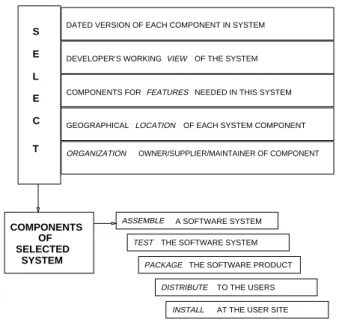
Figure 1.1 Software conguration management.
1.3 Rapid Evolution
Reused software evolves unusually quickly because it must meet the needs of a demanding and diverse community. Software Conguration Manage-ment [FHO92], with distribution capability, is the base technology nec-essary to address the problem. The various versions of the software must be easily stored, accurately recoverable, and automatically distributable. This requires a well-dened, controllable process. In our case, this process is known asAdvsoft. This section contains an example of the use of the Advsoft process applied to a tool called Yeast.
Figure 1.1 is an illustration of the goals of a conguration management process. The general notion is that there is an existing base of software components from which the components of a specic system are chosen, assembled, tested, and distributed to a user.
6 Belanger and Krishnamurthy
is selected from available versions (such as revisions), views, and perhaps components from other systems. Finally, selection is often based on a set of Modication Requests from a change control system. Following this selection, a system is assembled, tested, packaged, shipped to a customer site, and installed. At that point, it is ready for customer use. This ability to create a system selected from a variety of dimensions is crucial to the multiple use of software objects. We have made considerable progress in this area for example [FKSV94].
As an example of the above concept, consider the delivery of a specic version of a tool, Yeast, to a customer. It might look like this:
For Customer - North Carolina Lab
Select the August 1993 Version of Yeast
with Modification Requests for "NC" added, with Fault Tolerance & Security Features, using "libast" libraries.
The preceding syntax is ctitious (since these functions are currently not provided in a single tool), but the problem and capability are not. This de-livery specication could result in selection and packaging of all changes to Yeastnecessary to create the requested system from a computer in Mur-ray Hill, New Jersey, and shipping only the changes to \North Carolina Lab" to update their Yeast conguration. Once the changes are deliv-ered to North Carolina, the software is assembled, tested, and installed there. Note that though our customers use diverse software/hardware platforms, software requests as in the above example are free of plat-form specications. This is because we view portability as fundamental to software reuse and strive to develop technologies and disciplines that ensure portable code. We also ship source code. Changes necessitated by a port to a new platform are considered equivalent to bug xes. Chapter 2 discusses our approach to writing and maintaining portable software.
Software Reuse: A Decade-Long Experiment 7
done in small aggressive teams (sometimes consisting of only one indi-vidual), the rate of change of reusable software can be substantial. This process is managed using the following principles:
A single person owns responsibility for the process of distribution of
software.
A predictable process for freezing basic software components is in place
(this has proven hard in practice).
The responsibility of ensuring that software ready for distribution has
been tested is a distributed process. The responsibility is currently that of the software's creator.
Conguration, distribution, and process are replicated at user sites.
The entire process can be reused.
Conguration and distribution (and to a limited extent|testing) are
part of a single process. The goal is to combine and automate the processes of: congure, assemble, test, package, ship, and install (see Figure 1.1).
Few requirements can be enforced on the target (user) machine. The
current assumption is that it is a UNIX-like system with at least a 7th Edition UNIX Shell and a C compilation system. Even these require-ments are being relaxed.
Some of these principles have been easier to accomplish than others. There is a single responsible manager. Conguration and distribution are part of a single process, and few requirements are placed on either the target machine or on the capability of the distribution mechanism (for example, distribution is over wide areas and existing network facili-ties). Freezing the basic components in an environment in which changes are frequent has proven dicult. It could be done with a formal change management process, but we, as a research organization, have chosen to encourage change and work hard when freeze dates occur. Our choice is biased in the direction of frequent improvement, as opposed to control. Downstream distributors use formal change management. Their releases are less frequent but better controlled and tested. In Section 1.3.1, we trace the Advsoft process, as applied to a specic tool.
8 Belanger and Krishnamurthy
(described in Chapters 2 and 3, respectively). On the other hand, the technology for testing is not as advanced and automated as that for con-guration, assembling, packaging, shipping, and installation. Work is be-ing carried out on automatbe-ing and increasbe-ing the eectiveness of the testing process, but much is yet to be done. Today, those systems that are large, sophisticated, and/or critical to project operations are typically distributed to production users by downstream technology organizations (usually for a charge). In that case, our process supplies that downstream distribution channel.
1.3.1 A
DVSOFTProcess Example
In this section, we present an example of how we coordinate, congure, and track the development of a variety of software components that are distributed to organizations throughout AT&T. We use a tool called ship, which is a collection of KornShell command scripts (see Chapter 4) that packages components of a software distribution for a variety of hardware and operating system platforms in a portable way. ship requires that tools to be distributed be stored in a directory, together with an item le that lists the set of direct dependent entities of the tool (that is, libraries needed to build the tool). ship creates a portable archive (using pax) of the source and nmake (the build tool) les to be sent to the remote site. ship, pax, and nmake are described in Chapter 3.
The example in this section deals with how changes are automati-cally tracked in libast, a library on whichYeastand other tools depend. Taking advantage of the ship directory hierarchy and the item les, we are able to automate the generation of new versions of modied software via the Advsoft process. The automation itself, incidentally, is done via Yeast(see Chapter 9). The example is explained in more detail in Section 9.5.
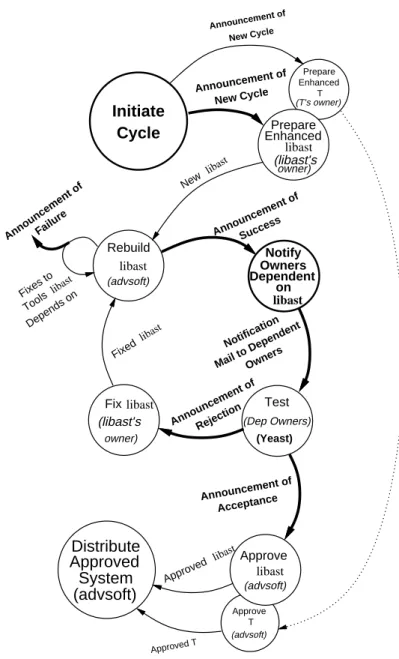
Figure 1.2 depicts the process that Advsoft manages. In the gure, the circles represent subprocesses and the arrows represent data ow be-tween subprocesses. Tool owners submit a copy of the newest version of their tools to Advsoft in cycles (about twice a year).
Software Reuse: A Decade-Long Experiment 9 Prepare Enhanced T (T’s owner) Approve T (advsoft) Rebuild libast (advsoft) Test (Dep Owners) (Yeast) Approve libast (advsoft) Distribute Approved System (advsoft) Initiate Cycle
Announcement ofSuccess
Announcement ofFailure
Notification
Mail to DependentOwners Announcement of
New Cycle
Announcement of Acceptance Announcement ofRejection
Announcement of New Cycle Approved T Prepare Enhanced libast owner) New libast Fixes to Tools libast Depends on Fixlibast Fixed libast Approved libast Notify Owners Dependent libast on (libast’s (libast’s owner)
Figure 1.2 A software tool development and distribution process. Portions
10 Belanger and Krishnamurthy
libast (solid lines), while showing that an identical process is carried out for all other toolsT in parallel (dotted lines). The rest of the diagram is
self-explanatory.
The conguration management tasks to be carried out by the Ad-vsoft process include coordinating changes (a new version of a tool requires notifying owners of all tools that depend on the modied tool), tracking the changes (some tool owners may reject the changes), and con-trolling the changes (waiting until all dependent tool owners accept the modied version).
The seemingly simple bookkeeping activities can be time-consuming and error-prone when performed by humans. Thus, automation of these responsibilities was undertaken. In particular, Yeast specications au-tomate those portions of Figure 1.2 that are shown in boldface.
The details of howYeastis used to implement theAdvsoft process are described in detail in Section 9.5. We simply present a brief outline here.
We rst generate specications for all tools and all owners that are under the management of Advsoft. Yeastwatches for the creation of new versions of tools, and generates notications about the successful building of these new versions. In the example, the notications are sent to tool owners dependent on libast, causing them to test their tools with the modied version of libast. Yeast also generates appropriate error messages if the new versions did not build properly.
Tool owners run regression tests on their tools and generate aYeast announcement (a user notication) indicating that they either accept or reject the modied version of libast. Yeast keeps track of all accep-tance and rejection announcements. If all dependent tool owners indicate acceptance, the modied version of libast is considered to be ready for distribution. If any of the dependent owners indicate rejection, the owner of libast is notied and the process involving libast is recommenced.
Software Reuse: A Decade-Long Experiment 11
1.4 Systems Architecture
A key to reuse at every level of software components is stability of the interface. At the basic|component|level of reuse, such as the UNIX System Libraries, a standard must be established at the level of C func-tion calls, parameters, return values, and names, most of which remain unchanged across versions. However, at higher levels of reuse, a framework must be in place to establish standards for a larger variety of things. For example, in many systems a language is necessary to express and execute actions for the system. This language is not, typically, part of the system itself|if each system has a unique action language, reuse will be severely impacted. In later chapters, there are examples of tools that have sepa-rated out the action language:Yeast,Easel, and nmake are three such tools. Nearly all of our high-level systems currently use the ksh93 version of the KornShell as the action language. Thus, it is important that the KornShell language evolves mostly in an upward compatible way.
Over time, a better understanding of the interaction between reuse and system architecture has evolved. These notions are the result of ob-servation of the use of many application developers, as well as our own work. In general, they are built around the common notions of separation of roles in a way that encourages reuse. This discussion is framed in the context of application systems, often driven by data management and user interfaces, but it also applies to tool applications.
Three principles were observed in practice:
A standard, high-level, comprehensive, action language is essential.
To minimize learning curves, it is essential that this language be widely distributed, understood, and accepted. We have used an extended UNIX System Shell, KornShell, for this purpose. Because it is also the command interpreter for many of the computer systems used by our customers, it has led to widespread understanding without extensive training.
Application systems should clearly identify their Architectural Styles
proper-12 Belanger and Krishnamurthy
ties of an architecture once the style is known. This was learned, over time, largely from the development and use of a system called Easel (Chapter 4). Easel is a tool that supports the ecient construction of application systems that can be built as a network of tasks. A task can be a variety of activities, with one of the most common being an interaction with a user of the application. Data is passed among tasks, control is from task to task, and a rich variety of user interface types are built into the tool.
An emerging area of reuse is Architectural Services, which should be
identied and leveraged for reuse. Architectural services are capabilities that are required independent of architectural style. They support the non-feature requirements of application systems. For example, most network management systems require high levels of availability and security, but these are not part of their application feature sets. A list of some such services is included in Figure 1.3. These capabilities are crucial to most software products, and make up a signicant part of the software in application systems. They have also become areas of some depth in their own right. This creates ideal conditions for the reuse of software: valuable/necessary functionality that is technically dicult to get right. Recent work in this department in the area of software fault tolerance (Chapter 8) has reinforced the value of this notion. This work has achieved widespread use in products in a shorter time than any equivalent project. Within a year of development, these techniques were in use or committed to by more than ten projects across several AT&T Business Units.
Software Reuse: A Decade-Long Experiment 13
A P P L I C A T I O N P R O G R A M
O L T P D S S Event-Action
Data Stream Pipes . . .
Fault Tolerance
Security O A & M Distribution
Visualization Portability . . .
Architectural
Styles
Architectural
Services
Components Existing
and
Generated
GUI Builder Database Application Components
Application Generators
Generic Components Domain Specific
Components
14 Belanger and Krishnamurthy
operations administration and maintenance (OA&M). These are inte-grated with the style tool, but are provided separately so that all styles can take advantage of the services. To complete an application system, a programmer must attach a variety of application components to the style tool. Some of these components can be automatically generated (compo-nent builderssuch as graphical user interface builders); some will already exist and be stored in the conguration system (existing components); and some will be newly programmed (new components). The term platform is often used to describe the portion of the application that is reused, that is, everything except the new application components.
Figure 1.3 shows how components can be used across a variety of styles. Consider the following illustrative example: A system to watch for patterns of signals from a set of remote computers and take action (for example, raise an alarm) when selected patterns are detected. The style can be called event/condition/action, that is, watch for events, check con-ditions, take dened actions. Formally, this style is likely to be modeled by a tool implementing a Finite State Machine or a Petri Net. Yeastis one tool that implements such a style.
Software Reuse: A Decade-Long Experiment 15
cs graphL ast dict screen
malloc sfio
ksh easel
nmake nDFS
app cia
watchd
lefty dot
neato
yeast
dotty
xray testtube
provence vpm
Figure 1.4 Four levels of the software described.
1.5 Four Levels
The software described in this book can be partitioned into four lev-els: substrate, base, standalone, and connected tools. Reuse is achieved at each of these levels: intralevel and interlevel. Figure 1.4 illustrates this four-level structure as it applies to the tools described in this book. Readers should note that the distinction between these layers is internal; application developers who build tools on top of our software will have a dierent notion of where the tools t in their hierarchy.
Each of the nodes in Figure 1.4 corresponds to a tool/library; an edge between two nodes indicates a dependence by the higher-level node on the lower-level node. All of the tools/libraries are discussed in the rest of the chapters of this book.
1.5.1 Substrate
16 Belanger and Krishnamurthy
to help portability by standardizing variances among dierent operating systems.
Tools at this level, and particularly so and malloc, illustrate partic-ularly well three important aspects of the reuse thought process. These are:
Dynamic life-cycle: Each of these tools, as they are at the foundation
of the reuse structure, has undergone substantial improvement over many years. This improvement is a critical factor in the quality of our software and in our ability to support the remainder of the hierarchy.
Understanding the problem: These tools were developed in response to
the needs of the higher-level tools. That is, they solve the needs of real applications and are driven by those applications. Knowing the characteristics of the systems that you write is a key to getting the fundamentals right.
Reuse induction: The substrate tools have evolved to become general
tools by solving problems for a sequence of real systems, and by con-centrating on improving the abstract model of the solution at each step.
The libraries are all described in Chapter 2.
1.5.2 Base
The second layer consists of what we label base tools (shown by ovals in Figure 1.4). These tools are important for the environment in which other tools are built. The primary dierence between tools at this level and the substrate layer is the complexity of their interfaces and how they are reused. The substrate is a collection of libraries with simple C function interfaces that can be reused as pluggable components, while the base tools provide languages and lters that encode knowledge reusable with some programming.
Software Reuse: A Decade-Long Experiment 17
at this level. n-DFS supports services such as fault tolerance and synchro-nization of data. It will likely support many other services as it matures. nmake and n-DFS are described in Chapter 3, ksh and Easel are described in Chapter 4.
1.5.3 Standalone Tools
The standalone tools (shown by circles in Figure 1.4) layer comes next. Tools at this layer reuse libraries in the substrate layer and are built in the environment of the tools in the second layer. The standalone tools perform a focused task and are not as generic as the base tools. For example, cia, a reverse engineering tool, uses libast in the lowest layer. cia is generic within a reasonably bounded application class. However, cia is not as generic as ksh, which provides a language in which arbitrary scripts can be written.
Both cia andAppare tools that aid program understanding. cia pro-vides static analysis while App aids in analysis at runtime. cia extracts C program entity relationships, whileAppprocesses assertions (specied as pre- and post-conditions) to generate self-checking C programs. Both cia and Appuse libast and libpp.
The watchd tool (together with the libft library) provides a mechanism to add fault tolerance to existing programs. watchd reuses libast.
Several tools have been written on top of cia forming theCia system. App and Cia are described in Chapters 5 and 6, respectively. While we do not have a tool that provides security as an architectural service, we discuss security aspects of software engineering in Chapter 7; watchd and libft are described in Chapter 8.
1.5.4 Connected Tools
18 Belanger and Krishnamurthy
the architectural style for his/her system, Yeastis a base tool, and the application (or part of it) is a connected tool.
Provence, an open process-centered software development environ-ment, is another connected tool. Provence's components are: Marvel (a tool developed outside AT&T), Enactor, Yeast, dotty and n-DFS. dotty, a graphical editor/layout tool, consists of dot and lefty. Test-Tube, formed by connecting cia andApp, identies subsets of test suites that need to be run when a new version of a system is created (thus help-ing in minimizhelp-ing the number of tests). Xray animates programs and visualizes the dynamic aspects of program execution either live or by playing back a recorded session. Xray is formed by connecting cia (to get relational information between entities in the program), App(for in-strumenting the code to output useful information during the run), and dotty (for visualizing). Vpm, a visual process monitor, permits dynamic monitoring of running processes across multiple machines.Vpmis formed by linking n-DFS and dotty.
Yeast and Provence are described in Chapters 9 and 10, respec-tively. dotty, Xray,Testtube, andVpmare all described in Chapter 11.
1.5.5 Reuse Experiences
Reuse from existing component libraries, internal to this department, is shown in Table 1.1. The rst column shows a partial list of tools we distribute (the tools are described in detail in the book). The second column shows the actual lines of source code in the tool (referred to as NCSL, or noncommented source lines), while the third column shows the total lines of code shipped (including all the libraries needed by the tool). On average, it is greater than ve lines reused per line of code written.
Software Reuse: A Decade-Long Experiment 19
The second factor is that there is also a hierarchy of reuse at the system level among the tools in Table 1.1. For example, ksh93 provides the action language for Yeast, Easel, nmake, and coshell; these tools support a variety of architectural styles. Also, tools, such as watchd, support several other tools by providing architectural services, such as Yeast. These reuse values are not in the table because they are in separate executables, but they represent large integer factors in terms of eort reduction, both for tool builders and in learning time for tool users.
Table 1.1 Software Reuse
Tool NCSL S-NCSL R-NCSL
3DFS 11099 83069 18466
App 5881 57097 11462
cia 5327 52914 13166
coshell 3884 49166 14026
cs 1723 45724 14092
dot 12952 16585 14245
dotty 1413 75918 27674
easel 25782 48024 38901
incl 1085 43868 5245
ksh 31310 69407 39288
lefty 12730 59333 18601
nmake 17319 64687 28663
pax 6479 42225 15344
probe 345 34943 7278
proto 208 47389 2124
ss 504 42272 5867
subsys 360 41194 7301
Vpm 1100 115621 40043
watchd 3133 10694 3552
Yeast 7288 56397 14913 NCSL: Non-commented source lines S-NCSL: Shipped NCSL
20 Belanger and Krishnamurthy
1.6 An Example of Architectural Style
and Service
In this section, we present an illustration of architectural styles and ser-vices as a way of building new applications out of reusable components. First, we briey discussYeast, an event-action specication tool, as an example of a tool that enables an architectural style.Yeastis described in detail in Chapter 9. Next, we show how two architectural services, namely fault tolerance and visualization, have been added to Yeast. Fault tolerance is described in more detail in Chapter 8 and visualization in Section 11.2.
1.6.1 Architectural Style
Yeastruns as a daemon on a single machine on a network and accepts client specications from users. When these specications are matched, user-specied actions are triggered by Yeast. Client commands|such as, add, remove, and suspend specications|can be issued from any of several machines in the network. Yeastpermits arbitrary actions to be triggered when event patterns of interest are matched. It can match tem-poral events and nontemtem-poral events, such as changes of attributes in objects belonging to a variety of object classes. The list of predened attributes for these object classes can be extended, as can the classes themselves. With the use of external event notications (called announce-ments), Yeast can model a wide range of applications that follow the event-action paradigm.
Software Reuse: A Decade-Long Experiment 21
1.6.2 Architectural Services
We next look at two architectural services that dramatically improved the power and capability ofYeast. The rst is the fault tolerance service provided by a combination of a library and a watcher process. The second example is visualization support provided via a language mechanism.
1.6.2.1 Fault Tolerance
Software fault tolerance is a way to make software withstand faults that arise during execution. It is signicantly more than checking boundary conditions and several techniques have been identied. It is not enough to rollback, recover, and restart; nor is it enough to test adequately. Some faults in programs fall in the category of transient failures resulting from a particular input sequence or a set of environment conditions. The ap-proach taken in libft/watchd is to provide a platform that, with some modications to the software, provides an acceptable level of recovery from catastrophic conditions, as well as an opportunity to modify soft-ware faults when an exception happens.
The rst half of the fault tolerance technique is a library that, when linked with application programs, provides a checkpointing facility for recovering from failures. The second half is a watch daemon that aids in locating the fault. The library and the watch daemon free individual application programs from having to do their own separate fault tolerance. A signicant amount of useful code is thus reused.
Consider the example ofYeast, of which some customers require fault tolerance. Yeastclients do not know where theYeastdaemon process is running on the network. If the machine on which theYeastdaemon is running crashes, two problems arise: The existing set of specications is no longer being matched, and new client commands cannot communicate with a Yeast daemon. Ad hoc solutions, while reasonable, require a signicant amount of code to be added to Yeast, none of which deals with event-action matching|the stated purpose of the application.
22 Belanger and Krishnamurthy
Yeastcode and theYeastdaemon process is registered with watchd.
This requires minimal modications to Yeast. Upon a machine crash, the shadow process restarts aYeastdaemon on another machine on the network with the most recent value of the signicant data structures. This enables continued matching of the existing specications with no loss of state. Additionally, new client connections are automatically routed to the new daemon process, thus making the machine crash transparent to the users on the network.
1.6.2.2 Visualization
Visualization is often a key component of interfaces and application front ends. Visualization can be static or dynamic, depending on the applica-tion needs. For example, graph layouts are often a useful way to present visual information, especially when dealing with software entities. A ex-ible way to provide this is to use a graph description language consisting of nodes and edges at a simple level, and attributes (such as color) and abstractions (such as clusters, groupings) at a higher level. The choice for a visual representation language is driven by simplicity that minimizes the time spent in learning an additional language.
Unlike libft/watchd, where a library is used, a language is used here to describe the service. A graph drawing program should be able to parse a graph description language and construct a picture quickly. dot [GKNV93] is a tool that reads and writes graphs in an attributed graph description language. By combining dot with lefty [KD91] (a pro-grammable graphics editor), dotty was created. dotty can be used as a standalone tool or as a front end for applications that use graphs. In dotty, the lefty program implements the insertion and deletion of nodes and edges, the drawing of the picture, and functions that map user actions to operations on the picture. dotty can thus read dot input and create a dynamic front end that can be controlled through simple commands. dot, lefty, and dotty are all described in Section 11.2. Section 9.6.2.2 describes the visualization ofYeast specications in more detail.
The graphical front end forYeasttook a couple of hours to build and
In the most recent version of
Software Reuse: A Decade-Long Experiment 23
needed an addition of about 50 lines of code to Yeast. This technique has since been replicated for other tools in the department|a recent example is for a software process visualization environment, Provence (see Chapter 10).
We have examined how one tool (Yeast) has taken advantage of the architectural services that are available separately from the basic tools that they serve. Other examples can be found in this book.
1.7 Summary
Our experience shows that there is considerable value in a reasonably comprehensive set of reusable items of mixed levels (component, service, style, platform) when supported by strong marketing and distribution capabilities. The set can be put together in a variety of ways. A reuse factor greater than ve has been achieved locally using libraries (with a real reuse factor of 2 to 2.5 when the actual percentage usage of library functions is considered). The real impact is much greater than that if the use of architectural roles and levels is considered, but we do not yet have accurate measures of that eect.
The book follows the four-level structure described in Section 1.5. The software entities in the substrate and base levels concentrate on the princi-ples on which they were built and the reusability they oer to the higher-level tools. The standalone tools chapters begin with a description of the tool, describe their architecture, and highlight the lower-level com-ponents reused by them. They also point toward how they were used as components to the tools in the later chapters. The chapters dealing with connected tools discuss the reuse of the standalone tools at the component level and show how they were assembled eciently.
1.8 Reading This Book
There are a number of ways to read this book.
24 Belanger and Krishnamurthy
basic library support for software development (Chapter 2), congura-tion management (Chapter 3), static and dynamic code analysis (Chap-ters 5 and 6), secure/reliable application systems (Chap(Chap-ters 7 and 8), high level languages for system development (Chapters 4 and 9), and in-tegrated applications (Chapters 10 and 11). They describe software that is in widespread use and reect what we have learned in several application areas.
A second is as a collection of tools and ideas that, when taken together, provide a platform for eective software development. The software de-scribed in this book supports the technique of obtaining high-leverage reuse by division of software into several architectural roles. From this point of view: Chapter 2 describes basic components; Chapters 4 and 9 describe tools to support certain architectural styles using high-level languages; Chapters 5 and 6 describe development environment support; Chapters 7 and 8 describe architectural services; Chapters 3, 10, and 11 describe integrated applications. Development activity is supported both within the development environment and for reuse within devel-oped systems. Particular attention is paid to such issues as portability and conguration for the development of large-scale software.
Libraries and File System
Architecture
Glenn Fowler, David Korn, Stephen North,
Herman Rao, and Kiem-Phong Vo
2.1 Libraries
Libraries are the most widely understood and used form of code reuse. A collection of generic routines that can be simply plugged into diverse applications is often a strong motivating factor for reuse. However, there are several principles that have to be kept in mind to create a successfully reusable library. This chapter deals with a broad cross section of software ranging from memory allocation to operating system services. The soft-ware is organized into a collection of libraries called the ast libraries that form the backbone for the rest of the tools described in the book.
The main sections of the chapter are:
Section 2.2 gives an introduction to the ast libraries along with a
de-tailed discussion of the design principles used in writing them. This section also overviews some of the main components of ast including the porting base libast.
Section 2.3 deals with a resource acquisition and management
param-eterization technique|disciplines and methods|that enhances library
The left running heads in chapters 2, 3, 4, and 11 indicate the author(s) of each section.