Which Retail Analytics Do You need?
To increase ROI, match the right analytic
techniques to your business objectives
The most competitive retailers today are increasing response rates and revenues by using predictive models and other analytics to make relevant, personalized, precisely timed offers to customers. Analytics provide a concrete means of realizing the long-standing exhortation to “Know your customer.” They enable retailers to treat customers differently, even individually, based on insights into their desires, preferences and future behavior.
Retailers who know their customers analytically are making smarter strategic decisions about online/ brick-and-mortar store design, merchandising and other investments. Analytics also enable them to implement these organizational-level strategies in individual-level offers. They aim for the “sweet spot” where customer behavior unites with what the retailer and its suppliers need to accomplish.
Choosing the right analytics for the job is becoming a job in itself, however. Numerous vendors have crowded into the marketplace offering a jumble of similar-sounding solutions. Beneath the surface, there are actually significant differences in the analytic techniques being employed, the types of insights they provide and the business benefits they deliver. “One-size” definitely does not fit all requirements. To obtain a substantial return from your analytic investment, choose the right technique for what you’re trying to accomplish. This white paper:
• Helps you match analytics solutions to your business needs.
• Explains what each analytic technique can tell you about customers and the kinds of actions you can take informed by such insights.
• Discusses specific benefits, such as increasing ROI with better incentive targeting, improving supply chain throughput and cash flow by accelerating customer purchasing patterns, and building loyalty program membership, usage and retention.
• Shares FICO case studies illustrating the value retailers are seeing from analytics.
Number 49
www.fico.com Make every decision countTM
Find out how retailers are using advanced
analytics at scale to replace generalized
communications with personalized messaging
that achieves up to nine times the ROI.
»
insights
For retailers, one of the greatest values of analytics is to provide decision points for determining how to treat customers differently. Analytics provide a reliable means, based on statistically valid data analysis instead of hunches or observational judgments, of deciding what actions to take with your customers. “Will it be profitable to offer free delivery?” “Which offers will have the biggest impact on a customer’s shopping behavior?”
Consider what happens when consumers visit an online or brick-and-mortar store for the first time. Initially, the retailer knows nothing about these potential customers and thus treats them all the same. At some point, the consumer may click on a product or category, or make a purchase. This consumer behavior is likely to trigger a business rule that initiates an action by the retailer. Coupons might be printed for complementary products. An email might be sent offering a discount on a product in an abandoned online shopping cart.
In such instances, consumers are differentiating themselves by their behavior. The retailer, however, is still treating them the same because everyone who exhibits the same behavior receives the same offers. Inevitably the offers made will be more relevant to some recipients than to others, and responses will vary accordingly. Because the retailer doesn’t know anything more about these consumers beyond that they clicked on or purchased a product, there’s no reliable basis on which to make a more specific decision on a more relevant offer.
Now let’s look at what different types of analytics can tell retailers about their customers, giving them more decision points to consider when determining which actions to take.
Here’s an overview of the analytic techniques that are most valuable in retail and the kinds of targeted actions they’re enabling retailers to take. The benefits of analytics can begin with the first visit, but they really come into play as retailers develop customer relationships for longer-term revenues and profits. For this reason, while our discussion starts with a common technique used with first-time customers, we’ll focus on more powerful analytics that deliver stronger value.
Collaborative Filtering—Inferring Behavior Based On Similarity
Collaborative filtering enables retailers to take a degree of targeted action even for first-time customers. This type of analytics is often behind the product recommendations offered on e-commerce sites and the printed coupons generated at in-store checkout.
The form of collaborative filtering most often used in retail is sometimes referred to as an “affinity model” or “lookalike model.” It infers how an individual will behave based on how other individuals who look similar (share one or more characteristics) have behaved in the past: “People who buy/view product X often buy product Y.”
Collaborative filtering doesn’t have to be triggered by a current transaction. It can be used to target subsequent outgoing campaigns and other kinds of promotions. Still, this analytic technique is fundamentally transaction-oriented. The algorithms used are best suited to modeling data about items purchased or viewed. They’re not effective for modeling purchase and view data with the wide range of other information retailers have in their databases (e.g., attitudinal data, seasonal purchase patterns, natural product adjacencies, basket builders) or can access from external sources (e.g., demographics, public records, third-party marketing information).
For known customers, therefore, other types of analytics provide far more powerful and
»
What Value Does
Analytics Bring
to Retail?
»
The More You Know,
the More Relevant
Actions You Can Take
www.fico.com page 3
»
insights
»
insights
Clustering Algorithms—Segmenting
Known Customers by Their
Past Behavior
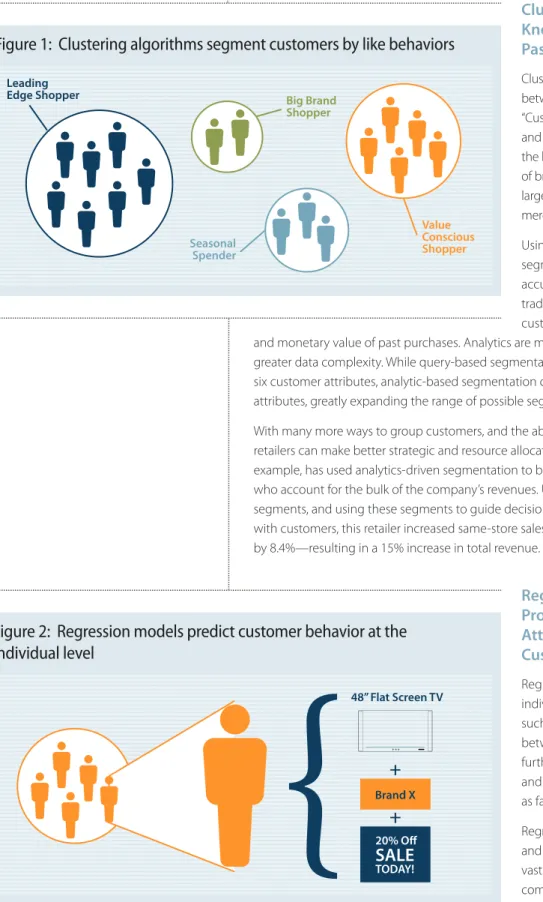
Clustering algorithms enable retailers to differentiate between customers in broad ways such as
“Customers who like leading-edge technology” and “Customers who are value conscious.” One of the benefits of painting customers with this kind of broad brush is that it can help direct and justify large-scale expenditures on store design, new merchandising schemes and promotional programs. Using analytics in this way (often called “behavioral segmentation”) enables retailers to make far more accurate decisions than can be achieved through traditional methods of database querying on customer attributes such as recency, frequency and monetary value of past purchases. Analytics are more accurate partly because they can handle greater data complexity. While query-based segmentation generally involves no more than three to six customer attributes, analytic-based segmentation can encompass dozens or even hundreds of attributes, greatly expanding the range of possible segmentation schemes.
With many more ways to group customers, and the ability to try lots of alternative groupings quickly, retailers can make better strategic and resource allocation decisions. One large national retailer, for example, has used analytics-driven segmentation to better understand and serve those customers who account for the bulk of the company’s revenues. Using their characteristics to define population segments, and using these segments to guide decisions from store layouts to how staff interacts with customers, this retailer increased same-store sales in the first quarter of implementation alone by 8.4%—resulting in a 15% increase in total revenue.
Regression Models—Predicting
Propensity, Response, Revenue,
Attrition and Other Individual
Customer Behaviors
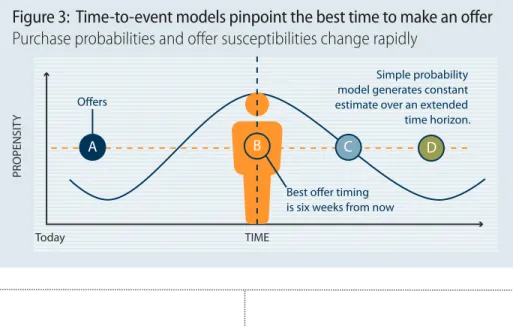
Regression models enable retailers to predict how individual customers are likely to behave. With such specific insights, retailers can differentiate between customers to a much greater degree, further increasing the granularity of segmentation and the relevancy of offers. In fact, retailers can go as far as to essentially create segments of one. Regression analysis delivers this level of specificity and accuracy because while it can encompass a vast range of internal and external data, its power comes from pinpointing the specific customer attributes most predictive of a future behavior.
Leading
Edge Shopper Big Brand
Shopper Seasonal Spender Value Conscious Shopper
Figure 1: Clustering algorithms segment customers by like behaviors
Figure 2: Regression models predict customer behavior at the
individual level
Brand X 20% OffSALE
TODAY!+
+
48” Flat Screen TV»
insights
»
insights
Relationships between numerous attributes and other variables are examined to see how a change in the value of one variable affects the value of another, dependent variable. Attributes that prove to be highly predictive of a behavioral outcome are incorporated into a predictive model. For example, a regression model can be built to predict a customer’s propensity to make a purchase in a product category or to discontinue using a service.
Because these models can predict for each individual customer the likelihood of such an outcome, they open up the possibility of unique treatment. Moreover, by using multiple regression models, retailers can gain a much clearer picture of the customer. Knowing that Jane is not only likely to buy a 48” TV, but that she tends to like the Sony brand, but doesn’t tend to go for cutting-edge products, enables the retailer to greatly increase the relevancy of individualized offers and interactions. Here are a couple examples of how leading retailers are applying such insights:
• One FICO client, who implemented propensity models for all of its product categories, can dynamically generate individually tailored emails for customers. Every customer is scored for propensity to buy in each product category. Based on where the customer scores the highest, the retailer’s automated decision system determines which of several overall mailing themes is most relevant, then adds features or offers in six product categories. No more than 20 customers in a million receive the same set of recommendations. This kind of tailored promotion has enabled the retailer to achieve email open rates of up to 50% and up to 9 times the ROI compared to generalized mailings.
• Another retailer is using predictive analytics to build membership and activity in its fee-based premium loyalty program. The program delivers 12 individually selected relevant offers per month to each member; these are loaded onto the customer’s loyalty club card and can also be accessed from the retailer’s website or from kiosks in stores. Each offer package includes rewards aimed at increasing buying frequency and customer retention. It also includes an offer encouraging the customer to try a product in a relevant category where they have not purchased before. In the first six months alone, this retailer increased program membership by over 43%.
Time-to-Event Models—Predicting
When a Specific Customer Behavior
Is Likely to Occur
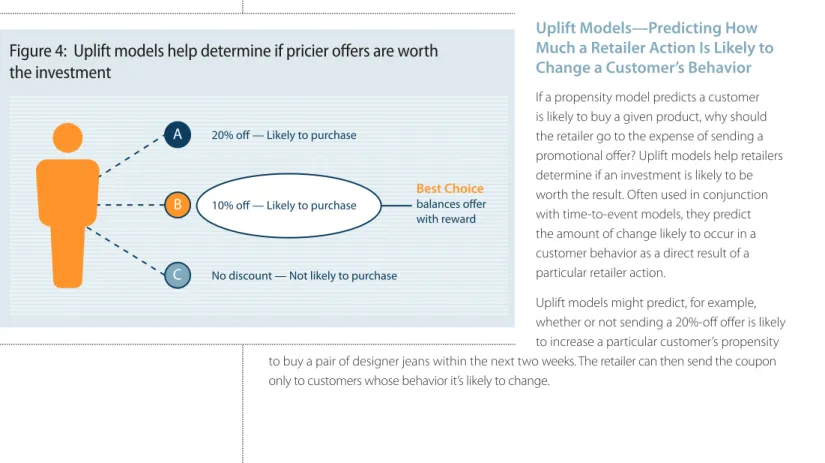
Knowing that a customer is likely to behave in a certain way is useful, but knowing when they are likely to do it is even more powerful. Retailers are working anywhere from a few days to a few weeks out in their decisions about what to promote to whom. The propensity of a customer to buy a specific product, however, varies over time, as shown in Figure 3. A time-to-event model predicts a window of opportunity when the customer is most likely to act. By timing campaigns and other promotions to these windows, retailers can improve relevancy for their customers,
Best offer timing is six weeks from now
PROPENSIT
Y
TIME
Figure 3: Time-to-event models pinpoint the best time to make an offer
Purchase probabilities and offer susceptibilities change rapidly
Offers
A
B
C
D
Simple probability model generates constant estimate over an extended time horizon.
www.fico.com page 5
»
insights
Similarly, the likelihood that a customer will attrite from buyers clubs and premium services varies over time. Some customers fail to renew, and others just stop using the service. Retailers want to prevent this from happening because once a customer has lapsed, it is much more difficult to re-engage and capture his/her previous spending behavior. Leveraging personally timed, relevant offers can encourage a customer to remain active in the program and not fall into a lapsed behavior group.
Here’s how some FICO clients are using time-to-event models:
• A large retailer is using this type of analytics to increase the ROI from promotional mailings. When a popular new DVD or videogame comes on the market, for example, the retailer sends offers only to those likely to buy the product within the offer redemption period. Response rates are two-to-three-times higher than when the same offer is sent to everyone. And because the retailer is not wasting customer time with irrelevant offers, future
promotions are likely to be received with due attention.
• A home improvement retailer used time-to-event models in an email campaign directing recipients to one of several web landing pages featuring a specific do-it-yourself project, such as painting or replacing flooring. The customers targeted for the emails were those identified by the models as likely to purchase in that product category within a short period of time. • A large retailer is improving its ability to predict when customers are about to make a big
purchase by incorporating customer clickstream data into time-to-event models. Many consumers do extensive online research before making an online purchase or walking into a store to inspect the item. By analyzing clickstream data from its site, along with customer purchasing histories and historical behavior patterns, the retailer can pinpoint the right moment to make an offer. Early results are impressive—and too competitive to be revealed.
Uplift Models—Predicting How
Much a Retailer Action Is Likely to
Change a Customer’s Behavior
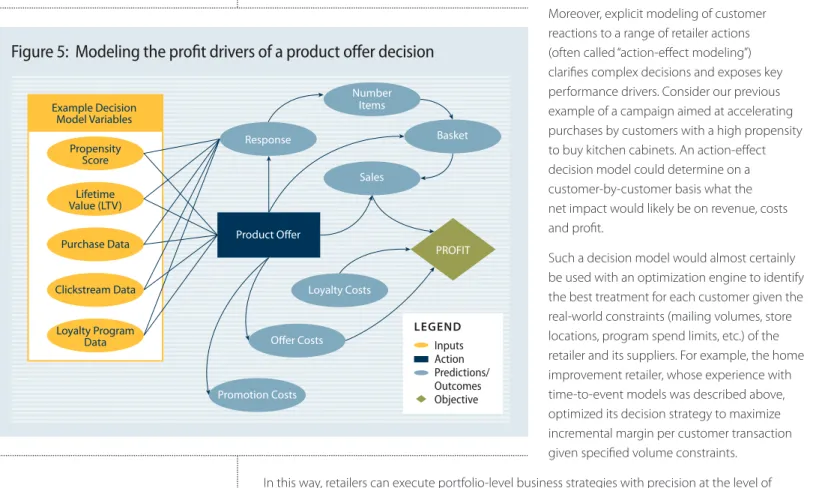
If a propensity model predicts a customer is likely to buy a given product, why should the retailer go to the expense of sending a promotional offer? Uplift models help retailers determine if an investment is likely to be worth the result. Often used in conjunction with time-to-event models, they predict the amount of change likely to occur in a customer behavior as a direct result of a particular retailer action.
Uplift models might predict, for example, whether or not sending a 20%-off offer is likely to increase a particular customer’s propensity to buy a pair of designer jeans within the next two weeks. The retailer can then send the coupon only to customers whose behavior it’s likely to change.
Figure 4: Uplift models help determine if pricier offers are worth
the investment
A
B
C
20% off — Likely to purchase
10% off — Likely to purchase
No discount — Not likely to purchase
Best Choice
balances offer with reward
»
insights
On the other hand, when uplift modeling indicates a customer’s behavior is likely to be affected by a promotion, it can also help retailers determine which promotion will have the most impact. Will 20% off be much more effective than 10% off? Than free shipping? Is offering 12 months of interest-free credit necessary, or will 6 months be nearly as enticing? Uplift models provide the analytical insights retailers need to make precise decisions about where to put marketing spend for higher ROI.
Uplift models are based on cutting-edge analytic techniques that can predict individual customer sensitivities to price incentives, redemption terms and even promotional package design. For instance, one FICO retail client that helps to “make markets” for new products by spending heavily on promotion, is using uplift models to increase its return on this investment. The analytics provide insights that are enabling the retailer to accelerate the purchasing behavior of so-called “laggers”—customers who historically haven’t been among the first to purchase. By targeting these customers with offers that are likely to change their historical behavior, the retailer is increasing the concentration of sales in the first two months of the product lifecycle—its “critical period” before competitors can draft off of their momentum. Given shrinking product lifecycles, pushing sales forward in this way is becoming ever more critical to this retailer’s success.
As retailers add better analytics, they increase the number of decision points for differentiating between customers and making more targeted decisions. But just as having lots of data can be overwhelming and of little value in and of itself, so it is with the analytic predictions drawn from this data. Their business value depends on the retailer’s ability to operationalize them.
The challenge is to bring all of the relevant analytic insights together into day-to-day decisions. To do that, retailers need a powerful business rules management system (BRMS) and optimization engine. Best-in-class systems incorporating these technologies can take the analytic output of thousands of models and deploy them in decisions across millions of customers.
A BRMS is a fundamental capability since customer behavioral predictions are usually linked with actions through business rules. For example: “If a customer has a high propensity for purchasing new kitchen cabinets in the next 90 days, and is 20% more likely to act within the next 30 days if they receive Coupon A, then include them in this emailing.”
Related rules like these make up a decision strategy, that will generally be tested on a small population segment, and the results analyzed. Retailers can make this process faster and more efficient by using technology solutions that allow models to be deployed directly (i.e., without any kind of recoding) into the BRMS powering operational decisions.
Retailers can further compress test-and-learn cycles—accelerating performance gains—by using experimental design. Also called “multivariate testing,” this is a methodology with which large numbers of decision strategies are tested simultaneously on smaller population subsets. Because this approach enables testers to infer what the results would have been on untested populations, it yields more learning from fewer tests.
»
Maximizing—and
Measuring—the Value of
Analytics in Operations
www.fico.com page 7
»
insights
Another way to speed up operational improvements is through “decision modeling,” depicted in Figure 5. Every decision, even one based on a single “If …, then …” business rule, could be described as a model, since it is a representation of how a decision is being made. But when large numbers of analytic predictions are used to differentiate and treat customers individually, the number of rules can explode. The decision process can become difficult to manage and even to fully comprehend. A decision model simplifies such complex decisions by mathematically mapping the relationships between all the factors and outputting an actionable result, such as a recommended customer treatment.
Moreover, explicit modeling of customer reactions to a range of retailer actions (often called “action-effect modeling”) clarifies complex decisions and exposes key performance drivers. Consider our previous example of a campaign aimed at accelerating purchases by customers with a high propensity to buy kitchen cabinets. An action-effect decision model could determine on a customer-by-customer basis what the net impact would likely be on revenue, costs and profit.
Such a decision model would almost certainly be used with an optimization engine to identify the best treatment for each customer given the real-world constraints (mailing volumes, store locations, program spend limits, etc.) of the retailer and its suppliers. For example, the home improvement retailer, whose experience with time-to-event models was described above, optimized its decision strategy to maximize incremental margin per customer transaction given specified volume constraints.
In this way, retailers can execute portfolio-level business strategies with precision at the level of individual customers. They can find the “sweet spot” where what the customer wants and what the business and its partners want intersect. It’s the realization of the very definition of successful marketing—”Find a need and fill it.”
Success, of course, must be measurable, and thus retailers need systematic testing practices and rigorous measurement. They must able to determine how much of a result is due to analytics as opposed to other decision elements and operational factors.
For example, a retailer might come to the erroneous conclusion that a discount coupon program produced inadequate ROI because of failing to properly control for selection biases in the coupon targeting. Causal modeling/matching techniques can be used to eliminate or mitigate such biases. These techniques can also empirically tease apart operational outcomes, so that the impact of the analytics on the coupon campaign can be isolated and accurately measured.
Figure 5: Modeling the profit drivers of a product offer decision
PROFIT Response Product Offer Loyalty Costs Number Items Basket Promotion Costs Inputs Action Predictions/ Outcomes Objective LEGEND Sales Offer Costs Example Decision Model Variables Clickstream Data Lifetime Value (LTV) Propensity Score Purchase Data Loyalty Program Data
»
insights
Choose the right analytics technique for your business goals
Analytics type Works By Best Used For Benefits
Collaborative Filtering Inferring customer behavior based on similarities (e.g., "People who bought A also bought B")
Treating first-time customers Enables limited differentiation when no historical behavioral data on a customer is available
Clustering Algorithms Grouping customers based on similar historical behavior patterns
Creating broad customer segments for promotional programs and strategic planning
Lifts response rates (generally from the traditional 1-2% to 5-6%) over traditional query-based segmentation
Performs data-driven customer differentiation at a large enough scale to guide/justify business investments in store design, merchandising, etc.
Regression Models Identifying customer attributes predictive of future behaviors
Predicting individual customer behavior for 1-to-1 marketing and other personalized treatment
Is generally up to twice as effective as collaborative filtering for targeting known customers Increases response rates (often doubling performance) and boosts conversion rates over clustering algorithms
Time-to-Event Models Predicting when a specific customer behavior is likely to occur
Timing offers for when a customer is most likely to buy; accelerating customer behavior
Lifts performance by as much as 50% over regression models (2% lift in response rates not uncommon)
Uplift Models Predicting how much a particular action by a retailer is likely to change a forecasted customer behavior
Determining whether or not a particular action will be worth the expense
Lifts performance by as much as 50% over other analytic techniques
Decision Models Mapping the mathematical relationships between numerous predictive model outputs and other decision elements, including a range of possible retailer actions and customer reactions
Managing and improving complex decisions; capturing key results drivers, including constraints, for use with an optimization engine
Pinpoints the best offer, given all retailer/supplier objectives and constraints, for each customer
»
insights
Retailers of all sizes are bringing analytics into their operations. The key to making choices and investments that deliver on your expectations is to understand what various types of analytics do and how they fit (or don’t fit) what you’re trying to accomplish.
It’s also important to think about how you will bring those analytics to life in your marketing plan. Wherever you are in the spectrum of adding analytics to your organization, there’s a next step you can take for the next level of benefit.
Find out more about what type of analytics and marketing applications you need most: • Visit www.fico.com/retail
• Download Insights paper #32 “Top Retailers Compete With True 1-to-1 Marketing”
»
Conclusion
FICO Retail Solutions:
Transforming Analytic Insights into Real-Time Decisions and Marketing Actions
FICO® Customer Dialogue Manager
FICO Customer Dialogue Manager is a multi-channel marketing platform that enables marketers to design, execute and manage precisely timed and targeted campaigns that engage customers across all channels based on their known interactions and preferences. By integrating and harnessing enormous volumes of customer data from every channel, it provides a basis for gaining sharp insights into customer interactions and behaviors. Marketers can apply those insights to generate more individualized, interactive dialogue with customers in a coordinated fashion across channels, including social media. Through dialogue, you learn more about what the customer wants, which leads to increased sales and marketing ROI.
FICO® Analytic Offer Manager
FICO Analytic Offer Manager combines proven predictive analytics and optimization capabilities to deliver highly personalized, relevant offers to customers right when they are most likely to act on them. Going beyond simply making recommendations, the solution enables precisely targeted offers based on observed propensities for specified time frames. It combines these customer-level predictions with retailer business objectives and constraints to pinpoint the optimal decisions for achieving an overall goal, such as maximizing redemption, revenue or margin. FICO Analytic Offer Manager can integrate with FICO Customer Dialogue Manager to enable marketers with millions of customers and potentially thousands of offers to deliver relevant and timely offers to individual customers across all channels—digital, social, mobile or traditional.
FICO and “Make every decision count” are trademarks or registered trademarks of Fair Isaac Corporation in the United States and in other countries. Other product and company names herein may be trademarks of their respective owners. © 2011–2014 Fair Isaac Corporation. All rights reserved.
2758WP 04/14 PDF
The Insights white paper series provides briefings on research findings, technology innovations and recommended best practices from FICO. To subscribe, go to www.fico.com/insights.
For more information North America Latin America & Caribbean Europe, Middle East & Africa Asia Pacific
www.fico.com +1 888 342 6336 +55 11 5189 8222 +44 (0) 207 940 8718 +65 6422 7700