EVIDENCE-AS-A-SERVICE: STATE RECORDKEEPING IN THE CLOUD
Lorraine L. Richards
A dissertation submitted to the faculty of the University of North Carolina at Chapel Hill in partial fulfillment of the requirements for the degree of Doctor of Philosophy in the School
Information and Library Science.
Chapel Hill 2014
© 2014 Lorraine L. Richards ALL RIGHTS RESERVED
ABSTRACT
Lorraine L. Richards: Evidence-as-a-Service: State Recordkeeping in the Cloud (Under the Direction of Christopher A. Lee)
The White House has engaged in recent years in efforts to ensure greater citizen access to government information and greater efficiency and effectiveness in managing that information. The Open Data policy and recent directives requiring that federal agencies create capacity to share scientific data have fallen on the heels of the Federal Government’s “Cloud First” policy, an initiative requiring Federal agencies to consider using cloud
computing before making IT investments.
Still, much of the information accessed by the public resides in the hands of state and local records creators. Thus, this exploratory study sought to examine how cloud computing actually affects public information recordkeeping stewards. Specifically, it investigated whether recordkeeping stewards’ concerns about cloud computing risks are similar to published risks in newly implemented cloud computing environments, it examined their perceptions of how cross-occupational relationships affect their ability to perform
recordkeeping responsibilities in the Cloud, and it compared how recordkeeping roles and responsibilities are distributed within their organizations. The distribution was compared to published reports of recordkeeping roles and responsibilities in archives and records
management journals published over the past 42 years.
The study used an interpretive, constant comparative approach to data collection and an analytical framework from Structuration Theory. Findings were drawn from 29 interviews and their associated transcripts and from 682 published articles from six archives and records management journals dating from 1970 onwards.
It was found that the actual work environments reported by interview participants most resembled the recordkeeping environments published by archival continuum theorists. In addition, records managers reported greater worry about status and a lack of clearly demarcated lines of responsibility in their work than did the archivists. Records managers also reported less impact from the new technology as physical artifact than from political and inter-occupational power adjustments that altered their status after the cloud
implementations. It was also found that current cloud computing environments exhibit a variety of disincentives for accurate and complete recordkeeping, some of which are primarily due to political changes and others from the distributed nature of information storage in the Cloud.
To Don Robert Richards, Sr. (1922-2000) and Donna Lorraine Richards (1924-1988)
ACKNOWLEDGEMENTS
So many people have helped me in so many ways along my path. It isn’t possible to thank them all here. Chances are good they know who they are, though, and will forgive any omissions here because they also know how absent-minded I can sometimes be. Obviously, I owe a tremendous debt to my advisor Cal (Christopher) Lee. He spent a great deal of time discussing and critiquing ideas, urging me onward, reading a few hideous first drafts, and pushing me to think (and therefore) write more clearly. I also owe a huge debt to my co-advisor Helen Tibbo, who has been a constant professional role model. I have benefited so much from her unrelenting honesty, her incisive and extensive knowledge of the profession, and her friendly help in every aspect of my degree program when I’ve needed it. I also want to thank the other members of my comprehensive exam committee and my dissertation committee, who have each provided helpful comments and critiques, and have offered professional insights along the way – Paul Jones, Richard Marciano, and Jeffrey Pomerantz from the School of Information and Library Science (SILS) at the University of North Carolina, Chapel Hill (UNC-CH) and Theresa A. Pardo from the Center for Technology and Government (CTG) at the University at Albany, the State University of New York (SUNY).
I want to thank the interview respondents who took the time to discuss their
workplace environments, concerns, and work objectives. I hope you keep in mind that this paper is not attempting to report “objective truths” about your organizations but rather, to highlight the perceptions which you have discussed so openly.
A large number of friends and colleagues have also provided help to me while writing this. I want to thank Amber Cushing and Sarah Ramdeen for some very early comments and critiques that helped me fine tune my ideas and better present them. I also want to thank the past and current members of the Curation and Archives Research Group at SILS. I received a number of excellent comments and questions from the members of this group during the various presentations and discussions we had. In addition, I want to extend a huge thank you to the SILS administrative folks who have provided excellent services along the way – Lara Bailey, Tammy Cox, Kaitlyn Murphy, Susan Sylvester, Shaundria Williams, and others too numerous to mention! And of course, thank you to Barbara Wildemuth and Gary
Marchionini, who taught my first class in the Ph.D. program at SILS and who now perform so many administrative and academic duties to help students succeed that it boggles my mind.
I want to thank two very good friends who have provided moral support, intellectual aid, and good humor along the way – Jewel Ward and Carolyn Hank. I couldn’t have done it without your advice, your jokes, and your willingness to listen to whining. Carolyn, I decided finally to write my own acknowledgments instead of just using yours. Your parents are undoubtedly great, but if I used your acknowledgments *you* wouldn’t have been in them! Jewel, thank you for keeping me going when things seemed dark and thank you for rushing to Hillsborough to be my witness on the morning Garnet and I decided to just go get married.
I want to thank my very patient, very loving (and did I mention very patient?) family – Garnet Bornn, Jennifer Ryden, Christopher Nayar, and Jay Eakin. They put up with the days I could do nothing but write and the days that I couldn’t write to defend myself. They offered support, made sarcastic comments when necessary (and funny), and have always
made not just my work, but my entire life, brighter for their being in it. Garnet - thank you for coming back into my life. You are my best friend and my true love. Luna, Chris, and Jay – I love you and am so proud of you! Thank you for putting up with me!
And of course, thank you Bootsie, Jimoa, Hobo, Saber, Matches, and Butters who gave me lots of furry love these past years.
Finally, I want to thank my dear, departed friend and boss Joe Fuhrig from my Golden Gate University days. I haven’t followed directly in your path but I have learned so many lessons from you about the ways the market can work when founded on ethical behavior, about the nature of dedication and the pursuit of knowledge, and about sticking to your fundamental beliefs even when no one else accepts them. You never gave up and you never gave in. I miss you, and think of you often.
TABLE OF CONTENTS
1. INTRODUCTION ... 2
1.1. Background ... 2
1.1.1. Why cloud computing? ... 8
1.1.2. Why state government? ... 12
1.2. Research Questions and Methods ... 15
2. LITERATURE REVIEW ... 18
2.1. The Work Environment ... 18
2.1.1. Work in Complex Sociotechnical Systems ... 18
2.1.2. The Structuration of a Social System ... 22
2.1.3. Changing Patterns of Work ... 25
2.1.3.1. Increasing Collaboration in State Government ... 25
2.1.3.2. Accountability Concerns in Society and at Work ... 31
2.1.3.3. Accountability in the ARM Literature ... 37
2.2. The Workers ... 43
2.2.1. ARM Occupational Identity in the Pre-Computerization Era ... 43
2.2.2. Occupational Identity of ARM Workers in the Computerized Era ... 48
2.2.3. Current Thoughts on ARM Identity ... 57
2.2.4. Recordkeeping Roles and Responsibilities ... 59
2.2.4.1. ISO 15489-1 ... 62
2.2.4.2. DoD 5015.02 ... 64
2.3. The Technology ... 65
2.3.1. Cloud Computing as a New and Emerging Technology ... 65
2.3.2. Defining Cloud Computing ... 69
2.3.2.1. Cloud as Hardware, Architecture, or Market ... 69
2.3.2.1.1. Delivery Models ... 71
2.3.2.1.2. Deployment Models ... 73
2.3.2.2. Cloud as Structure ... 74
2.3.2.3. Comparing Cloud to Earlier Forms of Computing ... 76
2.3.2.3.1. The Evolution of Cloud Computing ... 76
2.3.2.3.2. Grid, Supercomputers, Cluster, Web 2.0 and P2P ... 79
2.3.2.3.3. Comparing Cloud and Its Relatives ... 85
2.3.2.1. Handling Recordkeeping Risks in the Cloud ... 88
3. METHODS ... 98
3.1. Methodological Strategy ... 100
3.2. Rationale for Case Selection ... 102
3.3. Selection of Cases ... 103
3.4. Post-Interview Process ... 112
3.5. Unit of Analysis ... 114
3.6. Data Sources ... 115
3.7. Documentary Analysis of Site-Specific Materials ... 116
3.8. Content Analysis of Published ARM Literature ... 116
3.9. Literature Selection ... 117
4. RESULTS ... 122
4.1. Case 1: Statewide Email and Communications Cloud ... 125
4.1.1. Introduction ... 125
4.1.1.1. The Decision to Move to the Cloud ... 126
4.1.2. Recordkeeping Stewards ... 131
4.1.2.1. Minnesota’s Information, Data, and Recordkeeping Environment ... 131
4.1.2.2. Minnesota Historical Society and State Archives ... 132
4.1.2.3. Records Management (within the Department of Administration) ... 134
4.1.2.4. Information Policy Analysis Division (IPAD) ... 135
4.1.2.5. Information Technology ... 135
4.1.3. Legal Environment Affecting Stewards ... 136
4.1.4. Requirements and Actions ... 139
4.1.4.1. Defining the Recordkeeping Requirements ... 139
4.1.4.1.1. Recordkeeping Requirements as Seen by IT ... 139
4.1.4.1.2. Recordkeeping Requirements as Seen by Records Managers ... 142
4.1.4.1.3. Recordkeeping Requirements as Seen by Executive Management ... 143
4.1.4.1.4. Recordkeeping Requirements as Seen by Archivists ... 144
4.1.4.1.5. Recordkeeping Requirements as Seen by IPAD ... 145
4.1.4.2. Acting Upon Requirements ... 146
4.1.4.3. Vendor Selection ... 150
4.1.5. Stewards’ Perceptions ... 150
4.1.5.1. Perceptions of “Records” ... 150
4.1.5.2. Perceptions of “Cloud Computing” ... 158
4.1.5.3. Perceptions of Roles and Responsibilities ... 159
4.1.6. Concerns and Perceptions of Risk ... 163
4.1.7. Interactions between Recordkeeping Stewards ... 165
4.1.7.1. Perceptions of Working (Together) in the Cloud ... 165
4.1.7.2. Perceptions of Changes Brought by the Cloud ... 177
4.1.8. Synopsis of Case 1 Findings ... 179
4.2. Case 2: Multi-Jurisdictional Cloud Implementation ... 181
4.2.1. Introduction ... 181
4.2.1.1. The Decision to Move to the Cloud ... 184
4.2.2. Recordkeeping Stewards ... 188
4.2.2.1. United States Centers for Disease Control and Prevention (CDC) ... 189
4.2.2.2. State Departments of Health ... 190
4.2.2.3. Association of State and Territorial Health Officials (ASTHO) ... 192
4.2.2.4. National Association of City and County Health Officials (NACCHO) ... 193
4.2.2.5. The International Society for Disease Surveillance (ISDS) ... 193
4.2.2.6. Local Pharmacies ... 193
4.2.2.7. States and Local Jurisdictions ... 194
4.2.2.8. Department of Defense (DoD); Veterans’ Administration (VA) ... 195
4.2.2.9. National Laboratories ... 195
4.2.2.10. Research and Data Management Organizations ... 195
4.2.3. Legal Environment Affecting Stewards ... 196
4.2.4. Requirements and Actions ... 198
4.2.4.1. Defining the Recordkeeping Requirements ... 213
4.2.4.2. Acting on Requirements ... 214
4.2.4.3. Vendor Selection ... 216
4.2.5. Stewards’ Perceptions ... 216
4.2.5.1. Perceptions of “Records” ... 216
4.2.5.2. Perceptions of “Cloud Computing” ... 218
4.2.5.3. Perceptions of Roles and Responsibilities ... 219
4.2.6. Concerns and Perceptions of Risk ... 220
4.2.7. Interactions between Recordkeeping Stewards ... 222
4.2.7.1. Perceptions of Working (Together) in the Cloud ... 222
4.2.7.2. Perceptions of Working (Together) in the Cloud ... 224
4.2.7.3. Perceptions of Changes Brought by the Cloud ... 225
4.2.8. Synopsis of Case 2 Findings ... 227
4.3. Case 3: Agency-Specific Cloud Implementation ... 228
4.3.1. Introduction ... 228
4.3.1.1. The Decision to Move to the Cloud ... 230
4.3.2. Recordkeeping Stewards ... 232
4.3.2.1. Office of Knowledge & Information and Data Services (KIDS) ... 232
4.3.2.2. Records Officers ... 232
4.3.2.3. Kentucky Commonwealth Office of Technology (COT) ... 233
4.3.2.4. Kentucky State Archives and Records Commission ... 233
4.3.2.5. Kentucky Department for Libraries and Archives (KDLA) ... 234
4.3.2.6. Public School System Archives & Records Units ... 234
4.3.3. Legal Environment Affecting Stewards ... 235
4.3.4. Requirements and Actions ... 236
4.3.4.1. Defining the Recordkeeping Requirements ... 236
4.3.4.1.1. Recordkeeping Requirements as Seen by COT ... 236
4.3.4.2. Recordkeeping Requirements as Seen by the Department of Education ... 237
4.3.4.3. Recordkeeping Requirements as Seen by Local Archivists/Records Managers ... 237
4.3.5. Stewards’ Perceptions ... 238
4.3.5.1. Perceptions of “Records” ... 238
4.3.5.2. Perceptions of “Cloud Computing” ... 239
4.3.6. Concerns and Perceptions of Risk ... 240
4.3.7. Interaction between Recordkeeping Stewards ... 240
4.3.7.1. Perceptions of Working (Together) in the Cloud ... 240
4.3.7.2. Perceptions of Changes Brought by the Cloud ... 248
4.3.8. Synopsis of Case 3 Findings ... 251
4.4. The ARM Literature ... 252
4.4.1. The ARM Literature on Recordkeeping Roles and Responsibilities ... 252
4.4.2. The ARM Literature on Cloud Computing ... 262
4.5. Analysis and Discussion ... 264
4.5.1. Introduction ... 264
4.5.2. Reported Recordkeeping Stewards ... 266
4.5.3. Perceived Requirements in the Cloud ... 269
4.5.4. Interaction between Recordkeepers ... 272
4.5.5. Evidence of ARM Functions in the Cloud Environments ... 276
4.5.5.1. ARM Functions and Their Occupational Allocation ... 276
4.5.5.2. Stewards’ Perceptions of ARM Roles and Responsibilities ... 288
4.5.6. Cloud Recordkeeping Risks ... 290
4.5.6.1. Risks Reported in the ARM Literature ... 290
4.5.6.2. Recordkeeping Risks as Reported by Recordkeeping Stewards ... 291
4.6. Overall Findings ... 297
4.6.1. A variety of individuals from different occupational groups act as recordkeepers within their organization ... 298
4.6.2. Thinking of stewardship as an organizational (as opposed to individual) responsibility may create disincentives for engaging in appropriate levels of long-term preservation. ... 301
4.6.3. Different occupational group members may have different notions of “stewardship.” ... 306
4.6.4. The distribution of information ownership and processing in a new cloud computing environment creates disincentives to engage in appropriate levels
of recordkeeping. ... 313
4.6.5. Cloud computing is a used to help justify and smooth the changing power dynamics within organizations when they implement new technology perceived to represent this social structure. ... 329
4.6.6. The degree of worker mobility affects the participants’ reported levels of comfort with new cloud computing implementations... 332
4.6.7. Presence or lack of trust between participants is a key factor in participants’ comfort with the implementation of cloud computing. ... 334
4.7. Final Comments ... 336
5. CONCLUSION ... 340
5.1. Recap ... 340
5.2. Limitations ... 343
5.3. Import of Findings ... 345
5.4. Further Research Requirements ... 346
APPENDIX A - DEFINITIONS OF CLOUD COMPUTING, BY SOURCE ... 349
APPENDIX B - DEFINITIONS OF GRID COMPUTING, BY SOURCE ... 351
APPENDIX C – MINNESOTA ARCHIVAL REQUIREMENTS FOR THE MICROSOFT 365 IMPLEMENTATION, JULY 2009 ... 353
APPENDIX D – DISSERTATION REQUEST TO PARTICIPATE LETTER ... 358
APPENDIX E – CONSENT TO PARTICIPATE FORM ... 359
APPENDIX F – MINNESOTA RECORDKEEPING LAWS ... 362
APPENDIX G – LEGAL ENVIRONMENT AFFECTING BIOSENSE 2.0 ... 364
APPENDIX H – KENTUCKY RECORDKEEPING LAWS ... 367
APPENDIX I – ARTICLES REFERENCING CHANGES IN ARM OCCUPATIONS AS A RESULT OF COMPUTER TECHNOLOGIES ... 369
REFERENCES ... 380
LIST OF TABLES
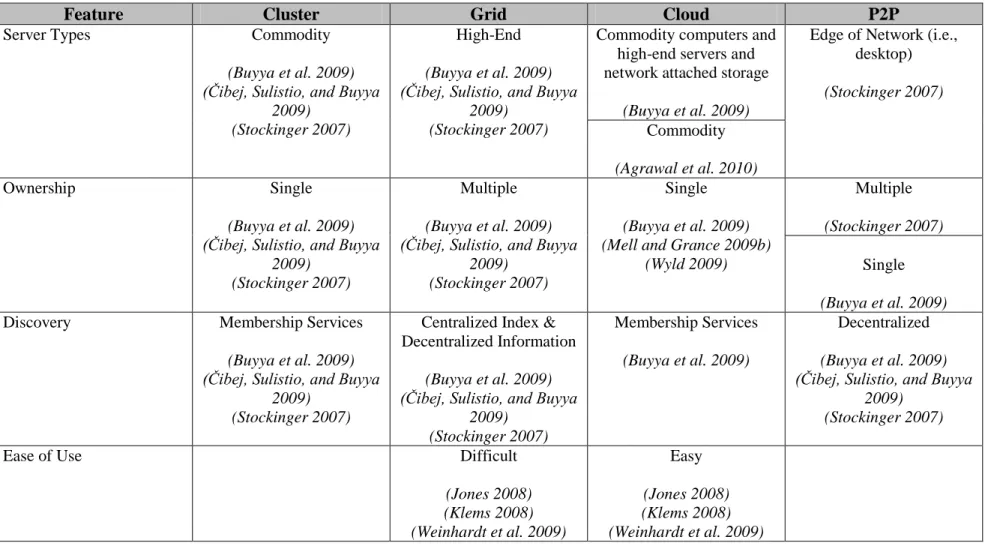
Table 1 - Comparing Cloud to Related Architectures, by Feature and Source ... 89
Table 2 - Yin's Criteria for Selecting Research Design ... 100
Table 3 - States That Meet the Selection Criteria ... 106
Table 4 – Project Research Questions Mapped to Chapter 4 Section Headings ... 123
Table 5 - In-Interview Frequency of Conversational Use of the Stub “Record,” by Occupation ... 155
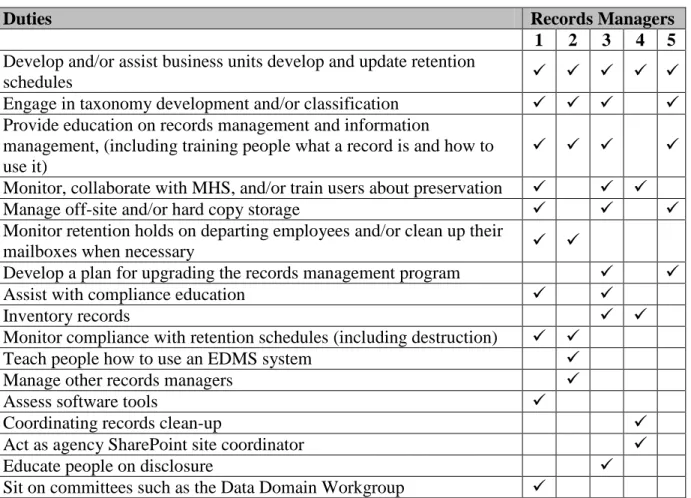
Table 6 - Self-Described Responsibilities of MN Records Managers ... 160
Table 7 - Employee Concerns Regarding the New Cloud Computing Service ... 166
Table 8 - Status of BioSense 2.0 Jurisdiction Onboarding, July 2013 ... 187
Table 9 - BioSense 2.0 Minimum Set of Shared Data Elements (ISDS 2011, 56-65) ... 199
Table 10 - Reported ARM Functions ... 258
Table 11 - Cloud Recordkeeping Risks Reported in ARM Literature ... 263
Table 12 - Reported Occupations of Record Recordkeeping Stewards, with Interviewee Occupation and Case(s) ... 267
Table 13 - Steward Performance of Tasks within ARM Functional Area ... 278
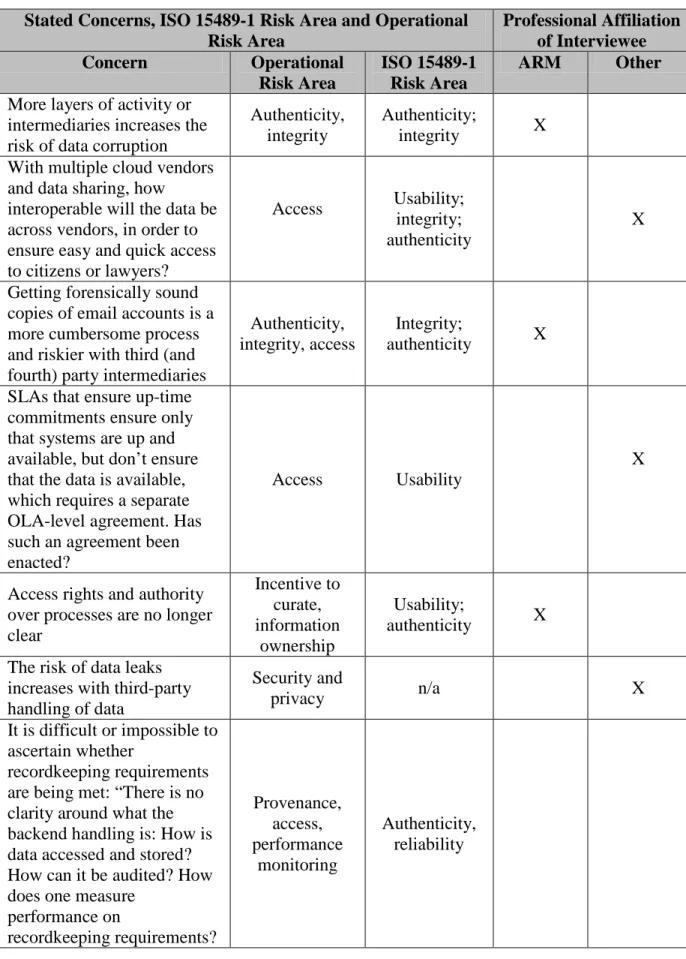
Table 14 - Comparison of Interviewee Reports with ARM Literature Reported Risks ... 294
Table 15 - Interviewee Concerns Missing from ARM Literature... 295
Table 16 - Similarities and Differences between Cases ... 341
LIST OF FIGURES
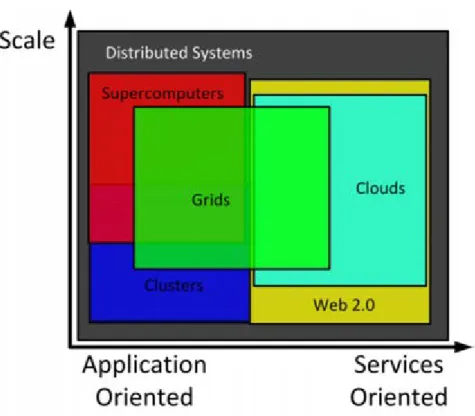
Figure 1 - Computation Systems Compared (Foster et al. 2008) ... 82 Figure 2 – Organizational Location of Stewards in Minnesota’s Microsoft Cloud ... 169 Figure 3 - BioSense 2.0 Information Providers and Data Warehouse (Kass-Hout, Barr,
and Alletto 2012) ... 215 Figure 4 - Functions Attributed to ARM Personnel More than Five Times in ARM
Journal Articles, 1970-2010 ... 255 Figure 5 - Respondents' Reported Risks and Concerns about Cloud Computing ... 292
LIST OF ABBREVIATIONS
A29 DPWP Article 29 Data Protection Working Party ACL Access Control List
AICPA American Institute of Certified Public Accountants ARM Archives and Records Management
ARPA Advanced Research Projects Agency
ARMA Association of Records Managers and Administrators ARRA American Recovery Reinvestment Act
AST Adaptive Structuration Theory
ASTHO Association of State and Territorial Health Officials
AWS Amazon Web Services
BCS Bureau of Computer Services
BT Bioterrorism
CCUCDG Cloud Computing Use Case Discussion Group CDC Centers for Disease Control
CFR Code of Federal Regulations
CIITS Continuous Instructional Improvement Technology System CIO Chief Information Officer
CISO Chief Information Security Officer CJIS Criminal Justice Information System
CO2 Carbon dioxide
CoSA Council of State Archivists
COT Commonwealth Office of Technology CRM Customer Relationship Management CSP Cloud Service Provider
CSTE Council of State and Health Officials CSV Comma-separated values
DCC Digital Curation Centre
DFEH Department of Fair Employment and Housing DGS Department of General Services
DHHS Department of Health and Human Services DoD Department of Defense
DoT Department of Transportation DPH Department of Public Health
DTI Department of Technology and Information DTS Department of Technology Services (Utah)
DUA Data Use Agreement
EASC Enterprise Architecture and Standards Committee EC2 Elastic Compute Cloud
EOC Emergency Operations Center HER Electronic health record
EUCC Enterprise Unified Communications and Collaboration FBI Federal Bureau of Investigation
FCCSET Federal Coordinating Council for Science, Engineering, and Technology FIPS Federal Information Processing Standards
FISMA Federal Information Security Management Act FOIA Freedom of Information Act
GARP Generally Accepted Recordkeeping Principles GigaPOP Gigabit network points of presence
GIS Geographic Information System GSA General Services Administration HEAA Higher Education Assistance Authority HHS Health and Human Services
HIPAA Health Insurance Portability and Accountability Act
HITECH Health Information Technology for Economic and Clinical Health HL7 Health Level Seven
HPCC High Performance Computing and Communications H.R. House of Representatives
IaaS Infrastructure-as-a-Service IBM International Business Machines ICA International Council on Archives
ICD-10 International Statistical Classification of Diseases and Related Health Problems, 10th Revision
ICT Information and Communication Technology ILP Individual Learning Plan
InterPARES International Research on Permanent Authentic Records in Electronic Systems
IPAD Information Policy Analysis Division IRB Institutional Review Board
ISDS International Society for Disease Surveillance ISO International Organization for Standardization IT Information Technology
JISC Joint Information Systems Committee KDE Kentucky Department of Education
KDLA Kentucky Department of Libraries and Archives KETS Kentucky Education Technology Services
KIDS Kentucky Office of Knowledge, Information and Data Services KSIS Kentucky Student Information System
LARM Libraries, Archives, and Records Management LOC Library of Congress
LOINC Logical Observation Identifiers Names and Codes MEEC Maryland Education Enterprise Consortium MHS Minnesota Historical Society
MIS Management Information Systems MOU Memo of Understanding
MPI Master Patient Index
MREN Metropolitan Research and Education Network
MS Microsoft
NACCHO National Association of City and County Health Officials NARA National Archives and Records Administration
NC DETECT North Carolina Disease Event Tracking and Epidemiologic Collection Tool NCSU North Carolina State University
NHPRC National Historical Publications and Records Commission NIST National Institute of Standards and Technology
NPACI National Partnerships for Advanced Computational Infrastructure NPI National Provider Identifier
NUBC National Uniform Billing Committee
OET Office of Enterprise Technology (Minnesota) OMB Office of Management and Budget
OPRR Office for Protection from Research Risks
P2P Peer-to-Peer
PaaS Platform-as-a-Service
PACI Partnerships for Advanced Computational Infrastructure PASS Provenance-Aware Storage System
PCAOB Public Company Accounting Oversight Board PCI DSS Payment Card Industry Data Security Standard PHEP Public Health Emergency Preparedness
PHSIP Public Health Surveillance and Informatics Program PII Personally Identifiable Information
PKI Public Key Infrastructure
POIT Psychological Ownership of Information Theory QoS Quality of Service
REST Representational State Transfer RFP Request for Proposal
RIM Records and Information Management
RMA Records Management Application S3 Simple Storage Service
SAA Society of American Archivists SaaS Software-as-a-Service
SARC State Archives and Records Commission SAS-70 Statement of Auditing Standard 70 SEC Securities and Exchange Commission SERI State Electronic Records Initiative SLA Service Level Agreement
SME Subject matter expert
SNOMED Systemized Nomenclature of Medicine SOAP Simple Object Access Protocol
SOX Sarbanes-Oxley
SSL Secure Sockets Layer
SSRC Southwood Shared Resource Center UNC University of North Carolina
US United States
U.S.C. United States Code
vBNS Very high-speed backbone network service VIA Virtual Interface Architecture
VO Virtual Organization
1. INTRODUCTION
The motivation for undertaking this exploratory study is to gain increased
understanding of how new technologies affect the theory and practice of archives and records management (ARM) in complex organizational settings. The specific goals of this study are to examine how recordkeeping stewards who work in state government or alongside other state government recordkeeping stewards in cloud computing environments perceive and act upon electronic recordkeeping requirements in the Cloud, to understand which of the
functions of ARM work described by ARM academic literature occur in the recordkeeping environments examined, and to determine whether these functions are performed by ARM workers or by other recordkeeping stewards when they do occur.
1.1.Background
In the past forty years, archives and records management researchers have paid a great deal of attention to the effect of new computing technology on ARM functions,
capabilities, and roles and responsibilities. As early as the late 1960s members of the Society of American Archivists engaged in conversations about the potential impacts of automatic data processing and information retrieval technologies (Brown 1984). Discussions of computing technologies from that point onward focus on a wide variety of technical, theoretical, and social dimensions influencing how technology affects the archives and records management profession. For example, in the 1970s, Evans and Gustafson admitted to the “possibility” that computers may someday have a role in archival operations (1975),
while Hickerson, Winters, and Beale spoke of the actual role of automated indexing in archival practice (1976). By the 1980s, a number of computer-based records management systems and automated indexes had been built in the United States and other countries; one can see descriptions of many of these projects in each issue of the journal The American Archivist throughout the 1980s, in its regular section called “The International Scene: News and Abstracts.” Although the articles specifically referencing computer technology in the 1970s were for the most part practical and although this pragmatic trend continued into the 1980s, a number of researchers began to question the ways in which technology would change the nature of archives, the roles and responsibilities of the archivist, and archival theory and concepts (Bearman 1989a; Ham 1981, 1984; Cook 1983; Lytle and Dürr 1980; Burke 1981; Weldon 1983; Jimerson 1989; Peterson 1984) during the latter decade.
During the 1990s the ongoing presence of computerized technology had largely become accepted as a lasting component of archival practice, albeit still somewhat problematic from technical (Martin 1994; Weissman 1994; Curtin 1990; Pederson 1990; Greenberg 1998; Cox 1990), managerial (Tibbo 1995; Curtin 1990; Hedstrom 1991;
Bearman 1992; Gilliland-Swetland and Hughes 1992), educational (Gilliland-Swetland 1993; Henry 1993; Kesner 1993; Ruller 1993; Walch 1994), political (Elliott 1990; Lyman 1994; O'Toole 1994; Lubar 1999), legal (Brown 1995; Piasecki 1995; Kahin 1988), social
(Lockwood 1990), and theoretical (Hedstrom; Stielow 1991; O'Toole 1993; Bearman 1995) perspectives. In 1993, Victoria Irons Walch conducted a study which combined Everett Roger’s theory of diffusion of innovation (1983) with Houle’s analysis of professional work settings (1970) to conclude that the archival profession had by then reached Roger’s “early majority” stage in relation to the automation of their activities, a point at which members of
the occupation could be expected rapidly to accept new technologies and to begin demanding assistance in using them.
During the 1990s and 2000s, some researchers began to place more emphasis on the need to build theoretical structures to understand better the relationship between archival theory and practice and changing technologies. For example, Margaret Hedstrom (1991) argued early in the decade that archivists “need a framework for research on electronic records issues” (1991, 334) and that “research on electronic records issues spans all archival functions and may challenge basic archival theory and practice” (335). She recommended a more interdisciplinary and theoretical research agenda for understanding the role of
technology in ARM theory, urging researchers to pay close attention to research
methodology and pointing out that the term “technology” is very ambiguous. Frederick Stielow argued that the nature of electronic records requires archivists to “anticipate a restructuring of descriptive theory” (1992, 335). In 1996, Elizabeth Yakel made a strong argument that archivists could use the work of organizational theory to gain a “more sophisticated view of organizational processes,” and by doing so, gain a greater
understanding of the “role of records and recordkeeping systems in organizations” (454). Yakel, in fact, provided such an analysis in 2001, when she examined the changing nature of records and records management roles and responsibilities as radiological records moved from analog to digital formats (2001). Terry Cook had already revived interest in the Australian continuum theory (Cumming 2010) with his well-known article “Electronic Records and Paper Minds” (1994). He predicted that by moving from a textual to an
electronic environment, archivists would need to accept a new paradigm that focuses not on the record, but on the act of recording; not on the content, but on the context. For the most
part, within these discussions the focus was on dichotomies between a “paper” (or “analog”) world and an “electronic” (or “digital”) world and between the practices required to maintain and preserve paper records and those required to maintain and preserve electronic records. The continuum theorists argued that archivists must move beyond thinking of archives (and especially, the arrangement and description of archives) using the old physical models and begin to think about their activities in logical terms, distinguishing between “physical” and “logical” similarly to the way data modelers conceive of the physical design versus the logical design of databases.
By the 2000s, authors such as Fiorella Foscarini (2012) engaged in studies that accept electronic, or often, hybrid1, environments as the norm, and attempt to understand more about the theoretical frameworks and constructs that guide electronic recordkeeping environments. With the apparent convergence of traditional records management into a mixed activity that involves general management, records and information management (RIM), and information science concepts (Yusof and Chell 1998, 1999, 2002; Ryan 2006; Benfell 2007), new questions about the role of the records manager and the nature of the record have surfaced. If it is no longer the case that the records manager should handle only current, active records, in contrast to the archivist, who handles the inactive, preservation-worthy records, is there in fact (or should there be) a convergence between the two occupational fields?
One difficulty involved in answering this question rests upon the varying contexts within which recordkeeping activities occur. Functionally, the goals of an archives or digital 1
The term “hybrid” is used differently among different academic and professional domains. Here the term is being used in the sense typically used in archives and records management, where a hybrid environment is one which includes both electronic records management and paper-based records management within the same work environment.
repository that is aimed at collecting and preserving already-created records for the long-term appear to be different from those of a complex organization which creates records to enable the tracking of transactions but which does not consider records to be the primary component of its mission. Likewise, different organizations structure their information technology (IT) functions quite differently, thereby requiring a variety of different types of relationship-management activities, depending upon whether IT is managed in a centralized, a decentralized, or a hybrid environment2, and whether shared services occur across organizational boundaries.
However, although the ARM literature is full of speculation regarding the theoretical and practical impacts of computerized technology on ARM theory and practice, only one article between 1970 and the present can be found that explicitly discusses the potential changes that evolving enterprise IT architectures will bring (Weissman 1994).3 In this article Weissman discusses changes that could be wrought by the advent of object-oriented
programming, increased use of relational databases, and greater network connectivity, suggesting that archivists will increasingly need to become “information-engineering experts” (34). Moreover, since publication of that article in 1994, technological
environments have evolved even more and the days when relational databases and object-oriented programming were ARM workers’ only technical challenges may well be
characterized as “the good old days.” For example, cloud computing represents an emergent 2 Here the term “hybrid” is used as it is used in organizational management, where a hybrid environment is one in which the IT work is managed neither in a centralized way nor a decentralized way but rather, with some elements of work managed centrally and some managed by local business units themselves.
3 One could appropriately argue, however, that the work of the Monash Clever Recordkeeping Metadata
(CRKM) project, which is geared toward automating metadata creation and sharing metadata between business systems, current recordkeeping systems and archival systems also addresses the issue of new enterprise IT architectures, although it does not explicitly present this as a goal. Rather, it focuses on its ties to records continuum theory (Evans, McKemmish, and Bhoday 2004; Evans, Reed, and McKemmish 2008).
technology that may require radical changes in ARM activities beyond the question of whether recordkeepers handle paper or electronic documents, or think with “electronic minds” (Upward 1996).
In addition, with the exception of continuum theorists (Hurley 1995, 2011; Iacovino and Reed 2008; Reed 2005; Upward 1996, 1997; Upward and McKemmish 1994) and some proponents of digital curation ((DCC) 2010; Beagrie 2006; Lee and Tibbo 2011; Tibbo and Lee 2012), previous studies have often characterized ARM functions in a manner suggesting that they are performed by a specific and readily-identifiable set of practitioners (“archivists” or “records managers”), whose functional responsibilities are clearly defined within
relatively well-bounded organizations or collaboration agreements. Within much archival literature, the focus of activities naturally tends to be on the archival functions, and authors assume that records management is merely a necessary component of good archival practice with goals that are subsumed by the needs of the archival practice (Yusof and Chell 2002). Other researchers have noted that within the archival literature, there appears to be a separation between archives and records management (Cox 2000b), with many records management articles expressing a RIM, or corporate orientation (Kim and Lee 2008). Yusof and Chell (2002, 55-56) argue that this is because records management as a field has derived from several different “streams of thought”: archival theory, information science, and
management information systems (MIS).
This study will show that in complex organizations which have a primary goal that is not long-term preservation, not only has the distinction between the work of the records managers and the archivists already begun to disintegrate, but the activities that have traditionally been associated with archives and records management are dispersed among a
variety of occupational groups. This has created potential issues with data and process ownership that places the goal of ensuring that records-related accountability continues to occur within these organizations at risk. It also points to the need to examine the actual changes in the roles and responsibilities of recordkeeping stakeholders within organizations using new technologies in order to clarify the ways in which changing practices and
expectations may need to be reflected within ARM theory and practice.
This study addresses gaps in previous literature in two ways. First, the study
examines the actual environments of workplaces that are not archives4 ̶ the recordkeeping stewards interviewed either work within state governments or collaborate with others who work in state government. The study highlights a range of electronic recordkeeping practices within those organizations. Second, the study examines an emerging technology (i.e., cloud computing) that has rarely been examined in the ARM literature with respect to its impacts on ARM theory and practice5 in actual organizations. By painting a picture of actual
recordkeeping environments using cloud computing, the study examines how this emerging technology places stress upon academic depictions of the work of archives and records management, and points toward areas of research that need to be examined in order to ensure that the theoretical work in archives and records management remains consistent with the continually evolving technological environments that organizations face.
4 Here I use Barbara Reed’s definition of an archives as “an organisation or part of an organisation not immediately connected to the creation and management processes of the records which is deemed responsible for the continued management and preservation of a selection of records” (Reed 2005).
5 Two exceptions exist in academic literature: Askhoj, Sugimoto, and Nagamori (2011) attempt to show the inadequacy of the Reference Model for an Open Archival Information System (OAIS) for cloud computing environments and to construct a layered model that is relatively consistent with the OAIS model, except for relying on services rather than entities. Also, Stuart and Bromage (2010) investigate some of the risks of cloud computing for records management, although they tend to blur the distinction between activities on the World Wide Web and cloud computing and also mistakenly conflate cloud computing with third-party storage or application hosting.
1.1.1. Why cloud computing?
Cloud computing is a form of information technology (IT) provision that treats computing as a set of services that can be purchased on-demand through networks. Individuals and businesses can thereby use the amount of service they want to use without having to make large infrastructure investments that may lead to idle resources when computing needs are lower than maximum capacity. This arrangement allows computing infrastructure, hardware, and software to be treated as largely modular services that can be scaled up and down easily and with minimal ongoing interaction and negotiation with one’s computing resource provider. This arrangement also allows organizations to minimize the number of information technology professionals necessary to meet the IT needs of the organization.
Cloud computing has become associated with the notion of economic sustainability in a number of IT circles. Because it allows organizations to make use of large amounts of computing power without having to make correspondingly large capital investments in IT infrastructure (Creeger 2009), numerous organizations have found shifting to “the Cloud” to be both cost effective and operationally straightforward. Some have even argued that the movement to the Cloud is an inexorable, overarching shift from one mode of industrialization to an entirely new mode (McAfee 2009), similar in nature to the shift from steam power to electrical power during the late nineteenth and early twentieth centuries (Carr 2008).
The Obama administration has made cyber-infrastructure in general and cloud computing in particular key priorities for the federal sector (InformationWeek 2009). In September 2009, the federal government announced its “Cloud Computing Initiative,” outlining both the rationale for the initiative and some of its key components, such as its major characteristics, its delivery methods, and its deployment models (Lewin 2009). In May
2010, then first Chief Information Officer (CIO) of the United States of America Vivek Kundra published a report on the state of public sector cloud computing, describing thirty high-profile implementations that were in place or in process (Kundra 2010). Kundra has since left his position as the U.S. CIO, but new U.S. CIO Steven VanRoekel announced very early in his tenure that he intended to continue Kundra’s “Cloud First” policy (proofpoint 2011), which requires federal agencies to evaluate “safe, secure cloud computing options” before making any new investments (Kundra 2011, 2). Since that time, VanRoekel has reported,
With our Cloud First initiative, agencies identified 79 services to move to the Cloud in order to reap savings and service improvements. This year, agencies successfully migrated 40 services to the Cloud and were able to eliminate more than 50 legacy systems in order to save taxpayer dollars while expanding capabilities. As part of this effort, agencies created six services in the Cloud that they weren’t previously able to provide (2011).
In late 2011 the U.S. General Services Administration (GSA) launched the FedRAMP (GSA 2012), “a standardized approach to security assessment, authorization, and continuous monitoring for cloud products and services which every agency will be required to use” (VanRoekel). In addition, in 2012 the CIO Council, in conjunction with the Chief
Acquisition Officers’ Council, published a set of best practices for agencies acquiring cloud computing services (2012).
An examination of the websites of state governments in the United States (US) shows that at least three-quarters of all states have adopted cloud computing or are in the process of adopting cloud computing within one or more of their state-level agencies (excluding basic website hosting services). For example, Wyoming has shifted the email of all of its
approximately 10,000 state government employees to Google Apps for Government, “putting them on a single email platform for the first time” (Office of Governor Matt Mead 2011).
Minnesota implemented Microsoft Office 365 to deliver the state’s Enterprise Unified Communications and Collaborations services (MN OET). New Jersey’s Transit Authority implemented an on-demand, cloud-based customer relationship management (CRM) service from Salesforce.com, allowing it to handle more than five times the number of customer inquiries than it had before implementing the service. The transit authority’s response time reportedly dropped by more than 35 percent, and its productivity increased by 31 percent (Kundra 2010). The State of Utah implemented a hybrid6 solution that uses an internal private cloud (Towns 2009) in conjunction with Force.com for CRM, Google Earth
Professional for shared Geographic Information System (GIS) planning, and Wikispaces for self-provisioned wikis. These contracts are managed centrally through the state’s Department of Technology Services (DTS). Initial estimates suggested that Utah, which has an IT budget of $150 million per year, will save four million dollars per year as a result of moving to the Cloud (Kundra 2010).
However, if cloud computing sometimes seems straightforward from the point-of-view of IT costs and service provision, its benefits for records management are murkier. The U.S. National Archives and Records Administration (NARA) has suggested that agencies should be aware of the potentially adverse effects of cloud computing on records
management work (2011). NARA noted that some cloud architectures “lack formal technical standards governing how data is stored and manipulated in cloud environments,” thereby threatening the long-term trustworthiness and sustainability of the data. In addition, a lack of portability standards might make it difficult to dispose of or transfer records in accordance
6 This is yet another disciplinary-specific use of the term “hybrid.” Here, “hybrid” refers to a cloud computing implementation which includes both a public cloud and a private cloud jointly. The organization thus provides and manages some cloud computing resources in-house and some externally.
with recordkeeping requirements. ARMA International pointed out that a wide range of potential records management risks are associated with cloud computing, such as the potential failure to meet recordkeeping regulatory requirements, jurisdictional issues regarding data storage, vendor continuity concerns, lack of clarity surrounding data
ownership, and interoperability challenges (2010). Although some vendors are beginning to produce records management applications that can be integrated with cloud computing services (Miller 2011; Alfresco 2011; SpringCM 2011), state government professionals must be diligent to ensure that their agencies adopt appropriate records management policies and procedures when cloud computing services are contracted in order to satisfy state and federal recordkeeping requirements.
As threats to the long-term trustworthiness and sustainability of data, the risks that NARA and ARMA International associate with cloud computing strike at the heart of ARM goals. Richard Cox argued that records management exists to “support accountability, the protection of crucial evidence, and the nurturing of corporate memory” (2001, 13). He pointed to records’ role in ensuring organizational accountability and providing evidence of organizational transactions and decisions. Likewise, Anne Gilliland-Swetland (2005), examining the development of a research agenda for electronic records management, noted that since the late 1980s ARM professionals have largely accepted that recordkeeping as an activity is geared toward ensuring the evidentiary quality of records. The international recordkeeping standard ISO 15489-1, which “provides a framework for any organization, public or private, to adopt and use to manage its records, irrespective of the medium on which they are created, captured and maintained” (McLeod 2003), adds that in addition to providing evidence and ensuring its accountability, an organization has the responsibility to
manage its records so that it can support the continuing conduct of its business and remain compliant with its regulatory requirements. To do this, ISO 15489-1 says an organization must “create and maintain authentic, reliable and useable records, and protect the integrity of those records for as long as required” (ISO 2001, 6). Both the Society of American
Archivists (SAA) code of ethics (2012) and the ARMA International code of ethics (2011) agree, stating that protecting the authenticity, integrity, and accessibility of records is a key ethical and professional responsibility of ARM workers. Thus, to the extent that cloud computing presents a risk to an organization’s ability to effectively manage and maintain its records, it threatens the goals of the organization’s ARM professionals.
In addition, as will be seen in the next chapter, cloud computing represents a new and unfamiliar technology for most recordkeeping professionals, increasing the risk that lack of knowledge about the nature of the technology will lead workers to overlook some of the procedures in which they should engage when attempting to ensure the authenticity of records over time or fail to address all of the potential risks that inhere in this technological approach.
1.1.2. Why state government?
In order to govern adequately, a government must manage and maintain its records effectively. Authentic, reliable, and accessible records provide the organizational memory necessary for the government to fulfill its mission legally and effectively. Moreover, they provide the accountability and evidence that assure the public that the government is doing its job legally and effectively. The Council of State Archivists (CoSA) describe a number of reasons why state governments must ensure that they maintain authentic, reliable, and accessible records (2007):
• Government records are essential to protect life in the case of disaster. They provide the means for rescue workers to find and save lives and for rebuilding necessary infrastructure when destruction has occurred.
• Government land records protect property by proving “ownership, boundaries, and other essential information for home and business owners” (11) and provide proof of inheritance, property distributions, and educational attainment.
• Government records document and verify the rights of individual citizens such as “the right to vote (voter registrations), the right to government services (military service records, birth records, employment records, education records), and the right to justice (court records, criminal justice records)” (11).
• Government records document the rights of communities and groups, including “civil rights (employment regulations, laws, court records), community welfare (land records, transportation records, public health records), and civil protection (military records, criminal justice records)” (11).
• Government records document the “transactions, decisions, and precedents” (12) of government activities, allowing the government to maintain its operations on an ongoing basis and providing accountability to citizens.
• Government records provide citizens with a “sense of community, a sense of
belonging, a sense of place,” (12) by maintaining their accessibility to the temporally structured and geographically bounded artifacts that link them together as a
community.
Although theoretically a government could do a good job of managing and maintaining its records and still fail to perform its mission or sustain legitimacy with the
populace, it cannot provide assurance that it is performing its mission or acting legitimately without authentic, reliable and accessible records. Thus, to the extent that cloud computing poses risks to government’s ability to effectively manage and maintain its records, it threatens the legitimacy and effectiveness of government itself.
However, no research has previously examined in detail the ways in which a cloud computing adoption will impact the nature of recordkeeping work within state agencies. In fact, since Ernst Posner’s (1964) survey of state agency ARM programs in the early 1960’s, no detailed examination of state ARM work has occurred at all, with the exception of the Council of State Archivists’ (CoSA) report “The State of State Records” (2007) and their recent State Electronic Records Initiative (SERI) Report (CoSA SERI Committee 2012). Posner’s study examines only the structure of the state ARM programs, providing
information about the structure of the various state programs, their budgets during the period studied, and state laws that govern the disposition of records. It does not offer a detailed examination of recordkeeping functions within any state, nor does it describe technological systems used for ARM purposes (as would be expected, given its publication well before electronic recordkeeping became common). The CoSA State of State Records report provides updated state archival program information, but again, this report focuses on ARM programs themselves, offering more general knowledge about funding arrangements, program
structure, and holdings. Because the report aims to provide a comprehensive understanding of state government archival programs throughout the U.S., it does not delve into a detailed examination of the relationship between recordkeeping functions and the sociotechnical systems within which those functions reside. The SERI report focuses upon the status of state electronic records programs within the fifty states, but does not examine detailed roles and
responsibilities of recordkeeping workers. It concludes that the total holdings of electronic records held in state or territory archives “… represents only a fraction of the total volume of electronic records with long-term value held in state and territorial governments’ agencies and offices that will or should come to the archives” (13). This underscores the need for deriving a greater understanding of what types of electronic recordkeeping activities are actually occurring in those agencies and offices. In addition, the primary interviewees of the SERI report are state archivists, and the report takes as a given that the preservation-worthy electronic records should all be transferred to the state archives (2012, 13). This assumption has been rejected by records continuum theorists, and thus is open to examination by this study, which seeks to understand better the relationship between the actualities of state electronic recordkeeping and the underlying assumptions of ARM theory. Indeed, this finding presents a question regarding whether it could even be possible to achieve such a transfer of all preservation-worthy electronic records to state archives or statewide records management programs, especially given increasing use of IT practices such as shared services and cloud computing. Furthermore, the lack of systematic, empirically grounded research on state recordkeeping work presents a serious gap for those interested in
understanding how a new technological arrangement such as cloud computing affects existing electronic recordkeeping activities within state government.
1.2.Research Questions and Methods
As mentioned earlier, the specific goals of this exploratory study are to examine how recordkeeping stewards who work in state government or alongside other state government recordkeeping stewards in cloud computing environments perceive and act upon electronic recordkeeping requirements in the Cloud, to understand which of the functions of ARM work
described by ARM academic literature occur in the recordkeeping environments examined, and to determine whether these functions are performed by ARM workers or by other recordkeeping stewards when they do occur.
Several research questions have informed the investigation reported here:
• Within the environments examined, what occupational groups are reported to act as key stewards of the information and how do members of these groups perceive and act upon recordkeeping requirements in the Cloud?
• How do the various stakeholders interact with each other with respect to
recordkeeping activities within their cloud computing environments, and what do these relationships suggest about how ARM occupational roles and responsibilities are being handled in cloud computing environments?
• How do the various stakeholders perceive the roles and responsibilities of archives and records management personnel?
• What cloud computing risks does the professional and academic ARM literature report, and do recordkeeping stewards in state government cloud environments express concerns about these same risks?
• Of the main recordkeeping functions that the ARM literature attributes to ARM workers, are these functions evident in the recordkeeping environments examined and if so, are they performed by ARM workers?
The project described here uses an interpretive strategy and a multiple-case study research design. Data collection methods include semi-structured interviews conducted with a wide set of state and federal government personnel, private consultants, and representatives
of professional organizations,7 the collection of internal and published state government documents, and an examination of 682 published articles from six ARM journals over a 42 year period. Data analysis uses the constant comparative method from Grounded Theory and documentary content analysis. Final reporting is presented within the framework of
Structuration Theory. The results of the individual components of the overall study are triangulated to develop the study’s conclusions.
Chapter 2 reviews in more detail the literature on how ARM professionals have characterized the effects of new technologies – specifically, computerized technologies – on ARM theory and practice, focusing on ARM roles and responsibilities and key constructs from ARM theory, theories about the effects of new technologies on occupational roles & responsibilities, and cloud computing as an emerging technology with direct impacts on organizational recordkeeping. Chapter 3 describes the methods used in this study. Chapter 4 discusses the results of the documentary analysis and multiple case study, considering each case separately, and then comparing and contrasting findings across all cases and interviews. Chapter 4 also analyzes these results in light of the five research questions given above. Chapter 5 discusses the implications and importance of this research and offers suggestions for future research.
7 The professional organizations were the National Association of State CIOs (NASCIO) and RTI International.
2. LITERATURE REVIEW
Over the past fifty years archivists and records managers have been facing a continual onslaught of new and previously unfamiliar technologies for handling their information. These new and emerging technologies can influence their work in a variety of ways. To understand the impacts of a given technological adoption on a specific set of workers, however, one must understand who these workers are, why they engage in the activities in which they engage, and how these activities and reasons for engagement impact and are impacted by the new technology. This literature review provides the core concepts and empirical understandings that situate this study. It provides a framework deriving from technology- and work-related research in multiple disciplines, offers a historical and conceptual examination of the occupational commitments of ARM workers, and discusses cloud computing as a new and emerging technology.
2.1.The Work Environment
2.1.1. Work in Complex Sociotechnical Systems
Work environments are social systems which exhibit varying degrees of complexity. When an organization brings technology into the work environment, workers enact that technology and social relations simultaneously, creating non-random, yet not entirely predictable, outcomes (Orlikowski 2000). Within such a system people and technology combine to create products or services jointly. To understand the outcomes that result when a new or emerging technology is introduced, one must consider both the human element and the technical elements jointly, considering the requirements of both for engaging in
directed work and understanding how these two elements interact (Fox 1995). One must also understand the wider historical and environmental structures that shape human action durin the performance of work (Orlikowski and Robey 1991). In fact, one can consider a
computerized work environment to be a “sociotechnical system,” if one uses that term in a broad sense to indicate that human action, work context, and technology interact together to influence outcomes (Dillon 2000).
Sociotechnical systems tend to be complex. Vicente (1999, 13-16) highlights the characteristics of a complex sociotechnical system.8 All complex sociotechnical systems will exhibit some or all of these elements. However, the degree to which any given feature is exhibited will vary across types of systems. As he points out, the characteristics defining a nuclear power plant are significantly different from those defining a small office
environment.
A complex system, according to Vicente, tends to reflect a large problem space in which numerous elements interact so that it is difficult (or even impossible) for people within the system or external to the system to enumerate all the key variables that influence the operation and the outcomes of behavior within the system. Likewise, such systems are social in nature, requiring significant human-to-human and human-to-technology interaction. Because of the social nature of these systems, they are characterized by heterogeneous perspectives, whereby the people within the system are strongly motivated by different value
8 Since every worker relies upon both discursive and tacit knowledge, the distinction between a sociotechnical system and a non-social system is an analytical distinction rather than an ontological distinction. Even the lone writer uses the language and tacit skills learned while growing up in a social system. Similarly, virtually any enabling artifact could be considered a technology, as far as it requires technê. One can understand Vicente’s cognitive engineering view, however, as one of degree rather than one of kind.
systems. In spite of the difference of values, some degree of coherence occurs through cooperation and competition, governed by tacit and explicit authority mechanisms.
The various elements of complex systems also tend to be distributed, both
geographically and functionally. This can make it difficult to monitor and control the system as a whole without specific mechanisms designed to do so. In addition, the goal-relevant properties of the system tend to be dynamic and often the overall system takes considerable time to reflect change in response to changes in these properties. The whole system will evolve as its properties evolve, but often with a lag in response time.
Complex systems can often be hazardous as well, in that the outcomes of operational errors in the elements of the system or its inability to adjust to changing internal and external factors can lead to harmful outcomes, whether those outcomes be in terms of health and safety, economics, or some other variable. For example, in the realm of nuclear power, Vicente shows how inaccurate mental models of the technical processes led to a nuclear power plant meltdown. Likewise, in the realm of digital curation, human action, machine failure, or human-machine breakdowns can lead to catastrophic data loss. For example, on March 30, 2012, personally identifiable healthcare information of more than 750,000 Utah citizens was stolen when the computer system on which it resided was allowed to retain its out-of-the-box (i.e., “default”) password by a systems administrator (Towns 2012; Henetz 2012; Gibson 2012; Utah Department of Health 2012).
Complex sociotechnical systems are generally composed of yet other systems which are coupled in a variety of configurations themselves. In other words, they are often systems of systems (Ackoff 1971). Because of the complexity of the interactions between all of the components and participants, it is generally difficult or impossible to predict fully the
outcomes of changes in these interactions or to predict the effects on the whole system when a single significant change occurs in one of the component systems. This is because of the large number of possible interaction effects that can occur and because it is not always possible for any given individual to disentangle all of the different ways in which the component systems are coupled. Moreover, because such systems comprise human agency, where agency is defined as “the capability of engaging in action” (Giddens 1984), choice regarding how people will use the technology cannot be fully predicted; thus, the overall impacts of a group of interrelated agents may engender unanticipated consequences. “People adapt systems to their particular work needs, or they resist them or fail to use them at all; and there are wide variances in the patterns of computer use and, consequently, their effects on decision making and other outcomes” (DeSanctis and Poole 1994, 122).
In addition, complex systems are often highly automated, with machinery or computerized technology performing many of the detailed operations, and use of the
technology involving mediated interaction with it. For example, computer interfaces may be used by people in order to present to the people the relevant variables to which they must direct system inputs in order to perform their goal-directed activities.
Finally, complex sociotechnical systems are often characterized by a tendency toward disturbances, where a disturbance is an unpredicted factor that influences the operation of the whole system. For example, financial institutions are prone to economic shocks in the form of unanticipated resource depletion (such as an earthquake influencing supply lines), or external funding resources suddenly drying up due to political shocks (Vicente). Because of this tendency toward disturbances, it is desirable that the system be prepared to respond to unanticipated factors that directly affect some or all of its component properties. In an
exemplary system, people and machines will react flexibility and appropriately to unpredictable shocks.
2.1.2. The Structuration of a Social System
Until now, the term “system” has been used as it is used in everyday speech. As a common language habit, there is nothing particularly problematic with this; we often talk about living “in” social systems, as if the system itself is some sort of structure or thing that exists independently of our membership in it. However, this approach to defining systems creates conceptual problems when used theoretically. By treating a social system as if it has some sort of independent existence apart from the people within it, one reifies9 the concept in a manner which makes it seem as if social reality and physical reality are two entirely
separate, concrete entities. Such treatment has caused numerous arguments over whether social reality is really “real,” whether it is “socially constructed,” or whether there is such a thing as a so-called “objective” reality, and has led to a theoretical inability to explain how the two different aspects of our existence (i.e., subjective and objective, or ideal and material) can act upon each other at all.
In order to reconcile this dualism, sociologist Anthony Giddens treats systems as “reproduced relations between actors or collectives, organized as regular social practices” (25). Structures are “rules and resources, or sets of transformation relations, organized as properties of social systems” (25). Giddens examines the ways by which social systems are reproduced via a recursive process in which the structures that mediate human action are simultaneously reproduced by that action. Thus human action and structures are not separate phenomena but rather, are co-constituted when agents engage in interaction via structures of 9 I use the term “reify” in this paper in its philosophical sense of treating an abstract concept as if it has concrete existence. This is in contrast to other senses that have been adopted, for example, in computer science or natural language theory.
signification (i.e., interpretive schemes), structures of legitimation (i.e., norms), and structures of domination (i.e., facilities). In other words, when humans interact with each other and the world, the interaction “implies the interlacing of meaning, normative elements and power” (28-29) and it is within these routine10 interactions that structure comes into being. Structure is thus in a constant state of becoming. Social systems, of which structures are properties, are reproduced as a result of human action yet the acting individuals view the systems as constraining that action. Since human agency allows choice with respect to taking particular actions at any point in time, and since humans may engage in actions that have unintended impacts on the world, the social system not only reproduces but also evolves with changing purposes and as a result of unintended interaction effects. This leads to
modifications in the structure of society over time.
Giddens’ original Theory of Structuration is generally considered a “meta-theory” in that Giddens does not attempt to explain in detail all the micro-relations in the behavior of individual people or in organizational behavior. Rather, he elaborates how society and its members co-evolve through human agency. In addition, he does not discuss technology per se, but several organizational theorists use his theory to discuss the micro impacts of
technology on organizational structure (Barley 1986; DeSanctis and Poole 1994; Orlikowski 1992, 1996, 2000; Orlikowski and Barley 2001; Orlikowski and Robey 1991; Orlikowski and Yates 1994). For example, Barley examines the ways in which CT scanners affect the
organizational and occupational structures of radiological work, treating technology as a social object. Orlikowski criticizes this conception, noting that while it may be appropriate
10 Giddens used the notion of “routine” to indicate that when people act and interact they rely upon both tacit and discursive knowledge. He made a point of noting that the tacit element of our knowledge, that which he called “practical knowledge,” provides a frequently underestimated impact on our day-to-day existence.