http://www.ijorl.com pISSN 2454-5929 | eISSN 2454-5937
Original Research Article
Merits of harmonic scalpel over conventional hemostasis in open
thyroid surgery: a randomised controlled trial
Anushree Bajaj*, Bhalchandra Paike, Shahnaz Sheikh, Vikrant Vaze
INTRODUCTION
The pioneers of thyroid surgery, Theodor Kocher and Theodor Billroth, developed an acceptable technique of standardized thyroid surgery between 1873 and 1883. By 1920, the principles of safe and efficient thyroid surgery were already established consisting of three basic phases viz identification and ligation of vessels, identification and preservation of laryngeal nerves, and parathyroid glands.1 The harmonic scalpel was introduced into the surgeon’s armamentarium almost two decades ago. Using mechanical vibrations at 55.5 KHz, this device is able to cut and coagulate tissue simultaneously. The advantages
of using this device over traditional electrocautery include less lateral thermal tissue injury, a lack of neuromuscular stimulation, and the avoidance of electrical energy transmission either to or through the patient.2 It has been claimed that the use of Harmonic scalpel decreases the operative time, complications and bleeding in abdominal surgery, thoracic surgery, parotid surgery and thyroid surgery.3-6 The present prospective randomized trial study was designed to evaluate the efficacy and safety of Harmonic scalpel use compared with conventional haemostasis in open thyroid surgery. The main objectives of the study were the reduction of operative time, postoperative pain and overall drain Department of Otorhinolaryngology, Dr. Ulhas Patil Medical College, Jalgaon, Maharashtra, India
Received: 24 June 2019 Revised: 01 November 2019 Accepted: 05 November 2019
*Correspondence: Dr. Anushree Bajaj,
E-mail: [email protected]
Copyright: © the author(s), publisher and licensee Medip Academy. This is an open-access article distributed under the terms of the Creative Commons Attribution Non-Commercial License, which permits unrestricted non-commercial use, distribution, and reproduction in any medium, provided the original work is properly cited.
ABSTRACT
Background: The pioneers of thyroid surgery, Theodor Kocher and Theodor Billroth, developed an acceptable technique of standardized thyroid surgery between 1873 and 1883. The aim of this prospective randomized trial was to evaluate the efficacy and safety of harmonic scalpel use compared with conventional haemostasis in open thyroid surgery.
Methods: A total of 60 consecutive patients underwent open total thyroidectomy were randomized into two groups. Group A with harmonic scalpel and Group B with electrocautery with 30 patients each. Factors including age, sex, pathology, thyroid volume, haemostatic technique, operative time, drainage volume, thyroid weight, postoperative pain, postoperative complications and hospital stay. The results were analysed using the students t-test and x2. Results: No significant difference was found between the two groups concerning mean thyroid weight and mean hospital stay. The mean operative time was shorter in the harmonic scalpel group. The total fluid drainage fluid volume was lower in Harmonic scalpel group shorter in. Harmonic scalpel group experienced significantly less post-operative pain at 24 and 48 hours.
Conclusions: In patients undergoing thyroidectomy, harmonic scalpel is a reliable and safe tool. AS compared with conventional haemostasis techniques, its use reduces operative times, post-operative pain, drainage volume and transient hypocalcemia.
Keywords: Haemostasis, Harmonic scalpel, Thyroidectomy
volume in thyroid surgery with the use of the Harmonic scalpel.
METHODS
This study was conducted at Dr Ulhas Patil Medical College Jalgaon from January 2017 to January 2018. A total of 60 patients were included in the study. Patients were randomly divided into two groups Group A and Group B including 30 patients each. A detailed ENT examination was done including CBC, thyroid function tests, FNAC, USG neck. In Group A (harmonic focus: HS) patients surgery was performed using harmonic scalpel only (Figure 1) and no other haemostatic tool and in the Group B (CH) surgery was performed using conventional haemostasis tools like the classic technique of tying knots, resorbable ligature, bipolar diathermy electrocautery (Figure 1). The harmonic scalpel setup consists of a generator, a hand piece and a blade. All the patients were signed an informed consent before enrollment in the trial. The patients were divided according to age, preoperative diagnosis, and thyroid size to generate homogeneous groups.
Figure 1: Harmonic scalpel.
Inclusion criteria
Age >18 years; acceptance to participate in the study (signed informed consent form); total thyroidectomy for multinodular goiters or low risk differentiated carcinoma (T1N0M0) were included in this study.
Exclusion criteria
Pre-operative medication including analgesics, corticosteroids or non-steroidal antinflammatory drugs; coagulation disorders; pregnancy; cervical mediastinal goiters; total thyroidectomy with neck dissection in case of invasive cancer; concomittant parathyroid disorders; previous neck surgery; history of neck radiation were excluded in this study.
A total thyroidectomy for benign or malignant low-risk thyroid disease (papillary carcinoma T1N0M0) was performed under general anesthesia and with endotracheal intubation in all the cases. Preoperative
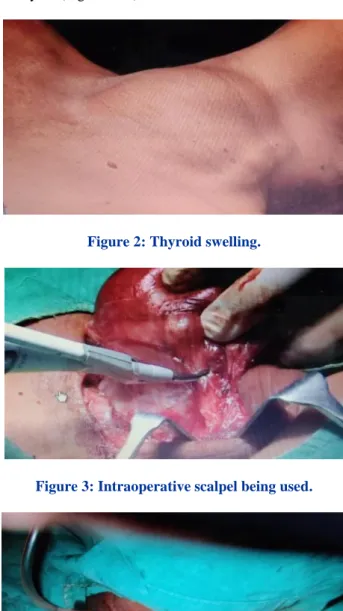
investigations like serum thyrotropin levels, ultrasonography (to evaluate the nodule size and gland volume) and fine needle aspiration cytology was obtained for all the patients. Patients were positioned and draped in the conventional manner. A horizontal neck crease incision was made depending upon the size of thyroid gland. Subplatysmal flaps were developed and strap muscles were separated in the midline and reflected laterally. The inferior, middle and superior thyroid vessels were then divided either with HS or with conventional technique. The thyroid lobe was then medially rotated, and vessels in the ligament of, with the RLN under direct vision were clamped and tied in both the groups. The same steps were repeated for the removal of contralateral lobe. Finally, the wound was irrigated and closed using 3-0 Vycril to approximate the strap muscles and the platysmal layer. The skin was closed using the 4-0 ethylon (Figures 2-4).
Figure 2: Thyroid swelling.
Figure 3: Intraoperative scalpel being used.
The various outcome factors of the study including the operative time, fluid content in the suction balloon (drainage volume) during the first 24 hours after surgery, post-operative pain, hospital stay and the incidence of complications. Suction drainage was used to evaluate the overall amount of blood loss after the procedure and to assess the actual difference between the two groups. Drains were removed 24-48 hours after the ±procedure. Both pre-operative and post op serum calcium levels in all the patients were obtained during the first post-operative day and then once every three weeks. Pre-operative RLN status were determined by indirect laryngoscopy. Pain assessment was analysed according to patient responses to a visual analogue scale and a verbal response scale. The VAS consisted of a printed 10 cm horizontal line anchored by the descriptors no pain (minimum, on the left end of the scale) and worst pain imaginable (maximum on the right end). All the subjects were well oriented with time space and person. VAS was used to assess the level of pain generally 24 and 48 hours postoperatively. Patients were also asked to describe the anatomical location of pain to differentiate surgical incision pain from the non-surgical pain like neck or back pain. VRS offered 5 options: 0 for no, 1for light, 2 for endurable, 3 for strong, and 4 for unendurable pain. Pain was graded by the patients 24 to 48 hours postoperatively. A written informed consent was taken from all the patients.
RESULTS
The results were analyzed using the students t-test and x2 test. A value of p 0.05 was considered statistically significant. The pre-operative diagnosis and demographic characteristics of the patients are highlighted in the Table 1. The mean age in both groups were 47.7 and 52.4 respectively, the diagnosis was simple nodular goiter in Group A and B was 15 and 17, toxic nodular goiter in Group A and B was 9 and 8 respectively, graves’ disease 2 in each group while differentiated carcinoma in 4 and 3 respectively.
No significant differences were found between the two groups concerning mean thyroid weight 42.8±18.7 grams in HS group. 51.1±14.8 grams in CH group, p.0.05) and mean hospital stay (2.0±0.8 days in HS group: 3.9±1.5 days in CH group; p>0.05 as shown in Table 2. The average operative time was significantly shorter in HS group (42.9±7.3 minutes) compared with the CH group (71.5±11.7 minutes) p<0.001 as shown in Table 2. The total drainage fluid volume lower in HS than inch (34.4±3.4 versus 58.1±5.2 resp, p<0.001 as shown in Table 2. Complication rate was observed in both the groups as shown in Table 3.
Table 1: Demographic characteristics and preoperative diagnosis in harmonic scalpel (HS) group and conventional hemostasis group.
HS group (n=30) CH group (n=30)
Age in years (range) 47.7 (20-72) 52.4 (22-71)
Sex (M/F) 8/12 7/13
Thyroid volume (mean±SD) (range in ml) 40.3±12.9 (10-60) 36.8±15.1 (8-59) Preoperative diagnosis simple
Multinodular goiter toxic 15 17
Multinodular goiter graves 9 8
Disease differentiated 2 2
Carcinoma 4 3
Table 2: Operative time, postoperative drainage, hospital stay and thyroid weight in harmonic scalpel group (HS) and conventional haemostasis group (CH).
HS group (n=30) CH group (n=30) P value
Operative time (mean±SD) range in minutes 42.9±7.3 71.5±11.7 <0.001 Postoperative drainage at 24 h (mean±SD) range in ml 34.4±3.4 58.1±5.2 <0.001 Hospital stay (mean±SD) days 2.0±0.8 3.9±1.5 >0.05 Thyroid weight (mean±SD) range in grams 42.8±18.7 51.1±14.8 >0.05
Table 3: Postoperative complications -transient hypocalcemia, definitive hypothyroidism, transient recurrent laryngeal nerve injury and permanent recurrent laryngeal nerve injury in Group 1 (HS) and Group 2 (CH). Post operative complications HS group CH group P value
No one 0 percent had transient RLN palsy in HS group and it was observed in 1.2 cases that is about 4 percent in CH group. No patient developed permanent palsy. Hypocalcemia was defined as a serum calcium level below 8.0 mg/dl. Postoperative transient hypocalcemia occurred more frequently in CH group than in HS group. In the CH and HS groups, about 34 percent of patients and 8 percent of patients respectively, required oral calcium carbonate supplementation postoperatively. All the patients were recovered completely and no definite hypoparathyroidism was reported. According to VAS and VRS scores, less postoperative pain was observed in HS group as compared to CH group. The differences in the VAS scores and the differences in the VRS scores were statistically significant at 24 and 48 hours postoperatively.
DISCUSSION
The harmonic scalpel is a new device that has been introduced to surgery during the last decade uses high frequency mechanical energy to cut and coagulate the tissues at the same time. The denatured protein coagulum that coapts and tamponades blood vessels is the ultimate result of ultrasonic coagulation similar to that of electrocautery despite the mechanism by which the protein becomes denatured is completely different. Both the electrocautery and the lasers form the coagulum by heating the tissues to denature the protein. The harmonic scalpel denatures protein by using ultrasonic vibration to transfer mechanical energy to break the tertiary hydrogen bonds.7 The blade of harmonic scalpel vibrates at 55.5 kHZ over a distance of 80 micrometer cavitational fragmentation and mechanical cutting are at least two mechanisms by which the harmonic scalpel cuts.8 Utilization of harmonic scalpel for total thyroidectomy significantly reduced the operative time as compared to CH techniques by greater than 28 minutes and 29 percent of decreased risk of transient postoperative hypocalcemia. We concluded that not only in HS utilization for total thyroidectomy significantly faster than the conventional approach, with acceptable post-operative complication rates, but it may also protect against the development of transient post-operative hypocalcemia. During thyroidectomy, the dissection, ligation, and division of the major thyroid vessels are time consuming. Statistical analysis showed operative time was shorter in operations where a HS was used to seal the small vessels of the thyroid gland. Operative time was further shortened when HS was used for all of the vessels including main arteries and veins. Bleeding in thyroid surgery can occur from main arteries and veins of the gland, small tributaries, or the gland itself due to inappropriate dissection resulting in ligation and inadvertent traction. United States Food and Drug has approved the ultrasonic HS for the ligation of vessels up to 3 mm in diameter. Thermal damage is limited to 0-2 mm beyond the tissue grasped with in the forceps of the device.9,10 The last generation of the HS is even more appropriate since it is approved for closing the vessels up
to 5 mm of diameter.11 Leonard and Timon in their study concluded that use of a HS was not superior to conventional techniques with respect to operative time, many other studies reported decrease in operative time of between 6 and 78 minutes.12,13 Even in the thyroidectomy with central or lateral neck dissection , the use of HS significantly reduces the operating time.14,15 All the studies reported an increased risk of post-operative hypocalcemia with conventional hemostasis technique, though only one report had a large enough cohort for the association to be statistically significant.16 Transient hypocalcemia observed after total thyroidectomy is believed to be related to traumatization of the parathyroid glands, which are anatomically intimately related to the thyroid gland and share its blood supply. As HS may facilitate dissection of parathyroid glands in a plane farther away from the parathyroid gland capsule, thus reducing the chances of damaging their blood supply, directly or indirectly, with either mechanical forces or electrical currents.
CONCLUSION
The study establishes the conclusion that harmonic scalpel is a very useful device in thyroid surgery with merits over the conventional hemostasis with respect to lesser operative time and lesser postoperative drain amount. Minimal lateral thermal tissue damage, less smoke formation, no neuromuscular stimulation, no electrical energy to or through the patient, mechanical shears are safe, smaller incisions for open surgery, no need of bleeder ligation up to 3-5 mm diameter are other supposed advantages of harmonic scalpel over conventional methods.
Funding: No funding sources Conflict of interest: None declared
Ethical approval: The study was approved by the Institutional Ethics Committee
REFERENCES
1. Becker WF. Pioneers in thyroid surgery. Ann Surg. 1977;185(5):493-504.
2. Roye GD, Monchik J, Amaral JF. Endoscopic adrenalectomy using ultrasonic cutting and caugulation. Surg Technol Inter. 2000;9:129-38. 3. Chamberlain RS, Korvick D, Mootoo M, Story S,
Dubiel B, Sharpnack D. Can harmonic focus curved shear effectively seal the pancreatic ducts and prevent pancreatic leak? Feasibility and evaluation and testing in ex vivo and vivo porcinre models. J Surg Res. 2009;157(2):279-83.
4. Takagi K, Hata Y, Sasamoto S. Late onset postopertative pulmonary fistula following a pulmonary segmentectomy using electrocautery or a harmonic scalpel. Ann Thorac Cardiovasc Surg. 2010;16(1):21-5.
different harmonic scalpels, Eu Arch Oto- Rhinolaryngol. 2009;266(12):1965-70.
6. Karvounaris DC, Antonopoulos V, Psarras K, Sakadamis A. Efficacy and safety of ultrasonically activated shears in thyroid surgery. Head Neck. 2006;28(11):1028-31.
7. Walker RA, Syed ZA. Harmonic scalpel tonsillectomy versus electrocautery tonsillectomy. Comparative pilot study. Otolaryngol Head Neck Surg. 2001;125(5):449-55.
8. McCarus SD. Physiologic mechanism of the ultrasonically activated scalpel. J Am Associ Gynaecol Laproscop. 1966;3(4):601-8.
9. McHenry CR, Speroff T, Wentworth D. Risk factors for post thyroidectomy hypovcalcemia. Surg. 1994;116(4):641-8.
10. Bliss RD, Gauger PG, Delbridge LW. Surgeons approach to the thyroid gland: surgical anatomy and the importance of technique. World J Surg. 2000;24(8):891-7.
11. Markogiannakis H, Kekis PB, Memos N. Thyroide surgery with the new harmonic scalpel: a prospective randomized study. Surg. 2011;149(3):411-5.
12. Leonard DS, Timon C. Prospective trial of ultrasonic dissector in thyroid surgery. Head Neck. 2008;30(7):904-8.
13. Shemen L. Thyroidectomy using the harmonic scalpel: analysis of 105 consecutive cases, Otolaryngol Head Neck Surg. 2002;127(4):284-8. 14. Miccoli P, Materazzi G, Fregoli L, Panicucci E,
Kunz-Martinez W, Berti P. Modified lateral neck lympadenectomy: prospective randomized strudy comparing harmonic scalpel with clamp and-tie technique. Otolaryngol Head Neck Surg. 2009;140(1):61-4.
15. Koh YW, Park JH, Lee SW, Choi EC. The harmonic scalpel technique without supplementary ligation in total thyroidectomy with central neck dissection: a prospective randomized study. Ann Surg. 2008;247(6):945-9.
16. Miccoli P, Berti P, Dionigi G. Randomised controlled trial of harmonic scalpel use during thyroidectomy. Arch Otolaryngol Head Neck Surg. 2006;132(10):1069-73.