TECHNICAL UNIVERSITY OF CLUJ-NAPOCA
ACTA TECHNICA NAPOCENSIS
Series: Applied Mathematics, Mechanics, and Engineering Vol. 61, Issue II, June, 2018
THE SELECTION OF INDUSTRIAL ROBOTS FOR MILITARY INDUSTRY
USING AHP METHOD: A CASE STUDY
Mihaela SIMION, Lavinia SOCACIU, Oana GIURGIU, Silviu Mihai PETRIŞOR
Abstract: Given the multitude of industrial robots manufacturing companies, the complex structural configuration and the automation degree, the selection of industrial robots in order to carry out specific task, is becoming more and more difficult. In this research paper, the AHP method was applied to select the most favorable configuration of an industrial robot that must perform the technological process of ARC welding of the tracked mini-robots housing, used in military applications. For this purpose, several industrial robots manufacturing companies that are producing industrial robots with different technical specifications were taken into consideration. The study highlights the usefulness in applying decision-making methods in automated technological processes, in order to facilitate and simplify the selection process of the industrial robot, to obtain the best version of industrial robot, from a set of alternatives that carry out one or more specific tasks.
Key words: selection of industrial robots, welding, military industry, AHP method.
1. INTRODUCTION
The improved performance of the industrial robots was determined by the fast development, in the last years, of information technology and engineering science, making them increasingly used in most common work areas, such as: engineering, medical domain, military, maintenance, food industry, etc., as well as in industrial environments and in hazardous environments such as: explosive, nuclear, or aquatic domain, and many others [1-8].
A wide range of industrial robots is offered by the international market, from lightweight robots, for which precision, repeatability and high working speed are important requirements, respectively heavy duty industrial robots for which high loading capacity is required [9-10]. Thus, the selection of industrial robots for a specific field of work or for a specific task becomes increasingly difficult, considering the structural variations of industrial robots available on international market.
Selecting an industrial robot for a specific application consists in identifying the robot configuration, taking into account certain factors
(technical, economic, maintenance), so the selected robot will correspond to the functional requirements.
In the selection process of industrial robots, the objective (tangible) factors that can be taking into consideration are: the control resolution, velocity, accuracy, repeatability, load carrying capacity, degrees of freedom, manipulator reach (arm, body and wrist), maximum tip speed, memory capacity and supplier’s service quality [9,11].
The subjective (intangible) factors are: reliability, programing flexibility, man–machine interfacing ability, mounting type, vendor’s service quality [9].
For decisional aspects, mathematical models have been developed, based on some influence factors, which allow the identification of the best solution, from technically, economically and maintenance point of view, from a wide range of finished products, like industrial robots. The research focuse on selecting industrial robots, in order to accomplish a certain task, by using different decision methods: Analytic Hierarchy Process (AHP), Technique for Order Preference by Similarity to Ideal Solution (TOPSIS), Vlse Kriterijumska Optimizacija Kompromisno Resenje (VIKOR), Analytic Network Process (ANP) and Fuzzy models [1, 3-5, 14]. More studies regarding industrial robots selection are given in [10-13, 15-20].
The aim of this research paper was to select the best variant of an industrial robot from 15 alternatives, that can perform the welding process. The task for the selected industrial robot was to perform the welding of the tracked mini-robots for military applications housing, while complying some requirements like: high speed, accuracy, large arm reach, reduced dimensions of the robot’s body and arm, high flexibility and reduced cost. For this purpose, the AHP method was used to obtain the weights of the criteria that influence the selection decision, and also to hierarchize the proposed industrial welding robots (the alternatives).
2. MATERIAL AND METHOD
Analytical Hierarchy Process (AHP) is a powerful multi-criteria decision-making tool
especially in hierarchical decision-making where the decision problem is structured into components of different levels. Decision-makers elicit pairwise comparisons, based on their value judgments, of the elements in the same level, respecting an element in higher immediate level. The strength of the AHP consist in capturing subjective judgments of decision-makers and integrating them into the decision-making process [21]. According to [20-23] the main steps in computing the AHP method are:
Step 1: Constructing of the model. Problem should be clearly defined, established the general objective and then decomposed into criteria and sub criteria for each studied alternative. Subsequently, the hierarchical tree would be realized, based on criteria and sub criteria previously defined. The General Objective of this study was to select the best alternative of industrial robot with AHP method, from a set of industrial robots. The task for the industrial robots is to perform the welding of the tracked mini-robots for military applications housing made of 4 – 15 mm thickness high quality steels. Thus, for this case study were selected 15 industrial robots (A 1÷A 15) that execute ARC welding (the most commonly used metal welding process) from three manufacturing companies. Some of these 15 selected industrial robots are not limited to ARC welding, they can also perform PLASMA and/or MIG welding. From each company where chosen five ARC welding industrial robots, with different technical specifications. In figure 1 is illustrated the hierarchical tree for this case study.
The hierarchical tree used for the selection of the best alternative of industrial robots for military industry was divided into three main criteria: C 1 – Technical criterion, C 2 – Size and dimensional criterion, C 3 – Other criterion.
The technical criterion (C 1) is divided into sub-criteria: C 1.1 – Motion (with: C 1.1.1 (Speed of axis) grouped into C 1.1.1.1 – Min and C 1.1.1.2 – Max; C 1.1.2 (Range) grouped into C 1.1.2.1 – Min and C 1.1.2.2 – Max); C 1.2 – Repeatability; C 1.3 – Allowable loading moment (with: C 1.3.1 – Wrist grouped into C 1.3.1.1 – J4, C 1.3.1.2 – J5 and C 1.3.1.3 – J6; C 1.3.2 – Inertia grouped into C 1.3.2.1 – J4, C 1.3.2.2 – J5 and C 1.3.2.3 – J6).
The size and dimensional criteria (C 2) is divided into following sub-criteria: C 2.1 – Payload; C 2.2 – Robot mass and C 2.3 –
Robot reach (with C 2.3.1 – V-reach and C 2.3.2 – H-reach).
The C 3 – Other criteria, is grouped as following: C 3.1 – Power rate; C 3.2 – Cost; C 3.3 –Flexibility (with: C 3.3.1 – Mounting type grouped into: C 3.3.1.1 – Floor, C 3.3.1.2 – Ceiling; C 3.3.1.3 – Angle and C 3.3.1.4 – Wall; C 3.3.2 – Welding type, grouped into: C 3.3.2.1 – ARC, C 3.3.2.2 – Plasma, C 3.3.2.3 – MIG; C 3.3.3 – Other applications, grouped into: C 3.3.3.1 – Material Handling and C 3.3.3.2 – No other application. For this specific application, the type of welding was considered a level 2 sub-criterion (S.L.2) indicating the degree of flexibility of the industrial robots from the welding process (criteria C 3.3) point of view.
In table 1 (part 1÷3) are given the characteristics of the alternatives for each criterion.
Table 1 The characteristics of the alternatives for each criterion (part 1).
Criteria /Alter-natives
C 1.1.1.1 C 1.1.1.2 C 1.1.2.1 C 1.1.2.2 C 1.2 C
1.3.1.1 C 1.3. 1.2
C 1.3.1.3
A 1 215 (Axis J2) 625 (Axis J6) 250 (AxisJ2) 720 (Axis J6) ± 0,08 8.9 8.9 3 A 2 270 (Axis J1,2,3) 720 (Axis J6) 230 (Axis J2) 720 (Axis J6) ± 0,03 11.9 11.9 6.7 A 3 260 (Axis J1) 630 (Axis J6) 250 (Axis J2) 720 (Axis J6) ± 0,08 7.7 7.7 0.22 A 4 380 (AxisJ2) 1000 (AxisJ6) 245 (AxisJ2) 720 (AxisJ6) ± 0,02 16.6 16.6 9.4 A 5 200 (AxisJ1,2) 630 (AxisJ6) 255(AxisJ2) 900 (AxisJ6) ± 0,08 7.7 7.7 0.2 A 6 250 (Axis1,2) 700(Axis6) +145 - 105(Axis2) ±360 (AxisJT6) ± 0,06 13 13 7.5 A 7 220 (Axis J3) 650 (Axis J6) +150-90 (Axis J2) ±360 (AxisJT6) ± 0,06 12 12 3.75 A 8 215 (Axis J3) 700 (Axis J6) +145-150(Axis J2) ±360 (AxisJT6) ± 0,06 22 22 10 A 9 300(Axis1,2,3) 740(axis6) +118-172(Axis3) ±360 (AxisJT6) ± 0,03 12.3 12.3 7 A 10 190(Axis1) 610(Axis6) +155 - 105(Axis2) ±360 (AxisJT6) ± 0,06 22 22 10 A 11 175 (Axis2) 600 (Axis6) +155 -100 (Axis2) ±360 (Axis6) ± 0,08 38 38 17.7 A 12 175 (Axis J2) 560 (Axis6) +155-100 (Axis J2) ±200 (Axis6) ± 0,08 38.6 38.6 7.5 A 13 200 (Axis J2) 610 (Axis6) +155-90 (Axis J2) ±360 (Axis6) ± 0,08 11.8 9.8 5.9 A 14 200 (AxisJ2) 630 (Axis J6) +155 -90 (Axis2) ±10 (Axis6) ± 0,08 10.5 10.5 3.2 A 15 170(Axis1,2) 520 (Axis6) ±150 (Axis4) ±200 (Axis6) ± 0,08 8.8 8.8 2.9
The characteristics of the alternatives for each criterion (part 2).
Criteria
/Alternatives C 1.3.2.1 C 1.3.2.2 C 1.3.2.3 C 2.1 C 2.2 C 2.3.1 C 2.3.2 C 3.1 C 3.2
C 3.3.1.1
The characteristics of the alternatives for each criterion (part 3).
Criteria
/Alternatives C 3.3.1.2 C 3.3.1.3 C 3.3.1.4 C 3.3.2.1 C 3.3.2.2 C 3.3.2.3
C 3.3.3.1
C
3.3.3.2 References
A 1 Yes Yes Yes Yes
[24-27] A 2 Yes Yes Yes Yes Yes Yes
A 3 Yes Yes Yes Yes A 4 Yes Yes Yes Yes A 5 Yes Yes Yes Yes A 6 Yes Yes Yes A 7 Yes Yes Yes A 8 Yes Yes Yes A 9 Yes Yes Yes A 10 Yes Yes Yes A 11 Yes Yes Yes Yes A 12 Yes Yes Yes Yes A 13 Yes Yes Yes A 14 Yes Yes Yes Yes A 15 Yes Yes Yes
Step 2: Generating the pairwise comparison matrices. The relative importance for each alternative, criteria or sub criteria was establish by using Saaty’s nine-point scale (table 2) to convert the verbal judgments in numerical quantities from 1 (equal importance) to 9 (extreme importance) [21]. Then building the pairwise comparison matrices for each alternatives, sub criteria and criteria, where the aij (i,j = 1÷n) element indicate the relative
importance for alternative i respecting the
alternatives j using the relation (1).
. 0 a , a 1 a , 1 a , a a a a a a a a a A ij ij ji ii nn 2 n 1 n n 2 22 21 n 1 12 11 ≠ = = = L M O M M L L (1)
Step 3: Developing a normalized matrix by dividing each number from the column of the pairwise comparison matrix by its column sum.
Then, averaging each row of the normalized matrix to obtain the relative weight Wi (i=1÷n)
of the alternative preferences respecting each criterion/ sub-criterion.
Step 4: Constructing the n – dimensional column vector, which represents the weighted sum of each alternative considered separately and considering each criterion:
= ⋅ = ⋅ = n 2 1 n 2 1 nn 2 n 1 n n 2 22 21 n 1 12 11 c c c w w w a a a a a a a a a W A X M M L M O M M L L .(2)
Step 5: Obtaining the priority vectors (w) from the pairwise comparison matrix (A) by solving an eigenvalue problem in the following equation:
w
λ
w
A⋅ = max⋅ (3)
Step 6: Calculating the consistency index (CI), random inconsistency (RI) and consistency ratio (CR) using the relations (4)-(6):
Table 2 Saaty`s fundamental scale [21]
Rating scale
Definition Explanation
1 Equal importance Two elements contribute equally to the objective
2 Weak Between equal and moderate
3 Moderate importance Experience and judgment slightly favor one element over another 4 Moderate plus Between moderate and strong
5 Strong importance Experience and judgment slightly favor one element over another 6 Strong plus Between strong and very strong
7 Very strong An element is favored very strongly over another 8 Very, very strong Between very strong and extreme
(
λ n) (
/ n 1)
CI= max − − (4)
(
)
[
1.987 n 2]
/nRI= ⋅ − (5)
RI / CI
CR= . (6)
If CR < 0.1, then the matrix is consistent, namely the vector of the weights is well determined [22, 23], thus the algorithm is reiterated form step 2 until this condition is fulfilled.
3. RESULTS AND DISCUSSION
Because the mathematical model obtained after running the AHP algorithm is complex, in tables 3÷5 are illustrated, as examples, decision matrix, normalized matrix and the results obtained for the general objective, for criterion 2, respectively for sub criteria level 3 (S.L.3) C 1.1.1.1÷C 1.1.2.2.
Table 3 Steps and results obtained for the criterion C 1.1.1.1 level 3 (model).
Decision matrix C 1.1.1.1
C 1.1.1.1 A 1 A 2 A 3 A 4 A 5 A 6 A 7 A 8 A 9 A 10 A 11 A 12 A 13 A 14 A 15 A 1 1.00 0.25 0.25 0.11 1.00 0.25 1.00 1.00 0.17 2.00 2.00 2.00 1.00 1.00 2.00 A 2 4.00 1.00 1.00 0.11 4.00 1.00 4.00 4.00 0.17 4.00 4.00 4.00 4.00 4.00 4.00 A 3 4.00 1.00 1.00 0.11 4.00 1.00 4.00 4.00 0.17 4.00 4.00 4.00 4.00 4.00 4.00 A 4 9.00 9.00 9.00 1.00 9.00 9.00 9.00 9.00 9.00 9.00 9.00 9.00 9.00 9.00 9.00 A 5 1.00 0.25 0.25 0.11 1.00 0.25 1.00 1.00 0.17 2.00 2.00 2.00 1.00 1.00 2.00 A 6 4.00 1.00 1.00 0.11 4.00 1.00 4.00 4.00 0.17 4.00 4.00 4.00 4.00 4.00 4.00 A 7 1.00 0.25 0.25 0.11 1.00 0.25 1.00 1.00 0.17 2.00 2.00 2.00 1.00 1.00 2.00 A 8 1.00 0.25 0.25 0.11 1.00 0.25 1.00 1.00 0.17 2.00 2.00 2.00 1.00 1.00 2.00 A 9 6.00 6.00 6.00 0.11 6.00 6.00 6.00 6.00 1.00 6.00 6.00 6.00 6.00 6.00 6.00 A 10 0.50 0.25 0.25 0.11 0.50 0.25 0.50 0.50 0.17 1.00 1.00 1.00 0.50 0.50 1.00 A 11 0.50 0.25 0.25 0.11 0.50 0.25 0.50 0.50 0.17 1.00 1.00 1.00 0.50 0.50 1.00 A 12 0.50 0.25 0.25 0.11 0.50 0.25 0.50 0.50 0.17 1.00 1.00 1.00 0.50 0.50 1.00 A 13 1.00 0.25 0.25 0.11 1.00 0.25 1.00 1.00 0.17 2.00 2.00 2.00 1.00 1.00 2.00 A 14 1.00 0.25 0.25 0.11 1.00 0.25 1.00 1.00 0.17 2.00 2.00 2.00 1.00 1.00 2.00 A 15 0.50 0.25 0.25 0.11 0.50 0.25 0.50 0.50 0.17 1.00 1.00 1.00 0.50 0.50 1.00
Decision matrix C 1.1.1.2
C 1.1.1.2 A 1 A 2 A 3 A 4 A 5 A 6 A 7 A 8 A 9 A 10 A 11 A 12 A 13 A 14 A 15 A 1 1.00 0.25 1.00 0.11 1.00 0.25 0.33 0.25 0.25 1.00 1.00 2.00 1.00 1.00 2.00 A 2 4.00 1.00 4.00 0.11 4.00 1.00 4.00 1.00 1.00 4.00 4.00 4.00 4.00 4.00 4.00 A 3 1.00 0.25 1.00 0.11 1.00 0.25 0.33 0.25 0.25 1.00 1.00 2.00 1.00 1.00 2.00 A 4 9.00 9.00 9.00 1.00 9.00 9.00 9.00 9.00 9.00 9.00 9.00 9.00 9.00 9.00 9.00 A 5 1.00 0.25 1.00 0.11 1.00 0.25 0.33 0.25 0.25 1.00 1.00 2.00 1.00 1.00 2.00 A 6 4.00 1.00 4.00 0.11 4.00 1.00 4.00 1.00 1.00 4.00 4.00 4.00 4.00 4.00 4.00 A 7 3.00 0.25 3.00 0.11 3.00 0.25 1.00 0.25 0.25 3.00 3.00 3.00 3.00 3.00 3.00 A 8 4.00 1.00 4.00 0.11 4.00 1.00 4.00 1.00 1.00 4.00 4.00 4.00 4.00 4.00 4.00 A 9 4.00 1.00 4.00 0.11 4.00 1.00 4.00 1.00 1.00 4.00 4.00 4.00 4.00 4.00 4.00 A 10 1.00 0.25 1.00 0.11 1.00 0.25 0.33 0.25 0.25 1.00 1.00 2.00 1.00 1.00 2.00 A 11 1.00 0.25 1.00 0.11 1.00 0.25 0.33 0.25 0.25 1.00 1.00 2.00 1.00 1.00 2.00 A 12 0.50 0.25 0.50 0.11 0.50 0.25 0.33 0.25 0.25 0.50 0.50 1.00 0.50 0.50 1.00 A 13 1.00 0.25 1.00 0.11 1.00 0.25 0.33 0.25 0.25 1.00 1.00 2.00 1.00 1.00 2.00 A 14 1.00 0.25 1.00 0.11 1.00 0.25 0.33 0.25 0.25 1.00 1.00 2.00 1.00 1.00 2.00 A 15 0.50 0.25 0.50 0.11 0.50 0.25 0.33 0.25 0.25 0.50 0.50 1.00 0.50 0.50 1.00
Results for C 1.1.1.1 Results for C 1.1.1.2
C 1.1.1.1 W X CV λ CI RI CR C 1.1.1.2 W X CV λ CI RI CR CR<0.1
A 1 0.030 0.028 13.948
14
.9
51
-0
.0
03
1.
72
2
-0
.0
02
A 1 0.027 0.029 15.861
15
.2
73
0.
01
9
1.
72
2
0.
01
1
T
R
U
E
F
O
R
C
1
.1
.1
.1
a
nd
C
1
.1
.1
.2
A 2 0.084 0.056 9.999 A 2 0.093 0.071 11.449
A 3 0.084 0.056 9.999 A 3 0.027 0.029 15.861
A 4 0.322 0.426 19.856 A 4 0.346 0.424 18.408
A 5 0.030 0.028 13.948 A 5 0.027 0.029 15.861
A 6 0.084 0.056 9.999 A 6 0.093 0.071 11.449
A 7 0.030 0.028 13.948 A 7 0.057 0.041 10.739
A 8 0.030 0.028 13.948 A 8 0.093 0.071 11.449
A 9 0.173 0.143 12.430 A 9 0.093 0.071 11.449
A 10 0.018 0.024 19.573 A 10 0.027 0.029 15.861
A 11 0.018 0.024 19.573 A 11 0.027 0.029 15.861
A 12 0.018 0.024 19.573 A 12 0.017 0.025 21.560
A 13 0.030 0.028 13.948 A 13 0.027 0.029 15.861
A 14 0.030 0.028 13.948 A 14 0.027 0.029 15.861
Table 4 Steps and results obtained for the criterion 2 (model).
Decision matrix W X CV λ CI RI CR CR<0.1 C 2 C 2.1 C 2.2 C 2.3 C 2.1 1.00 9.00 1.00 0.474 0.474 3.000
3.
00
0
0.
00
0
0.
66
2
0.
00
0
T
RU
E
C 2.2 0.11 1.00 0.11 0.053 0.053 3.000 C 2.3 1.00 9.00 1.00 0.474 0.474 3.000
Decision matrix W X CV λ CI RI CR CR<0.1
C 2.3 C 2.3.1 C 2.3.2 C 2.3.1 1.00 0.11 0.100 0.100 2.000
2.
00
0
0.
00
0
0.
00
0
0.
00
0
T
RU
E
C 2.3.2 9.00 1.00 0.900 0.900 2.000
Table 5 Steps and results obtained for the general objective (model).
Decision matrix Normalized matrix W X CV λ CI RI CR <0.1CR C 1 C 2 C 3 C 1 C 2 C 3 C 1 1.00 9.00 1.00 C 1 0.474 0.474 0.474 0.474 0.474 3.000
3.
00
0
0.
00
0
0.
66
2
0.
00
0
T
RU
E
C 2 0.11 1.00 0.11 C 2 0.053 0.053 0.053 0.053 0.053 3.000 C 3 1.00 9.00 1.00 C 3 0.474 0.474 0.474 0.474 0.474 3.000
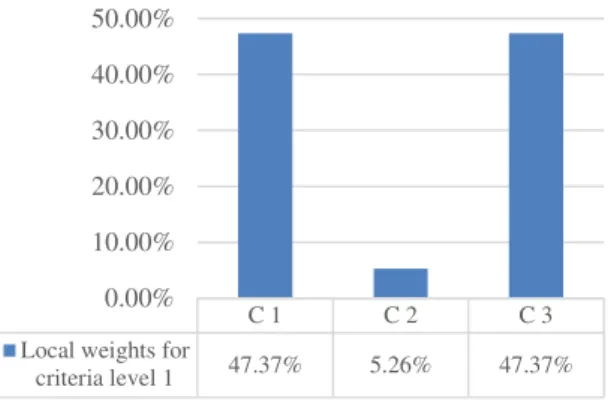
In figure 2 is presented the local weights of criteria from level 1 based on the general objective.
Fig. 2. The local weights of criteria from level 1
After analysis with AHP method, results that C 1 (technical criteria) and C 3 (other criteria) have obtained the greatest priority (47.37 %), followed by C 2 (size and dimensional criteria) with score (5.26 %).
This means that in order to choose the best variant of ARC welding industrial robot for the welding process of the tracked mini-robot for military applications housing, it is necessary that the technical characteristics (like working speed, repeatability) to be fulfilled, as well as other characteristics like mounting type.
From this AHP first level criteria analysis, results that for the welding process for tracked mini-robots it is necessary to acquire industrial robots with high technical performances. The low value for C 2, regarding the size of the
industrial robot, can be explained by the fact that the selection of the optimal variant of robot is not constrained by the working space, in military industry spacious industrial halls are used.
In figure 3÷5 are illustrated the local weights of criteria from level 2.
Fig. 3. The local weights of criteria from level 2,
Criterion C1
In figure 3 are illustrated the local weights of criteria from level 2 with respect to technical criteria (C 1), the sub-criteria C 1.2 (repeatability) with value 74.5% has the highest ranking, followed by sub-criteria C 1.1 (motion) with 20 %, and the last ranking with 5.46 % corresponding to sub-criteria C 1.3 (allowable loading).
From this level 2 criteria classification, results that it is important for the welding robot to work repeatability in certain limits. For example, in military industry, it is necessary to perform the spot welding in a precise spot, or on
C 1 C 2 C 3
Local weights for
criteria level 1 47.37% 5.26% 47.37%
0.00% 10.00% 20.00% 30.00% 40.00% 50.00%
C 1.1 C 1.2 C 1.3
Local weights for criteria level 2,
Criterion C1
20.04% 74.50% 5.46%
a certain spot line, under identical welding conditions.
The evaluators have taken into consideration, as well, the sub-criteria C 1.1 (motion of the industrial robot), in which it was considered the speed of axis of joints of the robot, respectively the range of robot’s arm features with high importance in the welding process in the military industry.
Fig. 4. The local weights of criteria from level 2,
Criterion C2
In the case of main criteria C 2, the sub-criteria C 2.1 (payload) and C 2.3 (robot reach) have the highest priority (47.37 %), followed by C 2.2 (robot mass) with only 5.26 %. Analyzing the obtained weight, ensue that it is necessary that the variant of industrial robot to have a high loading capacity, respectively a maximum arm reach, to ensure an extensive workspace, in both vertical and horizontal plane.
For the last main criteria (C 3), the sub criteria C 3.2 (cost) and C 3.3 (flexibility) have the same weight (47.37 %), and for C 3.1 (power rate) have obtained only 5.26 %. In this case, both technic and economic factors are considered in the selection of the suitable industrial robot for ARC welding process in military industry.
Fig. 5. The local weights of criteria from level 2, Criterion C3
Technically, the robot must offer a high flexibility, namely the possibility of reprogramming for another task in the military industry (for example pick and place task), mounting the robot in different positions (like wall, ceiling, angle), respectively setting various welding devices on the free end of the robot’s arm for different welding techniques (MIG, PLASMA, ARC). On the other hand, the economical factor is equally important as the technical factor, because it is desirable that the proper robot, with the best technical performance, it is bought at an affordable price. In figure 6 are illustrated the local weights of criterion from level 3.3.1.
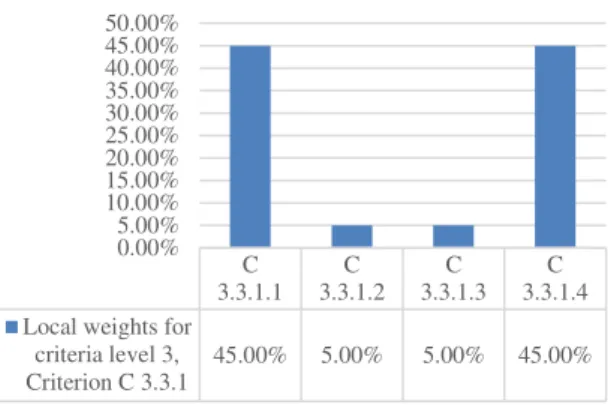
Fig. 6. The local weights of criteria from level 3, Criterion C 3.3.1
The chart from figure 6 represents the distribution of the local weights of criteria from level 3 of the sub-criteria C 3.3.1 (Mounting type). Criteria C 3.3.1.1 (Floor) and C 3.3.1.4 (Wall) have earned the highest weights (45%) thus to perform the ARC welding procedure of the tracked mini-robots housing, the chosen industrial robots, beside standard mounting on the floor, have also the mounting option on the wall, where the robot`s base is in the plane. Mounting the welding robot on the wall or on the lifting crane, makes the end-effector (the welding head) programable to execute complex paths in the work space, by using the robot`s arm extension closest to its maximum opening, to cancel the singularities in the kinematic chain, or to obtain a larger work space for the welding robot.
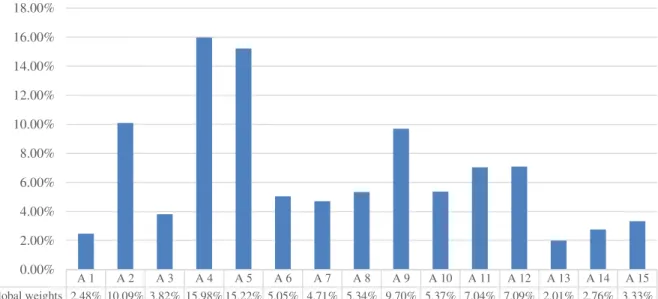
In figure 7 it is shown the global weights of alternatives considering each criterion.
C 2.1 C 2.2 C 2.3
Local weights for criteria level 2,
Criterion C2 47.37% 5.26% 47.37%
0.00% 10.00% 20.00% 30.00% 40.00% 50.00%
C 3.1 C 3.2 C 3.3
Local weights for criteria level 2,
Criterion C3 5.26% 47.37% 47.37%
0.00% 10.00% 20.00% 30.00% 40.00% 50.00%
C 3.3.1.1
C 3.3.1.2
C 3.3.1.3
C 3.3.1.4 Local weights for
criteria level 3, Criterion C 3.3.1
45.00% 5.00% 5.00% 45.00% 0.00%
Fig. 7. Global weights of alternatives taking into account all the criteria
Of the 15 industrial robots alternatives analyzed using the AHP method, taking into account all the identified criteria and sub criteria, respectively by the tangible and intangible characteristics, it has emerged that the alternatives that have obtained the highest weight are: on the first rank is A 4 with ≈ 16%, followed
by A 5 (≈ 15%), and then next alternatives (A 2
and A 9) have the same value ≈ 10%.
The diagram from Figure 8 represents the distribution of the local weights of some criteria from level 1 for the well-ranked four alternatives.
Fig. 8. The distribution of the local weights of some
criteria from level 1, for the alternatives A4, A5, A2, A9
From a global analysis of the diagram presented in Figure 8, it was found that the alternative A 4 obtained the favorable weight to the criteria C 1.2 (Repeatability), C2.2 (Robot mass), C 3.1 (Power rate), compared to the other three alternatives (A5, A2, A9). Locally, the
criteria C 1.2 has obtained the highest score (30.42%), followed by C 2.2 with 18.93% and the lowest scores was obtained by C3.2 (Cost) with 8.27% and C 2.1 (Payload) with 6.06%. It can be noticed that in case of alternative A5 (ranked in position 2 after analysis with AHP), the criteria Cost (C3.2) has the highest weight (44.92%), then C3.1 (15.8%), C 3.2 (8.14%), C 2.2 (2.96%). Although, for both alternatives A4 and A5, the technical criteria have comparable values, but from the cost point of view, the alternative A4 has obtained the lower score, which makes it to be the favorable choice for the proposed application.
4. CONCLUSIONS
In literature it is proven that the AHP technique is a powerful tool for selection problem solving in order to achieve the best solution from a multitude of alternatives for a specific goal (the general objective), taking into account tangible and intangible factors, respectively various criteria and sub criteria. The applicability of AHP technique is large, being successfully used in different domains with different applications, such as the military industry.
In this research paper, is presented a case study for solving a decisional problem using the AHP method. With AHP method was obtained the best variant of ARC welding industrial robot from 15 alternatives based on established general objective, respectively tangible and intangible
A 1 A 2 A 3 A 4 A 5 A 6 A 7 A 8 A 9 A 10 A 11 A 12 A 13 A 14 A 15
Global weights 2.48% 10.09% 3.82% 15.98% 15.22% 5.05% 4.71% 5.34% 9.70% 5.37% 7.04% 7.09% 2.01% 2.76% 3.33%
0.00% 2.00% 4.00% 6.00% 8.00% 10.00% 12.00% 14.00% 16.00% 18.00%
C 1.2 C 2.1 C 2.2 C 3.1 C 3.2 A 4 30.42% 6.06% 18.92% 15.87% 8.27% A 5 1.76% 8.14% 2.96% 15.87% 44.92% A 2 17.55% 1.77% 18.92% 15.87% 1.53% A 9 17.55% 1.77% 18.92% 5.24% 8.27%
factors (criteria and sub criteria level 1, 2 and 3). The industrial robot task considered for this case study is to carry out the ARC welding of the metal components from mechanical housing structure of the tracked mini-robots for military applications. For AHP method, the criteria and sub criteria are defined considering both technical and economic factors. Even if for this specific application the welding procedure is ARC, for AHP was taken into consideration the welding type as a sub criteria level 2. Thus, the chosen industrial robot can be also used for welding of other types of materials, such as aluminum, increasing the degree of flexibility of the chosen robot.
Also, with AHP method was obtained the ranking of the alternatives by global weights of alternatives considering each criterion. In the case of the technical criteria (C 1.2, C 2.1, C 2.2, C 3.1) the alternatives A 4, A 5 and A 9 have obtained the highest scores, but from the cost aspect, the alternative A 5 achieved the highest score and alternative A 2 the smallest value (1.53%). This expresses the fact that the industrial robot corresponding to the alternative A 5 has good technical characteristics at an acceptable cost, which makes it a good choice for the chosen application.
Future research will be performed using the AHP method results by applying a more complex decision-making process, like AHP – TOPSIS in fuzzy environment. Fuzzy TOPSIS is employed to determine the priorities of the alternatives based on the weights obtained with AHP method.
8. REFERENCES
[1] Özgüler, Ș., Güneri, A.F., Gülsün, B., Yilmaz, O. Robot selection for a flexible manufacturing system
with AHP and TOPSIS methods. 15th International
Research/Expert Conference” Trends in the Development of Machinery and Associated Technology” 12-18 September, Prague, Czech Republic. 2011
[2] Daneshmand, M., Bilici, O., Bolotnikova, A., Anbarjafari, G. Medical robots with potential applications in participatory and opportunistic
remote sensing: A review. Robotics and
Autonomous Systems, 2017
[3] Nazmul Huda, M., Yu. H., Cang, S. Robots for
minimally invasive diagnosis and intervention.
Robotics and Computer-Integrated Manufacturing, vol 41, pp. 127-144, 2016.
[4] Steopan, M., Şteopan, A., Costea, A. Mobile
platform for indoor use. Acta Technica Napocensis
Series: Applied Mathematics and Mechanics Vol. 55, Issue I, pp. 95-98, 2012.
[5] Bican, O., Ispas, V., Steopan, M., Design of a
mobile micro-robot for detecting metal objects. 1st
International Conference on Quality and Innovation in engineering and Management, 2011 [6] Aoyama, H., Ishikawa, K., Seki, J., Okamura, M.,
Ishimura, S., Satsumi, Y. Development of Mine
Detection Robot System. International Journal of
Advanced Robotic Systems, volume 4, number 2, 2007.
[7] Lyons, D. M., Arkin, R.C., Jiang, S., O’brien, M., Tang, F., Tang, P. Performance Verification for
Robot Missions in Uncertain Environments.
Robotics and Autonomous Systems, 2017.
[8] Qi, Y., Tang, D., Wang, J. Space robot active collision avoidance maneuver under thruster
failure. Aerospace Science and Technology,
volume 67, pp. 72-77, 2017.
[9] Tahriri, F., Dawal, S.Z.B. Integrated decision making and optimization model for robot
technology from planning to implementation.
Proceedings of the 41st International Conference on Computers & Industrial Engineering, Los Angeles, California, pg. 1069-1074, 2011.
[10] Bairagi, B., Dey, B., Sarkar, B., Sanyal, S. A novel multiplicative model of multi criteria analysis for
robot selection. International Journal on Soft
Computing, Artificial Intelligence and Applications (IJSCAI), volume 1, number 3, pp. 1-9, 2012.
[11] Gorabe, D., Pawar, D., Pawar, N. . Selection of industrial robots using Complex Proportional
Assessment method. American International Journal
of Research in Science, Technology, Engineering & Mathematics, pp. 140-143, 2014.
[12] Athawale, V. M., Chatterjee, P., Chakraborty, S.
Selection of industrial robots using Compromise
Ranking Method. Proceedings of the 2010
International Conference on Industrial Engineering and Operations Management, January 9 – 10, Dhaka, Bangladesh, 2010.
[13] Adakane, R. V., Narkhede, A.R. Multi Attribute
Decision Making: A Tool for Robot Selection.
International Journal of Engineering Development and Research, volume 2, number 1, pp. 589-596, 2014.
[14] Karimirad, M. A subjective-objective decision
making in fuzzy environment. World of Sciences
[15] Haleh, H., Nezu, K. A multi-criteria approach to robot selection for a computer integrated
manufacturing system. 8th IEEE International
Conference on Intelligent Engineering Systems, vol 151, pp. 569-574. 2004
[16] Chatterjee, P., Mondal, S., Chakraborty, S. A comparative study of preference dominance-based
approaches for selection of industrial robots.
Advances in Production Engineering & Management, vol 9, no 1, pp. 5-20, 2014.
[17] Tahriri, F., Taha, Z. Critical success factors for
technology selection specifically ROBOTS. Journal
of Business Management and Economics vol 2, nr 3, pp. 089-097, 2011.
[18] Rao Venkata, R., Padmanabhan, K.K. Selection, identification and comparison of industrial robots
using digraph and matrix methods. Robotics and
Computer-Integrated Manufacturing, vol. 22, pp 373-383, 2006.
[19] Athawale, V. M., Chakraborty, S. A comparative study on the ranking performance of some multi-criteria decision-making methods for industrial
robot selection. International Journal of Industrial
Engineering Computations, volume 2, pp. 831-850, 2011.
[20] Bhattacharya, A., Sarkar, B., Mukherjee, S.K.
Integrating AHP with QFD for robot selection
under requirement perspective. International
Journal of Production Research, volume 43, number 17, pp. 3671–3685, 2005.
[21] Castillo C.N., D. F. K., Gitgano F.T., Loo L.A., Pacaanas S.M., Toroy N., Ocampo L., Sia L., Ocampo C.O. Appropriate criteria set for personnel promotion across organizational levels
using analytic hierarch process (AHP).
International Journal of Production Management and Engineering, volume 5, number 1, pp. 11-22, 2017.
[22] Pinto, D., Shrestha, S., Babel, M.S., Ninsawat, S.
Delineation of groundwater potential zones in the Comoro watershed, Timor Leste using GIS, remote sensing and analytic hierarchy process (AHP)
technique. Appl. Water Science, vol. 7, pp. 507-519,
2017.
[23] Acharya, V., Sharma, S.K., Gupta, S.K. Analyzing the factors in industrial automation using analytic
hierarchy process. Computers and Electrical
Engineering, pp. 1-10, 2017.
[24] Fanuc Robots, http://www.fanucam
erica.com/home/industrial-solutions/manuf acturing-applications/spot-welding-robots.
[25] Robot Worx, https://www.robots.com/
applications/arc-welding.
[26] Yaskawa, https://www.motoman.com
/spot-welding#robots.
[27] Kawasaky, https://robotics.kawasaki.com /en1/applications/robotic-arc-welding.
SELECTAREA ROBOTILOR INDUSTRIALI IN INDUSTRIA MILITARĂ FOLOSIND METODA AHP:
STUDIU DE CAZ
Abstract: Avand in vedere multitudinea companiilor care produc roboti industriali, configurația structurală complexăși
gradul de automatizare al roboților industriali, selectarea roboților industriali pentru a îndeplini o anumită
sarcină devine din ce în ce mai dificilă. În această lucrare de cerectare, s-a aplicat metoda AHP pentru a selecta
cea mai favorabilă configurație a unui robot industrial care trebuie să efectueze sudarea ARC a carcaselor
mini-roboţilor şenilaţi utilizaţi în aplicaţii militare. În acest scop, au fost luate în considerare mai multe companii
care produc roboți industriali cu diferite specificaţii tehnice. Studiul evidențiază utilitatea aplicării metodelor
de luare a deciziilor în procesele tehnologice automatizate, pentru a facilita și simplifica procesul de selecție a
robotului industrial, pentru a obține varianta potrivită a robotului industrial dintr-un set de alternative, care
realizează una sau mai multe sarcini specifice.
Mihaela SIMION, Ph.D, Eng, Lecturer, Technical University of Cluj-Napoca, Mechanical
Engineering Department, E-mail: [email protected], No.103-105, Muncii Blvd., 400641, Cluj-Napoca
Lavinia SOCACIU, Ph.D, Eng, Lecturer, Technical University of Cluj-Napoca, Mechanical
Engineering Department, E-mail: [email protected], No.103-105, Muncii Blvd., 400641, Cluj-Napoca
Oana GIURGIU, Ph.D, Eng, Teacher Assistant, Technical University of Cluj-Napoca, Mechanical
Engineering Department, E-mail: [email protected], No.103-105, Muncii Blvd., 400641, Cluj-Napoca
Silviu Mihai PETRIŞOR, Ph.D, Eng, Associate Professor, “Nicolae Bălcescu” Land Forces
Academy, Technical Science Department, E-mail: [email protected], No. 3-5, Revoluţiei