Journal of Chemical and Pharmaceutical Research
__________________________________________________
ISSN No: 0975-7384 CODEN(USA): JCPRC5
J. Chem. Pharm. Res., 2010, 2(4):878-886
______________________________________________________________________________
RP-HPLC method development and validation of Valsartan tablet
dosage form
*
Bodela Narendra Reddy1,Ustelamuri Chenna Reddy2, P. Nagarjuna3, CH. Dileep Kumar4
1
Department of Pharmaceutical Analysis, Dr Samuel George Institute of Pharmaceutical Sciences, Markapur, A.P, INDIA
2
Department of Pharmaceutics, Vagdevi College of Pharmacy, Gurazala, A.P, INDIA
3
Department of Pharmacy, Dr Samuel George Institute of Pharmaceutical Sciences, Markapur, A.P, INDIA
4
Department of Pharmacy, Orchid Health Care, Chennai,
______________________________________________________________________________ ABSTRACT
A simple, rapid, sensitive, reverse phase isocratic RP-HPLC method was developed for determination of Valsartan in tablet dosage form. The method was carried out using Thermo-hypersil ODS column (150 mm × 4.6 mm i.d., 5 µm particle size) with mobile phase comprised of water: acetonitrile: glacial acetic acid (500:500:01). The flow rate was set at 1.0 ml/min and effluent was detected at 273nm. The retention time of valsartan was found to be 4.6 minute. The method was validated for specificity, accuracy, precision, linearity, and limit of detection, limit of quantification, robustness and solubility stability. LOD and LOQ were found to be 2.72 µg/ml and 8.25 µg/ml respectively. The calibration curve was linear in the concentration range of 40-140 µg/ml with coefficient of correlation 0.9990. The percentage recovery for the valsartan was found to be 99.0-100.2 and the % RSD was found to be less than 2 %. The proposed method was successfully applied for quantitative determination of valsartan in tablet dosage form.
Key words: Valsartan, HPLC, Validation
______________________________________________________________________________
INTRODUCTION
subtype & used for treatment of high blood pressure, of congestive heart failure (CHF), and post-myocardial infarction (MI). By blocking the action of angiotensin, valsartan dilates blood vessels and reduces blood pressure. Methods such as HPLC 3-5, LC-MS 6-8, Protein precipitation Capillary electrophoresis and Simultaneous UV spectrophotometric methods are reported for estimation of Valsartan alone or in combination with other agents. However, there were few methods reported for determination of valsartan individually. The focus of present study was to develop & validated a rapid, stable, & economic HPLC method for the estimation of valsartan in tablet dosage form.
MATERIALS AND METHODS
Chemicals & Reagents
Valsartan API was purchased from Cadila Healthcare Ltd, Ahmedabad, India. Valsartan tablets, claimed to contain 320mg of Valsartan procured from Zydus Cadila Ltd, Ahmadabad, India. The HPLC grade solvent used were of E-Merck (India) Ltd, Mumbai. HPLC grade water prepared using Millipore System (Millipore, Molesheim France, Model Elix-10). All other reagents were of AR grade.
Fig 1: Structure of valsartan Instruments
The instrument was used Shimadzu LC 2010C integrated system equipped with quaternary gradient pump, 2010C UV-VIS detector in isocratic mode. The system was equipped with Millennium 32 Software. The analytical column used was Thermo-hypersil ODS (150 mm × 4.6 mm i.d., particle size 5 µm).
Chromatographic Conditions
For HPLC, mobile phase, water: acetonitrile: glacial acetic acid (500:500:01) was filtered and degassed. The injection volume was injected 20µl with a flow rate of 1.0ml/min. Detection was carried out at 273 nm at column temperature 250c and run time set at 10 minutes.
Assay Procedure: Standard preparation
A stock solution of valsartan was prepared by accurately weighing 100 mg of drug, transferring to 100 ml volumetric flask, dissolving in 50 ml of diluents water:acetonitrile (50:50) and was sonnicated to dissolve. Make volume up to mark with diluent. Dilute 5.0 ml of this solution to 50ml with diluent to obtained final standard solution of 100 µg/ml of valsartan.
Sample Preparation
through 0.45µm filter; collect the filtrate by discarding first few ml of the filtrate. Dilute 5.0 ml of this solution to 50 ml with diluent to obtained standard solution of 100 µg/ml.
Assay of valsartan
Standard and sample solution of valsartan was injected. Assay was performed as per given chromatographic conditions. The amount of valsartan present in the sample was computed from the linearity curve.
Method Validation:
The method was validated for the parameters like system suitability, specificity, range and linearity, limit of detection (LOD), limit of quantification (LOQ), accuracy, precision, ruggedness and robustness.
System suitability
System suitability of the method was evaluated by analyzing the repeatability, peaks symmetry (Symmetry factor), theoretical plates of the column, peak area and retention time.
Range and Linearity
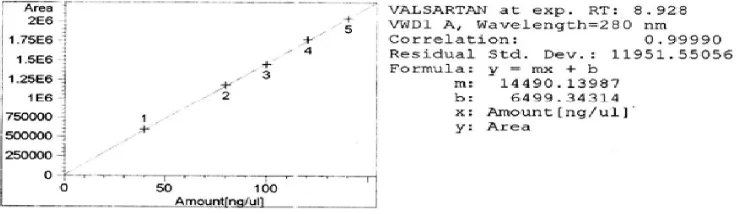
To evaluate the linearity, serial dilution of analyte were prepared from the stock solution by taking suitable volume and diluted up to 50 ml to get the desired concentrations (40, 80, 100, 120 and 140 µg/ml) for linearity in the range of 40-140 µg/ml. The prepared solutions were filtered through 0.45 µm membrane filter and each of the dilutions was injected five times into the column. Absorbance at 273nm was measured and calibration curve for valsartan was constructed by plotting the mean peak area (Y-axis) against the concentration (X-axis).
Precision
The precision of method was investigated with respect to repeatability and ruggedness.
Method Precision (Repeatability):
Method precision for assay was established by determining the assay of six sample preparations under same conditions. Six replicates of valsartan sample solution was prepared at sample concentration by one analyst and analyzed on same day.
Intermediate Precision (Ruggedness):
Different analyst, using a different system, repeated the procedure followed for method precision on a different day using same lot of sample.
Accuracy
Accuracy was determined over the range 50% to 150% of the sample concentration. Calculated amount of Valsartan from standard stock solution was added in placebo to attain 50%, 100% and 150% of sample concentration. Each sample was prepared in triplicate at each level. Blank and standard preparations were injected and the chromatograms were recorded.
Specificity
preparation were spiked in a pre weighed quantity of drugs and then absorbance was measured and calculations done to determine the quantity of the drugs.
Robustness
The method was found to be robust, as small but deliberate changes in the method parameters have no detrimental effect on the method performance. Change in flow rate of mobile phase to 0.9 ml/min and 1.1ml/min (± 10%) or column oven temperature (± 5°C absolute) to 25°C and 35°C or organic phase ratio of mobile phase by (±2% absolute) as Water: Acetonitrile (49:51), Water: Acetonitrile (51:49) and to observe their effect on system suitability.
Standard and sample solution stability
Standard and sample preparation was prepared as per test procedure and assay of standard and sample was determined as per method. Standard and sample solution was stored for 24 hours at room temperature. Assay of standard and sample solution was determined after different hours till 24 hours using freshly prepared standard. The assay obtained was compared with the initial assay value and recorded.
Detection and Quantification limit
Limit of detection and limit of quantification was calculated by the proposed method which was based on the standard deviation (s) of the response and the slope (S) of the calibration curve at levels approximating the LOD and LOQ, LOD= 3.3 (s/S) and LOQ= 10 (s/S).
RESULT AND DISCUSSION
Method Development
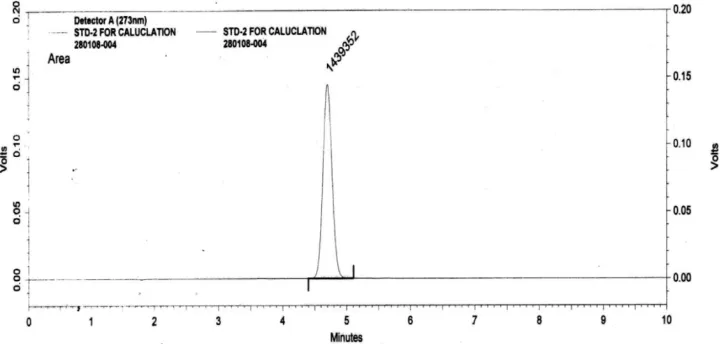
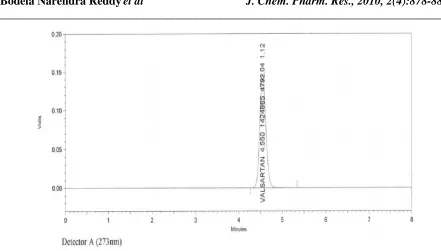
[image:4.595.120.483.509.681.2]The aim of this study was to develop a simple, accurate and precise HPLC method for the analysis of valsartan in bulk and tablet dosage forms using mobile phase and commonly employed Thermo-hypersil ODS column with UV detector at 273 nm. The typical chromatogram of valsartan was shown in fig.2 and fig.3. The optimal retention time found to be 4.6 minute.
Figure 3 Chromatogram of Test solution of Valsartan
Method Validation
The described method has been validated for the assay of drugs in bulk drug and its dosage. The method was validated for the parameters like system suitability, specificity, and linearity, limit of detection (LOD), limit of quantification (LOQ), accuracy, precision, ruggedness and robustness.
System suitability testing
System suitability shall be performed and calculated at the start in study of each validation parameters. Results of system suitability obtained during the entire study were summarized in table-1. System suitability test are an integral part of chromatographic methods and reproducibility of the system are adequate for the analysis to be performed.
Table 1 Data derived from System suitability experiment for Valsartan
S.NO PARAMETERS VALSATRAN
1. Peak area 1425053
2. Theoretical plates 4882.90
3. Retention time 4.63
4. Asymmetry 1.11
5. % RSD 0.05
Linearity
suitability for analysis. The calibration curve was carried out and found to be linear in the concentration range of 40-140 µ g/ml (Fig.4). The result of linearity was given in Table 2.
Figure 4 Linear calibration curve for Valsartan
Table 2 Data derived from linearity experiment of Valsartan
Level ml added Diluted to Ppm Absorbance
25% 2 200 5 0.159
50% 2 100 10 0.313
100% 2 50 20 0.620
125% 1 20 25 0.803
150% 3 50 30 0.921
Precision
[image:6.595.114.483.150.257.2]Precision is a measure of the ability of the method to generate reproducible results. The precision of method was evaluated using repeatability and ruggedness. Repeatability refers to the use of the analytical procedure within a laboratory over a short period of time using the same analyst with the same equipment and is expressed as the % RSD. The results of method precision are shown in Table 3. The % RSD for method precision was found to be 1.5. The ruggedness of an analytical method is the degree of reproducibility of the test results obtained by the same samples under a variety of conditions, such as different laboratories, different analysts, different instruments, different lots of reagents and different days. The assay result indicated that the method was capable with high precision (Table.4). The result of % RSD (1.2 %) proves the ruggedness of developed method.
Table 3 Data derived from Method Precision experiment of Valsartan
Set Test weight(mg) Test reading(mg) Mg/tab % assay Mean % assay % RSD
1. 360.30 1446042 320.47 100.1
101.6% 1.5
2. 360.00 1442130 319.87 100.0
3. 360.00 1465730 325.11 101.6
4. 360.00 1500679 332.86 104.0
5. 360.10 1476739 327.46 102.3
Table 4 Data derived from Intermediate precision (Ruggedness) experiment of Valsartan
Set Test weight(mg) Test reading(mg) Mg/tab % assay Mean % assay % RSD
1. 360.30 1431913 320.89 100.3
100.5% 1.2
2. 360.30 1469703 329.35 102.9
3. 360.20 1427392 319.96 100.0
4. 360.20 1426762 319.91 100.0
5. 360.10 1426638 319.88 100.0
6. 360.00 1426750 319.99 100.0
Accuracy
[image:7.595.65.516.349.410.2]Accuracy of an analytical method is the closeness in agreement between the accepted true value or a reference value and the actual result obtained. Accuracy studies are usually evaluated by determining the recovery of a spiked sample of the analyte into the matrix of the sample to be analyzed. The results of accuracy studies are shown in table 5. Results of recoveries and coefficient of variation (%RSD) indicate that the method is accurate within the desired range.
Table 5 Data derived from Accuracy experiment of Valsartan
Levels Mean Area Mg added Mg added
(actually)
Mg recovered
% recovery Mean %
recovery
% RSD
50% 714541 50.16 50.09 50.17 100.16 100.20 0.3
100% 1415721 100.36 100.36 99.41 99.20 99.20 0.1
150% 2114240 150.33 149.92 148.47 99.03 99.00 0.1
Specificity
Specificity is the ability of a method to discriminate between the analyte of interest and other components that are present in the sample. The method demonstrated good separation between the peaks and was found to be free of interference. For demonstrating the specificity of the method for drug formulation, the drug was spiked, wherein the excipients used in different formulation products did not interfere with the drug peak and thus the method was specific for Valsartan.
Robustness
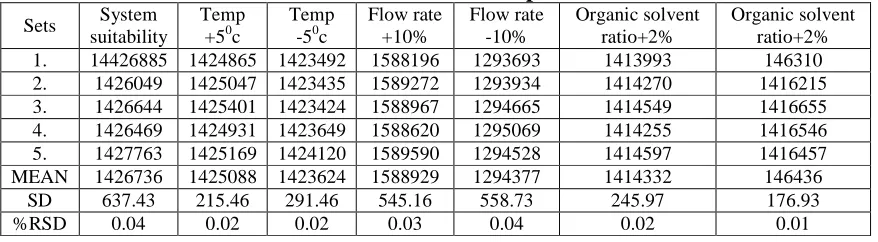
This was done by small deliberate changes in the chromatographic conditions. The results of robustness study are summarized in table 6 indicate that the method was robust enough that the selected factors remained unaffected by small variations of these parameters.
Table 6 Data derived from Robustness experiment for Valsartan
Sets System
suitability
Temp +50c
Temp -50c
Flow rate +10% Flow rate -10% Organic solvent ratio+2% Organic solvent ratio+2%
1. 14426885 1424865 1423492 1588196 1293693 1413993 146310
2. 1426049 1425047 1423435 1589272 1293934 1414270 1416215
3. 1426644 1425401 1423424 1588967 1294665 1414549 1416655
4. 1426469 1424931 1423649 1588620 1295069 1414255 1416546
5. 1427763 1425169 1424120 1589590 1294528 1414597 1416457
MEAN 1426736 1425088 1423624 1588929 1294377 1414332 146436
SD 637.43 215.46 291.46 545.16 558.73 245.97 176.93
[image:7.595.80.519.608.729.2]Stability Studies
Stability of reagents, mobile phase, standard and sample solutions were studied for 48 hours and compared with the freshly prepared solutions and was found to be stable.
Detection & Quantification limit
The detection limit or LOD is the lowest amount of analyte in a sample that can be detected, but not necessarily quantitated. LOD was expressed as a concentration that gives a signal to noise ratio of 2:1 or 3:1. Quantitation limit or LOQ, on the other hand is the lowest amount of analyte in a sample that can be under the stated experimental conditions. LOQ is measured in terms of signal to noise ratio of 10:1. LOD and LOQ were calculated by the equation given in ICH guidelines. This may be expressed as LOD = 3.3 σ /S and LOQ = 10 σ / S, where σ is the standard deviation of the response, S is the slope of the calibration curve which may be estimated from the calibration curve of the analyte17,18. The limit of detection and limit of quantification of the proposed method at 273 nm were found to be 2.72 µg/ml and 8.25 µg/ml respectively shown in table 7. The proposed high-performance liquid chromatographic method has been evaluated as per ICH guidelines, Parameters such as linearity, precision, accuracy, LOD, LOQ, specificity and robustness are proved to be convenient for the quality control of valsartan in tablet dosage form. The proposed RP-HPLC method enables the determination of valsartan because of good separation of chromatographic peaks. The method can be used successfully for the analysis of valsartan in tablet dosage form.
Table 7 Characteristics of the Analytical Method Derived from the Standard Calibration Curve
Compound LOD LOQ Linearity Correlation coefficient
r2
Residual std Regression
(σ)
Slop of Regression
(s)
Valsartan 2.72 8.25 40-140 0.9999 11951.55 14490.14
Acknowledgement
The authors are thankful to the Management, Dr.samuel George institute of pharmaceutical sciences, for providing necessary facilities to carry out this work. And we are greatful to my parents to their encouragement.
REFERENCES
[1] O’Neil MJ, Smith A, Heckelman PE, Kinneary JF, The Merck Index: An Encyclopedia of Chemicals, Drugs and Biologicals, 14th Edn., 2006, 1767.
[2] Matrindale-The Complete Drug Reference, 34th Edn., Pharmaceutical Press, London, Chicago,2002, 1018.
[3] Kocyigit-Kaymacoglu B, Unsalan S and Rollas S.,Determination and validation of Ketoprofen, Pantoprazole, and Valsartan together in human plasma by high performance liquids chromatography, Pharmazie, 2006, 61,586-589.
[5] Gonzalez L, et al., Fast screening method for the determination of angiotensin II receptor antagonists in human plasma by high-performance liquid chromatography with fluroimetric detection, J Chromatogr A, 2002, 949,49-60.
[6] Koseki N, et al., Development and validation of a method for quantitative determination of Valsartan in human plasma by liquid chromatography-tandem mass spectrometry, Pharm
Biomed Aanal., 2007, 43,1769-1774.
[7] Li H, et al., A liquid chromatography/tandem mass spectrometry method for thesimultaneous quantification of Valsartan and Hydrochlorthiazide in human plasma. J Chromatogr B Analyt
Technol Biomed Life Sci., 2007, 852,436-442.
[8] Selvan PS, et al., Simultaneous determination of fixed dose combination of Nebivolol and Valsartan in human plasma by liquid chromatographic- tandem mass spectrometry and its application to pharmacokinetic study, J Chromatogr B Analyt Technol Biomed. Life Sci., 2007, 858,143-150.
[9] Macek J, Klima J and Ptacek P., Rapid determination of Valsartan in human plasma by protein precipitation and high-performance liquid chromatography, J Chromatogr B Analyt
Technol Biomed Life Sci., 2006, 832,169-172.
[10]Hillaert S and Bossche VW., Simultaneous determination of Hydrochlorthiazide and several angiotensin-II receptor antagonists by capillary electrophoresis, J Pharm Biomed Anal., 2003, 31,329-339.
[11]Satana E, et al., Simultaneous determination of Valsartan and Hydrochlorthiazide in tablets by first-derivative ultraviolet spectrophotometry and LC, J Pharm Biomed Anal, 2001, 25,1009-1013.
[12]Tatar S and Saglik S., Comparison of UV- and second derivative-spectrophotometric and LC methods for the determination of Valsartan in pharmaceutical formulation, J Pharm Biomed
Anal., 2002, 30,371-375.
[13]ICH. Q2B, Validation of analytical procedures methodology, In Proceedings of The International Conference on Harmonization, Geneva, 1993.
[14]Sethi PD, HPLC quantitative analysis of pharmaceutical formulations, First Edn, Delhi, CBS Publishers and distributers, 2001,11-160.
[15]Krull, I., and swartz, M., Validation Viewpoint, Introduction: National and International Guidelines, LC-GC. 1997, 15(6), 534-539.
[16]United States Pharmacopoeia Validation of Compendial Methods, United States Pharmacopoeia Convention, Rockville, 2007.
[17]ASTM E Standard Guide for Conducting Ruggedness Tests (Plackett-Burman Design),1169-1189.