Journal of Chemical and Pharmaceutical Research
__________________________________________________
ISSN No: 0975-7384 CODEN(USA): JCPRC5
J. Chem. Pharm. Res., 2010, 2(4):569-575
569
Studies on 1, 10- phenanthroline complexes of some diaryltellurium
dihalides
Shashi Chhabra and K. K. Verma*
Department of Chemistry, M. D. University, Rohtak, India
______________________________________________________________________________
ABSTRACT
The synthesis and structural features of some 1, 10-phenanthroline complexes of diaryltellurium dihalides, R2TeX2.Phen (R = p-hydroxyphenyl, 3-methyl-4-hydroxyphenyl, p-methoxyphenyl and
X = Cl,Br,I) are reported. These complexes have been subjected to elemental analyses, conductance and cryoscopic measurements, infra-red and proton magnetic resonance spectral studies. Solution studies reveal the weak to 1:1 electrolyte type behaviour of these complexes in solution. Spectral studies suggest the linkage of phenanthroline to the tellurium atom through the nitrogen atoms. An octahedral environment around the tellurium atom has been suggested.
Keywords: diaryltellurium dihalides, phenanthroline complexes, conductance, cryoscopy,
spectral studies.
______________________________________________________________________________
INTRODUCTION
Aryltellurium trihalides are known to behave as Lewis acids and form molecular complexes with several nitrogen, oxygen and sulphur donor bases but such reports on diaryltellurium dihalides are relatively less in number [1-13]. It has been reported that Lewis acidity of tellurium atom falls significantly on going from RTeX3 to R2TeX2 [14] A few such compounds are known
[1,12] to posses antimicrobial activity as well. In continuation of our work on phenanthroline complexes of organotellurium trihalides [15], we hereby report the synthesis and characterization of 1,10- phenanthroline complexes of some diaryltellurium dihalides.
EXPERIMENTAL SECTION
Materials and Methods
570
and dried before use. Bis(p-hydroxyphenyl)tellurium dichloride, bis(3-methyl-4-hydroxyphenyl)tellurium dichloride and bis(p-methoxyphenyl)tellurium dichloride were obtained by reactions of tellurium tetrachloride with phenol [16], o-cresol [17] and anisole [18] respectively. The diaryltellurium dichlorides were converted to corresponding dibromides and diiodides by halogen- exchange processes [16-19] by using KBr or KI in dry methanol.
Preparation of 1, 10-Phenanthroline Complexes
A saturated solution of 1, 10-phenanthroline (0.99 g, 5 mmol) in chloroform (~10 ml) was added with constant stirring to a saturated solution of 5.0 mmol of R2TeX2 in about 20 ml of dry
methanol in a R.B. flask. The contents were stirred for about 2-3 h under an atmosphere of dry N2. This resulted in the separation of a coloured solid product. This was filtered, washed with
chloroform and dried over P4O10 in vacuum desiccator.
Physical Measurements
The conductance measurements in nitrobenzene, acetone and acetonitrile were performed on a Systronic type 305 conductivity bridge at 25 + 2o C using a dip type cell with smooth platinum electrodes.The molecular weights were determined cryoscopically in purified nitrobenzene using a Beckmann’s freezing point appratus. The IR spectra (4000-400cm-1) were recorded in KBr pellets on a Perkin Elmer Model 2000 FTIR spectrometer. 1H NMR spectra were recorded on BRUKER AC-300F operating at 299.9486 MHz in DMSO - d6 using tetramethylsilane as an
internal reference. The spectral data were obtained from SAIF, Panjab University, Chandigarh.
RESULTS AND DISCUSSION
Tellurium tetrachloride when heated with phenol, o-cresol, or anisole appears to undergo Friedel-Crafts type condensation reaction whereby, TeCl3+ unit attacks a position para to the electron
releasing (-OH / -OCH3) groups in the aromatic ring, resulting in the formation of
diorganyltellurium dichlorides [16,17].
2 R – H + TeCl4 R2TeCl2 + 2 HCl
(R = p-hydroxyphenyl, 3-methyl-4-hydroxyphenyl, p-methoxyphenyl)
These diaryltellurium dichlorides when treated with KBr/KI undergo halogen-exchange processes to yield the corresponding dibromides and diiodides.
R2TeCl2 + 2 KX R2TeX2 + 2 KCl (X = Br, I)
These diaryltellurium dihalides when reacted with 1,10-phenanthroline give 1 : 1 type complexes.
R2TeX2 + Phen R2TeX2.Phen
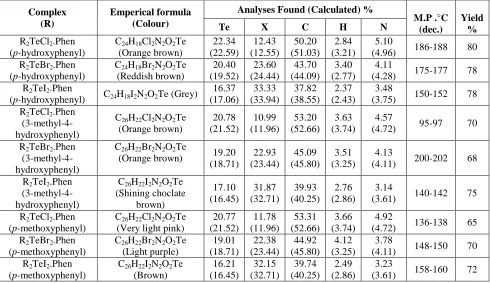
All the complexes have been analysed for their tellurium, halogen, C, H, N contents and the analytical data are presented in Table-1.
571
Conductance and cryoscopic studies
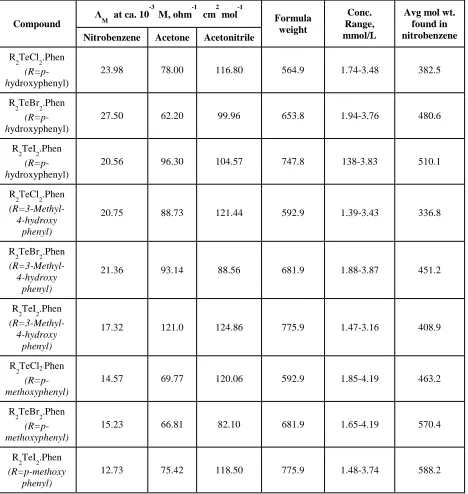
[image:3.595.69.559.155.438.2]The molar conductance and cryoscopic data for 1,10-phenanthroline complexes are presented in Table 2.
Table 1. Analytical data, physical properties and yields for 1, 10-phenanthroline complexes
Complex (R)
Emperical formula (Colour)
Analyses Found (Calculated) %
M.P .°C (dec.)
Yield %
Te X C H N
R2TeCl2.Phen
(p-hydroxyphenyl)
C24H18Cl2N2O2Te
(Orange brown) 22.34 (22.59) 12.43 (12.55) 50.20 (51.03) 2.84 (3.21) 5.10
(4.96) 186-188 80 R2TeBr2.Phen
(p-hydroxyphenyl)
C24H18Br2N2O2Te
(Reddish brown) 20.40 (19.52) 23.60 (24.44) 43.70 (44.09) 3.40 (2.77) 4.11
(4.28) 175-177 78 R2TeI2.Phen
(p-hydroxyphenyl) C24H18I2N2O2Te (Grey)
16.37 (17.06) 33.33 (33.94) 37.82 (38.55) 2.37 (2.43) 3.48
(3.75) 150-152 78 R2TeCl2.Phen
(3-methyl-4-hydroxyphenyl)
C26H22Cl2N2O2Te
(Orange brown) 20.78 (21.52) 10.99 (11.96) 53.20 (52.66) 3.63 (3.74) 4.57
(4.72) 95-97 70
R2TeBr2.Phen
(3-methyl-4-hydroxyphenyl)
C26H22Br2N2O2Te
(Orange brown) 19.20 (18.71) 22.93 (23.44) 45.09 (45.80) 3.51 (3.25) 4.13
(4.11) 200-202 68
R2TeI2.Phen
(3-methyl-4-hydroxyphenyl)
C26H22I2N2O2Te
(Shining choclate brown) 17.10 (16.45) 31.87 (32.71) 39.93 (40.25) 2.76 (2.86) 3.14
(3.61) 140-142 75
R2TeCl2.Phen
(p-methoxyphenyl)
C26H22Cl2N2O2Te
(Very light pink)
20.77 (21.52) 11.78 (11.96) 53.31 (52.66) 3.66 (3.74) 4.92
(4.72) 136-138 65 R2TeBr2.Phen
(p-methoxyphenyl)
C26H22Br2N2O2Te
(Light purple) 19.01 (18.71) 22.38 (23.44) 44.92 (45.80) 4.12 (3.25) 3.78
(4.11) 148-150 70 R2TeI2.Phen
(p-methoxyphenyl)
C26H22I2N2O2Te
(Brown) 16.21 (16.45) 32.15 (32.71) 39.74 (40.25) 2.49 (2.86) 3.23
(3.61) 158-160 72
The ΛM values for 1,10-phenanthroline complexes of bis(p-anisyl)tellurium dihalide complexes
in nitrobenzene, acetone and acetonitrile are lower than the values reported [20] for 1 : 1 electrolytes reflecting their partial dissociation or weak electrolyte type behaviour in these solvents. The phenanthroline complexes of bis(hydroxylaryl)tellurium dihalides, where the ΛM
values at ca. 10-3 M in nitrobenzene and acetonitrile are close to the ranges reported for 1 : 1 electrolyte, appear to behave as weak to 1 : 1 electrolyte probably dissociating into (R2TeX.
Phen)+ and X- ions in these solvents. The ΛM values of these phenanthroline complexes in
acetone reflect the weak electrolyte type nature in acetone.
Infra-red Spectra
The IR spectra of phenanthroline adducts are quite complex and therefore, an attempt has been made to identify the donor sites of the ligand by comparing the spectra of the complexes with those of parent diaryltellurium dihalide and phenanthroline.
572
the third region that characteristic ring frequencies of phenanthroline occur. The intense bands at about 1500 cm-1, 1590 cm-1 and 1423 cm-1 are reported [21] to move towards higher frequencies on coordination, the 1423 cm-1 band being least sensitive. This is the υC=N band, which the most workers have reported [1,15,22,23] to shift towards higher frequency upon complexation. The complexes of diaryltellurium dihalides show medium to strong intensity bands around 1601-1655 cm-1, which were not present in the parent R2TeX2. This certainly suggests the linkage of
1,10-phenanthroline molecule to the tellurium atom of R2TeX2through the two nitrogen atoms,
[image:4.595.67.535.225.719.2]thus enhancing the coordination number of tellurium to six in these complexes.
Table 2. Molar conductance and cryoscopic data for 1, 10-phenanthroline complexes
Compound
Λ
M at ca. 10 -3
M, ohm-1 cm2 mol-1 Formula
weight
Conc. Range, mmol/L
Avg mol wt. found in nitrobenzene
Nitrobenzene Acetone Acetonitrile
R
2TeCl2.Phen (R=p-hydroxyphenyl)
23.98 78.00 116.80 564.9 1.74-3.48 382.5
R
2TeBr2.Phen (R=p-hydroxyphenyl)
27.50 62.20 99.96 653.8 1.94-3.76 480.6
R
2TeI2.Phen (R=p-hydroxyphenyl)
20.56 96.30 104.57 747.8 138-3.83 510.1
R
2TeCl2.Phen
(R=3-Methyl-4-hydroxy phenyl)
20.75 88.73 121.44 592.9 1.39-3.43 336.8
R
2TeBr2.Phen
(R=3-Methyl-4-hydroxy phenyl)
21.36 93.14 88.56 681.9 1.88-3.87 451.2
R
2TeI2.Phen (R=3-Methyl-4-hydroxy
phenyl)
17.32 121.0 124.86 775.9 1.47-3.16 408.9
R
2TeCl2.Phen (R=p-methoxyphenyl)
14.57 69.77 120.06 592.9 1.85-4.19 463.2
R
2TeBr2.Phen (R=p-methoxyphenyl)
15.23 66.81 82.10 681.9 1.65-4.19 570.4
R
2TeI2.Phen (R=p-methoxy
phenyl)
12.73 75.42 118.50 775.9 1.48-3.74 588.2
573
Table 3. I R Data for 1,10-phenanthroline complexes
Complex υυυυ
(O-H) υυυυ (C=N) δ (OH) R
2TeCl2.Phen (R=p-hydroxyphenyl) 3400-3200 mb 1634 s 1342 m
R
2TeBr2.Phen (R=p-hydroxyphenyl) 3429-3220 mb 1637 s
1618 m
1340 m
R
2TeI2.Phen (R=p-hydroxyphenyl) 3461-3200 mb 1640 s
1619 m
1344 m
R
2TeCl2.Phen (R=3-Methyl-4-hydroxy
phenyl)
3360-3280 mb 1640 m
1614 m 1601 m
1337 m
R
2TeBr2.Phen (R=3-Methyl-4-hydroxy
phenyl)
3335-3240 mb 1645 m
1615 m
1337 m
R
2TeI2..Phen (R=3-Methyl-4-hydroxy
phenyl)
3409-3240 mb 1615 m 1336 w
R
2TeCl2.Phen (R=p-methoxyphenyl)
-
1653 m
- R
2TeBr2.Phen (R=p-methoxyphenyl)
-
1647 m
- R
2TeI2.Phen (R=p-methoxyphenyl)
-
1655 m
-
[image:5.595.67.550.397.708.2]s = strong, , m = medium, , b = broad
Table 4. 1H NMR data (δδδδ ppm) for 1,10-phenanthroline complexes in DMSO-d6.
Compound Chemical Shift Assignment
N N d a c b b c a d TeCl2 OH HB
HC H
A
2 HB
R2TeCl2.Phen
(R = p-hydroxyphenyl)
6.90d (4H)
7.79d, 7.83m, 8.10d (8H)
8.47d (2H)
9.23d (2H)
9.90b (2H)
HB
Ha, Hb + HA
Hc Hd -OH N N d a c b b c a d TeCl2 CH3 OH HB
HC H A
2
R2TeCl2.Phen
(R = 3-methyl-4-hydroxyphenyl)
2.18s (6H)
6.81, 6.96b (2H)
7.78, 7.91, 8.01 - 8.20cm (8H)
8.74d (2H)
9.23d (2H)
9.69b (2H)
-CH3 protons
HB
Ha, Hb, HC + HA
Hc
Hd
574
N N
d a
c
b b
c
a
d
TeCl2
OH
HB
HA HA
HB
2
R2TeCl2.Phen
(R = p-methoxyphenyl)
3.85s (6H)
7.02d (4H)
7.81-7.84m, 7.91-8.0m (8H)
8.52d (2H)
9.18d (2H)
-OCH3
HB
Ha, Hb, HA
Hc
Hd
s = singlet, b = broad, m = multiplet, cm = complex multiplet, d = doublet
The cryoscopic data of these complexes in nitrobenzene generally support the predictions of conductance measurements.
Proton Magnetic Resonance Spectra
1
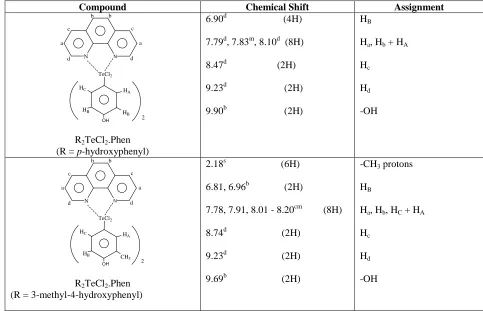
H NMR spectral data for 1,10- phenanthroline complexes are presented in Table 4. 1,10- Phenanthroline shows [24] four sets of two equivalent protons each at δ 7.62 (a), 7.80 (b), 8.26 (c) and 9.21(d) ppm. Upon complexation with R2TeCl2 these are shifted to downfield side,
whereas the aryl protons of diaryltellurium moiety shift to upfield side. The OH protons of hydroxyaryl group in their complexes remains intact, showing its non participation as predicted by IR studies as well. Although a lot of mixing of signals of protons of phenanthroline and diaryl groups takes place, yet independent assignment of downfield proton (Hc and Hd) are possible.
These results of 1H NMR spectra suggest the linkage of phenanthroline to the tellurium atom through nitrogen atoms.
On the basis of above spectral evidences tellurium appears to be hexacoordinated in these phenanthroline complexes, presumably in a distorted octahedral environment.
Acknowledgements
The authors are thankful to Maharshi Dayanand University, Rohtak (India) for providing necessary facilities.
REFERENCES
[1] TN Srivastava; M Singh; HB Singh. Indian J. Chem., 1982, 21A, 307. [2] MV Garad; S Gopinathan; C Gopinathan. Indian J. Chem., 1979, 18A, 267. [3] TN Srivastava; S Mehrotra. Synth. React. Inorg. Met. Org. Chem., 1985, 15, 709. [4] TN Srivastava; AKS Chauhan; GK Mehrotra. Indian J. Chem..1983, 22A, 712. [5] TN Srivastava; P Kumar. Indian J. Chem..1987, 26A, 263.
[6] TN Srivastava; MA Siddiqui; SK Srivastava. Indian J. Chem., 1988, 27A, 550. [7] TN Srivastava; JD Singh. J. Indian Chem. Soc., 1986, 63, 1015.
[8] TN Srivastava, JD Singh; SK Srivastava. Polyhedron,1987, 6, 219. [9] YD Kulkarni; S Srivastava. Indian J. Chem.,1985, 24A, 429.
[10] YD Kulkarni; S Srivastava; SHR Abdi ; M Athar. Synth. React. Inorg. Met. - Org. Chem.,
1985,15, 1043.
[11] YD Kulkarni; S Srivastava; M. Athar. Indian J. Chem., 1985, 24A, 1069. [12] YD Kulkarni; A Rani; RA Siddiqui. J. Indian Chem. Soc.,1992, 69, 353. [13] S Srivastava; DK Soni; HS Gupta. J. Indian Chem. Soc., 1996, 73, 255.
575
[15] KK Verma; Seema; S Chhabra. Phosphorous, Sulfur and Silicon, 2008, 183, 3037-3045. [16] BL Khandelwal; K Kumar; FJ Berry. Inorg. Chim. Acta,,1981, 47, 135-137.
[17] BL Khandelwal; K Kumar; K Raina. Synth. React. Inorg. Met. –Org. Chem., 1981, 11(1), 65-78.
[18] J Bergman. Tetrahedron., 1972, 28, 332.
[19] KJ Irgolic. The Organic Chemistry of Tellurium, Gordon and Breach, New York,1974, 81. [20] WJ Geary. Coord. Chem. Revs.,1971, 7, 81.
[21] AA Schilt; RC Taylor. J. Inorg. Nucl. Chem., 1959, 9, 211. [22] BS Ferth; N Kahlen. J. Organometal. Chem., 1960, 25, 809.
[23] AA Osowole; JAO Woods; OA Odunola. Synth. React. Inorg. Met –Org Chem., 2002, 32, 783.