Social Grid Agents
by
Gabriele Pierantoni
A Thesis submitted to
The University of Dublin
for the degree of
Doctor of Philosophy
Department of Computer Science,
University of Dublin,
Trinity College
Declaration
This thesis has not been submitted as an exercise for a degree at any other University. Except where otherwise stated, the work described herein has been carried out by the author alone. This thesis may be borrowed or copied upon request with the permission of the Librarian, University of Dublin, Trinity College. The copyright belongs jointly to the University of Dublin and Gabriele Pierantoni.
Abstract
The problem of resource allocation in Grid computing has been actively tackled by the scientific community for some years; its complexity is in meeting the expectations of different actors with different concepts of optimality within an environment divided into geographically dispersed and different administrative domains and thus unsuited to supporting centralized management systems. The complexity of the problem is further increased by the fact that the scientific community produced different Grids with different standards, focuses and technologies.
This problem closely resembles that of an economy and has consequently been investigated with economic paradigms, leading to models that are often tailored to one or more specific situation.
This thesis speculates that an approach reflecting the social structures that sup-port economic models could allow different models to co-exist as they do in the real world; this thesis also speculates that a successful solution should be able to encom-pass different Grids both present and future.
In order to achieve this, the modelling of the different actors and their behaviour is inspired by some behaviours that are common in societies; to encompass different grids, the environment of the actors is modelled as a metagrid: a conceptual space divided into three regions: the different existing middlewares, the metagrid region and border regions at the intersection of the two where interoperability issues are tackled by a combination ofabstraction and translation.
The proposed model is based on four different kinds of topologies: a Production Topology where services are performed, a Social Topology where agents that control the production process engage in social and economic processes, a Control Topol-ogy where the agents belonging to the Social Topology control those belonging to the Production Topology, and a Value and Price Topology that connects social and production agents to determine the value and price of a resource.
Social Grid Agents communicate with messages and their behaviour is defined by sets of policies that determine how they relate to each other. The need for an efficient and expressible native language with which the agents express policies and messages led to the decision to use a functional language as a base for the agent’s native language.
Acknowledgements
I would like to dedicate this thesis to ”no frills” flying which allowed me to pursue this research in Trinity College Dublin while still being able to bask (at times) under the plentiful light of my native sky becoming what, for long, I longed for: a European citizen. But, much more importantly and much more gratefully, I dedicate this work to Gaia that, in these years, flew ”without frills” over and over and over with the loving and rocky stubbornness of her people to join me and gaze at the stars under Dobbblin’s cloudless sky.
The person I own more for this research is Dr.Brian Coghlan, my supervisor, whom I thank most sincerely not only for being always of help and guidance in the often hazy routes of this research but especially for demonstrating me that truly admirable work ethics are not just abstract ideas but can be found in real people. His support and help, always generously offered even at the latest hours and from the remotest corners of this little, blue planet, has been a balsm for a cynical and mildly disillusioned Italian such as myself.
I would like to thank sincerely John Walsh who desperately tried (unfortu-nately often failing) to teach me the very basics of system administration and always volunteered his time to help me in both practical and theoretical matters. But I especially want to thank John for two more things: for being a friend in these years and for his most peculiar musical inclinations which strengthened my tolerance and acceptance of diversity.
I want to thank Dr.Eamonn Kenny, the research manager, for his help in mathematics and for the unpredictable paths of our conversations that, oscillating between graph theory to theology, rendered much less boring waiting at airport gates. I want to thank Dr.Stephen Childs, Dr.David O Callaghan, Dr.John Ryan and Dr.Geoffrey Quigley for their help in setting up the experimental testbed. I want to thank Dr.Keith Rochford for the time, always profitable and entertaining, in which we carried out the joint part of this research. I want to thank all the present and past people of the Computer Architecture Group: Kathryn Cassidy, Dr. Soha Maad, Peter Lavin, Simon O’Neil, Dr. Stuart Kenny, Stephan Dudzinky, Ronan Watson and Oliver Lyttleton who where always kind to me, helped whenever was possible and even went through the pains of throwing me a heartening surprise party.
I want to thank my family that had the wiseness (or madness) to support me practically and emotionally in going back to be a student when I had a stable job.
Contents
1 Introduction 1
1.1 Foreword . . . 2
1.2 Grids, Stakeholders and Societies . . . 2
1.3 Description of this work . . . 7
1.4 Main Contributions . . . 8
2 A look at the landscape 10 2.1 Introduction . . . 11
2.2 Resource Allocation Mechanisms . . . 11
2.2.1 Classical Resource Allocation Mechanisms . . . 12
2.2.2 Socially and Economically Inspired Resource Allocation Systems 18 2.3 Interoperability . . . 28
2.3.1 Major current interoperability approaches . . . 29
2.4 Social Grid Agents . . . 31
2.4.1 Optimization . . . 32
2.4.2 Diversity and Interactions . . . 33
2.4.3 Complexity . . . 34
2.5 Motivations . . . 34
3 Methods 36 3.1 Introduction . . . 37
3.2 Social Grid Agents Main Concepts . . . 37
3.2.1 Production . . . 37
3.2.3 Social Topologies . . . 44
3.2.4 Exchange . . . 44
3.2.5 Value and Price . . . 48
3.2.6 Policies and Modalities . . . 50
3.2.7 Additional Social Dimensions . . . 54
3.2.8 Limitations . . . 56
3.3 Topologies . . . 56
3.4 Production Topologies . . . 57
3.4.1 Simple Producer . . . 57
3.4.2 Service Rental . . . 57
3.4.3 The Company . . . 58
3.4.4 The Market . . . 58
3.4.5 Complex production topologies . . . 59
3.5 Social Topologies . . . 60
3.5.1 Simple Relationship . . . 60
3.5.2 Tribe . . . 61
3.5.3 Pub . . . 62
3.5.4 Keynesian Scenario . . . 62
3.6 Control and Ownership Topologies . . . 62
3.7 Value and Price Topologies . . . 63
3.8 Additional Social Dimensions . . . 67
3.8.1 Banking Dimensions . . . 67
3.8.2 Indexing Dimensions . . . 68
3.8.3 Trusting Dimensions . . . 69
3.9 Complex Topologies . . . 69
3.10 A Metagrid Paradigm . . . 71
3.10.1 An abstract view . . . 72
3.10.2 A concrete view . . . 75
3.11 Social Grid Agents and Metagrids . . . 77
3.11.2 Native Agents . . . 78
3.11.3 Discussion . . . 78
3.12 Architecture . . . 79
3.13 Abstract Architecture . . . 80
3.14 Types of agents . . . 81
3.15 Agent anatomy . . . 82
3.15.1 Messages . . . 83
3.15.2 Service Providers . . . 85
3.16 Topologies . . . 93
3.16.1 Simple Purchase . . . 94
3.16.2 Pub Topology . . . 95
3.16.3 Tribe Topology . . . 95
3.16.4 Keynesian Scenario . . . 96
3.17 Appropriate Technologies . . . 97
3.18 Behaviour Policies . . . 97
3.18.1 The Native Language . . . 98
3.18.2 ClassAd and Agents . . . 101
3.18.3 Policy Enforcement . . . 113
4 Implementation and Experiments 116 4.1 Introduction . . . 117
4.2 Past Implementations . . . 117
4.2.1 First Implementation . . . 117
4.2.2 Second Implementation . . . 118
4.2.3 Third Implementation . . . 118
4.2.4 Fourth Implementation . . . 119
4.3 The current prototype . . . 119
4.3.1 A metagrid implementation . . . 120
4.3.2 Implemented Prototypes of Social Grid Agents . . . 122
4.3.3 An example topology . . . 141
4.4 Experiments . . . 156
4.4.1 Reliability and Efficiency . . . 156
4.4.2 Scalability . . . 160
4.4.3 Agent behaviour . . . 168
4.4.4 First behaviour experiment . . . 168
4.4.5 Second behaviour experiment . . . 173
4.4.6 Conclusion . . . 178
5 Conclusions 184 5.1 Evaluation versus core criteria . . . 185
5.2 Evaluation of the technologies used . . . 185
5.2.1 Jar Wars . . . 186
5.3 Evaluation of the architecture . . . 187
5.3.1 Flexible policies . . . 188
5.3.2 Support for multiple middlewares . . . 188
5.3.3 Awareness of self and surroundings . . . 188
5.4 Evaluation of the Prototype . . . 189
5.4.1 Do SGAs degrade the performance of the resources they control ?189 5.4.2 How scalable are SGAs ? . . . 190
5.4.3 How do SGAs behave ? . . . 190
5.4.4 Other questions about the prototype . . . 191
5.4.5 How do SGAs fit into the surveyed Taxonomies ? . . . 192
5.4.6 Relation with related work . . . 193
5.5 Contributions . . . 194
5.6 Future Work . . . 195
5.6.1 Deployment on a Production Infrastructure . . . 195
5.6.2 Additional Services . . . 196
5.6.3 Negotiation Protocols and Service Level Agreements . . . 196
5.6.4 Advanced decision systems . . . 197
5.6.5 Large scale indexes . . . 197
5.6.7 Trust . . . 198
5.6.8 Service Level Agreements . . . 199
5.7 Acknowledgements . . . 199
5.8 Conclusions . . . 200
A Detailed Metrics of Reliability Experiment 201
B Detailed Metrics of the Scalability Experiment on the Concrete
Testbed 205
C Detailed Metrics of the Scalability Experiment on the Synthetic
Testbed 208
D Detailed Metrics of First Behavioural Experiment 213
List of Figures
1-1 In the beginning, It’s hard to see all the bumps. . . 1
2-1 Hoy, hoy, hoy ! Digital land ahead ! . . . 10
2-2 A simplified view of the resource allocation architecture in the gLite middleware. . . 14
2-3 Simple Resource Allocation architecture in the Condor middleware. . 18
2-4 Multiple Resource Allocation architecture in the Condor middleware. 19 3-1 Social Non-Grid Agents exchanging information. . . 36
3-2 Representation of a grid service as a micro-economic supply chain . . 38
3-3 Detail of a grid service production chain . . . 38
3-4 Example of the production paradigm . . . 39
3-5 Example of the production paradigm . . . 40
3-6 Demands and Supplies. . . 45
3-7 Demands and Supplies are disjoint sets . . . 46
3-8 Abundance, Needs are completely covered . . . 46
3-9 Scarcity, Needs cannot be covered . . . 47
3-10 Agent’s topologies . . . 48
3-11 Value and price . . . 50
3-12 Information flows . . . 51
3-13 Policies and modalities . . . 53
3-14 Simple Producer. . . 57
3-15 Service Rental. . . 58
3-17 A company with outsourced services. . . 59
3-18 A Market. . . 59
3-19 A complex production topology. . . 60
3-20 Simple Relationships. . . 61
3-21 Tribe. . . 61
3-22 A pub model. . . 62
3-23 Keynesian Scenario. . . 63
3-24 Example of control topology: simple use. . . 64
3-25 Example of control topology: rent and simple use. . . 64
3-26 Metrics, Value and Price in the different layers. . . 65
3-27 Different approaches to the computation of value and price. . . 66
3-28 A banking extension of an exchange. . . 67
3-29 An indexing extension of an exchange. . . 68
3-30 Different approaches to the computation of value and price. . . 69
3-31 Open and closed economies. . . 70
3-32 A closed, synthetic economy. . . 71
3-33 Connection between a synthetic and real economy. . . 72
3-34 Abstract view of a metagrid. . . 73
3-35 A concrete view of the metagrid . . . 76
3-36 Abstract architecture of the agents. . . 82
3-37 Taxonomy of grid agents. . . 83
3-38 Social and production agents. . . 84
3-39 Agent Architecture. . . 85
3-40 Architecture of the outsourcing mechanism. . . 86
3-41 Different messages exchanged by agents. . . 87
3-42 Different messages exchanged by agents. . . 88
3-43 Agent Behaviour Engine Architecture. . . 89
3-44 Mapping a message to a processor. . . 90
3-45 Example of steps performed by a synchronous processor. . . 91
3-47 Behaviour of an asynchronous processor. . . 93
3-48 The manager. . . 94
3-49 A Pub Topology. . . 96
3-50 A Keynesian Topology. . . 97
3-51 Policies and modalities. . . 108
3-52 Policies and modalities abstraction. . . 110
3-53 Policies and modalities enforcement. . . 113
4-1 It’s a dirty job but someone has to do it. . . 116
4-2 Architecture of the second prototype. . . 118
4-3 Architecture of the example. . . 120
4-4 Topology of the example. . . 121
4-5 Architecture of the gLite-wms-pga agent. . . 124
4-6 Actions performed by the Asynchronous Job Submission Processor. . 126
4-7 Actions performed by the Policies Processor. . . 127
4-8 Architecture of the gt4-gram-pga agent. . . 129
4-9 Interaction architecture among SGA and Grid4C agents. . . 132
4-10 Architecture of the gLite-wms-sga agent. . . 135
4-11 Actions performed by the Asynchronous Job Purchase Processor. . . 136
4-12 Actions performed by the Policies Processor in the gLite Wms Social Agent. . . 137
4-13 Architecture of a bank agent. . . 139
4-14 Architecture of an indexing agent. . . 140
4-15 Architecture of the example topology. . . 142
4-16 Agent’s interaction under conditions of light workload. . . 143
4-17 Agent’s interactions in a pub topology. . . 144
4-18 Agent’s interactions during the outsourcing process. . . 144
4-19 Policies and modalities enforcement. . . 145
4-20 Subspace defined by the modalities requested by the Client. . . 146
4-21 ClassAd Expression defining the modalities requested by the Client. . 149
4-23 Subspace defined by the social policies. . . 151
4-24 ClassAd expression after the social policies enforcement. . . 152
4-25 ClassAd expression after the production policies mapping. . . 153
4-26 ClassAd expression after the production policies enforcement. . . 154
4-27 Subspace defined by the production policies. . . 154
4-28 Subspace defined by the execution policies. . . 155
4-29 Abstract view of the reliability and efficiency experiments. . . 157
4-30 Abstract view of the reliability and efficiency experiments. . . 159
4-31 Testbed for the scalability experiment. . . 160
4-32 Creation Times for a Large Scale ClassAd Map. . . 166
4-33 Query Times for a Large Scale ClassAd Map. . . 167
4-34 Testbed for the behaviour experiment. . . 168
4-35 Relations among the different metrics of the first behaviour experiment.179 4-36 Main metrics of the first behaviour experiment. . . 180
4-37 Testbed for the second behaviour experiment. . . 181
4-38 Relations among the different metrics of the second experiment. . . . 182
4-39 Main metrics of the behaviour experiment. . . 183
5-1 It’s time to take a look back. . . 184
A-1 Submission reliability of the gLite border. . . 201
A-2 Submission time of the gLite border. . . 202
A-3 Submission efficiency of the gLite border. . . 203
A-4 Execution reliability of the gLite border. . . 204
B-1 Dispatch time of the scalability experiment. . . 205
B-2 Execution time of the scalability experiment. . . 206
B-3 Return time of the scalability experiment. . . 206
B-4 Total time of the scalability experiment. . . 207
C-2 Execution time of the small-scale scalability experiment on the
syn-thetic testbed. . . 209
C-3 Return time of the small-scale scalability experiment on the synthetic testbed. . . 209
C-4 Total time of the small-scale scalability experiment on the synthetic testbed. . . 210
C-5 Dispatch time of the large-scale scalability experiment on the synthetic testbed. . . 210
C-6 Execution time of the large-scale scalability experiment on the syn-thetic testbed. . . 211
C-7 Return time of the large-scale scalability experiment on the synthetic testbed. . . 211
C-8 Total time of the large-scale scalability experiment on the synthetic testbed. . . 212
D-1 Workload. . . 213
D-2 Endowment of SGA1. . . 214
D-3 Endowment of SGA3. . . 215
D-4 Execution tokens granted by PGA2 to SGA1. . . 216
E-1 Workload. . . 217
E-2 Endowment of SGA1. . . 218
E-3 Endowment of SGA3. . . 219
E-4 Endowment of SGA4. . . 220
List of Tables
3.1 ClassAd extension of the Boolean AND function. . . 114
4.1 Action to Provider map in the Job Asynchronous Processor. . . 126
4.2 Actions to Providers map for the Policies Processor. . . 127
4.3 Metrics for gLite Workload Management System. . . 133
4.4 Action to Provider map in the Job Purchase Asynchronous Processor. 137 4.5 Actions to Providers map for the Policies Processor in the gLite Wms Social Agent. . . 138
4.6 Degradation of service on the gLite border (10 consecutive jobs re-peated 5 times). . . 158
4.7 Degradation of service on the gLite border (50 consecutive jobs re-peated 5 times). . . 158
4.8 Degradation of service on the gLite border (100 consecutive jobs re-peated 5 times). . . 158
4.9 Parameters of the scalability experiment. . . 161
4.10 Results of the scalability experiment. . . 162
List of Acronyms
CE Computing Element CPU Central Processor Unit
EERM Economic Enhanced Resource Manager GA Grid Agent
GMD Grid Market Directory
GRAM Grid Resource Allocation Manager GT4 Globus Toolkit 4
JVM Java Virtual Machine
OGSA Open Grid Service Architecture OGSI Open Grid Service Infrastructure OO Object Oriented
OOA Object Oriented Architecture JVM Java Virtual Machine
PGA Production Grid Agent RB Resource Broker
RMS Resource Management System RUS Resource Usage Service
SE Storage Element SGA Social Grid Agent
Chapter 1
[image:18.612.201.427.286.633.2]Introduction
The secret of a good sermon is to have a good beginning and a good ending, then
having the two as close together as possible.
George Burns
1.1
Foreword
One of the first scientific essays I have read describes in its foreword the sense of awe and, at times, even despair that the author felt in discovering the limitless vastitude of its field of enquiry: a cubic millimeter of a turtle’s retina, a truly minuscule entity. Nevertheless, the investigation of that microscopic cube unravelled a universe of unforeseen complexity, a treacherous ford that the author managed at the very end to cross, but just.
Only now can I really understand those words. This enquiry does not even have a cubic millimeter of wonderful, menacing matter to stand upon, nevertheless, travers-ing its maze was difficult.
This voyage starts from the simple wish to improve resource allocation in Grid infrastructures, sets sail to the distant shores of social and economic behaviour and returns at last to the concrete implementation with a still slightly blurred idea of how to make things a bit better.
Is this not, after all, the purpose of every journey ?
1.2
Grids, Stakeholders and Societies
structures to more complex and interconnected ones.
If users and resources are under the same administrative domain, security re-quirements and allocation mechanisms can be defined and enforced directly by the administrator. This arrangement has its strengths in its simplicity but its weakness resides in the fact that the resources of the group must suffice for all possible de-mands of its members. Using again a social example, we can model a department of a university (or a company) under a single administrative domain as a self-sufficient tribe which has to provide all the needed resources; these are shared among their members under the rule of an chieftain. The chieftain of the tribe is analogous to the system administrator (or whoever the system administrator takes orders from) and the resources are not food or shelter but digital resources such as computational time or storage space.
A self-sufficient system can either acquire vast amounts of resources (if it can at all) to cope with all foreseen peaks in demand or else accept that some requirements may not be fulfilled (possibly even threatening survival). An obvious way to overcome such limitations is to share resources among different groups allowing a more stable distribution. One way to do this is by trading resources. Trade allows acquisition of resources but also allows specialization. If actors can trade, they need not bother any more to provide themselves all the possible goods and services because they can be found elsewhere. Trading actors can now concentrate at doing what they are best at and trade for all the rest.
specialization.
Farmers might produce corn and exchange it with fish caught by those living on the shores; fish and corn might be exchanged with game hunted by the tribes of the hills. The department of Astrophysics might have to bother no longer with cumber-some tasks of system administration which might be dealt with by the experts of the Computer Science group. The leaders of the Astrophysics and the Computer Scien-tists might meet and arrange compensation for the Computer ScienScien-tists in exchange for the provided services.
In the simplest case, in a Grid there are three main kind of stakeholders: those who own the resources, those who want to use them and those who are in control of the Virtual Organization that encompasses the first two. The stakeholders owning resources are usually namedResource Owners, the stakeholders that use the resources are usually named Clients or Users while the last are usually named VO Managers. All these stakeholders (or actors) have different and, at times, conflicting goals. In most cases and in absence of other constraints, the clients will be mainly interested in having their jobs run in the fastest possible time, the resource owners will try to have their resources idle for the least possible time and the VO Managers will try to satisfy the requirements of both the resource and job owners that belong to the Virtual Organization. This consideration leads to a first important distinction between the functionalities that are performed and the policies with which they are executed. A request of the execution of a job on a grid specifies as functionalities the executable, inputs, outputs and other parameters while it may specify as policies additional constraints to define time and/or budget for the execution.
de-centralized scheduling system, the execution requests are submitted to different services, each controlled by a resource owner, these systems are best suited to fulfill the preferences of the resource’s users. By combining different systems in multi-layered architectures, it is possible to create hierarchical structures that allow the resource owners to define local allocation policies and the users to avail themselves of the advantages of a centralized system.
The different scheduling approaches reflect the fact that having multiple actors negotiating the allocation and sharing of resources poses a major problem: any one of these actors will have its own (quite often selfish) idea of ”how” resources should be shared, a concept of”optimality” that is frequently clashing with that of others.
This is the very heart of an economy in its broader understanding: ”The ad-ministration of the concerns and resources of any community or establishment with
a view to orderly conduct and productiveness”1
, or better still: ”The science which studies human behaviour as a relationship between ends and scarce means which have
alternative uses” 2
.
This view of the resource allocation problem in Grid Computing is nothing new. The scientific community already investigated and still investigates many ways in which economics could be used to optimize and regulate the way actors with different ideas of ”optimality” share their resources. Economy can be used to describe the theoretical basis of sharing mechanisms and can also be used to investigate how effective a sharing mechanism is. In recent years the scientific community produced both theoretical investigations on the best economic models for the Grid problem and also real systems that use economic principles for resource allocation.
In this thesis I speculate that this economic approach, while profitable and invalu-able, has a shortcoming. Most of these economically inspired systems are tailored to a particular economic perspective: some have centralized planners, others rely en-tirely on free markets, others use economically driven optimization for scheduling. I believe that, as it is in the real world, there is no ”optimal” economic model able to encompass efficiently all the bewildering variety of relations and allocation schemes
1
Oxford English Dictionary - http://dictionary.oed.com/cgi/entry/50071995?
2
of a Grid. It is my belief that a high-level allocation system in Grid computing should allow a variety of allocation philosophies to co-exist and allow transactions that range from competitive to cooperative, from selfish to empathic.
As a matter of fact, the exchange andsharing of computational resources already encompass many different economic philosophies. From charitable empathy-based computation platforms to business-oriented distributed computing (often referred to asCloud Computing); one may argue that the full spectrum and complexity of society and economics is already present in Grid Computing.
The second argument is slightly more subtle. I argue that economies are a product of societies and that they could not exist at all without all the other characteristics of a society. I speculate that economically based solutions will eventually have to face this truth and ”open” themselves both to a larger variety of allocation philosophies and build stronger links to all the other aspects of Grid computing such as user, provider, charitable and miscreant behaviours that constitute the ”other tiles” of the Grid social canvas. In fact, a system capable of encompassing different allocation philosophies must be capable of selecting the type of allocation philosophy depending to its social relations.
For these reasons I define a Social Paradigm to analyze the problem of resource allocation and as an abstract theoretical ground to design prototypical solutions capable of testing, in the experimental sense, different sharing philosophies in different Grid environments.
To tackle the problem posed by the existence of different middlewares I define the environment as a metagrid, a conceptual space encompassing different middlewares. A metagrid space is divided into three different regions.
• Grid and Workflow regions that host different existing middlewares
• The metagrid region where social and economic interactions take place
• Border regions at the intersection of the two where interoperability issues are tackled by a combination of abstraction and translation.
1.3
Description of this work
The structure of this thesis reflects the path from these abstract concepts to a pro-posed prototypical implementation and the experiments thereon.
Chapter 1, Introduction, introduces the basic concepts and the aims of this research. It also describes the architecture of the thesis and summarizes its achieve-ments and contributions.
Chapter 2, A look at the landscape, briefly overviews the work of the scien-tific community relevant to this research: the concept of resource allocation in Grid computing from an abstract and concrete perspective and the different approaches to the problem of interoperability. The chapter introduces the concept of Social Grid Agents, an agent-based system for high-level brokerage in Grid computing and it explains how this paradigm relates to economic concepts such as production and
exchange and to social concepts such as selfishness and empathy.
Chapter 3, Methods, is devoted to the description of the methods followed in this thesis. Firstly it details the social and economic paradigm, then it describes the different topologies in which the agents can be arranged and how different social and economic models can be described in such a way. The problem of interoperability is tackled in a section devoted to the concept ofmetagrid a candidate environment for SGAs. The architecture of the agents is described in a dedicated section and, finally, a section explains the information flows that regulate the behaviour of the agents and how a functional language,ClassAd, is used for this purpose.
Chapter 4, Use Cases and Implementation, details the implementation of the Social Grid Agents prototype from different perspectives: the implemented topologies, the implemented agents and an example of policies. The chapter is con-cluded with a section devoted to experiments that were performed to assess the reliability, scalability and correctness of the agent’s behaviour.
Chapter 5, Conclusions and Future Work, concludes this enquiry and briefly explores possible future research directions.
used by the agents both internally and externally. The two chapters describe each of these topics with an increasing level of detail starting from an abstract perspective to implementation examples.
1.4
Main Contributions
The main aim of this research is a resource allocation system for Grid computing ca-pable of encompassing different allocation philosophies across different middlewares. To design a system capable of encompassing different allocation philosophies I used a social paradigm to try to mimic, in the Grid, some of the social behaviours that, in the real world, allow to humans to act according to different economic philosophies that depend on their social context.
To design a system capable of harnessing different middlewares I used a concept of a metagrid that embraces three different domains: the existing middlewares, bor-der regions where agents act as intermediators and a native metagrid region where agents that belong to different topologies, engage in social and economic relations. The need to deal with both functionalities and policies in a distinct albeit closely intertwined fashion, the impossibility to know at design time which agent will be making a final decision and the infeasibility of the assumption that all the informa-tion will be available to all actors suggested to base the native language of the agents on a functional language to allow delayed evaluation. A functional language widely used in Grid computing called ClassAd was selected as a basis to define a native language that agents use both internally and to communicate among each other. The prototype allowed to test this solution in an environments encompassing three middlewares and to experiment with agents capable of enforcing different, co-existing allocation mechanisms.
The main contribution of Social Grid Agents can be summarized in three broad, different areas
implementing different, and possibly co-existing, allocation mechanisms that can range from cooperation to competition, from unregulated economic-based systems to centralized planning. This agnostic view of the allocation problem allows Social Grid Agents to offers the possibility to instruct agents to expose different behaviours depending on their social context.
• Thanks to the metagrid approach, Social Grid Agents, are capable of harnessing different middlewares; the definition of border regions where interoperability issues that regard both functionalities and policies are tackled by a combination of translation and abstraction performed by border agents allows for the design of stable and flexible interoperability infrastructure
• The use of a functional language such as ClassAd as a basis for the agent’s lan-guage allows the definition of functionalities and policies that can be evaluated in different, potentially unknown a priori, steps and this is a useful feature as it allows the definition of policies that can be enforced in a structure that is not known a priori.
Chapter 2
[image:27.612.144.483.289.527.2]A look at the landscape
It is not from the benevolence of the butcher, the brewer, or the baker that we expect
our dinner, but from their regard to their self-love, and never talk to them of our
own necessities but of their advantages
Adam Smith
If you knew what I know about the power of giving, you would not let a single meal
pass without sharing it in some way
Buddha
The reason that the invisible hand often seems invisible is that it is often not there
Joseph E. Stiglitz
The real voyage of discovery consists not in seeking new landscapes but in having
new eyes.
Marcel Proust
2.1
Introduction
This chapter overviews the related work on the topics investigated in this thesis: the problem of resource allocation and interoperability in Grid computing followed by the motivations and the beliefs that underline this research.
2.2
Resource Allocation Mechanisms
The problem of resource allocation in Grid computing has been actively investigated by the scientific community and consequently the literature regarding this issue is both extremely vast and rich in content.
storage), software services (optionally accessed through licenses) and more complex services such as workflow engines. The environment comprises one or more Grid middlewares and in future might be expected to include a plethora of additional services (indexes, markets and banks) that should eventually connect the user to the resources it needs.
This problem is further complicated by the scarcity of resources (and the conse-quent need of their optimal use) and by the need to meet the user’s satisfaction. This leads to different and often clashing optimization concepts that have to co-exist in the same environment.
Although the various solutions[29],[40] envisaged by the scientific community to tackle the complexities of resource brokerage and allocation in Grids encompass ge-netic algorithms, simulated annealing and hybrid solutions[20], we focus this survey on classical resource allocation approaches as well as on those that are economy-based, ranging from competitive liberalism to cooperation, from uncontrolled markets[29][85] to centralized controlled economies[42][35].
The first part of this literature survey encompasses some ”classic” allocation systems; the second, some based on economic paradigms.
2.2.1
Classical Resource Allocation Mechanisms
A proposal for a taxonomy of resource allocation systems in Grid Computing is described in [49]. This paper concisely describes issues, context and functions of resource allocation systems and offers a taxonomy based on the concepts of grid type, namespace organization, resource dissemination protocols, resource discovery, scheduling model, state estimation and scheduling policy.
Another taxonomy is proposed in [52]. This analysis is based on the definition of an abstract model for a Resource Management System (RMS) and also uses actors that cover the roles of resource requesters, resource providers and resource controllers. RMSs are categorized along different dimensions:
• Resources: how the RMS is related to the resources it manages. This dimension is further decomposed in the following sub-dimensions:
– Resource Model: that can be either based on Schemas (where the de-scription of the resource is expressed in a dede-scription language) or Object Models (where the description of the resource also comprises the actions that can be performed on the resource), both of which can be either fixed or extensible.
– Organization of the Resource’s namespace: that can be relational, hierar-chical or graph-based.
– Quality of Service: that can be either be absent,soft (where attributes of the request can be expressed but not enforced directly by the RMS) and
hard (where the attributes of the request are guaranteed to be met).
– Organization of the store for the resource information: that can either be implemented through Network Directories (such as LDAP [18]) or Dis-tributed Objects (such as CORBA [6]).
– Resource discovery: that is performed either through queries or agents.
– Resource dissemination: that can be either periodic or on demand.
• Scheduling philosophy: that can be centralized, hierarchical or distributed.
• State estimation: that can be either predictive or non predictive.
gLite
In the gLite middleware, the action of matching jobs and resources is performed by the Workload Management System (WMS) [23, 27] where the information on the available resources is matched against the job description.
ClassAd language [80, 79, 81, 56] is used to define aJob Description Language named
JDL[68, 69] that is employed to specify both the requirements of the job owners and the preferences of the resource owners. The description of the jobs and those of the resources are matched in a component of the Workload Management System called the Resource Broker [27, 43].
While the description of the jobs is directly determined by the user, the de-scription of the resources and their status is the result of a gathering and filtering process performed by a multi-layered hierarchical architecture of elements known as
[image:31.612.144.484.303.526.2]BDII [27]. Mutual trust mechanisms between those responsible for the resources and those responsible for the various BDII servers minimize the likelihood of malicious tampering with the information.
Figure 2-2: A simplified view of the resource allocation architecture in the gLite middleware.
To access resources users must possess a valid User Certificate [27] issued by a Certificate Authority [27] that is accepted by the resource providers. With this certificate a user can issue a Proxy Certificate [27] that will be accepted by the resources that are enabled to do so.
The user can define the requirements of its job as a Boolean function (known as
The user can also specify a Rank function to rate different resources. The same can be done by the resource’s owners. Hence gLite can choose resources and jobs that respect the requirements (expressed with the Requirements function) and the preferences (expressed with theRank functions) of both the resource and job owners. The user can query the gLite services for a list of available resources through a
matchmaking operation and then target specifically that resource by specifying it in the requirements field or it can ask the WMS system to find and use an ”optimal” resource by invoking a one-step submit operation.
It is worth noting that the Requirements function defines a sub-space in the space
of the parameters where the requirements of both the user and the resources are met while the Rank function defines an ordering in the parameter space.
gLite also allows a certain degree of a site-level, VO-based fair-share scheduling
as those responsible for the schedulers can implement fair-share policies on systems such as MAUI [15].
Fair-share scheduling [35, 42] entails that all users belonging to the VOs encom-passed in a Grid can receive the services that were agreed upon when they joined the Grid. Although simple in principle this concept is difficult to implement because of the unpredictable and volatile nature of the workloads submitted by the users. An a priori allocation will fail in presence of heavy concurrent requests of resources. Let’s imagine an allocation system where all users are granted the right to consume a given amount of computation over a period of time, if all users concentrate their requests in the same time frame, then it is possible, if not probable at all, that a system will not be able to cope with the demand peak and, consequently, the users will not be able to avail themselves of the share of resources they were granted. The implementation of fair-share policies is further complicated in Grids by the autonomy of the resource owners in the definition and enforcement of local allocation policies.
In gLite, MAUI implements a fair-share policy by setting the amount of waiting time that is then propagated through the BDII hierarchy to the WMS.
spec-ification (thus leaving the WMS to take into account only the requirements of the resource owners). On the other hand the job description may contain very detailed requirements and even target a specific resource.
The taxonomy of [52] describes the gLite middleware with the following char-acteristics: a hierarchical architecture, a hierarchical namespace with an extensible schema model, a network directory store, no explicit QoS support, discovery via dis-tributed queries, periodical push dissemination of the information, and a hierarchical scheduler with extensible policies.
Globus
The Globus GRAM [91] (part of the Globus Toolkit [92]) has a different approach to resource allocation: it offers a sophisticated level of abstraction capable of harnessing different schedulers with an integrated staging system for the job sandboxes1
but it offers no direct brokerage facility.
Jobs are described with the RSL language [93] where the requirements are directly expressed as key-value pairs for parameters. This is a significant difference from the gLite approach where the parameters are indirectly defined as the sub-space where the requirements function evaluates totrue.
The Globus approach explicitly defines a point in the space of the parameters:
p1 = v1 (2.1)
pn = vn (2.2)
pN = vN (2.3)
The gLite approach is to define a subspace:
Requirements = f(p1, pn, pN) (2.4)
1
The two solutions coincide if the gLite Requirements is composed of equivalences, such as:
Requirements = (p1 == v1)&&(pn ==vn)&&(pN ==vN) (2.5)
The taxonomy of [52] describes the Globus middleware with the following char-acteristics: a cell architecture, a hierarchical namespace with an extensible schema model, a network directory store, soft QoS support, periodical push dissemination of the information and a decentralized scheduling infrastructure where the schedulers are provided externally.
Condor
The Condor middleware has an approach that is similar to that of gLite. In fact the ClassAd language used by gLite was originally developed for Condor. One difference between the Condor and gLite middleware is the way in which the information is gathered and published by the resources and the users. While the gLite middleware delegates both the steps of matching and binding the requester and the provider to the WMS component, the Condor architecture is more flexible, allowing the two steps to be separated. This is achieved by specifying different protocols.
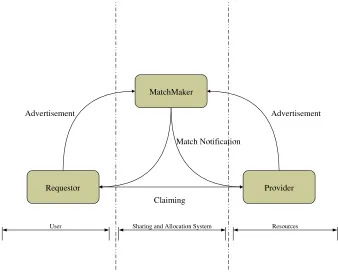
A simple allocation scenario in a Condor system is described in Figure 2-3. Firstly theProvider and theRequestor advertise the description of requests and resources to the Matchmaker. This communication is regulated by a specific advertisement pro-tocol. Once the matchmaker has found a compatible pair of ClassAd advertisements it communicates the match to the requestor and the provider with the notification protocol. Finally, the requestor and the provider may engage in the final binding step through a third protocol known as the binding protocol.
Figure 2-3: Simple Resource Allocation architecture in the Condor middleware.
The taxonomy of [52] describes the Condor middleware with the following charac-teristics: a flat architecture, a hybrid namespace with an extensible schema model, a network directory store, no QoS support, discovery via distributed queries, periodic push dissemination of the information and a centralized scheduler.
2.2.2
Socially and Economically Inspired Resource
Alloca-tion Systems
Chapter 1 introduced the concept that the problem of resource allocation in Grid computing closely resembles the definition of an economy. In fact economic-inspired solutions both at theoretical and practical level are actively investigates and proposed by the Grid community.
Figure 2-4: Multiple Resource Allocation architecture in the Condor middleware.
nevertheless it offers a theoretical and practical approach to understanding the eco-nomics of computers and, although written in a period in which computers were large mainframes, the discussion on pricing models could be extended to the modern scenarios.
In [96] and [97] there is an attempt to analyze the problem of economic-based resources (only cpu and disk space are taken in account) allocation in Grid computing (at times referred to asComputational Economies) both at a theoretical and practical level through simulations. A set of assumptions to use Computational Economics are defined and two main pricing mechanisms: Commodity Market and Auctions
are analyzed in different market conditions. The conclusion of the authors is that, although auction-based systems are widely used (the authors suggest that this is due to the relative simplicity of the implementation of auction-based systems), the commodity market models performs better in most market conditions.
com-puting, the study conducted in [63] contradicts these believes on different counts. The main problems raised by the authors are of different kinds: first General Equi-librium Theory does not offer any explanation for cases in which the markets fail, secondly they highlight the differences between real and computational markets that may result in an even higher probability of failure, lastly the authors point out that General Equilibrium Theory does not take into account aspects such as the role of government policies, the necessity of trust between the agents that are relevant in Grid computing.
[28] and [29] survey the market models that could be possibly be applied to Grid computing. These are deemed to be:
• Commodity Market Model: In such a model the price of a resource is set directly and solely by the owner of the resource. This model encompasses different strategies and algorithms for the definition of the price that can reflect the amount of resources used (that can be frequently adjusted in time to reflect demand and supply or that can be flat and thus remain constant for a period of time).
• Posted Price Model: This model is similar to the Commodity Market with the extension of special offers that a resource provider can post to attract new costumers. Both models are characterized by the fact that the price is set by only one party: the resource owner. In the real world this model is found in supermarkets where the price of each item is defined by the management of the supermarket and remains constant over a reasonable length of time.
• Tendering/Contract-Net Model: In this model the party requesting a resource publishes its requirements and collects offers from the resource owners. It can then rank the offers and choose the one that is most suitable. This model is used in the real world as a way to find and choose contractors.
• Auction Model: The auction model defines a one-to-many negotiation where a party offers resources to many possible buyers. The price that is set during the auction depends on the utility functions of the different actors involved but also depends heavily on the auction rules that are defined and enforced by a third party: theauctioneer. The rules define the auction protocols. Among the most common auction models are:
– English Auction: where all buyers can out-bid each other until only one offers remains.
– First price sealed bid: where all buyers submit their offer just once, without knowing those of the others, and the highest offer is selected.
– Vickery: where all buyers submit their offer just once without knowing those of the others; the winner is the bidder who offered the highest price but the price is the one offered by the second highest bidder.
– Dutch Auction: where a high starting price is set by the auctioneer, who lowers the price until one of the bidders accepts it.
• Community and Coalition Models: In such models the resources are shared among the members of a community from a common pool.
• Bid-based proportional sharing models: In such models the percentage of a resource that each requester can get is a proportion of the price it offered during the bidding process.
DGAS
gLite includes a distributed accounting system called DGAS [21] that is based on a network of accounting units that keep information on groups of users and resources. Classic records (CPU time and memory) are managed by the system, which also supports a limited form of economic accounting for economic brokering.
DGAS implements Resource Usage Service (RUS) [74, 94], which is an OGF [17] initiative to define an accounting system capable of encompassing different middle-wares (gLite using DGAS, SweGrid using SGAS [35, 42], and Unicore[77]) to achieve accounting interoperability.
An extensive survey of accounting in Grid Computing can be found in [70].
SweGrid and SGAS
Globus can be extended with economy-based resources allocation using theSGAS [35, 42] system developed at the Department of Computing Science and HPC2N of Umea University. The SGAS system focuses on interoperability and fair-share allocation. Interoperability is achieved by offering plugin-points for adapters specific to different environments.
SGAS is somehow inspired by a socialist perspective where great importance is attributed to the fairness of the allocation. To achieve this, SGAS implements a centralized economic model where a central authority grants different amounts of credits to the various users of the system.
This solution allows a fair allocation of resources (provided that the central au-thority is fair) in the sense that all users may be given a fair amount of credits; unfortunately, in the absence of a correcting mechanism, there is no guarantee that the credits can be really converted into services.
SGAS successfully tackles this problem by time-stamping the allocation credits and by reducing their validity to a certain time-frame. This discourages clients from hoarding credits and the possibility that they are used all at once.
servers).
SORMA
The SORMA project [19, 64, 65] attempts to adopt self-organization. First it postu-lates three different reasons that prevent effective implementation of market mech-anisms [19]: insufficiencies in the design of Grid markets, poor client support and inadequate connection with existing middleware. The project proposes an economic model calledDecentralized Local Greedy Mechanism inspired by the neo-liberist belief that a population of agents acting in the pursuit of their exclusive self-interest will eventually reach an equilibrium of economic efficiency that no single agent planned for at the beginning.
The model is further enriched in [78] to take SLA agreements into account. An
Economic Enhanced Resource Manager (EERM) uses a predictive model to foresee the impacts on the resources it manages of accepting a certain task. The model uses the concepts ofRevenue (the amount of credits that are to be paid if SLA terms are met), Penalty (the amount of credits that are to be paid if SLA terms are not met) and Gain (the difference between Revenue and Penalty). The EERM will decide whether to violate or not SLA terms, basing its decisions on the foreseen effects on resources and the financial outcome.
SORMA proposes an architecture where a Grid application will connect to a set of intelligent tools. These tools will use the economic knowledge provided by the Open Grid Market (contracts management, billing, security and monitoring) to optimize the Grid resources offered by an Economic Grid Middleware that connects the intelligent tools with the existing resources and enriches the information with economic-specific data.
SORMA implements an economic model that adjusts the amount to be paid according to the effective Quality of Service received by the user. In fact, each time a job is rescheduled, an amount of credits is paid to compensate for the jobs that are delayed.
Architecture and Autonomic Computing link this project philosophy with that of CATNETS discussed in 2.2.2.
ASSESS Grid
The ASSESS Grid project also focuses on solving the issues that arise in the im-plementation of SLAs in Grids. In [2] the shortcomings of SLAs (unwillingness of providers to agree on SLAs knowing that a penalty will have to be paid in case of violation and the uncertainty of users on the real enforcement of SLAs) is mitigated and taken into account in the decision mechanism with the concept of the Proba-bility of Failure (PoF) that describes the likelihood of a SLA to be violated. This information is published with the SLAs and allows for more complex and effective decision-making mechanisms by all the parties involved: users, resource owners and resource brokers.
CATNETS
CATNETS [4, 37] offers a theoretical analysis and simulation experiments of a market model based on the concept of a self-organizing population of agents. This approach is tightly linked to the concept of Service Oriented Architectures (SOA).
The agents used in the simulation are:
• Resource Agents that act as proxies for aggregation of Grid resources.
• Basic Service Agents that provide the Complex Service Agents with the basic service they need.
• Complex Service Agents that provide unspecialized entry points to Grids (they accept any request for a Complex Service) that compose the basic services into ones of higher complexity.
The simulation also encompasses two different types of markets for resources and services. This approach allows the evaluation of a free market allocation topology where no central broker exists.
GESA
The book”A Networking approach to Grid Computing” [57] devotes a chapter to the description of an OGSA-based architecture that supports Grid economic services: the Grid Economic Services Architecture (GESA). The proposal is not tailored to any specific economic model but offers an OGSA-compliant architecture to support different economic models and to build effective, standardized economic-based appli-cations in Grids. The architecture is harmonized with the architectural proposals of several OGF [8] working groups on Resource Usage Services, Grid Resource Alloca-tion Agreement Protocol and Usage Record.
GESA proposes a set of standardized metadata built on top of the OGSA Grid Service interface that describe Service Data Elements (service-specific advertising elements) that enrich the description of a Grid service with economic information such as pricing, currency and payment methods.
GESA architecture is flexible and comprehensive, it describes resources as well as complex payment issues such as compensation, refunding and support for multiple currencies.
The GridBus Project
The GridBus [12] project is the continuation of the Grid Economy Project [9] that produced an economic-aware infrastructure sitting on top of existing middlewares.
The overall architecture is composed of five different layers
• AGrid application layer that hosts the software applications that are executed on the GridBus middleware.
• A Core Grid middleware layer that hosts existing Grid middlewares such as Globus or Unicore alongside economy-specific services such as markets and banks.
• A Grid-Fabric Software layer that hosts Operating Systems (OSs), schedulers such as Condor [5] and the native Libra [14], and other technologies such as the Java Virtual Machine (JVM).
• A Grid-Fabric Hardware layer that hosts physical resources.
Native, economy-aware components are present in all layers except the bottom (Grid-Fabric Hardware) and top (Grid application layer). These are:
• Nimrod-G[16] that allows the economy-aware management of the execution of parameter-sweep applications across distributed computational resources.
• An economy-aware broker[11] that allows the discovery and selection of re-sources on the basis of budget constraint and time-constraint policies.
• A Grid Market Directory (GMD)[10] that allows the providers to publish their services and the related costs to the public. It permits the retrieval of informa-tion through its portal, a SOAP interface or specific APIs.
• A Grid bank that allows accounting, payments and authentication.
• Libra[14] that allows quality-of-service-aware and economic-aware scheduling, execution and monitoring of sequential and parallel jobs on a homogeneous Linux cluster. The job description is enriched by information regarding the allocated budget and the deadline required. This additional information allows the Libra scheduler to implement economy-driven time and budget optimization algorithms whilst respecting the QoS requested by the user.
It is worth noticing that, although the current implementation highlights time and budget constrained allocation modalities, its paradigm and the philosophy underlying its architecture is inspired by a broader analysis of many different economic models, see [28] and [29].
ArguGRID
Although it relies on Peer to Peer computing-oriented resources rather that Grid mid-dleware, the ArguGrid [1, 90] (funded by the European Commission under Framework Programme 6) proposes an interesting agent-based approach. Its design is inspired by Service Oriented Architecture and is based on a set of agents capable ofargumentation
to cope with incomplete knowledge and conflicting information for decision-making. The proposed architecture contains five layers: the topmost consists of user appli-cations that connect with dynamically formed Virtual Organizations of agents hosted in the fourth level. The third level contains middleware and web-services to connect to the second level, which contains the P2P computing networks. The level at the bottom hosts the network.
The most innovative aspect of ArguGrid is in the fourth level where intelligent agents use argumentation to negotiate with each other to produce contracts that describe task allocations and workflow descriptions.
A Trust-aware Economic-based Scheduling Model
Price Elasticity
[55] speculates that time-division based pricing mechanisms, where resources are priced depending on the average use through the day, are not used by the Grid users to their full advantage. To overcome this an economic model is proposed that affects both the behaviour of the user and the provider by introducing a function based on the price-elasticity concept that is used to adjust resource prices. An architecture based on OGSA is then proposed, where components hosted on the user and on the provider adjust pricing mechanisms and object-functions to maximize the user’s satisfaction.
2.3
Interoperability
The scientific community has long sought ways to cope with the challenges of using heterogeneous hardware, operating systems and application-specific software. One of the solutions was the concept ofMetacomputing, ultimately leading toGrid Comput-ing.
never-ending game of coping with the complexities generated by previous solutions, the Grid community is trying to address these new issues with a field of research, known as Grid Interoperability, that focuses on enabling different Grid middlewares to inter-operate with each other, and enabling combined usage of heterogeneous grid middleware.
For one Grid middleware to be able to use the capabilities of another, it must be extended to interface either directly with the other middleware, or with third-party middleware. While it is easier to just support the common services, it may actually be those very Grid-specific extended services that make interoperability desirable.
2.3.1
Major current interoperability approaches
P-Grade
The Hungarian P-GRADE (Parallel Grid Run-time and Application Development Environment) [54, 22, 26] offers an extensive toolset for creating workflows, and with the associated PROVE [75] provides for debugging and monitoring the execu-tion and performance of applicaexecu-tions. P-GRADE is based on GridSphere, a grid-enabled portal construction framework from Poznan. In recent times the support of P-GRADE for different Grid technologies has extended to include Condor, Globus and LCG/EGEE. One of the design goals here was to make it possible for a user to develop a workflow for the Grid without knowing the particulars of the underlying Grid technology and to be able to move the work to other Grids without altering the workflow. The focus is on allowing a user to work at a workflow level and interoperate with multiple middlewares.
GridLab
re-sources, specific libraries, tools, etc. Applications use the GAT through a fixed GAT API. The GAT is designed in a modular plug-and-play manner, such that tools de-veloped anywhere which conform to the GAT API will be inter-operable. In this context, GAT is a third-party middleware through which other middlewares may interoperate.
WLCG
For each pair of Grids, the worldwide WLCG [89] identifies common elements in the software stacks, and develops extra glue components to connect compatible ele-ments. Currently, interoperability between EGEE and OSG is the most developed: bi-directional job submission is possible, OSG sites appear in the EGEE information system and are tested using EGEE test suites. It should be noted that many of the issues involved in providing ongoing interoperation between Grids are administrative rather than technical.
While pragmatic, WLCG’s approach is not scalable, since forN Grids it leads to
≈ N2
extra glue components, i.e. ≈ N2
interoperability solutions.
Grid Interoperability Now (GIN)
OGF’s Grid Interoperability Now (GIN) [86] has identified four interoperability ser-vices that they would like to realise in the short term: authentication/authorization, a resource schema, job submission, and data management. In the longer term, work-flow, co-scheduling and accounting are also envisaged. The GIN group aims to tackle
2.4
Social Grid Agents
Chapter 1 postulated similarities between Grids and societies, in this thesis I explore a high level resource allocation system based on social behaviour and I do so by proposing a social and economic paradigm as an abstract platform upon which an experimental implementation can be constructed.
Grids allow computational resources to be shared in a relatively secure environ-ment. In this respect Grids allow users and resource owners to belong to different administrative domains. The separation of these domains poses many challenges: firstly, there must be a security infrastructure that connects the domains; secondly, (and more importantly for this research) there must be a way to find suitable re-sources across domains. Better still, there ought to be a way to find ”optimal” resources and, conversely, an ”optimal” way to use resources. When resources and users are in the same administrative domain it is relatively easy to define allocation algorithms aiming at the optimization of some metrics but in a system where these domains are disjoint it is even difficult to define what optimal means. These diffi-culties stem from different reasons: firstly, if the preferences of all the actors are to be taken into account by one or more actors when they make their decisions, there must be a homogeneous way of defining them, secondly all the information to be available to all the relevant decision makers and this is hard to achieve on a both practical and theoretical accounts. Information can be outdated when it reaches the relevant decision maker, the amount of information can result far too conspicuous to be handles and, finally, it cannot be assumed that all the involved actors will always be willing to share all their preferences to all the other actors.
in common and it is reasonable to assume that solutions devised for one might also prove profitable for the other. This consideration is at the very base of the desired paradigm.
This thesis speculates that Grids might be seen as ”societies in a digital envi-ronment” where goods and services are exchanged and where actors, either directly controlled by humans or of entirely automatic behaviour, expose social behaviours.
I see the potential similarities between human and grid societies as multi-faceted:
optimization, diversity and complexity.
2.4.1
Optimization
Mankind has developed societies supporting a variety of philosophies of sharing and allocation. How the different actors concur in the definition of the allocation mecha-nism appears to depend on the nature of the society itself: in some all the members contribute almost equally to decisions on allocation parameters, while in more ”auto-cratic” ones only few or even only one of the members will decide (sometimes to their own advantage). The author cannot claim any special expertise in the subject, but to cite John Kenneth Galbraith in his ”History of Economics” [50] and ”The Affluent Society” [41], the allocation mechanisms appear to be based on the current”common wisdom” of that society. Although the research of important pundits (as for example Stiglitz [87, 88]) points out many failures and shortcomings, in one ”common wis-dom” it is believed that ”free market” economics can approach optimal allocations in many (if not most or even all) scenarios.
The debate on the validity and shortcomings of different economic models is also present in Grids as presented in Section 2.2.2, there is no strong consensus on the best model for resource allocation. The theory of General Equilibrium Analysis fails to explain failure in the market system and ignores aspects such as trust and government intervention that are particularly important in Grids.
many scenarios, it seems that free-market allocation cannot even approach optimality without the intervention of a regulatory entity often referred to as the government. Governments are also key players for their capacity in investing in infrastructure that are of common benefit for the entire society. This behaviour of governments, often referred to as Keynesian Investments, will inspire one social topology investigated in this thesis. Investment in public infrastructures is a particularly important topic because many Grid infrastructures are publicly funded.
Human societies appear to have the capability of simultaneously encompassing al-location behaviours based on different (and possibly even contradictory) philosophies and being relatively stable and resilient at the same time.
For the time being, Grids are, fortunately, much simpler than human societies; they nevertheless face a very similar problem: the need to find a resource allocation philosophy that takes into account the different criteria of optimality of the various members. A job owner’s idea of ”optimal execution” will probably differ from that of a resource owner and a Grid that consistently ignores the needs of users or resource owners would soon be deserted by one of the two parties and collapse. As it is in human scenarios, ”free market” economics might approach optimal allocations in some scenarios while co-operative behaviours might be best suited for others. For these reasons I believe that in a Grid actors should be able to concurrently implement a large variety of allocation philosophies in a stable environment.
2.4.2
Diversity and Interactions
2.4.3
Complexity
There are cases of human societies where the emergence of a stable environment for a significant time coincided with an explosive increase in the complexity of the society itself and its products. In its beautiful book Jared Diamond, Arms, Germs and Steel [34], postulates causality: that whenever humans can rely on sufficient resources and social stability, they have the potential to engage in a momentous increase in the complexity of their social structure and of the complexity of their products.
An analogous coincidence is now happening in Grids: stable Grid environments have emerged, and now they are offering services of ever-increasing complexity. The first Grid middlewares offered limited services for job execution and data storage, then workflow engines followed, and currently highly sophisticated services even include semantic descriptions of themselves and complex metadata management.
Moreover, the possibility of harnessing multiple different middlewares (e.g. us-ing P-Grade) allows the creation of even more complex tasks or workflows. The CrossGrid [46] flooding management system [47] is just one enlightening example of a complex and sophisticated system in Grid computing. Examples such as this en-compass and orchestrate many different services that can be arranged in hierarchies of different complexities.
A society-based approach to grid interoperability that yields the concept of a
metagrid is detailed in Section 3.10.
2.5
Motivations
In Grid computing, the economic perspectives and beliefs used to investigate the resource allocation problem are as vast and diverse as those used to interpret real life. This consideration suggests an economic-agnostic approach based on a social paradigm capable of encompassing different economic philosophies to give allocation systems the flexibility to change its behaviour depending on the social context.
present and the belief that full interoperability defined through standardization will not achieved in a short time combined with the increasing complexity of the Grids suggests an technological-agnostic approach based on a metagrid, a conceptual view of interoperability based on the concept of border agents that act as translators and mediators at a technological and logical level.
Chapter 3
[image:53.612.199.427.283.621.2]Methods
Geometry is not true, it is advantageous
Jules H. Poincare I prefer drawing to talking. Drawing is faster, and leaves less room for lies.
Charles-douard Jeanneret-Gris dit ”Le Corbusier”
3.1
Introduction
This chapter begins with the explanation of the main concepts on which Social Grid Agents are based, it then describes the abstract architecture at three different levels: the topologies I used to model the different allocation philosophies, the architecture of the agents and the agent’s native language.