BETWEEN ATOMIC AND NUCLEAR REST
MASSES AND SELF-ORGANIZATION OF
ATOMS AND NUCLEI
F.A. Gareev, G.F. Gareeva and I.E. Zhidkova Joint Institute for Nuclear Research
Dubna, Russia e-mail: [email protected]
(Received 31 August 2007; accepted 7 December 2007)
Abstract
We come to the conclusion that all atomic models based on either the Newton equation and the Kepler laws, or the Maxwell equations, or the Schrodinger and Dirac equations are in reasonable agreement with experimental data. We can only suspect that these equations are grounded on the same fundamental principle(s) which is (are) not known or these equations can be transformed into each other. We proposed a new mechanism of LENR: cooperative processes in the whole system - nuclei+atoms+condensed matter - nuclear reactions in plasma - can occur at smaller threshold energies than the corresponding ones on free constituents. We were able to quan-tize phenomenologically the first time the differences between atomic and nuclear rest masses by the formula (in MeV/c2) ∆M= n
1
1
Introduction
The review of possible stimulation mechanisms of LENR (low en-ergy nuclear reaction) is presented in [2]. We have concluded that transmutation of nuclei at low energies and excess heat are possible in the framework of the known fundamental physical laws the univer-sal cooperative resonance synchronization principle [1], and different enhancement mechanisms of reaction processes [2]. The superlow energy of external fields, the excitation and ionization of atoms may play the role of a trigger for LENR. Superlow energy of external fields may stimulate LENR [3]. We bring strong arguments that the co-operative resonance synchronization mechanisms are responsible for explanation of how the electron volt world can influence the nuclear mega electron volt world [3].
Nuclear physicists are absolutely sure that this cannot happen. Almost all nuclear experiments were carried out in conditions when colliding particles interacted with the nuclear targets which repre-sented a gas or a solid body. The nuclei of the target are in the neutral atoms surrounded by orbital electrons. All existing experi-mental data under such conditions teach us that nuclear low energy transmutations are not observed due to the Coulomb barrier.
LENR with transmutation of nuclei occurs in different condi-tions and different processes (see publicacondi-tions in http://www.lenr-canr.org/ which contain more than 500 papers) but these processes have common properties: interacting nuclei are in the ionized atoms or completely without electrons (bare nuclei). Therefore, LENR with bare nuclei and nuclei in ionized atoms demonstrated a drastically different properties in comparison with nuclei in neutral atoms [1]. This is nuclear physics in condensed matter or in plasma state of matter. For example, the measured half-life [4] for bare187Re75+ of
T1/2 = (32.9±2.0) yr is billion times shorter than that for neutral 187Re.
Natural geo-transmutations of nuclei in the atmosphere and earth are established very well [7, 8, 9]. They occur at the points of a strong change in geo- and electromagnetic fields. Moreover, there are a lot of experimental data [10] that the nuclear fusion and transmutation in biological systems are the real phenomena.
our publications [1, 2, 3, 5] and Shadrin V.N. talk [6]). Nucleons in nuclei and electrons in atoms are nondecomposable into independent motions of nucleons and electrons.
Investigation of this phenomenon requires the knowledge of dif-ferent branches of science: nuclear and atomic physics, chemistry and electrochemistry, condensed matter and solid state physics, as-trophysics, biology, medicine, ...
•The differentiation of science which was rather useful at the be-ginning brings civilization to a catastrophe. Therefore the integration of different branches of science is a question of vital importance.
The puzzle of poor reproducibility of experimental data is the fact that LENR occurs in open systems and it is extremely sensitive to parameters of external fields and systems. The classical reproducibil-ity principle should be reconsidered for LENR experiments. Poor reproducibility and unexplained results do not mean the experiment is wrong. Our main conclusion is: LENR may be understood in terms of the known fundamental laws without any violation of basic physics. The fundamental laws of physics should be the same in micro- and macrosystems.
• LENRs take places in open systems in which all frequencies and phases are coordinated according to the universal cooperative resonance synchronization principle. Poor reproducibility of experi-mental results and extreme difficulties of their interpretation in the framework of modern standard theoretical physics (there are about 150 theoretical models [11] which are not accepted by physical soci-ety) are the main reasons for the persistent nonrecognition of cold fusion and transmutation phenomenon.
Recent progress in both directions is remarkable (see http://www.lenr-canr.org/, http://www.iccf12.org/, http://www.iscmns.org/);in spite of being rejected by physical society, this phenomenon is a key point for further success in the corresponding fundamental and applied re-search. The results of this research field can provide new ecologically pure sources of energy, substances, and technologies.
new possibilities for inducing and controlling nuclear reactions by atomic processes and new interpretation of self-organizations of the hierarchial systems in the Universe including the living cells. How do the atoms and nuclei have their perpetual motions? How is the Universe constructed? How it links the smallest structures in the Universe to the largest? The three questions are interconnected.
Let us start with the description of the hydrogen atom structure in different models using the standard basic physics that is well estab-lished, both theoretically and experimentally in micro- and macrosys-tems.
2
The Bohr Model
At the end of the 19th century it was established that the radi-ation from hydrogen was emitted at specific quantized frequencies. Niels Bohr developed the model to explain this radiation using four postulates:
1. An electron in an atom moves in a circular orbit about the nucleus under the influence of the Coulomb attraction between the electron and the nucleus, obeying the laws of classical mechanics.
2. Instead of the infinity of orbits which would be possible in classical mechanics, it is only possible for an electron to move in an orbit for which its orbital angular momentumLis integral multiple of ¯h:
L=n¯h, n= 1,2,3, (1)
3. Despite the fact that it is constantly accelerating, an electron moving in such an allowed orbit does not radiate electromagnetic energy. Thus, its total energyEremains constant.
4. Electromagnetic radiation is emitted if an electron, initially moving in an orbit of total energy Ei, discontinuously changes its motion so that it moves in an orbit of total energyEf. The frequency ν of the emitted radiation is equal to the quantity
νif =Ei−Ef
h , (2)
around proton. The Coulomb force is equal to the centripetal force, according to Newton’s second law
e2
r2 =
mv2
r , (3)
where r is is the radius of the electron orbit, and v is the electron speed. The force is central; hence from the quantization condition (1) we have
L=|~r∗~p|=mvr=n¯h. (4)
After solving equations (3) and (4) we have
v= e 2
n¯h, r= n2¯h2
me2 =n 2a
0. (5)
Following equation (3) the kinetic energy is equal to
Ek= 1 2mv
2= e2
2r, (6)
and hence the total energy is
E=Ek+V = e 2
2r− e2
r =− e2
2r. (7)
Having r from equation (5) one can write the expression for the energy levels for hydrogen atoms
E=− me
4
2¯h2n2; (8)
the same results were further obtained by quantum mechanics. Using the angular momentum quantization condition L =pr = nh/2π and Louis de Broglie’s relationshipp=h/λbetween momen-tum and wavelength one can get
2πr=nλ. (9)
2.1 The Bohr 3th postulate
Let us remember the Bohr 3th postulate:
•Despite the fact that it is constantly accelerating, an electron mov-ing in such an allowed orbit does not radiate electromagnetic energy. Thus, its total energyE remains constant.
The classical electrodynamics law: an accelerating electron ra-diates electromagnetic energies in full agreement with experimental data.
Therefore, Bohr’s postulate asserts that the classical electrody-namics does not work on an atomic scale. Surprisingly, the physical society accepts this postulate which declares that the physical laws in macro- and microworld are different. An electron in the Bohr model rotates around the motionless proton so the proton is a non-active partner. The motion of proton in hydrogen atom was ignored completely – fatal error of the Bohr model.
We are convinced that the physical laws are unique and are the same in different scale systems. The proton and an electron represent two components of the same system – a hydrogen atom. We consider the hydrogen atom as the whole nondecomposable system in which the motions of proton and electron are synchronized. Therefore, if proton stops to move, it should not be allowed for an electron to keep its own motion.
• The hydrogen atom in the ground state does not radiate elec-tromagnetic energy – experimental fact.
It was possible to describe the nonradiation hydrogen atom in the ground state even in 1913 on the basis of classical electrodynamics as the result of standing wave formation in which the motions of proton and electron are synchronized in such a way that the electromagnetic energy flows are equal to zero.
Bohr’s 3rd postulate can be reformulated in the following way:
• The hydrogen atom is an open system in which all frequencies and phases of proton and electron are coordinated according to the universal cooperative resonance synchronization principle.
The formation standing electromagnetic waves with zero energy flows is the main reason of the hydrogen atom stability.
2.2 Bohr’s 4th Postulate
Let us remember the Bohr 4th postulate:
• Electromagnetic radiation is emitted if an electron, ini-tially moving in an orbit of total energy Ei, discontinuously changes its motion so that it moves in an orbit of total en-ergy Ef. The frequency ν of the emitted radiation is equal to the quantity
νif =Ei−Ef
h , (2)
where his Planck’s constant.
The following old Rutherford question is: what is a source of information that an electron knows in advance the value of emitted (absorbed) energy. Rutherford put it in a letter to Bohr:
•How does an electron decide what frequency it is going to vibrate at when it passes from one stationary state to another. It seems to me that you would have to assume that electron knows beforehand where it is going to stop.
The answer is very simple but it was waiting in during 87 years [1].
We consider an electron motion in the one-dimensional infinite potential well whose coordinates are equal toz=−L/2 andz=L/2. Assume that an electron state is a superposition of the ground state and first excited one
ψ(z, t) =ψ1(z, t) +ψ2(z, t),
ψ1(z, t) =A1e−iω1tcosk1z, k1L=π,
ψ2(z, t) =A2e−iω2tcosk2z, k2L= 2π.
It is easy to calculate [14] the average value of az – coordinate elec-tron in one dimension potential:
z=32L 9π2
A1A2
A2 1+A22
Therefore, the average position of a charge oscillates with the frequency of beatingωbeating =ω2−ω1.
• It means that the radiation frequency of the electro-magnetic waves is equal to the beating frequency between the first excited state and the ground state
ωradiation=ωbeating =ω2−ω1,
according to the classical electrodynamics. An electron in the mixed states knows the value of emitted (absorbed) en-ergy in advance which is equal to the beating frequency multiplied by Planck’s constant. This is the resonance pro-cess in which the de Broglie wavelengthλchanges an integer number. Therefore, the de Broglie wavelength plays the role of the standard one. For example, the musical instruments emit the sounds with frequencies that are equal to instru-ments eigenfrequencies. The physical laws should be the same in micro- and macro-world.
The Bohr postulates were completely arbitrary and even violated the well established laws of the classical electrodynamics.
The standard point of view is that the Bohr model is actually accurate only for a one-electron system, see below.
2.3 The Sukhorukov Model – Generalization of the Bohr-Sommerfield Model
The Sukhorukov model [15] is the generalization of the Bohr-Sommerfield model for multi-electron atoms. Atoms have a plane-tary structure. Rydberg’s constant Rinf is the same for all atoms. The ionization potentials have been calculated [16] for 36 chemical elements with accuracy better than 1 eV.
2.4 The Parson Model
2.5 The Lucas Model of Atoms and Nuclei
We quote D.L. Bergman’s conclusion [19]: In 1996, while still a student in secondary school, Joseph Lucas introduced his model of atom [20]. In this model, electrons, protons and neutrons are all based on Bergman’s Spinning Charge Ring Model of Elementary Particles [21, 22] (a refinement of Parson’s Magneton). In terms of its predic-tive ability and conformance with all known experiments, the Lucas Model of the Atom is by far the most successful of all models of the atom ever proposed. It is a physical model that shows where particles are located throughout the volume of the atoms. This model predicts the ”magic numbers” 2,8,18, and 32 of electrons in the filled shells and also able to predict why the Periodic Table of the Elements has ex-actly seven rows. The Lucas model also predicts the structure of the nucleus and correctly predicts thousands of nuclide spins. Boudreaux and Baxter recently have shown that the Lucas model of the nucleus produces more accurate predictions of radioactivity and decay rates than prior models [23].
2.6 The Bergman-Lucas Model for Elementary Particles, Atoms and Nuclei
by the Special Theory of Relativity, but the origin of the effect is en-tirely physical. The model even accounts for the interaction of light and matter, and the physical process for absorption and emission of radiation by an electron is explained from classical electrodynamics. Using a ring particle absorption mechanism, classical explanations are given for black body radiation and photoelectric effect.
2.7 The Hydrogen Atom in Classical Mechanics
Is it possible to understand some properties of a hydrogen atom from classical mechanics ? The Hamiltonian for a hydrogen atom is
H =mprp~˙ 2
2 +
mere~˙ 2
2 −
e2
|~rp−~re|. (10)
All notation is standard. The definition of the center of mass is
mp~rp+me~re= 0, (11)
and the relative distance between electron and proton is
~r=~rp−~re. (12)
Equations (10)-(12) lead to the results:
~rp= me
mp+me~r, ~re=− mp
mp+me~r, (13)
H = µ~r˙ 2
2 −
e2
r, (14)
where
µ= mpme
mp+me. (15)
The Hamiltonian (14) coincides with the Hamiltonian for the ficti-tious material point with reduced massµmoving in the external field
−e2/r. If we known the trajectory of this fictitious particle~r=~r(t) then we can reconstruct the trajectories of electron and proton using equations (13)
~rp(t) = me
mp+me~r(t), ~re(t) =− mp
It is evident from (16) that the proton and electron move in the opposite directions synchronously. So the motions of proton, electron and their relative motion occur with equal frequency
ωp=ωe=ωµ, (17)
over the closed trajectories scaling by the ratio
ve vp =
mp me,
ve vµ =
mµ me,
vµ vp =
mp
mµ. (18)
I.A. Schelaev [25] proved that the frequency spectrum of any mo-tion on ellipse contains only one harmonic.
We can get from (16) that
~
Pp=P , ~~ Pe=−P ,~ (18a)
where –Pi~ =mi~ri˙ . All three impulses are equal to each other in absolute value, which means the equality of
λD(p) =λD(e) =λD(µ) =h/P. (19)
Conclusion:
⊗ Therefore, the motions of proton and electron and their relative motion occur with the same FREQUENCY, IMPULSE (linear mo-mentum) and the de Broglie WAVELENGTH. All motions are syn-chronized and self-sustained. Therefore, the whole system -hydrogen atom nondecomposable into independent motions of proton and elec-tron despite the fact that the kinetic energy ratio of elecelec-tron to proton is small:
Ek(e)
Ek(p) = 4.46∗10 −4.
It means that the nuclear and the corresponding atomic processes must be considered as a unified entirely determined whole process as the motions in the Solar system (remember the Moon faces the Earth without changing its visible side, the same case is in hydrogen atoms for protons and electrons)
H
a = 2.6∗10
14,
and water wave lengths λ on the surface of a lake in terms of the Bohr radius is equal to
λ
a ≈2π∗10
7.
• The greatness of mountains, the finger sized drop, the shiver of a lake, and the smallness of an atom are all related by simple laws of nature Victor F. Weisskopf [47].
2.8 The Gareev Model
Let us introduce the quantity f = rv which is the invariant of motion, according to the second Kepler law, then
µv= µvr
r =
µf
r , (20)
and we can rewrite equation (14) in the following way:
H = µf 2
2r2 −
e2
r. (21)
We can obtain the minimal value of (21) by taking its first deriva-tive over r and setting it equal to zero. The minimal value occurs at
r0=
µf2
e2 , (22)
and the result is
Hmin=Emin=− e
4
2µf2. (23)
The values of invariant of motionµf (in MeV*s) can be calculated from (23) if we require the equality of Emin to the energy of the ground state of a hydrogen atom
µf =µvr= 6.582118∗10−22
Conclusion:
⊗ The Bohr quantization conditions were introduced as a hypothe-sis. We obtain these conditions from a classical Hamiltonian requiring its minimality. It is necessary to strongly stress that no assumption was formulated about trajectories of proton and electron. We re-produced exactly the Bohr result and modern quantum theory. The Plank constant ¯his the Erenfest adiabatic invariant for a hydrogen atom: µvr= ¯h.
Let us briefly review our steps:
•We used a well established interaction between proton and elec-tron.
• We used a fundamental fact that the total energy=kinetic en-ergy+potential energy.
• We used the second Kepler law.
•We used usual calculus to determine the minimum values ofH.
• We required the equality of Emin to the energy of the ground state of hydrogen atom.
Classical Hamiltonian + classical interaction between proton and electron + classical second Kepler law + standard variational calcu-lus – these well established steps in macrophysics reproduce exactly results of the Bohr model and modern quantum theory (Schrodinger equation) – results of microphysics. We have not done anything spec-tacular or appealed to any revolutionary and breakthrough physics.
2.9 The Gryzinski model
In this subsection we shortly highlighted a very important re-sults (which were entirely ignored and forgotten despite that these papers were published in famous peer-reviewed journals) obtained by M. Gryzinski [26] on the basis of the Newton equation with well es-tablished Coulomb interactions. M. Grysinski pointed out that there was a lot of arguments that classical dynamics at the atomic level work, and that the concept of a localized electron was abandoned too early. It is a very interesting to bring some of his quotations (http://www.iea.cyf.gov.pl/gryzinski/misiek.html):
his famous inequality, dynamical considerations initiated by works of Thomson [27] and Rutherford [28] have disappeared from atomic physics almost completely. It was a result of a highly restrictive form of both the principles.
The author ignoring these principles turned back in 1957 to the old idea of a localized electron and showed that the classical collision theory developed on the basis of a classical two body problem worked [29].
On the basis of the Newton equation of motion and Coulomb low there were accurately described:
1. Collisional ionization and excitation of atoms and molecules [30],
2. Ramsauer effect and Vander Waals forces [31, 32],
3. Atomic diamagnetism [33] and atomic energy level shifts [34], 4. Electronic structure of He+
2 [35] as well as dynamical nature of a covalent bond [36].
M. Gryzinski [26] proved that atoms have the quasi-crystal struc-ture with definite angles: 90◦, 109◦ and 120◦ which are the well-known angles in crystallography.
2.10 The Gudim-Andreeeva Model
Authors of [37, 38, 39] propose a classical procedure to calculate the potential energy of electrons in the ground state of atoms using the interaction between an electron and a proton in the form
V =−e
2
r + ¯ h2 2mr2.
They were able to calculate the ground state energies for six lightest atoms in the reasonable agreement with experimental data.
2.11 The Huang Model
We should like to highlight of results obtained by X. Q. Huang [40] using the classical electromagnetic field theory.
• X.Q. Huang wrote [40]:
We study the energy conversion laws of the macroscopic harmonicLC
oscillator, the electromagnetic wave (photon) and the hydrogen atom. As our analysis indicates that the energies of these apparently differ-ent systems obey exactly the same energy conversion law. Based on our results and the wave-particle duality of electron, we find that the atom in fact is a natural microscopicLC oscillator. In the framework of classical electromagnetic field theory we analytically obtain, for the hydrogen atom, the quantized electron atom orbit radiusrn=a0n2, and quantized energy En = −RHhc/n2,(n = 1,2,3, ..), where a
0 is the Bohr radius and RH is the Rydberg constant. Without any adaptation of the quantum theory, we present a reasonable explana-tion of the polarizaexplana-tion of photon, the Zeeman effect, Selecexplana-tion rules and Pauli exclusion principle. Our results show that the concept of electron spin is not the physical reality and should be replaced by the intrinsic characteristic of the helical moving electron (Left-hand and Right-hand). In addition, a possible physical mechanism of su-perconductivity and a deeper physical understanding of the electron mass are also provided.
X.Q. Huang considered in first time the hydrogen atom as a natu-ral microscopicLCoscillator and he obtained the results in excellent agreement with the Bohr model and quantum mechanical theory.
2.12 The Mills Model
This leads to a physical model of subatomic particles, atoms, and molecules.
Equations are closed-form solutions containing fundamental con-stants only and agree with experimental observations. The calculated energies from exact solutions of one through twenty-electron atoms are available from the internet [43].
• R.L. Mills came to the conclusion: for 400 atoms and ions the agreement between the predicted and experimental results is remark-able. Other problems exactly solved as further tests of CQM are the anomalous magnetic moment of the electron, the Lamb Shift, the fine structure and superfine structure of the hydrogen atom, the superfine structure intervals of positronium and muonium. The agreement be-tween observations and predictions based on closed-form equations with fundamental constants only matches the limit permitted by the error in the measured fundamental constants.
The solution of the nature of the electron and photon for the first time also allow for exact solutions of excited states. For ever 100 excited states of the helium atom, the r-squared value is 0.999994, and the typical average relative difference is about 5 significant figures which is within the error of the experimental data.. Using only the Coulomb energy at the calculated radii, the agreement is remarkable. These results demonstrate the predictive power of CQM that further provides the nature of and conditions to form lower-energy states of hydrogen which are also based on electron-photon interactions.
• Conclusion: Splendidly, all atomic models based on either the Newton equation and the Kepler laws or the Maxwell equations, or the Schrodinger and Dirac equations achieved agreement with exper-imental data.
We can only suspect that these equations are grounded on the same fundamental principle(s) which is (are) not known or these equations can be transformed into each other. R.D. Feynman [44] proved the Maxwell equations assuming only Newton’s law of motion and the commutation relation between the position and velocity for a single nonrelativistic particle. The Dirac equation can be rewritten in the Maxwell equations form [45] and the Schrodinger equation can be obtained from Newtonian mechanics [46].
We think that the laws in macro- and microworld are the same.
2.13 The Gareev Model. Nuclei, Atoms, Molecules, Bio -molecules, Chrystalls,... as Open Coupled Resonators
Detailed description of this model the reader can found in [1, 3, 5]. 1) LENR may be understood in terms of the known fundamental laws without any violation of the basic physics. The fundamental laws of physics should be the same in micro- and macrosystems.
2)Weak and electromagnetic interactions may show a strong in-fluence of the surrounding conditions on the nuclear processes.
3)The conservation laws are valid for closed systems. Therefore, the failure of parity in weak interactions means that the correspond-ing systems are open systems. Periodic variations (24 hours, 27, and 365 days in beta-decay rates indicate that the failure of parity in weak interactions has a cosmophysical origin. Modern quantum theory is the theory for closed systems. Therefore, it should be reformulated for open systems. The closed systems are idealization of nature, they do not exist in reality.
4)The universal cooperative resonance synchronization principle is a key issue to make a bridge between various scales of interactions and it is responsible for self-organization of hierarchical systems in-dependent of substance, fields, and interactions. We give some ar-guments in favor of the mechanism ORDER BASED on ORDER, declared by Schrodinger in [12], a fundamental problem of contem-porary science.
6)First of all, the structure of a hydrogen atom should be estab-lished. Proton and electron in a hydrogen atom move with the same frequency that creates attractive forces between them, their motions are synchronized. A hydrogen atom represents the radiating and ac-cepting antennas (dipole) interchanging energies with the surround-ing substance. The sum of radiated and absorbed energy flows by electron and proton in a stable orbit is equal to zero [13] the secret of success of the Bohr model (nonradiation of the electron on a stable orbit). ”The greatness of mountains, the finger sized drop, the shiver of a lake, and the smallness of an atom are all related by simple laws of nature” Victor F. Weisskopf [47].
7)These flows created standing waves due to the cooperative res-onance synchronization principle. A constant energy exchange with substances (with universes) create stable auto-oscillation systems in which the frequencies of external fields and all subsystems are com-mensurable. The relict radiation (the relict isotropic standing waves at T=2.725 K the Cosmic Microwave Background Radiation (CMBR)) and many isotropic standing waves in cosmic medium [53] should be results of self-organization of the stable atoms, according to the universal cooperative resonance synchronization principle that is a consequence of the fundamental energy conservation law. One of the fundamental predictions of the Hot Big Bang theory for the creation of the Universe is CMBR.
8)The cosmic isotropic standing waves (many of them are not discovered yet) should play the role of a conductor responsible for stability of elementary particles, nuclei, atoms,, galaxies ranging in size more than 55 orders of magnitude.
9)The phase velocity of standing microwaves can be extremely high; therefore, all objects of the Universe should get information from each other almost immediately using phase velocity.
external fields? The review of possible stimulation mechanisms is pre-sented in [2, 13]. We will discuss new possibilities to enhance LENR rates in condensed matter.
2.14 The Magarshak model
The Magarshak model was published recently [48]. The abstract and postulates this model are taken from this publication:
As shown recently, the set of electronic configurations of all chemi-cal elements in the subshell partitioning has a four-dimensional struc-ture. Hence, all elements can be subdivided into cycles and su-percycles rather than into periods of the conventional Periodic Ta-ble. Moreover, in the plane of the principal and orbital quantum numbers there is an obvious symmetry between the hydrogen-atom spectrum (one-electron problem) and electronic configurations of all atoms (multi-electron problem). (It seems that this remarkable find-ing was done by Yu. Magarshak [49] first time - our remark.) In order to explain these phenomena, it is hypothesized that between shell electrons and nuclei protons there exists a reversible quantum-field interaction (electron+proton lef trightarrowneutron+neutrino resonance. Even if this interaction were a rare event, it can explain the existence of 4D symmetries mentioned above.Howewer, the model considered here is based on frequent epn interactions, taking place more often than 1015 per second. in this case, epn resonance and resonance between such resonances are supposed to underline the structure of all atoms and molecules. In particular, the functioning of all biological molecules, including electron transfer and enzymatic activity, is determined by resonance, resonance between resonances, hierarchy of resonance, and networks of resonances.
of substance, fields and interactions for microsystem. Thereby, we bring some arguments in favor of the mechanism – ORDER from ORDER, declared by Schrodinger [12], a fundamental problem of contemporary science.
It is interesting the quotation from the popular in India Shanti mantra [52]:
(That) Resonance: The same resonance, through resonance, ex-pands resonance. By resonance, supplementing resonance remains ever resonant.
The Magarshak model is formulated a such way that unify elec-trons and nucleons to whole systems –atoms [48]:
RESONANCE MODEL OF THE ATOM
Postulate 1: In atoms, there are no stationary electronic states. Postulate 2: All electrons constituting the shell of the atom are involved in the process with the following basic steps (collectively called resonance path):
i)ψβ capture of a shell electron by the atom nucleus;
ii) electron-proton↔neutron resonance interaction (epn-resonance) of the shell electron with the proton of the nucleus;
iii) by release of the electron from the nuclei and its return to a nonlocalizedψ-state in the shell.
Postulate 3: The physical nature of theψβshell electron capture by the nucleus, and the βψ by electron release from the nucleus is not the same. The ψβ capture takes place owing to the overlap of the electronic ψ-function with the volume occupied by the nucleus. The βψ release of the electron from the nucleus is possible only at energies determined by the Schrodinger equation for the space around the nucleus in which the electronic shell is disposed.
THE RESONANCE NATURE OF THE VALENCE BOND Postulate 1: In the valence interaction between atoms in a molecule, an electron on the shell of one of the atoms is involved in the epn -resonance interaction with a proton in the nucleus of another atom.
Postulate 2: A valence bond is formed owing to jumps of the shell electron between the nuclei connected by the valence bond, and each jump to a certain nucleus is of theepn-resonance nature.
The modern chemical bond models have some well-known diffi-culties which can be solve these problems by the Magarshak model which provide the basis for the formation of not only molecules, but also solids. However, discussion of this problem is beyond the scope of our paper.
3
LENR in Condensed Matter
Modern understanding of the decay of the neutron is
n→p+e−+νe. (25)
The energetics of the decay can be analyzed using the concept of binding energy and the masses of particles by their rest mass energies. The energy balance from neutron decay can be calculated from the particle masses. The rest mass difference ( 0.7823M eV /c2) between neutron and (proton+electron) is converted to the kinetic energy of proton, electron, and neutrino. The neutron is about 0.2% more massive than a proton, a mass difference is 1.29M eV. A free neutron will decay with a half-life of about 10.3 minutes. Neutron in a nucleus will decay if a more stable nucleus results; otherwise neutron in a nucleus will be stable. A half-life of a neutron in nuclei changes dramatically and depends on the isotopes.
The capture of electrons by protons
p+e−→n+νe, (26)
but for free protons and electrons this reaction has never been ob-served which is the case in nuclear+ atomic physics. The capture of electrons by protons in a nucleus will occurs if a more stable nucleus results.
3.1 Cooperative Processes
electron, and antineutrino. In the case of the capture of electrons by protons the quantityQ= 0.7823 MeV is a threshold electron kinetic energy under which the process (26) is forbidden for free proton and electron.
We have formulated the following postulate:
⊗The processes (25) and (26) in LENR are going in the whole system: cooperative processes including all nucleons in nuclei and electrons in atoms, in condensed matter. In these cases a threshold energy Q
can be drastically decreased by internal energy of the whole system or even more – the electron capture by proton can be accompanied by emission of internal binding energy - main source of excess heat phenomenon in LENR.
The processes (25) and (26) are weak processes. A weak interac-tion which is responsible for electron capture and other forms of beta decay is of a very short range. So the rate of electron capture and emission (internal conversion) is proportional to the density of elec-trons in nuclei. It means that we can manage the electron-capture (emission) rate by the change of the total electron density in the nu-clei using different low energy external fields. These fields can play a role of triggers for extracting internal energy of the whole system or subsystems, changing quantum numbers of the initial states in such a way that forbidden transitions become allowed ones. The distances between proton and electron in atoms are of the order 10−6− −10−5 cm and any external field decreasing these distances even for a small value can increase the process (26) in nuclei in an exponential way. Therefore, the influence of an external electron flux (discharge in con-densed matter: breakdown, spark and ark) on the velocity processes (25) and (26) can be of great importance.
The role of external electrons is the same as the catalytic role of neutrons in the case of the chain fission reactions in nuclei – neutrons bring to nuclei binding energies (about 8 MeV) which enhance the fission rates by about 30 orders.
4
Predicted Effects and Experimentum Crucis
regions of a strong change in geo-, bio-, acoustic-,... and electromag-netic fields.
Various electrodynamic processes at thunderstorms are responsi-ble for different phenomena: electromagnetic pulses,γ-rays, electron fluxes, neutron fluxes, and radioactive nuclei fluxes.
4.1 Neutron Production by Thunderstorms
The authors of [59] concluded that a neutron burst is associated with lighting. The total number of neutrons produced by one typical lightning discharge was estimated as 2.5∗1010.
4.2 Production of Radiocarbon and Failing of Radiocarbon Dating
The radiocarbon dating is based on the decay rate of radioactive isotope14Cwhich is believed to be constant irrespective of the phys-ical and chemphys-ical conditions. The half-life of radiocarbon14Cis 5730 years. A method for historical chronometry was developed assuming that the decay ratio of14Cand its formation are constant in time. It was postulated that14C is formed only by the cosmic ray neutrons
14N(n, p)14C. (27)
Radiocarbon dating is widely used in archeology, geology, antiqui-ties,... There are over 130 radiocarbon dating laboratories. The ra-diocarbon method of dating was developed by Willard F. Libby who was awarded the Nobel prize in Chemistry for 1960.
The radiocarbon method does not take into account the following facts which have been established recently:
⊗The neutron production by thunderstorms [59]
⊗The Production of radiocarbon by lighting bolts [57]. Let us consider the reaction
14
7 N+e−→ 14
6 C+νe, (27a)
4.3 Production Radiophosphorus by Thunderstorms
The life-times of32
15Pand3315Pare equal to 14.36 and 25.34 days, respectively. They were found in rain-water after thunderstorms [56]. Production of the radiophosphorus by thunderstorms can be under-stood in the following way:
32
16S+e−→ 32
15P+νe, (28)
33
16S+e−→ 33
15P+νe, (29)
thresholds of these processes are equal to 1.710 and 0.240 MeV, re-spectively. The precipitation of MeV electrons from the inner ra-diation belt [58] and enhancement of the processes by lightning are possible.
4.4 LENR Stimulated by Condensed Matter Discharge
Let us consider the condensed matter discharge (breakdown, spark and arc) using the different electrode. There are the following pro-cesses:
1. The electrode isN i. Orbital or external electron capture 58
28N i(68.27%) +e−→ 58
27Co(70.78days) +νe, (30)
The thresholdQ1= 0.37766keV of this reaction onN ishould be compared with the thresholdQ2= 0.7823 energy for electron capture by free protons: Q2/Q1≈2. The velocity of orbital electron capture can be enhanced by the discharge.
2.Orbital or external electron capture 58
27Co(70.78days) +e−→ 58
26F e(0.28%) +νe, (31)
with emission of energyQ2= 2.30408 MeV. 3. Double orbital or external electron capture
58
28N i(68.27%) + 2e−→ 58
26F e(0.28%) + 2νe, (32)
with emission of energyQ3= 1.92642 mostly by neutrinos.
The proposed cooperative mechanism of LENR in this case can be proved in an extremely simple way: presence of radioactive58
27Co and enriched isotope of58
26F e.
4.5 Neutrinoless Double Beta Decay
As we known [2], the physical roles of electron and neutrino for LENR in condensed matter has not been investigated in detail up to now despite the fact that weak processes in nuclei are well un-derstood. The double beta decay is the rarest spontaneous nuclear transition,in which the nuclear charge changes by two units while the mass number remains the same. Such a case can occur for the iso-baric tripletA(Z, N),A(Z±1, N∓1),A(Z±2, N∓2), in which the middle isobar has a greater rest mass than the extreme ones, and the extremes are the nuclei with the evenZandN. The usual beta-decay transferring a given nucleus into another via an intermediate nucleus is energetically forbidden.
The double beta decay in nuclei can proceed in different modes [60]:
⊗The two neutrinos decay mode 2νββ is
A(Z, N)→A(Z+ 2, N−2) + 2e−+ 2νe, (33)
which is allowed by the Standard Model of particle physics. The total kinetic energy of two emitted electrons present continuous spectra up toEmax.
⊗The neutrinoless mode 0νββ
A(Z, N)→A(Z+ 2, N−2) + 2e−, (34)
which requires violation of a lepton number. The total kinetic energy of two emitted electrons is equal toEmax.
Two neutrinos in the mode 2νββ carry out almost all emitted en-ergies. A fundamental question is: Does the neutrinoless double beta decay exist or not (for the review of the history see [60, 61])?. The emerged energies in the neutrinoless 0νββ mode are easily detected for practical use but these are the rarest spontaneous nuclear tran-sitions (T ≈1018−1030 years). Is it possible to enhance the decay rate?
of beta-decay (capture) the external electron flux with high density, or the laser of high intensity, or any suitable external fields should play this role. Any external field shortening distances between protons in nuclei and electrons in atoms should enhance beta-decay (capture) or double-beta decay (capture).
There is a great number of experiments in Japan, Italy, Russia, US, India, China, Israel, and Canada in which cold transmutations and excess energy were measured (see http://www.lenr-canr.org). In-deed the existence of LENR is now well established but the proposed about 150 theoretical models for interpretation of experimental data are not accepted (A. Takahashi, ICCF12).
It is very popular to use N i, P d, P tand W as electrodes in the condensed matter discharge (breakdown, spark, arc, and explosion) experiments. Let us consider the case ofP delectrodes. The difference of the rest masses are equal
m(110
46 P d)−m( 110
48 Cd) = 1.9989M eV /c 2;
therefore, the external field can open the channel 110
46 P d →11048 Cd withQ= 1.9989 MeV. In the cases N i,P t, andW we have
m(5828N i)−m( 58
26F e) = 1.92642M eV /c 2
,
m(18674 W)−m( 186
76 Os) = 0.47302M eV /c 2
,
m(19878 P t)−m( 198
80 Hg) = 1.05285M eV /c 2
.
The proposed cooperative mechanism of LENR in these cases can be proved in an extremely simple way: presence of enriched isotopes of58
26F e,11048 Cd,18676 Os, and19880 Hgfor the indicated above electrodes. The experimental data [62, 63, 64, 65, 66] seem to confirm such expectations.
Therefore, expensive and time consuming double beta decay periments can be performed in extremely cheap and short-time ex-periments by using suitable external fields. This new direction of re-search can give answers for fundamental problems of modern physics (the lepton number conservation, type of neutrino, neutrino mass spectrum,... ), it can open production of new elements (utilization of radioactive waste) and excess heat without an ecological problem.
between the rest mass130
56 Baand13052 T e, which is equal to 92.55 keV, indicates the possibilities to capture the 4e− cluster by130
56 Ba. It is a full analogy with the Iwamura reactions [67].
5
Quantization of Nuclear and Atomic Rest Masses
Almost all quantomechanical models describe excited states of nuclei, atoms, molecules, condensed matter,... neglecting structure of the ground state of the investigated systems. Therefore, we have very restricted information about the properties of nuclei, atoms,... in their ground states. Note that the mutual influence of the nucleon and electron spin (the superfine splitting), the Mossbauer effect,... are well-known. The processes going in the surrounding matter of nuclei change the nuclear moments and interactions of nucleons in nuclei.
We proved that the motions of proton and electron in the hydro-gen atom in the ground state occur with the same frequency; there-fore, their motions are synchronized. The cooperation in motion of nucleons in nuclei and electrons in atoms in their ground states is still an open problem for nuclei and atoms having many nucleons and electrons, respectively.
• We formulate a very simple and audacious working hypothesis: the nuclear and the corresponding atomic processes must be consid-ered as a unified entirely determined whole process. The nucleons in nuclei and the electrons in atoms form open nondecomposable whole systems in which all frequencies and phases of nucleons and electrons are coordinated according to the universal cooperative resonance syn-chronization principle.
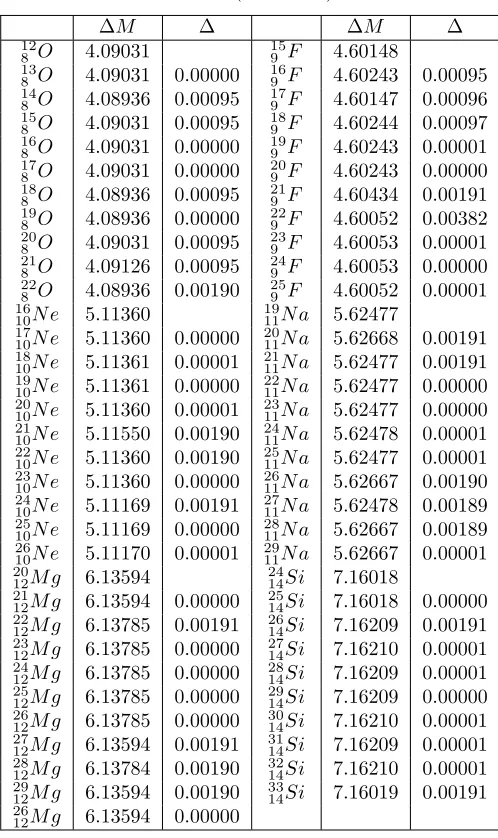
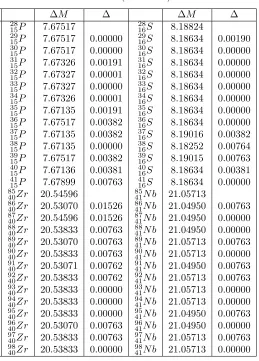
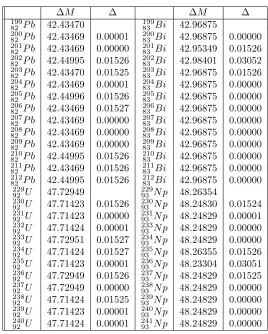
Table 1.
The differences between nuclear and atomic rest masses ∆M(Z, A) =Matom(Z, A)−Mnuclei(Z, A), ∆ = ∆M(Z, A)−∆M(Z, A−1), inM eV /c2
∆M ∆ ∆M ∆
1
1H 0.51099 2
1H 0.51105 0.00006 32He 1.02187 3
1H 0.51117 0.00012 42He 1.02210 0.00023 4
1H 0.51093 0.00024 52He 1.02186 0.00024 4
3Li 1.53327 62He 1.02186 0.00000
5
3Li 1.53351 0.00024 72He 1.02186 0.00000 6
3Li 1.53255 0.00096 82He 1.02186 0.00000 7
3Li 1.53350 0.00095 92He 1.02139 0.00047 8
3Li 1.53351 0.00001 10
2 He 1.02138 0.00001 9
3Li 1.53256 0.00095 6
4Be 2.04420 75B 2.55537
8
4Be 2.04468 0.00048 85B 2.55537 0.00000 9
4Be 2.04468 0.00000 95B 2.55584 0.00047 10
4 Be 2.04468 0.00000 105 B 2.55489 0.00095 11
4 Be 2.04467 0.00001 115 B 2.55584 0.00047 12
4 Be 2.04373 0.00094 125 B 2.55584 0.00000 13
4 Be 2.04372 0.00001 135 B 2.55585 0.00001 14
4 Be 2.04467 0.00095 145 B 2.55489 0.00096 15
7 B 2.55585 0.00096 8
6C 3.06702 117 N 3.57914
9
6C 3.06702 0.00000 127 N 3.57819 0.00095 10
6 C 3.06701 0.00001 137 N 3.57819 0.00000 11
6 C 3.06702 0.00001 14
7 N 3.57818 0.00001 12
6 C 3.06702 0.00000 15
7 N 3.57818 0.00000 13
6 C 3.06702 0.00000 167 N 3.58819 0.00001 14
6 C 3.06702 0.00000 177 N 3.57818 0.00001 15
6 C 3.06701 0.00001 187 N 3.57818 0.00000 16
6 C 3.06702 0.00001 197 N 3.57818 0.00000 17
6 C 3.06702 0.00000 207 N 3.57628 0.00190 18
6 C 3.06893 0.00191 217 N 3.57818 0.00190 22
Table 1 (continued)
∆M ∆ ∆M ∆
12
8 O 4.09031 159 F 4.60148
13
8 O 4.09031 0.00000 169 F 4.60243 0.00095 14
8 O 4.08936 0.00095 179 F 4.60147 0.00096 15
8 O 4.09031 0.00095 189 F 4.60244 0.00097 16
8 O 4.09031 0.00000 199 F 4.60243 0.00001 17
8 O 4.09031 0.00000 209 F 4.60243 0.00000 18
8 O 4.08936 0.00095 219 F 4.60434 0.00191 19
8 O 4.08936 0.00000 229 F 4.60052 0.00382 20
8 O 4.09031 0.00095 239 F 4.60053 0.00001 21
8 O 4.09126 0.00095 249 F 4.60053 0.00000 22
8 O 4.08936 0.00190 259 F 4.60052 0.00001 16
10N e 5.11360
19
11N a 5.62477 17
10N e 5.11360 0.00000 20
11N a 5.62668 0.00191 18
10N e 5.11361 0.00001 2111N a 5.62477 0.00191 19
10N e 5.11361 0.00000 2211N a 5.62477 0.00000 20
10N e 5.11360 0.00001 2311N a 5.62477 0.00000 21
10N e 5.11550 0.00190 2411N a 5.62478 0.00001 22
10N e 5.11360 0.00190 2511N a 5.62477 0.00001 23
10N e 5.11360 0.00000 2611N a 5.62667 0.00190 24
10N e 5.11169 0.00191 2711N a 5.62478 0.00189 25
10N e 5.11169 0.00000 2811N a 5.62667 0.00189 26
10N e 5.11170 0.00001 2911N a 5.62667 0.00001 20
12M g 6.13594 2414Si 7.16018
21
12M g 6.13594 0.00000 2514Si 7.16018 0.00000 22
12M g 6.13785 0.00191 2614Si 7.16209 0.00191 23
12M g 6.13785 0.00000 27
14Si 7.16210 0.00001 24
12M g 6.13785 0.00000 28
14Si 7.16209 0.00001 25
12M g 6.13785 0.00000 2914Si 7.16209 0.00000 26
12M g 6.13785 0.00000 3014Si 7.16210 0.00001 27
12M g 6.13594 0.00191 3114Si 7.16209 0.00001 28
12M g 6.13784 0.00190 3214Si 7.16210 0.00001 29
12M g 6.13594 0.00190 3314Si 7.16019 0.00191 26
[image:30.595.174.423.196.615.2]Table 1 (continued)
∆M ∆ ∆M ∆
28
15P 7.67517 2816S 8.18824
29
15P 7.67517 0.00000 2916S 8.18634 0.00190 30
15P 7.67517 0.00000 3016S 8.18634 0.00000 31
15P 7.67326 0.00191 3116S 8.18634 0.00000 32
15P 7.67327 0.00001 3216S 8.18634 0.00000 33
15P 7.67327 0.00000 3316S 8.18634 0.00000 34
15P 7.67326 0.00001 3416S 8.18634 0.00000 35
15P 7.67135 0.00191 3516S 8.18634 0.00000 36
15P 7.67517 0.00382 3616S 8.18634 0.00000 37
15P 7.67135 0.00382 3716S 8.19016 0.00382 38
15P 7.67135 0.00000 3816S 8.18252 0.00764 39
15P 7.67517 0.00382 39
16S 8.19015 0.00763 40
15P 7.67136 0.00381 40
16S 8.18634 0.00381 41
15P 7.67899 0.00763 4116S 8.18634 0.00000 85
40Zr 20.54596 8541N b 21.05713 86
40Zr 20.53070 0.01526 8641N b 21.04950 0.00763 87
40Zr 20.54596 0.01526 8741N b 21.04950 0.00000 88
40Zr 20.53833 0.00763 8841N b 21.04950 0.00000 89
40Zr 20.53070 0.00763 8941N b 21.05713 0.00763 90
40Zr 20.53833 0.00763 9041N b 21.05713 0.00000 91
40Zr 20.53071 0.00762 9141N b 21.04950 0.00763 92
40Zr 20.53833 0.00762 9241N b 21.05713 0.00763 93
40Zr 20.53833 0.00000 9341N b 21.05713 0.00000 94
40Zr 20.53833 0.00000 9441N b 21.05713 0.00000 95
40Zr 20.53833 0.00000 9541N b 21.04950 0.00763 96
40Zr 20.53070 0.00763 96
41N b 21.04950 0.00000 97
40Zr 20.53833 0.00763 97
41N b 21.05713 0.00763 98
[image:31.595.170.429.195.556.2]Table 1 (continued)
∆M ∆ ∆M ∆
199
82 P b 42.43470 19983 Bi 42.96875 200
82 P b 42.43469 0.00001 20083 Bi 42.96875 0.00000 201
82 P b 42.43469 0.00000 20183 Bi 42.95349 0.01526 202
82 P b 42.44995 0.01526 20283 Bi 42.98401 0.03052 203
82 P b 42.43470 0.01525 20383 Bi 42.96875 0.01526 204
82 P b 42.43469 0.00001 20483 Bi 42.96875 0.00000 205
82 P b 42.44996 0.01526 20583 Bi 42.96875 0.00000 206
82 P b 42.43469 0.01527 20683 Bi 42.96875 0.00000 207
82 P b 42.43469 0.00000 20783 Bi 42.96875 0.00000 208
82 P b 42.43469 0.00000 20883 Bi 42.96875 0.00000 209
82 P b 42.43469 0.00000 20983 Bi 42.96875 0.00000 210
82 P b 42.44995 0.01526 210
83 Bi 42.96875 0.00000 211
82 P b 42.43469 0.01526 211
83 Bi 42.96875 0.00000 212
82 P b 42.44995 0.01526 21283 Bi 42.96875 0.00000 229
92 U 47.72949 22993 N p 48.26354
230
92 U 47.71423 0.01526 23093 N p 48.24830 0.01524 231
92 U 47.71423 0.00000 23193 N p 48.24829 0.00001 232
92 U 47.71424 0.00001 23393 N p 48.24829 0.00000 233
92 U 47.72951 0.01527 23493 N p 48.24829 0.00000 234
92 U 47.71424 0.01527 23593 N p 48.26355 0.01526 235
92 U 47.71423 0.00001 23693 N p 48.23304 0.03051 236
92 U 47.72949 0.01526 23793 N p 48.24829 0.01525 237
92 U 47.72949 0.00000 23893 N p 48.24829 0.00000 238
92 U 47.71424 0.01525 23993 N p 48.24829 0.00000 239
92 U 47.71423 0.00001 24093 N p 48.24829 0.00000 240
92 U 47.71424 0.00001 241
93 N p 48.24829 0.00000
We demonstrated only a small part of our results in Tables 1. The differences between nuclear and atomic rest masses are quantized: ∆∆M = 0.06, 0.11−0.12, 0.24, 0.47−0.48, 0.94−0.96, 1.89−
1.91, 2.86, 3.81−3.82, 7.62−7.64, 15.25−15.27, 30.50−
30.53keV /c2. The minimal value of the quanta is equal to ∆∆M ≈ 0.06keV /c2.
•The differences of nuclear and atomic rest masses are quantized
[image:32.595.163.431.197.531.2]where M0 ≈0.06keV /c2. It is essential to note that this new phe-nomenological quantization rule of mass differences introduced a sim-ple doubling process of the mass quantaM0. What is a mechanism of such quantization?
5.1 Electron Capture and β-decay
The main quantity which characterizes electron capture and β -decay processes in nuclei is the rest mass differences ∆M(A, Z, Z′ = Z ±1, Z ±2) of the initial and final atoms with the same atomic number.
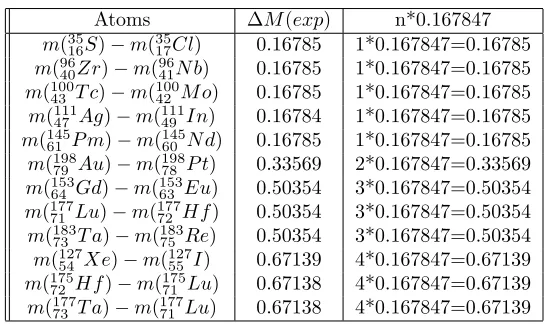
We observed accidentally long time ago (seventies) that some quantities ∆M are the same or their ratios are equal to an integer number for the atoms independent ofAandZ:
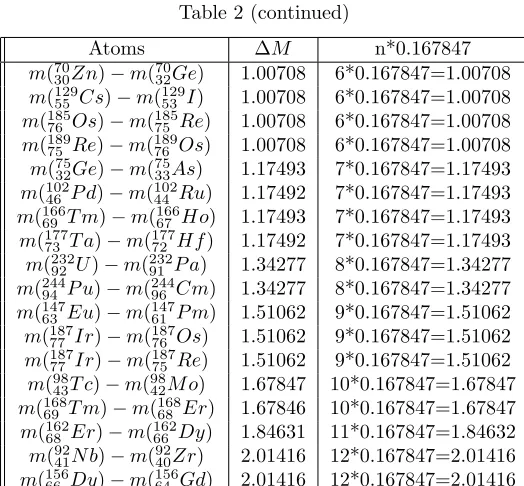
∆M =n∗0.167847, n= 1,2,3, ...12
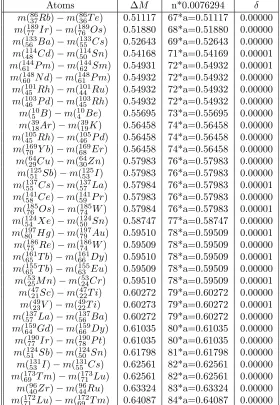
One can see from Table 2 that the quantities δ =| ∆M(exp)−n∗
[image:33.595.161.433.482.644.2]0.167847 | are equal to zero or 0.00001 M eV /c2 within the experi-mental errors.
Table 2.
The differences between atomic rest masses ∆M(exp) =M(A, Z)−M(A, Z′), Z−Z′=±1,±2,
M(theory) =n∗0.167847|.
Atoms ∆M(exp) n*0.167847
m(35
16S)−m(3517Cl) 0.16785 1*0.167847=0.16785
m(96
40Zr)−m(9641N b) 0.16785 1*0.167847=0.16785
m(100
43 T c)−m(10042 M o) 0.16785 1*0.167847=0.16785
m(111
47 Ag)−m(11149 In) 0.16784 1*0.167847=0.16785
m(145
61 P m)−m(14560 N d) 0.16785 1*0.167847=0.16785
m(198
79 Au)−m(19878 P t) 0.33569 2*0.167847=0.33569
m(153
64 Gd)−m(15363 Eu) 0.50354 3*0.167847=0.50354
m(177
71 Lu)−m(17772 Hf) 0.50354 3*0.167847=0.50354
m(183
73 T a)−m( 183
75 Re) 0.50354 3*0.167847=0.50354
m(127
54 Xe)−m( 127
55 I) 0.67139 4*0.167847=0.67139
m(175
72 Hf)−m(17571 Lu) 0.67138 4*0.167847=0.67139
m(177
Table 2 (continued)
Atoms ∆M n*0.167847
m(70
30Zn)−m(7032Ge) 1.00708 6*0.167847=1.00708
m(129
55 Cs)−m(12953 I) 1.00708 6*0.167847=1.00708
m(185
76 Os)−m(18575 Re) 1.00708 6*0.167847=1.00708
m(189
75 Re)−m(18976 Os) 1.00708 6*0.167847=1.00708
m(75
32Ge)−m(7533As) 1.17493 7*0.167847=1.17493
m(102
46 P d)−m(10244 Ru) 1.17492 7*0.167847=1.17493
m(166
69 T m)−m(16667 Ho) 1.17493 7*0.167847=1.17493
m(177
73 T a)−m(17772 Hf) 1.17492 7*0.167847=1.17493
m(232
92 U)−m(23291 P a) 1.34277 8*0.167847=1.34277
m(244
94 P u)−m(24496 Cm) 1.34277 8*0.167847=1.34277
m(147
63 Eu)−m(14761 P m) 1.51062 9*0.167847=1.51062
m(187
77 Ir)−m( 187
76 Os) 1.51062 9*0.167847=1.51062
m(187
77 Ir)−m( 187
75 Re) 1.51062 9*0.167847=1.51062
m(98
43T c)−m(9842M o) 1.67847 10*0.167847=1.67847
m(168
69 T m)−m(16868 Er) 1.67846 10*0.167847=1.67847
m(162
68 Er)−m(16266 Dy) 1.84631 11*0.167847=1.84632
m(92
41N b)−m(9240Zr) 2.01416 12*0.167847=2.01416
m(156
66 Dy)−m(15664 Gd) 2.01416 12*0.167847=2.01416
[image:34.595.166.428.185.428.2]Table 3.
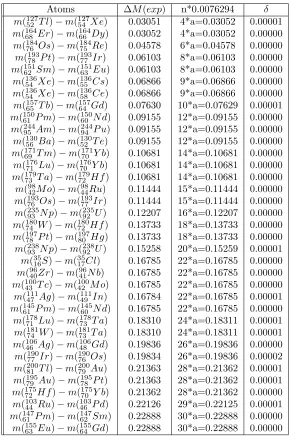
The differences between atomic rest masses ∆M, in M eV /c2
Atoms ∆M(exp) n*0.0076294 δ
m(127
52 T l)−m(12754 Xe) 0.03051 4*a=0.03052 0.00001
m(164
68 Er)−m(16466 Dy) 0.03052 4*a=0.03052 0.00000
m(184
76 Os)−m(18475 Re) 0.04578 6*a=0.04578 0.00000
m(193
78 P t)−m(19377 Ir) 0.06103 8*a=0.06103 0.00000
m(151
62 Sm)−m(15163 Eu) 0.06103 8*a=0.06103 0.00000
m(136
54 Xe)−m(13655 Cs) 0.06866 9*a=0.06866 0.00000
m(136
54 Xe)−m(13658 Ce) 0.06866 9*a=0.06866 0.00000
m(157
65 T b)−m(15764 Gd) 0.07630 10*a=0.07629 0.00001
m(150
61 P m)−m(15060 N d) 0.09155 12*a=0.09155 0.00000
m(244
95 Am)−m(24494 P u) 0.09155 12*a=0.09155 0.00000
m(130
56 Ba)−m( 130
52 T e) 0.09155 12*a=0.09155 0.00000
m(171
69 T m)−m( 171
70 Y b) 0.10681 14*a=0.10681 0.00000
m(176
71 Lu)−m(17670 Y b) 0.10681 14*a=0.10681 0.00000
m(179
73 T a)−m(17972 Hf) 0.10681 14*a=0.10681 0.00000
m(98
42M o)−m(9844Ru) 0.11444 15*a=0.11444 0.00000
m(193
76 Os)−m(19377 Ir) 0.11444 15*a=0.11444 0.00000
m(235
93 N p)−m(23592 U) 0.12207 16*a=0.12207 0.00000
m(180
74 W)−m(18072 Hf) 0.13733 18*a=0.13733 0.00000
m(197
78 P t)−m(19780 Hg) 0.13733 18*a=0.13733 0.00000
m(238
93 N p)−m(23892 U) 0.15258 20*a=0.15259 0.00001
m(35
16S)−m(3517Cl) 0.16785 22*a=0.16785 0.00000
m(96
40Zr)−m(9641N b) 0.16785 22*a=0.16785 0.00000
m(100
43 T c)−m(10042 M o) 0.16785 22*a=0.16785 0.00000
m(111
47 Ag)−m(11149 In) 0.16784 22*a=0.16785 0.00001
m(145
61 P m)−m( 145
60 N d) 0.16785 22*a=0.16785 0.00000
m(178
71 Lu)−m( 178
73 T a) 0.18310 24*a=0.18311 0.00001
m(181
74 W)−m(18173 T a) 0.18310 24*a=0.18311 0.00001
m(106
46 Ag)−m(10648 Gd) 0.19836 26*a=0.19836 0.00000
m(190
77 Ir)−m(19076 Os) 0.19834 26*a=0.19836 0.00002
m(200
81 T l)−m(20079 Au) 0.21363 28*a=0.21362 0.00001
m(195
79 Au)−m(19578 P t) 0.21363 28*a=0.21362 0.00001
m(175
72 Hf)−m(17570 Y b) 0.21362 28*a=0.21362 0.00000
m(103
44 Ru)−m(10346 P d) 0.22126 29*a=0.22125 0.00001
m(147
61 P m)−m(14762 Sm) 0.22888 30*a=0.22888 0.00000
m(155
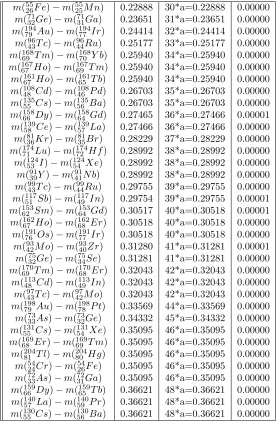
Table 3 (continued).
m(55
26F e)−m(5525M n) 0.22888 30*a=0.22888 0.00000
m(71
32Ge)−m(7131Ga) 0.23651 31*a=0.23651 0.00000
m(194
79 Au)−m(19477 Ir) 0.24414 32*a=0.24414 0.00000
m(96
43T c)−m( 96
44Ru) 0.25177 33*a=0.25177 0.00000
m(168
69 T m)−m( 168
70 Y b) 0.25940 34*a=0.25940 0.00000
m(167
67 Ho)−m(16769 T m) 0.25940 34*a=0.25940 0.00000
m(161
67 Ho)−m(16165 T b) 0.25940 34*a=0.25940 0.00000
m(108
48 Cd)−m(10846 P d) 0.26703 35*a=0.26703 0.00000
m(135
55 Cs)−m(13556 Ba) 0.26703 35*a=0.26703 0.00000
m(158
66 Dy)−m(15864 Gd) 0.27465 36*a=0.27466 0.00001
m(139
58 Ce)−m(13957 La) 0.27466 36*a=0.27466 0.00000
m(81
36Kr)−m(8135Br) 0.28229 37*a=0.28229 0.00000
m(174
71 Lu)−m(17472 Hf) 0.28992 38*a=0.28992 0.00000
m(124
53 I)−m(12454 Xe) 0.28992 38*a=0.28992 0.00000
m(91
39Y)−m(9141N b) 0.28992 38*a=0.28992 0.00000
m(99
43T c)−m(9944Ru) 0.29755 39*a=0.29755 0.00000
m(117
51 Sb)−m(11749 In) 0.29754 39*a=0.29755 0.00001
m(153
62 Sm)−m(15364 Gd) 0.30517 40*a=0.30518 0.00001
m(162
67 Ho)−m( 162
68 Er) 0.30518 40*a=0.30518 0.00000
m(191
76 Os)−m( 191
77 Ir) 0.30518 40*a=0.30518 0.00000
m(93
42M o)−m(9340Zr) 0.31280 41*a=0.31281 0.00001
m(75
32Ge)−m(7534Se) 0.31281 41*a=0.31281 0.00000
m(170
69 T m)−m(17068 Er) 0.32043 42*a=0.32043 0.00000
m(113
48 Cd)−m(11349 In) 0.32043 42*a=0.32043 0.00000
m(97
43T c)−m(9742M o) 0.32043 42*a=0.32043 0.00000
m(198
79 Au)−m(19878 P t) 0.33569 44*a=0.33569 0.00000
m(73
33As)−m(7332Ge) 0.34332 45*a=0.34332 0.00000
m(131
55 Cs)−m(13154 Xe) 0.35095 46*a=0.35095 0.00000
m(169
68 Er)−m(16969 T m) 0.35095 46*a=0.35095 0.00000
m(204
81 T l)−m(20480 Hg) 0.35095 46*a=0.35095 0.00000
m(54
24Cr)−m(5426F e) 0.35095 46*a=0.35095 0.00000
m(72
33As)−m(7231Ga) 0.35095 46*a=0.35095 0.00000
m(159
66 Dy)−m( 159
65 T b) 0.36621 48*a=0.36621 0.00000
m(140
57 La)−m( 140
59 P r) 0.36621 48*a=0.36621 0.00000
m(130
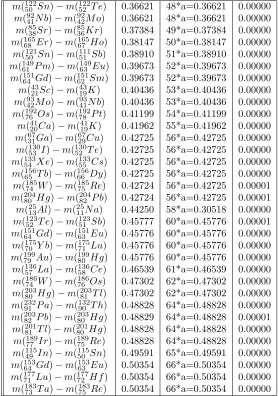
[image:36.595.160.436.202.625.2]Table 3 (continued).
m(122
50 Sn)−m(12252 T e) 0.36621 48*a=0.36621 0.00000
m(92
41N b)−m(9242M o) 0.36621 48*a=0.36621 0.00000
m(85
38Sr)−m(8536Kr) 0.37384 49*a=0.37384 0.00000
m(165
68 Er)−m( 165
67 Ho) 0.38147 50*a=0.38147 0.00000
m(121
50 Sn)−m( 111
51 Sb) 0.38910 51*a=0.38910 0.00000
m(149
61 P m)−m(14963 Eu) 0.39673 52*a=0.39673 0.00000
m(151
64 Gd)−m(15162 Sm) 0.39673 52*a=0.39673 0.00000
m(43
21Sc)−m(4319K) 0.40436 53*a=0.40436 0.00000
m(93
42M o)−m(9341N b) 0.40436 53*a=0.40436 0.00000
m(192
76 Os)−m(19278 P t) 0.41199 54*a=0.41199 0.00000
m(41
20Ca)−m(4119K) 0.41962 55*a=0.41962 0.00000
m(67
31Ga)−m(6729Cu) 0.42725 56*a=0.42725 0.00000
m(130
53 I)−m(13052 T e) 0.42725 56*a=0.42725 0.00000
m(133
54 Xe)−m(13355 Cs) 0.42725 56*a=0.42725 0.00000
m(156
65 T b)−m(15666 Dy) 0.42725 56*a=0.42725 0.00000
m(185
74 W)−m(18575 Re) 0.42724 56*a=0.42725 0.00001
m(204
80 Hg)−m(20482 P b) 0.42724 56*a=0.42725 0.00001
m(25
13Al)−m(2511N a) 0.44250 58*a=0.30518 0.00000
m(123
52 T e)−m( 123
51 Sb) 0.45777 60*a=0.45776 0.00001
m(151
64 Gd)−m( 151
63 Eu) 0.45776 60*a=0.45776 0.00000
m(175
70 Y b)−m(17571 Lu) 0.45776 60*a=0.45776 0.00000
m(199
79 Au)−m(19980 Hg) 0.45776 60*a=0.45776 0.00000
m(136
57 La)−m(13658 Ce) 0.46539 61*a=0.46539 0.00000
m(186
74 W)−m(18676 Os) 0.47302 62*a=0.47302 0.00000
m(203
80 Hg)−m(20381 T l) 0.47302 62*a=0.47302 0.00000
m(232
91 P a)−m(13290 T h) 0.48828 64*a=0.48828 0.00000
m(203
82 P b)−m(20380 Hg) 0.48829 64*a=0.48828 0.00001
m(201
81 T l)−m(20180 Hg) 0.48828 64*a=0.48828 0.00000
m(189
77 Ir)−m(18975 Re) 0.48828 64*a=0.48828 0.00000
m(115
49 In)−m(11550 Sn) 0.49591 65*a=0.49591 0.00000
m(153
64 Gd)−m(15363 Eu) 0.50354 66*a=0.50354 0.00000
m(177
71 Lu)−m(17772 Hf) 0.50354 66*a=0.50354 0.00000
m(183
73 T a)−m( 183
[image:37.595.159.437.203.599.2]Table 3 (continued).
Atoms ∆M n*0.0076294 δ
m(86
37Rb)−m(8636T e) 0.51117 67*a=0.51117 0.00000
m(189
77 Ir)−m(18976 Os) 0.51880 68*a=0.51880 0.00000
m(133
56 Ba)−m(13355 Cs) 0.52643 69*a=0.52643 0.00000
m(114
48 Cd)−m(11450 Sn) 0.54168 71*a=0.54169 0.00001
m(144
61 P m)−m(14462 Sm) 0.54931 72*a=0.54932 0.00001
m(148
60 N d)−m(14861 P m) 0.54932 72*a=0.54932 0.00000
m(101
45 Rh)−m(10144 Ru) 0.54932 72*a=0.54932 0.00000
m(103
46 P d)−m(10345 Rh) 0.54932 72*a=0.54932 0.00000
m(10
5 B)−m(104 Be) 0.55695 73*a=0.55695 0.00000
m(39
18Ar)−m(3919K) 0.56458 74*a=0.56458 0.00000
m(105
45 Rh)−m(10546 P d) 0.56458 74*a=0.56458 0.00000
m(169
70 Y b)−m( 169
68 Er) 0.56458 74*a=0.56458 0.00000
m(64
29Cu)−m( 64
30Zn) 0.57983 76*a=0.57983 0.00000
m(125
51 Sb)−m(12553 I) 0.57983 76*a=0.57983 0.00000
m(137
55 Cs)−m(13757 La) 0.57984 76*a=0.57983 0.00001
m(141
58 Ce)−m(14159 P r) 0.57983 76*a=0.57983 0.00000
m(185
76 Os)−m(18574 W) 0.57984 76*a=0.57983 0.00001
m(124
54 Xe)−m(12450 Sn) 0.58747 77*a=0.58747 0.00000
m(197
80 Hg)−m(19779 Au) 0.59510 78*a=0.59509 0.00001
m(186
75 Re)−m(18674 W) 0.59509 78*a=0.59509 0.00000
m(161
65 T b)−m(16166 Dy) 0.59510 78*a=0.59509 0.00001
m(155
65 T b)−m(15563 Eu) 0.59509 78*a=0.59509 0.00000
m(53
25M n)−m(5324Cr) 0.59510 78*a=0.59509 0.00001
m(47
21Sc)−m(4722T i) 0.60272 79*a=0.60272 0.00000
m(49
23V)−m(4922T i) 0.60273 79*a=0.60272 0.00001
m(137
57 La)−m( 137
56 Ba) 0.60272 79*a=0.60272 0.00000
m(159
64 Gd)−m( 159
66 Dy) 0.61035 80*a=0.61035 0.00000
m(190
77 Ir)−m(19078 P t) 0.61035 80*a=0.61035 0.00000
m(124
51 Sb)−m(12450 Sn) 0.61798 81*a=0.61798 0.00000
m(131
53 I)−m(13155 Cs) 0.62561 82*a=0.62561 0.00000
m(173
69 T m)−m(17371 Lu) 0.62561 82*a=0.62561 0.00000
m(96
40Zr)−m(9644Ru) 0.63324 83*a=0.63324 0.00000
m(172
[image:38.595.158.438.204.609.2]Table 3 (continued).
Atoms ∆M n*0.0076294 δ
m(121
52 T e)−m(12150 Sn) 0.64850 85*a=0.64850 0.00000
m(70
31Ga)−m(7030Zn) 0.64850 85*a=0.64850 0.00000
m(170
68 Er)−m(17070 Y b) 0.65613 86*a=0.65613 0.00000
m(209
82 P b)−m(20983 Bi) 0.65613 86*a=0.65613 0.00000
m(112
49 In)−m(11250 Sn) 0.66376 87*a=0.66376 0.00000
m(127
54 Xe)−m(12753 I) 0.67139 88*a=0.67139 0.00000
m(175
72 Hf)−m(17571 Lu) 0.67138 88*a=0.67139 0.00001
m(177
73 T a)−m(17771 Rh) 0.67138 88*a=0.67139 0.00001
m(196
79 Au)−m(19680 Hg) 0.67139 88*a=0.67139 0.00000
m(54
26F e)−m(5424Cr) 0.67902 89*a=0.67902 0.00000
m(77
35Br)−m(7733As) 0.67902 89*a=0.67902 0.00000
m(138
58 Ce)−m( 138
56 Ba) 0.68664 90*a=0.68665 0.00001
m(149
63 Eu)−m( 149
62 Sm) 0.68665 90*a=0.68665 0.00000
m(173
71 Lu)−m(17370 Y b) 0.68665 90*a=0.68665 0.00000
m(188
77 Ir)−m(18875 Re) 0.68665 90*a=0.68665 0.00000
m(85
36Kr)−m(8537Rb) 0.69428 91*a=0.69428 0.00000
m(127
52 T e)−m(12753 I) 0.70190 92*a=0.70190 0.00000
m(154
63 Eu)−m(15462 Sm) 0.70191 92*a=0.70190 0.00001
m(54
25M n)−m(5426F e) 0.70190 92*a=0.70190 0.00000
m(78
35Br)−m(7836Kr) 0.70190 92*a=0.70190 0.00000
m(180
73 T a)−m(18074 W) 0.71716 94*a=0.71716 0.00000
m(191
78 P t)−m(19176 Os) 0.71717 94*a=0.71716 0.00001
m(113
50 Sn)−m(11348 Cd) 0.71716 94*a=0.71716 0.00000
m(167
67 Ho)−m(16768 Er) 0.73242 96*a=0.73242 0.00000
m(197
78 P t)−m(19779 Au) 0.73242 96*a=0.73242 0.00000
m(52
25M n)−m( 52
23V) 0.74005 97*a=0.74005 0.00000
m(142
59 P r)−m( 142
58 Ce) 0.74768 98*a=0.74768 0.00000
m(125
51 Sb)−m(12552 T e) 0.76294 100*a=0.76294 0.00000
m(95
43T c)−m(9541N b) 0.76294 100*a=0.76294 0.00000
m(201
79 Au)−m(20181 T l) 0.76294 100*a=0.76294 0.00000
m(103
44 Ru)−m(10345 Rh) 0.77057 101*a=0.77057 0.00000
m(105
47 Ag)−m(10545 Rh) 0.77819 102*a=0.77820 0.00001
m(204
[image:39.595.159.439.203.606.2]Table 3 (continued).
Atoms ∆M n*0.0076294 δ
m(106
62 Sm)−m(10663 Eu) 0.80871 106*a=0.80871 0.00000
m(37
18Ar)−m(3717Cl) 0.81635 107*a=0.81635 0.00000
m(134
54 Xe)−m(13456 Ba) 0.82397 108*a=0.89397 0.00000
m(155
65 T b)−m(15564 Gd) 0.82397 108*a=0.89397 0.00000
m(196
80 Hg)−m(19678 P t) 0.82397 108*a=0.89397 0.00000
m(132
56 Ba)−m(13254 Xe) 0.83161 109*a=0.83160 0.00001
m(181
72 Hf)−m(18174 W) 0.83924 110*a=0.83923 0.00001
m(232
90 T h)−m(23292 U) 0.85449 112*a=0.85449 0.00000
m(161
67 Ho)−m(16166 Dy) 0.85450 112*a=0.85449 0.00001
m(180
73 T a)−m(18072 Hf) 0.85449 112*a=0.85449 0.00000
m(54
25M n)−m(5424Cr) 0.86212 113*a=0.86212 0.00000
m(75
34Se)−m( 75
33As) 0.86212 113*a=0.86212 0.00000
m(56
27Co)−m( 56
25M n) 0.86975 114*a=0.86975 0.00000
m(111
49 In)−m(11148 Ag) 0.86976 114*a=0.86975 0.00001
m(128
52 T e)−m(12854 Xe) 0.86976 114*a=0.86975 0.00001
m(58
27Co)−m(5828N i) 0.89264 117*a=0.89264 0.00000
m(84
37Rb)−m(8438Sr) 0.89264 117*a=0.89264 0.00000
m(110
47 Ag)−m(11046 P d) 0.89264 117*a=0.89264 0.00000
m(126
54 Xe)−m(12652 T e) 0.89264 117*a=0.89264 0.00000
m(94
41N b)−m(9440Zr) 0.90027 118*a=0.90027 0.00000
m(109
46 P d)−m(10948 Cd) 0.90027 118*a=0.90027 0.00000
m(195
77 Ir)−m(19577 Au) 0.90027 118*a=0.90027 0.00000
m(69
30Zn)−m(6931Ga) 0.90790 119*a=0.90790 0.00000
m(76
33As)−m(7632Ge) 0.92316 121*a=0.92316 0.00000
m(95
41N b)−m(9542M o) 0.93078 122*a=0.93079 0.00001
m(135
57 La)−m( 135
55 Cs) 0.93078 122*a=0.93079 0.00001
m(143
59 P r)−m( 143
60 N d) 0.93079 112*a=0.93079 0.00000
m(158
65 T b)−m(15866 Dy) 0.94605 124*a=0.94605 0.00000
m(164
67 Ho)−m(16468 Er) 0.96130 126*a=0.96130 0.00000
m(203
82 P b)−m(20381 T l) 0.96131 126*a=0.96130 0.00001
m(159
64 Gd)−m(15965 T b) 0.97656 128*a=0.97656 0.00000
m(131
53 I)−m(13144 Xe) 0.97656 128*a=0.97656 0.00000
m(120
51 Sb)−m(12052 T e) 0.97656 128*a=0.97656 0.00000
m(170
[image:40.595.159.438.202.620.2]Table (continued).
Atoms ∆M n*0.0076294 δ
m(46
20Ca)−m(4622T i) 0.99182 130*a=0.99182 0.00000
m(207
81 T l)−m(20783 Bi) 0.99182 130*a=0.99182 0.00000
m(199
81 T l)−m(19979 Au) 0.99182 130*a=0.99182 0.00000
m(182
75 Re)−m(18273 T a) 0.99182 130*a=0.99182 0.00000
m(167
67 Ho)−m(16768 Er) 0.99182 130*a=0.99182 0.00000
m(164
67 Ho)−m(16466 Dy) 0.99182 130*a=0.99182 0.00000
m(38
19K)−m(3817Cl) 0.99946 131*a=0.99946 0.00000
m(70
30Zn)−m(7032Ge) 1.00708 132*a=1.00708 0.00000
m(129
55 Cs)−m(12953 I) 1.00708 132*a=1.00708 0.00000
m(185
76 Os)−m(18575 Re) 1.00708 132*a=1.00708 0.00000
m(189
75 Re)−m(18976 Os) 1.00708 132*a=1.00708 0.00000
m(181
72 Hf)−m( 181
73 T a) 1.02234 134*a=1.02234 0.00000
m(191
78 P t)−m( 191
76 Os) 1.02234 134*a=1.02234 0.00000
m(50
23V)−m(5024Cr) 1.03760 136*a=1.03760 0.00000
m(111
47 Ag)−m(11148 Cd) 1.03760 136*a=1.03760 0.00000
m(113
50 Sn)−m(11349 In) 1.03759 136*a=1.03760 0.00001
m(121
52 T e)−m(12151 Sb) 1.03760 136*a=1.03760 0.00000
m(138
57 La)−m(13858 Ce) 1.03760 136*a=1.03760 0.00000
m(143
61 P m)−m(14360 N d) 1.05286 138*a=1.05286 0.00000
m(192
77 Ir)−m(19276 Os) 1.05285 138*a=1.05286 0.00001
m(198
78 P t)−m(19880 Hg) 1.05285 138*a=1.05286 0.00001
m(183
73 T a)−m(18374 W) 1.06811 140*a=1.06812 0.00001
m(186
75 Re)−m(18676 Os) 1.06811 140*a=1.06812 0.00001
m(85
38Sr)−m(8537Rb) 1.06812 140*a=1.06812 0.00000
m(101
43 T c)−m(10145 Rh) 1.07574 141*a=1.07575 0.00001
m(149
61 P m)−m( 149
62 Sm) 1.08338 142*a=1.08337 0.00001
m(176
70 Y b)−m( 176
72 Hf) 1.08337 142*a=1.08337 0.00000
m(193
76 Os)−m(19378 P t) 1.08338 142*a=1.08338 0.00001
m(174
72 Hf)−m(17470 Y b) 1.09863 144*a=1.09863 0.00000
m(195
77 Ir)−m(19578 P t) 1.11389 146*a=1.11389 0.00000
m(109
46 P d)−m(10947 Ag) 1.11389 146*a=1.11389 0.00000
m(238
92 U)−m(23894 P u) 1.12916 148*a=1.12915 0.00001
m(104
45 Rh)−m(10444 Ru) 1.13678 149*a=1.13678 0.00000
m(193
[image:41.595.154.440.201.626.2]