DOCTORAL THESIS
A
Study on Ultra-Low Power and
Large-Scale Design of Digital Circuit for
Wireless Communications
Hokkaido University
Mohd Shamian Zainal
The continuous growth of recent mobile and portable devices has caused a push greater towards low-power circuit designs. Various methods and techniques have been found, for
example, the utilization of concurrent or pipeline architecture with low supply voltage for
traditional circuits. Proper designs of subthreshold circuits operating in a weak inversion
region achieves ultra-low threshold and supply voltages and has been studied for both analog and digital circuits.
The analog circuit has been studied and implemented in many areas such as speech signal and image processing. On the other hand, digital circuits have been studied for very
low clock frequency and can be applied in medical devices such as pacemakers and defibrillators. For the idle state of low-power, subthreshold voltage condition has been used
for microprocessors in ultra-low voltage operation and leakage current. The idea to study subthreshold operation comes after much research carried out through conventional
analysis focusing on, for example, low power, low voltage, low frequency, and application in small circuit systems.
Recently, as a result of the aggressive scaling of transistor size for high-performance
applications, not only does subthreshold leakage current increase exponentially, but gate
leakage and reverse-biased source-substrate and drain-substrate junction band-to-band tunneling (BTBT) currents also increase significantly. The tunneling currents are
detrimental to the functionality of the devices. The well-known methods of low-power
design (such as voltage scaling, switching activity reduction, architectural techniques of
pipelining and parallelism, computer-aided design (CAD) techniques of device sizing,
interconnect, and logic optimization). This may not be sufficient in many applications such as portable computing gadgets, and medical electronics, where ultra-low power
consumption with medium frequency of operation is the primary requirement. To cope with
this, several novel design techniques have been proposed. Energy recovery or adiabatic
More recently, the design of digital subthreshold logic was investigated with transistors
operated in the subthreshold region.
The aim of this study is to achieve ultra-low power communication circuits operating
at high frequency. In this situation, we focus on implementing large-scale subthreshold
circuits and must explore a new design in which only the CMOS standard cell library is
used and simplify the modeling procedure of subthreshold circuits. The conventional design
involves subthreshold analysis on a transistor level or cell library preparation under multiple voltage conditions. This procedure has disadvantageous that requires a long time
to estimate the circuit performance for operation in the subthreshold region.
We proposed scale modeling so we need only to use a typical cell library, which is
suitable for large-scale digital circuits such as wireless communication circuits. In the
proposed method, each CMOS logic cell operating in the subthreshold region in circuit delays and power dissipation are analyzed and scaled factors are obtained by mapping from
typical to subthreshold voltage conditions. This process does not need preparation of a
special-purpose CMOS library operating in the sub-threshold region. The critical path delay
is also obtained by scaling factors and used for determining the optimal voltage condition that satisfies the required timing constrains. For practical examples, we have designed
wireless clrcuits of a channel equalizer, FIR filter and F l T used in an OFDM receiver.
These circuits have been power dissipated by adjusting the overall voltage conditions to satisfy the required timing constrains of IEEE802.11a standard.
Continuing from the first research, we explore the power reduction on dynamic
wordlength and voltage scaling for digital signal processing circuits. The determination of
wordlength in digital signal processing (DSP) affects system performance, hardware size, and power consumption. A large wordlength yields better performance in digital hardware
but increases power consumption. A small wordlength degrades system performance if the
dynamic range is insufficient. Use of a fixed wordlength determined in design-level lacks
flexibility for such changeable environments. Use of a dynamic variable wordlength technique can maintain system performance and keep power consumption low by
dynamically changing an optimal wordlength for various environments. This technique has been applied to an OFDM demodulator and to an equalizer. There are two ways in reducing
power for variable wordlength. One is to decrease switching activities by stopping
unnecessary bit operations. Variable wordlength chooses small and large wordlength modes.
effective in halting switching activities for registers. However, it requires a clock
management in its system. The other is voltage scaling (called as minimum power locus) to normalize a circuit delay for each wordlength mode. A small wordlength has a timing
margin in a critical path when the timing delay of a large wordlength is adopted. It enables
decreasing a voltage so as to have the same circuit delay of a large wordlength. Thus,
dynamic wordlength and voltage scaling (DWVS) is suitable for power reduction in variable wordlength architecture.
This second research focus is power modeling for DWVS. The work does transistor-level simulation or actual measurements to analyze power consumption of
variable wordlength. However, more rapid analysis and estimation done at gate-level and
function-level are required for large scale circuits. We present a new power modeling approach where both voltage scaling and switching activities are modeled as DWVS
subthreshold region.
The objective of this research is to attain ultra-low power communication circuits operating at high-frequency. Ultra word refers to a condition far from the usual norm in
which he showed to the extremist and extreme. For the words in the low voltage electronic
circuits it refers to situations where electrical power consumption that is deliberately kept
low. Therefore, the definition of ultra-low power refers to an electronic device that has millimeter or micro-watt power consumption. Large-scale digital circuit that has millimeter
or micro-watt power consumption be developed through research at the subthreshold
region.
Here, we concentrate on enforcing large-scale subthreshold circuits and must explore a new design in which only the CMOS standard cell library is used and simplify the
modeling procedure of subthreshold circuits. The conventional design involves
subthreshold analysis on a transistor level or cell library preparation under multiple voltage
conditions [ 7 ] - [ 9 ] . This procedure has disadvantageous that requires a long time to estimate the circuit performance for operation in the subthreshold region if many voltages are tested.
We introduced scale modeling because we only needed to use a typical cell library,
which is suitable for large-scale digital circuits such as wireless communication circuits. In
the proposed method, each CMOS logic cell operating in the subthreshold region in circuit delays and power dissipation are analyzed and scaled factors are obtained by mapping from typical to subthreshold voltage conditions. This process does not need preparation of a
special-purpose CMOS library operating in the subthreshold region. The critical path delay is also obtained by scaling factors and used for determining the optimal voltage condition
that satisfies the required timing constrains. For practical examples, we have designed
wireless circuits of a channel equalizer, FIR filter and FFT used in an OFDM receiver.
These circuits have been power dissipated by adjusting the overall voltage conditions to
satisfy the required timing constrains of IEEE802.11a standard.
After our first research, we continue to explore the power reduction on dynamic wordlength and voltage scaling for digital signal processing circuits. The determination of
wordlength in digital signal processing (DSP) affects system performance, hardware size,
and power consumption
[lo],
[Ill. A large wordlength yields better performance in digitalhardware but increases power consumption. A small wordlength degrades system performance if the dynamic range is insufficient. Use of a fixed wordlength determined in
additional process, circuit, or device unless the modification of some cells of the body
contact is needed. Referring to the research [21], in-depth understanding about the nature of
the transistor can be used to maximize the use of digital circuits at low voltage operation.
The use of digital to analog converter (DAC) circuit-based structure to produce a
modulated
Gaussian for low-frequency (3.1 to 5 GHz) and high-frequency (6 to 10.6 GHz) uWB band is explained in [22]. DAC reference voltage at the network obtained with the approach of constant cycle. Experimental results with Hspice software is used to determine power consumption in DAC circuit. Referring to the survey [22], Hspice software issuitable for use in evaluation of digital circuits using 0.18-pm CMOS technology with 1.8V
or lower supply voltage.
The work of [23] have proposed a low-power CMOS with high reliability can reduce
the current limit power dissipation circuit, and increase the reliability of the system with the
implementation of the foldback current limit circuit. This circuit produced by the 0.6-pm
CMOS technology site. Hspice simulation results prove eligibility circuit. Referring to the
research [23], the use of foldback circuit can improve reliability and reduce power
dissipation circuit. However, voltage scaling method is more convenient for reducing power
dissipation in digital circuit, and improves reliability.
A new approach to model the analysis to assess the impact of single event transient
(SET) in CMOS circuits is explained by Wirth et al. [24]. This model allows assessment of
recognizing the transient amplitude and width (duration) at the logic level, without having
to run the circuit level simulations. SET mechanisms in the circuit are usually investigated
by the simulation of MOS circuits, such as Hspice. The availability of simple models of the
logic gate level is likely to increase the sensitivity of circuit analysis. Referring to the work
of [24], circuit simulation can be made to assess the impact of single event transient (SET)
in CMOS circuits. However, this method requires early extensive research to assess the
functionality of SET logic circuits in CMOS circuits.
The authors of 1251 have studied low-power CMOS circuit design is adopted gradually changing power clock. A clock CMOS gate structure is presented and combination clock circuit design is analyzed. The Hspice simulations demonstrate the low-power
characteristic of clocked CMOS circuits using trapezoidal power-clock. Referring to the
research [25], method used is a bit similar to the method we use for evaluating the power and delay in digital circuits. However, we do not use power-trapezium even set the clock
Pamklang et al. [26] have been investigating the network of CMOS current control
output driver circuits which are suitable for low-voltage supply integrated circuits. This
consists of a current mirror negative, positive and basic CMOS inverter network.
This current mirror bias circuit can limit the current in the transition region, that techniques
take advantage for lower power operation. Even when the mirror is quite promising power
reduction, the current mirrors are complex when used in evaluating large digital circuits.
Referring to the research [26], style of digital circuit topology capable of operating at
low-voltage. This method is difficult to implement due to the concept of topology and
depends on the circuit purpose.
Power reduction can be done by reducing the active power and the power CMOS
motion estimator as illustrated in [27]. They have an architecture circuit capable of
reducing voltage in the supply and the number of logic gates, fast motion estimation algorithm, and the reduction of leakage current of the circuits. In the study [27] method
used to decrease the power done by reducing the supply voltage. The same method we use
to evaluate ultra-low power of digital circuits which operate at low-voltage.
Another way to reduce power dissipation are using Domino and Nora circuits style
were presented in 2002, by Samanta et al. [28]. In this study, they expect the delay and
strength of the circuit based on models presented in the domino and cell to Nora. The
results are then compared with static CMOS circuits synthesized by SIS standard devices.
This approach has successfully achieved better results related to the area, delay and power
consumption, compared with existing approaches. Referring to the use of Domino and Nora
circuit styles in the study [28] is highly successful in reducing power dissipation in digital circuits. However, to develop large-scale digital circuit, using the style of Domino and Nora
circuit must be maintained in every design. Therefore, the best method to evaluate ultra-low
peripheral interface (SPI) design. In general power savings of about 30% and 36%
on toggle rate can be seen with different complex clock gating methods with
to no clock-gating in the design.
Recent researches on low power VLSI design techniques had established various
innovations such as clock gating, multi-threshold voltage transistors, multi-supply voltage,
dynamic voltage and frequency scaling, power shut-off and etc. Hemantha et al. [50]
describe the multi-threshold CMOS design for low power digital circuits. The clock tree
synthesis (CTS) is the process of distribution clock signal from PLL to all the synchronous components within a design. The author of [51] explained about clock gating which is used
widely in clock distribution as a method to reduce clock network power dissipations. The
clock gating components are part of the clock tree distribution components during CTS
process. The clock root gating algorithm that is used to merge the clock gates with different
enables functioil had been implemented by [52]. However, in 1523 proposal, the initial clock
gates placement is not being optimized where merging of the clock gates might not able to
obtain the optimum clock gate structure.
2.8 Variable Wordlength
In the world of conlputing, the term for the natural unit of computer data used by a
particular design will refer to the words. A word is a group of bits handled by the system together. The number of bits in a word is important features of computer architecture.
The size of a word is reflected in many aspects of a computer's structure and operation.
The majority of the registers in the computer are usually word sized and the amount of data
transferred between the processing part computer and the memory system, in a single
operation, is most often a word. The largest possible address size, used to designate a
location in memory, is typically a hardware word (i.e, the full sized natural word of the
processor, as opposed to any other definition used on the platform).
Modem computers usually have a word size of 16, 32 or 64 bits but many other sizes have been used, including 8, 9, 12, 18, 24, 36, 39, 40, 48 and 60 bits. The slab is an
example of a system with an earlier word size. Several of the earliest computers used the
decimal base rather than binary, typically having a word size of 10 or 12 decimal digits and some early computers had no fixed word length at all.
imp0 rtant because wordlength affects system performance, hardware size, and power consumption. Analyzing finite wordlength errors and finding optimum wordlengths using
,imulation-based trials have been proposed for minimizing hardware cost [53]. However,
the minimum wordlengths found by these methods may degrade system performance under worse-than-e~pected conditions. In practice, extra bits are added to the length to reduce the
chances of this happening. This means that there is room to reduce power dissipation further under better conditions. Using a variable wordlength is an effective approach
because the wordlength can be optimized to match the conditions.
The variable-wordlength technique can be use electronic device such as a digital filter,
channel equalizer, and a microprocessor. Systems used in wireless environments must be
able to handle the sharp fluctuations in amplitude caused by multipath fading. This
approach is to have the system optimize the wordlength by monitoring its operating
performance and changing the wordlength appropriately.
2.9 Cell Libraries
Today, the power consumption of digital design is the major issue in the design of
integrated circuits for portable devices. Design methodologies at different abstraction levels
such as systems, architectures, logic design, basic cells as well as layout, must take into
account the power consumption.
The work of [54] present a high-speed low-power I-bit full adder cell designed upon
an alternative logic structure to derive the SUM and CARRY outputs. Hspice and Nanosim
simulations show that this full adder cell designed using a 0.35-pm CMOS technology and
supplied with 3.3V, exhibits delay and power dissipation around 720ps and 840W,
respectively. These features reflect an overall improvement of 30% in the power-delay
metric, when compared with the performance of other realizations recently published as
well featured cells f o ~ low-power applications.
The authors in [2], [7], 191, [33], [38], and [48] have developed a scalable full custom cell library for implementing bit-level systolic array signal processors. The cell library achieves high-performance and low power consumption by using dynamic logic circuits
with low-threshold voltage CMOS devices. The cell library is designed to implement signal
. m J E L RmS WOS [
tvERSIQN = 3 . 1 tXJ = IE-7
tKl = 0.5813738 tK38 = 11.3426872 tDEl0W = 0
+ m 0 = 0,5131166 +DO = 120.5316596 tUC = -lE-10 tP-GS = 0.393412'1 tmTA = 0 . 0 2 0 2 8 0 1 tRDSU.' = 265.2607374 tuR = 1
+a
= -2E-8 tDW6 = 7.670464E-9K I T = 0
m s m = 0
tOSUB = 1.2320494 tPDIBLC2 = 0.0432167 tPSCEjE1 = 1.732893E9 tDELTA = 0 . 0 1 tFRT = 0 t r n 1 L = O
tTJB1 = -7 61E-18 t WL = 0
t m = 1
tLLN = 1
+Lrn = D
KGD3 = 6.6E-ll?
tC J = 1.133858E-3 tCJSW = 2,066263E-10
CCJSWS = 3.22E-10
tCF = 0
tPK2 = 2.65706%-3
f PUO = -1.E46164 tFVSAT = -50
*
TNOH = 27
NCH = 4.1589E17
I-2 = 0.0303955
Wr) = 1E-6 3 T l W = 0
D 1 1 = 0.2665264 UA = 1.615493.E-9 WLT = 2E5
BO = 1.830733E-6 A1 = 0,1976E49
ERWG - 0 . 5
WINT = 0
XW = -lE-3
VOFF = -0.096172
COSC = 2.4E-4
ETA5 = 0,023671 FCLEI = 2.2854319
WIBm = -lE-3 F S m 2 = 5E-10
RSH = 7.6
UIE = - 1 . 5
KT> = n, :0:
D f l = -5.6E-11
WLN = 1 WL = 0 LW = n - m D = 2
CGSO = 6.6E-10
EB = 0.3534482
P B Z T = 0.6189346
PBSW = 0.6189346
N1.30 = 2.309546E-3 hWTA = 2.467864E-3 EUA = -8.060636-11 EETAO = 1E-4
LEVEL = 4 3 TOX = 4.2E-'3 VZvTRO = -0.4220357
K3 = 0
NLX = 9.976031E-8
9m:H = O D m 2 - 0 . 1 %E = 1E-21
nn = 1 . 6 7 1 4 : ~ 81 = 4.73921EE-6
A2 = 0.5797213
FRWB = -0.2145086 LINT = 2.176517E-8
D E = -4.223522E-8 NSCTOR = 2
a s m
= 0E'IPB = -0.3005133 PDIELC1 = 4.E3692lE-3
3R3UT = 9.3911E7E-4 FimG = 14.9616148
ma.93
= 1 2 3 1 = -0.11Uk1 = 4.31E-9
4T = 3.3E4
WW = 0
LL = 0
LYPEl = 1 XFmT = 0 . 5 CGEQ = 1E-12
HJ = O . ~ I Z J Z S Z
XJSW = 0.2893774
MJSWG = 0.2893774
FRDSW = 13.6e71174 LKETA = -2.56649E-3 FUB = 1E-21
FKETA = 2.794471E-3 f
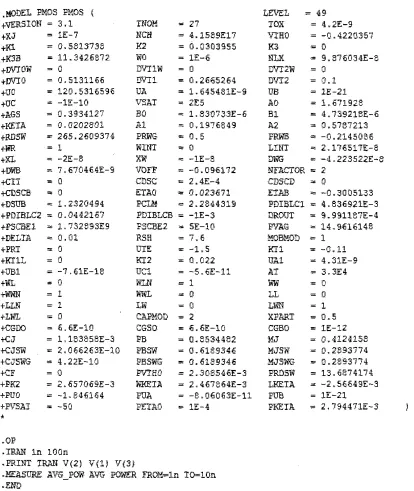
The evaluation of cell library has been done on every logic gate by focusing
low-voltage operation and high-frequency. Every logic cell showed the output
[image:30.634.93.507.88.579.2]performance with maintained the power reduction through the voltage scaling method.
Bibliography
T. Kuroda, "CMOS design challenges to power wall," Proc. of IEEE International
Conference on Microprocessor and Nanotechnology, pp. 6-7, November 2001.
H. Soeleman, K. Roy, and B.C. Paul, "Robust subthreshold logic for ultra-low power operation," IEEE Transactions on Very Large Scale Integration (VLSI)
Systems, vol. 9, Issue 1, pp. 90-99, February 2001.
J . Kim and K. Roy, "Double gate MOSFET subthreshold logic for ultra-low power
applications," Proc. of IEEE International on SOI Conference, October 2003, pp.
97-98.
J. F. Ryan, W. Jiajing, and H. Benton, "Analyzing and modeling process balance for subthreshold circuit design," Proc. of ACM 17th Great Lakes symposium on
VLSI, March 2007, pp. 275-280.
B. H. Calhoun, A. Wang, and A. Chandrakasan, "Modeling and sizing for
minimum energy operation in subthreshold circuits," IEEE Journal of Solid-State
Circuits, vol. 40, no. 9, pp. 1778-1786, September 2005.
R. Vaddi, S. Dasgupta, and R. P. Agarwal, "Device and circuit design challenges in
the digital subthreshold region for ultra-low power applications," Proc. of ACM
VLSI Design, January 2009, pp. 1-14.
B. C. Paul, A. Raychowdhury, and K. Roy, "Device optimization for digital
subthreshold logic operation," IEEE Transactions on Electron Devices, vol. 52, no.
2, pp. 237-247, February 2005.
K. Roy, S. Mukhopadhyay, and H. M. Meimand, "Leakage current mechanisms
and leakage reduction techniques in deep-submicrometer CMOS circuits," Proc. of
IEEE, February 2003, pp. 305-327.
H. Soeleman and K. Roy, "Digital CMOS logic operation in the subthreshold region," Proc. of ACM Tenth Great Lakes Symposium on VLSI, March 2000, pp.
107-112.
wireless OFDM demodulator," IEICE Trans. on Fundamentals, vol. E89-A, pp.
2866-2873, October 2006.
C. Jiang, J . Wan, X. Xu, Y. Li, X. You, D. Yu, "Dynamic voltage/frequency scaling for power reduction in data centers: enough or not?," International
Colloquium on Computing, Communication, Control, and Management, August
2009, pp. 428-431.
W. Sung and K. Kum, "Simulation-based word-length optimization method for
fixed-point digital signal processing systems," IEEE Trans. on Signal Processing,
vol. 43, pp. 3087-3090, December 1995.
K. Han and B. L. Evans, "Wordlength optimization with complexity and distortion measure and its applications to broadband wireless demodulator design," Proc. of
IEEE International Conference on Acoustics, Speech, and Signal Processing, May
2004, pp. 37-40.
W. Zhong and 2. Mao, "Design and VLSI architecture of a channel equalizer
based on adaptive modulation for IEEE 802.11a WLAN," Proc. of IEEE Asia
Pacific Conference on Circuits and Systems, December 2006, pp. 1699-1702.
S. Yoshizawa and Y. Miyanaga, "Use of a variable wordlength technique in an
OFDM receiver to reduce energy dissipation," Proc. of IEEE International
Symposium on Circuits and Systems, May 2007, pp. 3175-3178.
M. M. Nisar and A. Chatterjee, "Test enabled process tuning for adaptive baseband
OFDM processor," Proc. of 26th IEEE VLSI Test Symposium, May 2008, pp. 9-16.
B. H. Calhoun and A. Chandrakasan, "Ultra-dynamic voltage scaling using
subthreshold operation and local voltage dithering in 90nm CMOS," Proc. of
IEEE International Solid-State Circuits Conference, Febuary 2005, pp. 300-599.
B. Lin, A. Mall&, P. Dinda, G. Mem&, and R. Dick, "User and process driven dynamic voltage and frequency scaling," Proc. of IEEE International Symposium
on Performance Analysis of Systems and Software, December 2009, pp. 11-22.
P. E. Allen and D. R. Holberg, "CMOS Analog Circuit Design," New York, Oxford University Press, 2002.
B. Razavi, "Design of Analog CMOS Integrated Circuits," Singapore, McGraw-Hill, 2001, pp. 6-28.
no. 3, pp. 397-405, March 2005.
S. Choobkar and A. Nabavi, "A low power programmable CMOS circuit for
generating modulated pulses for UWB applications," Proc. of the 2nd International Conference on Wireless Broadband and Ultra Wideband Communications, August 2007, pp. 5-5.
C. X. Jie and F. Q. Yuan, "A low power high-reliability CMOS current limit
circuit," Proc. of Asia Pacific Conference on Microwave, December 2005, pp. 3.
G.I. Wirth, M. G. Vieira, and F. G. L. Kastensmidt, "Accurate and computer
efficient modeling of single event transients in CMOS circuits," IET Trans. on Circuit, Device and Systems, vol. 1, no. 2, pp. 137-142, April 2007.
X. Wu and M. Pedram, "Low power CMOS circuits with clocked power," Proc. of
IEEEAsia Conference on Circuit and Systems, pp. 513-516, December 2000.
J. Pamklang, K. Kumwachara, and P. Kongtanasunthorn, "Low power dissipation
CMOS output driver circuits," Proc. of TENCON 2000, September 2000, pp.
466-469.
T. Enomoto and T. Ei, "Low power CMOS circuit techniques for motion estimators," Proc. of the International Symposium on Circuits and Systems, May
2003, pp. 209-412.
D. Samanta, N. Sinha, and A. Pal, "Synthesis of high-performance low power dynamic CMOS circuits," Proc. of Asia and South Pacific International Conference on VLSI Design, January 2002, pp. 99-104.
A. Tajalli and M. Alioto, "Improving power delay performance of ultra-low power subthreshold SCL circuits," IEEE Trans. on Circuits and Systems, vol. 56, pp.
127-131, February 2009.
M. C. Casey, 0. A. Amusan, S. A. Nation, T. D. Loveless, A. Balasubramanian, B.
L. Bhuva, R. A. Reed, D. McMorrow, R. A. Weller, M. L. Alles, L. W. Massengill, J. S. Melinger, and B. Narasirnham "Single-event effects on combinational logic
circuits operating at ultra-low power," IEEE Trans. on Nuclear Science, vol. 55,
pp. 3342-3346, December 2008.
M. B. Henry, and S. B. Griffin, and L. Nazhandali, "Fast simulation framework for
subthreshold circuits," Proc. of IEEE Intemational Symposium on Circuits and Systems, May 2009, pp. 2549-2552.