
© 2017, IRJET | Impact Factor value: 5.181 | ISO 9001:2008 Certified Journal | Page 858
Operation Sequencing and Machining Parameter Selection in CAPP for
Cylindrical Part using Hybrid Feature Based Genetic Algorithm and
Expert System
Abhishek Agrawal
1, Dr. R.S. Rajput
2, Dr. Nitin Shrivastava
31
Ph.D Scholar, Dept of Mechanical Engg, UIT-RGPV Bhopal, Madhya Pradesh, INDIA
2Professor, Dept of Mechanical Engg & Director, UIT-RGPV Bhopal, Madhya Pradesh, INDIA
3
Assistant Professor, Dept of Mechanical Engg, UIT-RGPV Bhopal, Madhya Pradesh, INDIA
---***---Abstract -
Computer-Aided Process Planning (CAPP) is animportant interface between Computer-Aided Design (CAD) and Computer-Aided Manufacturing (CAM) in computer- integrated manufacturing environment. Process planning is concerned with the preparation of route sheets that list the sequence of operations and work centers that require producing the product and its components. In any CAPP system, selection of the machining operations sequence is one of the most critical activities for manufacturing a part as per the technical specification and the part drawing. The operation-sequencing problem in process planning is considered to produce a part with the objective of minimizing number of set-ups, maximizing machine utilization and minimizing number of tool changes and a single sequence of operations may not be the best for all the situations in a changing production environment with multiple objectives. In general, the problem has combinatorial characteristics and complex precedence relations, it makes the problem more difficult to solve. To overcome these difficulties, by combining Genetic Algorithm (GA) and Expert system (EX) in an appropriate way a new super hybrid genetic algorithms-expert System (S-GENEX) is developed in this research work. The feasible sequences of operations are generated using this hybrid algorithm, based on the inputs precedence cost matrix (PCM).
The present work is divided into two phases, the GA and Expert System. During the first phase, GA generates an initial population randomly. Then cross over and mutation operators are imposed for offspring generation based on the initial population. The cross over and mutation sites are selected randomly. This process is repeated for a period of generations for attaining an optimum solution. Expert System is used for selecting the machining parameters for facing, turning and boring operations for three types of materials. A program is developed in C++ based on proposed algorithm, to check its validity and the results are compared with the previous work. The main contribution of this work focuses on reducing the optimal cost with a lesser computational time along with generation of more alternate optimal feasible sequences.
Key Words: Computer-Aided Process Planning (CAPP); Computer-Aided Manufacturing (CAM); Computer-Aided Design (CAD); Genetic Algorithm; Expert System; Operation Sequencing.
1. INTRODUCTION
Today machining process planning has to yield such results that are to give maximum productivity and to ensure economy of manufacturing. Today the market has an ever changing demand for new products, which require shorter development cycle. An important part of the product development cycle is manufacturing process planning. Shorter process planning time can lead to the use of machining parameters that are not optimal and this can lead to the greater cost of production. A human process planner selects proper machining parameters by using not only his own experience and knowledge but also from handbooks of technological requirements, machine tool, cutting tool and selected part material.
This manual selection can be slow and does not have to give optimal results. To overcome that problem, machining process planning has gone automated, by the use of Computer-Aided Process Planning (CAPP) system. In addition to operation sequence and machining parameters, the CAPP system should also be able to automatically choose machine and cutting tool while taking in consideration part material. In this paper, the focus is given to cutting parameters optimization. Cutting parameters, such as cutting depth, number of passes, feed rate and machining speed have influence on overall success of machining operation [1,2]. In order to conduct optimization, a mathematical model has to be defined. It is not always easy to define a model that can be expressed by pure analytical functions. Besides, cutting parameters optimization presents a multi-objective optimization problem. So, the classical mathematical methods such as linear programming would not work with such input data.
© 2017, IRJET | Impact Factor value: 5.181 | ISO 9001:2008 Certified Journal | Page 859 next generation that should now consist of better results,
closer to a global optimum. Whole process is terminated when stopping criteria are met and a global optimum is found. GA ensures that the calculated result is global or close to the global optimum.
1.1 General Procedure for Retrieval CAPP Systems
The first step is to be determining the GT code number of part. With this code number the part family file is to be determined if the standard route sheet exists for the given part code. If the file contains the process of plan for the part, it is retrieved (hence the word retrieval for this CAPP system) and displayed for the user. The standard process plan is examined and determined whether any modifications are necessary. It has same code number and there are minor differences in the processes required to manufacture it. The user finalizes standard plan accordingly. If the file does not contain the standard process of plan for the given code number, the user may search the computer file for the similar or related code number from which the standard route sheet where it can be exists. Either by editing an existing process plan or by starting from scratch the user prepares for the new part. It becomes the standard process plan for the new part code. The process of planning session is concluded with the process of plan formatter, the route sheet in the proper format.
2. OPERATION SEQUENCING
In any CAPP system, selection of the machining operations sequence in one of the most critical activity for manufacturing a part as per the technical specification in the part of drawing. If any fixed sequence of the operations that is generated in a process plan cannot be the best possible sequence for all the production periods or for the criteria such as quality and machine utilization. The aim should be to generate feasible operation sequences of operations for the prevailing production environment. Manned methods, mathematical programming method as well as computer based method have been used to determine the method is used, for the operation sequence problem is inescapable. When this problem arises due to operations involved, the part features to be produced.
[image:2.595.346.564.128.242.2]The constraints are shown in Table 1. A feasible sequence is one, which does not violate any of the feasibility constraints listed in Table 1. These constraints are processed sequentially by the system with the results of each application being the generation of either precedence or relation statements. A precedence statement takes the form, fa (fb), meaning that feature, fa, cannot be machined until feature, fb, has been cut. That the relation statement of the form, (fa, fb,…..), pertains to multiple features indicating that these features must be machined in the same setup. The location constraint is concerned with an examination of the defined part to determine what reference face is used to locate each feature. The references identify the necessity that the locating surface be machined prior to the associated feature.
Table -1: Sequencing Constraints
3. METHODOLOGY OF DETERMINING OPERATION
SEQUENCING
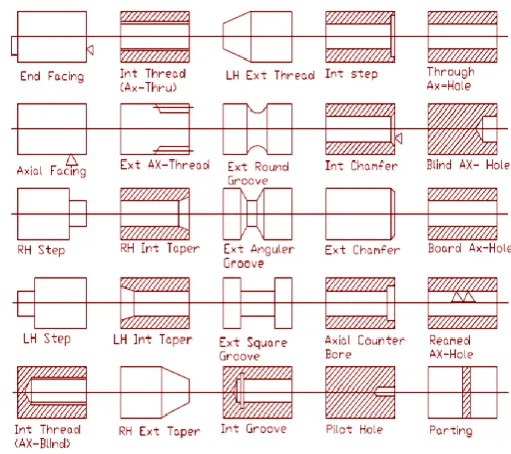
According to the process planning perspective, a feature must be identified as the enhancement of shape, surface of the size can be produced by the countable set of specific physical actions. These actions can be classified as changes in machining parameters, tool, set-ups or machines. For example, in case of rotational parts the operations such as facing, step turning, rough turning, finish turning, drilling, boring, counter boring, reaming & chamfering etc are shown in Figure.1.
Fig -1: Feature library of lathe operations
The last and the third “Form feature” group II includes those feature which are performed by machining the work piece internally, can be performed on more than one machine, and have precedence between them. Drilling, boring, counter boring, reaming are included in this group. Table 2 shows the details of feature in a particular group.
Feasibility Constraints Location reference Accessibility Non-destruction Geometric –tolerance Strict precedence Optimality Criteria Number of setups
[image:2.595.308.564.418.645.2]© 2017, IRJET | Impact Factor value: 5.181 | ISO 9001:2008 Certified Journal | Page 860
Table -2: Form Feature Group
Form Feature Group
Code No. Features
0
Facing Step Turning Taper Turning Chamfering
I Rough Turning
Finish Turning
II Drilling
Boring
Counter Boring Reaming
If any feature mention in the “Form Group‟ I or II repeats then “Form Group” number goes on increasing.
3.1 Generation of Precedence Cost Matrix
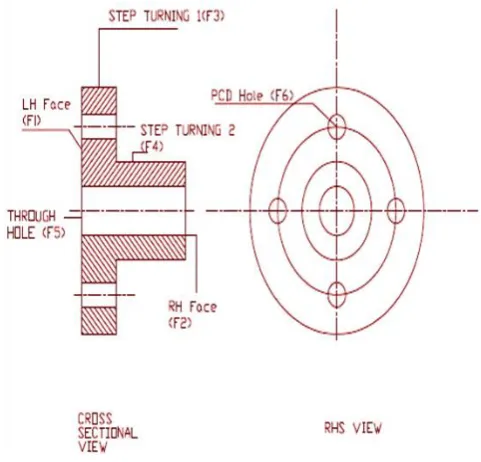
A Preceding Cost Matrix (PCM) is generated for any pair of features based on the approximate relative cost corresponding to the number of tasks that need to be performed in each category of attributes such as machining parameter change, tool change and set-up change, machine tool change & the type of constraint one feature has with the other, such as pre-condition, location, datum holding & bi-directional. The part shown in Figure 2 is rotational, stepped to one side, and has a through hole at centre and holes drilled on a Pitch Circle Diameter (PCD).
Fig -2: Feature Decomposition of a Part
3.2 Genetic Algorithm
Genetic algorithms are a family of computational models inspired by the evolution. When the genetic algorithms are often viewed as function of optimizers and although the range of problems to which genetic algorithms have been applied to be quite broad. An implementation of the genetic algorithm begins with a population of evaluates these structures and allocates reproductive opportunities in such a way that those chromosomes which represent a better solution to the target problem are given more chances to “reproduce” than those chromosomes which are poorer solutions. The “goodness” of a solution is typically defined with respect to the current population.
Genetic Algorithm consists of five main stages. These are the population, size, evaluation, selection, crossover and then mutation.
A. Creation of Initial Population
The initial population cannot consist of simple random generated strings as the local precedence of operations or features for each “Form Feature” cannot be guaranteed. To create the valid initial string and an element of the string is generated randomly from the first operations of each “Form Feature” group so as to follow the precedence order of the operations and the procedure is repeated by selecting elements from the remaining operations groups until all the operations are represented in the string. Let “n” be the number of features to be performed then the total number of strings generated initially are equal to 2n.
B. Population size selection
Population size selection is probably the most important parameter. Computational time increases with the increase of population size.
C. Evaluation of Fitness Function
The objective function is calculated for each string in the production as the sum of relative cost between the features or operations. The relative costs will correspond to the number of tasks that need to be performed in each category of attribute such as machine change, tool change, parameter change, setup change and the type of constraint one feature has with respect to the other.
The fitness value for the each string is calculated and the expected count of each string for the next generation is obtained on the basis of the string weight age (survival of fittest). So that the total count becomes the population size, because as mention above in the whole cycle of GA, the size of the population should remains same.
D. Reproduction
[image:3.595.32.273.494.725.2]© 2017, IRJET | Impact Factor value: 5.181 | ISO 9001:2008 Certified Journal | Page 861 the actual count is more than the population size then, the
strings with poor fitness functions are removed and if actual count is less than the population size then string from population are added with high fitness function such that the size of total population remains unchanged. The reproduced population is used for the next GA operator that is crossover.
E. Crossover and mutation
Crossover is a Genetic operator that generates new individuals based upon combination and possibly permutation of genetic material of ancestors. The crossover is carried out between the Parent 1 and Parent 2 by using bits that represent the alternative operation sequence that can be used. The two children are than reproduced, the crossover site can also be selected randomly.
3.3 Expert System for Machinability Data Selection
As we know that the machining process exhibits piecewise behavior it cannot be linearly extrapolated in a wide range. It also cannot be defined in a short range, and cannot be modeled effectively using theories and equations. Expert systems have emerged as a major tool for decision-making in such complicated situations. The need for an expert system arises because of the inherent weakness of process models to yield a logical solution to the data selection problem. An Expert system approach has the capability to take care of the numerous heuristics, exceptions, and we can be associated with metal cutting process. It is felt that knowledge of metal cutting physics if properly complied can be coded symbolically IF-THEN rules and can from the basis of an expert system.
4. RESULTS AND DISCUSSION
A computer program has been developed based on the algorithms. This program can be used for sequencing the operations (maximum up to 20) of any rotational component. After sequencing the features, this program gives the machining parameters for turning, boring and facing operations.
4.1 Operation Sequencing for a Cylindrical Part
(Case Study-I)
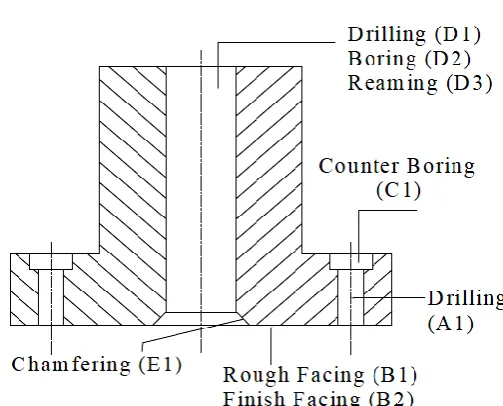
To validate the operation sequence generated from the Genetic Algorithm based program, a case study is taken from Weill et. al. (S. V. Bhashkara Reddy et. al.) [22] and suitably modified as shown in figure 3. Let the material of the part shown in figure 3 is Carbon steel with Brinell hardness of 200. The total numbers of features to be generated on component are 8, and are labeled as A1, B1, B2, C1, D1, D2, D3, and E1. These operations are coded as 5, 1, 2, 8, 5, 6, 7, and 9. The data enter by user is shown in the table 3.
[image:4.595.314.566.87.290.2]Fig -3: Example of Case Study of Weill et al.[7]
Table -3: Input Data
MATERIAL CODE
Carbon Steel 1
Material BHN Value
20 Ni55CrMo2 200
FEATURE CODE
Drill (A1) 5
Rough Facing (B1) 1
Finish Facing (B2) 2
Counter Boring (C1) 8
Drill (D1) 5
Rough Boring (D2) 6
Finish Boring (D3) 7
Chamfering (E) 9
[image:4.595.340.525.365.682.2]© 2017, IRJET | Impact Factor value: 5.181 | ISO 9001:2008 Certified Journal | Page 862 Table -4: Precedence Cost Matrix (PCM) for figure-3
Features
5 1 2 8 15 6 7 9
5 999 100 100 1 100 100 100 100
1 11 999 0 100 1 100 100 100
2 11 100 999 100 1 100 1 1
8 100 100 100 999 100 100 100 100
15 11 1 100 100 999 0 100 100
6 11 1 100 100 100 999 100 100
7 11 100 100 100 100 100 999 100
9 100 100 100 100 100 100 1 999
4.2
Output Parameters for Case Study-I
The various output parameters and optimal solutions obtained by S-GENEX for Case Study–I and The solutions are compared with the previous works and are listed in Table 5. The percentage improvements of solutions are shown Table 6. The optimal cost and feasible sequence was found to be same as reported by Weill et al. (1982), Bhaskara et al. (1999) and Krishna et al. (2006), however the computational time is greatly reduced to almost less than a second due to hybridization and SSRT. Figure 4 exhibits the convergence graph for Case study-I.
Table -5: Optimal Solution of S-GENEX compared with Previous Works [Case Study –I]
Weil et al. (1982)
Bhaskar a etal. (1999)
Krishn a et al. (2006)
Hybrid GENEX (Present)
Technique
Used - GA ACA Hybrid
Optimal
Cost 15 15 15 15
Computati onal Time in Second
- 30 11 <5
No. of feasible Sequence
[image:5.595.313.552.134.469.2]11 1 1 1
Table -6: Improvement Achieved by S-GENEX Algorithm [Case Study-I]
Parameter % Improvement
Optimal Cost 0
Computational Time in Second
90
Alternate Optimal Sequence
No
Whether Feasible or not? Feasible
Iterations
Fig -4: Convergence Graph [Case Study-I]
5. CONCLUSION
© 2017, IRJET | Impact Factor value: 5.181 | ISO 9001:2008 Certified Journal | Page 863 will obviate the need to do the real-time experiments before
the selection of the final sequence and machining parameters.
ACKNOWLEDGEMENT
I wish to express with facilitates words my deep sense of gratitude to my Supervisor Dr. R.S. Rajput, Director & Professor, Mechanical Engineering Department, UIT-RGPV, Bhopal and Co-Supervisor Dr. Nitin Shrivastava, Assistant Professor, Mechanical Engineering Department, UIT-RGPV, Bhopal for their valuable guidance and constant encouragement without which this research work could not be done.
REFERENCES
[1] Bhaskara Reddy S. V., Shunmugam M. S., and Narendran T. T., “Operation Sequencing in CAPP Using Genetic Algorithms”, International Journal of Production Research, 1999, Vol. 37, No. 5, 1063-1074. (Available online at Taylor & Francis Group- Article.htm)
[2] David E. Goldberg, “Genetic algorithms- in Search, Optimization & Machine learning”, Pearson Education, Inc., New Delhi 2005.
[3] Elaine Rich, Kevin Knight and Sivasankar B, Artificial Intelligence, 2nd Edition. Nair, Tata McGrawHill, 3/e,2004.
[4] Foerster H, Wischer G (1998) Simulated annealing for order spread minimization in sequencing cutting patterns. Eur J Oper Res 110:272–281
[5] Franci Cus, Joze Balic, “Optimization of Cutting Process by GA approach”, Robotics and Computer-Integrated Manufacturing 19, (2003) (Available online at www. elsevier.com/locate/rcim)
[6] Irani, S. A., Koo, H. Y. and Ranam, S. “Feature based operation sequence generation in CAPP”, Int. J. Prod. Res., Vol. 33, pp. 17-39, 1995.
[7] Weill, R., Spur, G. and Eversheim, W. “Survey of computer-aided process planning systems”. Annuals of CIRP, Vol. 31, pp. 539-551, 1982.
![Table -6: Improvement Achieved by S-GENEX Algorithm [Case Study-I]](https://thumb-us.123doks.com/thumbv2/123dok_us/8159225.805150/5.595.313.552.134.469/table-improvement-achieved-s-genex-algorithm-case-study.webp)
