© 2018, IRJET | Impact Factor value: 6.171 | ISO 9001:2008 Certified Journal | Page 926
A Contextual Analysis of the Advantages by Using Lightweight Concrete
Blocks as Substitution of Bricks
Kundan Kulbhushan
1, Sandeep Kumar Verma
2, Rahul Chaudhary
3,
Shahbaz Ahamad
4, Sneha Gupta
5, Shri Ram Chaurasia
61,2P.G. Student, Dept. of Civil Engineering, Madan Mohan Malviya University of Technology, Gorakhpur, India
3,4Assistant Professor, Dept. of Civil Engineering, Institute of Technology and Management Maharajganj, U.P., India
5Assistant Professor, Dept. of Civil Engineering, Madan Mohan Malviya University of Technology, Gorakhpur, India
6Associate Professor Dept. of Civil Engineering, Madan Mohan Malviya University of Technology, Gorakhpur, India
---***---Abstract -Conventionally the buildings are made with Burnt Clay Bricks which are associated with several disadvantages as Clay bricks are small in size though are heavy in weight and require a lot of concrete as masonry materials in joining each brick and plastering them from both the faces to fill the unevenness of the wall surface and to provide better finish. & Clay brick’s soundproof and thermal insulation effect is poor. Lightweight blocks reduced mortar consumption, offering a unique combination of high durability, strength and faster speed of work compared to brick masonry. Lightweight blocks are 10 times the size of clay bricks, with their demand increasing rapidly due to their overall low cost, light weight, almost 70% less than clay bricks and sound and thermal insulation properties. The primary goal of this examination is to study about the effect of Lightweight concrete blocks on building structure with specific stress on spearing in general cost and weight of the structure. Lightweight blocks were created reasonable as indicated by IS specification. To examine the effect of light weight blocks on building a theoretical genuine 100 ft2 wall of 4" and 9" walling area of a loft of the multistory story building was chosen as a contextual investigation and first broke down utilizing mud blocks in various perspectives quantity estimation, reinforcement figuring, measure of blocks assurance in the structure's wall. At that point the sample building was analyzed by utilizing Lightweight concrete blocks of 80% substitution 14.8% lessening in the overall building, weight has been watching when the contribution of block masonry load in overall building was 45% it was seen in the wake of performing examinations on various kinds of structure that light weight blocks indicate responsible outcome in elevated structure overwhelm in the block masonry.
Key Words: Aerated Concrete, Clay Bricks, Concrete Bricks, Foamed Concrete, Lightweight Blocks
1. INTRODUCTION
Nature takes 500 years to change over one inch of hard surface into the top soil. Furthermore, we evacuate this best soil inside couple of minutes and influence earth blocks to out of it; uncovering the desolate land again coming about into ecological risks like deforestation, surface water overflow and loss of the cultivable land. The open ovens of
block heating additionally prompt high air contamination. Traditionally the buildings are made in Burnt Clay Bricks resulting in being design as heavier structure that is mostly unnecessary and costly. One of its reasons is that the Clay bricks are 70% heavier than Lightweight blocks which increases the dead load of the structure and the risk associated with the concrete structure. It has been found that the considerable amount of dead weight which is contributed by the structural elements (such as non-load bearing walls) can be reduced if lighter options are utilized. For building there are many lightweight options available that can be used as replacement of the clay bricks or used with the concrete by partial or full replacement to reduce the weight of clay bricks by keeping the desired strength. Lightweight blocks are created from the regular materials, for example lime, sand, cement and water, and a little measure of rising agent are utilized to deliver light weight pieces .Considering these focal points, and Lightweight blocks were utilized to see most extreme conceivable dead load decrease in the building.
2. METHODOLOGY
Methodology of the study includes:
1. The production of the Lightweight blocks 2. Building analysis
a). Traditional building analysis b). Lightweight building
3. TYPES OF LIGHTWEIGHT CONCRETE BLOCKS AND PRODUCTION
The Lightweight concrete blocks can be divided into three main types according to the method of production. They are autoclaved aerated concrete (AAC), foamed concrete (CLC) and non-autoclaved aerated concrete (NAAC)).
© 2018, IRJET | Impact Factor value: 6.171 | ISO 9001:2008 Certified Journal | Page 927
3.1. Autoclaved Aerated Concrete (AAC)
The AAC is produced by adding in a predetermined amount of aluminum powder and other additives into slurry of ground high silica sand, cement or lime and water and autoclaved curing is done. The AAC began approximately 100 years ago. Invented in 1923 by Swedish architect and inventor Dr. Johan Axel Eriksson and has been around for over 90 years with being extensively in developed European countries, USA, Japan & China. Discovered a mixture of cement, lime, water and sand that was expanded by the adding aluminum powder to generate hydrogen gas in the cement slurry.
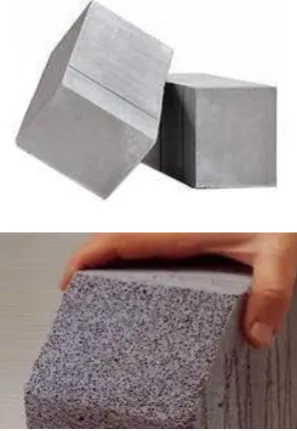
AAC Block
3.2. Cellular Lightweight Concrete (CLC)
Foamed concrete is produced by injecting preformed stable foam or by adding a special air entraining admixture known as a foaming agent into a base mix of cement paste or mortar (cement + water or cement + sand + water). The foamed concrete was produced in Europe more than 60 years prior and has from that point forward been on the International market for over 20 years. Foamed concrete have high flowability, low self-weight, least utilization of aggregate, controlled low quality, and great thermal insulation properties. The density of foamed concrete has wide range
(1600 to 400 kg/m3), with fitting control in the
measurements of the foam, can be gotten for application to structural, partition, insulation, and filling grades.
Foaming agent Foam formation
Cellular structure CLC Blocks
3.3 Non autoclaved aerated concrete (NAAC)
NAAC is the concrete which is light in weight that is used as an alternative construction material in modern world. It is a green building material, possess excellent thermal insulating properties, good sound absorber and can also be used as a decorative material.
[image:2.595.86.235.245.461.2]The NAAC is produced by adding in a predetermined amount of aluminum powder and other additives into slurry of ground high silica sand, cement or lime and water & then the concrete is cured in water this is called as non-autoclaved concrete or water cured concrete. Different dosages of aluminum powder (0%, 0.04%, 0.08%, 0.12% and 0.16%) taken by using weight of dry material to design aerated concrete blocks of 600mm × 200mm × 100mm sizes.
Table -1. Comparison of various bricks and blocks (AAC blocks vs CLC blocks vs red clay bricks)
S.No Parameter AAC Blocks Red Clay Bricks CLC Blocks
1 Raw Materials Cement, fly ash, water and Air entraining agents Locally avaiable clay Cement, lime, specially grinded sand,foam
© 2018, IRJET | Impact Factor value: 6.171 | ISO 9001:2008 Certified Journal | Page 928 3 Strength (As per Compressive
IS codes) 3-4 N/mm2 3.5 N/mm2 2 -2.5 kg/cm2
4 Dry Density (As per IS codes)
550-650 kg/m3 It sone-third of the weight of clay brick which
makes it easy to lift and transport
1800 kg/m3 800 kg/m3
5 Cost Benefit
For high rise buildings there will be reduction of Dead weight
which leads to saving in Concrete and steel quantities.
As easily available in local market hence it is beneficiary for low rise
structure.
For high rise buildings there will be reduction of Dead weight which leads to saving
in Concrete and steel quantities.
6 Fire Resistance (8″ Wall) Upto 4 Hours Around 2 Hours Around 4 Hours
7 Quality of End Product Factory made product. So the quality of end product is consistent and good
Locally made product. Quality depends on various parameters like quality of raw materials
used, process of manufacture etc.,
The quality of the end product depends on the foam used and
degree of quality control
8 Insulation Sound absoprtion/insulation as Better Sound
compared to bricks Normal
Better Sound absoprtion/insulation as
compared to bricks
9 Environmental Friendliness
In AAC Block there is no top soil utilization and it transmits low Carbon dioxide as contrast with bricks while fabricating
One sq ft of cover territory with bricks walling will devour 25.5
kg of soil (approx). It really harms condition
In CLC Block there is no soil utilization and it produces
low Carbon dioxide as contrast with Brickss while
fabricating.
10 External Plaster Internal and
As these blocks have dimensional precision, the
inner and extenal mortar thickness can be lessened
Requires thick mortar surface as there are
varieties in the measurements
As these blocks have dimensional precision, the
inner and extenal mortar thickness can be lessened
11 Construction Cost of 1 Cum costs – Rs. 4200/- 1 Cum costs – Rs. 2440/- 1 Cum costs – Rs. 4000/-
12 Joining Process
Substance mortars can be utilized for joining the block. This diminishes the material utilization of concrete and furthermore abstains from
curing process
Traditional mortar needs to be used and the brick work should be cured at least for 7 days before plastering
Substance mortars can be utilized for joining the block. This diminishes the material utilization of concrete and furthermore abstains from
curing process
13 Insulator Thermal
AAC Blocks are great thermal insulator if cooling is a noteworthy part of any building month to month costs
it will spare cost for whole lifetime
It have low thermal insulation as compare
to AAC and CLC Block
CLC Blocks are great thermal insulator if cooling is a noteworthy part of any building month to month costs it will spare cost for
whole lifetime
14 Absorption Water Absorb 12- 15% by total volume of AAC blocks total volume of red clay Absorb 17 -20% by brick
Absorb 12-15% of water by total volume of Block
15 Application Range of They are suitable for Non load bearing or RCC structure in partition wall
They are useful in both load bearing and non load baring structure
© 2018, IRJET | Impact Factor value: 6.171 | ISO 9001:2008 Certified Journal | Page 929 5. INVESTIGATION
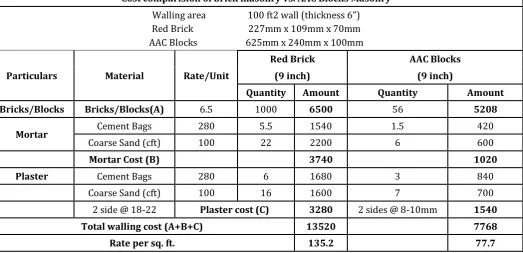
[image:4.595.32.567.181.440.2]To investigate the effect of light weight blocks on building a hypnotical real life 100 ft2 wall of 4” and 9” walling area of an apartment of multistory stories building was selected as a case study and first analyses using clay bricks in different aspects quantity estimation.
Table 2. Cost comparison of brick masonry vs. AAC Blocks Masonry for 4” wall
Cost comparision of brick masonry vs. AAC Blocks Masonry Walling area 100 ft2 wall (thickness 4”)
Red Brick 227mm x 109mm x 70mm AAC Blocks 625mm x 240mm x 100mm
Particulars Material Rate/Unit Red Brick AAC Blocks
(4 inch) (4 inch)
Quantity Amount Quantity Amount
Bricks/Blocks Bricks/Blocks(A) 6.5 500 3500 56 2604
Mortar Cement Bags 280 2.25 630 1 280
Coarse Sand (cft) 100 10 1000 4 400
Mortar Cost (B) 1630 680
Plaster Cement Bags 280 6 1680 3 840
Coarse Sand (cft) 100 16 1600 7 700
2 side @ 18-22 Plaster cost (C) 3280 2 sides @ 8-10mm 1540
Total walling cost (A+B+C) 8410 4824
Rate per sq. ft. 84.1 48.24
Table-3. Cost comparison of brick masonry vs. AAC Blocks Masonry for 9” wall
Cost comparision of brick masonry vs. AAC Blocks Masonry Walling area 100 ft2 wall (thickness 6”) Red Brick 227mm x 109mm x 70mm AAC Blocks 625mm x 240mm x 100mm
Particulars Material Rate/Unit
Red Brick AAC Blocks
(9 inch) (9 inch)
Quantity Amount Quantity Amount
Bricks/Blocks Bricks/Blocks(A) 6.5 1000 6500 56 5208
Mortar Cement Bags 280 5.5 1540 1.5 420
Coarse Sand (cft) 100 22 2200 6 600
Mortar Cost (B) 3740 1020
Plaster Cement Bags 280 6 1680 3 840
Coarse Sand (cft) 100 16 1600 7 700
2 side @ 18-22 Plaster cost (C) 3280 2 sides @ 8-10mm 1540
Total walling cost (A+B+C) 13520 7768
[image:4.595.41.565.485.738.2]© 2018, IRJET | Impact Factor value: 6.171 | ISO 9001:2008 Certified Journal | Page 930 Table-4. Cost comparison of brick masonry vs. AAC Blocks Masonry for 4” wall
Cost Calculation for 100 Sq. Ft Wall
Clay Bricks (4” Thick wall) 230x110x75mm CLC Bricks (4” Thick wall) 600x200x100mm No. of Bricks 550 @ Rs.6.50/pic 3575 No. of Bricks 68 @ Rs.35/pic 2380
Mortar @ 1:6 1100 Mortar 365
Plastering @ 1:2 (Both Side) 1140 Plastering @ 1:2 (both sides) 1140 Labour (Construction and Two Coats
Plastering ) 1800 Labour (Construction and Single Coat Plastering) 1200
[image:5.595.34.566.272.403.2]Total Cost 7615 Total Cost 5085
Table-5. Cost comparison of brick masonry vs. AAC Blocks Masonry for 9” wall
Cost Calculation for 100 Sq. Ft Wall
Clay Bricks (9” Thick wall) 230x110x75mm CLC Bricks (9” Thick wall) 600x200x100mm No. of Bricks 1100 @ Rs.6.50/pic 7150 No. of Bricks 68 @ Rs.70/pic 4760
Mortar @ 1:6 2100 Mortar 365
Plastering @ 1:2 (Both Side) 1140 Plastering @ 1:2 (both sides) 1140 Labor (Construction and Two Coats
Plastering ) 2000 Labor (Construction and Single Coat Plastering) 1200
Total Cost 12390 Total Cost 7465
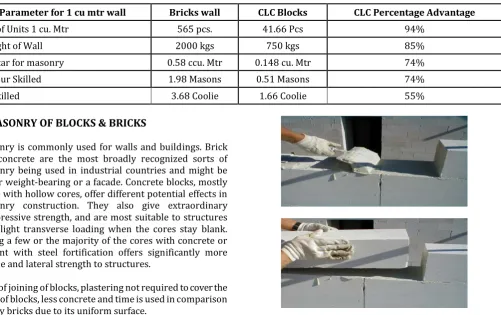
Table-6. Overall look on the total saving of cost, labor and materials
Parameter for 1 cu mtr wall Bricks wall CLC Blocks CLC Percentage Advantage
No. of Units 1 cu. Mtr 565 pcs. 41.66 Pcs 94%
Weight of Wall 2000 kgs 750 kgs 85%
Mortar for masonry 0.58 ccu. Mtr 0.148 cu. Mtr 74%
Labour Skilled 1.98 Masons 0.51 Masons 74%
Unskilled 3.68 Coolie 1.66 Coolie 55%
6.MASONRY OF BLOCKS & BRICKS
Masonry is commonly used for walls and buildings. Brick and concrete are the most broadly recognized sorts of masonry being used in industrial countries and might be either weight-bearing or a facade. Concrete blocks, mostly those with hollow cores, offer different potential effects in masonry construction. They also give extraordinary compressive strength, and are most suitable to structures with light transverse loading when the cores stay blank. Filling a few or the majority of the cores with concrete or cement with steel fortification offers significantly more tensile and lateral strength to structures.
Ease of joining of blocks, plastering not required to cover the faces of blocks, less concrete and time is used in comparison of clay bricks due to its uniform surface.
[image:5.595.59.561.435.750.2]
© 2018, IRJET | Impact Factor value: 6.171 | ISO 9001:2008 Certified Journal | Page 931 Brick mason plastering required
7. CONCLUSION
1. As we known that in this building masonry wall contributes around 45% load of the building so if the weight of the block decreases then total load of the building can be decreases.
2. Blocks are 1/3 weight of bricks and 1/5 weight of concrete and are in easily handed sizes. It reduces dead load of the structure, consequently consumption and investment in steel saving up to 15% and concrete.
3. Blocks give superior thermal & acoustic insulation because of low air infiltration. Moreover, lesser joints and better compacted (thin) joining mortar add to the thermal & acoustic insulation. This leads to well insulated interiors, keeping out warm air in summers and cold in winters. Blocks reduce energy cost by up to 30%.
4. Speedy construction due to its big size light weight and ease to cut in any size or shape.
REFERENCES
[1] Robert, I. “Cost - Estimating Principles.” The Journal of Construction Engineering and Management, Vol. 115, ©ASCE, ISSN 0733-9364/89/0004 0545/$1.00+ $.15 per page. Paper No. 24107, December, 1989.
[2] Choi, K.C., William Ibbs, C., “Costs and Benefits of Computerization in Design and Construction.” The Journal of Computing in Civil Engineering, Vol. 4, ©ASCE, ISSN 0887-3801/90/0001-0091/$1.00 + $.15 per page.Paper No. 24285, 1, January.
[3] Sawhney, A., Mund, A., Syal, M., “Energy-Efficiency Strategies for Construction of Five Star Plus Homes.” The Practice Periodical on Structural Design and Construction, Vol. 7, 1, 2002. ©ASCE, ISSN 1084-0680/2002/4-174 – 181/$8.00ϩ$.50 per page, 4, November.
[4] Gautam Prashant, Saxena Navdeep, “Comparison of Autoclaved Aerated Concrete Blocks with Red Bricks”, International Journal of Engineering Research & Technology (IJERT) Vol. 2 Issue 10, October 2013.