The Impact of texting (SMS) on Students Academic
Writing
Faiza Ashraf
Government College Women University Sialkot
DOI: 10.29322/IJSRP.9.03.2019.p8710
http://dx.doi.org/10.29322/IJSRP.9.03.2019.p8710
Abstract- The present examination is planned to find the Impact of Texting (SMS) on understudies English Academic Performance. So the examination is required by the way that most understudies ongoing occasions have depended on the utilization of content informing in their classroom just as in their investigation time. When sending instant messages on their cell phone to companions, family, understudies regularly utilize a unique kind of register which is called 'Textese'. Short message administration is a content informing administration segment of most phone, cell phones, internet and communication frameworks. It utilizes institutionalized correspondence conventions to empower cell phones to trade short instant messages. With the assistance of instant message, despite the fact that understudies can speak with one another, still they are deficient in appropriate sentence development. There have been recommendations from the two media sources and instructors that messaging may negatively affect the proficiency abilities of the understudies. Understudies don't update what they composed and don't attempt to address their spelling botches produce a major propensity for not reexamining their composed stuff amid papers, assignments and formal work. The analyst attempts to illuminate the miss utilization of messaging through this paper. The review investigate strategy is utilized to direct this examination. Information were gathered through a poll. After the outcomes, we give the conceivable arrangement and proposals. The determination of understudies in the examination test depended on straightforward arbitrary inspecting and 100 understudies from various branches of Government College Women University Sialkot establish the investigation test. The examination utilized recurrence appropriation, spellbinding insights on the overview information to test the exploration speculations.
Index Terms- Increase the use of text messaging, language skills, improper use of grammar and spelling, advancement of technology
I. INTRODUCTION
(Bond, 09/27/2013 )texting is the event of arrangement and sending electronic messages, typically belong of alphabetic and numeral quality between two or more users of mobile phones, fixed proneness (e.g) desktop computers or portable services (tablets computers, smartphones). (2011, 2011). It can be destructive if not regulate and left to accept make up words, choppy lingo, sloppy spelling and grammatical errors to get A
very rational tool to hoist language skills and sub skills if controlled and written in proper English especially that it gives and take the main corpus of people's communication. (Ferlazzo, 2018). As more and more students are fascinated themselves in a mobile phone using the text users are being multiplied every day. SMS styles and its conceivable results on understudies' composition abilities; and what teachers and understudies themselves consider the sensation. (Crystal, 2018).
University students frequently transmit and take cellular phone text messages throughout their Study time and students frequently use texting in their daily academic work. Students spend their time in no of texting. (John-Harmen Valk, 2010). Impact that we faced on our writing due to texting are, now we face problem in writing correct spellings and most of the time students use short spellings for different words and sentences like Fab for fabulous, Sup? For what’s up? So these are the effects that students face now during different office works or university projects we face difficulty in writing correct spellings and complete sentence. Short message administration (SMS): The focal point of this examination is to see whether there is an effect of SMS on the formal composition of college understudies as the majority of our tests, assignments, reports and appraisals depend on composed work of understudies, and on the off chance that it exists, how solid this effect is on the spelling and accentuation the understudies use in such composition.
II. SHORT MESSAGE SERVICE (SMS):
Short Message Service (SMS) is a text messaging service component of most telephone, World Wide Web, and mobile telephony systems. Text messaging is an act of preparing and sending message electronically between two or more mobile phone, computer users and fixed or portable devices over the network. It uses standardized communication protocols to enable mobile phone devices to exchange short text messages.
III. OBJECTIVES OF THE RESEARCH:
• To find out the frequent use of text messages (SMS) and their effects on student’s written skills.
• To explore the factors that affect the students written skills in their daily academia work.
IV. WRITING SKILLS:
Writing skills mean writing the correct language in daily academic work and in assignments, presentations as well as their papers by the students relating grammar and spelling reproducing.
V. WRITING SKILLS HARM:
ML, (2010) conducted a research to investigate the affects of texting on students written skills. it has been found that with the help of text messaging, Texting does hurt writing skills a sit just finishes the beauty of a sentence. Spellings are most contrived, very badly. In past years, communication has to Sustain a drastic transformation which has positive and negative impacts
VI. LITERATURE REVIEW;
(Moursund, 2004). Conducted one study on SMS they found that the number of relevant text messages sends and received during a lecture cover the topic of developmental psychology was connected to students' mental faculty of the lecture and student’s and the study proved that the right use of information and communication technology Improved Student-Teacher Interaction Innovation has enhanced the understudy and educator connection amazingly. Presently numerous instructors utilize numerous mechanical guides to interface with their understudies.
Crystal (2008), conducted a research on text messaging and its effects onstudent’s written communication skills. They found that the presentation of printing, transmit, phone, and broadcasting caused comparative dangers however the interest, doubt, dread, vulnerability, restriction, appeal, energy and excitement at the same time that messaging has stimulated in such a limited capacity to focus time is outperformed by no phonetic wonder.
Danish, et., al (2011) conducted a research on SMS texting and its potential Impacts on student’s written communication skills. They found that the more students write, the more they improve upon their writing skills. Therefore, they explore some important factors about the excessive usage of texting they found that its increased use rather enhances the literacy of users, especially the youth instead of harming it.The debate is carried to another level by the third group who doubt whether texting really has any effect (positive or negative) on English grammar at all. These views will be expanded later under the literature review section. I would like to posit that text messaging in itself is not bad. (Dansieh, SMS Texting and Its Potential Impacts on Students’ WrittenCommunication Skills, 2011).
VII. THE EFFECT OF THE INTERNET ON WRITING: The internet has changed the style people live in numerous things, but the largest is the impact it is getting on the way they interact ordinary. Most social media are used to transmit one’s emotions and ideas, for instance, ‘Facebook’ users may employ the language freely as they want (Brown, , 2017 ).
VIII. SMS AND ITS NEGATIVE EFFECTS ON LANGUAGE:
Abbreviations, acronyms, and pictogram:
(Samson, 2008) For example ‘’l8r” use for later. U for ‘’you”, and ‘wanna’ for want and ‘guyz’ for guys and ‘’sec” for a second. Acronyms are letter sequences that stand for a longer phrase, such as “IDk’’ for I don’t know, ‘’OMG’’ for oh my God’’ pictograms are series of characters that speak to an inclination or idea, such as’’ for a smile and ‘’<3’’ for ‘’love’’.
OIC-oh I see WAN2-want to There-Their U-you UR-your COZ-because N-and F9-fine RI8-Right LI8-light
OTP-on the phones JK-just kidding
IMHO-in my humble opinion L8R-latter
OIC-oh I see WAN2-want to There-Their U-you UR-your COZ-because N-and F9-fine RI8-Right LI8-light
OTP-on the phones JK-just kidding
IMHO-in my humble opinion L8R-latter
BRB-be right back OMG-on my God TTYL-talk to you later TNX-thanks
GR8-great 2day-Today
IX. VOCABULARY:
X. STATEMENT OF THE PROBLEM:
The fundamental reason for this examination is to discover the effect of SMS use on the composition abilities of understudies and furthermore see if the understudies composing aptitudes influencing or not.
XI. METHODOLOGY:
The Methodology adopted for this study is mixed method i.e. both Qualitative and Quantitative. Mixed is very useful as it covers the limitations of both methodologies. The data were collected by conducting an online survey by sending a well developed questionnaire to the students within the target population. The target population was defined as all the student from Sialkot enrolled in university classes. In a given situation, purposive sampling is a more appropriate technique to make sure that all groups within the targeted population are represented. The optimal sampling scheme for this study is decided to be a purposive sampling. one hundred questionnaires were sent to the students of which 90 were received back. After the scrutiny and analysis of the filled questionnaire, twenty questionnaires were dropped as they have a lot of missing response and some misleading information. Finally, 70 questionnaires were included in the final
analysis and hence the sample size for this study is 70 participants enrolled in universities in Sialkot, Punjab Pakistan. The researcher tries to clarify the miss use of texting through this paper. The focus of this study is to find out if there is an impact of SMS on the formal writing of the under graduate students as most of our exams, assignments, test system, report writings , and essay writings are base on formal work of students, and if it exists, how strong this impact on students academic writing performance. The collected data was analyzed using descriptive statistics, chi-square, Non parametric test.
Questions:
1. Does the frequent use of texting (SMS) affect your written skills?
2. Do you think that texting affect your formal writing? 3. Do you chat?
4. Do you care about the language used in your texting? 5. Do you think that "short message “affect negatively your
grammar and spelling?
6. Which social media and messaging platform are being used for texting?
XII. FINDINGS: FREQUENCIES:
Frequency Table:
Table 2
Q.1 Frequency percent Valid percent Cumulative percent NO YES TOTAL 16 54 70 22.9 77.1 100.0 22.9 77.1 100.0 22.9 100.0 Q.2 NO YES TOTAL Frequency 23 47 70 Percent 32.9 67.1 100.0 V.P 32.9 67.1 100.0 C.P 32.9 100.0
Q.3 Frequency percent V.P C.P
Q.6
Facebook WhatsApp Instagram
Text messages app ALL
TOTAL
Frequency 7
41 6 5 11 70
Percent 10.0 58.6 8.6 7.1 15.7 100.0
V.P 10.0 58.6 8.6 7.1 15.7 100.0
C.P 10.0 68.6 77.1 84.3 100.0
Respondent’s writing skills Do you chat?
Respondent’s care about the language texting affect formal writing
SMS affect negatively your grammar and spelling Social media use
Analysis and interpretation: Descriptive Statistic:
no
yes
0 10 20 30 40 50 60
22.90% 77.10% Series1
no
yes
0 20 40 60 80
5.70% 94.30%
Series1
no
yes
0 10 20 30 40 50
32.90% 67.10%
Series1
no
yes
0 10 20 30 40 50 60
22.90% 77.10%
Series1
no yes
0 10 20 30 40 50
57.10% 42.90%
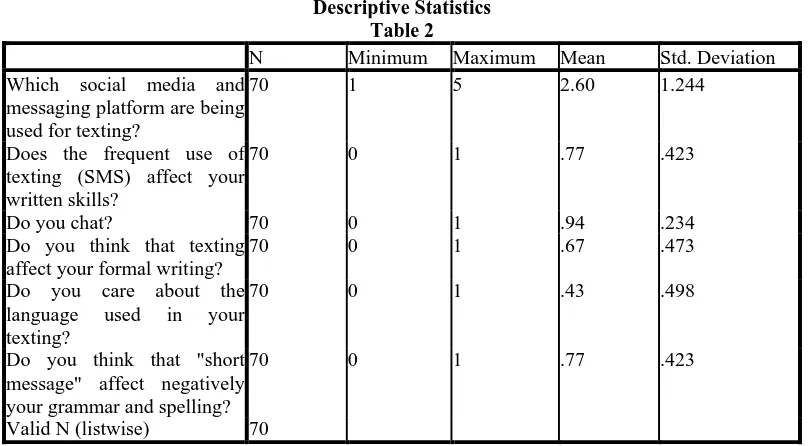
Descriptive Statistics Table 2
N Minimum Maximum Mean Std. Deviation Which social media and
messaging platform are being used for texting?
70 1 5 2.60 1.244
Does the frequent use of texting (SMS) affect your written skills?
70 0 1 .77 .423
Do you chat? 70 0 1 .94 .234
Do you think that texting affect your formal writing?
70 0 1 .67 .473
Do you care about the language used in your texting?
70 0 1 .43 .498
Do you think that "short message" affect negatively your grammar and spelling?
70 0 1 .77 .423
Valid N (listwise) 70
XIII. EPILOGUE:
The study uses a primary data collected through conducting an online survey. The greater part of the respondents report and stress over the issue recorded as a hard copy English in examination and assignments. They mostly do not use punctuation in formal writing and that is a big trouble. Students use wrong spellings and sentences due to which both the sender and reader pronounce, read and write it in the wrong way and spellings will be used academic writing in projects and assignments, papers, with the time they get used to overcome this in the near future or during their professional life or carrier.
Proof got from overview shows that the destructive impacts of content informing on understudy composing aptitudes is yet to wind up a noteworthy risk for college and undergrads.
In any case, it is essential to avoid lack of concern and rather take up cognizant and even minded estimates now in order to block the marvel from further intensifying understudies' composition aptitudes. So the theory concerned is endorsed and it's reasonable the unnecessary utilization of messaging influence understudies composed aptitudes. All endeavors must, in this way, be made to enable understudies to compose great English whether on telephone on paper and casual work. The ongoing computing and smartphone advancement has negative impact on student’s academic writing performance and requires serious policies to stop students to excessive use of SMS during their study time and also in assignments and papers. Decisions have to be taken carefully. Such work would be valuable for educational policies. The purpose of this paper is not to against advance technology like social media, smartphones, and internet. Texting can hurt students writing and grammar. Text because they are used toting was made easier for the students. Students can accidentally put slang language in their formal writings without realizing it. Students expect someone to fix their misspellings in class because they are used to their autocorrect doing it on their phones.
XIV. RECOMMENDATIONS:
As I am a learner and don’t speak English that much well that’s the reason SMS’s affected my grammar, spellings, and punctuation in a very negative way because I mostly considered those slang spellings as the actual spellings and pronounced them the way they were written, so it just ruined my English. It is government responsibility to provide a free training and seminars to stop students to the use of texting (SMS) in their formal writing. If we add this research in the educational policies then we will definitely stop student to use of SMS in their assignments, as well as examination.
REFERENCES
[1] 2011, S. A. (2011). Short message service (SMS) language and written language skills: educators' . 10-12.
[2] Bond, J. (09/27/2013 ). How to fix delayed texts messages on your mobile phone. 4-5.
[3] Brown. (, 2017 ). Negative Effects Of Internet On Students And Teenagers. 7-8.
[4] By Janna Anderson, L. R. (2012). Teens, technology, and human potential . 40-50.
[5] Cramb, A. (2003). English essay in phone text shorthand. 2-3.
[6] Crystal, D. (2018). how pronunciation provokes passionate reactions. 3-4. [7] Dansieh, S. A. (2011). SMS Texting and Its Potential Impacts on Students’
WrittenCommunication Skills. 9-10.
[8] Dansieh, S. A. (2011). SMS Texting and Its Potential Impacts on Students’ WrittenCommunication Skills. 9-10.
[9] Ferlazzo, L. (2018). Ways to Integrate Writing Into Science Classes. 15-18. [10] Janna Anderson, L. R. (2018). Concerns about the future of people’s
well-being. 18-20.
[11] John-Harmen Valk, A. T. (2010). Using Mobile Phones to Improve Educational Outcomes. 18-20.
[12] ML, I. (2010). Short Message Service (SMS) Is Corrupting Our Language. 5-7.
[13] Moursund, D. (2004). planning, forecasting and inventing your computers in education future. 12-18.
[16] Samson, F. (2008). Impact of Short Message Service. 5-6.
[17] Sherman, A. (2010). How Social Media is Affecting the Way We Speak and Write. 4-5.
[18] Ali, S. (2011).“SMS Texting and Its Potential Impacts on Students’ Written Communication Skills”. International Journal of English Linguistics. 1(2), 222-229, ISSN 1923-869X E-ISSN 1923-8703 222.
AUTHORS