Telematic practice and research
discourses: Three practicebased research
project case
Sermon, P
Title
Telematic practice and research discourses: Three practicebased research
project case
Authors
Sermon, P
Type
Book Section
URL
This version is available at: http://usir.salford.ac.uk/10730/
Published Date
2010
USIR is a digital collection of the research output of the University of Salford. Where copyright
permits, full text material held in the repository is made freely available online and can be read,
downloaded and copied for noncommercial private study or research purposes. Please check the
manuscript for any further copyright restrictions.
Proof Copy
2 3 4 5 6 7 8 9 10 11 12 13 14 15 16 17 18 19 20 21 22 23 24 25 26 27 28 29 30 31 32 33 34 35 36 37 38 39 40 41 42 43 44
2 3 4 5 6 7 8 9 10 11 12 13 14 15 16 17 18 19 20 21 22 23 24 25 26 27 28 29 30 31 32 33 34 35 36 37 38 39 40 41 42 43 44
Telematic Practice and Research Discourses:
Three Practice-based Research
Project Case Studies
Paul Sermon
Introduction
This chapter focuses on the production, documentation and preservation of the
author’s telematic, practice-based research in the interactive media arts. It reflects a timely practice review with significant implications for the future of exhibiting and archiving the broad range of creative arts in this field. These fundamental
research questions also have relevance across a number of practice-based research
fields including performance arts and the ephemeral nature of open-system
interactive artworks. The objective of this chapter is to propose research methods that will approach the question of how to document and archive appropriately this transient creative practice that is so often reliant on its immediate cultural and
historic context.
Since the early 1990s my artistic practice has identified and questioned the
notions of embodiment and disembodiment in relation to the interacting performer in telematic and telepresent art installations. At what point is the performer embodying the virtual performer in front of them? Have they therefore become disembodied by doing so? A number of interactive telematic artworks will be looked at in detail in this chapter. These case studies range from Kit Galloway and Sherrie Rabinowitz’s seminal work Hole-in-Space to my own telepresent
experiments with Telematic Dreaming and include the current emerging creative/ critical discourse in Second Life, the networked virtual/social environment, that
polarizes fundamental existential questions concerning identity, the self, the ego
and the (dis)embodied avatar.
The preservation and documentation of this work is extremely problematic
when we consider the innate issues of (dis)embodiment in relation to presence and
intimacy, as experienced and performed in telematic and virtual environments.
How can it become possible to reencounter a performance of dispersed and
expanded bodies, multiple and interconnected identities, spectral representations and auras: in short, hybrid bodies (selves) made of flesh and digital technologies,
1 2 3 4 5 6 7 8 9 10 11 12 13 14 15 16 17 18 19 20 21 22 23 24 25 26 27 28 29 30 31 32 33 34 35 36 37 38 39 40 41 42 43 44
1 2 3 4 5 6 7 8 9 10 11 12 13 14 15 16 17 18 19 20 21 22 23 24 25 26 27 28 29 30 31 32 33 34 35 36 37 38 39 40 41 42 43 44
Proof Copy
Telematic practice
My work in the field of telematic arts explores the emergence of a user-determined
narrative by bringing remote participants together in a shared telepresent environment. Through the use of live chroma-keying and videoconferencing technology, two public rooms, or installations, and their audiences are joined in a virtual duplicate that turns into a mutual, visual space of activity. Linked via an
internet videoconference connection, this form of immersive interactive exchange
can be established between two locations almost anywhere in the world.
The audiences form an integral part of these telematic experiments, which
simply would not function without their presence and participation. Initially, the viewers seem to enter a passive space, but they are instantly thrown into the performer role by discovering their own body-double in communication with another physically remote user on video monitors in front of them. They usually adapt to the situation quickly and start controlling and choreographing their human avatar. The installation, which is set up in the form of an open accessible platform, also offers a second choice of engagement: the passive mode of just observing the
public action, which often appears to be a well-rehearsed piece of drama confidently played out by actors. Compelling to watch, it can be a complex issue to discover
that the performers are also part of the audience and are merely engaging in a role. The entire installation space then represents two dynamic dramatic functions: the players, controllers or puppeteers of their own avatar, absorbed by the performing role; and the off-camera members of the audience, who are themselves awaiting
the next available slot on the telematic stage, soon to share this split dynamic.
However, the episodes that unfold are not only determined by the participants, but
by the given dramatic context. As an artist I am both designer of the environment
and therefore ‘director’ of the narrative, which I determine through the social and political milieu that I choose to play out in these telepresent encounters.
Headroom: A space between presence and absence (2006)
This case study represents the first theoretical account of Headroom1 a
site-specific interactive art installation produced in Taipei by myself, as the successful
recipient of the 2006 Taiwan Visiting Arts Fellowship. This residency programme was a joint initiative between Visiting Arts, the Council for Cultural Affairs Taiwan, British Council Taipei and Arts Council England. The development
of this interactive art installation was extensively documented as part of the AHRC Performing-Presence project led by Professor Nick Kaye from Exeter
Proof Copy
1 2 3 4 5 6 7 8 9 10 11 12 13 14 15 16 17 18 19 20 21 22 23 24 25 26 27 28 29 30 31 32 33 34 35 36 37 38 39 40 41 42 43 44
1 2 3 4 5 6 7 8 9 10 11 12 13 14 15 16 17 18 19 20 21 22 23 24 25 26 27 28 29 30 31 32 33 34 35 36 37 38 39 40 41 42 43 44
University in partnership with Stanford University.2Headroom was exhibited at
Xinyi Assembly Hall Taipei in April 2006.
Headroomis a juxtaposition of the artist’s ethnographic research experiences
in Taipei, between the ways people ‘live’ and the ways that they ‘escape’ the city, as an analogy between the social networking telepresent aspirations of the ‘headroom’ (internet) space and the solitude of the ‘bedroom’ (private) space. Referencing Roy Ascott’s essay, ‘Is There Love in the Telematic Embrace?’ (1990), and reminiscent of Nam June Paik’s early TV-Buddha installations,4
Headroomis a reflection of the self within the telepresent space, as both the viewer
and the performer. The television ‘screen’ is transformed into a stage or portal between the causes and effects that simultaneously take place in the minds of the solitary viewers. The installation overtly intertwines private and public space, and the sense of the ‘inside’ and ‘outside’ of the installation’s ‘place’.5 It is partly in
this breaking down of oppositions that the participants’ sense of the ‘presence’
of their co-performers is amplified. In this aspect, Headroomradically extends a
disruption of oppositions in which video art/installation and site-specific work has
frequently operated. The co-performers discover themselves acting out a series of intertwinings of public/private, inside/outside. The installation itself and its title emphasize the intimate nature of this overlaying of spaces – the aspect of fantasy or dream – while the public nature of the installation sanctions or appears to give
permission or consent to this closeness. In this context, co-performers discover themselves ‘coming closer’ in a paradoxical distribution of presence – an intimacy
produced by a telepresent distance. Here, visitors discover themselves occupying and acting out their co-performer’s private space, while seeing their own private space acted out by their telepresent partner. The spatial rules of public interaction are breached, producing an intimacy, a particular and shocking closeness, and a
dialectic between the explicit sense of being here (in the bedroom, for example)
and being there (acting out the space of the other), while seeing and responding to their co-performer’s mirrored reaction. [Plate 9.1]
Located in the east of Taipei city in the shadow of the 101 Tower and Taipei’s
World Trade Centre is a Taiwanese war veterans’ housing complex built around 1949. This site has been renovated and converted into a museum and exhibition
space. It sits on some of the most commercially sought-after space in the city, but because of its historical importance to the liberation of Taiwan it remains a listed building. The back-to-back terraced streets have been knocked through
into entire buildings, creating three large exhibition halls that retain the original
2 AHRC Performing-Presence project, <http://presence.stanford.edu:455/ Collaboratory/500>.
R. Ascott, Telematic Embrace (Berkeley: University of California Press, 200), pp. 22–46.
1 2 3 4 5 6 7 8 9 10 11 12 13 14 15 16 17 18 19 20 21 22 23 24 25 26 27 28 29 30 31 32 33 34 35 36 37 38 39 40 41 42 43 44
1 2 3 4 5 6 7 8 9 10 11 12 13 14 15 16 17 18 19 20 21 22 23 24 25 26 27 28 29 30 31 32 33 34 35 36 37 38 39 40 41 42 43 44
Proof Copy
appearance of the houses on the outside. The spaces that interested me most were the small facade rooms created by the larger space conversion, which have been separated from the gallery space by interior glass walls and are only accessible
from existing external front doors. The two facade rooms I used for the installation
were identical in size and were used to house a connected telepresent installation where the audience participants in the separate facade rooms were unable see each other. However, this allowed the audience inside the gallery to observe both participants in the space through the glass walls. The rooms were only about 2 m by .5 m wide, and 2.5 m high. The original houses were longer, but no wider and the original inhabitants often halved the height of the rooms to create separate sleeping and living areas. This two-level use of the space interested me, and also reminded me of the outside of the space, with the 101 Tower in stark contrast to
the little houses huddled around its base. This paradox can be seen in much of
Taipei’s culture, from very basic noodle bars and soup kitchens between Karaoke
TV clubs, 7/11 convenience stores and high-rise office blocks to countless temples
devoted to countless incarnations of the Buddha.
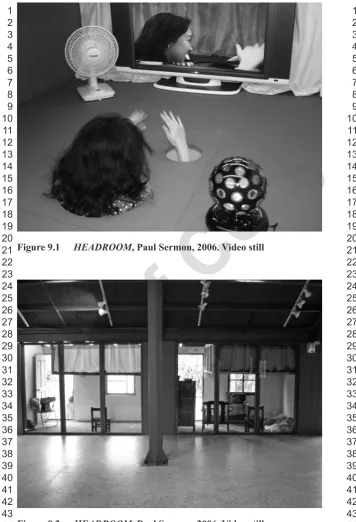
The project functioned by combining the two identical room installations within the same video image via simple videoconference techniques. The system worked as follows: The two rooms both had false ceilings lowered to a level of
approximately 1.5 m, which left a cavity space above each room of approximately
1 m high and which forced the gallery visitors to bend down when entering the spaces. However, there was one location in each room where the viewer was able to stand up straight and put his or her head and hands through a hole in the false ceiling and into the cavity space above. Although each room shared identical dimensions, each had a strikingly different appearance. One of the rooms contained drab, used furniture in the lower part and had a very lived-in appearance; the cavity space above it was brightly decorated, appearing to be a personal shrine or Karaoke bar, containing a large video screen at one end. The other room by contrast, was empty in the lower section and very bright in the cavity above, including illuminated blue walls and another large video screen. A video camera in each space recorded a live image of the head and hands of each participant and fed this recording directly
to a video chroma-key mixer. The background in the profile head-shot recorded against the bright blue walls was extracted by the video mixer and replaced with the other live profile head shot – placing the two heads opposite each other within
the same live video image. [Figures 9.1., 9.2 and 9.]
The red room represented a very theatrical, illusionary space. The blue room, by contrast, appeared to be a more functional backstage space. However, from the outside point of view there was not so much a front and backstage division as a
juxtaposition of two entirely separate spaces, which, due to their sheer proximity,
were meant to have something in common and yet, somehow, never became a telepresent synthesis. For Gabriella Giannachi there is a postmodern dialectic here,6 expressed visually in the impossibility of the two spaces to become one:
Proof Copy
1 2 3 4 5 6 7 8 9 10 11 12 13 14 15 16 17 18 19 20 21 22 23 24 25 26 27 28 29 30 31 32 33 34 35 36 37 38 39 40 41 42 43 44
1 2 3 4 5 6 7 8 9 10 11 12 13 14 15 16 17 18 19 20 21 22 23 24 25 26 27 28 29 30 31 32 33 34 35 36 37 38 39 40 41 42 43 44
[image:6.484.62.419.77.600.2]Figure 9.1 HEADROOM, Paul Sermon, 2006. Video still
1 2 3 4 5 6 7 8 9 10 11 12 13 14 15 16 17 18 19 20 21 22 23 24 25 26 27 28 29 30 31 32 33 34 35 36 37 38 39 40 41 42 43 44
1 2 3 4 5 6 7 8 9 10 11 12 13 14 15 16 17 18 19 20 21 22 23 24 25 26 27 28 29 30 31 32 33 34 35 36 37 38 39 40 41 42 43 44
Proof Copy
the external viewer, standing in front of the two spaces, actually sees ‘nothing’ but
the real, whereas to see the telepresent space you actually have to be willing to be within it.
Liberate your Avatar (2007)
Since May 2007 my practice and research has undergone what might appear to be a paradigm shift, focusing on the creative possibilities of the online multi-user virtual environment of Second Life. Whilst this represents a major departure from
my established telematic projects, there are significant parallels between the earlier telematic video experiments and the presence and absence experiments currently
being developed in Second Life. Together, these aspects of telepresence and the
merger of ‘first life’ and Second Life aim to question fundamental assumptions of
the Second Life phenomenon.
The aim of this project is to investigate critically how online participants in three-dimensional worlds, Second Life in particular, interact socially within
innovative creative environments and appropriate these cultural experiences as
part of their everyday lives, and question what is ‘real’ in this relationship. The project brings together ethnographic and creative practice-based methods that identify and develop original and innovative interactive applications, interface design and imperative cultural and sociological knowledge that will help shape and
Proof Copy
1 2 3 4 5 6 7 8 9 10 11 12 13 14 15 16 17 18 19 20 21 22 23 24 25 26 27 28 29 30 31 32 33 34 35 36 37 38 39 40 41 42 43 44
1 2 3 4 5 6 7 8 9 10 11 12 13 14 15 16 17 18 19 20 21 22 23 24 25 26 27 28 29 30 31 32 33 34 35 36 37 38 39 40 41 42 43 44 define the emerging online society and ‘metaverse’7 of Second Life, significantly
contributing to the quality of both ‘first life’ and Second Life.
In Second Life you create an avatar that lives out an online existence. There are
no set objectives; you can buy property, clothing, accessories, furnish your home, modify your identity, and interact with other users. This online community has grown to eleven million residents since launching in 2000, generating a thriving economy. However, whilst the virtual shopping malls, nightclubs, bars and beaches often reach their user capacity, there is a noticeable lack of creative and sociological modes of attraction and consequently the growing media attention
around Second Life warns that this expanding community has become ambivalent
and numbed by its virtual consumption and that there is an increasing need to identify new forms of interaction, creativity, cultural production and sociability.
However, when the Front National, the far-right French political party of Jean-Marie Le Pen, opened its Second Life headquarters in January 2007, the Second Life residents reacted in a way that would suggest they are far from complacent avatars wandering around a virtual landscape and that they possess a far greater degree of social conscience than the consumer aesthetics of Second Life suggest. Through prolonged mass virtual protest the centre was razed to the ground in the space of a week and has not returned since. The reaction to the Le Pen Second
Life office begs the question: is Second Life a platform for potential social and
cultural change? Is there a hidden desire and ambition to interact and engage with this online community at an intellectual and creative level that transcends the collective ‘I shop therefore I am’ apparentness of its community?8 Moreover,
does Second Life influence ‘first lives’? If so, could our ‘first life’ existence start to reflect our Second Life conscience as this community continues to grow and develop into the future? As the landmass and population of Second Life expands
at an ever-increasing rate, it is clear that essential research into the intersection and
interplay between ‘first life’ and Second Life, and both new and old patterns of
consumption, cultural production and sociability is urgently needed.
This second case study focuses on some of my most recent Second Life
experiments entitled Liberate your Avatar, an interactive, public video art performance incorporating Second Life users in a real-life environment, as shown in Figure 9.2.9 Located in All Saints Gardens, Oxford Road, Manchester, for the
Urban Screens Festival, 12 October 2007 from 5.00 pm to 6.00 pm, this installation
merged the realities of ‘All Saints Gardens’ on Oxford Road with its online three-dimensional counterpart in Second Life, and for the first time allowed ‘first life’ visitors and Second Life avatars to coexist and share the same park bench in a live
7 The term ‘metaverse’ comes from Neal Stephenson’s 1992 classic science fiction
novel Snow Crash, and is now widely used to describe the vision behind current work on fully immersive D virtual spaces.
8 The phrase ‘I shop therefore I am’ was used by artist Barbara Kruger in 1998 as a pun on consumerism and René Descartes’ statement ‘I think therefore I am.’
1 2 3 4 5 6 7 8 9 10 11 12 13 14 15 16 17 18 19 20 21 22 23 24 25 26 27 28 29 30 31 32 33 34 35 36 37 38 39 40 41 42 43 44
1 2 3 4 5 6 7 8 9 10 11 12 13 14 15 16 17 18 19 20 21 22 23 24 25 26 27 28 29 30 31 32 33 34 35 36 37 38 39 40 41 42 43 44
Proof Copy
interactive public video installation. By entering into this feedback loop through
a portal between these two parallel worlds this event exposed the identity paradox
in Second Life. [Plate 9.2]
This unique project, commissioned by Lets Go Global in Manchester, brought together earlier practice-based telepresence research projects and current
experiments and experiences in the online three-dimensional world of Second
Life. The installation investigated the notion of demonstration and how it has been transposed from the real into the virtual environment. Liberate your Avatar exposed the history of All Saints Gardens; relocating Mancunian Suffragette
Emmeline Pankhurst as an avatar within Second Life, where she remained locked to the railings of the park, just as she did a hundred years ago, reminding us of the continual need to evaluate our role in this new online digital society. Liberate Your Avatar examined this new crisis whilst drawing upon the history of the site, creating a rich, provoking and entirely innovative interactive experience.
The installation consisted of three specific spaces, two of which were located
in the virtual world of Second Life while the third was physically located in All
Saints Gardens on Oxford Road, in Manchester. The two virtual environments included a blue box studio and a three-dimensional replica of All Saints Gardens.
They were located adjacent to each other, allowing the Second Life avatars to move
freely between the two spaces. When an avatar entered the blue box space his/her
image became chroma-keyed with a live video image from All Saints Gardens. This combined live video image of the avatar in the ‘real’ All Saints Gardens was then streamed back onto the internet and presented on a virtual screen in both Second Life spaces. An image of the Second Life version of All Saints Gardens, with its virtual ‘big screen’ was then presented on the public video screen in the ‘real’ All Saints Gardens.
Liberate your Avatar brought together theoretical and practical methods from
the field to address this identity crisis in ‘first life’ and Second Life. Although
online communities have been studied in-depth for some time now, the focus here will be upon an ethnographic, multidisciplinary and practice-based discussion in
order to paint a richer picture of future experiences.
In this respect, the project uncovered more question than answers, principally concerning identity and self. The ontological questions of virtual reality and
identity, online or offline, have been at the centre of the contemporary media
arts and science debate for the past three decades. Liberate your Avatar points
at the social, political and cultural significance of Second Life by questioning the emerging relationship between ‘first life’ and Second Life as a platform
for potential social and cultural change: which is potentially appropriated as a
mirror image of ‘first life’? Through this discourse the project questioned whether Second Life is a reflection of ‘first life’ or if ‘first life’ is actually a reflection of Second Life? By consciously deciding to refer to this mirrored image as ‘first’ life rather than ‘real’ life, this central question polarized the paradox in Second Life,
Proof Copy
1 2 3 4 5 6 7 8 9 10 11 12 13 14 15 16 17 18 19 20 21 22 23 24 25 26 27 28 29 30 31 32 33 34 35 36 37 38 39 40 41 42 43 44
1 2 3 4 5 6 7 8 9 10 11 12 13 14 15 16 17 18 19 20 21 22 23 24 25 26 27 28 29 30 31 32 33 34 35 36 37 38 39 40 41 42 43 44 own body image reflected in the mirror ‘stage’.10 However, there are no mirrors
in Second Life, which raises the fundamental question of whether it is possible to formulate our second self (or alter ego) in Second Life at all. Or is the computer screen itself the very mirror we are looking at?
Hidden Voices: Memoryscape (2006)
The final case study project Hidden Voices: Memoryscape11 was commissioned by
the Taipei City Department of Cultural Affairs for the fourth ‘City on the Move Art
Festival’: ‘From Encounter to Encounter – Expounding the Playground’, which
took place at the Children’s Recreation Centre Taipei, Taiwan, in November 2006.
Hidden Voices: Memoryscape invited visitors to enter the amusement park and, guided by PDAs and maps, to search out randomly stories taking place amidst
the physical terrain – for example, unusual past experiences that people had at the
amusement park when they were children: ‘a strawberry ice cream dripping on an orange skirt, a lost shoe, falling over and grazing a knee or how the space appeared then …’.12 Stories and incidental experiences allow adults to reinterpret this place,
which is the ‘territory of children’, while memories in synch with the archetypal
concept of the venue induce the expansion of the subconscious, constructing an
aesthetic of imagined memories in relation to the venue. Thus, the augmentation of individual memories is transformed into collective memory. In addition to the augmented mediascape, I presented a series of video-projected images in the tunnel of the miniature train ride. These video sequences referred to a momentary
transition between the past and present experience of the amusement park and thus
further assisted in augmenting the participants’ journey around the environment [Plate 9.].
This project commenced by interviewing parents and visitors at the adventure
playground over a one-week period and recording two-to-five-minute episodes about their own childhood experiences and memories of the adventure playground
– intimate personal stories and strange and unusual memories about incidental
experiences. In order to create this dynamic audio and video narrative, the work
was partly constructed/dramatized and partly real-life stories/interviews.
This layering of augmented memories over the actual experience of visiting
the adventure playground today was further assisted by providing visitors with a map that guided them through the locations and the stories attached to them. Whilst further conceptual information was provided in this guide, other discrete and unusual sounds and visuals that the user stumbled across were included, providing an abstract story or chain of events that brought the piece together
10 J. Lacan, ‘The Mirror Stage’, in Jacques Lacan, Écrits (Paris: Éditions du Seuil, 1966).
1 2 3 4 5 6 7 8 9 10 11 12 13 14 15 16 17 18 19 20 21 22 23 24 25 26 27 28 29 30 31 32 33 34 35 36 37 38 39 40 41 42 43 44
1 2 3 4 5 6 7 8 9 10 11 12 13 14 15 16 17 18 19 20 21 22 23 24 25 26 27 28 29 30 31 32 33 34 35 36 37 38 39 40 41 42 43 44
Proof Copy
within an interactive experience of a collective memory of the playground. The
audio sequences were recorded using binaural microphones which placed the sounds spatially as they were when recorded. Additional visual references to this augmented narrative were provided as video clips projected in the interior of the tunnel of the children’s train ride. A combination of slow-motion and
strobe-flashing image sequences took the visitor further into this augmented memoryscape,
a momentary return to the history and collective memory of the environment. Augmented reality involves the overlaying of digital information onto real
space. By moving through the real environment users experienced the digital
information at the location to which it referred. Headphones were connected to a Hewlett Packard iPAQ PDA, a small hand-held computer, that played the
appropriate sound file corresponding to the position of the user in the playground.
The location of the user was determined by a GPS (Global Positioning System) receiver unit attached to the PDA. GPS is a worldwide radio navigation system that uses satellites to calculate position. The playing of sound and video sequences
was defined according to a software authoring tool. The authoring tool used a map of the area as a background onto which regions were drawn. Specific commands were associated with each region and defined what the user should experience
when they entered or re-entered the space, and a client program running on the
PDA worked out which sound file should be played depending on where they were
in the region.1
Conclusion
I have tried to keep as much as possible of the original notes, video recordings, and documentation of all my projects. I started doing this with with Telematic Dreaming in 1992, even though then I had no idea how important this material would become. It is interesting that I would hear my own commentary on a project – often no more than a couple of sentences, or a kind of short story – told by others, who often had not seen the installation, and told with perfect clarity.
Each time Telematic Dreaming is shown it is as if the empty bed is filled with
potential. When the ‘story’ that allows the arrangement and idea of the piece to be understood is told, it enables an immediate understanding of that potential. The participant or user becomes the creator or artist, and my role is to imagine and make possible the space for all that is potential to happen. For me the archived ‘lineout’ images are the single most important archived element of these telematic
encounters, such as that shown in fig 9.1. They are far more significant than
documented images of the installation, representing as they do the moment of communication, meaning and creation of the work.
1 Software development by HP Labs Bristol. Supported by the University of Salford
Proof Copy
1 2 3 4 5 6 7 8 9 10 11 12 13 14 15 16 17 18 19 20 21 22 23 24 25 26 27 28 29 30 31 32 33 34 35 36 37 38 39 40 41 42 43 44
1 2 3 4 5 6 7 8 9 10 11 12 13 14 15 16 17 18 19 20 21 22 23 24 25 26 27 28 29 30 31 32 33 34 35 36 37 38 39 40 41 42 43 44
I have a considerable archive of this recorded lineout video feed. Watching it is something like a portal to the past; you are looking at the very images that caused the scene or effect you are looking at. As the viewer of this archive watches
this continual loop of self-reflective experience, the emotions and sensations are
brought back to life. There is something almost spiritual about this.
What remains for me as the developer or composer of these installations is the concept – a few pieces of paper or a set of instructions as simple as: ‘projector
mounted to ceiling, monitors positioned left and right, camera connected to mixer