International Journal of Emerging Technology and Advanced Engineering
Website: www.ijetae.com (ISSN 2250-2459,ISO 9001:2008 Certified Journal, Volume 4, Issue 7, July 2014)
175
An Efficient Technique to Optimize the Energy in Wireless
Sensor Networks Using Mobile Relay
Megha V Kadakol
1, Sneha K
2, Dr. B. G. Prasad
31
PG Student, MTech (CNE), BNMIT, Bangalore, India
2Associate Professor, 3Professor and HOD, Dept. of CSE, BNMIT, Bangalore, India
Abstract— A wireless sensor network consists of one or
more sensor nodes. The role of sensor nodes is to process data. Since sensor nodes have limited storage capacity, processing huge volumes of data would result in battery drainage. Hence mobile relays are proposed which are low cost and disposable which helps in optimizing the energy utilization in data-intensive wireless sensor networks. The two main aspects used in our approach are: firstly, it does not require any complex architecture and secondly, we use both mobility and wireless transmission technology to reduce the energy utilization. Our framework consists of three static assumptions: in the first case, we consider the optimal routing of the mobile relay, in which it moves either to right or left or center of sensor nodes depending on the file size. In the second and third case, we consider the optimal routing in which the mobile relay moves in zigzag fashion by considering variable and fixed file size. Experimental results show that our algorithm significantly reduces the energy consumption when compared with the existing solutions.
Keywords— Wireless Sensor Network, Battery Drainage, Mobile Relay, Energy Utilization, Data Intensive, Mobility, Optimal Routing.
I. INTRODUCTION
Many sensors can be networked together to form a sensor network. The role of a sensor node is to perform sensing. A wireless sensor network is controlled through software. A wireless sensor network is said to be self-configured which means they can gather information from a large geographical area or movements of objects etc. Sensor networks can be used for tracing the target object, monitoring the environment, traffic control and various other applications.
A sensor node comes in different sizes. The cost of sensor nodes is equally variable .A typical sensor node consists of a sensing unit, processing and memory unit, and power unit.
Sensing Unit:
The sensing unit consists of a sensor and an analog-to-digital converter. The converter converts the analog signals produced by the sensors to digital signals. They are then fed into the processing unit. The sensing unit collets data from outside and interacts with the processor.
Processing and Memory Unit:
The processing unit performs computations on data and stores the resulting information in the memory for further utilization.
Power Unit:
The sensor node consumes power for sensing, communicating and data processing. Power is stored in batteries. Batteries, both rechargeable and non-rechargeable, are the main source of power supply for sensor nodes.
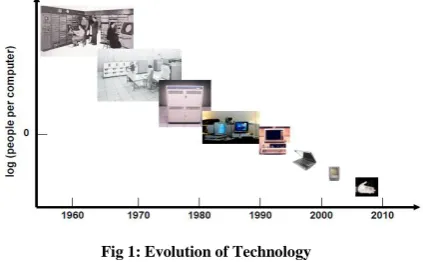
[image:1.595.328.540.461.592.2]Since 1960 till date, there have been drastic improvements in the technology. Earlier communication and computing were wired. As the years passed, huge computers were replaced with portable devices, and furthermore, wireless technology came into existence where sensing, communication and computing of particular data can be gathered from distant locations. Figure 1 shows such an evolution.
Fig 1: Evolution of Technology
We make the following contributions in this paper:
1.The problem of Optimal Mobile Relay
Configuration is formulated by processing huge volumes of data in WSNs. Our main aim is to optimize the energy that is conserved by both mobility of mobile relay node and wireless transmissions.
2.We propose an optimal tree construction where
nodes are considered to be static with no mobility.
3.We develop two algorithms. First is optimization
International Journal of Emerging Technology and Advanced Engineering
Website: www.ijetae.com (ISSN 2250-2459,ISO 9001:2008 Certified Journal, Volume 4, Issue 7, July 2014)
176
4.We conduct various analysis and it can be shown
that our algorithms can reduce the energy consumption compared to the existing system. The rest of the paper is organized as follows. Section 2 reviews related work. Section 3 describes about proposed system. In section 4, we present an optimization algorithm, an optimal solution with a single mobile relay and distributed algorithm. In Section 5, we present a practical analysis of our approach and Section 6 concludes this paper.
II. RELATED WORK
Three different approaches are reviewed, mobile base stations, data mules, and mobile relays that use mobility in wireless sensor networks to reduce energy consumption.
In first approach, a base station which is mobile moves around the network and collects data from the nodes. At times all nodes perform multiple hop transmissions to the base station, and the main aim is to go around and look at which nodes are close to the base station in order to balance the transmission load [1], [2], and [3]. In some cases, nodes only pass on data to the base station when it is close to them. The objective is that before nodes undergo buffer overflows, we have to calculate a mobility path to collect data from visited nodes [4], [5]. Several rendezvous based data collection algorithms are projected, where the mobile base station only visits a selected set of nodes referred to as rendezvous points within a limit and the rendezvous points buffer the data from sources. All the above approaches acquire high latency due to the low to moderate speed of mobile base stations.
In second approach, data mules pick up data from the sensor nodes and transfer it to the sink which is nothing but the base station. The data mule visits all the nodes to collect data, transports data over some distance, and then transmit it to the static base station through the network [10]. The objective is to find a movement path that minimizes both communication and mobility energy consumption. They also incur large delays.
In third approach, the network consists of mobile relay nodes along with static base station and source node. Relay node do not transport data to the destination; instead, they move to different locations to decrease the transmission costs. We use the mobile relay approach in this work. An author named Goldenberg et al. [11] showed that in iterative mobility algorithm, each relay node which moves to the middle of its neighbor nodes converges on the best possible solution for a single routing path. In [12], mobile nodes decide to move only when moving is advantageous.
III. PROPOSED SYSTEM
A key challenge faced by data-intensive WSNs is to minimize the energy consumption of sensor nodes so that all the data generated within the lifetime of the application can be transmitted to the base station. Several different approaches have been proposed to significantly reduce the energy cost of WSNs by using the mobility of nodes. A robotic unit may move around the network and collect data from static nodes through one-hop or multihop transmissions [1], [3], [4], and [5]. The mobile node may serve as the base station that transports data between static nodes and the base station [6], [7], and [8]. Mobile nodes may also be used as relays that forward data from source nodes to the base station. Several movement strategies for mobile relays have been studied in [9], [11]. All these approaches lead to the disadvantages which are mentioned below:
It leads to energy consumption.
It requires complex motion planning of mobile
nodes.
Mobile nodes need to repeatedly compute optimal
motion paths.
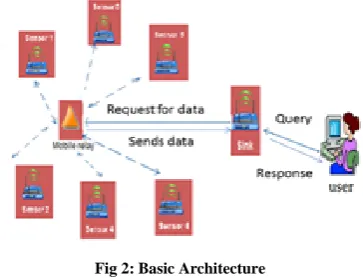
[image:2.595.341.523.549.688.2]In this paper, low-cost disposable mobile relay is proposed to reduce the total energy consumption of data-intensive WSNs. Different from mobile base station or data mules, mobile relays do not transport data; instead, they move to different locations and then remain stationary to forward data along the paths from the sources to the base station. Thus, the communication delays can be significantly reduced compared with using mobile sinks or data mules. Moreover, each mobile node performs a single relocation unlike other approaches which require repeated relocations. Figure 2 shows the basic architecture of the proposed system.
Fig 2: Basic Architecture
Some of the advantages of proposed system are:
In our approach, mobile relay moves in zigzag
International Journal of Emerging Technology and Advanced Engineering
Website: www.ijetae.com (ISSN 2250-2459,ISO 9001:2008 Certified Journal, Volume 4, Issue 7, July 2014)
177
Our approach only requires one-shot relocation to
designated positions after deployment.
IV. PROBLEM DEFINITION
A. Optimization Algorithm
In this optimization algorithm, we compute the optimal position of the relay node. The algorithm starts by uploading the files to all the sensors present in the network. Once the uploading is done, the mobile relay node moves to each and every sensor nodes to gather the data and then sends it to the sink.
Optimization algorithm is shown in figure 3.Here the
network consists of source nodes xi and pi, one mobile
relay node si, and one sink.
Algorithm: To compute optimal position of a relay node
Input: A fixed or variable size file uploaded to all the source nodes {fs}
Output: Optimal position of a relay node si
Procedure optimal_position 1. if fs1 in xi > fs2 in pi then
2. Consider case si moves right
3. end if
4. Repeat until TRUE 5. if fs1 in xi < fs2 in pi then 6. Consider case si moves left 7. end if
8. Repeat until TRUE
9. Repeat step 1 to 7 for left over source nodes 10. Return fs
Fig 3: Algorithm to compute the optimal position of a relay node in a zigzag fashion.
B.Distributed Algorithm
In this algorithm, we make use of greedy geographic routing. In this type of routing, each node forwards data to the neighbor node that is closest to the sink and it should be within the communication range.
Whenever the user first sends a request to the sink, it forwards it to the mobile relay. The mobile relay node then moves in accordance to the optimization algorithm as explained above.
The distributed algorithm works as follows. When the
mobile relay node is in the range i.e.,
MOBILE_IN_RANGE, it forwards the data to the sink. It will send the data of the form SEND (sender, META_DATA, info) to the sink. Sender means from which sensor node the data is being taken. META_DATA means the data will be divided into packets and finally info means the information about the data.
There are two types of process offers:
ACCEPT_OFFER and REJECT_OFFER.
ACCEPT_OFFER is considered when the mobile relay node moves in the network. In REJECT_OFFER, mobile relay node moves back to its original position.
We can also increase the number of nodes in the network by using UPDATE_STRUCTURE.
V. PRACTICAL ANALYSIS
A.Energy Consumption Graph
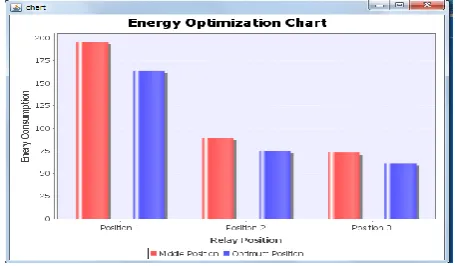
[image:3.595.317.545.473.606.2]Initially we carried out the experiment with 6 source nodes which are within the communication range of 30m, 1 sink node and 1 mobile relay node. We plotted the energy consumption graph for mobile relay with 6 source nodes by considering energy consumption vs. mobile relay position. Since there are 6 nodes, we have considered 3 positions i.e., position 1 is considered when the relay node is between sensor node 1 and 2. Position 2 is considered when the relay node is between sensor node 3 and 4. Position 3 is considered when the relay node is between sensor node 5 and 6. When the relay node is in position 1, we have considered both the middle position and optimum position. The same thing is repeated for position 2 and position 3. When we make an analysis of the graph, we can observe that energy consumed by mobile relay node when in optimum position is less than energy consumed by mobile relay node when in middle position. The figure 5 shows such an analysis.
Fig 5: Energy consumption chart with 6 nodes and 3 positions
International Journal of Emerging Technology and Advanced Engineering
Website: www.ijetae.com (ISSN 2250-2459,ISO 9001:2008 Certified Journal, Volume 4, Issue 7, July 2014)
[image:4.595.48.283.116.269.2]178
Fig 6: Energy consumption chart with 6 nodes and 5 positions and constant file size
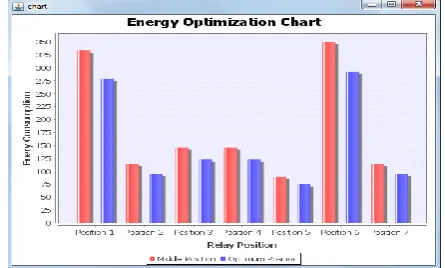
[image:4.595.323.542.210.346.2]The figure 7 shows an energy consumption chart by considering 6 sensor nodes and 5 positions. The first 3 positions are same as explained but the 4th and 5th position is considered when the mobile relay node moves in zigzag fashion. In figure 7 we are considering the file size to be variable.
Fig 7: Energy consumption chart with 6 nodes and 5 positions and variable file size
As an advancement we can extend the nodes in a network. Figure 8 shows the same energy consumption chart by considering 14 sensor nodes and 7 positions. Here the mobile relay node moves with respect to optimization algorithm.
Fig 8: Energy consumption chart with 14 nodes and 7 positions and variable file size
[image:4.595.324.541.369.521.2]As a security issue, we have extended our analysis to work even on a web application by using Tomcat Servers by taking into consideration both user name and password. The user can download or delete the data only when he enters the necessary credentials i.e., username and password which is shown in the following figures.
Fig 9: Web Application by Using Tomcat Servers
Fig 10: User Login
VI. CONCLUSION
In this paper, we have proposed an approach to minimize the energy consumption on source nodes by using mobile relay node. Our approach can work with less optimal initial configurations such as greedy geographic routing. Our approach improves the initial configuration using two schemes. New nodes into the tree are inserted first. The optimal position of relay node in the tree is then computed given a fixed topology. This algorithm is suitable for a variety of data-intensive wireless sensor networks. When optimization algorithm is considered in zigzag fashion, we can observe that energy is optimized to the greater extent. Here our approach considers only static nodes but it can further be extended to dynamic nodes. Our analysis results show that it considerably reduces the energy consumption and also provides security to an extent.
[image:4.595.53.276.373.487.2] [image:4.595.52.275.580.714.2]International Journal of Emerging Technology and Advanced Engineering
Website: www.ijetae.com (ISSN 2250-2459,ISO 9001:2008 Certified Journal, Volume 4, Issue 7, July 2014)
179
REFERENCES[1] S. R. Gandham, M. Dawande, R. Prakash, and S. Venkatesan, ―Energy efficient schemes for wireless sensor networks with multiple mobile base stations,‖ Proc. IEEE Globecom, 2003. [2] J. Luo and J.-P. Hubaux, ―Joint mobility and routing for lifetime
elongation in wireless sensor networks,‖ Proc. IEEE INFOCOM, 2005.
[3] Z. M. Wang, S. Basagni, E. Melachrinoudis, and C. Petrioli, ―Exploiting sink mobility for maximizing sensor networks lifetime,‖ Proc. 38TH Ann. Hawaii Int’l Conf. System Sciences(HICSS), 2005.
[4] A. Kansal, D. D. Jea, D. Estrin, and M. B. Srivastava, ―Controllably mobile infrastructure for low energy embedded networks,‖ IEEE Transactions on Mobile Computing, vol. 5, pp. 958–973, 2006.
[5] G. Xing, T. Wang, W. Jia, and M. Li, ―Rendezvous design algorithms for wireless sensor networks with a mobile base station,‖ Proc. ACM MobiHoc, pp. 231–240, 2008.
[6] D. Jea, A. A. Somasundara, and M. B. Srivastava, ―Multiple controlled mobile elements (data mules) for data collection in sensor networks,‖ Proc. IEEE First Int’l Conf. Distributed Computing in Sensor Systems (DCOSS), 2005.
[7] R. Shah, S. Roy, S. Jain, and W. Brunette, ―Data mules: Modeling a three-tier architecture for sparse sensor networks,‖ Proc. IEEE First Int’l Workshop Sensor Network Protocols and Applications (SNPA), 2003.
[8] S. Jain, R. Shah, W. Brunette, G. Borriello, and S. Roy, ―Exploiting mobility for energy efficient data collection in wireless sensor networks,‖ Mobile Networks and Applications, vol. 11, pp. 327–339, 2006.
[9] W. Wang, V. Srinivasan, and K.-C. Chua, ―Using mobile relays to prolong the lifetime of wireless sensor networks,‖ Proc. ACM MobiCom, 2005.
[10] C.-C. Ooi and C. Schindelhauer, ―Minimal energy path planning for wireless robots,‖ Proc First Int’l Conf. Robot Comm. And Coordination (ROBOCOMM), p. 2, 2007.
[11] D. K. Goldenberg, J. Lin, and A. S. Morse, ―Towards mobility as a network control primitive,‖ Proc. ACM MobiHoc, pp. 163–174, 2004.