International Journal of Emerging Technology and Advanced Engineering
Website: www.ijetae.com (ISSN 2250-2459, ISO 9001:2008 Certified Journal, Volume 8, Issue 8, August 2018)13
The Implementation of E-government Projects in the World and
Libya
Aref Busoud
1, Prof. Dr Dejan Zivkovic
2, Dr. Abdalla Gheryani
3 1,2,3Singidunum University & 32 Danijelova 11000 Belgrade, Serbia
Abstract— Among the processes taking place in the majority of the modern world is shifting from the traditional ways of communication and service deliverance by the governments towards electronic ways of communication. Generally distincted, E-government symbolizes a kind of a utilization of Information and Communication Technologies (ICT) to endorse extra competent and successful management, make easy further available supervision services, permit better public admittance to information, and compose management extra answerable to populace. It includes delivering services over the Internet, gadgets without wires, telephone or supplementary methods of connections.
The purpose of this paper, above all, is to recognize the elements and processes which would help authorities understand the key issues influencing people`s needs as well as their approval with the services provided and also using the quality criteria to grade government’s service delivery process. Furthermore, our objective is to offer facts, terms, and requirements for establishment of E-government in Libya, to indicate the best solution for the emerging issues and actions to be taken to develop E-government and further bring benefit to the society.
The contact connecting the government and civil sector and its involvement in work of government is very important. E-government enables the consumers to carry out their inquiries, requests, transactions on-line which greatly helps increase the output and reduce the response time on the requests tackled to the government`s departments and officers. In pace with the shift towards electronic communication, the government is indebted to ensure adequate protection of its citizen’s data, and block potential threats, hackers or intruders. The electronic safety measures are corresponding to conventional safekeeping what means building new-fangled work items in the command such as information safety surveillance unit that assurances electronic protection of the nation.
The ICT course of action in Libya has focused on the overture of telecommunications opposition, and invigorating of stern rules on wireless and supplementary digital technologies to give additional inducement for venture and expansion. Nevertheless, Libya incidents margins of ICT entrée as a consequence of its geography, underdeveloped infrastructure, weakness of schooling system, digital divide, and other political, societal, financial and technical precincts alongside with a olden times of restraining conventional civilizing ideals.
In the present research, we shall reflect on a few projects undertaken by Libya towards realization of E-government and their efficiency to emphasize their significance.
Keywords—E-government, Libya.
I. INTRODUCTION
The central theme of this work is E-government in Libya which is proven to be the chief theme in new Libyan system development as social, political, economic and cultural. Researchers in the recent years have shown how E-government in the entire world and their development had strong power on the community and monetary development. The complex transformation has affected even social life.
The economic strategy has changed since the 1999; therefore, the business administration, civil society and administration of government are involved in the utilization of the E-government. This work closely examines these advantage experiences in Libya and is showing initial facts on their correlation with other countries. In this way, internet, telephone communications, and substance capital are described in details.
International Journal of Emerging Technology and Advanced Engineering
Website: www.ijetae.com (ISSN 2250-2459, ISO 9001:2008 Certified Journal, Volume 8, Issue 8, August 2018)14
Therefore, the institutions of E-government necessitate an excellent understanding of the requests that subsist in the general public and that could be presented by means of ICT. The helpfulness of ICT in government is strongly connected with the ability of government to persuade a modify of the system inside its organizations as instrumental of transparency and information substitute and creation.Figure1: The regional average of E-government expansion in the world
II. E-GOVERMMENT IN ARAB COUNTRIES
If we come across at the political, financial, public and geographical Arab conditions, we would find out that there is a great need for upholding the E-government principle. It is known that Arabs heavily relay on their governments in supplying education, health, residence and other services. The government control economic funds in the area which increases its financial and communal role, although the infrastructure is in the low stage in the isolated areas. This should encourage spreading the necessary architecture to help in meeting peoples‘ needs. Many bet on the function of computer in defeating corruption, favoritism, and bureaucracy. The states in the Middle East and North Africa (MENA) face a huge number of challenges. In the earlier period, enlargement and progress have been moderately time-consuming with „per capita ―, profits decline or hardly keeping up with lofty populace increase rates.
Indicators to be mentioned are the most significant facts for developing of E-government, because stable economic situation is influencing on the growth of the same1. The factor of accumulation has resulted in growth rather than the factor of increased productivity, which reflects in low rates of technological progress, modernism and a great digital split in Media Information and Communication Technologies (MICT).
Furthermore, the main problem is the important function of the community division in production, despite a set of reforms and privatizationPolitical instability and other factors are influencing on stage of investment risk, and they are bringing less confidence within investors. Most of Arab states are in changeover to liberal regimes and they are transforming their market to free one. New standards and terms, which are provided by developed countries, are in the phase of implementation; moreover, these countries are trying to make basic stable economic environments.
E-government development stage in some Arab countries
There are many of different possibilities for
development of E-government. Current situation is different from country to country; for example, payment transaction capabilities in Arab countries.
Bahrein- The monarchy of Bahrain was the initial Arab nation states that set up the E-election method. In 2001, on the nationwide accomplishment contract and another time in parliamentary voting in 2002, the E-vote service was offered to Bahrain‘s nation.
United Arab Emirates (UAE) - The central E-government portal does not present nation with any E-democracy services. Nonetheless, at state rank, Dubai E-government portal gives view surveys capacity to obtain people estimations concerning matters of interest.
Qatar - The portal offers populace with the capacity to post their explorations, complains, counsels, and annotations concerning any E-government service.
Jordan– By means of online survey instrument, dialogue
forums, and online discussion services presented in this website, Jordanians can exchange attitudes and standpoints on matters of significance with governments and with the members of their society.
Kuwait - The portal presents populace online selection instrument to obtain their estimations and standpoints on the topic of subjects of significance.
Egypt- Populace could use the E-government portal to set their explorations, complains, approvals, and remarks on the subject of the services presented by E-government.
Saudi Arabia - A number of ministries afford debate forums in their websites.
Amongst the Arab states solitary three regimes afford E-payment business deal aptitudes to their populace or businesses and those are UAE, Bahrain and Qatar.
0.278 0.5403 0.4992
0.7188 0.424
0.4882
0 0.5 1
Africa Asia Oceania
International Journal of Emerging Technology and Advanced Engineering
Website: www.ijetae.com (ISSN 2250-2459, ISO 9001:2008 Certified Journal, Volume 8, Issue 8, August 2018)15
Despite the shortness of financial income, Jordan has developed fairly superior sophisticated E-government service deliverance potentials in E-democracy and two-way interface. To a minor degree, other states in the Arab E-government up-and-comings faction such as Egypt, Saudi Arabia along with Lebanon besides have developed a few promising or pioneering E-government service deliverance potentials.An easy way to comply with the conference paper formatting requirements is to use this document as a template and simply type your text into it.
III. E-GOVERNMENT IN DEVELOPED COUNTRIES
The experiences of E-government services in industrial states are very similar, because the main strength of industrial states is good infrastructure, beside their economic strength. In this section, we present three experience cases from USA, UK and Australia, for the reason that they are providing standards for other countries especially for those in transition.
The United States of America - According to the United Nations records, USA has retreated from the first grade in 2005 into the fourth grade in 2008 and what recognized the American experience in this field is how the government supports and understands the E-government. President Bill Clinton is the foremost president who used the term E-government in 1997. President Clinton determined the worth of applying the E-government applications by the American institutes and during his second presidential term he formed a work team to chart and organize applying the E-government technology in the government‘s institutes. After that in 2000 President George Bush was elected and (as he is from another political party) he almost invalidated what President Clinton‘s management had planned. President Bush started new plans which delayed what President Clinton had planned for the project. The E-government project had improved during the two presidential periods (8 years each) and expected that the new president might have new and different plans. The American experience could be useful for us if the significance of a safety planning to link electronically the governmental institutes through interoperability standards
is considered.
The condition in America is different from the other countries because the government consists of three layers (levels) the Federal one (presidential), the private level in every state (as each state has different systems) and the local level (each county inside the state has its own interests).
So how could they manage to tie all that states with different institutes and Federal roles with the other states? One of the achieved goals in this regard is the Federal architecture which intends to link and merge dissimilar ranks of the government.
In 2002 the Act of E-government, has approved ―to advance the techniques by which regime data, counting data on the Internet, is prearranged, conserved, and completed easy to get to the community˝. Each year the Office of Management and Budget reports to the US Congress on the condition of centralized E-government proposals. As of 2011, there were more than 5,600 community facing regime websites. Completely executable online service deliverance reimbursement equally regime and its ingredients. In the stretched run, such services present the probable for subordinate charge of service deliverance and compose them more broadly reachable to the common community. They no longer have to visit, note down or call a bureau to accomplish a definite service.
The websites inspected in year 2008, 89 percent recommend services that are totally executable online, increasing from 86 percent of the previous year. Of the sites this year, 11 percent have no services, 12 percent present one service, 10 percent have two services, and 67 percent have three or more services. Noticeably, state and national regimes are making important growth at insertion completely executable services online. Of the regime websites evaluated, 33 percent admit credit cards, and 13 percent permit for digital signatures (up from 1 percent of the previous year).
International Journal of Emerging Technology and Advanced Engineering
Website: www.ijetae.com (ISSN 2250-2459, ISO 9001:2008 Certified Journal, Volume 8, Issue 8, August 2018)16
In November 2005, the Cabinet Office published Transformational Government Enabled by Technology. The six-year plan aim is to ―set out how successful utilization of technology to distribute services considered around the requirements of populace and businesses can make a valid distinction to people‘s lives‖.Australia - According to the United States records, Australia has retreated from the sixth international grade in 2005 to the eighth grade in 2008. One of the most significant features of Australia‘s experience is how they managed to compact with different cultures, religions and languages for applying social inclusion principle which includes the significance of providing suitable services for all different classes of the society in different areas without distinguish between their educational and cultural level. Australia has improved some electronic sites with different languages such as Arabic, Chinese, Malayan, Indonesian, Indian, and Greek. Adding to this the digital gap, i.e. many citizens live in the central (Desert) and they usually lack the education and the utilization of technology. Nevertheless, the Australian experience helped us in schedule a date for applying the E-government, as the ex-president of Australia Mr. John Howard scheduling a fixed date (the end of 2001) for public institutes to apply all services electronically. This led suppliers to provide suitable quantity and disregarded the superiority of services.
A main feature of all industrial states in the
contemporary earth is elevated and rising
divide of services inside the general financial system. It is unimaginable that Australia might confront this tendency. Devoid of continuous and extensive development in services it cannot aim to continue their monetary status. But Australian services production face unparalleled confronts in the domestic and worldwide business surroundings. In the course of action stadium, their leading donation to nationwide employment and the steadiness of expenses carries on to be unsatisfactorily recognized together by regime and by business. Their national approaches to services production guidelines - beneath the directions of operate and production expansion, rivalry, venture, migration, schooling and teaching, and assessment - tends to be disjointed and unfocussed. The possible penalties of this are somber, whether it is a malfunction to execute required domestic alteration or to wholly develop chances obtainable by international trade consultation.
In the wider world, there is a main charge in front to market Australia as a foundation of extremely viable services. Australian nationwide strong points in other sectors do engross concentration from the competitive services exports they should present. The reality that they are a small, especially open financial system with a impulsive currency powerfully prejudiced by product prices, as well poses an additional stage of difficulty in administration of services exports.
Australia carries on to be the principal in the Oceania area. The nationwide portal (http://australia.gov.au) acts as a one-stop-shop that attaches people to the information and services of around 900 regime websites and state and region possessions. Information could be rapidly and simply entranced through the ‗People‘ and ‗Topics‘ sections, which unconditionally sort out exact substance whereas the ‗Services‘ section permits people to carry out numerous meanings such as building expenditure for taxes, driver license replenishments, means of transportation and business registrations, accommodation online forms and making online inquiries.
IV. LIBYAN E-GOVERNMENT
This part presents the history data and resources of Libyan country, by emphasizing the interconnection of government, E-government and Libyan community. The transition to E-government services in developing state like Libya can help to reorganize the function of government, which is large for its continued existence and enlargement in the universal contest. Therefore, the regime of Libya, which controls a large portion of economic activity, is significant to control up to date technology in order to get better the superiority and amount of services it provides to its citizens. The conversion starting with conventional regime to E-government services is a multifaceted process, stirring the political, civilizing, organizational, and technological characteristics of the whole lot that the regime and additional communal service suppliers do. In dealing with this dispute, regimes should combine labor structures, courses of action, growth, and interests into a dreadfully burly presentation administration structure that its workforce can utilize successfully.
History of E-government in Libya
International Journal of Emerging Technology and Advanced Engineering
Website: www.ijetae.com (ISSN 2250-2459, ISO 9001:2008 Certified Journal, Volume 8, Issue 8, August 2018)17
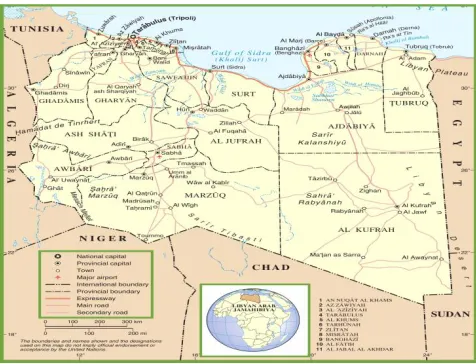
The state takes up a region of 1,760,000 million square kilometers: the enormity of the region might be shown by the detail that it shares 460 Km long west-north boundary with Tunisia, 980 Km long west border with Algeria, 355Km long south-west border with Niger, 1050 Km long south border with Chad, 383 Km long south-east border with Sudan, 1150 Km long east border with Egypt, and a long overlooking coastline of 1960 Km on the Mediterranean Sea.Due to the vast region of the country and small population of 6.3 million, the main metropolis have huge space amongst them (Figure2). Even the mother languages of Libya are Tamazight ―Berber‖, and Tebu, the official language is only Arabic while English is also used in business and trade. The three main cities in Libya are Tripoli, Benghazi and Sabah. The capital of Libya is Tripoli, which is residence to roughly 20% of Libya's populations. Libya has the fifth peak the gross domestic product (GDP) per capita of Africa as it has great fuel treasury, which is 2% of earth grease produced.
On 24 of December 1951 Libya has affirmed its sovereignty as the United Kingdom of Libya, a legitimate and inherited kingdom under King Idris, Libya's barely sovereign. Also, the detection of important oil treasury in 1959 allowed one of the world's underprivileged homeland to found an tremendously rich state. This economic recourse considerably enhanced Libyan regime‘s funds; dislike amongst various groups started to construct over the augmented absorption of the nation's riches in the hands of the King. During this time, Britain was implicated in widespread commerce missions in Libya and was as well the country's largest dealer of weapons. The United States as well upholded the large Wheels Air Base in the state.
In first of September 1969 a Military Coup under Colonel Qaddafi overthrew monarchy, and since then he became the absolute leader of Libya. The Military Coup control is not voted by the people and cannot be chosen out of bureau for the reason that they suppose they are in supremacy by asset of their participation in their riot. In the spring of 1972, a new political, directorial and lawmaking structure was set up as fraction of the Military Coup leadership, which started a communalist state, to be ruled merely by the citizens, but in fact Qaddafi was the only commander of Libya. In 1980s the principal formed the new communal convention (limited congregation) in each particular part of every one city to carry out the novel control of his leading.
[image:5.612.326.564.196.378.2]Private sector was prohibited and large choice of public-owned ventures was created, consequently, overseas corporations moved out from the state. Since that moment Libya became a one-party state of Colonel Qaddafi with no official foundation.
Figure 2 : The geography map of Libya (main region and cities)
The government foundations are inundated by fraud and discrimination. Individual relations matter more than conventional institutes, for illustration regime favors their acquaintances and family when it comes to staffing for career and other services. Regime information appears to be undisclosed and no information is revealed to people.
The regime has power over both state-owned and semi-autonomous medium by certain regulations counting the low on violence, to expurgate all programmers correlated to politics and religious conviction. In several cases the personal press was suppressed even though editorials of guidelines have been demanded and deliberately available by the military control itself as a way of set off reforms. In 2004 few civil associations were allowed while self-determining supporting parties are unlawful. Conversely, self-determining conventional employment unifications and expert associations do subsist. Supporting assessments are held in public forums (restricted gathering) in each part of all cities. They are called ―Comona‖ and run by a group selected by close associates or relatives to the party of Colonel Qaddafi.
International Journal of Emerging Technology and Advanced Engineering
Website: www.ijetae.com (ISSN 2250-2459, ISO 9001:2008 Certified Journal, Volume 8, Issue 8, August 2018)18
In addition, Libyan regime set up a financial plan of US 50 Billion dollars for development of lodging, sightseeing infrastructure which comprise telecommunication services, rails, roads, and airports projects. In adding up, Libyan regime set up considerable finances of US 14 Billion dollars for the communication and electrical energy for 2009, merely with the plan of getting E-government services into every single one area of the country.In February 2011, civil war in Libya began, and the project of E-government was put off. Today, Libyan government is struggling to put the previous program on its feet and continue the expansion of E-government in the country, which represents a huge challenge, especially since there is only transitional government.
TABLE 1:
STAGES OF E-GOVERNMENT IMPLEMENTATION AND THEIRPRESENCE IN LIBYA BY VERMA ET AL.,(2012)
V. CONCLUSION
Changing towards the E-government is supposed to be held on the foundation of reorganization of the appearance and construction as a substitute of varying the regime measures from material into automatic classification. At the present this modify has turned out to be an imperative subject in the developing nation states as well as in the urbanized states. The achievement of the E-government has need of affecting from the prior regime actions in dealing with records, providing services and running policy, since the E-government measured as a inclusive changing course of action to concentrate on the inhabitant self-interest.
Changing course has the aptitude to utilize records and knowledge for upgrading and to produce the regime further successful and adequate and effortlessness admission into the regime services, insert to this verdict and receiving more information relating to general public who become involved in decision-making processes.
Developing countries are showing the rate of linear progression when it comes to the usage of ICT and its implementation in creating E-governments. A huge compact of funds has been invested in this field so far. Developing countries are collaborating with successful private companies from ICT sector which could assist them define outlines, vision and main goals of their E-government websites, thus happen to more competent and productive.
Nevertheless, governments should parallel work on reducing if not entirely eliminating the obstacles preventing them to accomplish the goal of establishing efficient E-governments. And these obstacles are many, ranging from political and communal to economic and technological.
The presented contemporary knowledge is supposed to be used in a mode favorable for the regime and general public. As an alternative of spotlighting on the practical manner of the E-government, the focus is supposed to be on forming a framework that can efficiently respond to citizens‘ needs. E-government has to keep up with transforms in the inner and outdoor environments to advance citizens‘ awareness by providing them with computers and internet courses and facilitating them to compact with the E-government services.
VI. FURTHER RESEARCH
An E-government position is as high-quality as the techniques, dealings, and frameworks used to create it. Regardless of their wider apply, several of the contemporary measures have their own limitations; Potential work is supposed to spotlight on categorizing these boundaries and ruling ways to cure them. Furthermore, there requirements to be a steady explore for enhanced events to subtract E-government indexes and create grading of nation states with admiration to the transmission and accomplishment of E-government services. In toting up to studies that look at E-government services at the nationwide stage, explicit works that concentrate on the position of these services at restricted regime points will aid paint a more comprehensive portrait. Stage Presence Characteristics Libyan Scenario
I Web
Presence
Information: Presence
Web sites of Libyan government, departments & Universities available II Interactive
Presence
Interaction: Intake processes
Online processes, from filling, tenders, tax deposition are rare.
III Transactiona l Presence
Transaction: Complete transactions
Completion of online processes is totally absent IV Networked
Presence and
E-participation
Transformation : Integration & change
International Journal of Emerging Technology and Advanced Engineering
Website: www.ijetae.com (ISSN 2250-2459, ISO 9001:2008 Certified Journal, Volume 8, Issue 8, August 2018)19
It is as well supposed to be prominent that any examination of E-government services and subtraction of indexes for standing principles, based on a particular run of the websites like this work, is just a photograph of what is probable to modify through time, as the websites develop with admiration to their stage of E-government growth and other important features. Consequently, an accurate portrait will just be achieved if standard analyses are carried out over a rationally longer time. Thus, it is suggested thatupcoming researchers accomplish a longitudinal
examination of applicable websites, alike to those by (United Nations, 2005), (United Nations, 2008) and (United Nations, 2010). To entirely comprehend the function and force of obtainable ICT strategies in Africa in the improvement of E-government and connected services, it is supposed that extra study requirements to be carried out excessively.
REFERENCES
[1] Abdelkader A.M. A. A Manifest of Barriers to Successful E-Government: Cases from the Egyptian Programmer. International Journal of Business and Social Science Volume 6, No. 1, pp 169-186 (2015).
[2] African Development Bank (ADB). Libya Country Re-engagement Note.
(http://www.afdb.org/fileadmin/uploads/afdb/Documents/Project- and-Operations/Libya_-_Country_Re-Engagement_Note_2014-2016.pdf). ORNA, pp 1-28 2014-2016.
[3] Al-Fawwaz. M. B, AL-Shatnawi. M. A, Hunaiti. Z, and Harfoushi. O. E-Government: Evolving Relationship of Citizens, Government and Domestic Development-Case of Jordan. Contemporary Engineering Sciences, Volume 6, No. 6, pp 285-295 (2015). [4] Al-KhouriA. M. E-Government in Arab Countries: A 6-Staged
Roadmap to Develop the Public Sector. (www.sciedu.ca/jms). Journal of Management and Strategy Volume. 4, No. 1, pp 1-28 (2013).
[5] Almeida. G. De-O, and Zouain. D. M. E-Government Impact on the Doing Business Rankings and new Business Ownership Rate: an analysis of the dynamics based on countries‘ income from 2008 to 2014. (www/Internet). IADIS International Journal on Volume 13, No. 1, pp 30-42 (2014).
[6] Al-Sawad. A. A., Abdul-Hussain. W. A-H, Osman. W. R. Sh, and Al-Khafaji. N. J.
[7] Delivering Services for Libyan Citizens Through Utilizing Mobile Services: Literature Reviews as a Secondary Data. (https://www.academia.edu/12538233/Delivering _Services for Libyan Citizens Through?auto=download). IRF International Conference 22, pp 114-119 (2014).
[8] AL-Zoman.H.Ab.Arabic Domain Names. (http://www.wseas.us/e-library/conferences/2006madrid/papers/512-333.pdf), Madrid-Spain, pp 2-5 (2006).
[9] Asgarkhani. M.The Effectiveness of e-Service in Local Government: A Case Study‖ The Electronic Journal of e-Government on (www.ejeg.com), Volume 3: Issue 4, pp 157-166 (2005).
[10] Asogwa. B. E. The state of e-government readiness in Africa: A comparative web assessment of selected African countries. (http://www.academicjournals.org/JIIS). Journal of Internet and information system Volume 2, (3), pp., 43-57 (2011).
[11] Australian Services Roundtable (A.S.R)Creating a better business environment for Australia‘s services industries. (http://australianservicesroundtable.com.au/publications/), pp 1-15 (2005).
[12] Aziz. A. Information technology breeds new age terrorism. Thesis/Dissertation Collections. Rochester Institute of Technology. (http://scholarworks.rit.edu/theses). RIT Scholar Works pp 1-107 (2002).
[13] Backus. M. E-Governance and Developing Countries. Introduction and examples. Research report No. 3, pp 1-47 (2001).
[14] Ben-Ali. Z. El-A.ICT in Tunisia: A Strategic Lever for Building a Knowledge-Based
Economy.(http://citeseerx.ist.psu.edu/viewdoc/download?doi=10.1.1 .628.51&rep=rep1&type=pdf). The Global Information Technology Report 2009-2010, pp 153-164 (2009)
[15] Blakeley. C. J, and Matsuura J. H.E-Government:, Is e-Democracy inevitable (http://www.alliancelawgroup.com/e-gov_edemocracy.pdf), pp 1-8 (2001)
[16] Bobar. V.Methodological and institutional framework for development public procurement as G2B service of E-Government in Serbia (http://www.infotech.org.rs/blog/wp-content/uploads/radovi2013/021.pdf), pp 1-3 (2013).
[17] Busoud. A, and Zivković. D(2016) E-government in Libya. International Scientific Conference on ICT and E-Business Related Research. www.sinteza.singidunum.ac.rs: 513-517 (2016).
[18] Chartfield. A. T, and Alhujran. O.E-Government Service Delivery Capabilities: An Analysis of the Arab Countries in Africa & the
Middle East
(http://ro.uow.edu.au/cgi/viewcontent.cgi?article=9801&context=inf opapers), pp 616-623 (2007).
[19] Curristine. T, Lonti. Z, and Joumard. I. Improving Public Sector Efficiency: Challenges and Opportunities. (https://www.oecd.org/gov/budgeting/43412680.pdf). OECD Journal on Budgeting, Volume 7 – No. 1, pp 1-41 (2007).
[20] Danker. T, Dihrmann. Th, Killefer. N, and Mendonca. L.How can American government meet its productivity challenge? (http://www.mckinsey.com). McKinsy & Company, pp 2-23 (2006) [21] Davies. R.E-government using technology to improve public
services and democratic participation. European Parliamentary
Reseach Service (EPRS).
(http://www.europarl.europa.eu/RegData/etudes/IDAN/2015/565890 /EPRS_IDA(2015)565890_EN.pdf). Memners Research Service, pp 1-24 (2015).
[22] Dokhtesmati. M, Saberi. M, and Moradi S.The status of ministries‘ website of Middle Eastern countries in achieving e-government (http://www.ifla.org/past-wlic/2011/124-dokhtesmati-en.pdf). World Library and Information Congress 77th IFLA general Conference and Assembly, pp 3-10 (2011).
[23] Elzawi and Kenan Internet and emerging Information technologies in Libyan Universities into reduce. Digital Divide – 2013.
International Journal of Emerging Technology and Advanced Engineering
Website: www.ijetae.com (ISSN 2250-2459, ISO 9001:2008 Certified Journal, Volume 8, Issue 8, August 2018)20
[25] Fitz-Gerald. V.Creating a better business environment for Australia‘s services industries.
(http://australianservicesroundtable.com.au/wp- content/uploads/2014/07/creating-better-business-environments-oct-05.pdf). Australian Services Roundtable, pp 1-15 (2005).
[26] Hafkin. N. J. E-government in Africa: An Overview of Progress
Made and Challenges Ahead.
(http://unpan1.un.org/intradoc/groups/un/documents/un/unpan03400 2.pdf) Building Capacity in Knowledge Management through Partnership, held at the United Nations Economic Commission for Africa., pp 1-17 (2009).
[27] Jarbas. Th. S. De-A, and Sidney. J. Da-S. E-Government Benchmarking in Brazil: Indicators of E-Gov in the Greater ABC Region. American International Journal of Contemporary Research (http://www.aijcrnet.com/journals/) Volume 4, No. 9, pp 153- 164 (2014).
[28] Granapathy. V. B, and Kumar. V. K. E-Government: Concepts and Applications. IPASJ International Journal of Computer Science (IIJCS). (http://ipasj.org/IIJCS/Volume2Issue8/IIJCS-2014-08-03-9.pdf). A Publisher for Research Motivation, Volume 2, Issue 8, pp 16-19 (2014).
[29] Ministry of Communications and Informatics.E-Libya Strategy Development. (http://css.escwa.org.lb/ICTD/3233/14p2.pdf) Regional Workshop on E-government Best Practices Presentation Agenda Amman – Jordan, pp 2-19 (2013a).
[30] E-Libya Program (www.cim.gov.ly/newsletter/3_en.pdf), Issue 1, pp 1-5 (2013b).
[31] Mohammad. M., and Lan. Y-C.Improving E-Government Services for Non- English Speaking Background (NESB) Communities in Australia. (http://waset.org/Publication/improving-e-government- services-for-non-english-speaking-background-nesb-communities-in-australia/4719). International Scholarly and Scientific Research & Innovation, Volume 6, No12, pp 3519-3524 (2012).
[32] OECD Measuring and Evaluating E-Government in Arab Countries. (http://www.oecd.org/mena/governance/39856235.pdf). Dubai School of Government, pp 91-113(2007).The Case for E-Government: Excerpts from the OECD Report ―The E-Government Imperative‖. (https://www.oecd.org/gov/budgeting/43496369.pdf) OECD Journal on Budgeting, Volume 3, No. 1, pp 61-131 (2003). [33] Patil. S, and Kulkarni. M.Technologies used for E-government
Integration: A Survey.
(http://www.ijetae.com/files/Volume3Issue5/IJETAE_0513_86.pdf). International Journal of Emerging Technology and Advanced Engineering. Certified Journal, Volume 3, Issue 5, pp 518-524 (2013).
[34] Pelly. R, and Kramer-Eis. H. Creating a better Business Environment for Financing Business, Innovation and Green Growth. (http://www.oecd.org/finance/private-pensions/48621154.pdf). OECD Journal Financial Market Trend., Volume I, Issue 1, pp 1-12(2011).
[35] Prasad. S. Localizing ICT Content – How relevant?(Review of case studies from South-Asian countries). (http://www.uasb.in/yahoo_site_admin/assets/docs/150.352101038.p df). ICAR-Central Inland Fisheries Research Institute, pp 1-11 (2015).
[36] Puneet K, Dharminder K, and Narendra KE-Governance in India: Definitions, Challenges and Solutions. (http://arxiv.org/pdf/1411.1876.pdf). International Journal of Computer Applications. Volume 101, No.16, pp 6-8 (2014).
[37] Rawan T. Khasawneh, and Emad A. Abu-Shanab E-Government and Social Media Sites: The Role and Impact. (http://www.hrpub.org/download/201307/wjcat.2013.010103.pdf). World Journal of Computer Application and Technology 1(1), pp10-17. (2013).
[38] Rokhman. A.E-Government Adoption in Developing Countries; the
Case of Indonesia.
(http://www.cisjournal.org/archive/vol2no5/vol2no5_4.pdf). Journal of Emerging Trends in Computing and Information Sciences, Volume 2, No 5, pp 228-236 (2011).
[39] Saidi. N, and Yared. H.E-Government: Technology for Good Governance, Development and Democracy in the MENA countries. (http://www.mafhoum.com/press4/114E13.pdf). Mediterranean Development Forum IV, pp 1-125 (2002).
[40] Sarpoulaki. M, Eslami-Rad. A, and Saleknia. A. E-Government Concept and Spatial Information: A Case Study In Islamic Republic
Of Iran.
(http://www.isprs.org/proceedings/XXXVII/congress/4_pdf/05.pdf). The International Archives of the Photogrammetry, Remote Sensing and Spatial Information Sciences, Volume 37, Part B4, pp 14-24 (2008).
[41] Shailendra C. Jain Palvia, & Sushil S. SharmaGovernment and E-Governance: Definitions/Domain Framework and Status around the World (2014).
[42] Terterov. M, and Wallace. J.Doing Business with Libya: Second Edition. London: Kogan Page Limited and contributions (2002). [43] United Nations United Nations Government Survey:
E-Government for the Future we want. (https://publicadministration.un.org/egovkb/portals/egovkb/documen ts/un/2014-survey/e-gov_complete_survey-2014.pdf). Department of Economic and Social Affairs, pp 1-262 (2014a).
[44] United Nations E-Government Survey: World E-Government rankings.
(https://publicadministration.un.org/egovkb/Portals/egovkb/Docume nts/un/2014-Survey/Chapter1.pdf), pp 13-44 (2014b).
[45] United Nations E-Government Survey: World E-Government rankings.
(https://publicadministration.un.org/egovkb/Portals/egovkb/Docume nts/un/2012-Survey/Chapter-1-World-e-government-rankings.pdf). Chapter One, pp 9-35 (2012a).
[46] United Nations E-Government Survey: E-Government for people. (https://publicadministration.un.org/egovkb/Portals/egovkb/Docume nts/un/2012-Survey/Complete-Survey.pdf). Department of Economic and Social Affairs, pp 1-143 (2012b).
[47] Verma. S, Kumari. S, Arteimi. M, Deiri. A, and Kumar .R.(2012) Challenges in Developing Citizen-Centric E-government in Libya. International Arab Journal of E-technology, Volume 2, No 3, pp 152-160.