Generalized Synchronization of Different Dimensional
Spatial Chaotic Dynamical Systems
Quan Hai
1,2,
Shutang Liu
1,∗,
Changquan Hu
11CollegeofControlScienceandEngineering,ShandongUniversity,Jinan250061,China 2CollegeofMathematicsScience,InnerMongoliaNormalUniversity,Huhhot010022,China
Copyright c2016 by authors, all rights reserved. Authors agree that this article remains permanently open access under the terms of the Creative Commons Attribution License 4.0 International License
Abstract
In this paper, the generalized synchronization and the inverse generalized synchronization of different dimensional spatial chaotic dynamical systems are studied. The generalized synchronization results have been derived using active control method and Lyapunov stability theory. Numerical simulations are performed to verify the effective-ness of the proposed schemes.Keywords
Generalized Synchronization, Inverse Gener-alized Synchronization, Spatial Chaos, Lyapunov Stability1
Introduction
In recent years, synchronization of chaotic systems has drawn much attention due to its wide application in various fields of physics and engineering [1, 2, 3]. The generalized synchronization of 1D chaos systems has been a topic of rent focus [4, 5, 6, 7, 8]. For 2D spatial chaos, however, cur-rent research only focuses on the following spatially general-ized Logistic system [9]
xm+1,n+ωxm,n+1 = 1−a((1 +ω)xm,n)2, (1)
where ω is a real constant, µ is a positive parameter and
m, n ∈ Nr ={r, r+ 1, r + 2,· · · | r is an integer and
r ≤0}. The basic characteristics of system (1), such as the fixed plane, spatial Lyapunov exponents, spatial periodic or-bit, stability of spatially periodic oror-bit, spatial chaos, spatial fractal, spatial chaos control and spatial chaotic synchroniza-tion, have obtained very rich contents [10, 11, 12, 13, 14, 15, 16, 17, 18].
Based on Lyapunov stability theory, constructive schemes are presented in this paper to research the generalized syn-chronization and the inverse generalized synsyn-chronization be-tween different dimensional spatial chaotic dynamical sys-tems. Besides, the new synchronization criterions are estab-lished in the form of simple algebraic conditions which are very convenient to be verified.
The remainder of this paper is organized as follows: In Sect. 2, the generalized synchronization of spatial chaotic dynamical systems is investigated; In Sect. 3, the inverse generalized synchronization of spatial chaotic dynamical sys-tems is studied; Sect. 4 demonstrates the proposed synchro-nization schemes and the derived theoretical results by using numerical examples and simulations, and Sect. 5 is the final conclusion.
2
Generalized
Synchronization
of
Spatial Chaotic Dynamical Systems
Consider the following drive spatial chaotic system
Xm+1,n+ωXm,n+1=f1(ω, Xm,n), (2)
whereXm,n = (x1m,n, x2m,n,· · ·, xsm,n)T ∈ Rsis the state
vector and f1 : Rs →Rscontains the linear and nonlinear
parts of the drive system. As far as the response system is concerned, consider the following controlled chaotic system
Ym+1,n+ωYm,n+1=B[(1 +ω)Ym,n] +
g1(ω, Ym,n) +U, (3)
where Ym,n = (ym,n1 , y
2
m,n,· · ·, y t m,n)
T ∈
Rt, B is an
m×mmatrix that represents the linear part of system dy-namics,g1 :Rt→Rtis the nonlinear part of response
sys-tem (3), andU = (ui)1≤i≤t∈Rtis the vector controller to
be determined.
Next, we introduce the definition of generalized synchro-nization for coupled spatial chaotic systems given in Eqs. (2) and (3).
Definition 1 The drive system (2) and the response system (3) are said to be generalized synchronization with respect to vector mapΦif there exists a controllerU = (ui)1≤i≤t∈Rt
and a given mapΦ :Rs→Rtsuch that
lim m→∞
n→∞
kem,nk= limm→∞ n→∞
In order to study the generalized synchronization of the dynamical systems given in Eqs. (2) and (3), we discuss the asymptotic stability of the zero solutions of synchronization error systemem,n=Ym,n−Φ(Xm,n). We design controller
U such that the solution of error system ei
m,n → 0 , i = 1,2,· · ·, s, asm, n→ ∞.
In this case, the error dynamics between drive system (2) and response system (3) can be derived as
em+1,n+ωem,n+1
=B[(1 +ω)Ym,n] +g1(ω, Ym,n)−
Φ(f1(ω, Xm,n)) +U. (5)
To achieve the generalized synchronization between sys-tems (2) and (3), we can choose vector controllerU as fol-lows
U =−L1[(1 +ω)Ym,n]−
g1(ω, Ym,n) + Φ(f1(ω, Xm,n))+
(L1−B)Φ((1 +ω), Xm,n), (6)
whereL1 ∈Rt×tis an unknown control matrix to be
deter-mined. By substituting Eq.(6) into eq.(5), the error system can be described as
em+1,n+ωem,n+1= (B−L1) [(1 +ω)em,n]. (7) Theorem 1 If we select control matrixL1 such thatP1 =
I−(B−L1)T(B−L1)is a positive definite matrix, then the drive system (2) and the response system (3) are globally gen-eralized synchronization with respect toΦ, under controller law (6).
Proof. Constructing the candidate Lyapunov function in the form
V(ω, em,n) = [(1 +ω)em,n]T[(1 +ω)em,n]. (8)
The difference ofV(ω, em, n)along the solution to (7) is ∆V(ω, em,n)
= [em+1,n+ωem,n+1]T[em+1,n+ωem,n+1]−
[(1 +ω)em,n] T
[(1 +ω)em,n] = [(B−L1)(1 +ω)em,n]
T
[(B−L1)(1 +ω)em,n]− [(1 +ω)em,n]
T
[(1 +ω)em,n] =−[(1 +ω)em,n]
T
P1[(1 +ω)em,n]
<0. (9)
Thus, from the Lyapunov stability theory, it is immediate that
lim m→∞ n→∞
eim,n= 0, (i= 1,2,· · · , t). (10)
So, the zero solution of error system (7) is globally asymptot-ically stable, and therefore, systems (2) and (3) are globally generalized synchronization.
3
Inverse Generalized
Synchroniza-tion of Spatial Chaotic Dynamical
Systems
Now, we consider the drive and the response chaotic sys-tems as,
Xm+1,n+ωXm,n+1=A[(1 +ω)Xm,n] +
f2(ω, Xm,n), (11)
Ym+1,n+ωYm,n+1=g2(ω, Ym,n) +U, (12)
whereXm,n= (x1m,n, x2m,n,· · ·, xsm,n)T ∈RsandYm,n= (y1
m,n, y2m,n,· · ·, ytm,n)T ∈Rt, are state vectors of the drive
system and the response system, respectively, A ∈ Rs×sis
ans×smatrix that represents the linear part of system dy-namics,f2 : Rs→ Rsis the nonlinear part of drive system
(11),g1:Rt→Rtcontains the linear and nonlinear parts of
response system (12), andU ∈Rtis the vector controller to
be determined.
The definition of inverse generalized synchronization for coupled chaotic systems given in Eqs.(11) and (12) is given by
Definition 2 The drive system (11) and the response sys-tem (12) are said to be inverse generalized synchronization with respect to vector map Ψ if there exists a controller
U = (ui)1≤i≤t ∈ Rtand a given mapΨ :Rs → Rtsuch
that
lim m→∞
n→∞
kem,nk= lim m→∞
n→∞
kXm,n−Ψ(Ym,n)k= 0. (13)
In order to study inverse generalized synchronization of the dynamical systems given in Eqs. (11) and (12), we dis-cuss the asymptotic stability for the zero solutions of syn-chronization error system em,n = Ym,n−Ψ(Xm,n). We
design controller U such that the solution of error system
ei
m,n→0,i= 1,2,· · ·, s, asm, n→ ∞.
In this case, the error dynamics between drive system (11) and response system (12) can be derived as
em+1,n+ωem,n+1
=A[(1 +ω)Xm,n] +f2(ω, Xm,n)−
Ψ(g2(ω, Ym,n) +U). (14)
To achieve inverse generalized synchronization between sys-tems (11) and (12), vectorU can be chosen as follows
U =−g2(ω, Ym,n)+
Ψ−1[f2(ω, Xm,n)) +L2(1 +ω)Ym,n+ (A−L2)Ψ((1 +ω)Xm,n)], (15)
whereΨ−1 : Rs → Rt is the inverse of mapΨandL2 ∈
Rs×s is an unknown control matrix to be determined later.
By substituting Eq.(15) into eq.(14), the error system can be described as
Theorem 2 If we select control matrixL2 such thatP2 =
I−(A−L2)T(A−L2)is a positive definite matrix, then the drive system (11) and the response system (12) are globally inverse generalized synchronization with respect toΨ, under controller law (15).
Proof. Consider the candidate Lyapunov function in the following form
V(ω, em,n) = [(1 +ω)em,n] T
[(1 +ω)em,n]. (17)
The difference ofV(ω, em, n)along the solution to (16) is ∆V(ω, em, n)
= [em+1,n+ωem,n+1]T[em+1,n+ωem,n+1]−
[(1 +ω)em,n] T
[(1 +ω)em,n] = [(A−L2)(1 +ω)em,n]
T
[(A−L2)(1 +ω)em,n]− [(1 +ω)em,n]
T
[(1 +ω)em,n] =−[(1 +ω)em,n]
T
P2[(1 +ω)em,n]
<0. (18)
Thus, we derive from the Lyapunov stability theory that
lim m→∞
n→∞
eim,n= 0, (i= 1,2,· · ·, s). (19)
So, the zero solution of the error system (16) is globally asymptotically stable, and therefore, systems(11) and (12) are globally inverse generalized synchronization.
4
Simulation Examples
In this section, two examples are provided to validate the proposed theoretical synchronization results.
4.1
Example 1: Generalized Synchronization
Between Spatial 2D Henon System and
Spatial 2D Logistic System
Here, we consider the spatial 2D Henon system as the drive system and the controlled spatial 2D logistic system as the response system. The spatial 2D Henon system can be de-scribed as
x1m+1,n+ωx1m,n+1=1 +b(1 +ω)x2m,n−
a
(1 +ω)x1m,n2
, x2m+1,n+ωxm,n2 +1=(1 +ω)x1m,n,
(20)
whereω, bare real constants andais a positive parameter. Assuming thata >1.55, then spatial 2D Henon system (20) has a transversal homoclinic orbit for all|b| < εfor some
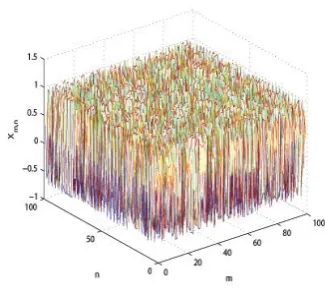
ε >0. In particular, for|b|< ε, system (20) is chaotic [19]. For example, when(a, b, ω) = (1.75,0.03,−0.02), system (20) is spatial chaos, as shown in Fig. 1.
The controlled spatial 2D Logistic system can be described as
ym+1,n+ωym,n+1= 1−µ[(1 +ω)ym,n]
2
[image:3.595.347.510.94.238.2]+U, (21)
Figure 1.Chaotic behavior of system (20) withω=−0.02,a= 1.75and
b= 0.03.
whereU is the scalar controller. Assuming thatµ > 1.55, then, spatial 2D Logistic system (21) is chaotic inR2×R
in the sense of Li and Yorke [9]. For example, when
[image:3.595.348.509.377.518.2](a, ω) = (1.68,−0.02), system (21) is spatial chaos, the spa-tial chaotic behavior of system (21) is shown in Fig. 2.
Figure 2.Chaotic behavior of system (21) withω=−0.02anda= 1.68.
Taking (a, b, ω) = (1.75,0.03,−0.02) and (µ, ω) = (1.68,−0.02), spatial 2D Henon system and spatial 2D Lo-gistic system exhibit chaotic behavior. If we select mapΦ:
R2→Ras
Φh x1m,n, x2m,nTi
=x1m,n+x2m,n, (22) and control matrixL1as
L1= 0.72, (23) then, according to our approach presented in Sect. 2, we ob-tain
B= 0, (24) and
g1(Y(m, n)) = 1−µ[(1 +ω)ym,n]
2
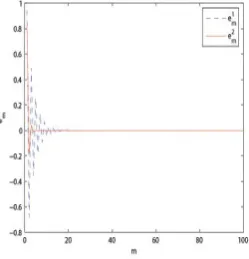
Figure 3.Time evolution of synchronization errors of systems (20) and (21).
By simple calculations, we can show thatI−(B−L1)T(B−
L1)is a positive definite matrix. Therefore, in this case, sys-tems (20) and (21) are generalized synchronization. The error function evolution is shown in Fig. 3.
Specially, we takeω= 0, n= 0, corresponding the spatial 2D Henon system (20) and the spatial 2D Logistic system (21) can be written as
(
x1m+1=1 +bx2m−a x1m 2
,
x2m+1=x1m, (26)
and
ym+1= 1−µ(ym)
2
[image:4.595.295.537.107.182.2]+U. (27) Clearly, when(a, b) = (1.75,0.03)andµ = 1.68, systems (26) and (27) realize generalized synchronization as demon-strated in Fig. 4.
Figure 4.Time evolution of synchronization errors of systems (26) and (27).
4.2
Example 2: Inverse Generalized
Synchro-nization Between the Spatial 2D Henon
System and the Spatial 2D Logistic System
For systems (20) and (21), take (a, b, ω) = (1.75,0.03,−0.02) and (µ, ω) = (1.68,−0.02), the spatial 2D Henon system and the spatial 2D Logistic systemexhibit chaotic behavior. If we select mapΨ:R→R2as Ψ(ym,n) = (ym,n,2ym,n)T, (28)
and control matrixL2as
L2=
0.72 b2(1 +ω)
(1 +ω) 0.22
, (29)
then, according to our approach presented in Sect. 3, we ob-tain
A=
0 b2(1 +ω)
(1 +ω) 0
, (30)
and
f2(X(m, n)) =
1−a
(1 +ω)x1
m,n 2
0
. (31)
By simple calculations, we can show thatI−(A−L2)T(A−
[image:4.595.338.492.420.557.2]L2)is a positive definite matrix. Therefore, in this case, sys-tems (20) and (21) are inverse generalized synchronization. Fig. 5 shows the error function evolution. On the hand, sys-tems (26) and (27) realize inverse generalized synchroniza-tion as demonstrated in Fig. 6.
[image:4.595.99.226.517.650.2]Figure 5.Time evolution of synchronization errors of systems (20) and (21).
[image:4.595.353.478.617.747.2]5
Conclusions
In this paper, the generalized synchronization and the in-verse generalized synchronization of spatial chaotic dynami-cal systems are analyzed. What’s more, a new control method is proposed in each case, and numerical simulations are per-formed to verify the effectiveness of the proposed schemes.
It should be pointed out that these analytic methods and theoretical results have in effect extended the generalized chaos synchronization from temporal systems to spatial sys-tems, which is a significant development in the study on the subject of chaos synchronization.
Acknowledgments
Thank you for reviewer’s valuable suggestions. The work was supported by the Key Program of National Natural Sci-ence Foundation of China (No. 61533011) and the National Nature Science Foundation of China (No. 61273088).
REFERENCES
[1] R. Roy, K. S. Thornburg. Experimental synchronization of chaotic lasers. Phys. Rev. Lett, 1994, 72: 2009–2012.
[2] G. S. Duane, P. J. Webster, J. B. Weiss. Go-occurrence of north and southern hemisphere blocks as partially synchro-nized chaos. J. Atoms. Sci., 1999, 56(24): 4183–4205.
[3] B. Blasius, L. Stone. Chaos and phase synchronization in eco-logical systems. Int. J. Bifur. Chaos, 10(10): 2361–2380.
[4] L. Junge, P. Ulrich. Synchronization using dynamic coupling. Phys. Rev. E, 2001, 64: 0552041–4.
[5] R. He, P. G. Vaidya. Analysis and synthesis of synchronous periodic and chaotic systems. Phys. Rev. E, 1992, 46(121): 7387–92.
[6] L. M. Pecora, T. L. Carroll. Synchronization in chaotic sys-tems. Phys. Rev. Lett, 1990, 64(8): 821–4.
[7] U. Parlitz, L. Junge, L. Kocarev. Subharmonic entrainment of unstable period orbits and generalized synchronization. Phys. Rev. Lett, 1997, 79(17): 3158–61.
[8] F. R. Nikolai, M. S. Mikhail, S. T. Lev. Generalized synchro-nization of chaos in directionally coupled chaotic systems. Phys. Rev. E, 51(2): 980–94.
[9] S. T. Liu, G. Chen. On spatial Lyapunov exponents and spatial chaos. Int. J. Bifurc. Chaos, 2003, 13: 1163–1181.
[10] S. T. Liu, G. Chen. Asymptotic behavior of delay 2D discrete logistic systems. IEEE Trans. Circuits Syst. I Fundam. Theory Appl., 2002, 49: 1677–1682.
[11] S. T. Liu, G. Chen. Nonlinear feedback-controlled general-ized synchronization of spatial chaos. Chaos Solitions Frac-tals, 2002, 22: 35–46.
[12] S. T. Liu, G. Chen. On spatial Lyapunov exponents and spatial chaos. Int. J. Bifurc. Chaos, 2003, 13: 1163–1181.
[13] G. Chen, S. T. Liu. On generalized synchronization of spatial chaos. Chaos Solitions Fractals, 2003, 15: 311–318.
[14] P. Wang, S. T. Liu. Feedback control and linear generalized synchronization of spatial-alternated Julia sets. Acta Phys. Sin., 2014, 63(6): 060503.
[15] D. Wang, S. T. Liu. Synchronization between the spatial Julia sets of complex Lorenz system and coplex Henon map. Non-linear Dyn., 2015, 81: 1197–1205.
[16] P. Liu, C. A. Liu. Linear generalizad synchronization of spa-tial Julia sets. Int. J. Bifurc. Chaos, 2011, 21: 1281–1291.
[17] S. T. Liu, S. T. Wu. Uniformity of spatial physical motion systems and spatial chaos behavior in the sense of Li-York. Int. J. Bifurc. Chaos Appl. Sci. Eng., 2006, 16: 2697–2703.
[18] S. T. Liu, P. Liu. Spatial chaos on surface and its assoicated bifurction and Feigenbaum problem. Nonlinear Dyn., 2015, 81: 283–298.